

1. Home
  2. Archives
  3. Vol 3 (2021) Issue 2
  4. Articles

High-Fat Diets-Induced Metabolic Disorders to Study Molecular Mechanism of Hyperlipidemia in Rats

Abstract

Hyperlipidemia is a lipid metabolism disorder occurring due to consumption of a high-fat diet (HFD), which contributes to atherosclerosis and cardiovascular disease development. HFD causes metabolic problems in Rodentia animals like human metabolic abnormalities, making it a popular model for studying the signaling systems involved. Hyperlipidemia is a condition in which the body's cholesterol levels elevate. In recent years, several studies have investigated the relationship between HFD feeding and hyperlipidemia and signaling pathways involved in cholesterol homeostasis. However, this signaling mechanism in lipid metabolism has not been fully explained, so additional analysis is needed. The present study aimed to investigate the mechanism that occurs from hyperlipidemia due to HFD feeding. The method used is a literature review approach following the PRISMA scheme for selecting the primary literature, including identification, screening, eligibility test, and inclusion. Eleven articles included primary literature with credibility (H-index) of 20, 33, 71, 92, 93, 162, 180, 192, and 332 (six articles from Q1 journals and five from Q2 journals). Long-term administration of HFD directly affects lipid metabolism, including an increase in the concentration of total cholesterol, triglycerides, LDL, and a decrease in HDL concentration, followed by an increase in body weight. In addition, HFD also disrupts adipose tissue and insulin resistance. The conclusion of this study is that HFD can cause hyperlipidemia either directly or indirectly by inducing insulin resistance, which contributes to lipid metabolism disorders.

Keywords

1. Introduction

North Bandung Area (NBA) is well-known for its natural resources. Its mountain view and cool air make NBA as tourist destination [1,2]. Besides, NBA is also famous for its potential in agriculture. This area has soil and climate that support the development of agricultural business. Some districts in the NBA, such as Lembang, Parongpong, and Cisarua, produce vegetables, fruits, and flowers [3].

Furthermore, NBA is also a protected area based on the Regulation of the Province of West Java Number 2 of 2016 about Guidelines for Controlling the North Bandung Area as a Strategic Area for West Java Province [4]. Adharani and Nurzaman [5] state that NBA has a considerable influence on water management in the area below. Based on the Directorate of Geology and Environmental Management data, 60% of 108,000,000 m3 groundwater flows into the Bandung Basin from the NBA [6]. In addition, NBA is a basin-shaped highland [7]. This area also has several tributaries that flow into the Citarum River [8]. This landscape makes NBA vulnerable to various natural disasters

such as floods, landslides, and erosion [7]. Thus, land utilization in the NBA must be carried out in a controlled manner to maintain the function of water absorption and natural disasters prevention in the NBA and the area below it.

Since 1982, the Government of West Java Province has issued several regulations about the designation of NBA as a protected area. Regulation of West Java Province Number 2 of 2016 stated about Guidelines for Controlling the North Bandung Area as a Strategic Area for West Java Province [4]. These regulations are made in response to the rapid development of settlements and tourism facilities that decrease the function of water system protection and preservation in NBA [2,5,9–11]. However, development permit violations still occur in NBA [12].

The most prominent change in land cover in NBA is the conversion of vegetation into built-up areas, resulting in a decrease in water absorption in this area. Furthermore, it causes various environmental problems in Bandung Basin area, such as disturbances in groundwater reserves and supplies in Bandung City, Cimahi City, Bandung Regency, and West Bandung Regency. As an impact of this environmental problem is drought in dry season [5,13,14]. Moreover, land cover change in NBA can increase runoff that lead land erosion, river sedimentation, flood, and landslide [15–17].

Another environmental problem as a result from escalation of built-up areas in the NBA is increasing Land Surface Temperature (LST) which is defined as temperature of land surface area measured radiometrically, including various land surface components such as vegetation and soil [18]. Man-made structures like buildings and roads usually have low albedo and high heat storage that contribute to rise LST [19]. The negative impact of this phenomenon is reducing human health and comfort [19–21]. Therefore, this study was conducted to describe LST distribution based on land cover types in specific years of 2010, 2014, and 2018.

2. Materials and Method

2.1. Study Area

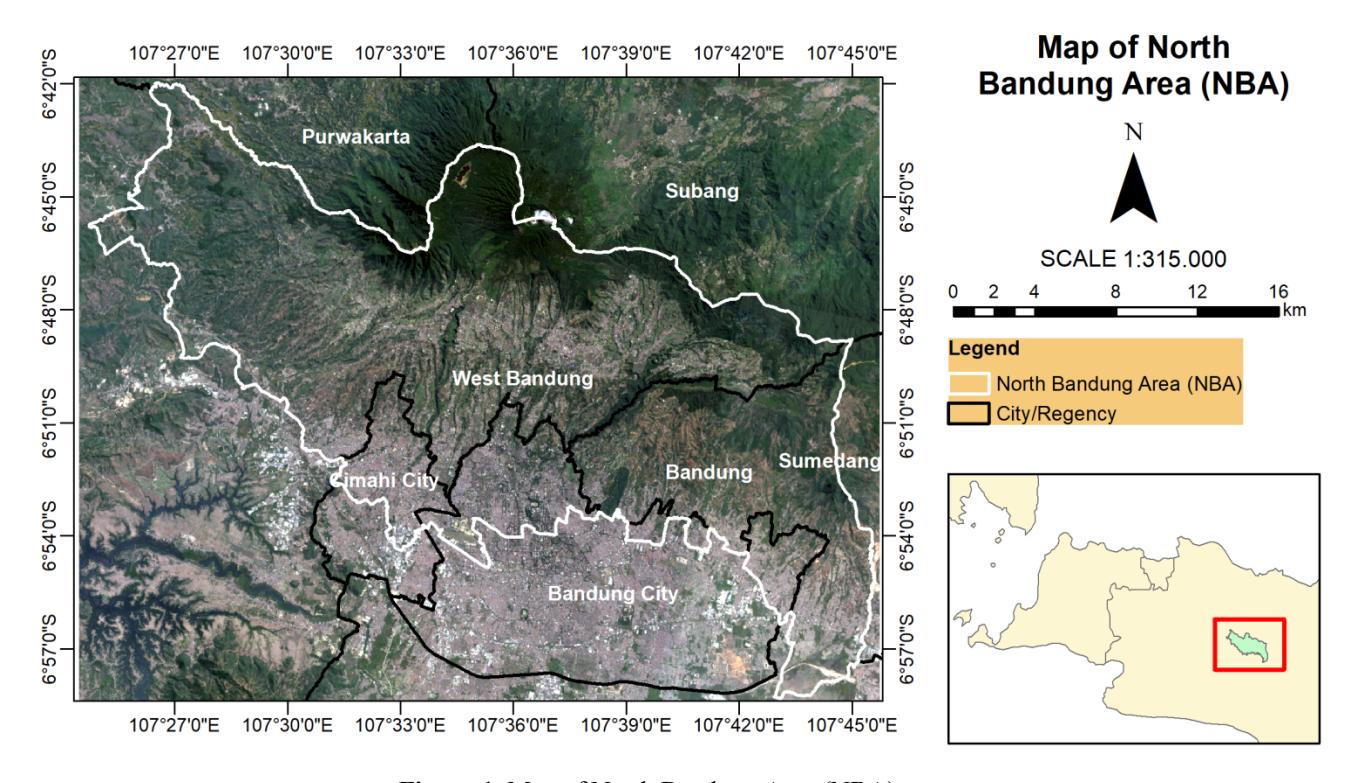
North Bandung Area (NBA) is about ±485 km2 with altitude varies from 454-2,206 m. This area covers four cities and regencies: Bandung City, Cimahi City, Bandung Regency, and West Bandung Regency. In the northern part of NBA is adjacent with Purwakarta and Subang Regency, in the eastern part with Sumedang Regency, in western part with West Bandung Regency and Cimahi City, and in southern part with Bandung City and Bandung Regency (Figure 1).
8

Figure 1. Map of North Bandung Area (NBA)

2.1. Data

Information of this study was obtained from Landsat 5 and 8 Surface Reflectance (SR) Tier 1 imagery data, Peta Rupa Bumi Indonesia or Indonesian Topography RBI administration maps at a scale of 1:25,000, and West Java land cover maps in 2010, 2014, and 2018 at a scale of 1:250,000 developed by Badan Perencanaan Pembangunan

Daerah or Development Planning Agency at Sub-National Level (BAPPEDA) in West Java. Map of NBA was extracted from RBI administration maps, then overlaid with West Java land cover maps from ArcGIS Service Directory BAPPEDA of West Java Province. The acquisition time for Landsat imagery data was based on Phan et al. [22]. Information about Landsat imagery data acquisition time is shown in Table 1.

Type of Landsat Imagery Data Acquisition Time Data Number Use of Data Landsat 5 SR Tier 1 1 June-30 September 2009 and 2010 Landsat 8 SR Tier 1 1 June-30 September 2013 and 2014 1 June-30 September 2017 and 2018 17 LST mapping in 2018

Table 1. Time and Numbers of Acquired Landsat Imagery Data.

2.2. Methods

2.2.1.Classification of Land Cover Classes

The NBA map is classified using ArcMap 10.4.1 into four classes, i.e., built-up areas, vegetation, water bodies, and open areas [23] (Table 2). According to Saha et al. [23], these four land cover classes were based on the sensitivity of an object on the earth's surface to certain wavelengths of electromagnetic radiation that were detected by a specific band on the satellite sensor.

2.2.2.Land Surface Temperature (LST) Calculation

Method from Sultana and Satyanarayana [24] is used to calculate LST. The calculation was carried out by using Google Earth Engine. First, the cloud covers in the obtained Landsat image collection were masked using cloud masking. The Landsat image collection was then merged into one Landsat median composite image. Later, this image was clipped by RBI administration maps of NBA to obtain Landsat median composite image. Then, LST was calculated from Landsat median composite image.

Four variables are needed to calculate LST. The first variable is the Normalized Difference Vegetation Index (NDVI). This variable was calculated by using Equation 1.

\[NDVI = \frac{NIR - R}{NIR + R} \tag{1}\]

NIR in Equation 1 is a value of surface reflectance of the NIR band, and R is a value of surface reflectance of the red band. In Landsat 5, NIR and red bands are found in bands 4 and 3, respectively. In Landsat 8, NIR and red bands are found in band 5 and 4, respectively.

The second variable is fractional vegetation (PV). PV value was calculated by using Equation 2.

\[P_{V} = \left[\frac{NDVI - NDVI_{\min}}{NDVI_{\max} - NDVI_{\min}}\right]^{2} \tag{2}\]

NDVImax is a maximum value of NDVI, while NDVImin is a minimum value of NDVI. After the PV value was obtained, the value of variable \(\epsilon\) (emissivity) can be calculated by using Equation 3.

\[\varepsilon = 0.004 \times P_V + 0.986\] (3)

The value of the brightness temperature (TB) is then calculated. In Landsat 5 dan 8 SR Tier 1, the value of brightness temperature is found in the thermal band. Hence, the TB value can be calculated by using Equation 4.

\[T_B = Thermal \times 0.1_{(4)}\]

The thermal band in Landsat 5 is found in band 6, and the thermal band in Landsat 8 is found in bands 10 dan 11. Due to the stray light issue in band 11 [25], this study only used band 10 in Landsat 8. In Equation 4, the value of 0.1 is a scale factor of the thermal band. TB value in Equation 4 is obtained in units of Kelvin.

After the values of the four variables are obtained, LST can be calculated. LST is calculated by using Equation 5.

\[LST = \frac{T_B}{(1 + w\frac{T_B}{p}\ln[\varepsilon])} - 273.15\] (5)

In Equation 5, w is the wavelength of emitted radiance. The w value for Landsat 5 band 6 is 11.5 \(\mu\)m, while the w value for Landsat 8 band 10 is 10.8 \(\mu\)m [26]. The p constant has a value of 1.438 X 10⁻²m · K. This value is obtained from Equation 6.

\[p = h \times \frac{c}{\sigma} \tag{6}\]

In Equation 6, h is Planck constant with a value of 6.626 X 10⁻³⁴ J\(\cdot\)s. Variable c is the velocity of light with a value of 2.988 X 10⁸ m/s. Variable \(\sigma\) is Boltzmann constant with a value of 1.38 X 10⁻²³ J/K.

Table 2. New Land Cover Classes that Included Old Land Cover Classes

New Land Cover Classes
(Saha et. al., 2020)
Old Land Cover Classes from
BAPPEDA West Java
Built-up areasBuilt-up areas (including
settlements, industries, and
buildings)
VegetationForest
Water bodiesRiver/Lake/Reservoir
Open areasGarden/Plantation, Field, Rice
Field, Shrubs

2.2.3.Data Analysis

LST range classes in 2010, 2014, and 2018 was classified from NBA map, then mean LST in each year in different land cover class were analysed to clarify the significance of mean LST of NBA and the mean LST of each land cover class in the three observed years. Classification of LST range classes was carried out by using equal intervals method [27] in ArcMap 10.4.1. LST maps of NBA were classified into five classes based on Sun et al. [28] as shown in Table 3.

Table 3. Classification of LST in NBA

LST Class TypeTemperature Range (°C)
Very Low0-15.7
Low15.7-20.3
Medium20.3-24.8
High24.8-29.4
Very High29.4-33.9

Kolmogorov-Smirnov normality test was used to observe LST data distribution both in NBA and in each land cover class. In addition, Kruskal-Wallis and Post Hoc Kruskal-Wallis test was used to observe whether there are significance differences among mean LST of NBA and mean LST of each land cover class in the three observed years.

3. Results and discussion

3.1. Change in Mean LST of NBA and Mean LST of Land Cover Classes

Land surface Temperature in three observed years show significant difference from 2010 (22.53±2.72°Ca ) to 2014 (23.64±2.87°Cb ) and 2018 (23.40±3.06°Cb ), however mean LST from 2014 to 2018 has slightly change as shown in Table 4.

Table 4. Mean LST of NBA in the Three Observed Years

Year
NBA Mean
LST±Standard
201020142018
Deviation (°C)22.53±2.72
(a)
23.64±2.87
(b)
23.40±3.06
(b)

*Mean LST with the same letter are not significantly different

Mean LST of each land cover class in 2010, 2014, and 2018 can be seen in Table 5. Built-up areas show the highest mean LST (24.98±1.93 in 2010; 26.46±2.09 in 2014, and 26.30±1.96 in 2018) and area with vegetation has the lowest LST (18.29±2.10 in 2010; 19.78±1.87 in 2014, and 19.61±2.15 in 2018). This trend is similar to study conducted by Sun et al. [28], Peng et al. [29] in China, and Saha et al. [23] in India related to calculation of LST in different land cover types.

Table 5. Mean LST of Land Cover Classes in the Three Observed Years

Land Cover ClassNBA Mean LST±Standard Deviation (°C)
Year 2010Year 2014Year 2018
Built-up Areas24.98±1.93 (a)26.46±2.09(b)26.30±1.96 (b)
Water Bodies22.22±1.97 (a)23.70±3.26 (b)23.14±2.73 (ab)
Open Areas22.30±2.12 (a)23.16±2.28 (a)22.97±2.35 (a)
Vegetation18.29±2.10 (b)19.78±1.87 (a)19.61±2.15 (a)

*Mean LST with the same letter in the same row are not significantly different

3.2. Distribution of Land Cover Area and Temperature Class in NBA

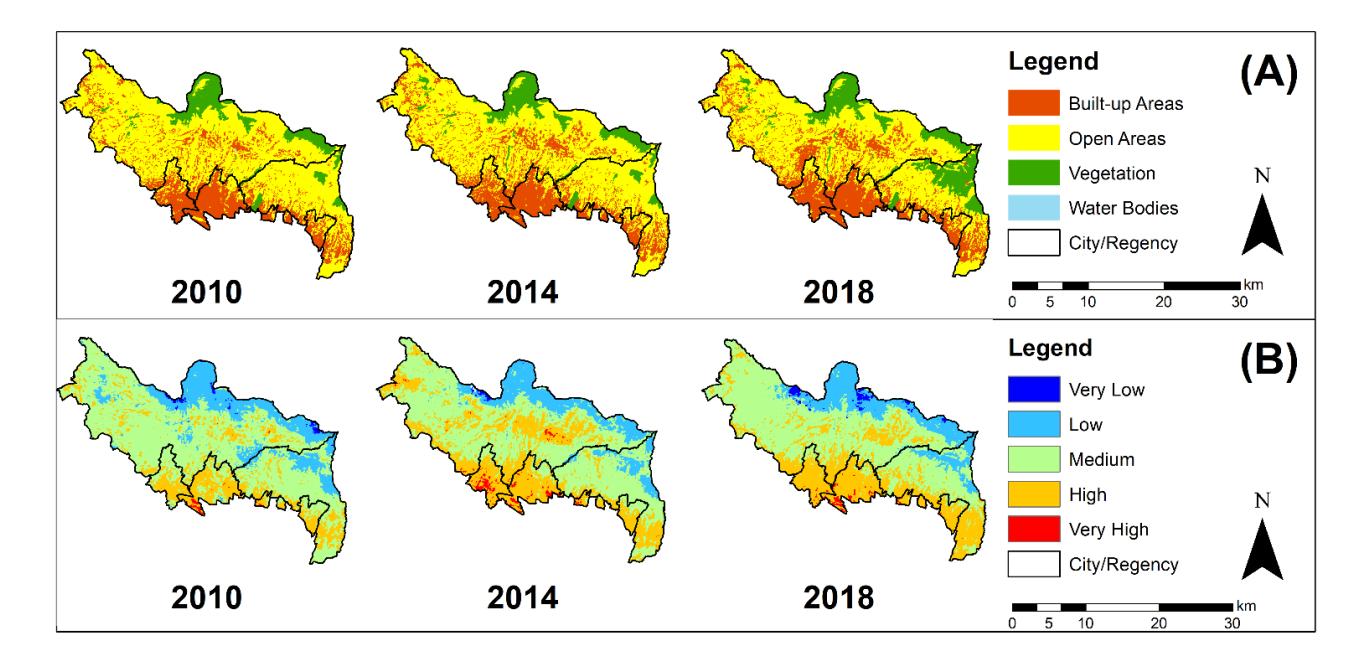
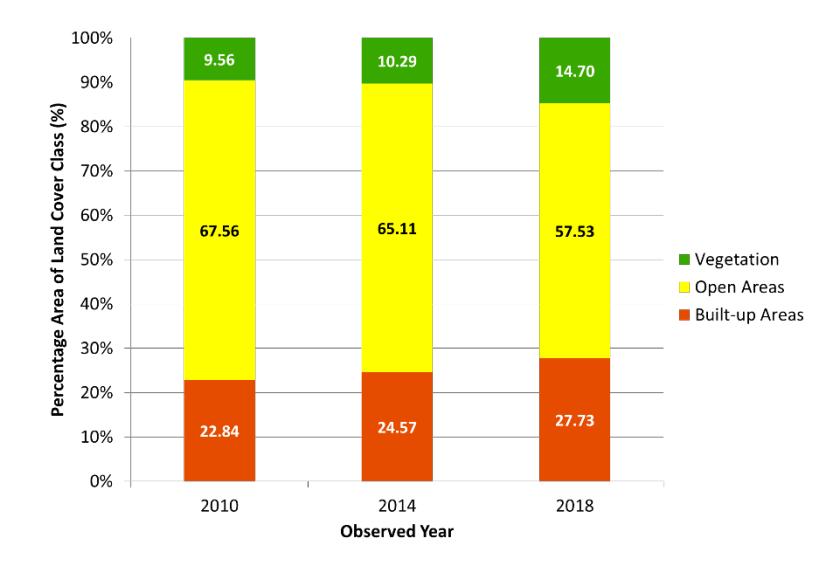
The largest land cover area in NBA is open areas (garden, agricultural land, plantation, field, rice field, and shrubs) which are commonly found in West Bandung Regency and Bandung Regency in the three observed years (Figure 2). Based on the Government of West Bandung and Bandung Regency data, agricultural lands are spread over several districts such as Lembang, Parongpong, Cisarua, Cimenyan, and Cilengkrang. These areas have suitable environmental conditions (cool temperature and volcanic soil) to support agriculture [30]. These areas are classified as medium LST class. The percentage of open areas in NBA is about 67.56%, then 27.73% of built-up areas and 14.70% for vegetation (Figure 3).

Built-up areas which are covered by settlements, industries, and buildings show high and very high LST classes (Figure 2). This land cover class is mostly found in Bandung and Cimahi City. In addition, some built-up areas are also found in Cileunyi, Ngamprah, Cisarua, Parongpong, and Lembang District (Figure 2). The percentage of the built-up regions increased from 2010 (22.84%) to 2018 (27.73%) (Figure 3) due to various factors, such as the nice natural view [2], development of tourism activities [1,31], availability of good infrastructure (road) [6], urban expansion of Bandung City [9,10], and the development of industry and urban areas in West Bandung Regency [3].

Built-up areas are related to high temperatures due to several factors such as waterproof surfaces that decrease evaporation and materials with high thermal diffusivity; thus these physical properties will increase heat storage during the day and slow heat release at night. [23,32]. The components of built-up areas generally have high surface albedo that increases LST in this land cover class [19].

The term vegetation in this study refers to forests found in the northern part of the West Bandung Regency (Figure 2). Forest cover in some areas such as in Cimenyan and Cilengkrang District shows a prominent increase from 2014 (10.29%) to 2018 (14.70%) due to the reforestation program led by Perhutani [33,34]. The result from land cover change data in NBA by Samodoro et al. (2020) also shows similar results; forest cover in this area increased from 2015 (4,400.51 ha) to 2018 (6,669.84 ha) [35]. Forested areas show low and very low LST classes. Vegetation decreases LST by its shading effect, therefore reducing solar energy to the soil surface. These maps cannot determine water bodies because the area is too small (Figure 2).

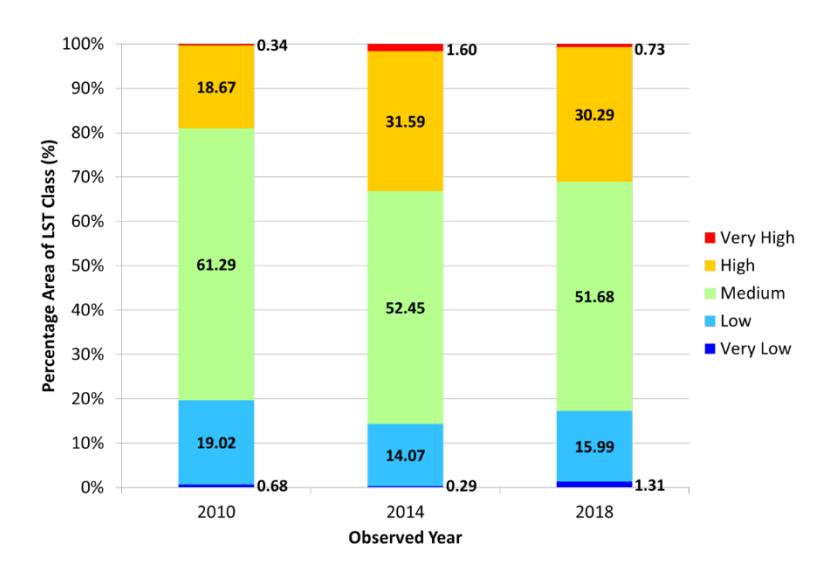
The percentage area with a medium and low class of LST decreased from 2010 (61.29%; 19.02%) to 2018 (51.68%; 15.99%). Meanwhile, there is a significant change of highclass LST from 2010 (18.67%) to 2018 (30.29%) (Figure 4). Even though the forested area increased due to the reforestation program, a high percentage of the built-up regions negatively impact land surface temperature. Therefore, reforestation or rehabilitation programs should be expanded in open areas to lowering surface temperature. This result aligns with the study conducted by Lin et al. (2018) in Hangzhou, China, from 1990-2010 [36]. This data shows that the increase in heated areas was directly proportional to the rise in urban areas.
9

Figure 2. Maps of the Distribution of the Land Cover Class (A) and the LST Class (B) in NBA in the Three Observed Years
2

Figure 3. Percentage Area of Land Cover Class in NBA in the Three Observed Years
4

Figure 4. Percentage Area of LST Class in NBA in the Three Observed Years

Land surface temperature is affected by factors, e.g., weather, physical properties of a surface, type of surface material, material structure, surface color, and surface roughness. These material characteristics will affect thermal diffusivity, which indicates how easily heat can penetrate a material [32]. In addition, the water content will affect LST in terms of the cooling process through evapotranspiration. Especially in urban areas, the geometry of the street and Sky View Factor (SVF) also affected LST [37].

3.3. The Implication of Findings

There is a significant change of land cover area in NBA from 2010-2018. Studies related to the land cover change in

NBA showed terrible impacts on the environment. Expansion of the built-up regions in the NBA can decrease the water catchment area, reducing the water reserves and supplies in Bandung City, Cimahi City, Bandung Regency, and West Bandung Regency [5,14]. In addition, NBA has a quite high level of landslide vulnerability. The existence of fields and settlements in this area will exacerbate the level of landslide vulnerability [38]. NBA also has several tributaries that flow into Citarum River [8]. The decrease of vegetation cover in this area will cause an increase of runoff and erosion. Erosion will cause river sedimentation that makes the capacity of the river to decrease. This impact will result in a flood in the upstream area of the river and the area below it [17].

Also, the increase of LST in the NBA negatively impacts human health and comfort [19–21]. According to Arifwidodo et al. [20], negative impacts of high LST on human comfort include sleep deprivation, decrease in daily travel time, and increase in sedentary behavior, which is behaviors with less physical activities. The increasing LST will result in heat stress and other heat-related diseases in humans. Besides, several studies found that an increase in LST will encourage the use of air conditioning in households which causes electrical energy consumption to increase [20]. This impact will increase greenhouse gas emissions that result in global warming [39].

To prevent the negative impacts of land cover change in NBA, several actions should be taken, including limitation of constructed building development, providing a proportional green open space, maintaining forest cover, and expanding vegetated cover as stated in Regulation of the Province of West Java Number 2 of 2016 [4].

4. Conclusion

Land cover change in NBA from 2010 to 2018 caused an increase in LST. The percentage of open areas in the NBA decreased from 67.6% to 57.5%. Meanwhile, vegetation and the built-up regions increased from 9.6% to 14.7% and 22.8% to 27.7%, respectively. Medium class of LST in NBA shifts from 61.3% to 51.7%; low LST class decrease from 19% to 16%; and high LST class increases from 18.7% to 30.3%. Built-up areas are found in high and very high LST because they have material characteristics that decrease evaporation and increase thermal diffusivity. Therefore these physical properties can store heat during the day and slow heat release at night.

Research Intelligence

Data from OpenAlex ↗

Metrics

8
Citations
0.44
FWCIfield-weighted
56th
Percentilevs same year + field
Article
Work type
Open Access

Citation Trend

Citation Timeline

YearCitations
20261
20252
20242
20232
20211

Institution Network

References

  1. Rochlani Y, Pothineni NV, Kovelamudi S, Mehta JL. Metabolic syndrome: pathophysiology, management, and modulation by natural compounds. Ther Adv Cardiovasc Dis [Internet]. 2017 Aug 1 [cited 2021 Jul 18];11(8):215. Available from: /pmc/articles/PMC5933580/. DOI: https://doi.org/10.1177/1753944717711379 DOI: 10.1177/1753944717711379
  2. Yuan Y, Liu Q, Zhao F, Cao J, Shen X, Li C. Holothuria leucospilota polysaccharides ameliorate hyperlipidemia in high-fat diet-induced rats via short-chain fatty acids production and lipid metabolism regulation. Int J Mol Sci [Internet]. 2019 Oct 1 [cited 2021 Jun 27];20(19):4738. Available from: /pmc/articles/PMC6801986/. DOI: https://doi.org/10.3390/ijms20194738 DOI: 10.3390/ijms20194738
  3. Munshi RP, Joshi SG, Rane BN. Development of an experimental diet model in rats to study hyperlipidemia and insulin resistance, markers for coronary heart disease. Indian J Pharmacol [Internet]. 2014 [cited 2021 Jun 27];46(3):270–6. Available from: /pmc/articles/PMC4071702/. DOI: https://doi.org/10.4103/0253-7613.13215 DOI: 10.4103/0253-7613.13215
  4. Wang L, Fan W, Zhang M, Zhang Q, Li L, Wang J, et al. Antiobesity, Regulation of Lipid Metabolism, and Attenuation of Liver Oxidative Stress Effects of Hydroxy- α-sanshool Isolated from Zanthoxylum bungeanum on High-Fat Diet-Induced Hyperlipidemic Rats. Oxid Med Cell Longev [Internet]. 2019 [cited 2021 Jul 22];2019. Available from: https://pubmed.ncbi.nlm.nih.gov/31534622/. DOI: https://doi.org/10.1155/2019/5852494 DOI: 10.1155/2019/5852494
  5. Buettner R, Schölmerich J, Bollheimer LC. High-fat diets: Modeling the metabolic disorders of human obesity in rodents [Internet]. Vol. 15, Obesity. Obesity (Silver Spring); 2007 [cited 2021 Jun 27]. p. 798–808. Available from: https://pubmed.ncbi.nlm.nih.gov/17426312/. DOI: https://doi.org/10.1038/oby.2007.608 DOI: 10.1038/oby.2007.608
  6. Szpirer C. Rat models of human diseases and related phenotypes: a systematic inventory of the causative genes. J Biomed Sci 2020 271 [Internet]. 2020 Aug 2 [cited 2021 Oct 27];27(1):1–52. Available from: https://jbiomedsci.biomedcentral.com/articles/10.1186/s12929-020-00673-8. DOI: https://doi.org/10.1186/s12929-020-00673-8 DOI: 10.1186/s12929-020-00673-8
  7. Bryda EC. The Mighty Mouse: The Impact of Rodents on Advances in Biomedical Research. Mo Med [Internet]. 2013 [cited 2021 Oct 27];110(3):207. Available from: /pmc/articles/PMC3987984/
  8. Iannaccone PM, Jacob HJ. Rats! Dis Model Mech [Internet]. 2009 May [cited 2021 Oct 27];2(5–6):206. Available from: /pmc/articles/PMC2675817/. DOI: https://doi.org/10.1242/dmm.002733 DOI: 10.1242/dmm.002733
  9. Wali JA, Jarzebska N, Raubenheimer D, Simpson SJ, Rodionov RN, O’sullivan JF. Cardio-metabolic effects of high-fat diets and their underlying mechanisms—a narrative review [Internet]. Vol. 12, Nutrients. MDPI AG; 2020 [cited 2021 Jun 27]. Available from: https://pubmed.ncbi.nlm.nih.gov/32455838/. DOI: https://doi.org/10.3390/nu1205150 DOI: 10.3390/nu1205150
  10. Bays HE, Toth PP, Kris-Etherton PM, Abate N, Aronne LJ, Brown WV, et al. Obesity, adiposity, and dyslipidemia: A consensus statement from the National Lipid Association. J Clin Lipidol [Internet]. 2013 Jul 1 [cited 2021 Jul 18];7(4):304–83. Available from: http://www.lipidjournal.com/article/S1933287413001608/fulltext. DOI: https://doi.org/10.1016/j.jacl.2013.04.001 DOI: 10.1016/j.jacl.2013.04.001
  11. Xiao C, Dash S, Morgantini C, Hegele R, Lewis G. Pharmacological Targeting of the Atherogenic Dyslipidemia Complex: The Next Frontier in CVD Prevention Beyond Lowering LDL Cholesterol. Diabetes [Internet]. 2016 Jul 1 [cited 2021 Jul 13];65(7):1767–78. Available from: https://pubmed.ncbi.nlm.nih.gov/27329952/. DOI: https://doi.org/10.2337/db16-0046 DOI: 10.2337/db16-0046
  12. Li T-T, Liu Y-Y, Wan X-Z, Huang Z-R, Liu B, Zhao C. Regulatory Efficacy of the Polyunsaturated Fatty Acids from Microalgae Spirulina platensis on Lipid Metabolism and Gut Microbiota in High-Fat Diet Rats. Int J Mol Sci Artic [Internet]. 2018 [cited 2021 Jul 22]; Available from: www.mdpi.com/journal/ijms. DOI: https://doi.org/10.3390/ijms19103075 DOI: 10.3390/ijms19103075
  13. Nour OA, Ghoniem HA, Nader MA, Suddek GM. Impact of protocatechuic acid on high fat diet-induced metabolic syndrome sequelae in rats. Eur J Pharmacol. 2021 Sep 15;907:174257. DOI: https://doi.org/10.1016/j.ejphar.2021.174257 DOI: 10.1016/j.ejphar.2021.174257
  14. Gohar A, Shakeel M, Atkinson RL, Haleem DJ. Potential mechanisms of improvement in body weight, metabolic profile, and liver metabolism by honey in rats on a high fat diet. PharmaNutrition. 2020 Dec 1;14:100227. DOI: https://doi.org/10.1016/J.PHANU.2020.100227 DOI: 10.1016/j.phanu.2020.100227
  15. Moreno-Fernández S, Garcés-Rimón M, Vera G, Astier J, Landrier JF, Miguel M. High Fat/High Glucose Diet Induces Metabolic Syndrome in an Experimental Rat Model. Nutrients [Internet]. 2018 Oct 14 [cited 2021 Jul 23];10(10). Available from: /pmc/articles/PMC6213024/. DOI: https://doi.org/10.3390/nu10101502 DOI: 10.3390/nu10101502
  16. Ihsanario A, Ridwan A. Optimal Feeding Frequency on the Growth Performance of Whiteleg Shrimp (Litopenaeus vannamei) during Grow-out Phase. 3BIO J Biol Sci Technol Manag [Internet]. 2021 Jul 13 [cited 2021 Jul 26];3(1):42–55. Available from: http://journals.itb.ac.id/index.php/3bio/article/view/16120. https://doi.org/10.5614/3bio.2021.3.1.5 DOI: 10.5614/3bio.2021.3.1.5
  17. Mikolajewicz N, Komarova S V. Meta-Analytic Methodology for Basic Research: A Practical Guide. Front Physiol [Internet]. 2019 [cited 2021 Jul 18];10(MAR):203. Available from: /pmc/articles/PMC6445886/. DOI: https://doi.org/10.3389/fphys.2019.00203 DOI: 10.3389/fphys.2019.00203
  18. Hariri N, Thibault L. High-fat diet-induced obesity in animal models. Nutr Res Rev [Internet]. 2010 Dec [cited 2021 Jun 27];23(2):270–99. Available from: https://pubmed.ncbi.nlm.nih.gov/20977819/. DOI: https://doi.org/10.1017/S0954422410000168 DOI: 10.1017/s0954422410000168
  19. Miah P, Mohona SBS, Rahman MM, Subhan N, Khan F, Hossain H, et al. Supplementation of cumin seed powder prevents oxidative stress, hyperlipidemia and non-alcoholic fatty liver in high fat diet fed rats. Biomed Pharmacother [Internet]. 2021 Sep 1 [cited 2021 Jul 16];141:111908. Available from: https://linkinghub.elsevier.com/retrieve/pii/S0753332221006909. DOI: https://doi.org/10.1016/j.biopha.2021.11190 DOI: 10.1016/j.biopha.2021.11190
  20. Yerlikaya FH, Öz M. Aberrant expression of miRNA profiles in high-fat and high-sucrose fed rats. Vol. 27, Clinical Nutrition Experimental. Elsevier Ltd; 2019. p. 1–8. DOI: https://doi.org/10.1016/j.yclnex.2019.07.001 DOI: 10.1016/j.yclnex.2019.07.001
  21. Wang L, Xu F, Zhang XJ, Jin RM, Li X. Effect of high-fat diet on cholesterol metabolism in rats and its association with Na+/K+-ATPase/Src/pERK signaling pathway. J Huazhong Univ Sci Technol - Med Sci. 2015;35(4):490–4. DOI: https://doi.org/10.1007/s11596-015-1458-6 DOI: 10.1007/s11596-015-1458-6
  22. Ness GC. Physiological feedback regulation of cholesterol biosynthesis: Role of translational control of hepatic HMG-CoA reductase and possible involvement of oxylanosterols. Vol. 1851, Biochimica et Biophysica Acta - Molecular and Cell Biology of Lipids. Elsevier; 2015. p. 667–73. DOI: https://doi.org/10.1016/j.bbalip.2015.02.008 DOI: 10.1016/j.bbalip.2015.02.008
  23. Afonso MS, Marcondes Machado R, Ferrari Lavrador MS, Rocha Quintao EC, Moore KJ, Lottenberg AM. Molecular pathways underlying cholesterol homeostasis [Internet]. Vol. 10, Nutrients. MDPI AG; 2018 [cited 2021 Jun 26]. Available from: https://pubmed.ncbi.nlm.nih.gov/29899250/. DOI: https://doi.org/10.3390/nu10060760 DOI: 10.3390/nu10060760
  24. Han Q, Yeung SC, Ip MSM, Mak JCW. Dysregulation of cardiac lipid parameters in high-fat high-cholesterol diet-induced rat model. Lipids Health Dis. 2018;17(1):1–10. DOI: https://doi.org/10.1186/s12944-018-0905-3 DOI: 10.1186/s12944-018-0905-3
  25. Fan Q, Yin X, Rababa’h A, Diaz AD, Wijaya CS, Singh S, et al. Integrative Cardiovascular Physiology and Pathophysiology: Absence of gravin-mediated signaling inhibits development of high-fat diet-induced hyperlipidemia and atherosclerosis. Am J Physiol - Hear Circ Physiol [Internet]. 2019 [cited 2021 Jul 10];317(4):H793. Available from: /pmc/articles/PMC6843010/. DOI: https://doi.org/10.1152/ajpheart.00215.2019 DOI: 10.1152/ajpheart.00215.2019
  26. Kitamori K, Naito H, Tamada H, Kobayashi M, Miyazawa D, Yasui Y, et al. Development of novel rat model for high-fat and high-cholesterol diet-induced steatohepatitis and severe fibrosis progression in SHRSP5/Dmcr. Environ Health Prev Med [Internet]. 2012 May [cited 2021 Jul 27];17(3):173–82. Available from: https://pubmed.ncbi.nlm.nih.gov/21853259/. DOI: https://doi.org/10.1007/s12199-011-0235-9 DOI: 10.1007/s12199-011-0235-9
  27. Petersen MC, Shulman GI. Mechanisms of insulin action and insulin resistance [Internet]. Vol. 98, Physiological Reviews. American Physiological Society; 2018 [cited 2021 Jun 27]. p. 2133–223. Available from: /pmc/articles/PMC6170977/. DOI: https://doi.org/10.1152/physrev.00063.2017 DOI: 10.1152/physrev.00063.2017
  28. Du H, Li C, Wang Z, He Y, Wang Y, Zhou H, et al. Effects of Danhong injection on dyslipidemia and cholesterol metabolism in high-fat diets fed rats. J Ethnopharmacol. 2021 Jun 28;274:114058. DOI: https://doi.org/10.1016/j.jep.2021.114058 DOI: 10.1016/j.jep.2021.114058
  29. Zhang Q, Fan X, Ye R, Hu Y, Zheng T, Shi R, et al. The Effect of Simvastatin on Gut Microbiota and Lipid Metabolism in Hyperlipidemic Rats Induced by a High-Fat Diet. Front Pharmacol [Internet]. 2020 Apr 29 [cited 2021 Jul 10];11:522. Available from: www.frontiersin.org. DOI: https://doi.org/10.3389/fphar.2020.00522 DOI: 10.3389/fphar.2020.00522
  30. Niroumand S, Khajedaluee M, Khadem-Rezaiyan M, Abrishami M, Juya M, Khodaee G, et al. Atherogenic Index of Plasma (AIP): A marker of cardiovascular disease. Med J Islam Repub Iran [Internet]. 2015 [cited 2021 Oct 27];29(1):240. Available from: /pmc/articles/PMC4715400/
  31. Cai G, Shi G, Xue S, Lu W. The atherogenic index of plasma is a strong and independent predictor for coronary artery disease in the Chinese Han population. Medicine (Baltimore) [Internet]. 2017 Sep 1 [cited 2021 Oct 27];96(37). Available from: /pmc/articles/PMC5604669/. DOI: https://doi.org/10.1097/MD.0000000000008058 DOI: 10.1097/md.0000000000008058
  32. Kammar-García A, López-Moreno P, Hernández-Hernández ME, Ortíz-Bueno AM, Martínez-Montaño M de LC. Atherogenic index of plasma as a marker of cardiovascular risk factors in Mexicans aged 18 to 22 years. Proc (Bayl Univ Med Cent) [Internet]. 2021 [cited 2021 Oct 27];34(1):22. Available from: /pmc/articles/PMC7785179/. DOI: https://doi.org/10.1080/08998280.2020.1799479 DOI: 10.1080/08998280.2020.1799479
  33. Himms-Hagen J. Role of thermogenesis in the regulation of energy balance in relation to obesity. Can J Physiol Pharmacol [Internet]. 1989 [cited 2021 Jul 27];67(4):394–401. Available from: https://pubmed.ncbi.nlm.nih.gov/2667732/. DOI: https://doi.org/10.1139/y89-063. DOI: 10.1139/y89-063
  34. Abdel Maksoud HA, Elharrif MG, Mohammed RR, Omnia MA, El Sayed NE. Biochemical changes associated with low and very low calorie diets on lipid metabolism, iron profile and kidney function in obese rats. Clin Nutr Exp. 2020 Oct 1;33:32–8. DOI: https://doi.org/10.1016/j.yclnex.2020.07.004 DOI: 10.1016/j.yclnex.2020.07.004
  35. Hori S, Abe T, Lee DG, Fukiya S, Yokota A, Aso N, et al. Association between 12α-hydroxylated bile acids and hepatic steatosis in rats fed a high-fat diet. J Nutr Biochem. 2020 Sep 1;83:108412. DOI: https://doi.org/10.1016/j.jnutbio.2020.108412 DOI: 10.1016/j.jnutbio.2020.108412
  36. Zhang Y, Shanshan G, Yang Z, Li Z, Gong X, Zhang Q, et al. Disturbance of di-(2-ethylhexyl) phthalate in hepatic lipid metabolism in rats fed with high fat diet. Food Chem Toxicol. 2020 Dec 1;146:111848. DOI: https://doi.org/10.1016/j.fct.2020.111848 DOI: 10.1016/j.fct.2020.111848
  37. Ortiz M, Soto-Alarcón SA, Orellana P, Espinosa A, Campos C, López-Arana S, et al. Suppression of high-fat diet-induced obesity-associated liver mitochondrial dysfunction by docosahexaenoic acid and hydroxytyrosol co-administration. Dig Liver Dis. 2020 Aug 1;52(8):895–904. DOI: https://doi.org/10.1016/j.dld.2020.04.019 DOI: 10.1016/j.dld.2020.04.019
  38. Adermark L, Gutierrez S, Lagström O, Hammarlund M, Licheri V, Johansson ME. Weight gain and neuroadaptations elicited by high fat diet depend on fatty acid composition. Psychoneuroendocrinology. 2021 Apr 1;126:105143. DOI: https://doi.org/10.1016/j.psyneuen.2021.105143 DOI: 10.1016/j.psyneuen.2021.105143
  39. Wiktorowska-Owczarek A, Berezińska M, Nowak J. PUFAs: Structures, Metabolism and Functions. Adv Clin Exp Med [Internet]. 2015 [cited 2021 Jul 19];24(6):931–41. Available from: https://pubmed.ncbi.nlm.nih.gov/26771963/. DOI: https://doi.org/10.17219/acem/31243 DOI: 10.17219/acem/31243
  40. Ruiz R, Jideonwo V, Ahn M, Surendran S, Tagliabracci VS, Hou Y, et al. Sterol Regulatory Element-binding Protein-1 (SREBP-1) Is Required to Regulate Glycogen Synthesis and Gluconeogenic Gene Expression in Mouse Liver. J Biol Chem [Internet]. 2014 Feb 28 [cited 2021 Jul 27];289(9):5510. Available from: /pmc/articles/PMC3937627/. DOI: https://doi.org/10.1074/jbc.M113.541110 DOI: 10.1074/jbc.m113.541110
  41. Duan Y, Zeng L, Zheng C, Song B, Li F, Kong X, et al. Inflammatory links between high fat diets and diseases. Front Immunol [Internet]. 2018 Nov 13 [cited 2021 Jul 4];9(NOV):2649. Available from: www.frontiersin.org. DOI: https://doi.org/10.3389/fimmu.2018.02649 DOI: 10.3389/fimmu.2018.02649
  42. Rai P, Kumar M, Sharma G, Barak P, Das S, Kamat SS, et al. Kinesin-dependent mechanism for controlling triglyceride secretion from the liver. Proc Natl Acad Sci U S A [Internet]. 2017 Dec 5 [cited 2021 Jun 30];114(49):12958–63. Available from: https://pubmed.ncbi.nlm.nih.gov/29158401/. DOI: https://doi.org/10.1073/pnas.1713292114 DOI: 10.1073/pnas.1713292114
  43. Li J, Huang J, Li JS, Chen H, Huang K, Zheng L. Accumulation of endoplasmic reticulum stress and lipogenesis in the liver through generational effects of high fat diets. J Hepatol. 2012 Apr 1;56(4):900–7. DOI: https://doi.org/10.1016/j.jhep.2011.10.018 DOI: 10.1016/j.jhep.2011.10.018
  44. Namgaladze D, Brüne B. Macrophage fatty acid oxidation and its roles in macrophage polarization and fatty acid-induced inflammation. Vol. 1861, Biochimica et Biophysica Acta - Molecular and Cell Biology of Lipids. Elsevier B.V.; 2016. p. 1796–807. DOI: https://doi.org/10.1016/j.bbalip.2016.09.002 DOI: 10.1016/j.bbalip.2016.09.002
  45. Barazzoni R, Zanetti M, Gortan Cappellari G, Semolic A, Boschelle M, Codarin E, et al. Fatty acids acutely enhance insulin-induced oxidative stress and cause insulin resistance by increasing mitochondrial reactive oxygen species (ROS) generation and nuclear factor-κB inhibitor (IκB)-nuclear factor-κB (NFκB) activation in rat muscle, in the. Diabetologia [Internet]. 2012 Mar [cited 2021 Jul 12];55(3):773–82. Available from: https://pubmed.ncbi.nlm.nih.gov/22159911/. DOI: https://doi.org/10.1007/s00125-011-2396-x DOI: 10.1007/s00125-011-2396-x
  46. Valente AJ, Irimpen AM, Siebenlist U, Chandrasekar B. OxLDL induces endothelial dysfunction and death via TRAF3IP2. Inhibition by HDL3 and AMPK activators. Free Radic Biol Med. 2014;70:117–28. DOI: https://doi.org/10.1016/j.freeradbiomed.2014.02.014 DOI: 10.1016/j.freeradbiomed.2014.02.014
  47. Vandanmagsar B, Youm Y-H, Ravussin A, Galgani JE, Stadler K, Mynatt RL, et al. The NALP3/NLRP3 Inflammasome Instigates Obesity-Induced Autoinflammation and Insulin Resistance. Nat Med [Internet]. 2011 Feb [cited 2021 Jul 12];17(2):179. Available from: /pmc/articles/PMC3076025/. DOI: https://doi.org/10.1038/nm.2279 DOI: 10.1038/nm.2279
  48. Roden M, Shulman GI. The integrative biology of type 2 diabetes. Nature [Internet]. 2019 [cited 2021 Jun 27];576:51. DOI: https://doi.org/10.1038/s41586-019-1797-8 DOI: 10.1038/s41586-019-1797-8
  49. Abdulmalek SA, Fessal M, El-Sayed M. Effective amelioration of hepatic inflammation and insulin response in high fat diet-fed rats via regulating AKT/mTOR signaling: Role of Lepidium sativum seed extracts. J Ethnopharmacol. 2021 Feb 10;266:113439. DOI: https://doi.org/10.1016/j.jep.2020.113439 DOI: 10.1016/j.jep.2020.113439
  50. Song L, Schindler C. IL-6 and the acute phase response in murine atherosclerosis. Atherosclerosis [Internet]. 2004 Nov 1 [cited 2021 Jun 29];177(1):43–51. Available from: http://www.atherosclerosis-journal.com/article/S0021915004003788/fulltext. DOI: https://doi.org/10.1016/j.atherosclerosis.2004.06.018 DOI: 10.1016/j.atherosclerosis.2004.06.018
  51. Akieda-Asai S, Koda S, Sugiyama M, Hasegawa K, Furuya M, Miyazato M, et al. Metabolic features of rats resistant to a high-fat diet. Obes Res Clin Pract. 2013 Jul 1;7(4):e243–50. DOI: https://doi.org/10.1016/j.orcp.2013.01.004 DOI: 10.1016/j.orcp.2013.01.004
  52. Kim SM, Grenert JP, Patterson C, Correia MA. CHIP-/--Mouse Liver: Adiponectin- AMPK-FOXO-Activation Overrides CYP2E1-Elicited JNK1-Activation, Delaying Onset of NASH: Therapeutic Implications. Sci Rep [Internet]. 2016 Jul 12 [cited 2021 Jun 30];6. Available from: https://pubmed.ncbi.nlm.nih.gov/27406999/. DOI: https://doi.org/10.1038/srep29423 DOI: 10.1038/srep29423
  53. Hu N, Yang L, Dong M, Ren J, Zhang Y. Deficiency in adiponectin exaggerates cigarette smoking exposure-induced cardiac contractile dysfunction: Role of autophagy. Pharmacol Res. 2015 Oct 27;100:175–89. DOI: https://doi.org/10.1016/j.phrs.2015.08.005 DOI: 10.1016/j.phrs.2015.08.005
  54. Hua P, Yu Z, Xiong Y, Liu B, Zhao L. Regulatory Efficacy of Spirulina platensis Protease Hydrolyzate on Lipid Metabolism and Gut Microbiota in High-Fat Diet-Fed Rats. Int J Mol Sci [Internet]. 2018 Dec 13 [cited 2021 Jul 22];19(12). Available from: /pmc/articles/PMC6320850/. DOI: https://doi.org/10.3390/ijms19124023 DOI: 10.3390/ijms19124023
  55. Yadav A, Kataria MA, Saini V, Yadav A. Role of leptin and adiponectin in insulin resistance. Vol. 417, Clinica Chimica Acta. Elsevier; 2013. p. 80–4. DOI: https://doi.org/10.1016/j.cca.2012.12.007 DOI: 10.1016/j.cca.2012.12.007
  56. Wilcox G. Insulin and Insulin Resistance. Clin Biochem Rev [Internet]. 2005 [cited 2021 Jul 28];26(2):19. Available from: /pmc/articles/PMC1204764/
  57. Haeusler RA, Mcgraw TE, Accili D. Biochemical and cellular properties of insulin receptor signalling. Nat Rev Mol Cell Biol. 2018;19(1):31–44. DOI: https://doi.org/10.1038/nrm.2017.89 DOI: 10.1038/nrm.2017.89
  58. Small L, Brandon AE, Turner N, Cooney GJ. Modeling insulin resistance in rodents by alterations in diet: What have high-fat and high-calorie diets revealed? [Internet]. Vol. 314, American Journal of Physiology - Endocrinology and Metabolism. American Physiological Society; 2018 [cited 2021 Jun 27]. p. E251–65. Available from: https://pubmed.ncbi.nlm.nih.gov/29118016/. DOI: https://doi.org/10.1152/ajpendo.00337.2017 DOI: 10.1152/ajpendo.00337.2017
  59. Biddinger S, Hernandez-Ono A, Rask-Madsen C, Haas J, Alemán J, Suzuki R, et al. Hepatic insulin resistance is sufficient to produce dyslipidemia and susceptibility to atherosclerosis. Cell Metab [Internet]. 2008 Feb 6 [cited 2021 Jul 14];7(2):125–34. Available from: https://pubmed.ncbi.nlm.nih.gov/18249172/. DOI: https://doi.org/10.1016/j.cmet.2007.11.013 DOI: 10.1016/j.cmet.2007.11.013
  60. Ji G, Zhao X, Leng L, Liu P, Jiang Z. Comparison of Dietary Control and Atorvastatin on High Fat Diet Induced Hepatic Steatosis and Hyperlipidemia in Rats. Lipids Health Dis [Internet]. 2011 [cited 2021 Jul 10];10(23):1–10. Available from: http://www.lipidworld.com/content/10/1/23. DOI: https://doi.org/10.1186/1476-511X-10-23 DOI: 10.1186/1476-511x-10-23
  61. Ding S, Jiang J, Zhang G, Bu Y, Zhang G, Zhao X. Resveratrol and caloric restriction prevent hepatic steatosis by regulating SIRT1-autophagy pathway and alleviating endoplasmic reticulum stress in high-fat diet-fed rats. PLoS One [Internet]. 2017 Aug 1 [cited 2021 Jul 22];12(8). Available from: /pmc/articles/PMC5560739/. DOI: https://doi.org/10.1371/journal.pone.0183541 DOI: 10.1371/journal.pone.0183541
  62. Dávalos-Salas M, Mariadason JM, Watt MJ, Montgomery MK. Molecular regulators of lipid metabolism in the intestine – Underestimated therapeutic targets for obesity? Biochem Pharmacol. 2020 Aug 1;178:114091. DOI: https://doi.org/10.1016/j.bcp.2020.114091 DOI: 10.1016/j.bcp.2020.114091