

1. Introduction
Sedentary lifestyle, food habits, and stressful living conditions were reported to cause chronic oxidative stress, resulting in chronic lifestyle diseases [1], the top causes of death for the global urban population. The poor intake of nutritious food coupled with constant exposure to environmental pollution or prolonged stressful condition with minimum exercise leads to oxidative stress [2]. Oxidative stress is a phenomenon caused by an accumulation of free radicals, which are by-products of metabolic processes in the biological systems. The excess presence of reactive oxygen species (ROS) in cells causes negative effects on proteins, lipids, and nucleic acids. Cells in the human body can naturally activate antioxidant defense systems by producing enzymes such as superoxide dismutase (SOD) and catalase (CAT) to prevent ROS cell damage, but only to an extent. The consumption of food rich in antioxidants may help the body in doing so [3]. Antioxidants are scavengers of free radicals in the human body, thus protecting them from chronic diseases caused by oxidative stress [4]. The consumption of food with high-antioxidant content has been linked to minimizing oxidative stress and reducing the risk of cardiovascular diseases, cancer, aging [5], neurodegenerative diseases [6], and type 2 diabetes [7]. These recent studies also emphasize that the quenching of free radicals in our body by various antioxidant compounds of fruits and vegetables is crucial and irreplicable by treating supplements containing only certain types of antioxidants.
1) Agricultural Engineering Study Program, School of Life Sciences and Technology, Institut Teknologi Bandung
2) Biotechnology Study Program, School of Life Sciences and Technology, Institut Teknologi Bandung
Antioxidants also hold great potential in alleviating symptoms related to viral infection. For instance, the presence of free radicals complemented by COVID-19 may increase pathogenesis in comorbid patients due to elevated oxidative stress. Therefore, COVID-19 patients are prone to decreased levels of antioxidants due to their utilization in counteracting free radicals [8]. In addition to pharmacological therapy, high-antioxidant dietary treatment is recommended in treating COVID-19 and comorbidities [9]. Hence, providing high-antioxidant food is crucial to alleviate the risks of chronic and infection diseases for either urban or rural populations.
However, the limited arable land in urban areas impedes its population's access to fresh vegetables and fruits when their antioxidant content is the highest. Furthermore, poor postharvest management and long transportation of fruits and vegetables to reach urban customers also reduce their antioxidant benefits [10]. Thus, in this research, we explored the alternative of cultivating microgreens in an urban farming system to improve antioxidant content. Microgreens are young vegetables, which could be leafy greens or fruit vegetables, that are approximately harvested at 5 – 10 cm tall [11]. They are found to contain vitamins, minerals, and antioxidants 4-6 times more than the amount found in mature vegetables. In the past few years, microgreens consumption has increased along with consumers' awareness of the importance of nutritious vegetables [12]. Microgreens can be quickly grown in a soilless medium in a short period (10-15 days), creating opportunities to be cultivated in a limited space. Therefore, microgreens have potential in urban farming because of their accessibility to urban citizens.
Wheatgrass (Triticum aestivum) is often grown as microgreens due to its abundance of antioxidants, promoting the consumers' health. For instance, routine consumption of wheatgrass was recorded to improve immune parameters in colorectal cancer patients [13]; protect rats from streptozotocin-induced diabetes [4]; and proposed as a potential therapeutic agent for chronic diseases [14]. Wheatgrass microgreens are typically harvested during their vegetative state (10 days after sowing). Wheatgrass grows ideally in a temperature range of 18-26 ˚C and a humidity of 40-50% [15]; [16]; [17]. In plants, photosynthesis occurs when chlorophyll pigments are present [18] and when light emits electromagnetic radiation, also known as photosynthetically active radiation (PAR), as the energy source of photosynthesis [19]. Microgreens can be cultivated using artificial light, such as light-emitting diodes (LED), which are an efficient source of light for plant cultivation due to customizable spectra, high light output, and low emission [20]. Furthermore, antioxidant content in vegetables is also regulated by the photoperiod and wavelength of the exposed lights [21]; [22]; [23]. In this research, the antioxidants content of wheatgrass microgreens was examined after a cultivation period under exposure to several light combinations. This research reveals that modulation of certain types of antioxidants by exposure to red/blue light is unique and is not always reflected by the total antioxidant capacity. The results could be the foundation for designing a system for cultivating highantioxidant microgreens in urban households.
2. Methodology
2.1. Seed sowing and light equipment installation
Sowing was performed on an organic growth medium with a pH of 5.5 in a 35 x 10 cm tray. The bottom compartment of the tray was filled with 750 mL of water for bottom-up watering of the plants; water could reach the medium due to capillary force and then was absorbed by roots. As many as 250 grams of seeds were sowed and stored in a dark room for 3 days for germination. The trays were moved to a shelf equipped with LED installation and exposed to the lighting combinations in a photoperiod of 12 hours (h) of light and 12 h of dark for 10 days (Figure 1F). The LED installation consisted of a collection of red and blue LED lights, a shelf with a height of 40 cm, a power supply, and a timer. After the light installation was assembled, a black, opaque curtain was installed to block any light from going inside. The red and blue light combinations used were based on the percentage of RGB ratio, which were 91% red and 9% blue (91R/9B); 83% red and 17% blue (83R/17B); 47% red and 53% blue (47R/53B); 35% red and 65% blue (35R/65B); and white fluorescent light as the control (C). The intensity and wavelengths of each light combination or treatment are presented in Figure 1A-E.
Watering was made once in 3 days by adding 100 mL of water into the bottom compartment of the tray. Harvesting was done on the 10th-day post sowing (Figure 1G) by gently removing the whole plant from the growth medium. Plant height for each treatment was recorded 3, 6, and 10 days after sowing (DAS) by measuring from the surface of the medium until the tallest point of the plant, taken from 5 samples. Fresh biomass from 5 samples from each treatment was recorded upon harvest.
2.2. Total chlorophyll and carotenoids content
Total chlorophyll and carotenoid contents were determined using the Kirk method [24]. The extract was prepared from 50 mg of fresh wheatgrass homogenized in 10 mL acetone 80%. The extract was then centrifuged at 3000rpm for 15 minutes. The obtained supernatant was disposed of, and the pellet was dissolved in 5 mL acetone 80%. The extract was centrifuged again until clear. Finally, UV-Vis measured the absorbance at 480, 645, and 663 nm. Samples were measured in duplicates, and then total
chlorophyll and carotenoid contents were determined using equations 1 and 2, respectively.
Total chlorophyll \[(\mu g/mL) = 20.2(A_{645}) + 8.02(A_{663})\] (1)
Total carotenoid \((\mu g/mL) = A_{480}) + (0.114 \times A_{663}) - (0.638 \times A_{645})\) (2)
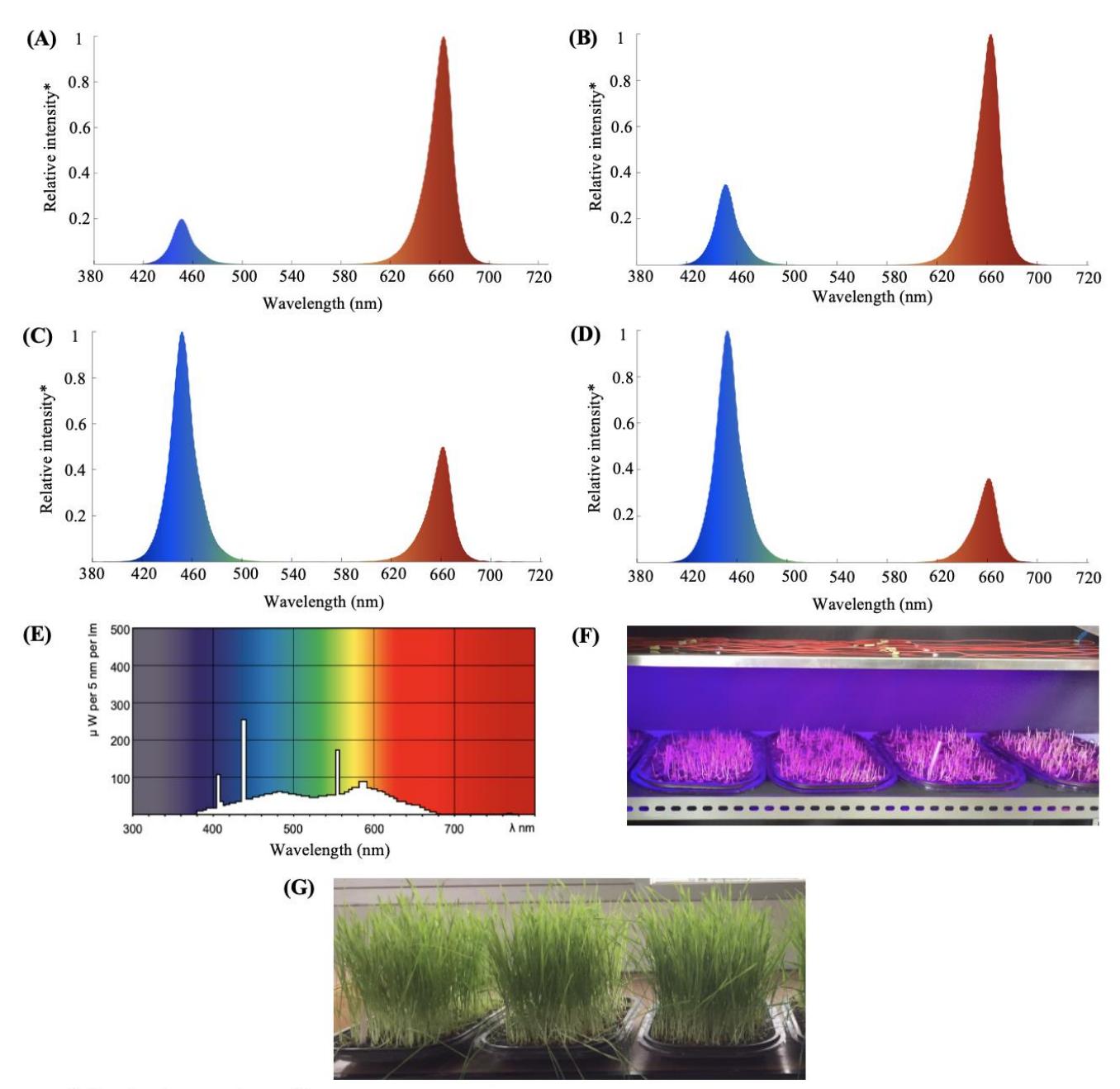
Figure 1. The intensity and wavelength of each combination of light used as the treatment in this research. The RGB color ratio of each treatment were 91% red and 9% blue (A); 83% red and 17% blue (B); 47% red and 53% blue (C); and 35% red and 65% blue (D). The trays of sown seeds were placed 40 cm under the light set up (E), and the microgreens of wheatgrass were ready to harvest on day 10 (F).
2.3. Total flavonoid
Total flavonoid content was determined by the AlCl3 assay, using quercetin as the standard solution. Around 100 mg of quercetin was dissolved in 100 mL methanol PA. 0,1 mL of standard quercetin solution (100, 200, 400, 600, 800, and 1000 μg/mL), 4 mL of distilled water, and 0.3 mL of 5% NaNO2 were added to a test tube to make the standard solution. After 5 minutes, 0.3 mL of 10% AlCl3 was added. After 6 minutes, 2 mL of 1M NaOH was added. Finally, distilled water is added until the volume is made up to 10 mL, which will eventually result in a yellowish-colored solution. The absorbance is measured at 510 nm using UV-Vis, with distilled water used as the blank. Samples were performed in duplicates, and the calibration curve was plotted using quercetin as the standard. As much as 0,1 mL of wheatgrass aliquot is made by oven-drying wheatgrass at 60 ˚C for six h. The dried mass is weighed at 0.1 gram and dissolved in 10 mL aqueous methanol (1:1). The sample was then vortexed for 3 h at 150 rpm and centrifuged at 9000 rpm for 10 minutes. The obtained supernatant was stored at 4 ˚C prior to testing. The sample was then tested using the same AlCl3 assay [24]. Total flavonoid content was determined using equation 3.
\[8.64E - 5x + 6.31E - 3 = 0.967 \tag{3}\]
2.4. Antioxidant activity
The DPPH assay determined antioxidant activity. Fresh wheatgrass was weighed 5 grams and then oven-dried for 72 h at 40 ˚C. Next, 0.5 grams of dry mass was extracted using 10 mL acetone 80%. The extract was vortexed at room temperature for 24 h to separate the supernatant and pellets. To make the DPPH solution, 0.002 grams of DPPH was dissolved in 25 mL acetone 80%. A 25 μL sample, 2975 μL acetone 80%, and 1000 μL DPPH solution are added into a glass vial and stored in a dark room for 30 minutes to determine the antioxidant activity. Finally, the absorbance was measured at 517 nm using UV-Vis, performed in duplicates. The blank was made by dissolving 3000 μL acetone 80% in 1000 μL DPPH solution [26]. The percentage of scavenged DPPH was determined using equation 4.
DPPH Scavenged (%) = \[(Ab - A_{517})(Ab^{-1})(100)\] (4)
2.5. Statistics analysis
The obtained data were analyzed statistically using a oneway analysis of variance and subsequently tested with the Tukey test with a 95% confidence level (p<0.05) in Python (Jupyter Notebook, 2020). Data visualization was also made in the same program with the boxplot function.
3. Results and discussion
Indoor farming is the potential solution in supporting nutrition for the growing global population without further converting wild habitats. This system is suitable for farming in urban areas and maximizing the use of vertical space. Indoor farming also allows access to fresh and highly nutritious fruits and vegetables for the urban population, reducing the need for postharvest and transport management. However, the system depends on artificial lighting, which requires optimization to improve specific crops' qualities. This research tested four-light combination treatments based on the RGB ratio percentage, namely 91R/9B, 83R/17B, 47R/53B, 35R/65B, and white fluorescent light as the control (C) (Figure 1). Previous research indicated that light modification in the spectral area of red and blue improved the morphology [27]; [23], yield [27]; [28], and/or antioxidant content [29]; [27]; [23] either in leafy vegetables or fruits. Here, we tested wheatgrass ten days after sowing (DAS) and cultivated it in the treatments mentioned above to determine the potential of providing an antioxidant source in a limited urban household area and within a short time.
Our results (Figure 2A) showed no significant difference in the height of plants, but distinct patterns of height increase were recorded in each treatment. Treatment 87R/13B resulted in a sigmoid growth wherein the second observation (6th day), there was a height increase of 9 cm, followed by a stable growth. Treatments 83R/17B, 43R/57B, and 35R/65B showed exponential growth, whereas linear growth was found in control. Meanwhile, the highest average of fresh weight (Figure 2B) after harvest was detected in treatment 43R/57B but was not significant to treatment 35R/65B or control. Sigmoidal growth occurs when plants experience small growth at the beginning, followed by exponential growth, and eventually ending in a decrease in growth [30]. Exponential growth occurs from the first observation until the last; the plants experience exponential biomass accumulation [31]. Meanwhile, linear growth is indicated by the constant increase in plant growth [32].
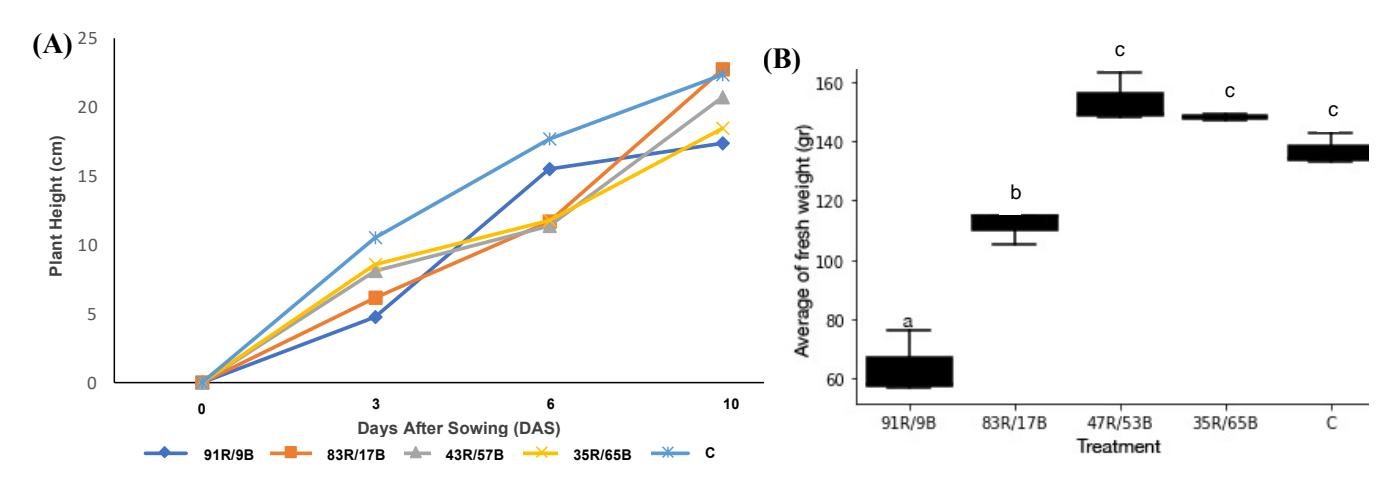
Figure 2. The height (A) and fresh weight (B) of wheatgrass microgreens. Height was recorded on days 3, 6, and 10 after sowing, while fresh weight was only on the day of harvest on 10 DAS. Statistically significant values (Tukey's HSD test, p<0.05) are indicated by the letter on top of the box plot corresponding to each treatment.
The light amount and quality directly affect plant growth and chemical composition. Chlorophyll pigments absorb light in the spectral range of red light (663 nm and 642 nm) and blue light (430 nm and 453 nm), affecting plant growth immensely [33]. Red light is perceived by phytochrome receptors and generates responses related to germination, stem elongation, and leaf expansion. Therefore, highintensity red light applied after germination can accelerate plant height growth in wheatgrass [34]. Blue light stimulates plant growth, leaf expansion, photosynthesis, and pigment accumulation. A combination of blue and red light with a higher ratio of blue light was found to increase fresh mass in comparison to monochromatic light, specifically on lettuce and spinach. However, other plants such as tomatoes and petunias resulted in higher fresh mass when cultivated with intensive red light. This suggests that the effect of red and blue light differs on various species [23]. Despite that, the ratio of red and blue light must be determined carefully because excessive blue light may cause a decrease in fresh mass [33]. Radiation of red light on plant sprouts may maximize photosynthesis. This also eliminates the need for plant protection from photodamage and energy dissipation from other lights. In comparison to a full-spectrum light, radiation with only narrow-length waves on microgreens may decrease the risk of photodamage and increase plant abilities in water absorption and fresh tissue accumulation [19].
Chlorophyll content was also regulated by the spectral area of exposed light, as indicated by the significantly lower content in the leaves cultivated in 91R/9B compared to other treatments and control. A similar result was also recorded by [27] in green leaf lettuce (Lactuca sativa L. 'Grand Rapid TBR') that a high ratio of red light reduced chlorophyll content but not significantly when decreased to 87R/13B. They also found that the treatment of blue light dominant
showed the opposite effect. However, this was not demonstrated in our research as chlorophyll content in 47R/53B, and 35R/65B treatment were similar to control (Figure 3). This indicates that plant response, in terms of chlorophyll content, to light exposure during cultivation was unique to each species, if not a cultivar. Further, Zheng et al. [34] also reported that blue light exposure improved chlorophyll content in Sinningia speciosa but did not in Cordyline australis and Ficus benjamina.
The antioxidant activity of wheatgrass microgreens was determined by measuring the amount of scavenged DPPH. We found that they were not significantly different among treatments when measured on day 10 after sowing. Shon et al. [27] recorded that the high intensity of red light reduced, while blue light increased antioxidant content in both red leaf lettuce (Lactuca sativa L. 'Sunmang') and green leaf lettuce (Lactuca sativa L. 'Grand Rapid TBR') after four weeks of treatment. Conversely, increased antioxidant capacity under high-intensity red light treatment was recorded in sprouting (3 days after sowing) lentil, radish, and wheat seeds [23]. Altogether, these suggest that the growth stage of each plant might as well regulate the total antioxidant capacity.
Similar to the other phytochemical content, we found that our results, along with the previous research, could not point to whether red or blue light exposure is more potent to increase carotenoids [34] or flavonoid [27] content. However, in this research, 35R/65B treatment resulted in the highest content of carotenoids, while 87R/17B resulted in the highest flavonoid content. Bohn et al. [34] showed that both high red and blue light intensities increased carotenoid content in Sinningia speciosa but not in Cordyline australis and Ficus benjamina. Also, higher flavonoid content was recorded in red leaf lettuce under high intensity of either red or light treatment, but in green leaf lettuce was only in the plants treated with high intensity of blue light [27].
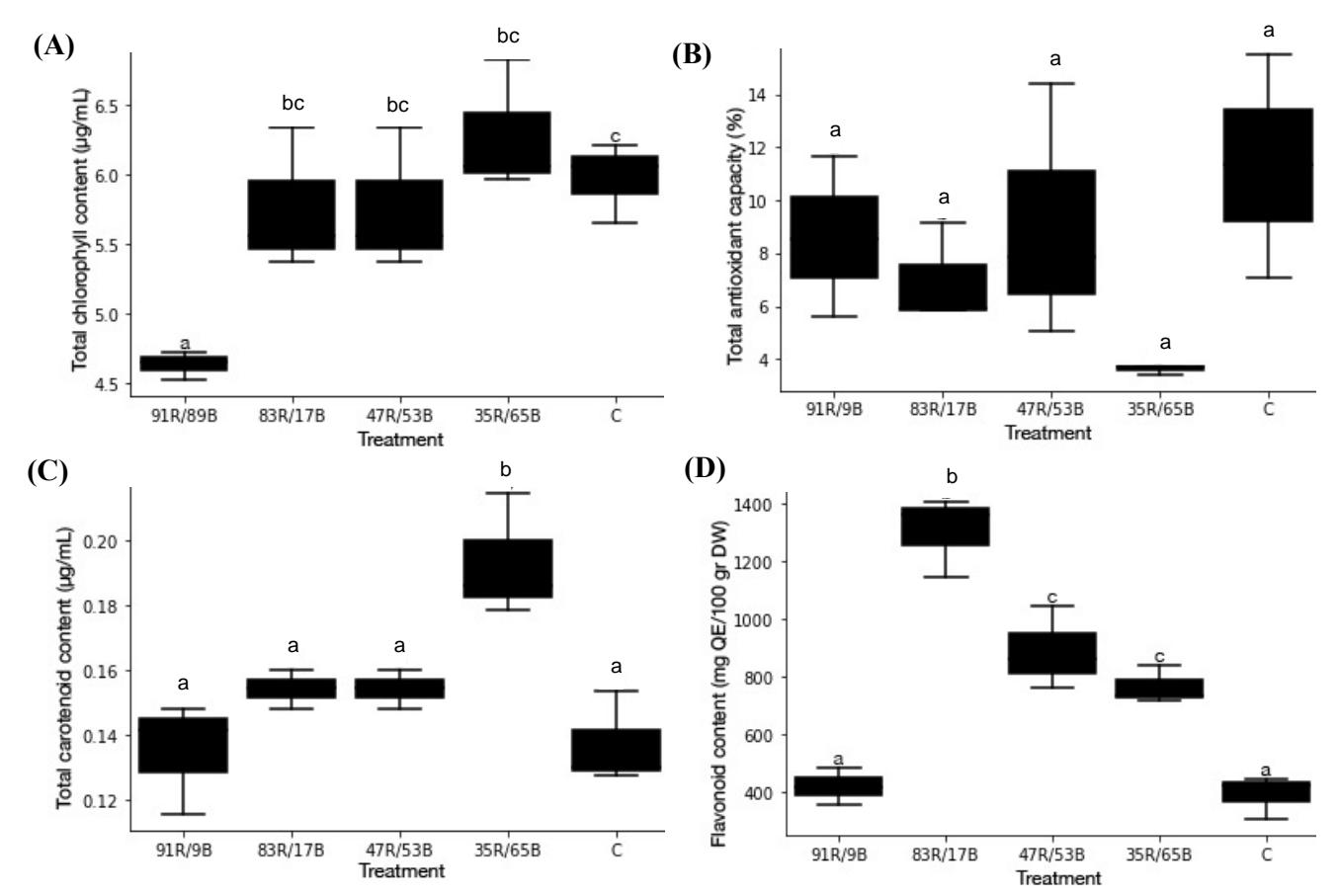
Figure 3. Phytochemical content of the wheatgrass microgreens following 10 days of cultivation in each treatment. Chlorophyll (A) and carotenoids (B) content were determined from identical leaves samples, while total antioxidant capacity (C) and flavonoid content (D) were determined separately. Statistically significant values (Tukey's HSD test, p<0.05) are indicated by the letter on top of the box plot corresponding to each treatment.
Even though none of the treatments we tested was able to increase the total antioxidant capacity, we found that 35R/65B and 87R/13B were able to increase carotenoids and flavonoid content, respectively. Carotenoids and flavonoids are among the most sought Phyto-antioxidants due to their health benefits. For instance, as extensively reviewed by [35], dietary intake of carotenoids has been associated with a reduced risk of several chronic diseases, including brainrelated diseases, obesity, cardiovascular diseases, type 2 diabetes, and some types of cancer. Whereas routine intake of flavonoids has improved cardioprotective and hepatoprotective capacities [36], anti-aging and depigmenting effects in dermatological applications [37], and has been associated with lower mortality in cancer patients [38].
Furthermore, the antioxidant property of carotenoids and flavonoids have also been considered to boost recovery from COVID-19 by quenching advanced inflammatory [39]; [10].
Fakhri et al. [40] suggested that a certain carotenoid, such as astaxanthin, with their known roles in anti‐inflammatory, antiapoptotic, and autophagy‐modulatory activities, could be one of the promising treatments to alleviate the complications of COVID-19. Antiviral activity of siponaxanthin has also been explored, and this carotenoid was shown to reduce infection of SARS-CoV-2 pseudovirus on HEK293 cells overexpressing angiotensin-converting enzyme 2 (ACE2) [41]. The antiviral role of flavonoids against SARS-CoV-2 is also currently receiving more attention. For instance, [42] indicated through molecular docking simulation that Quercetin-3-O-rhamnoside flavonoid is a potential drug to inhibit the function of Chymotrypsinlike protease (3CL pro) of the virus.
In conclusion, the health benefits of carotenoids and flavonoids go beyond their role as antioxidants and potentially as antiviral agents (s). Hence, the system we develop in this research could improve the urban
population's access to include high carotenoid and flavonoid diets routinely. However, further research to elaborate on specific carotenoids and flavonoids contained in the wheatgrass microgreens would give us a better view of their detailed roles in our health.
4. Conclusion
Increasing demand for nutrition is inevitable as the global population continues to grow. The conversion of wild habitats into farming land is no longer an option as we have witnessed too many negative outcomes from this practice. On the other hand, the prevalence of chronic diseases in the urban population is also growing due to unhealthy lifestyles, such as the limited consumption of fresh vegetables. This research offers a system for the urban population to produce wheatgrass microgreens in their household, with increased content of carotenoids and flavonoids. These two antioxidants are receiving more attention as potential antiviral agent(s) and their already well-defined roles in quenching inflammatory reaction that often complicates infection or chronic diseases. Further research to define the specific carotenoids and flavonoids contained in the wheatgrass microgreen and the system's design so that it is portable and easy to install would further benefit the urban consumers.
Acknowledgements
The authors would like to thank Riset Peningkatan Kapasitas Dosen 2019, Institut Teknologi Bandung, for the research funding granted to KM.