

1. Introduction
The increasing interest in non-sugar sweeteners in recent years has led to the growing popularity of stevia as a sweetener. Stevia is derived from the leaves of Stevia rebaudiana, a flowering plant native to Paraguay and belonging to the Asteraceae family [1]. The sweetness of stevia is attributed to a group of diterpene compounds called steviol glycosides, including stevioside, rebaudioside A, rebaudioside M, and others [2]. Steviol glycosides are calorie-free, up to 400 times sweeter than sucrose, and have positive health effects such as decreasing insulin levels and reducing inflammation [3-5].
S. rebaudiana is not extensively cultivated from seeds due to their low germination rate [6]. Instead, S. rebaudiana are commonly propagated using stem cuttings. However, it produces limited number of new individual plants. Another method employed for the propagation of S. rebaudiana is micropropagation. This method involves growing small parts from a plant into new individuals in a sterile nutrient medium, often supplemented with plant growth regulators, which enables the generation of a larger quantity of plants in a relatively short time [7].
Photoperiod is an important light factor influencing the growth and development of S. rebaudiana, in addition to light quality and intensity [8-10]. It is well established that extending the photoperiod can lengthen the photosynthesis period and enhance dry matter accumulation in numerous plant species [11]. Studies on the effect of photoperiod on the growth of S. rebaudiana in ex vitro conditions have been conducted previously [8, 12-13]. However, the impact of photoperiodon the in vitro growth of S. rebaudiana has not been extensively explored. Therefore, the aim of this study is to evaluate the influence of photoperiod on the growth S. rebaudiana shoot and root in vitro, as well as the growth of in vitro grown S. rebaudiana after acclimatization.
2. Methodology
2.1. Explants Source
The source of explants used in this study were 3-week-old S. rebaudiana BL clone obtained from the Biotechnology and Bioindustry Research Center, Bogor, Indonesia. Stem node segments were used as explants for in vitro shoot initiation.
2.2. Treatment and Growth Conditions
This study employed three treatments: 8-hour, 12-hour, and 16-hour photoperiods. The light source used was fluorescent lamps, with an intensity of 48 W/m2 . The room temperature was maintained at 23 ± 2°C. These treatment and growth conditions were applied during the shoot initiation, rooting, and acclimatization phases.
2.3. Explant Sterilization
The cut node segments were washed with soap in running water for 30 minutes, then immersed in a 0.1% fungicide solution for 5 minutes. Under aseptic conditions in a laminar airflow cabinet, the explants were immersed in 70% alcohol for 1 minute, then washed in a 0.79% NaClO solution with two drops of Tween 20 for 10 minutes, and finally rinsed three times with sterile distilled water. The sterilized node segments were cut into 1-2 cm sizes.
2.4. Effect of Photoperiod on In Vitro Shoot Initiation
The node segments were cultured on MS medium (Murashige and Skoog, 1962) containing 1.13 mg/L benzyladenine (BA), 0.35 mg/L indole-3-acetic acid (IAA), 30 g/L sucrose, and 8.5 g/L agar. The medium's pH was adjusted to 5.8 ± 0.2. The medium was autoclaved at 121 °C and 124 kPa for 15 minutes before use. After four weeks, the shoot length, number of nodes per shoot, and number of branches per shoot were measured.
2.5. Effect of Photoperiod on In Vitro Rooting
The 1-3 cm shoots obtained from the initiation phase were cut and cultured on half-strength MS medium containing 0.1 mg/LIAA, 30 g/L sucrose, and 8.5 g/Lagar. The medium's pH was adjusted to 5.8 ± 0.2. The medium was autoclaved at 121 °C and 124 kPa for 15 minutes before use. After four weeks, the number of roots per shoot and root length were measured.
2.6. Effect of photoperiod on acclimatization
The in vitro shoots with developed roots were rinsed with sterile distilled water and planted in a growth medium composed of a mixture of fertile soil, burnt rice husk, cocopeat, and manure. Liquid NPK fertilizer and 0.1% fungicide were sprayed at the beginning of acclimatization. Watering was done initially and every two weeks. After five weeks, the change in shoot length, change in nodes number, total area as well as total fresh weight of the leaves that emerged during acclimatization per shoot were measured.
2.7. Statistical analysis
The experiment was conducted using a completely randomized design (CRD). The biological replicates used for in vitro shoot initiation, in vitro rooting, and acclimatization were 14, 11, and 8 replicates, respectively. Significant differences were analyzed using one-way ANOVA, followedby Tukey's HSD test (p < 0.05) using IBM Statistics SPSS 25 software.
3. Result and Discussion
3.1. Effect of Photoperiod on In VitroShoot Initiation Ideal in vitro shoot growth is important for S. rebaudiana micropropagation because a higher number of nodes or branches produced leads to a higher rate of plantlet multiplication. Regulating growth conditions such as lighting duration is one way to obtain optimal in vitro shoot growth. S. rebaudiana explants treated with a 16 hours photoperiod for four weeks resulted in taller shoots (5.93 cm) compared to the 8-hour (3.08 cm) and 12-hour (3.48 cm)photoperiods (Figure 1a). However, photoperiod did not have a significant effect on the number of nodes per shoot and the number of branches per shoot (Figure 1b and c).
These results support the findings of the positive effect of long photoperiod on plant's growth [14-17]. It has been demonstrated that longer photoperiod increased the daily availability of light for photosynthesis which improved the growth performance of plants [15,18]. This might explain the increase of in vitro S. rebaudiana shoot's length in our result.
3.2. Effect of Photoperiod on In Vitro Rooting
In vitro rooting is a crucial stage prior to acclimatization. Plantlets with roots usually have a greater chance of survival during acclimatization. In this study, photoperiod does not affect the number of roots per shoot and root length. The average number of roots per shoot for the 8-hour, 12-hour, and 16-hour photoperiods were 2.36, 2.55, and 2.64, respectively (Figure 2a). Meanwhile, the average root length for the 8 hour, 12-hour, and 16-hour lighting treatments were 1.13 cm, 0.84 cm, and 0.92 cm, respectively (Figure 2b).
There have been several reports suggesting that longer photoperiod can also increase root growth by increasing photosynthesis duration [19-21]. However, our research did not yield the same results as there was no impact of photoperiod on rooting. It probably was not due to the sample size, as our sample size was not too small (30 plants per treatment). The photosynthetic products from the shoots reaching the roots might be not substantial enough to make a significant difference.
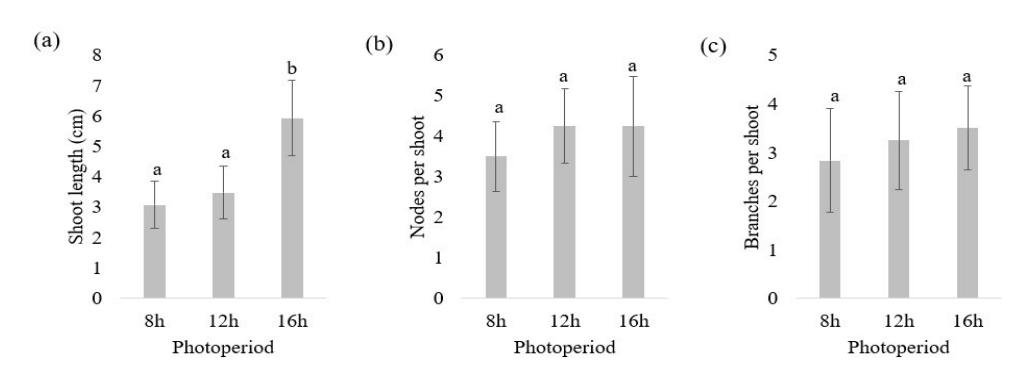
Figure 1. The effect of different photoperiod treatment on (a) in vitro shoot length, (b) the number of nodes per in vitro shoot, and (c) the number of branches per in vitro shoot after four weeks. Data represents mean ± standard deviation (n = 14). Different letters indicate significant differences using Tukey HSD test (p < 0.05).
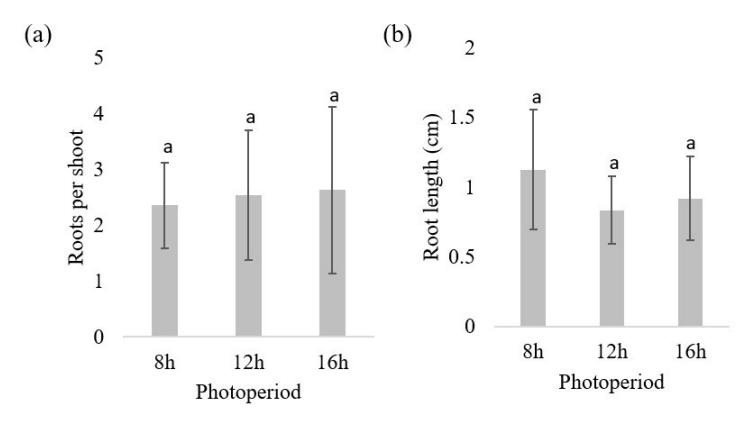
Figure 2. The effect of different photoperiod treatment on (a) the number of in vitro roots per shoot and (b) in vitro root length after four weeks. Data represents mean ± standard deviation (n = 11). Different letters indicate significant differences using Tukey HSD test (p < 0.05).
3.3. Effect of Photoperiod on Acclimatization
Acclimatization is a stage carried out before the micropropagated plantlets are exposed to ex vitro conditions. After 5 weeks of acclimatization, the plantlets become more vigorous in all treatments (Figure 3). Photoperiod did not significantly affect the number of nodes (Figure 4a). However, there was a trend where longer photoperiods resulted in higher shoot length (Figure 4b), which might be due to increase in photosynthesis duration [15,18]. The number of nodes and total leaf area per shoot were also not influenced by photoperiod (Figure 4c-d). The highest total leaf fresh weight was obtained with a 16-hour photoperiod treatment (0.2 g) (Figure 4e), consistent with previous findings. This also might be due to increase in photosynthesis duration, which in turn causes the accumulation of biomass in the leaves [22-23]. Thus, the most effective photoperiod for the growth enhancement of S. rebaudiana plantlets during the acclimatization process is 16 hours.
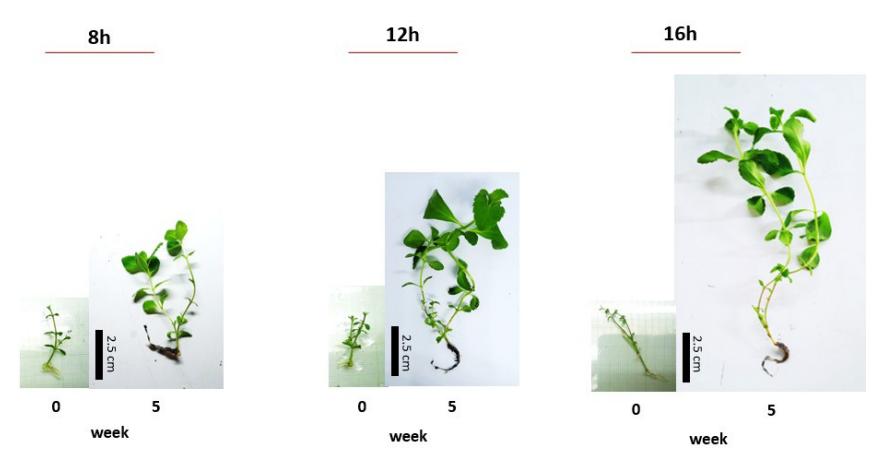
Figure 3. S. rebaudiana planlets morphology before and after five weeks acclimatization under all photoperiod treatments.
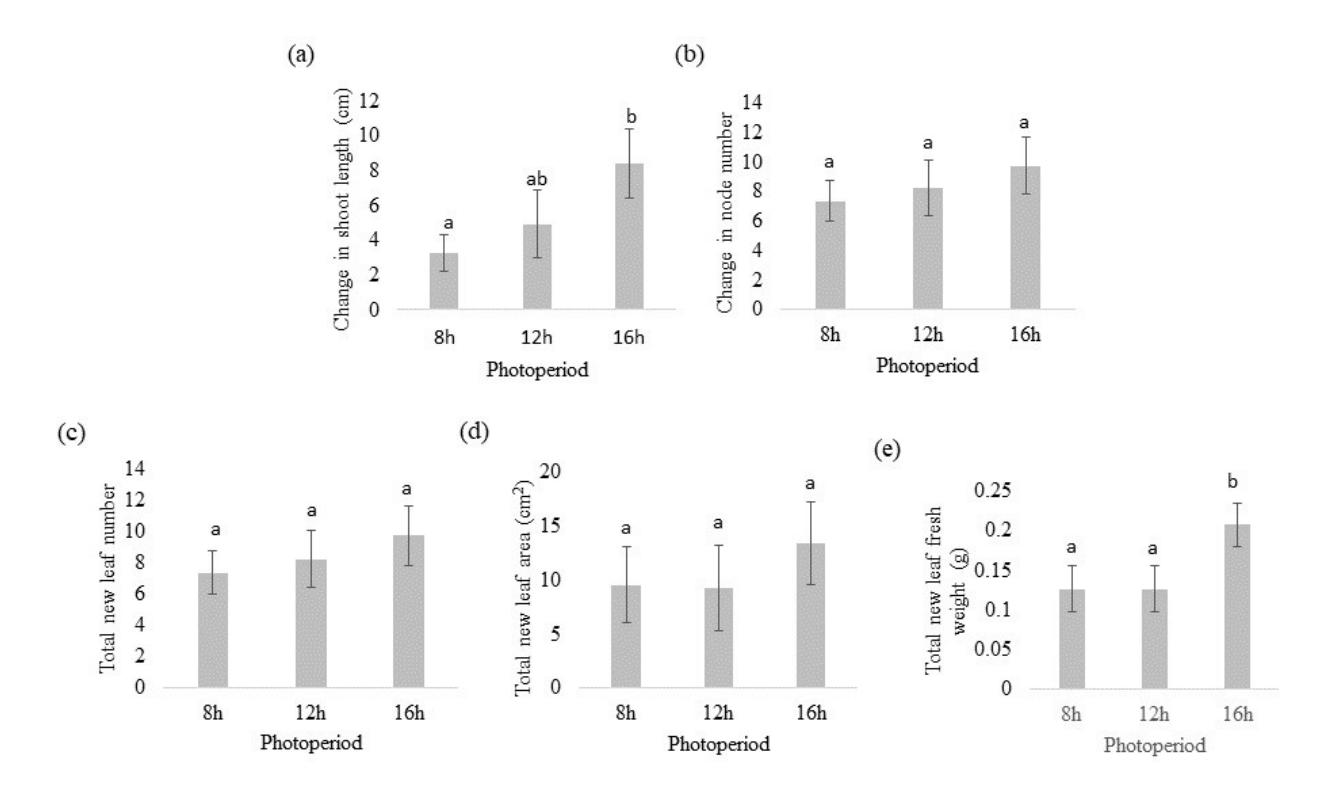
Figure 4. The effect of different photoperiod treatment on (a) the change in shoot length, (b) the change in node number, (c) total number of the new leaves, (d) total area of the new leaves, and (e) total fresh weight of the new leaves of S. rebaudiana plantlets after five weeks acclimatization. Data represents mean ± standard deviation (n = 8). Different letters indicate significant differences using Tukey HSD test (p < 0.05).
4. Conclusion
A 16-hour photoperiod increases shoot length during the in vitro shoot initiation phase, making this photoperiod most suitable for shoot multiplication. On the other hand, a 16-hour photoperiod also increases shoot length and leaf fresh weight during acclimatization. The increase in leaf biomass will enhance the total steviol glycoside production in S. rebaudiana. The results of this study indicate that photoperiod has an impact on the in vitro growth of S. rebaudiana.
Acknowledgement
This investigation was partially funded by the Plant Sciences and Biotechnology Research Group Scheme of the P2MI ITB 2023. The first author also wish to express his gratitude to Beasiswa Pendidikan Indonesia (BPI)/LPDP (The Indonesian Endowment Fund for Education, Ministry of Finance of Republic of Indonesia) for the scholarship provided during this study.