

1. Introduction
The COVID-19 pandemic has had a profound and far-reaching impact on Indonesia's economy, particularly in the tourism sector, as well as on the health sector. The tourism industry plays a vital role in generating state revenue and stimulating economic growth. According to the Ministry of Tourism and Creative Economy, the pandemic resulted in a significant decrease in income for the tourism sector, amounting to a total of Rp. 20.7 billion. The pandemic's visible impact on the tourism industry in Indonesia is evident in the significant decline in the number of global tourist arrivals, which plummeted from 847 million to 1,139 million people, resulting in a drop of 58-78%. Furthermore, the COVID-19 pandemic has had a direct and negative impact on workers in the Indonesian tourism sector.
As the global situation continues to improve, the tourism industry is gradually returning to normalcy, with ecotourism becoming increasingly popular. It is anticipated that communities will increasingly prefer eco-based tourism and outdoor activities when selecting travel destinations. Among the institutions that can significantly contribute to the economy are Islamic boarding schools. Although these institutions are often misconstrued as focusing solely on religious education, they have the potential to serve as significant economic drivers closely intertwined with the local community. Despite being one of the oldest educational institutions in Indonesia, Islamic boarding schools can play a vital role in promoting sustainable tourism and enhancing the local economy.
The potential for economic development through tourism exists at Darul Arqam Muhammadiyah Islamic Boarding School in the Garut Region, one of the Islamic boarding schools inWest Java. In both developed and developing countries, tourism has been proven to be a successful driver of rural economies [1]. The underutilized Cipeujeuh Valley presents an opportunity to develop its ecotourism potential. By harnessing this potential, the strategic role of Islamic boarding schools in supporting the regional development of 1) School of Life Sciences and Technology, Institut Teknologi Bandung
<sup>2)</sup> School of Architecture, Planning and Policy Development, Institut Teknologi Bandung
*) Corresponding author; e-mail: nashihaal@gmail.com
Garut Regency can be realized. This aligns with the Garut Regency Regional Regulation No. 2 of 2019, which focuses on the 2019-2025 Regional Tourism Development Master Plan. Darul Arqam Muhammadiyah Islamic Boarding School in the Garut Region, located in Cilawu District, is included in the Regency Tourism Development Area (KPPK), which covers natural, cultural, and artificial tourism development.
To fully study all aspects of the development, a business model is required to facilitate planning and governance for the ecotourism potential in Cipeujeuh Valley, with Islamic boarding schools at its core. The Business Model Canvas (BMC) is a model that describes how a business is created, delivered, and captured, enabling business planners to effectively depict and modify business models, generating new strategic alternatives that can be readily comprehended by diverse groups [2]. The purpose of this research is to analyze the ecotourism spectrum of Cipeujeuh Valley based on the Islamic boarding school community, the push and pull factors motivating tourist visits, the response and participation level of the boarding school community, and the business model planning for the development of community- based ecotourism in Cipeujeuh Valley. The business model canvas is a fundamental tool in this study, and it is expected to be implemented for the economic development of Islamic boarding schools, thereby aiding the government in
2. Methodology
This study was carried out from November 2022 to June 2023 at the Darul Arqam Muhammadiyah Islamic Boarding School in the Garut Region, which is situated at Jl. Raya Garut-Tasikmalaya No. 36, RT 03/RW 02, Ngamplangsari Village, Cilawu District, Garut Regency, West Java Province. The research focused on the Cipeujeuh Valley, which is located in the region behind the Islamic boarding school (see Figure 1). The study employed various data collection methods, such as observation, interviews, questionnaires, and literature study. The sampling method used was purposive sampling, selecting individuals who were considered knowledgeable in providing input on the business model canvas design. A total of 93 respondents participated
analysis, identification of ecotourism potential, examination of visitor motivation, and evaluation of community engagement within the Islamic boarding school. The identification of ecotourism potential was facilitated through the utilization of the Ecotourism Opportunity Spectrum (ECOS) framework, which entailed calculating the Recreational Zone Index (RZI) value to determine a suitable ecotourism spectrum. This approach provided a practical means for destination development, as indicated by the specified reference [3]. The formula employed in this process is as follows:
\[RZI = \Sigma \left( \frac{Ni}{Nmax} \right) \times 100\%\]
With:
Ni = I-th variable value
N1 = Access components
N2 = Related resources components
N3 =Attraction components
N4 = Infrastructure components
N5 = Components of ability and knowledge
N6 = Components of social interaction
N7 = Visitor impact components
Nmax = Maximum value of all categories
The outcomes of the calculations can be categorized into the ecotourism spectrum in accordance with Table 1.
An examination of visitor motivation was conducted through a push and pull factor analysis, which facilitated comprehension of the factors and requirements that tourists consider when traveling [4]. The engagement of the Islamic boarding school community was assessed using rapid rural appraisal methods, which enabled a swift evaluation of the community's circumstances and the development of plans and actions to enhance their standard of living [5]. Based on these assessments, the subsequent step involved the development of a business model utilizing the Business Model Canvas [2] to effectively map out a suitable model for the advancement of the Cipeujeuh Valley. The model is employed to elucidate the business logic that has been constructed and developed by encompassing four crucial areas: customer, offering, infrastructure, and financial feasibility. These nine components can serve as a validation form of the development potential of
Table 1. RZI Assessment
| No | Index | Ecotourism Spectrum |
|---|---|---|
| 1 | >67% | Eco Specialist (ES) |
| 2 | 66%-34% | Intermediate (IM) |
| 3 | 0%-33% | Eco Generalist (EG) |
in the study, including Cipeujeuh Valley managers, tourists who had visited the area, and individuals residing at the Darul Arqam Islamic boarding school.
Data analysis within thisstudy comprised descriptive a business idea. The following are the specifics from Business Model Canvas: customer segment, value proposition, channel, customer relationship, revenue streams, key resources, key activities, key partners, and cost structures.
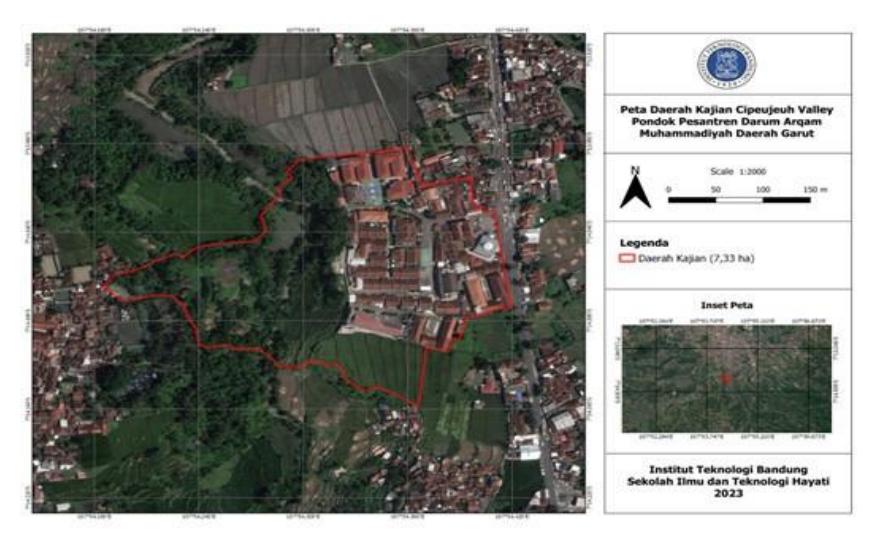
Figure 1. Research Study Area
3. Results and Discussion
3.1 Ecotourism Potential
Analyses of the potential for ecotourism in the Cipeujeuh Valley, utilizing Islamic boarding schools, were conducted using the ECOS framework. The analysis entailed calculating a spectrum assessment with the RZI formula [6], which incorporated seven parameters. The value of each parameter was employed in the calculation. The eco-specialist
ecotourism spectrum [3]. Hard ecotourism attractions include intense overnight trips to national parks, while examples of soft ecotourism include forest climbing with short track trails and health-oriented spas and catering services. The development of the intermediate ecotourism spectrum can be observed in the formation of visitor patterns that can be used to segment customers. This can lead to an increase in the number of visits and changes in tourist expectations, as well
Table 2. ECOS Component Value
| No | Component | Spectrum | Value | |
|---|---|---|---|---|
| 1 | Access | Eco-Generalist | 1 | |
| 2 | Activity | Eco-Generalist | 1 | |
| 3 | Attractions offered | Intermediate | 2 | |
| 4 | Infrastructure | Intermediate | 2 | |
| 5 | Social Interaction | Eco-Generalist | 1 | |
| 6 | Manager's Knowledge and Skill Level | Intermediate | 2 | |
| 7 | Impact of Visitors' Acceptance on The Nature | Intermediate | 2 | |
| Total | ||||
spectrum was essentially a value of "3" the intermediate spectrum was assigned a value of "2" and the eco-generalist spectrum was given a value of "1".
According to the information in Table 2, the RZI value can be determined using the following formula:
The RZI value of 52.38% signifiesthat the ecotourism spectrum of the Cipeujeuh Valley falls within the intermediate range, as calculated below.
\[RZI = \Sigma \left( \frac{Ni}{Nmax} \right) \times 100\%\]
\[RZI = \Sigma \left(\frac{II}{2I}\right) \times 100\% = 52.38\%\]
The ecotourism spectrum that falls between hard ecotourism and soft ecotourism is known as the intermediate as an increased awareness of the environment in the tourist destination. Travelers who participate in ecotourism with an intermediate spectrum typically visit in small groups, using transportation commonly used for tourism, and utilize the facilities and services provided by tourism management.
The diverse range of eco-tourism attractions available at Cipeujeuh Valley and Darul Arqam Islamic Boarding School provide visitors with a variety of activities that showcase the natural surroundings. At Cipeujeuh Valley, educational experiences such as hands-on learning about the environment and outdoor activities that teach children about nature are available. In addition, adventure sports like tracking, archery, river tubing, and flying fox are offered to promote physical and spiritual well-being. Visitors can also learn about agriculture and partake in activities such as vegetable and fruit picking and enjoying the culinary harvests. Furthermore, camping activities provide an exciting outdoor living experience. All these activities are aimed at fostering
"sports and adventure," is related to the psychological happiness that comes from engaging in sports and adventure activities. This happiness is derived from fulfilling basic psychological needs such as autonomy, competence, and social connectedness, as well as from a connection with nature
Figure 2. Ecotourism Attraction. (a) River Tubing, (b) Agrotourism, (c) Camping
environmental awareness, promoting health, and offering a fun and educational recreational experience. A visual representation of these activities can be found in Figure 2.
3.2 Interpretation of Push Factors and Pull Factors
Following extensive testing to evaluate push and pull factors that motivate tourists, the study has produced results that identify and describe the factors, along with their respective percentages of overall contribution.
3.2.1 Push Factors
The four factors comprising the tested push variables were identified through a thorough analysis. It is essential to provide an interpretation and appropriate naming for these factors. The factor loading values play a crucial role in determining the influence of each variable on other variables. Hence, variables with higher factor loading values are expected to have a more significant impact on representing other factors. The factors were named based on the distinct characteristics of each item within the factor, which is clearly demonstrated in Table 3.
Table 3 in the text provides an interpretation and naming of each factor that influences tourist motivation for eco-tourism in the Cipeujeuh Valley. The factors are named based on the variables they contain. The first factor, named
[7]. The second factor, named "recreation and relaxation," has a positive correlation with nature-based recreation and mental health, leading to improved mood, cognition, recovery, and well-being, and potentially reducing anxiety and depression [8]. The third factor, named "social status," is related to individuals using tourism travel to display and affirm their social status to friends, relatives, and colleagues [9]. Lastly, the fourth factor, named "quality time," involves spending quality time with family, which can strengthen family bonds, alleviate stress and tension, foster better relationships, and benefit family members [10].
3.2.2 Pull Factors
The Pull variables were categorized into two factors, and it is essential to provide an interpretation and naming of these factors. The variables that exhibit higher factor loading values are considered to be more influential in representing the other factors. The factors were named based on the characteristics of each member in the factor, as illustrated in Table 4.
Table 4 provides a comprehensive interpretation and categorization of the factors influencing tourist motivation for eco-tourism in the Cipeujeuh Valley. The factors are named based on the variables contained within each category. The first factor, "nature and local community," encompasses
Table 3. Interpretation of Push Factors
| Factor | Variable | Factor Loading | Description | |
|---|---|---|---|---|
| Sports and Adventure | X18 | 881 | Testing Adrenaline | |
| X16 | 783 | Desire to do challenging activities | ||
| (22.58%) | X15 | 779 | Exercise physical strength | |
| X04 | 854 | Get rid of stress | ||
| Recreation and | X05 | 836 | Take advantage of vacation time | |
| Relaxation (22.42%) | X03 | 825 | Break away from fullness | |
| X01 | 736 | Looking for a new experience | ||
| X07 | 847 | Looking for a luxurious and exclusive place | ||
| Social Status (15.20%) | X09 | 817 | Show social class and prestige | |
| X11 | 746 | Meet new people | ||
| Quality Time | X10 | 794 Spend time with your partner/family/friend | ||
the natural beauty and charm of the village, the pristine environment, fresh air, appealing photography spots, and a peaceful atmosphere that attracts tourists to visit. Additionally, an interest in the local community contributes to achieving a balance between the environment, economy, society, and culture in sustainable tourism development. The interaction between local communities and tourists serves as a means for them to connect and engage socially, as stated in reference [11]. The second factor, "enjoying facilities," considers the availability of accommodations and transportation, which are key attractions for visitors. The appeal of these amenities, both domestically and internationally, determines their value as assets in the tourism industry, as noted in reference [12].
3.3 Islamic Boarding School Community Participation
Following a Rapid Rural Appraisal, the findings indicated that 61.3% of the community expressed their readiness to participate, while 38.7% indicated their unwillingness to be involved in the development of Cipeujeuh Valley ecotourism.
The diverse range of individuals who have expressed interest in contributing to the development of Cipeujeuh Valley encompass a variety of roles, including the upkeep and management of agrotourism gardens, serving as facilitators for educational programs designed for children, acting as guides for tourists on excursions, providing instruction on Islamic history and interpreting religious texts such as the Quran and hadith, as well as selling pre-packaged products.
The abilities of the community members contribute
Table 4. Interpretation of Pull Factors
| Factor | Variable | Factor Loading | Description |
|---|---|---|---|
| X20 | 814 | The atmosphere and the air | |
| X25 | 805 | Local culture | |
| Nature and Local Community | X19 | 797 | Interesting environment and nature |
| (38.04%) | X26 | 782 | Local community activities |
| X23 | 709 | Natural produce produced | |
| X27 | 708 | Local community hospitality | |
| Enjoying Facilities (29.53%) | X29 | 892 | Enjoy accommodation facilities |
| X28 | 841 | Visiting artificial tourist rides and games | |
| X30 | 766 | Enjoying other facilities |
significantly to the development of Cipeujeuh Valley ecotourism. These skills encompass foreign language proficiency, artistic talents, culinary expertise, sports skills, and souvenir making. The knowledge of foreign languages, particularly English and Arabic, can be utilized for languagerelated activities such as storytelling, language lectures, poetry readings, and writing stories, among other language- related activities. The artistic abilities of the community members encompass performances in karawitan, angklung, traditional thread art, and various other artistic activities. Additionally, the preparation of special local dishes can serve as an activity to introduce culinary specialties and showcase the local culture. The community can also guide workshops on Sundanese cuisine. Furthermore, the sports skills of the community members can be utilized both in Cipeujeuh Valley and at Darul Arqam Islamic boarding school, with individuals serving as guides and coaches in sports such as basketball, volleyball, jogging, gymnastics, archery, traditional thread games, and other sports.
The participation of the Islamic boarding school community in the management of ecotourism can offer chances for a variety of activities, serve as additional sources of income, preserve cultural heritage, and contribute to the conservation efforts of the ecotourism area [13].
3.4 Business Model Canvas
The objective of creating the Business Model Canvas (BMC) is to establish a strategic basis for Darul Arqam Islamic Boarding School's participation in the Cipeujeuh Valley ecotourism development business plan, which is specifically designed for the Islamic boarding school community.
3.4.1 Customer Segment
The offerings in Cipeujeuh Valley's ecotourism sector, which are focused on the Islamic boarding school community, encompass a diverse array of activities. These activities include educational experiences, agrotourism, sports and adventure, recreation and relaxation, as well as opportunities for social status enhancement, quality time spent with loved ones, and engagement with activities inspired by the natural surroundings and local community. The facilities already exist and are utilized in order to cater to a wide range of customers, including preschool to college students, organizations, communities, and families, who all fall within the customer segmentation of Cipeujeuh Valley.
3.4.2 Value Proposition
The factors that influence tourists' decisions to visit Cipeujeuh Valley and are used to determine their interest in its
attractions are presented in Table 5. These values serve as a crucial element in the decision-making process.
Factors that influence tourists' decisions to visit Cipeujeuh Valley and their interest in its attractions are presented in Table 5. These factors serve as a vital element in the decisionmaking process.
The Cipeujeuh Valley's value propositions are numerous and diverse. The Islamic Boarding School environment, which is steeped in religious significance and represents the Islamic community's way of life, is a highly attractive destination for tourists. Additionally, the valley utilizes natural resources as tourist attractions, which helps to conserve the environment while also generating economic benefits. By empowering the Islamic Boarding School community to participate in managing and operating tourism activities, they are provided with additional sources of income. Edu-tourism offers visitors the opportunity to enjoy learning and enrich their experiences, while eco-tourism fosters environmental education and a love for nature, contributing to the Islamic Boarding School's economy.
3.4.3 Channel
The different channels that Cipeujeuh Valley can utilize to promote its tourist products to potential visitors, thus minimizing marketing costs, are presented in Table 6.
The Cipeujeuh Valley's channels have been categorized into three types: owned, partner, and customer channels. Owned channels include direct web sales via marketing on the website and social media platforms like Instagram, Facebook, and Twitter. Business-owned channels involve distributing printed tourism maps in clinics, laundries, catering services, and cooperatives. Partner channels are indirect and involve collaboration with various stakeholders, including the pesantren community (students, mentors, teachers, and staff), local small and medium-sized enterprises (SMEs), alumni associations, parents of students, the Garut Regency government, and tourism agencies. Lastly, customer channels rely on word-of-mouth from visitors.
3.4.4 Customer Relationship
To build a strong relationship with consumers, Cipeujeuh Valley's management must undergo three distinct phases. The initial phase entailsthe acquisition process, during which digital promotion is executed via various partnerships, such as collaborations with Islamic boarding schools' community, alumni networks, and the local government of Garut Regency. Complementary to the campaign, pertinent information about tourism products will be disseminated through virtual videos and website pages. Patrons can easily
| Table 5. Cipeujeuh Valley's Value Proposition | |||
|---|---|---|---|
| Cipeujeuh Valley Value Proposition | |||
| Islamic boarding school Environment | The Islamic boarding school environment is an interesting environment to visit because it is closely related to religion and is a miniature of the life of the Islamic community | ||
| Natural Resource Utilization | The use of natural resources as attractions offered can be a solution to keep environmental conservation running along with economic income | ||
| Empowering the Community of Islamic boarding school | Helping the Islamic boarding school community to be involved in the management and travel of tourism activities so that they can then become an additional source of income for their economy | ||
| Edu Tourism | The provision of tourism-based education makes learning fun and adds interesting experiences | ||
| Economic Development of Islamic boarding school | Ecotourism is one of the major sources of income for Islamic boarding school that is close to education and love for the environment | ||
register and reserve travel packages, both online and offline.
The subsequent stage is the retain phase, during which Cipeujeuh Valley management must create a positive and lasting first impression to ensure that tourists have a delightful experience from the very beginning. This involves presenting them with welcome beverages and snacks, such as West Java specialties, and granting them access to evaluate ecotourism activities. By demonstrating a willingness to receive feedback and suggestions, the management is fostering greater sustainability within the tourism industry.
The final phase emphasizes the importance of nurturing a solid rapport with tourists. To achieve this, Cipeujeuh Valley managers ought to present visitors with a diverse selection of enticing and exclusive tour packages. It is essential to supply pertinent information about Cipeujeuh
Valley's tourism offerings via the website and social media outlets consistently to entice tourists. Moreover, captivating promotions can be disseminated through private messaging services to further stimulate interest.
Social media has a favorable impact on ecotourism as it effectively and efficiently promotes tourism products. Moreover, it functions as an online platform for tourists to share their experiences and obtain information about ecotourism [14].
3.4.5 Revenue Streams
The Cipeujeuh Valley, known for its numerous tourist attractions, hasthe potential to generate revenue from multiple sources. These include admission fees for entering the valley, individual tickets for specific attractions, the bundling of
Table 6. Cipeujeuh Valley's Channels
| Channel type (Theory) | Channel type (Application) | ||||
|---|---|---|---|---|---|
| Owned | Directly | Web sales Marketing via website and social media such as Instagram, Facebook, Twitter, etc | |||
| Owned | Marketing with tourism map (print) attached to Clinic, Laundry, Catering and | ||||
| business Partner | cooperatives Islamic boarding school Community (Students, builder Teachers and All Ma'had Apparatus) | ||||
| MSMEs in the boarding school environment | |||||
| Partner | Not directly | Alumni Association | |||
| Student's parents | |||||
| Regional Government of Garut Regency | |||||
| Bureau or tourist tour service | |||||
| Tourists | Word of mouth | ||||
attractions into comprehensive tour packages, rental services for camping equipment and other necessary items, and various other tourism-related services. Furthermore, the Economic Sector of Islamic Boarding School provides funding through loans. Moreover, the provision of insurance and certification services for various activities contributes to the revenue generated during tourist activities.
3.4.6 Key Resources
The presence of appealing natural resources, religious activities, infrastructure, and facilities that cater to the needs of tourists is crucial. Moreover, having human resources with a strong interest in tourism activities is a vital asset that can be continuously developed for the ecotourism of Cipeujeuh Valley. It is of paramount importance to maintain the preservation of natural resources for the purpose of achieving environmental sustainability by ensuring that all activities at tourist attractions are centered around environmental conservation and do not disrupt or harm the natural surroundings.
Local religious activities and wisdom are among the attractionsthat ought to be introduced to touriststo preserve the cultural and traditional heritage of the community. To this end, engaging tourists in activities, art performances, exploration, and direct interaction with knowledgeable individuals can be effective strategies. Additionally, the development and improvement of infrastructure and facilities can enhance the comfort and convenience of tourists during their visits to Cipeujeuh Valley.
Finally, it is essential for human resources involved in tourism activities to receive training and continuous
support to maintain their enthusiasm and involvement in the sector. Establishing a competent workforce with expertise in managing tourism is crucial for ensuring the standardization of ecotourism services [15].
3.4.7 Key Activities
Cipeujeuh Valley is dedicated to developing nature tourism and tourism centered around the Islamic boarding community, which are both essential and require further growth. This approach represents a pioneering strategy to improve the appeal of Cipeujeuh Valley's tourism offerings. By offering more enticing attractions, visitors are likely to visit the area more frequently, ultimately leading to increased economic benefits for Cipeujeuh Valley. The primary activities available in Cipeujeuh Valley are summarized in Table 7.
The table outlined in Table 7 indicatesthat Cipeujeuh Valley's primary activities are education, sports, agrotourism, and camping. By incorporating environmental education into educational activities, young people's understanding of the environment can be enhanced, and environmental awareness can be fostered among a wide range of participants [16]. Moreover, transforming sports into a tourist attraction can have a positive impact on tourists by promoting physical and mental well-being through physical movement [17]. Developing agrotourism as a tourist attraction can provide multiple benefits, including stimulating scientific and educational activities, improving overall health and fitness, relieving stress and monotony, and offering access to organic food [18]. Camping, too, offers tourists a direct way to appreciate the beauty of nature and provides a recreational experience that immerses them in the thrill of outdoor living [19].
Table 7. Cipeujeuh Valley's Key Activities
| Key Activities | Area | Tourism Activities |
|---|---|---|
| Nature - Based Tourism | Cipeujeuh Valley Area and Rivers | Enjoy the view Agrotourism Camping Tree Guard The River Tube Gymnastics Cross the Bridge Jogging Archery Education planting Self-Service Culinary |
| Tourism Based on the Community of islamic boarding school | Darul Arqam Islamic Boarding School Area | Islamic History Tour West Java Art Show A sport show Visit to the creation of ecobrick, maggots, management trash |
Table 8. Cipeujeuh Valley's Key Resources
| Key Resources | |||||
|---|---|---|---|---|---|
| Cost Details | Infrastructure | Facilities | Human Resources | ||
| Fixed Cost | Construction of major infrastructure supporting tourism utilities, maintenance | Information center construction Plantation area development Setting campground area Procurement of plant seeds for agrotourism activities Promotional activities Other | Manager's Salary | ||
| Variable Cost | Overhead cost | Bridge repair Repair the sails Toilet repair Procurement of needs in tourist packages Promotional and gift programs | Training management for manager and the community of Islamic boarding schools | ||
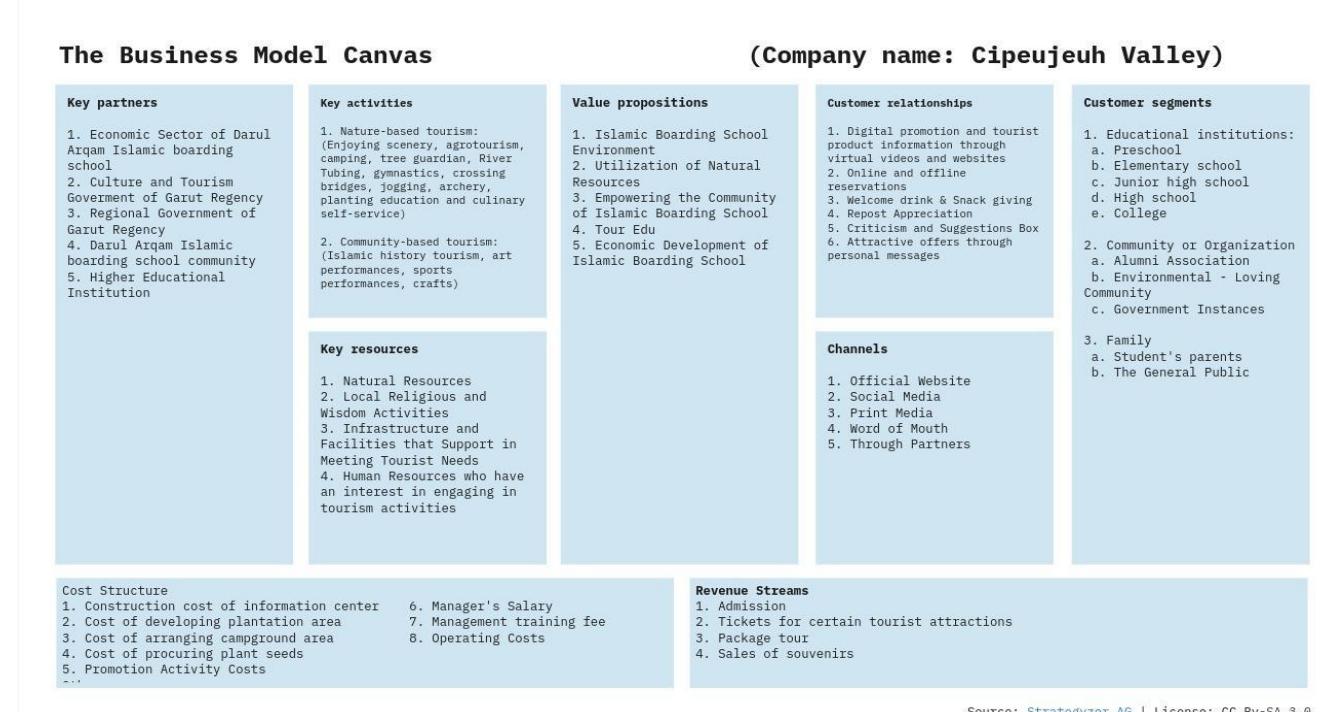
Figure 3. Business Model Canvas
3.4.8 Key Partner
A key partner is a collaborative partner that plays a crucial role and possesses the potential to support each other in ongoing and future tourism endeavors. Cipeujeuh Valley, designated for development, requiresthe support and assistance of various stakeholders to progress in a positive direction. The Darul Arqam Islamic Boarding School, as a business sector, can assume the role of a manager responsible for the financial
aspects of ecotourism development. Moreover, the Ministry of Culture and Tourism, operating under the Garut Regency Regional Government, can offer various forms of assistance and training throughout the development process. The Islamic Boarding School Community, as a party directly involved with the Cipeujeuh Valley, is also a crucial partner in the collaborative effort to manage and sustain the Cipeujeuh Valley area. Furthermore, higher education institutions are expected to consistently contribute to the discussion and consideration of development through their research endeavors. It is hoped that these entities will actively participate in the current and future tourism development activities within Cipeujeuh Valley.
3.4.9 Cost Structure
The expenses incurred in the development of Cipeujeuh Valley encompass fixed costs, which are recurring and variable costs and semi-variable costs, which are not routinely incurred but are only incurred under specific circumstances. The cost structure required for Cipeujeuh Valley is illustrated in Table 8.
Figure 3 displays the standard Business Model Canvas. To successfully integrate the nine key elements within the canvas, it is essential to initiate the optimization process for each element, whether they are absent or present and require improvement.
4. Conclusion
The calculation of the RZI value indicates that Cipeujeuh Valley's ecotourism falls within the intermediate range at 52.38%. Intermediate ecotourism typically involves small group visits using readily available transportation and taking advantage of the facilities and services provided by the tourism management. Four push factors for tourist visits are sports and adventure, recreation and relaxation, social status, and quality time. Nature and local community, also enjoying facilities serve as pull factors for tourists. Among the community, 61.3% have expressed their willingness to participate in the development of Cipeujeuh Valley's ecotourism. They are interested in activities such as maintaining and managing agrotourism gardens, acting as educational facilitators, guiding visitors during their tourism experiences, promoting Islamic history and the interpretation of the Quran and Hadith, as well as selling handicraft products. The business model for the development of Cipeujeuh Valley's ecotourism is depicted using the Business Model Canvas (BMC), targeting customer segments that include educational institutions, communities or organizations, and families. The value proposition revolves around the environment of the Islamic boarding school, sustainable utilization of natural resources, empowerment of the Islamic boarding school community, educational tourism, and economic development. Channels of promotion include official websites, social media, print media, word of mouth, and partnerships. Customer relationship consists of the acquisition phase, retain phase, and enhancement phase. Revenue streams are generated from admission tickets, attraction tickets, camping equipment
rentals, and souvenir sales. Key resources include attractive natural resources, religious and local wisdom activities, infrastructure and facilities that cater to the needs of tourists, and a workforce with a keen interest in tourism activities. Key activities focus on nature-based and community-based tourism experiences. Key partners involve the Economic Sector of Darul Arqam Islamic Boarding School, the Garut Regency Local Government, the Darul Arqam Community, and Higher Education Institutions. The cost structure encompasses the construction of an information center, development of plantation areas, campground planning, plant seedling procurement, promotional activities, management salaries, training programs, and operational expenses.
The determination of the RZI value indicates that Cipeujeuh Valley's ecotourism falls within the intermediate range, at 52.38%. This type of ecotourism typically involves small group visits, utilizing readily available transportation, and making use of the facilities and services provided by the tourism management. The push factors for tourist visits are sports and adventure, recreation and relaxation, social status, and quality time. Nature and the local community, as well as the availability of facilities, serve as pull factors for tourists. Among the community, 61.3% have expressed their willingness to participate in the development of Cipeujeuh Valley's ecotourism. They are interested in activities such as maintaining and managing agrotourism gardens, acting as educational facilitators, guiding visitors during their tourism experiences, promoting Islamic history and the interpretation of the Quran and Hadith, as well as selling handicraft products. The business model for the development of Cipeujeuh Valley's ecotourism is depicted using the Business Model Canvas (BMC), targeting customer segments that include educational institutions, communities or organizations, and families. The value proposition revolves around the environment of the Islamic boarding school, sustainable utilization of natural resources, empowerment of the Islamic boarding school community, educational tourism, and economic development. Channels of promotion include official websites, social media, print media, word of mouth, and partnerships. Customer relationship management encompasses three key phases: acquisition, retain, and enhancement. Revenue is generated from various sources, such as admission and attraction tickets, camping equipment rentals, and souvenir sales. Key resources include attractive natural resources, local wisdom activities, infrastructure and facilities catering to tourists' needs, and a workforce with a keen interest in tourism activities. Key activities focus on nature-based and community-based tourism experiences. Key partners include the Economic Sector of Darul Arqam Islamic Boarding School, the Garut Regency Local Government, the Darul Arqam Community, and Higher Education Institutions. The cost structure includes the construction of an information center, the development of plantation areas, campground planning, plant seedling procurement, promotional activities, management salaries, training programs, and operational expenses. It is important to note that the specific details of the cost structure may vary and should be determined based on a thorough analysis of the relevant factors.
Acknowledgement
The researchers expressed gratitude to the Darul Arqam Muhammadiyah Islamic boarding school for their substantial support. The authors also extended their appreciation to Mr. Wildan Kamal for providing valuable information about Cipeujeuh Valley.