

Abstrak
Kafein dan nikotin merupakan bahan adiktif yang banyak digunakan secara luas di seluruh dunia. Beberapa penelitian menunjukkan bahwa nikotin dapat meningkatkan asupan kafein. Penelitian pada hewan mengindikasikan bahwa nikotin dapat meningkatan perilaku yang disebabkan oleh kafein terutama akibat kafein pada dosis rendah. Namun penelitian mengenai interaksi antara perilaku akibat kafein dan nikotin dengan efek yang dihasilkan masih terbatas. Percobaan ini dibangun untuk mempelajari interaksi antara nikotin dan kafein pada kondisi akibat pengaruh kedua zat tersebut. Untuk membuat model yang terpengaruh, digunakan paradigma pemilihan tempat yang lebih disukai atau lebih dikenal sebagai metode CPP (conditioned place preference). Uji paksa untuk berenang (FST) digunakan untuk mengamati efek dari kafein dan kombinasinya dengan nikotin pada tanda-tanda depresi. Dosis kafein yang lebih rendah (5 mg/kg) diinduksikan untuk mendapatkan perilaku yang diharapkan. Namun pada kafein dosis tinggi (50 mg/kg) timbul perilaku permusuhan yang terlihat dari adanya penurunan nilai yang diharapkan. Injeksi nikotin tidak memiliki efek yang signifkan pada kafein dosis rendah. Namnun pada kafein dosis tinggi, 0,7 mg/kg nikotin secara intraperitoneal (i.p.) dapat mengurangi perilaku permusuhan yang ditimbulkan dan mengubah pola perilaku reda-kambuh yang dihasilkan dari dosis kafein 50 mg/kg. Terlebih lagi, kafein dosis tinggi (50 mg/kg i.p) dapat menimbulkan rasa cemas dan juga hiperkinesia yang ditunjukkan oleh rendahnya waktu diam pada pengujian FST. Injeksi nikotin pada pemberian kafein dosis tinggi dapat mengurangi timbulnya kecemasan dan hiperkinesia. Hasil dari penelitian ini memperlihatkan bahwa nikotin dapat menekan timbulnya perilaku akibat kafein, terutama pada kafein dosis tinggi.
Kata kunci : Kafein, nikotin, conditioned place preference (CPP), permusuhan, keinginan, forced swim test (FST)
Introduction
Caffeine and nicotine are well known as most consumed addictive substance in the world. Interaction between these susbtance is intriguing as the fact that smokers or ex-smoker tend to drink more coffee especially when they are smoking (Swanson et al., 1994). Likewise, smokers also smoke more cigarette during drinking the coffee and consume beverages contained higher caffeine (Istvan and Materazzo, 1984). Interaction between caffeine and nicotine could be emerged as pharmacokinetic and pharmacodynamic evidence. Benowitz have shown that consumption of nicotine could increase the caffeine metabolism, meanwhile smoking cessation could decrease caffeine metabolism significantly
(Benowitz et al., 1989). Indeed, smokers tend to drink coffee more than nonsmoker in order to maintain the caffein level in blood (Benowitz et al., 1989). However, recently interaction of caffeine and nicotine is believed not just emerged as pharmacokinetic evidence.In preclinical studies with animal models, caffeine appears to enhance the discriminativestimulus effect of nicotine by pharmacodynamic rather than pharmacokinetic interaction (Gasior et al., 2002). Caffeine interacts with adenosine receptor A1 and A2 (Snyder et al., 1981). Caffeine administration can raise the acetylcholine level in hippocampus and cortex region (Carter, 1995). Hence, there might be any modulatory interaction between adenosine and cholinergic systems in caffeine-nicotine induced dependence behavioral.
*Penulis yang dapat dihubungi untuk korespondensi kusnandar@fa.itb.ac.id
Experimental
Animals
Male Swiss Webster mice 6-8 weeks at the beginning of the experiment from School of Pharmacy animal husbandary. The mice were given free access to food and water except during training and test sessions.
Materials
Nicotine dihydrogen tartrate (Sigma), sodium diclofenac, caffeine (Merck), saline
Conditioned Place Preference Apparatus
The place conditioning (CPP) apparatus consists of three distinct compartmens (separated by guillotine doors). The overall inside dimension of conditioning apparatus(L x W x H) in centimeters were 46.5 x 12.7 x 12.7. The center compartment (7.2 cm in long) is gray with smooth acryclic floor. In one of the choice (each 16.8 cm in long) the walls are all black with the stainless steel grid floor consisting of 3.2 mm rods placed on 7.9 mm center. The other choice compartment is all white with 6.35 x 6.35 mm stainless steel mesh floor. The apparatus has clear acrylic lid for animal loading. CPP apparatus was placed under the lighting of 40 Watt light bulb approximately 1 meter upper.
Handling and Experimental Room Habituation
Prior to the conditioning, the animals were habituated in experimental room for seven days from 9 a.m until 16.00. After acclimatization for about 2 – 3 hours, each mouse was grasped and stroked at the neck and back until they appeared to show reduced indicators of stress when handled in this manner. Each mouse was then held as if i.p. injection is to be given. After the habituation session in each day, mice were returned to animal house.
In day 5 until 7, mice were also habituated to CPP apparatus by placing and letting the mice move around the CPP apparatus for 10 minutes while the guillotine door was openned.
Preconditioning Test
This conditioning experiment was conducted according to bias paradigm place preference. Hence, the animal was conditioned with lower score compartment paired to the stimulus. Preconditioning test was aimed to determine the lower preferential score chamber. The test was conducted in the day eight of habituation, a day prior to place conditioning. Each mouse was put in the gray area with the closed guillotine doors. After 5 minutes acclimated to the gray area, guillotine doors were openned and mouse was allowd to access all three compartments in 15 minutes. The times spent in black and white
compartment were recorded. Preference scores were then determined by dividing sojourn times in each of compartment to the total tiomes spent in both of compartment.
Caffeine Dependence Behavior
Place conditioning
During the place conditioning, mouse was injected by saline or caffeine before put in the certain compartement. Saline was paired with the higher preferential score compartment, while caffeine was paired with the lower preferential score determined in preconditioning test. The mice was put in certain compartment for 30 minutes. After 30 minutes, mice were taken from the compartment and put in the intial cage. Four hours later, mice were conditioned for alternate condition and substances, if in the morning mice received drug condition then in the afternoon they received saline conditioning and vice versa. For the second day, the conditioning procedure was inverted, if the first day mouse got drug conditioning, then in the second day mouse would be gotten the saline conditioning. These procedures were repeated for another eight days as the preliminary experiment has shown that this duration gave most obvious dependence behavior. Four doses of caffeine were used in this step: 0.5 mg/kg, 5 mg/kg, 10 mg/kg, and 50 mg/kg.
Conditioning test
After getting 10 days place conditioning, mice were tested for postconditioning side preference. The procedure was same with preconditioning test.
Extinction Period
Extinction period was started a day after conditioning test. The procedure was the same with conditioning place preference except the substance that injected was saline for both compartment. Extinction procedure was repeated for another 13 days.
Postextinction and relapse test
Postextinction test was conducted a day after the last extinction period. The procedure was the same with conditioning and preconditioning test. Relapse test was conducted by injecting certain dose of caffeine prior conditioning test.
Nicotine effect on Caffeine Dependence Behavior
In this experiments, mice were divided into 4 groups: nicotine group, caffeine 5 mg/kg+ nicotine group, caffeine 50 mg/kg+ nicotine group, caffeine 5 mg/kg group, and caffeine 50 mg/kg group. Caffeine was given 30 minutes before nicotine (0.7 mg/kg) injection and conditioning. All of the groups were tested for conditioning, postextinction, and relapse preferential. However, in the relapse test, each of combination group were divided into two groups, the first got caffeine injection while the other got nicotine injection.
Forced Swim Test
Forced swim test was conducted to observe and confrim the depression and stimulation effect of caffeine and/ or nicotine. This test was using the cylinder with 12.5 cm in diameter filled with 13 cm in depth of water. The initial water temperature was maintained for approximately 23-25°C. The procedure was conducted in two days with the first day for traning session and the second day for the test session. Mouse was put on the cylinder filled water for 6 minutes and recorded. Total immobility time was measured around the minute 2 for 4 minutes. Immobility was defined as floating state without any movement or only slightly movement for make a balance.
One way ANOVA followed by LSD for post hoc test and Students t-test were used for statistical analysis.
Result and Discussion
Caffeine Dependence Behavior
Figure 1 shows the motivational properties of caffeine in mice. Four different doses were used in this study with saline as the control.
Figure 3 shows nicotine effect on caffeine dependence behavior. Nicotine injection did not influence the preference of caffeine 5 mg/kg group. However, nicotine increased the preference score in nicotine+caffeine50 mg/kg compared to caffeine 50 mg/kg group. As previously imply, caffeine 50 mg/kg lead to aversion behavior indicated by the decrease of preference score. Figure 8 can depict the effect of nicotine in caffeine dependence more obvious.
Statistical Analysis
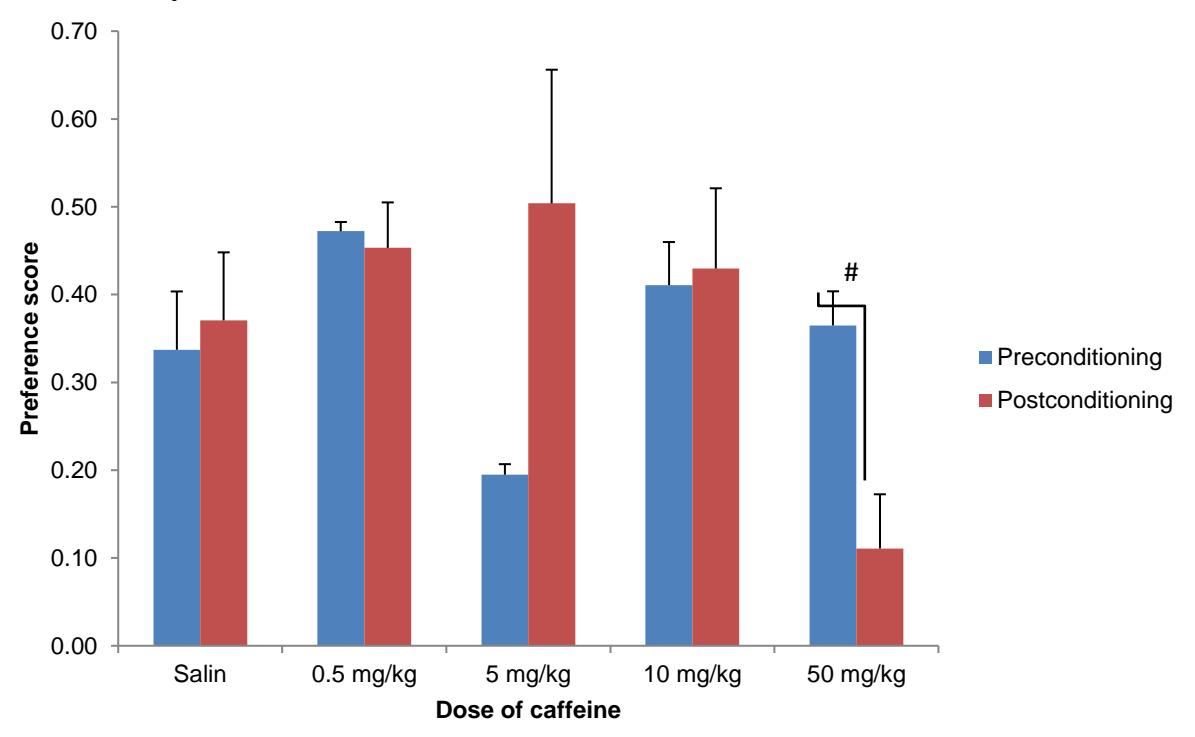
Figure 1. Preference scores resulted from four different doses of caffeine. Preconditioning test was conducted a day prior initial conditoning. Place conditioning was conducted 10 days by injecting drug or saline paired with one of the preconditioning test predefined compartments. Preference score is expressed as mean±SEM. The significance differences between groups was assessed with one-way ANOVA followed by LSD test while significance difference between test session of the same group was assessed by student's t-test. *p<0.05 vs within group preconditioning preference score.
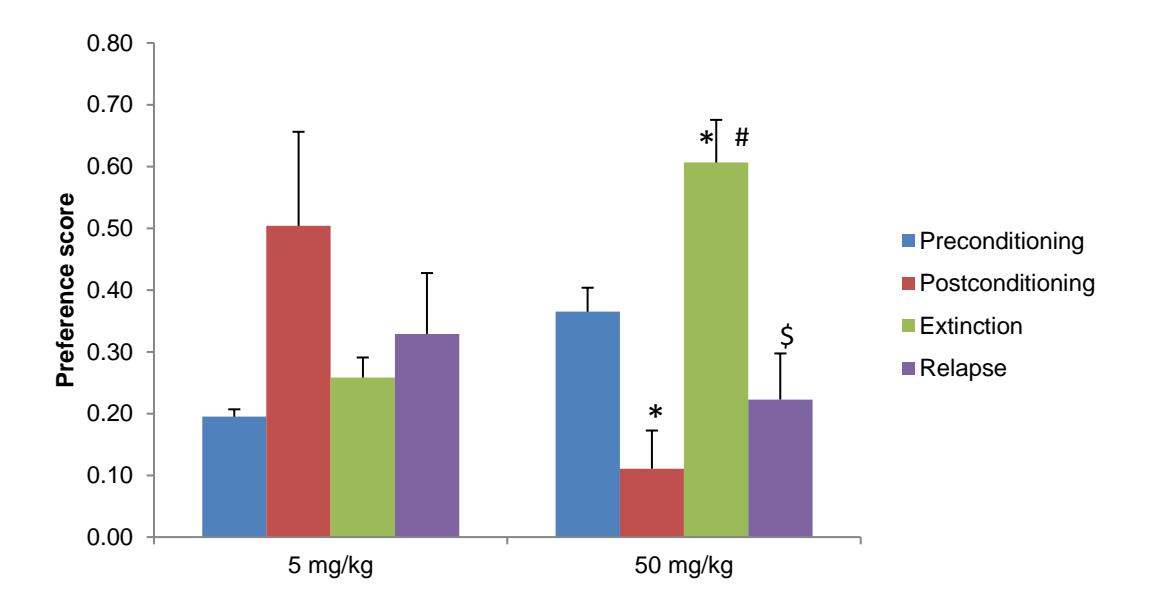
Figure 2. Preference score of preconditioning, postconditioning, extinction, and relapse from group treated with repeated dose of 5 mg/kg and 50 mg/kg caffeine. Preconditioning test was conducted a day prior initial conditioning. Caffeine was i.p injected for subsequent 10 days. A day after the last injection, mice were tested for postconditioning score. Extinction period was started a day after conditioning test and conducted for 14 days. Saline, instead of caffeine was injected and paired for both compartment. Postextinction preference score was assessed a day after the last extinction session. After postextinction test, mice were primed with certain dose of caffeine prior relapse test. Preference score is expressed as mean\(\pm\)SEM. The significance differences were assessed with one-way ANOVA followed by LSD. *p<0.05 vs within group preconditioning score, #p<0.01 vs within group postextinction score.
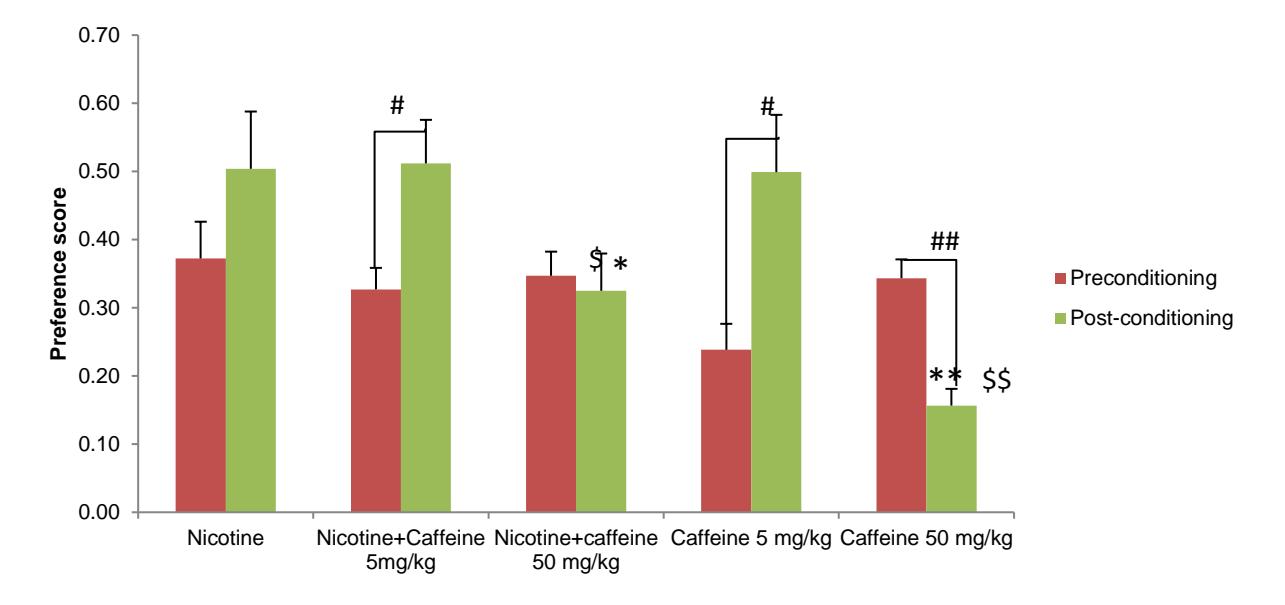
Figure 3. Effect of nicotine 0.7 mg/kg on caffeine dependence behavior. Caffeine was given 30 minutes before the nicotine injection on each conditioning session. The significance differences were assessed with one-way ANOVA followed by LSD. *p<0.05, **p<0.001 vs nicotine conditioned group. $p<0.05, *p<0.01 vs caffeine 5 mg/kg conditioned group. *p<0.05, *p<0.01 vs within group preconditioning score.
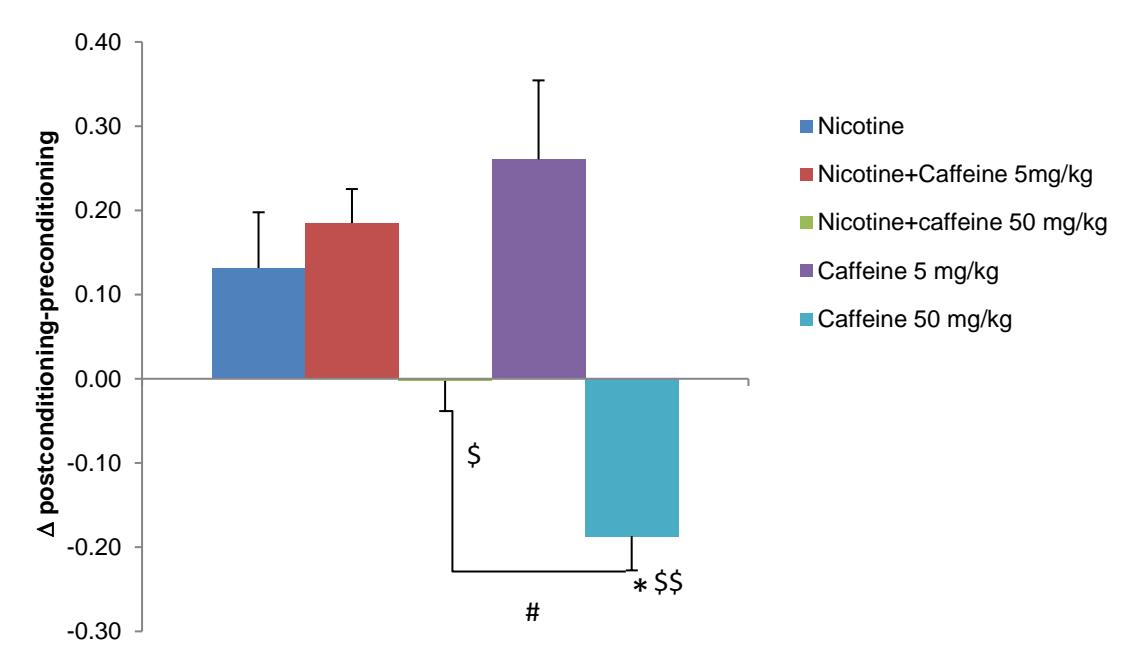
Figure 4. Effect of nicotine 0.7 mg/kg on caffeine dependence behavior. The data shown here are means differences between postconditioning score and preconditioning score\(\pm\)SEM. *p<0.01 vs nicotine group. $p<0.01, $$p<0.001 vs caffeine 5 mg/kg group, p<0.05 vs caffeine 50 mg/kg group.
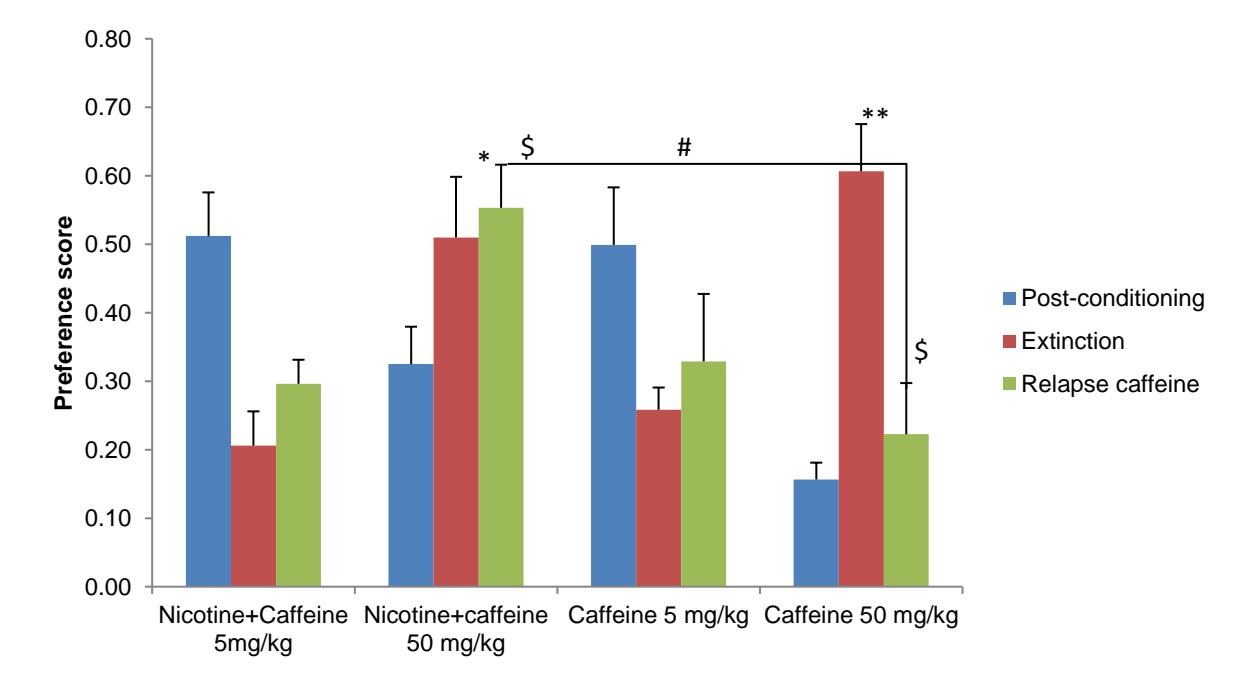
Figure 5. Effect of nicotine 0.7 mg/kg on caffeine extinction and relapse state behavior. Caffeine was given 30 minutes before nicotine injection on each conditioning session. Extinction session was conducted for 14 days. Priming was given 30 minutes prior CPP test. The significance differences were assessed with one-way ANOVA followed by LSD. *p<0.05, **p<0.01 vs caffeine 5 mg/kg group within extinction session. $p<0.05 vs caffeine 5 mg/kg group within relapse. *p<0.01 nicotine + caffeine 50 mg/kg vs caffeine 50 mg/kg.
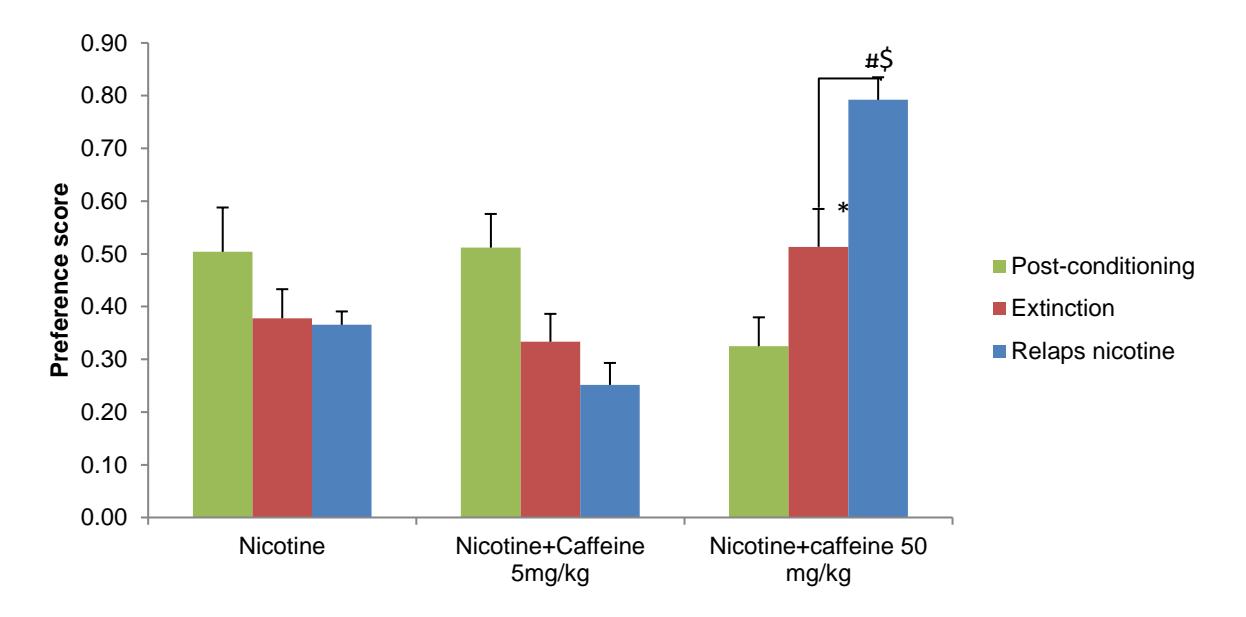
Figure 6. Extinction and nicotine induced relapse state behavior. Caffeine was given 30 minutes before the nicotine injection on each conditioning session. Extinction session was conducted for 14 days. Nicotine priming was given 30 minutes prior CPP test. The significance differences were assessed with one-way ANOVA followed by LSD. *p<0.01 vs nicotine group within extinction session. $p<0.001 vs nicotine within relapse. #p<0.05 extinction vs relapse within group.
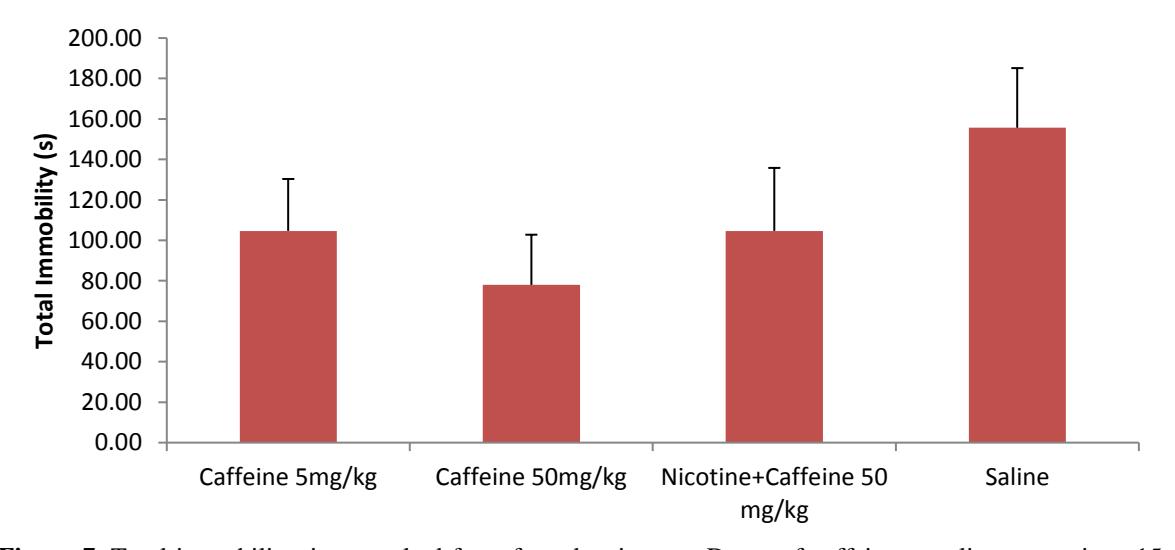
Figure 7. Total immobility time resulted from forced swim test. Doses of caffeine or saline were given 15 minutes prior to the test. Nicotine was given 30 minutes prior to caffeine. The test was conducted for 6 minutes. Total immobility time was measured from minute 2 for 4 minutes. The significance differences were assessed with one-way ANOVA followed by LSD.
To know the reinstatment properties of caffeine, the experiment was continued to extinction and relapse session. Extinction session was directed to reduce caffeine preference and aversive behavior resulted from conditioning session. Figure 2 shows the postextinction and relapse preference score. As caffeine 5 mg/kg gave the preference properties, extinction session led to decrease of preference score. Afterwhile priming with such dose of caffeine for relapse test, could increase the preference score. However, the increment of preference score in relapse state was not higher that in postconditioned state. It might be indicate that reinstatment of caffeine in doses of 5 mg/kg is low.
Extinction session of mice given 50 mg/kg of caffeine shows the different result compared to mice given 5 mg/kg in conditioning session. Extinction session
increase the preference score of mice (p< 0.01). It indicated the decrease of aversion behavior of the mice. Priming with such dose in relapse session resulted in significant aversion behavior compare to postextinction state.
Difference value are resulted from subtraction of postconditioning score with preconditioning score. Negative value means that postconditioning score is lower that of preconditioning, while positive value means higher postconditioning score. Nicotin seemed not increase the difference score in caffeine 5 mg/kg dose. However, nicotine alleviated the aversion behavior resulted from caffeine 50 mg/kg injection (p<0.05). The difference of postconditioning and preconditioning score was not so negative compared to caffeine 50 mg/kg group.
Nicotine administration during conditioning sessionsalso modulated the extinction and relapse state of caffeine especially in higher dose of caffeine (50 mg/kg), as shown in figure 5. Nicotine administration, however, did not resulted any difference pattern in group treated with 5 mg/kg of caffeine. Extinction preference score exhibitied from both of caffeine 50 mg/kg group and nicotine pretreated-caffeine 50mg/kg group were increase. It means that aversion behavior resulted from higher dose of caffeine was extinguished. However, relapse score from both of groups were very different. Caffeine priming to caffeine 50 mg/kg group resulted the reinstatement of aversion behavior. While caffeine priming to nicotine pretreated-caffeine 50mg/kg group resulted preference behavior. Hence administration of nicotine in higher dose of caffeine would changes the dependence pattern.
To get more obvious evidence of nicotine modulation toward caffeine dependence, the nicotine priming was alo conducted. There was no differences between nicotine and nicotine+caffeine 5 mg/kg. However, interesting data was also shown by nicotine+caffeine 50 mg/kg. Despite the preference score pattern of this group is the same with shown on figure 9, priming with nicotine resulted higher preference score than with caffeine.
Previous studies have proven that long term higher doses of caffeine administration could result depression behavior (Fredholm et al., 1999). There was a correlation between depression state and smoking. Spring et al, previously have demonstrated that self administration of nicotine improved depression-prone smokers emotional response to a pleasant stimulus (Spring, et al., 2008). Thus, the forced swim test was done to confirm any depression effect on caffeine administration and its combination with nicotine. Data resulted from forced swim test
upon acute administration of caffeine and nicotine is shown in figure 7.
Despite there was no significant different between the group, graphic shows the decrease of total imobility time during 4 minutes observation compared to salin group. Moreover, high doses of caffeine (50 mg/kg) reduce more total immobility time. The decrease of total immoblity time reflect the stimulant effect while increase of total immobiltiy time reflect the depressant effect. Hence, all caffeine treated group showed stimulant effect compared to salin group. Further, higher dose of caffeine showed the most stimulant effect upon acute administration. In addition, the decrease total immobility time resulted form higher dose of caffeine migh indicate anxiety and hyperkinesia condition. Combination with nicotine appeared to reduced the negative effect resulted from higher dose of caffeine and made the immobility time as high as resulted from the caffeine 5 mg/kg group. Thus, it is speculated that nicotine given prior to caffeine administration could alleviated the negative effect as result of high dose caffeine admistration.
Caffeine could promote bimodal behavioral properties. The lower dose, 5 mg/kg which correspond to about 1 cups of coffee in human, could generate addictive effect, while the doses ten time higher, 50 mg/kg, could bring aversion effect. Aversion effect could be resulted from unpleasant sensation stimulated by higher dose of caffeine. Chronic use of higher doses of caffeine also believed to promote depression effect (Fredholm, et al., 1999).
The action of caffeine in central nervous system mainly facilitated by A1 and A2A adenosine receptor (Snyder et al., 1981). Differ with classical neutransmitter, release of adenosine is not released vesicularly in response to neuronal firing. A1 and A2A adenosine receptor are distributed in all brain area. Drugs rewarding effect involved the role of mesolimbic system in which predominated by dopaminergic neurons. A2A is thought to be responsible in development of caffeine rewarding behavior. A2A is more dominant than A1subtype receptor in mesolimbic area. However differs with another reinforcing drugs, caffeine does not induce the dopamine increase in N.Ac. This leads to low reinforcing capacity of caffeine compared to amphetamine and cocaine (Acquas et al., 2002).
The results imply that nicotine might be not influence the caffeine dependence behavior in lower doses of caffeine. However, previous publication have shown that lower doses of caffeine could enhance the discriminative behavior to nicotine (Gasior et al., 2002). Other publication have shown that caffeine 3 mg/kg could increase the response rate of the rats treated with 0.5 mg/kg of nicotine (White, 1988). In spite of those previous result stated the lower doses of caffeine increase the dependence toward nicotine, the most interesting feature from this experiment is the improvement of aversion behavior resulted form 50 mg/kg caffeine.
Nicotine could affect the dependence behavior of caffeine, especially in higher dose of caffeine. It might possible that there is molecular interaction between cholinergic system and adenosine system as adenosine by A2A could modulate the GABAergic neurons in nucleus accumbens that in turn affect the cholinergic neuron there. A1 adenosine receptor also play modulation role in cholinergic neurons of nucleus accumbens (Fredholm et al., 1999). Caffeine may increase acetylcholine in hippocampaland cortical area which is relevant to psychostimulant effect of caffeine (Carter et al., 1995).
Obvious effect of nicotine was shown in higher doses of caffeine. As the result shown, nicotine could reduce the aversion behavior resulted from higher dose caffeine administration. Further, nicotine also changed the extinction and reinstament pattern of higher dose of caffeine.Combination with nicotine appeared to reduced the negative effect resulted from higher dose of caffeine and made the immobility time as high as resulted from the caffeine 5 mg/kg group. Thus, it is speculated that nicotine administration could alleviate the negative effect as result of high dose caffeine admistration.The result might imply the irreversible changes of preference score after nicotine and high caffeine treatment. Extinction session could not reduce the dependence behavior and either caffeine or nicotine primining indeed increase the dependence state even higher than before (conditioning state). Thus, it might reflect the difficulties in treatment of addiction in smoker who drink high dose of caffeine.
Caffeine could not increase the dopamine level in N.Acc (nucleus accumbens) (Acquas et al., 2002). Hovewer, nicotine indeed could increase dopamine by stimulation VTA dopaminergic neuron projecting to N.Ac (Fu et al., 2000). Thus, the alteration behavior pattern of higher doses of caffeine might be due to effect of nicotine in N.Acc.
In addition, decrease of immobility time could be addressed as increasing of anxiety level. Higher doses of caffeine could lead to anxiety effect. Anxiety effect of caffeine might be due to increase of dopamine in prefrontal cortex as antidepressant drugs usually lead to increase of dopamine in this area (Acquas et al., 2002). Nicotine administration seemed to reduce the anxiety level resulted from higher doses of caffeine.
Hence, there might be any interaction of caffeine and nicotine effect within PFCx.
Taken together from the cholinergic involvement in alteration of caffeine dependence behavior, especially in higher doses of caffeine could be due to several neuronal mechanism involved. Further, this findings still need to be confirm in neuronal and molecular level.
Conclusion
Nicotine could modulate the dependence behavior of caffeine, especially in higher doses of caffeine (50 mg/kg). It also implies that higher consumption of caffeine will make the treatment for resolving nicotine addiction more difficult.
Acknowledgement
Thank to School of Pharmacy Institut Teknologi Bandung for supporting part of this research.
References
Acquas, E., Tanda, G., & Chiara, G. D., 2002, Differential Effects of Caffeine on Dopamine and Acetylcholine Transmission in Brain Areas of Drug Naive and Caffeine-Pretreated Rats. Neuropsychopharmacology , 182-193.
Benowitz, N.L., Hall, S.M., Modin, G., 1989, Persistent increase in caffeineconcentrations in people whostop smoking. Br. Med. J. 298: 1075 - 1076.
Carter, A.J., O'Connor, W.T., Carter, M.J., and Ungerstedt, U., 1995, Caffeine enhances acetylcholine release in the hippocampus in vivo by a selective interaction with adenosine A1 receptors. J. Pharmacol. Exp. Ther. 273:637–642.
Fredholm, B. B., Battig, K., Holmen, J., Nehlig, A., and Zvartau, E. Z., 1999, Actions of Caffeine in the Brain with Special Reference to factors That Contribute to Its Widspread Use. Pharm. Rev. , 84- 132.
Fu, Y., Matta, S. G., Gao, W., Brower, V. G., and Sharp, B. M., 2000, Systemic Nicotine Stimulates Dopamine Release in Nucleus Accumbens: Reevaluation of the Role of N-Methyl-D-aspartate Receptors in the Ventral Tegmental Area. J. Pharmacol. Exp. Ther. , 458-465.
Gasior, M., Jaszna, M., Munzar, P., Witkin, J. M., and Goldberg, S. R., 2002, Caffeine Potentiates the
Discriminative-Stimulus Effects of Nicotine in Rats. Psychopharmacology , 385-395.
Istvan, J.and Matarazzo, J.D., 1984, Tobacco, alcohol, and caffeine use:a review of their interrelationships. Psychol. Bull. 95:301–326.
Snyder, S.H., Katims, J.J., Annau, Z., Bruns, R.F., and Daly, J.W., 1981, Adenosine receptors and behavioral actions of methylxanthines. Proc. Natl. Acad. Sci. 78 (5): 3260 - 3264.
Spring, B., Cook, J. W., Appelhans, B., Maloney, A., Richmond, M., Vaughn, J., Vanderveen, J., Hedeker, D., 2008, Nicotine effects on affective response in depression-prone smokers. Psychopharmacology , 461–471.
Swanson, J.A., Lee, J.W., Hopp J.W., 1994, Caffeine and nicotine: A review of their joint use and possible interactive effects in tobacco withdrawal. Addict. Behav. 19: 229 - 256.
White, J. M., 1988, Behavioral Interactions Between Nicotine and Caffeine. Pharmacol. Biochem. & Beh., 63-66.