

Abstrak
Pada penelitian ini dilakukan penentuan aktifitas antidiare dari kombinasi ekstrak air daun jambu biji (Psidium guajava L.) dan ekstrak air daun teh hijau (Camellia sinensis L.) dengan menggunakan metode induksi dengan minyak jarak dan melihat waktu singgah pada saluran cerna. Penelitian ini menggunakan 25 jantan galur Swiss Webster dengan bobot berkisar antara 20-35 g yang dibagi menjadi 5 kelompok untuk setiap metode. Kelompok pertama diberi gom 2% secara peroral (po) sebagai kelompok kontrol, kelompok kedua diberi loperamid hidroklorida 0,52 mg/kg berat badan secara peroral. Kelompok ketiga, keempat dan kelima masing-masing diberi kombinasi ekstrak air daun jambu biji (G) dan ekstrak air daun teh hijau (T) dengan perbandingan sebagai berikut (G:T) 112,5 : 110,55 ; (G:T ) 75 : 221,1 dan (G:T) 37,5 : 331,65 mg/kg BB. Hasil penelitian menunjukkan bahwa seluruh ekstrak memiliki aktifitas antidiare, terdapat perbedaan yang signifikan pada konsistensi feses, berat feses, onset dan durasi diare, dan pada waktu singgah saluran cerna antara mencit yang diberi ekstrak dan mencit pada kelompok kontrol. Frekuensi dari defekasi pada mencit yang diberi ekstrak air (G : T) 75 : 221,1 pada menit ke 180-240 menunjukkan adanya efek yang serupa dengan kelompok pembanding dan memiliki perbedaan yang bemakna dengan kelompok kontrol (p<0,05). Kombinasi antara ekstrak air daun jambu biji 75 mg/kg BB dan ekstrak air daun the hijau 221,1 mg/kg BB merupakan kombinasi yang paling baik dalam penelitian ini.
Kata kunci : Metode waktu singgah saluran cerna, induksi oleum ricini, ekstrak air, daun jambu biji, daun teh hijau.
Introduction
Diarrhea is defined as the passage of three or more loose or liquid stools per day (or more frequent passage than is normal for the individual). Diarrheal disease is the second leading cause of death in children under five years old, and is responsible for killing 1.5 million children every year. Diarrhea can last several days, and can leave the body without the water and salts that are necessary for survival. Most people who die from diarrhea actually die from severe
dehydration and fluid loss. Children who are malnourished or have impaired immunity are most at risk of life-threatening diarrhea (WHO 2012).
Indonesian community had known that guava leaves (Psidium guajava L.) and green tea leaves (Camellia sinensis L.) had antidiarrheal effect (Depkes 1995). For that, in this research effectiveness of water extract of guajava and green tea leaves combination was determined as antidiarrheal based on stool
consistency, stool weight, onset and diarrhea duration, and intestinal transit time.
Materials and Methods
Material
Guava leaves, green tea leaves, castor oil, loperamide, water and gom.
Instrument
Analytical scales, scales rats (Tanita, KD-160 d = 1 g), oral sonde, board surgeon, surgical instruments, vaporizer vessel, pipette drops, mortars and stamper, ship rats observer, ruler, furnace (Barnstead thermolyne), oven (Memmert).
Animal Experiment
Swiss webster mice
Extraction
Extraction was done by infusa method used water.
Procedure
This study begins with a collection of material, which guava (Psidium guajava L.) leaves obtained in Ciamis, West Java and green tea (Camellia sinensis L.) leaves obtained in Gambung Plantation. In addition, washed, dried and crushed for raw material powder. The plants were determined in Herbarium Bandungense, Faculty of life sciences and technology, the ITB.
Experimental animals
Swiss webster male mice (20-35 g) were used. The animals were housed under standard conditions, maintained on a 12 h light/dark cycle and had free access to food and water up to the time of experimentation. The animals were acclimatized to the laboratory environment 7 days before the experiments. Animals were randomly distributed into groups of 5 animals each.
Drugs
Loperamide hydrochloride served as a standard drug (Depkes RI 1978) for castor oil induced diarrhea and small intestine transit time. The dose of water extracts of guava leaves and water extracts of green tea leaves combination was selected randomly as Guava : Green tea (G : T) 112.5 : 110.55; 75 : 221.1; and 37.5 : 331.65 mg/kg body weight of the animal used.
Castor oil-induced enteropooling
Mice were fasted for 1 h and divided into five groups of five animals each. Group 1 received gom 2% orally served as a control, group 2 received loperamide hydrochloride (0,52 mg/kg BW, po.) and groups 3, 4 and 5 received water extract of guava leaves and water extract of green tea leaves combinations (G:T) i.e 2.5 : 110.55; 75 : 221.1; 37.5 : 331.65 mg/kg body weight orally respectively, 1 h before the oral administration of castor oil. In this method, parameters measured were the start of diarrhea, the duration of diarrhea, the frequency of defecation, weight of stool and stool consistency (Suryawati and Santoso 1993; Awounters et al. 1978).
Small intestinal transit
Mice were fasted for 18 h and divided into five groups of five animals each, Group 1 received gom 2% orally served as a control, group 2 received loperamide hydrochloride (0.52 mg/kg BW, po.) and groups 3, 4 and 5 received water extract of guava leaves and water extract of green tea leaves combinations (G : T) i.e 2.5 : 110.55; 75 : 221.1; 37.5 : 331.65 mg/kg body weight orally respectively, 45 minutes before the administration of 0,1 ml/10 g BW of marker (5% charcoal suspension in 2% gum acacia. The mices sacrificed after 65 minutes and the distance travelled by charcoal meal from the pylorus was measured and expressed as percentage of the total length of the intestine from the pylorus to rectum (Suryawati and Santoso 1993; Mascolo et al. 1994).
Statistical analysis
The data was expressed as mean ± S.E.M. (standard error of the mean). Student's t-test was used for the evaluation of data and p<0.05 accepted as significant.
Results
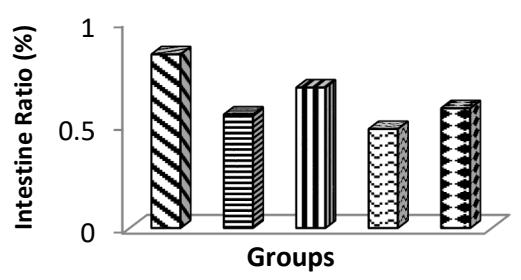
Figure 1. Chart the ratio of the average length of small intestine traversed with charcoal suspension. Gom 2%; Loperamide; G;T (111.5 : 110.55) G:T (75 : 221.1); G:T (37.5 : 331.65).
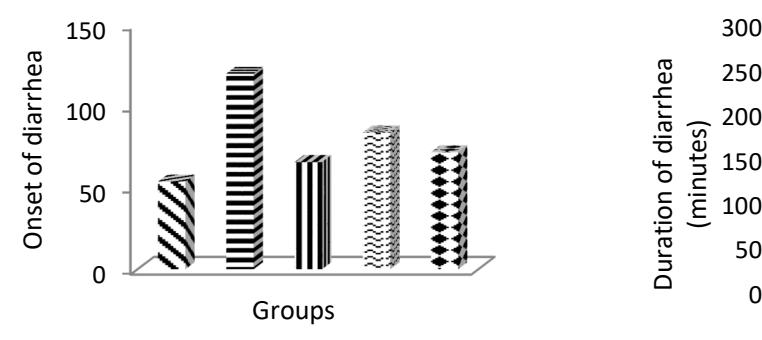
Figure 2. Chart of onset diarrhea in testing anti diarrheal activity of water extract of guava and green tea leaves combination. Gom 2%; Loperamide; G:T (112.5 : 110.55); G:T (75 : 221.1); G:T (37.5 : 331.65)
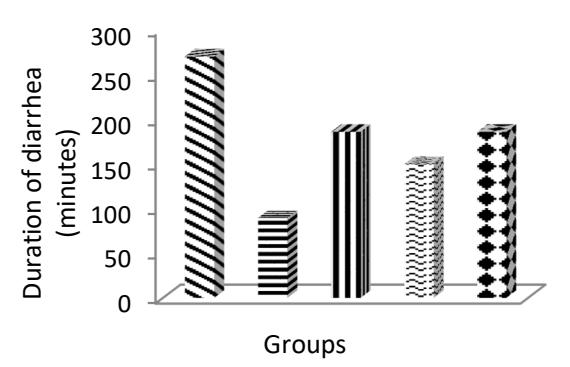
Figure 3. Chart of average diarrhea duration in testing anti-diarrheal activity of water extract of guava and green tea leaves combination. Gom 2%; Loperamide; G:T (112.5 : 110.55); G:T (75 : 221.1); G:T (37.5 : 331.65)
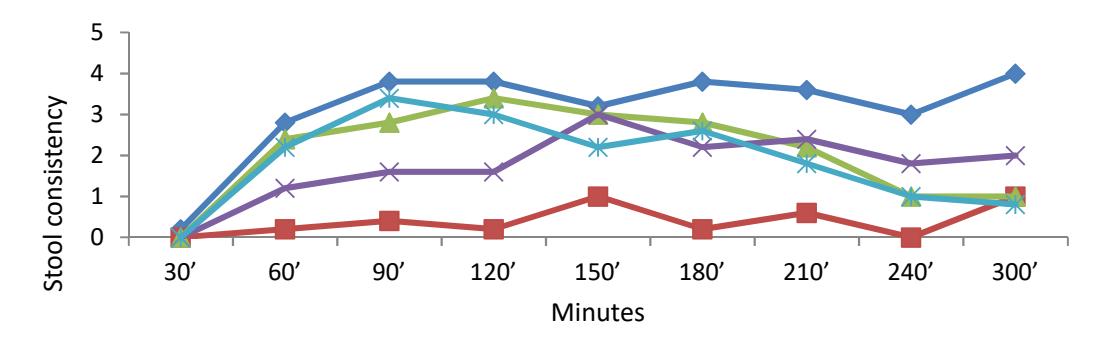
Figure 4. Profile of average stool consistency in testing anti diarrheal activity of water extract of guava and green tea leaves combination. Measured of consistency: (0 = no stool, 1 = compact, 2 = soft compact, 3 = soft, 4 = soft liquid, 5 = liquid). Gom 2%; Loperamide; G:T (112.5 : 110.55); G:T (75 : 221.1); G:T (37.5 : 331.65)
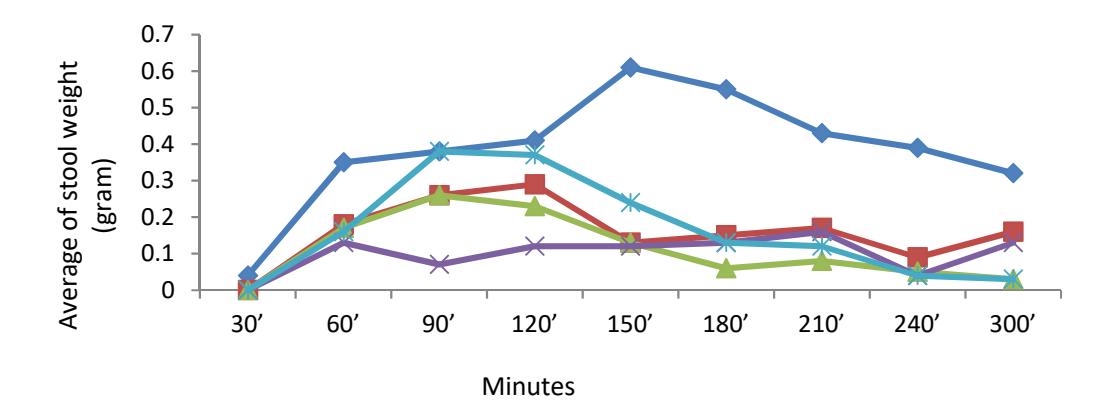
Figure 5. Profile of average stool weight in testing anti-diarrheal activity of water extract of guava and green tea leaves combination. Gom 2%; Loperamide; G:T (112.5 : 110.55); G:T (75 : 221.1); G:T (37.5 : 331.65).
Animal modeling experiments successfully conducted, in which healthy mice after induction dose of castor oil 0.75 mg/20 g BW become sick (diarrhea). Water extract of guava leaves and water extract of green tea leaves combinations had an effect as antidiarrheal.
Based on the observations on intestinal transit method showed that all three doses of water extract of guava leaves and water extract of green tea leaves combination give anti-diarrheal effect because the value percentage is less than the percentage in the control group.
The value of the ratio intestine that was important because it showed the activity of intestinal peristalsis. If a substance test have the activity of an antidiarrheal, it would depresses activity of intestinal peristalsis.
In vivo experiments showed that the test group (G : T) 75 : 221.1 mg/kg BW had the best antidiarrhea activity and a little closer to the standard group with capable of delaying the onset of diarrhea, shorten the duration of the diarrhoea, at the minute to 300 was able to suppressed the frequency of diarrhea, and also able to suppressed stool weight and significantly different compared to control group, but was not able to increase the consistency of feces (p<0,05).
Discussion
The use of castor oil induced diarrhoea model in our research, is well justified because the autocoids and prostaglandins are involved these have been implicated in the causation of diarrheas in man. Castor oil is also reported to induce diarrhea by increasing the volume of intestinal content by prevention of the reabsorption of Water. The liberation of ricinoleic acid from castor oil results in irritation and inflammation of the intestinal mucosa, leading to release of prostaglandins, which stimulate motility and secretion (Saralaya et al. 2010).
In this study, loperamide hydrochloride produced a significant reduction in the number of stools and delaying the onset of diarrhea.
The antidiarrheal activity of the extract may also be due to the presence of denature proteins forming protein tannates in guava n green tea, which make the intestinal mucosa more resistant and reduce secretion. The extract resulted in a marked reduction in the number of diarrhoea stools and the reduction in the weight and volume of the intestinal contents, as well as a modest reduction in intestinal transit.
Conclusion
In this research, diarrhea mice model is formed. Water extract of guava and green tea leaves combination have anti-diarrheal activity. Water extracts of guava and green tea leaves combination had significant differences in increased stool consistency, stool weight, onset and diarrhea duration, and intestinal transit time in mice compared to those of control group (p < 0.05). Combination water extract of guava leaves 75 mg/kg BW and water extract of green tea leaves 221.1 mg/kg BW is the best combinations.
References
Awounters F, Niemegeers CJE, Lenaerts FM, Janseen PAJ, 1978, Delay of castor oil diarhoea in rats; a new way to evaluate inhibitors of prostaglandin biosynthesis, Journal of Pharmacy Pharmacology 30: 41-45.
Departemen Kesehatan Republik Indonesia, 1978, Farmakope Indonesia, ed. 3, Direktorat Jenderal Pengawasan Obat dan Makanan, Jakarta.
Departemen Kesehatan Republik Indonesia, 1995, Materia Medika Indonesia, Vol. VI, Direktorat Jenderal Pengawasan Obat dan Makanan, Jakarta.
Mascolo N, Izzo AA, Avotore G, Barboto F, Capasso F, 1994, Nitric oxide and castor oil included diarrhea, Journal of Pharmacology and Experimental Therapeutics 268: 291-292.
Saralaya GM, Patel P, Patel AN, Patel M, Roy SP, Patel AN, 2010, Antidiarrheal Activity of Methanolic Extract of Moringa oleifera Lam Roots in Experimental Animal Models., International Journal of Pharmaceutical Research, 2(2), 35-39.
Suryawati S, Santoso B (Eds.), 1993, Penapisan Farmakologi Pengujian Fitokimia dan Pengujian Klinik, Yayasan Pengembangan Obat Bahan Alam Phytomedica, Jakarta, 19–21.
World Health Organization, Diarrhea, http://who.int/ mediacentre/factsheets/fs330/en/index.html (Cititation at November 19th, 2012).