

Abstrak
Temu kunci (Beosenbergia pandurata Roxb.) secara tradisional digunakan untuk mengobati berbagai macam penyakit, salah satunya adalah sebagai antioksidan. Tujuan dari penelitian ini adalah untuk mengisolasi dan mengidentifikasi komponen antioksidan yang dimiliki temu kunci. Rimpang temu kunci diekstraksi dengan cara maserasi menggunakan etanol 95%. Ekstrak etanol kemudian difraksinasi dengan ekstraksi cair-cair, kromatografi cair vakum, dan kromatografi kolom klasik. Aktivitas antioksidan kemudian dipantau dan diuji menggunakan kromatografi lapis tipis (KLT) menggunakan reagen 0,2% DPPH (1,1-diphenyl-2-picrylhydrazyl). Uji kemurnian dilakukan dengan pengembangan tunggal KLT menggunakan 3 macam fase gerak yang berbeda dan KLT dua-dimensi. Isolat BP-1 merupakan hasil isolasi dari ekstrak etanol dan aktif sebagai antioksidan. Berdasarkan spektrum UV-Vis dan inframerah, isolat BP-1 teridentifikasi sebagai flavanone karena adanya gugus hidroksil yang hilang pada posisi orto (o-diOH), dengan substitusi –OH pada C5 dan C7.
Kata kunci : Temu kunci, Boesenbergia pandurata, DPPH, antioksodan.
Introduction
An amount of evidence showed that free radicalmediated damage plays an important role in several human diseases such as cancer and cardiovascular diseases. Free radical which continuously generated during normal metabolism eventually triggers the onset of degenerative diseases. Exogenous antioxidants derived from dietary components sometimes required preventing this condition. The study about isolation and activity testing of plantorigin antioxidants was significantly increased in recent years. Potential sources of antioxidant compounds have been searched in several types of plant materials such as vegetables, fruits, leaves, barks, roots and crude plant drugs.
Temu kunci (Boesenbergia pandurata Roxb.) rhizomes is one of Zingiberaceae family which used to treat some diseases such as stomach disorders, reproductive infections, kidney stones, or laxative (Subarnas 2001). In vitro test showed that Temu kunci
(Boesenbergia pandurata Roxb.) rhizomes could increase the number of lymphocytes, specific antibodies, and kill cancer cells (Fahey and Stephenson 2002). Boesenbergia pandurata Roxb. which has been widely used as a medicinal plant, was reported to possess significant anti-oxidative properties (Shindo et al. 2006; Seal 2011). Temu kunci rhizomes contain essential oil component such as metylcinnamate, champhor, cineole (Norajit et al. 2007). Temu kunci rhizomes also contain saponin and flavonoid such as pinostrobin, pinocembrin, alpinetin, cardamonin, and panduratin (Chairul and Harapini 1996; Win et al. 2008; Ching et al. 2007). Phenolic compounds such as flavonoid which contain hydroxyls, are responsible for the radical scavenging effect in the plants (Seal 2011; Ren et al. 2003).
According to its benefits, especially in the treatment of various degenerative diseases, it is necessary to conduct further study to find antioxidant component of temu kunci rhizomes. In this study, an activityguided purification was conducted to isolate the free
radical scavenging components from Temu kunci rhizomes.
Materials & Methods
Plant material
Rhizomes of Boesenbergia pandurata Roxb. were collected from Bandung, Indonesia. The specimens were identified at Herbarium Bandungense, School of Life Sciences and Technology, Bandung Institute of Technology. The rhizomes were cut into slices and dried at temperature ± 42˚C on the drying cabinet. Dried sample was grind in a comminution mill.
Extraction and Fractionation of Rhizomes
Dried powder (900 g) of Boesenbergia pandurata Roxb. rhizomes was extracted by maceration method using ethanol 96% for 3 x 24 hours (1000 mL each). The extract was filtered through Whatman filter paper and the filtrate was concentrated by rotavapor. Total extracts was 95.98 g. Ethanol extract was partitioned by liquid-liquid extraction using n-hexane, ethyl acetate, and ethanol. N-hexane fraction was fractionated by vacuum liquid chromatography, using silica gel 60H as stationary phase and n-hexane-ethyl acetate mixture as mobile phase with gradient elution.
Antioxidant activity test
Isolation of antioxidant compound was guided by antioxidant activity. Antioxidant component of Boesenbergia pandurata Roxb. was determined qualitatively by TLC using silica gel GF 254 as stationary phase and n-hexane-ethyl acetate (9:1) as mobile phase with DPPH (1,1-diphenyl-2 picrylhydrazyl) as visualizing agent.
Purification
Purification was performed by column chromatography using silica gel 60 as stationary
phase and n-hexane-ethyl acetate (9:1) as mobile phase. Purified isolate was obtained by washing the isolate by n-hexane. Purity test performed by a single development TLC using three different kinds of mobile phases and two-dimensional TLC.
Characterization and Identification of Isolate
Isolate was characterized and identified by UV-Vis Spectrophotometer using shifting reagent and IR Spectrophotometer.
Result and Discussion
Fractions which obtained from liquid-liquid extraction showed antioxidant activity (figure 1). Fraction of nhexane showed strong yellow and rapid colour change, so that fraction used for further fractination with vacuum liquid chromatography. Thin layer chromatogram of 11 fractions from Vacuum liquid chromatography (figure 2) showed that fraction number 4, 5, and 6 showed strong yellow and rapid colour change.
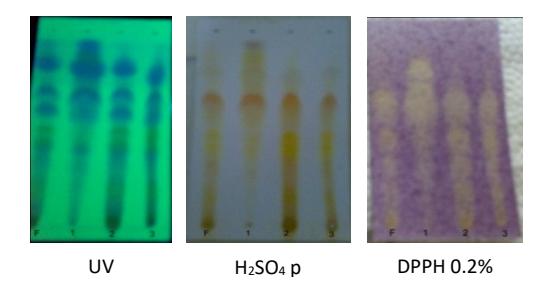
Figure 1. Thin Layer Chromatogram of Extract (F), n-hexane fraction (1), ethyl acetate fraction (2), and metanol-H2O fraction (3); with silica gel GF 254 as stationary phase and hexane-EtOAc (9:1) as mobile phase.
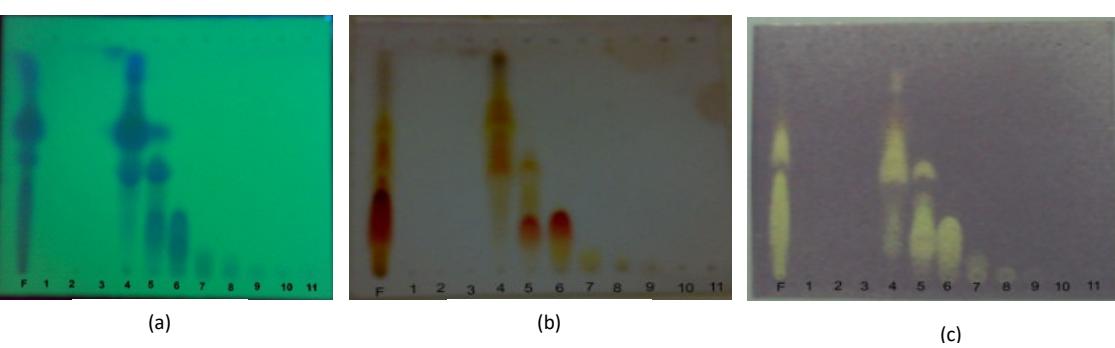
Figure 2. Thin Layer Chromatogram of Extract (F), fractions from VLC (1-11); with silica gel GF 254 as stationary phase and hexane-EtOAc (9:1) as mobile phase using detector/visualizing agent (a) UV λ 254 nm; (b) H2SO4; (c) DPPH 0.2%.
Fraction number 6 has one big spot but less spot if compared to fraction number 4 and 5. Further separation by coloumn chromatography gave 31 fraction (1a-31a). Fraction 3a-23a had antioxidant activity. Crystal from fraction 17a was washed by nhexane, and gave isolate BP-1. Purity test was performed by a single development TLC using three different kinds of mobile phase and two-dimensional TLC showed that BP-1 was pure. Isolate BP1 indicated as flavonoid because it gave yellow-green fluoresens when identified by TLC using AlCl35% as spotting agent.
Isolate characterization by spectrophotometer UV-Vis showed two band (figure 4), λ1-MeOH 320 nm and λ2- MeOH 289 nm. Isolate was indicated as flavanon or dihydroflavonol. UV-Vis spectrum of Isolate with NaOH showed that band II shifted from 289 to 321 nm (bathochromic 32 nm). This result indicated OHsubstitution on C5 and C7.
OH-subtitution on C5 also indicated by Natrium Acetate (MeOH/NaOAc) UV-Vis spectrum which showed that band II shifted from 289 to 324 nm (bathochromic 34 nm). This result indicated BP1 was flavanon with OH-substitution on C5 and C7.
UV-Vis spectrum of Isolate + AlCl3 5% showed that band II shifted from 289 to 308 nm (bathochromic 19 nm). It was indicated OH-substitution on C5.
There was no OH-substitution on ortho position. Which was indicated by MeOH/AlCl3 and MeOH/AlCl3/HCl UV-Vis spectrum of BP1 which did not give any shift. This result supported by MeOH/NaOAc/H3BO3spectrum which showed no shifting relative to MeOH spectrum.
Infrared spectrum showed there were C-O (1087 cm-1), C=C (1488 cm-1), C=O (1639 cm-1), O-H (3093 cm-1) and aromatic (3016 cm-1). Isolate BP1 was predicted as Pinocembrin (figure 3) (Ching et al., 2007).
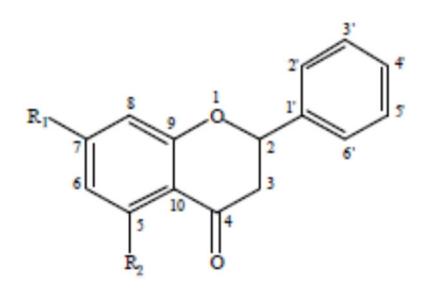
Figure 3. Structure of Pinocembrin. R1, R2 : OH.
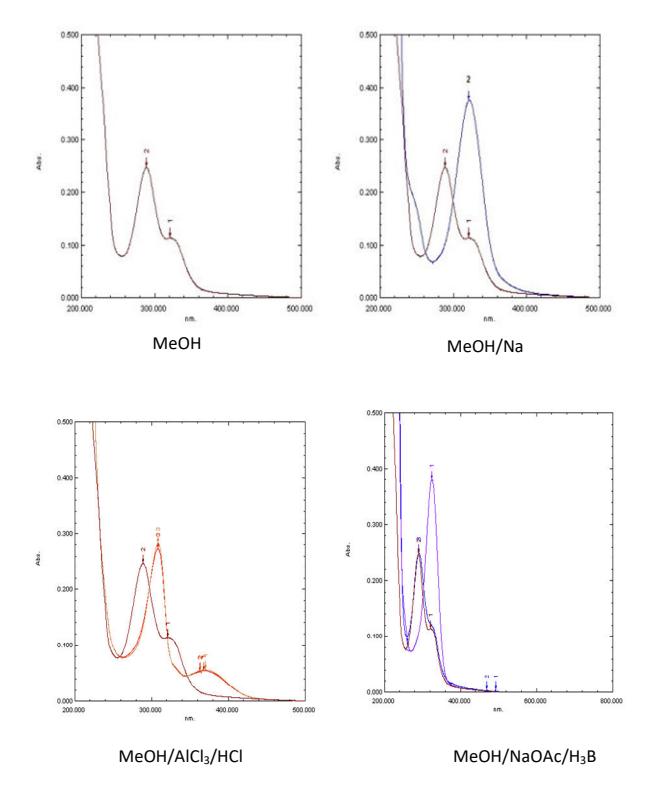
Figure 4. UV-Vis spectrum of Isolate BP-1
Conclusion
Isolate BP-1 was isolated from the ethanol extract and active antioxidant. Based on ultraviolet-visible and infrared spectrum, isolate BP-1 was identified as flavanone in the absence of hydroxyl groups at the ortho position (o-diOH), with substitution of -OH at C5 and C7.
References
Chairul M, Harapini S, 1996, Analisis Komponen Kimia dari Temu Putri dan Temu Kunci, Simposium Penelitian Bahan Obat Alami VIII Proceeding, Perhimpunan Penelitian Bahan Obat Alami, Bogor, 628-634.
Ching AYL, Wah TS, Sukari MA, Lian GEC, Rahmani M, Khalid K, 2007, Characterization of Flavonoid Derivatives from Boesenbergia rotunda (L.), The Malaysian Journal of Analytical Sciences 11(1) 154-159.
Fahey JW, Stephenson KK 2002, Pinostrobin from Honey and Thai Ginger (Boesenbergia pandurata): A Potent Flavonoid Inducer of Mammalian Phase 2 Chemoprotective and Antioxidant Enzymes, J. Agric. Food Chem. 50, 7472-7476.
Norajit K, Laohakunjit N, Kerdchoechuen O, 2007, Antibacterial Effect of Five Zingiberaceae Essential Oils, Molecules, 12, 2047-2060.
Ren W, Qiao Z, Wang H, Zhu L, Zhang L, 2003, Flavonoids: Promising Anticancer Agents, Medicinal Research Reviews 23(4): 519-534.
Seal T, 2011, Evaluation of Antioxidant Activity of Some Wild Edible Fruits of Meghalaya State in India, Int. J. Pharm. Sci. 3(4), 233-236.
Shindo K, Kato M, Kinoshita A, Kobayashi A, Koike Y, 2006, Analysis of antioxidant activities contained in the Boesenbergia pandurata Schult. Rhizomes, Biosci. Biotechnol. Biochem. 70: 2281–2284.
Subarnas A, 2001, Komponen Aktif Antioksidan dalam Bahan Alami, Pemahaman konsep Radikal Bebas dan Peranan Antioksidan dalam Meningkatkan Kesehatan Menuju Indonesia Sehat 2010 Proceeding, UNPAD, Bandung, 1-2.
Win NN, Awale S, Esumi H, Tezuka Y, Kadota S, 2008, Panduratins D-I, Novel Secondary Metabolites from Rhizomes of Boesenbergia pandurata, Chem. Pharm. Bull. 56(4): 491-496.