

PENENTUAN NILAI SUN PROTECTIVE FACTORS (SPF) DAN AKTIVITAS ANTIOKSIDAN EKSTRAK ETANOL KULIT RAMBUTAN (NEPHELIUM LAPPACEUM L.)
ABSTRAK
Kulit buah rambutan (Nephelium lappaceum L.) merupakan sampah organik dengan banyak manfaat kesehatan, namun belum dimanfaatkan secara optimal. Penelitian ini bertujuan untuk menentukan nilai SPF dan aktivitas tabir surya ekstrak etanol dari kulit buah rambutan. Kulit buah rambutan diekstraksi dengan menggunakan metode maserasi dimana etanol digunakan sebagai pelarutnya. Nilai SPF ditentukan dengan menggunakan metode in vitro yang sederhana, cepat dan dapat diandalkan, yakni dengan mengukur serapan dari ekstrak yang telah diencerkan pada panjang gelombang 290-320 nm. Serapan diukur pada setiap 5 nm dengan menggunakan spektrofotometer UV. Nilai SPF kemudian dihitung berdasarkan serapan yang terekam dengan menggunakan persamaan matematika yang dikembangkan oleh Mansur. Aktivitas antioksidan dari kulit buah rambutan ditentukan dengan menggunakan metode DPPH dan vitamin C sebagai pembanding. Nilai SPF dari kulit buah rambutan yang diukur pada konsentrasi ekstrak 50, 100, 150 dan 200 µg/mL adalah 6,47±0,45; 9,26±0,28; 13,01±0,33; dan 16,17±0,63 secara berurutan. Aktivitas antioksidan dilakukan melalui penentuan nilai IC50. Nilai IC50 dari kulit buah rambutan adalah 41,47 ± 3,89 µg/mL sementara nilai IC50 Vitamin C adalah 24,87 ± 0,69 µg/mL. Berdasarkan hasil penelitian ini, ekstrak etanol kulit buah rambutan memiliki potensi sebagai tabir surya dan antioksidan.
Kata kunci : kulit buah rambutan, SPF, antioksidan, IC50
Introduction
Rambutan is a tropical fruit belongs to family Sapindaceae. The origin of rambutan is uncertain, but the probable centre of origin are Indonesia and Malaysia (Lim 2013). In Indonesia, there are about twenty two varieties of rambutan derived from pure variety and grafting from two different varieties (Tindall 1994). Some varieties are cultivated for its economic values. Rambutan is mainly eaten fresh while some of them are canned in light syrup without the seed. The rind and the seed often remained as waste.
Rambutan rind are organic waste with many potential health benefits, such as antioxidant activity (Thitilertdecha et al. 2008, Palanisamy et al. 2008, Sun et al. 2011, Ling et al. 2010, Sun et al. 2012), antihyperglicemic activity (Palanisamy, 2011), antimicrobial activity (Zhao et al. 2011), anticancer activity (Wan. 2011), and antiobesity activity (Zhao et al. 2011 and Lestari, 2013). Rambutan rind contains flavonoids, tannins, ellagic acid and the major functional group of CH<sub>3</sub>, aliphatic CH<sub>3</sub>, and C=O compounds (Lestari, 2013). Palanisamy et al. (2011) have isolated geraniin, an ellagitannin as the major bioactive compound with strong antioxidant activity and showed antihyperglycemic activity. Sun et al. (2011) in another study have found that free phenolic compounds which was isolated from rambutan pericarp have higher antioxidant activity compare to soluble and insolublebound phenolic compounds.
Phenolic compounds has the ability to scavenge free radicals from UV exposure, thus it can be used as sunscreen (Svobovoda 2003). Some studies have shown that the photoprotective and antioxidant activity of natural plants were related to the phenolic compounds isolated from the plants (Fatmawati et al. 2014 dan Souza et al. 2014). This recent study aimed to determine the sun protective factor (SPF) and antioxidant activity of ethanolic extract of rambutan rind.
Materials and Methods
Plant material and preparation of extract
Rambutan fruit were collected in Palopo, South Sulawesi, Indonesia. Rambutan rind was separated from its fruit, then washed out and cut into small pieces to prepare for the drying step.
The pieces were dried on straw paper and later grinded and sieved using 24 mess. 200 g of powder of Rambutan rind powder (200 g) was macerated using ethanol for 5 x 24 hours. Every 24 hours, the solvent was replaced. The result of the consecutive maceration was filtered and evaporated using rotary evaporator at 50 °C to get concentrated ethanolic extract. Ethanolic extract 25 mg was weighed and transferred into 50 mL volumetric flask, then it was diluted by ethanol to make stock solution of 0.5 mg/ml for further assays.
In Vitro SPF Assay
Concentration series of 50, 100, 150, and 200 \(\mu\)g/mL, were prepared from aforementioned stock solution. The absorbance of each concentration was measured between 290-320 nm using 1 cm quartz cell at an interval of 5 nm using UV-Vis Spectrophotometer (Agilent 8453). Each concentration was replicated three times. The SPF value was calculated using Mansur equation (Mansur et al. 1986).
SPF = CF x \[\Sigma^{290-320}\]EE(\(\lambda\)) x I (\(\lambda\)) x Abs(\(\lambda\))
Where, CF = 10 (correction factor), \(EE(\lambda)\) = Erythematogenic effect of radiation of wavelength \(\lambda\), I (\(\lambda\)) = Intensity of solar radiation at a wavelength and Abs (\(\lambda\)) = Spectrophotometric absorbance at wavelength \(\lambda\). The values of \(EE(\lambda)xI(\lambda)\) are constants as listed in Table 1 (Sayre et al. 1979).
Table 1 Normalized product function used in the calculation of SPF
| Wavelength (nm) | ΕΕΧΙ (λ) |
|---|---|
| 290 | 0.0150 |
| 295 | 0.0817 |
| 300 | 0.2874 |
| 305 | 0.3278 |
| 310 | 0.1864 |
| 315 | 0.0837 |
| 320 | 0.0180 |
| Total | 1 |
Antioxidant Activity Assay
The antioxidant activity was measured by determining the free radical scavenging activity of the extract using 2,2-diphenyl-1-picryl-hydrazyl (DPPH) radical (Mensor et al. 2001). The ability of the extract in scavenging the DPPH free radical was showed by the discoloration of the DPPH solution. Stock solution of 0.5 mg/mL of the extract were diluted in ethanol to final concentrations of 5, 10, 15, 20 and 25 µg/mL. DPPH solution were added to the diluted extract and allowed to react at room temperature for 30 minutes. Each concentration was replicated three times. The absorbance values were measured at 518 nm and converted into percentage of antioxidant activity (%AA) using the following formula:
% AA = ((absorbance control – absorbance sample)/absorbance control ) x 100
Absorbance control is the absorbance of DPPH solution in ethanol, ethanol was used as blank. IC50 was calculated by linear regression using GraphPad Prism® 7.01 program. The IC50 values represent the concentration of extract to scavenge 50% DPPH free radicals. The ability of vitamin C in scavenging the DPPH solution was measured as a positive control.
Results and Discussion
The result of the in vitro SPF assay was shown in Table 2, at the concentration of 50 µg/mL, the SPF value was more than 6. The SPF value of the rambutan rind ethanolic extract increased along with the increasing concentration of extract.
Table 2 SPF Value of Varies concentration of Rambutan rind ethanolic extract
| Extract Concentration (ppm) | SPF Value (mean ± SD) |
|---|---|
| 50 | 6.47 ± 0.45 |
| 100 | 9.26 ± 0.28 |
| 150 | 13.01± 0.33 |
| 200 | 16.17± 0.63 |
In vitro SPF Assay
Antioxidant activity was measured using DPPH. DPPH is a free radical because of the unpaired electron. With the presence of hydrogen donor, the unpaired electron of the radical becomes paired, thus decreasing the absorbance in the wavelength of 518 nm. The antioxidant activity of rambutan rind ethanolic extract was presented in Figure 1, in % AA. IC50 represents the concentration in which the inhibition of free radical DPPH by 50% as shown in Table 3.
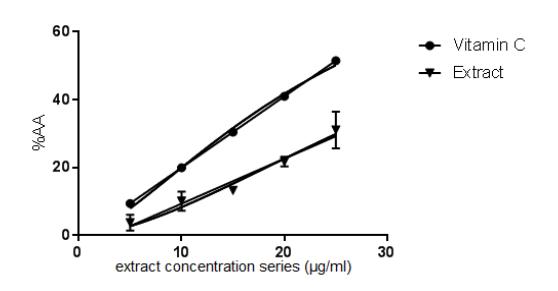
Figure 1 Percentage of Antioxidant activity (%AA) of Rambutan rind ethanolic extract
Table 3 IC50 value of rambutan rind ethanolic extract and vitamin C as positive control
| Sample | IC50 value |
|---|---|
| Vitamin C | 24.87 ± 0.69 |
| Rambutan Rind ethanolic | 41.47 ± 3.89 |
| Extract |
Rambutan is a sweet seasonal tropical fruit. The peel and the seed are organic waste of rambutan possessing many health benefits but have not used optimally. SPF value has become the international standard for quantitative measurement of sunscreen products. In cosmetics, SPF of 15 is mainly used to protect the skin from the UV radiation. This present study showed that rambutan rind ethanolic extract has the capacity as UV filter. At a concentration range of 50-200 µg/mL, the SPF value was ranging from 6 to 16. The capacity of natural SPF plants acts as sunscreen is related to its phenolic compounds. Previous studies have shown that the higher the phenolic compound the better value. Wungkana et al. (2013) showed that the phenolic fraction of waste corn cobs have high SPF value.
Another study by Martono et al. (2010) described that the phenolic content of black tea industrial waste related to its potent UV filter effectiveness. Thus in this research the SPF value of rambutan rind ethanolic extract could be related to its phenolic content, however future research are needed to confirm this statement.
The percentage of antioxidant activity of rambutan rind ethanolic extract at concentration of 25 µg/mL was around 31.11%. The IC50of rambutan rind ethanol extract was 41.47 ± 3.89 µg/mL which was about two folds higher then IC50 value of vitamin C (24.87 ± 0.69 µg/mL). This data showed that the antioxidant activity of rambutan rind ethanolic extract was two folds lower than vitamin C. In another study, IC50 of methanolic fraction of rambutan rind was 4.94 µg/mL (Thitilertdecha 2010). This value indicated that the methanolic fraction from the later study showed better antioxidant activity than the ethanolic extract. The location source of plant, extraction method and the solvent used could be different, resulting in different value of IC50. Despite of that, this study was in line with each other in supporting the fact that rambutan rind is a potent antioxidant.
The main bioactive compounds of rambutan rind are phenolic compound, flavonoids and tannis. Phenolic compound and flavonoids have been related to the antioxidant activity of this extract.
Conclusion
Rambutan is a tropical fruit contained high in flavonoids and phenolic compounds. The ethanolic extract of rambutan rind showed both UV filter activity and antioxidant activity. Its activities possibly related to its bioactive components. Thus, further research in relating phenolic and flavonoid content to sunscreen activity is needed.
References
Bravo L, 1998, Polyphenols: chemistry, dietary source, metabolism and nutritional significance, Nutr Rev 56: 317-333.
Fatmawati N, Anggreini, N, Firmansyah, MY, Erdityo, C, Yunilawati E, 2014, Hubungan senyawa flavonoid dari kulit batang Erythrina Fusca L., dengan uji aktivitasnya sebagai
sunscreen, Proseeding elektronik (e-proceedings) PIMNAS, PKM-P. http://artikel.dikti.go.id/ index. php/PKM-P/article/view/488 (Accessed on 25 July 2016)
Lestari SR, Djati SR, Rudijanto A, Fatchiyah, 2013, Production and Potency of Local Rambutan at East Java As A Candidate Phytopharmaca. Agrivita 35(3) : 270-276.
Lim TK, 2013, Edible Medicinal and non-Medicinal Plants. Volume 6, Netherlands: Springer Netherlands.
Ling LT, Palanisamy UD, Cheng HM, 2010, Prooxidant/antioxidant ratio (ProAntidex) as a better index of net free radical scavenging potential. Molecules. 15(11):7884–7892.
Mansur JS, Breder MNR, Mansur MCA, Azulary RD, 1986, Determination of Sun Protection Factor for Spectrophotometr, An Bras Dermatol 62:121-124.
Martono Y, 2010, Potency of Industrial Tea Waste : Comparison between green and black tea industrial wastes as UV Filter for Sunscreen, Indonesian Journal of Cancer, Chemoprevention, I(1): 54-59.
Mensor LL, Menezes F, Leitao GG, Reis AS, Santos TC, Coube TS, Leitao SG, 2001, Screening of Brazilian plant extracts for antioxidant activity by the use of DPPH free radical method. Phytother.Res. 15: 127-130.
Palanisamy U, Cheng HM, Masilamani T, Subramaniam T, Lai TL, Radhakrishnan AK, 2008 Rind of the rambutan, Nepheliumlappaceum, a potential source of natural antioxidants, Food Chem 109(1):54–63.
Palanisamy UD, Ling LT, Manaharan T, Appleton D, 2011, Rapid isolation of geraniin from Nepheliumlappaceumrind waste and its antihyperglycemic activity, Food Chem 127(1):21–27.
Sayre RM, Agin PP, LeVee GJ, Marlowe E, 1979, Comparison of in vivo and in vitro Testing of Sunscreening Formulas. Photochem Photobiol 29 : 559-566.
Souza MSK, Dos Santos AT, Alves FCA, Paula OA, Almeida AVH, Alves SFJ, Da Cruz AEC, Da Silva AJR, Santos SND, Pereira NX , 2014, Identification of flavonol glycosides and in vitro photoprotective and antioxidant activities of Triplaris gardneriana Wedd, JMPR Vol 9(7) 2017-215.
Sun J, Peng H, Su W, Yao J, Long X, Wang J, 2011, Anthocyanins extracted from rambutan (NepheliumlappaceumL.) pericarp tissues as potential natural antioxidants. J Food Biochem 35:1461–1467.
Sun L, Zhang H, Zhuang Y, 2012, Preparation of free, soluble conjugate, and insoluble-bound phenolic compounds from peels of rambutan ( Nepheliumlappaceum) and evaluation of antioxidant activities in vitro, J Food Sci 77:C198– C204.
Svobovoda, A, Psotova J, Walterova D, 2003, Natural Phenolics in the prevention of UV-induced Skin Damage,Biomed Pap 147:137-145.
Thitilertdecha N, Teerawutgulrag A, Rakariyatham N, 2008, Antioxidant and antibacterial activities of NepheliumlappaceumL. extracts. LWT – Food. Part SciTechnol 4(10):2029–2035.
Thitilertdecha N, Teerawutgulrag A, Kilburn JD, Rakariyatham N, 2010, Identification of major phenolic compounds from NepheliumlappaceumL.
and their antioxidant activities. Molecules. 15:1453–1465.
Tindall HD, 1994, Rambutan Cultivation in FAO Plant Production and Protection Devision, Rome, Italy: Cransfield Institute of Technology.
Wan NurHidayat WS, Ridhwan AW, Azamn S, 2011, Promising effect of Nepheliumlappaceum rind extract as cancer chemopreventive agent through apoptosis and cell cycle arrest mechanisms on human osteosarcoma cells, In: Proceedings of Universiti Malaysia Terengganu 10th international annual symposium UMTAS 2011: Empowering Science, Technology and Innovation Towards a Better Tomorrow, pp 163– 169.
Wungkana I, Suryanto E, Momuat L, 2013, Antioxidant activity and sunscreen of phenolic fraction of waste corn cobs (Zea mays L.), Pharmacon Jurnal ilmiah farmasi UNSRAT 2(4):149-155.
Zhao YX, Liang WJ, Fan HJ, Ma QY, Tian WX, Dai HF, Jiang HZ, Li N, Ma XF, 2011, Fatty acid synthase inhibitors from the hulls of NepheliumlappaceumL. Carbohydr Res. 346 (11): 1302–1306.