

*Correspondence
Aditya Trias Pradana aditya_trias @staff.ubaya.ac.id
KAJIAN FORMULASI DAN STABILITAS GRANULA EFERFESEN KEDELAI VARIETAS DETAM I (GLYCINE MAX (L.) DENGAN BERBAGAI BAHAN EFERFESEN YANG BERBEDA
ABSTRAK
Penelitian ini dilakukan untuk menganalisis efek perbedaan konsentrasi dan tipe asam pada karakterisitik fisika dan stabilitas kimia granul effervescent kedelai hitam (Glycine max L. Merrill) varietal Detam I. Granula eferfesen dibuat dibuat dengan tiga asam yang berbeda, dimana formula I 15% asam sitrat, formula II campuran 5% asam sitrat dan 10% asam tartrat, dan formula III 8% campuran asam sitrat dan 16% asam tartrat. Karakteristik fisika granul meliputi distribusi ukuran partikel, densitas spesifik, densitas ruah, kandungan kelembapan, waktu aliran, sudut tenang, dan waktu effervescent. Kandungan fenol total dievaluasi selama 28 hari dan sampel dikumpulkan pada hari ke-0, 1, 4, 7, 14, 21, dan 28 hari. Sampel dikur menggunakan spektrofotometri UV pada λ 505,5 nm. Hasil menunjukkan bahwa granul effervescent dengan formula III dipilih sebagai formula terbaik dalam semua parameter uji, kecuali distribusi ukuran partikel. Kadar Fenol total pada formula I memiliki kadar tertinggi dengan profil stabilitas lebih baik dibandingkan formula II dan III. Hal ini menunjukkan bahwa formula dengan kombinasi 8% asam sitrat dan 16% asam tartrat merupakan formula optimum. Untuk penelitian lebih lanjut, penggunaan adsorben dan rasio pengikat pada formula serta ketahanan kelembapan pada kemasan primer perlu dipertimbangkan.
Kata kunci: kedelai (Glycine max (L.) Merr., granula eferfesen, bahan eferfesen, formulasi, stabilitas
INTRODUCTION
Free radicals and other reactive oxygen species (ROS) can be obtained from internal sources in the body as a result of metabolism or from external sources, such as cigarette smoke and pollutants. Roles as oxidants or reductants are obtained from highly reactive and unstable unpaired electron in atomic orbital of the free radicals. Free radicals can cause adverse changes in the body and several diseases, such as cancer and atherosclerosis (Lobo et al. 2010).
Antioxidants in the body naturally work to reduce cell impairment. However, these endogenous antioxidants might not be sufficient to counteract free radical compounds that increase rapidly. Additional antioxidants are needed to help protection of the body, which can be obtained from the intake of antioxidants from outside of the body (exogenous antioxidants). One of the compounds that can work well as an antioxidant is flavonoids (Yulia et al. 2015).
Soybean is a source of natural antioxidants with the active ingredient of flavonoid compounds, namely: isoflavones (Saija et al. 1995). Positive physiological effects on the body caused by isoflavone compounds can be seen with the consumption of isoflavone compounds at least 50 mg / day. Soybean contains isoflavones as the major compound, genistein (4 ', 5'7 tryhydroxyisoflavone) and daidzein (4', 7 dihydroxyisoflavone), β-glycoside-derived compounds and genistin (Wang and Murphy 1994).
Black soybean has antioxidant activity worth 15 times higher than yellow soybeans (Yulia. et al. 2018). Black soybeans are also known to contain six times more flavonoids than yellow soybeans (total flavonoids of black and yellow soybeans are 2.57 and 0.41 mg equivalent to catechins per gram, respectively). (Xu and Chang 2007). Soybeans used as antioxidant active pharmaceutical ingredient (API), have moisture sensitive properties (hygroscopic). Thus, an innovative dosage formulation is required for a hygroscopic API. To make a solid dosage form stable against moisture and acceptable to various societies, an innovation of effervescent granular dosage form was made.
Effervescent granules are coarse grains containing medicinal ingredients in dry mixtures which are usually comprised of acid sources such as citric acid and tartaric acid, and an alkali source of sodium bicarbonate. When added to water, acids and bases will react to liberate carbon dioxide and causes foam. The resulting carbonated solutions can mask the flavor of an uncomfortable or disagreeable active ingredient, thereby
constituting one advantage of the effervescent granular dosage form.
Citric acid and tartaric acid have advantages and disadvantages each that will affect the chemicalphysical characteristics of a formulated preparation. Both acid components were known to form an effervescent base together with sodium bicarbonate and react in water to liberate CO2. The disadvantage of citric acid as a single source of acid is its very sensitive nature to moisture, whereas single tartaric acid will produce granules that are brittle and easily agglomerate (Ansel 2011). The combination of them will prevent the formation of chalky friable granules or a sticky mixture that is difficult to form granules. The success of the formation of the effervescent granules will increase drug absorption in the gastric environment. (Diyya et al. 2018). Therefore, research on the formulation and evaluation of the stability of antioxidant preparation of effervescent granule of soybean glycine (Glycine max (L.) Merr.) variation of Detam I was obtained, and effervescent granule was produced with good physical and chemical stability.
MATERIALS AND METHODS
Plant material
The plant material used in this study was the soybean seed (Glycine max (L.) Merr.) certified Detam I varieties obtained from the Seed Sources Management Unit of the Nuts and Crop Research Centre named Balai Penelitian Tanaman Aneka Kacang dan Umbi (BALITKABI) Malang, East Java, Indonesia on October 2017.
Chemical
The chemicals used in this study were pvp (polyvinyl pyrrolidone) K30 p.g; citric acid anhydrous; tartaric acid; sodium bicarbonate; lactose monohydrate p.g; colloidal silicon dioxide (Cab-O-Sil®) p.g; magnesium stearate p.g; aspartame; strawberries flavor; rose dye; gallic acid p.a; natrium carbonate; Folin-Ciocalteu reagent.
Instruments
The instruments used in this research are as follows analytical scale (Ohaus Pioneer™), siever (16 mesh and 30 mesh), oven, tumbling mixer, retsch vibrator (Retsch Vibrator D- 42759 HAAN), tapping density (Pharma Test D-63512 Hainburg), moisture content balance (Ohaus MB45) climatic chamber, oscillating granulator, standard funnel, stopwatch, UV-Vis spectrophotometer (Shimadzu UV1280i).
Soybean (Glycine max (L.) Merr.) powder preparation
Soybean seeds were sorted and cleaned from the dirt by washing in running water, then were dried in a 45° oven for 30 min. After that, the process was continued using a blender for 2x1 min to grind and change the shape of soybean seeds into soy powder. The resulting powder was then passed by a 30 mesh sieve to uniformed the particle size, then the soybean powder was stored in the exicator.
Soybean granule formula
The Detam I soybean powder has been manufactured into effervescent granule as formula written in Table 1 below, while lactose monohydrate was used as filler to reach the final granule weight:
Dry granulation
The material included PVP K-30, magnesium stearate, colloidal silicon dioxide, aspartame, citric acid, tartaric acid, sodium bicarbonate, and lactose monohydrate were firstly sieved. All materials were mixed by tumbling mixer for 5 min, then prepared into granule using oscillating granulator. The granule mass was then sieved with a 16 mesh sieve. The acid and base parts of the granule were prepared separately and blended into homogenous effervescent granules at the end of the step. The resulting granules were evaluated for their physical characteristics and continued with a chemical stability study that was performed by determining the level of active substance in
Table 1. Soybean Effervescent Granule Formula
| Composition | Purpose | Formula | ||
|---|---|---|---|---|
| Formula | I | II | III | |
| Soybean seed powder (Glycine max L.Merrill) | Active ingredients | 200 mg | 200 mg | 200 mg |
| PVP K-30 | Binder | 4% | 4% | 4% |
| Aspartame | Sweetener | 4% | 4% | 4% |
| Citric acid anhydrous | Acid source | 15% | 5% | 8% |
| Tartaric acid anhydrous | Acid source | - | 10% | 16% |
| Sodium bicarbonate | Base source | 17% | 17% | 27% |
| Magnesium Stearate | Lubricant | 1% | 1% | 1% |
| Silicone dioxide | Glidant | 1% | 1% | 1% |
| Strawberries flavor | Flavour | 6% | 6% | 6% |
| Rose dye | Colorant | 0.2% | 0.2% | 0.2% |
granules using the visible spectrophotometric method.
Granule evaluation
Particle size distribution
Measurement of granular particle size distribution was done using a retsch vibrator. 100 g of granule was inserted into the siever with sequences of 20, 30, 50, 60, 80, and 100 mesh, respectively, and the fines container at the bottom. The sievers were vibrated for 20 min with 60 Hz vibration speed. A particle size distribution curve was created with the desired low amount of fines by the granulation process (Kumar et al. 2014).
Density and Hausner rasio
Hausner ratio is the ratio between the weight of the material type after it is compressed with small taps on the weight of the type without compaction. The tapping process was done when it reached no further volume changes (The USP Convention 2015). Hausner ratio and compressibility index can be calculated as follows:
Compressibility Index = \[100 x [(Vo - Vt)/Vo]\]
Hausner Ratio = \((Vo/Vt)\)
where Vo is unsettled apparent volume and Vt is the final tapped volume (with no further volume changes).
Moisture content
Moisture content was calculated using a moisture content balance. A total of 5 grams of granule was weighed and dried until it reached constant weight. Moisture content is then calculated as below (Sarkar 2014):
Moisture content (%) = \[\frac{\text{initial weight - final weight}}{\text{final weight}} \times 100\]
Flow properties
The properties of granular flow are observed from the flow rate and the angle of repose. One hundred grams of granules were inserted into the funnel. Flow velocity was measured with a stopwatch that was turned on when the funnel hole was opened until the entire granule passes through the hole. The maximum flow time for 100 g of granules was 10 seconds. Thereafter, the height of the heap (h) and the radius of the pile cone (r) were measured. The angle of repose ranges from 25-40° (The USP Convention, 2015) and calculated as follows:
Effervescent time
The effervescent time test was carried out by inserting 1 sachet of granule into a glass filled with 200 ml of water and calculated the time of granule effervesced, starting from granules dipped into the water until all the granules dissolved and the bubbles around the container disappeared.
Phenolic content determination
Qualitative analysis of total phenolic granul effervescent soybean seeds
Two mililiters of Folin-Ciocalteu reagent were added to the soybean extract in methanol followed by 4.0 ml of 7.5% sodium bicarbonate. Color change of the solution was observed. Positive results are indicated by changes in the color of the solution into dark green or blue.
Determination of standard solution
50.0 mg of gallic acid was weighed then dissolved in methanol until 100.0 ml and resulted in 500.0 ppm standard raw concentration. Working standard then prepared with the concentration of 20.0; 30.0; 40.0; 50.0; 60.0 ppm, respectively.
Preparation of test solution
5 grams of soybeans and effervescent granules were weighed. The fat removal process (defatication) was done by soaking it in 10 ml nhexane solvent for 2 x 24 hours. Soybean powder was extracted by maceration method with 10 ml of methanol for 24 hours, then the filtrate was filtered and the residue was discarded to obtain a test solution with a concentration of 500.0 ppm. The total phenolic content of all formulas was obtained using a visible spectrophotometer at 505.5 nm.
RESULTS AND DISCUSSION
Soybean powder and effervescent granules organoleptic
The results of an organoleptic test of soybean seed powder was a powder with a characteristic smell, distinctive taste, with yellow and black colour. While in effervescent granule of soybean seed, which is granule-shaped, with the aroma of strawberry, sweet taste, and pink coloured. Effervescent granule solution of soybean showed colloidal form, with the aroma of strawberries, sweet taste, and red coloured as shown in Figure 1.
Results of physical characteristic evaluations of granule in 28 days
The particle size distribution of all the three formulas evenly was distributed to each size of siever, but the amount of the fines of the three formulas did not meet the requirements. Another physical evaluation for 28 days resulted in satisfactory value and showed in Table 2. It met the specification and showed that formula III has better characteristics determined by several parameters, such as flowing properties and effervescent time.
Figure 1. Soybean granule and redispersed product, (a. soybean powder; b. soybean effervescent granules; c. redispersed product of soybean granules)
Table 2. Physical Characteristics of Granule
| Granule Characteristic | Formula | ||||
|---|---|---|---|---|---|
| 1 | 2 | 3 | |||
| Fines Amount | 31- 35% | 26-38% | 28-34% | ||
| Granule Compressibility Based on Hausner Ratio Granule compressibility spesification: ≤20% Hausner ratio specification: 1.00 - 1.25 (The USP Convention, 2015) | (+) | (+) | (+) | ||
| Moisture Content | 1.29- 1.77% (+) | 1.35- 1.75% (+) | 1.45- 1.81% (+) | ||
| Flowing Properties | Angle of repose requirements: 25°- 40° (The USP Convention, 2015) | 31.18- 34.15° (+) | 32.47- 38.20° (+) | 28.61- 30.96° (+) | |
| Flowing time spesification: 100 g of granules was flow below 10 seconds | 8.32- 9.71s (+) | 15.42- 19.16s (-) | 7.00- 9.20s (+) | ||
| Effervescent Time | 74.51s (+) | 78.88s (+) | 68.89s (+) | ||
- (+) indicates that the result met the specification and
- (-) indicates that the result did not meet the requirements
Total phenolic content determination
The chemical content of the products was evaluated by the determination of the total phenolic content of all three formulas using a visible spectrophotometric method at 505.5 nm wavelength and 20 min of operating time. The total phenolic content of the formula was obtained and shown in figure 2. The results showed that the total phenolic content reduction is very fast at 28 days of storage. This may be influenced by environmental relative humidity during the storage period.
The reduction profile of phenolic content appeared very rapidly at high concentrations at the beginning of the storage. At the end of the evaluation, the rate slowed down when the phenolic content reduced. The slope of the charts showed the value of 2,697, 2,844, and 2,8906 for
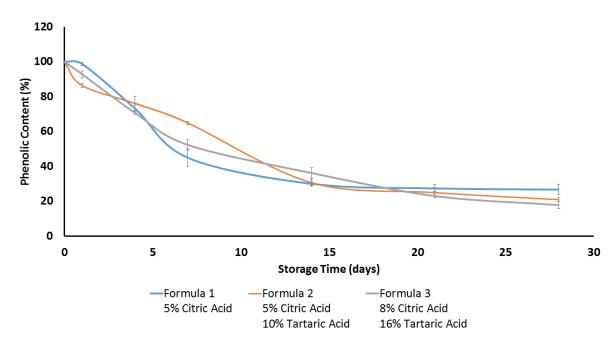
Figure 2. Total Phenolic Content Reduction Profile in 28 Days
formulas I, II, and III, respectively. The result obtained that formula I seems to provide a better result with the highest total phenolic compounds and lower reduction rate during the determination, although the results showed no significant differences between formulas. Based on these results, the use of other methods, the addition of absorbents and a more airtight container should be considered.
CONCLUSIONS
Differences in the selection of acid sources of effervescent agents influence the evaluation of the physical characteristics of the effervescent granules. Formula III with a combined source of citric acid 8% and 16% tartrate was the best formula by fulfilling the test requirements, i.e. density, flowing properties, angle of repose, moisture content, effervescent time, except on the particle size distribution test. The addition of tartaric acid makes the characteristics of the preparation better because it can mutually eliminate the weakness of citric acid that tends to stick.
Differences in the selection of effervescent agents also affected the evaluation of the total phenolic content in soybean effervescent granules. Formula I with 15% of citric acid shown the highest total phenolic content and lower reducement rate during storage. Although the orientation of the adsorbent in the formula and moisture resistant primary packaging must also be considered. Moisture content in the preparations showed a significant effect on total phenolic reduction in all samples.
In the formulation and storage of the dosage form, a room with a certain temperature and humidity is required to maintain the physical and chemical stability of the preparation. Some orientation in the dry granulation process and binder optimization must be considered to improve the physical characteristics of the granule effervescent, especially in particle size distribution.
ACKNOWLEDGMENT
The authors acknowledge the financial support from the DRPM-Ministry of Research, Technology and Higher Education of the Republic of Indonesia.
CONFLICT OF INTEREST
The authors declare that they have no conflict of interest.