

*Correspondence
Email: elisma@unja.ac.id
This study examined the characterization of crude drugs made from pigeon orchid leaves (Dendrobium crumenatum Sw.) and conducted phytochemical screening to identify the secondary metabolites present in them. Medicinal plants, particularly those from the orchid family, have significant potential for developing modern therapies due to the wide range of pharmacological compounds they contain, including anthocyanins, bibenzyl derivatives, and the main bioactive compound, dendrobine. In addition to their beauty, orchids are also beneficial for treating various diseases, making them a potential option for pharmaceutical preparations. The characterization results for the crude drugs derived from pigeon orchid leaves indicated water extractable matter of 42.01% and ethanol extractable matter of 79.11%. The moisture content was measured at 16.04%, and a total ash content of 22.10%. Phytochemical screening showed the presence of alkaloids, phenolic compounds, flavonoids, saponins, and tannins in the pigeon orchid leaves, while no steroids were detected.
Keywords: pigeon orchid leaves, crude drug characterization, phytochemical screening
KARAKTERISASI DAN PEMERIKSAAN FITOKIMIA DARI SIMPLISIA DAUN ANGGREK MERPATI (Dendrobium crumenatum Sw.)
ABSTRAK
Studi ini mengkaji karakteristik simplisia yang dibuat dari daun anggrek merpati (Dendrobium crumenatum Sw.) dan melakukan skrining fitokimia untuk mengidentifikasi metabolit sekunder yang ada di dalamnya. Tanaman obat, terutama yang berasal dari keluarga anggrek, memiliki potensi signifikan untuk terapi pengobatan menggunakan bahan alam karena berbagai senyawa farmakologi yang dimiliki, termasuk antosianin, derivatif bibenzil, dan senyawa bioaktif utama, dendrobin. Selain keindahannya, anggrek juga bermanfaat untuk mengobati berbagai penyakit, menjadikannya pilihan potensial untuk pembuatan sediaan farmasi berbasis bahan alam. Hasil karakterisasi untuk obat mentah yang berasal dari daun anggrek merpati menunjukkan kadar sari larut air sebesar 42,01% dan kadar sari larut etanol sebesar 79,11%. Kadar air simplisia sebesar 16,04%, dan abu total sebesar 22,10%. Skrining fitokimia menunjukkan adanya alkaloid, senyawa fenolik, flavonoid, saponin, dan tanin dalam daun anggrek merpati, sementara tidak terdeteksi adanya steroid.
Kata kunci: daun anggrek merpati, karakterisasi simplisia, penapisan fitokimia
INTRODUCTION
For a long time, medicinal plants have played an important role in cultural practices and traditional medicine systems by utilizing the pharmacological diversity of nature to treat various diseases, including infectious diseases. The diverse properties of these compounds and their small molecular size allow them to function through various pathways, making them interesting for therapeutic development (Atampugbire et al. 2024). The metabolite content found in plants that have been traditionally utilized holds significant importance in the optimal use of phytochemistry to recognize and identify compounds that can be formulated into various modern medicines.
Dendrobium crumenatum (Sw.) is one of the plants that can be used as a raw material for medicine. Dendrobium crumenatum is a tropical epiphytic orchid that usually lives on trees in Southeast Asia. The growth of the plant depends on temperature changes, and the orchid plants can bloom simultaneously in the same location. This orchid flower has fragrant and white color perianths resembling a dove. The pseudobulb is edible and can increase appetite, enhance saliva secretion, and improve overall health. Alkaloids are the main bioactive compounds, known as dendrobin (Azizah et al. 2023).
Orchids are renowned for their aesthetic qualities that showcase their beauty and uniqueness. Many people use orchids as decorations at various events and even as ornamental plants. In addition, orchids have the potential to become medicinal plants in various pharmaceutical preparations to address a range of diseases. The orchid genera that clearly have pharmacological properties include Anoectochilus, Coelogyne, Cymbidium, Calanthe, Nevilia, Dendrobium, Cypripedium, Ephemerantha, Ludisia, Gastrodia, Eria, Gymnadenia, Habenaria, Galeola, Luisia, and Thunia. Some of the main secondary metabolites contained in orchids that have therapeutic effects are anthocyanins, orcinol, bibenzyl derivatives, hircinol, cypripedium, jibantine, nidemin, loroglossin, and phenanthrenes (Gantait et al. 2021).
Raw materials and test products used in the drug development process must follow the standard
quality parameters and proven to be safe and efficacious through pre-clinical and clinical testing. Phytochemical screening is important for analyzing the groups of compounds contained in plants. The identification of certain chemical compounds will provide early information about the traditional and clinical use of herbs, as well as the potential adverse reactions. Therefore, conducting an analysis of the characteristics and screening can help in identifying the development of natural product based pharmaceutical and cosmetic products.
MATERIALS AND METHODS
Apparatus and Materials
The tools used in this research including beaker glass (Pyrex), measuring cylinder (Pyrex),test tube (Pyrex), analytical balance, mesh sieve, Oven, Erlenmeyer Flask (Pyrex), Aluminum Foil, Grinder, Microscope, Filter Paper, Mortar, Pestle, Spatula, and Slide. The materials used in the research are concentrated HCl, CH3COOH, Liebermann-Burchard reagent, anhydrous acetic acid, concentrated H2SO4, 10% NaOH, 1% gelatin, NaCl, 1% iron (III) chloride (FeCl3), chloroform, ethanol, Mg powder, aquades, Dragendorf reagent, and HCl 2N.
Sample Preparation
Fresh matured leaves of Dendrobium crumenatum Sw. were obtained from Kaweron village, Muntilan district, Magelang regency, Central Java province. The leaves are somewhat thick and flat, as they meet the requirements of good plants, which must be fresh, uncontaminated by pathogens or pests, and not physically damaged. The samples were airdried away from direct sunlight. After it had been completely dried, sorting was carried out, where parts of the plant other than the leaves and other impurities were eliminated. The sorted leaf samples were then ground using a blender to make powdered crude drugs and then weighed using an analytical balance.
Characterization of Crude Drug
1. Determination of Water Extractable Matter The crude drug powder was weighed and placed into a stoppered flask. Then, 100 ml of water saturated with chloroform was added and shaken several times. The solution was then filtered after
Putra and Elisma
18 hours of maceration. In an evaporating dish that had previously been heated at 105°C and tared, 20 ml of the filtrate was evaporated until dry. The filtrate was then reheated at 105°C until reaching its constant weight (Veninda et al. 2023).
2. Determination of Ethanol Extractable Matter The crude drug powder was weighed and placed into a stoppered flask. Then, 100 ml of ethanol with chloroform was added and shaken several times. The solution was then filtered after 18 hours of maceration. In an evaporating dish that had previously been heated at 105°C and tared, 20 ml of the filtrate was evaporated until dry. The filtrate was then reheated at 105°C until reaching its constant weight (Veninda et al. 2023).
3. Determination of Water Content
The crude drug powder and boiling stones were put into a round-bottom flask. Next, the roundbottom flask was assembled and connected to a receiving flask with a receiving tube. Then, proceed by adding 200 ml of toluene and 2 ml of water into the flask through the apparatus which was then connected to a reflux condenser. After that, the round-bottom flask was heated over a heating mantle. Copper wire that has been moistened with water-saturated toluene was used to clean the water adhering to the receiver after all the water has been distilled. After the water and toluene had completely separated, the receiving tube was cooled and the water content was measured per gram of the crude drug sample (Veninda et al., 2023).
4. Determination of Loss on Drying
The crude drug powder was weighed in a closed shallow weighing bottle. Before being tared, the bottle must be heated for 30 minutes at 105°C. Then, by shaking it, the crude drug was leveled in the weighing bottle. When the bottle cap is opened, drying was carried out in an oven at 105°C until reaching a constant weight (Depkes RI, 2017).
5. Determination of Total Ash Content
The crude drug was weighed and placed into a preignited and tared silica crucible. After that, the sample was gradually heated to a temperature of 800°C ± 25 °C. Then the ash was cooled and weighed until its constant weight was obstained.
Total ash content was calculated per gram of crude drug sample (Depkes RI, 2017).
Phtochemistry Screening
1. Alkaloids
In a test tube, 10 drops of H2SO4 2N was mixed into 1 gram of extract. Subsequently, Dragendorff reagent was added into the tube. Orange-red color precipitate indicates that the presence of alkaloid (Hanifah and Anjani 2022).
2. Flavonoids
One gram of crude drug was dissolved with water in a tube. Then, 0.5 g of magnesium powder, two drops of concentrated HCl solution, and 1 ml of amyl alcohol were added and the tube was shaken. The formation of a yellow to magenta red color on the upper layer of amyl alcohol within three minutes indicates the presence of flavonoid (Hanifah and Anjani 2022).
3. Phenolic
Five mL of extract was mixed with 2 ml of FeCl3 solution. The presence of phenolic compounds is marked by the appearance of reddish-brown to purplish-red color (Hanifah and Anjani 2022).
4. Tannin
One gram of the extract was dissolved in water and filtered. Then, one drop of FeCl3 solution was added into the extract solution. The presence of tannin was shown by the appearance of green, red, purple, or black color (Hanifah and Anjani 2022).
5. Saponin
One gram of crude drug was boiled with 10 mL of water for five minutes then filtered. The filtrate was put into a test tube, shaken for ten seconds, and allowed to stand for ten minutes. The presence of saponin was indicated by the formation of stable foam (Hanifah dan Anjani, 2022).
6. Steroids/Terpenoids
One milliliter of the chloroform phase was added to the spotting tile, 5 drops of the Liebermann-Burchard reagent were added to it, and the steroid/terpenoids will form a blue or green ring layer (Hanifah and Anjani 2022).
RESULT AND DISCUSSION
Characterization of Crude drug
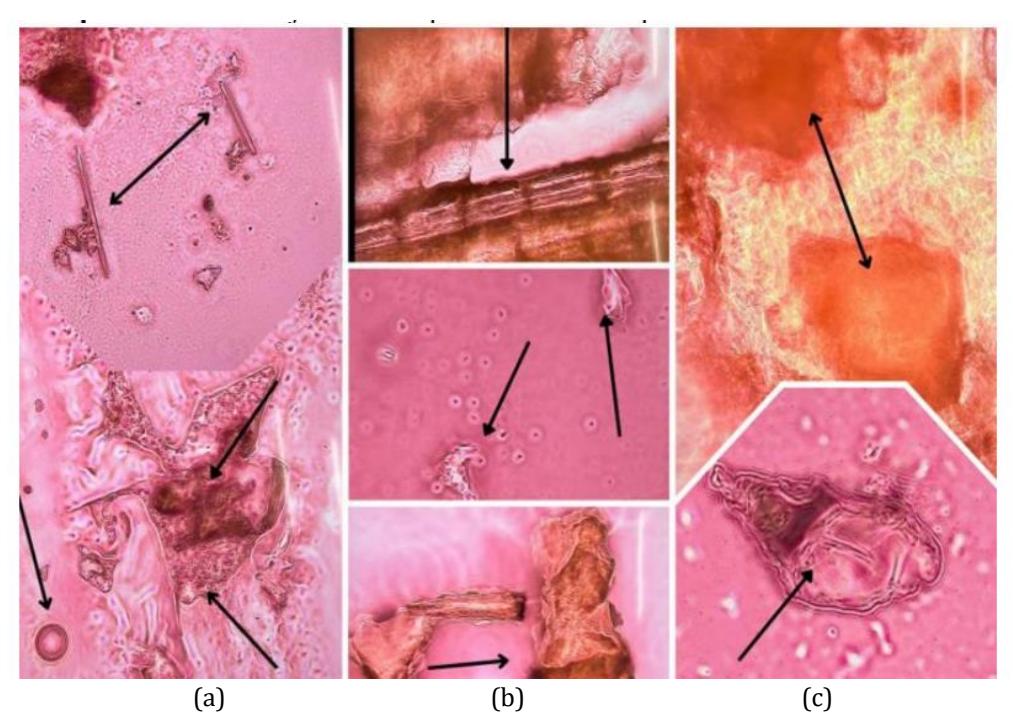
Figure 1. Microscopic view of a leaf with a 10x magnification field of view; trichome, guard cells on the stomata (a), xylem & phloem (b); Oil cell & epidermal stomata cell (c)
In the microscopic observation of pigeon orchid leaves crude drug, an epidermal layer containing yellow oil glands was found. This is because each layer of cells shows clear boundaries in their respective tissues, epidermis, palisade, and the tissue can be easily distinguished from the epidermal cell layer. The upper epidermis and lower epidermis consist of layers of closely packed rectangular cells with no intercellular spaces. Dendrobium crumenatum belongs to the class of Liliopsida, where most of this group has kidneyshaped stomata. The number and position of guard cells around the stomatal pore can vary, just as the epidermal cells (neighboring cells) can have different shapes.
Microscopic examination of the crude drug shows the presence of identifiable fragments in the form of vascular bundles (xylem and phloem) in the image. Plants that produce proanthocyanidins and alkaloids (especially sporophyll or benzylisoquinoline) often accumulate silica, especially in the cell walls of the leaf epidermis.
Parenchyma often contains small calcium oxalate crystals, especially in the oil cells. A single leaf with scattered stipules easily falls and leaves marks on the book. Calcium oxalate crystals are only occasionally found.
The determination of plants to be dried into crude drugs must be carried out by accredited institutions. This will identify the crude drug with its Latin name and plant origin. The quality of crude drug, also known as the characterization of crude drug, is examined to determine the quality of pigeon orchid leaves and to ensure that the quality and safety of crude drug are safe for health. Specific characterization includes macroscopic and microscopic tests, organoleptic tests, phytochemical screening, and determination of the content of ethanol and water-soluble extracts. Nonspecific characterization includes the determination of moisture content and total ash.
Table 1. Characteristic Examination of Crude drug
| Type of Determination | Percentage (%)±SD | |
|---|---|---|
| Water Soluble Extract Content | 42,01±1,15 | |
| Ethanol Soluble Extract Content | 79,11±5,87 | |
| Water Content | 10,03±0,82 | |
| Total Ash Content | 22,30±0,92 | |
| Loss on drying | 22,10±0,00 | |
Determining the water content provides information about the amount of water contained in a material. The growth of fungal microbes can be influenced by the amount of water in the crude drug, which can disrupt the biological activity of the crude drug. With an average moisture content of 10.03%, the crude drug of pigeon orchid leaves can be stored for a long period. The moisture content of crude drug is generally no more than 10%. The moisture content test is conducted to determine the maximum moisture limit of crude drug, so that the quality of the material can be preserved for a long time, as the possibility of mold in crude drug can affect and damage its quality. Ash is the residue from the combustion of organic and mineral compounds in crude drug, with an average ash content of 22.30%. The processes of washing, drying, and storage can also affect the amount of inorganic substances present in the crude drug. Human minerals such as calcium, phosphorus, and magnesium are necessary for bone growth, and the ash content indicates the level of minerals in the material. In food materials, minerals can be in the form of inorganic salts (such as phosphates, carbonates, chlorides, sulfates, and nitrates), or organic salts (such as malic acid, oxalate, acetate, pectate), and inorganic salts (such as phosphate, carbonate, chloride, sulfate, and nitrate salts). The ash content test indicates the mineral content and purity of the material. The drying shrinkage test is conducted to measure the amount of water in the granules that changes due to the heating of the granules during the drying process. The determination of drying shrinkage shows how much of the compound is lost during the drying process. The calculation of water content is carried out after determining the volume. The drying result of the leaf crude drug is 22.10%.
Determination of the water-soluble extract and ethanol-soluble extract is a quantitative method aimed at identifying the compounds that can be extracted by the solvent. The water-soluble extract
content is intended to determine the amount of active compounds that are polar or water-soluble. The ethanol-soluble extract content indicates the amount of active compounds that are nonpolar, soluble in ethanol solvent. The crude drug of the leaves has a higher water-soluble extract content compared to the ethanol-soluble extract content. This indicates that the leaves contain a higher amount of polar active compounds compared to semi-polar-nonpolar compounds. The watersoluble extract content of the leaves meets the quality standards based on the Indonesian Herbal Pharmacopoeia, which is >13.5% (Wijaya and Rissa 2024).
The test with Dragendorff's reagent also showed positive results in the crude drug, with orange to reddish-brown precipitates, but no alkaloids were found in the n-hexane extract. Because bismuth salts are easily hydrolyzed to form bismuthyl ions (BiO+), bismuth nitrate is dissolved in HCl to avoid hydrolysis reactions. As a result, the nitrogen in the alkaloid is used to form a coordinate covalent bond with K+, which is a metal ion. Meanwhile, in the Wagner reagent, a reddish-brown precipitate forms because the K+ ion in potassium iodide will form a coordinate covalent bond with the nitrogen in the alkaloid, resulting in a precipitate of the potassium-alkaloid complex (Kaur et al. 2022). The color that appears in the precipitate occurs because iodine (I2) reacts with the I- ion from potassium iodide, producing the reddish-brown I3 ion. The addition of HCl is used to identify compounds containing a benzopyranone core and benzopyrylium salts, also known as flavilium salts, which are produced as the final product. A reddishorange complex compound in flavonol will be produced by reduction with Mg powder and concentrated HCl. Basically, phenolic compounds tend to dissolve easily in polar solvents such as ethanol and water because they bond with sugars as glycosides and are usually found in cell vacuoles. The reaction of FeCl3 with the sample causes the formation of color in this test, where the ion Fe3+ undergoes hybridization. After adding 1% FeCl3 to the solution, the color changed to dark greenishblack. This phenomenon is the result of the reaction of FeCl3 with one of the hydroxyl groups present in the phenolic compound. The addition of FeCl3 that causes a color change indicates the presence of condensed phenolics (Nurjannah et al. 2022).
Table 2. Phytochemistry Screening Analysis
| Secondary Metabolite | Reagent | Result |
|---|---|---|
| Alkaloids | H2SO4 2N + Dragendorf | + |
| Flavonoids | HCl Pekat + Mg | + |
| Phenolic | FeCl3 1% | + |
| Tannin | Gelatine 1% + NaCl | + |
| Saponin | Hot Water + HCl 2N | + |
| Steroids/Terpenoids | Liebermann-Burchard | + |
The tannin test shows the presence of tannins. If the color reaction test produces a blue or dark green color, and if a 1% gelatin solution added to sodium chloride produces a white precipitate, this indicates the presence of tannins. The results of the phytochemical test showed that after homogenization and the addition of 2N HCl, a stable foam was formed. The purpose of adding 2N HCl in the test is to increase the polarity level, which results in the hydrophilic groups having stronger bonds and the foam formed being stable. The presence of foam or froth in the saponin test indicates the presence of glycosides, which have the ability to form foam in water and hydrolyze into glucose and other substances. Compounds that have polar and non-polar groups are active at the surface, so when saponin is shaken with its solvent, it can form micelles because the polar groups face outward and the non-polar groups face inward, making it look like foam. Steroid/terpenoids testing was conducted using the Liebermann-Burchard reagent on the crude drug, and the result was positive with colour green. The Liebermann Burchard reagent consists of a mixture of concentrated H2SO4 and concentrated HCl. In the steroid test with acetic acid and H2SO4, a blue or green color indicates the presence of steroids, because steroid compounds have the ability to form color with H2SO4 in acetic acid. The acetylation reaction of the steroid –OH group is a reaction that occurs between the steroid and acetic acid (Hanifa et al. 2021).
CONCLUSION
The results of the characterization examination of the pigeon orchid leaf crude drug showed an aqueous extract content of 42.01%, an ethanol extract content of 79.11%, a water content of 10.03%, a drying loss of 20.30%, and a total ash
content of 22.10%. The results of the phytochemical screening of pigeon orchid leaf crude drug showed the presence of alkaloid, phenolic, flavonoid, saponin, steroids/terpenoids and tannin compounds.