

*Correspondence
Email: satrialdi@itb.ac.id
Essential oil extracted from nutmeg (Myristica fragrans) contains various beneficial compounds that can be used in medicines and cosmetics. Nevertheless, nutmeg essential oil (NEO) use in pharmaceuticals is limited by its high lipophilicity and tendency to degrade. Encapsulating NEO into a nanostructured lipid carrier (NLC) can be an alternative to overcome these problems. Thus, this study aimed to develop an NEO formula in an NLC system (NEO-NLC) for topical use, to characterize NEO-NLC, and to elucidate its potential as an antioxidant. The optimization of the NEO-NLC formula included selecting liquid lipid components, adjusting their ratios, choosing a sonicator, selecting a surfactant system, and optimizing sonication amplitude. The optimum NEO-NLC formula was then characterized by determining particle size and distribution, measuring zeta potential, estimating encapsulation efficiency, and evaluating antioxidant activity. The optimum NEO-NLC formula was obtained with a composition of 1.8% cetyl alcohol, 3.0% almond oil, 1.2% NEO, 3.2% Tween 80, 0.8% Plantacare® 1200, and demineralized water. The resulting NEO-NLC exhibited a particle size of 124.4 ± 4.7 nm, a polydispersity index of 0.35 ± 0.05, a zeta potential of -39.0 ± 3.6 mV, and an encapsulation efficiency of 95.3 ± 0.6%. Encapsulation of NEO into an NLC system resulted in a 2.9-fold increase in antioxidant activity compared to unencapsulated NEO. The developed NEO-NLC showed potential for pharmaceutical or cosmetic raw material use.
Keywords: Myristica fragrans, nutmeg essential oil, nanostructured lipid carrier, antioxidant
FORMULASI DAN KARAKTERISASI MINYAK ATSIRI PALA (Myristica fragrans) DI DALAM SISTEM NANOSTRUCTURED LIPID CARRIER
ABSTRAK
Minyak atsiri yang diekstraksi dari biji pala (Myristica fragrans) mengandung berbagai senyawa bermanfaat yang dapat dimanfaatkan sebagai bahan baku obat maupun kosmetik. Namun, penggunaan minyak atsiri pala (NEO) di bidang farmasi dibatasi oleh sifat lipofilisitasnya yang tinggi dan kecenderungannya untuk terdegradasi. Enkapsulasi NEO ke dalam suatu nanostructured lipid carrier (NLC) dapat menjadi alternatif untuk mengatasi permasalahan tersebut. Dengan demikian, penelitian ini bertujuan untuk mengembangkan formula NEO dalam suatu sistem NLC (NEO-NLC) untuk penggunaan secara topikal serta melakukan karakterisasi NEO-NLC termasuk elusidasi potensinya sebagai antioksidan. Optimasi formula NEO-NLC dilakukan melalui pemilihan komponen lipid cair, optimasi rasio komponen lipid, pemilihan tipe sonikator, pemilihan sistem surfaktan, dan optimasi amplitudo sonikasi. Formula NEO-NLC optimum kemudian dikarakterisasi meliputi penentuan ukuran partikel dan distribusinya, pengukuran potensial zeta, dan penentuan efisiensi enkapsulasi, serta elusidasi aktivitas antioksidan. Formula NEO-NLC optimum diperoleh dengan komposisi 1,8% setil alkohol, 3,0% minyak almon, 1,2% MAP, 3,2% Tween 80, 0,8% Plantacare® 1200, dan air demineralisasi. NEO-NLC yang dihasilkan menunjukan ukuran partikel sebesar 124,4 ± 4,7 nm, indeks polidispersitas 0,35 ± 0,05, potensial zeta -39,0 ± 3,6 mV, dan efisiensi enkapsulasi 95,3 ± 0,6%. Enkapsulasi NEO ke dalam sistem NLC menghasilkan peningkatan aktivitas antioksidan sebesar 2,9 kali dibandingkan dengan NEO yang tidak dienkapsulasi. NEO-NLC yang dikembangkan menunjukan potensi untuk digunakan sebagai bahan baku farmasi maupun kosmetik.
Kata Kunci: Myristica fragrans, minyak atsiri pala, nanostructured lipid carrier, antioksidan
INTRODUCTION
Nutmeg (Myristica fragrans), recognized as one of Indonesia's indigenous plants, presents significant potential as a raw material for pharmaceutical and cosmetic applications. Additionally, essential oil derived from nutmeg (NEO) is particularly notable due to its rich composition of bioactive constituents with proven health benefits. As reported by (Ashokkumar et al. 2022), NEO exhibits a diverse range of pharmacological properties, including antibacterial, antioxidant, antifungal, and anti-inflammatory activities. The primary components of NEO that contribute to these beneficial effects include α-pinene, β-pinene, myristicin, 4-terpineol, safrole, sabinene, and limonene (Ansory et al. 2020). In addition to its potential applications in the pharmaceutical field, NEO faces several challenges when formulated as a pharmaceutical preparation. These challenges include its high lipophilicity, volatility, and susceptibility to degradation when exposed to environmental factors. Therefore, a delivery system is necessary to protect NEO while enhancing its penetration, particularly for topical applications on the skin.
Nanotechnology has emerged as a groundbreaking field, attracting considerable interest over the last few decades, especially within pharmaceuticals and cosmetics. The concept of nanotechnology was introduced by the Nobel laureate Richard Feynman in 1959, who inspired innovations by discussing the potential of manipulating materials on a small scale (Feynman 1960). Among the fascinating advancements in this field is the nanostructured lipid carrier (NLC), which is an effective vehicle for delivering highly lipophilic substances. NLC represents a significant evolution in lipid nanoparticles, marking it as a second-generation technology that boasts numerous advantages over its predecessor, the solid lipid nanoparticle (SLN).
NLCs are distinguished by their enhanced physical stability, higher drug loading capacity, and minimal drug expulsion during storage, ensuring the therapeutic compounds remain intact and ready for use (Chauhan et al. 2020). These advantageous characteristics originate from the innovative design of the NLC, which incorporates liquid lipid components into the carrier system (Muller et al.
2011). This unique formulation disrupts the formation of a perfect crystalline structure typically seen in SLNs, resulting in a more versatile and efficient delivery system (Müller, Radtke, and Wissing 2002). Previously, we succeeded in developing an NLC system as the carrier for clove essential oil, which improved clove essential oil's stability and antioxidant activity against fibroblast cells (Satrialdi et al. 2024).
In this research, we aimed to enhance the potential application of NEO by encapsulating it within an NLC system. We undertook several optimization processes, which included selecting the appropriate liquid lipid components, adjusting the ratio between solid and liquid lipids, choosing a suitable sonicator, selecting a surfactant system, and optimizing the sonication amplitude. After completing these optimizations, we evaluated the characteristics of the NEO-NLC by assessing particle size and distribution, measuring zeta potential, and estimating encapsulation efficiency. Additionally, we investigated the antioxidant activity of the developed NEO-NLC.
MATERIALS AND METHODS
Materials
The formulation components, including NEO, almond oil, grapeseed oil, virgin coconut oil, sesame oil, were purchased from PT. Darjeeling Sembrani Aroma (West Java, Indonesia), while cetyl alcohol was obtained from Gracefruit Ltd. (Bonnybridge, United Kingdom). The 2,2-diphenyl-1-picrylhydrazyl (DPPH) and ascorbic acid were purchased from PT. Smart-Lab (Banten, Indonesia) and Merck (Rahway, NJ, USA), respectively. All other chemicals and solvents utilized in this research were sourced as commercially available pro-analytical grade.
The fabrication of NEO-NLC
The NEO-NLC was prepared using the emulsification-sonication method, as previously described by (Soleimanian et al. 2018), with some minor modifications. First, the lipid components were combined and heated to 60 °C. Simultaneously, the aqueous surfactant system was heated in a separate container until it reached 60 °C. Once both phases reached this temperature, NEO was briefly introduced to the lipid phase, followed by mixing lipid and water phases using a homogenizer set to 6,600 rpm for 5 minutes. Finally, the mixture was sonicated to produce the NEO-NLC.
Formula optimization of NEO-NLC
Formula optimization was performed to develop the optimal NEO-NLC. This involved screening liquid lipids, optimizing lipid ratios, selecting a sonicator, selecting a surfactant system, and adjusting the sonicator amplitude. Four candidates—almond oil, virgin coconut oil, grapeseed oil, and sesame oil—were tested at a fixed concentration of 1.8%, combined with 3% cetyl alcohol. To stabilize the NEO-NLC, 4% Tween 80 was used, with NEO set at 1.2%. The next step involved optimizing the ratio of cetyl alcohol to the chosen liquid lipid, with variations of 3.0:1.8 and 1.8:3.0. Additionally, we evaluated the type of sonicator used to prepare the NEO-NLC by comparing the particle characteristics obtained from a bath-type sonicator with those from a probe-type sonicator. The impact of adding a cosurfactant was also investigated using two candidates: Plantacare® 1200 and Tego® care 165, combined with Tween 80 in a 1:4 ratio. Additionally, the sonicator amplitude was varied among 40%, 50%, and 60%. The optimal formula was evaluated based on particle size characteristics and its distribution at each stage of the optimization process.
Characterization of NEO-NLC
The optimized NEO-NLC was subjected to particle characterization. This evaluation included determining particle size and distribution, measuring zeta potential, and estimating encapsulation efficiency (EE%). The determination of particle size and distribution was carried out using a particle size analyzer (Beckman Coulter Delsa Nano C, Brea, CA, USA) utilizing the dynamic light scattering method, while the measurement of zeta potential was conducted using the electrophoretic light scattering method on the same instrument. Additionally, to estimate the amount of NEO encapsulated in the NLC system, firstly, the non-encapsulated NEO (free NEO) was separated from the NEO-NLC using centrifugal ultrafiltration at 10,000 rpm for 30 minutes. The concentration of free NEO was then analyzed by measuring the UV absorption at 266 nm. The encapsulation efficiency was estimated using the following equation (Gomaa et al. 2022):
\[\textit{EE \%} = \frac{\textit{initial NEO concentration } - \textit{free NEO concentration}}{\textit{initial NEO concentration}} \\ \times 100\%\]
Evaluation of antioxidant activity
The antioxidant activity of NEO-NLC was assessed using the DPPH scavenging method, following the technique of (Setiawan et al. 2018) with minor modifications. We compared the antioxidant activity of NEO-NLC and free NEO, using ascorbic acid as a control. A 0.2 mM DPPH methanolic solution was mixed with various sample concentrations in a 1:1 volume ratio and incubated in the dark for 30 minutes. After incubation, the absorbance was measured using a UV-Vis spectrophotometer. The antioxidant activity was then calculated using the following equation:
Free radical scavenging (%) \[= \frac{(DPPH \ absorbance - sample \ absorbance)}{DPPH \ absorbance} x100\%\]
The IC50 value, indicating the concentration that scavenges 50% of DPPH, was then calculated from three independent experiments.
Statistical analysis
The quantitative data in this research are presented as average values accompanied by standard deviations (S.D.) calculated from three independent experiments. A T-test was employed to assess the differences between the two groups, while a non-repeated ANOVA followed by the Student-Newman-Keuls (SNK) test was used to differentiate between more than two groups.
RESULT AND DISCUSSION
NEO-NLC was developed using an emulsification process followed by sonication. We began by selecting liquid lipid components to create NEO-NLC, screening four candidates: almond oil, virgin coconut oil, grapeseed oil, and sesame oil. As shown in Table 1, each liquid lipid resulted in different particle characteristics, particularly in particle size and distribution. These differences may arise from variations in the fatty acid composition of the liquid
Satrialdi et al.
lipids, differences in their viscosity, and their compatibility with other components in the formulation (Badea et al. 2015; Bashiri et al. 2020). This optimization process determined that almond oil was the most suitable liquid lipid for preparing NEO-NLC. This conclusion is supported by the resulting particle characteristics, which exhibited a relatively small particle size and a homogeneous
distribution. Additionally, the NEO-NLC produced with almond oil also demonstrated good reproducibility, as indicated by a relatively low standard deviation for particle size and polydispersity index (PDI). Thus, we decided to use almond oil as the liquid lipid component for the following experiments.
Table 1. Particle characteristics of NEO-NLC made from different liquid lipids
| Liquid lipid | Particle size (nm) | PDI |
|---|---|---|
| Almond oil | 210.9 ± 16.4 | 0.33 ± 0.03 |
| Virgin coconut oil | 260.3 ± 162.2 | 0.29 ± 0.11 |
| Grapeseed oil | 354.6 ± 67.8 | 0.35 ± 0.17 |
| Sesame oil | 1397.2 ± 1127.8 | 0.63 ± 0.11 |
Note: value = mean ± S.D. (n = 3)
Following the identification of the most appropriate liquid lipid component, we proceeded with our experiment by evaluating the impact of the solid-to-liquid lipid ratio on the characteristics of the particles. We investigated two ratios: 3.0:1.8 and 1.8:3.0. The results summarized in Table 2 demonstrate that the ratio of 1.8:3.0 yielded smaller particle sizes and improved distribution, as indicated by the particle size and PDI values, respectively. A similar trend was observed in our previous research, where an increase in the solid lipid composition resulted in larger NLC particle sizes (Satrialdi et al. 2023). This phenomenon can be attributed to the presence of a greater proportion of liquid lipids, which effectively reduces the viscosity and surface tension of the NLC system, thereby facilitating the formation of smaller particle sizes (Hu et al. 2005).
In the subsequent optimization process, we examined how different sonication methods affect the characteristics of NEO-NLC particles. We compared two types of sonicators: bath-type and probe-type. A bath-type sonicator generates multiple low-strength cavitation zones, while a probe-type sonicator creates a single, highstrength active zone, concentrating the energy at one point (Jiang et al. 2009). According to Figure 1, NEO-NLC produced with a probe-type sonicator had a relatively smaller particle size, improved particle size homogeneity, and greater reproducibility. Based on these findings, we chose to use a probe-type sonicator to prepare NEO-NLC for our next experiments.
Table 2. The effects of lipid composition on characteristics of NEO-NLC
| Cetyl alcohol (%) | Almond oil (%) | Particle size (nm) | PDI |
|---|---|---|---|
| 3.0 | 1.8 | 210.9 ± 16.4 | 0.33 ± 0.03 |
| 1.8 | 3.0 | 170.1 ± 35.6 | 0.31 ± 0.01 |
Note: value = mean ± S.D. (n = 3)
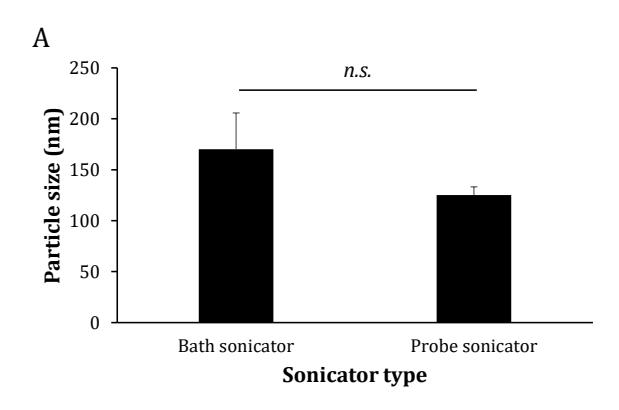
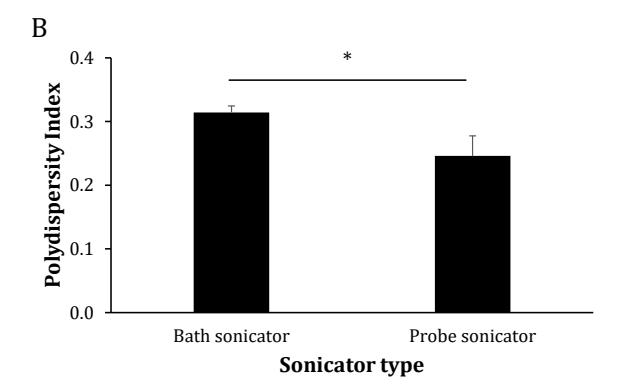
Figure 1. The effects of sonication type on (A) the particle size and (B) its distribution of the NEO-NLC. Value represented as the mean with S.D. from 3 independent experiments (n.s. = not significant; *p<0.05 by two-tail unpaired T-test).
After completing the above optimization processes, we proceeded with the NEO-NLC formulation by examining the changes in particle size after storing it for one day at a temperature of 4 °C. We observed a significant increase in the particle size of the NEO-NLC after this storage period (Table 3). This increase suggests that the resulting NEO-NLCs exhibit low stability. One possible explanation for this issue is that the single surfactant system cannot adequately stabilize the NEO-NLC. To address this, we investigated the effect of adding a co-surfactant on the stability of the NEO-NLC. We
combined Tween 80 with Plantacare® 1200 or Tego® Care 165 in a ratio of 4:1. As presented in Table 3, the inclusion of both Plantacare® 1200 and Tego® Care 165 enhanced the stability of the NEO-NLC, as shown by the minimal changes in particle size and distribution. However, we noted that some lipids adhered to the vial wall in aggregate form when NEO-NLC was prepared using Tego® Care 165 as a co-surfactant. Consequently, we used Plantacare® 1200 as the co-surfactant for preparing the NEO-NLC.
Table 3. The screening of surfactant system and its effects on the stability of the NEO-NLC
| S | Particle | Particle size (nm) | PDI | ||
|---|---|---|---|---|---|
| Surfactant system | H0 | H1 | H0 | H1 | |
| Tween 80 | 125.2 ± 8.0 | 343.9 ± 305.0 | 0.25 ± 0.03 | 0.27 ± 0.06 | |
| Tween 80-Plantacare® 1200 | 96.3 ± 4.3 | 95.0 ± 12.9 | \(0.34 \pm 0.02\) | 0.35 ± 0.02 | |
| Tween 80-Tego® Care 165 | 112.0 ± 9.9 | 120.8 ± 17.2 | 0.34 ± 0.04 | 0.29 ± 0.05 | |
Note: value = mean \(\pm\) S.D. (n = 3)
We then examined how sonication amplitude affects the properties of NEO-NLC. We tested three levels of sonication: 40%, 50%, and 60%. Figure 2 shows that increasing the sonication amplitude decreases the particle size. This happens because a higher amplitude generates more energy, which breaks up the particles. However, too much energy can create bubbles and lead to aggregation. Thus, sonication amplitude is crucial when making an NLC system. Based on the results in Figure 2, we chose a sonication amplitude of 50% to prepare NEO-NLC. The best formula for producing NEO-NLC is presented in Table 4, which uses a probe sonicator set at 50% amplitude.
The optimized formulation of NEO-NLC underwent a comprehensive characterization process. As presented in Table 4, the NEO-NLC demonstrated a particle size of approximately 125 nm, accompanied by an acceptable PDI value, indicating a homogeneous particle distribution. Furthermore, the zeta potential, which reflects the surface charge of the particles, revealed a notably high negative charge of approximately -39.0 mV. More than 95% of NEO was successfully encapsulated within the NLC system. Collectively, the characteristics of the resulting NEO-NLC suggest its potential efficacy as a topical agent. We then evaluated the antioxidant activity of NEO-NLC compared to nonencapsulated NEO using the DPPH scavenging
Satrialdi et al.
method. DPPH is a free radical that can react with an antioxidant agent, forming a reduced form of DPPH (Munteanu and Apetrei 2021). Our findings indicated that encapsulating NEO in an NLC system improved its antioxidant activity by 2.9-fold, as reflected in the \(IC_{50}\) value (Table 5). The observed increase in antioxidant activity can be attributed to the inclusion of almond oil in the NEO-NLC formula. Almond oil is renowned for its rich antioxidant content, which neutralizes free radicals and reduces oxidative stress (Csakvari et al. 2019). This oil has a synergistic effect with NEO, which enhances the overall antioxidant scavenging efficacy of the formula. Although the \(IC_{50}\) of NEO-NLC is relatively high compared to ascorbic acid, the developed NEO-NLC shows promise as a therapeutic strategy for various skin-related disorders, including antibacterial, antifungal, and anti-inflammatory applications.
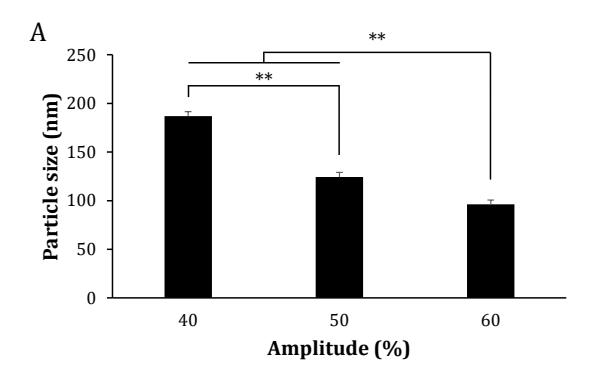
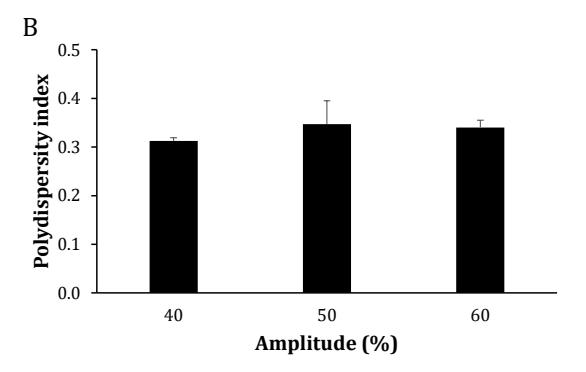
Figure 2. The effects of sonication amplitude on (A) the particle size and (B) its distribution of the NEO-NLC. The error bars indicate S.D. from three independent experiments (not significant for polydispersity index and **p<0.01 by non-repeated ANOVA followed by SNK Test).
Table 4. The optimized formulation of NEO-NLC and its characteristics
| Material | Concentration (%) | Particle characteristics |
|---|---|---|
| NEO | 1.2 | Particle size: 124.4 ± 4.7 nm |
| Cetyl alcohol | 1.8 | PDI: 0.35 ± 0.05 |
| Almond oil | 3.0 | |
| Tween 80 | 3.2 | ζ-potential: -39.0 ± 3.6 mV |
| Plantacare® 1200 | 0.8 | EE: 95.3 ± 0.6% |
| Demineralized water | Up to 100.0 |
Note: value = mean \(\pm\) S.D. (n = 3)
Table 5. DPPH radical scavenging activity of NEO and NEO-NLC
| Sample name | IC50 (μg/mL) | |
|---|---|---|
| Ascorbic acid | \(10.9 \pm 0.7\) | |
| NEO | 6770.8 ± 260.5 | |
| NEO-NLC | 2337.3 ± 101.7 | |
Note: value = mean \(\pm\) S.D. (n = 3)
CONCLUSIONS
In summary, we have developed an NLC system for encapsulating NEO with the following composition: 1.8% cetyl alcohol, 3.0% almond oil, 1.2% NEO, 3.2% Tween 80, 0.8% Plantacare® 1200, and demineralized water. The resulting NEO-NLC
displayed a particle size of \(124.4 \pm 4.7\) nm, a polydispersity index of \(0.35 \pm 0.05\), a zeta potential of \(-39.0 \pm 3.6\) mV, and an encapsulation efficiency of \(95.3 \pm 0.6\%\). We observed that the NEO-NLC exhibited a 2.9-fold increase in antioxidant activity compared to free NEO. Furthermore, the NEO-NLC showed promising potential as a therapeutic
strategy for various skin-related disorders and in cosmetic applications.