

INTRODUCTION
Information technology (IT) has become an important part of the operation of the tourism industry. If current trends continue, it is expected that IT will be one of the factors that will push tourism development in the future (Singh, 2000; Buhalis, 2003). This significant role of IT has not escaped the attention of academics and practitioners. In other countries (for example Australia, Hong Kong, India, Spain and the US), the intersection of IT and tourism has been widely studied (Baker, Sussman & Welch, 1999). How hotels adopt IT is one of the subjects that has received sufficient attention (see Camison, 2000; Connoly & Olsen, 2000; Enz, Namasivayam and Siguaw, 2000).
In the Philippines, the subject is severely under-researched. Very few published studies could be cited that dealt with the intersection of IT and tourism. Unearthed papers include a study on the number of travel agencies using global distribution systems done back in 1993 (Buhalis, 1998). More recently, Quiton (2003) explained the role and value of the internet in tourism intermediaries. No one has ever looked into IT adoption of hotels. Our study fills this gap.
Address corresponcence to Edieser L. de la Santa, Asian Institute of Tourism, University of the Philippines, Commonwealth Avenue, Diliman, Quezon City, 1101 Philippines. Email: edieser.de_la_santa@up.edu.ph, edlsanta@hotmail.com.
The specific of our study were as follows :
- 1. Examine the extent of use of IT among Philippine hotels, their speed in adopting the technology, and the degree to which these hotels actually use new technology; and
- 2. Investigate factors that influence the adoption of technology.
Given the important role ascribed to IT, an assessment of its utilization is important and appropriate. More so, when the technology in question (like IT) is amorphous and variations in the form of adoption are high. Not only would it permit us to know the IT bases of hotels, it would also allow us to gain insights on the various factors that shape the decision of hotels to adopt technologies. For hotels, especially those that maintain modest operations, the decision to commit to new technology could be difficult to make because the investment could be expensive, uncertain, and might involved high switching cost. Prior investments might also become obsolete. However, if a new technology is promising, it will create attractive new opportunities. For technology vendors catering to hotels, understanding how their potential customers adopt technologies can help in formulating superior marketing strategies, including coming up with better product designs, distribution schemes and prices. This appraisal becomes urgent when one considers the fact that the Philippine government has designated information and communications technology as a tool to leapfrog into the new economy. It plans to work on the development of needed ICT skills, improving condition of access, developing infrastructure, and establishing the appropriate policy and legal basis for ICT operations (National Economic and Development Authority, 2001).
The rest of the paper is organized as follows: a review of types of IT found in hotels as well as the factors that affect their decisions to adopt or not specific technologies. Presented next are facts on the current situation of the Philippine hotel industry. Theories that inform the adoption of IT are then discussed. Method to gather data, some hypotheses and testing procedures follow after. Discussion of results, conclusions and areas for future research complete the paper.
REVIEW OF RELATED LITERATURE
Hospitality-specific studies on adoption of IT are widely varied. Works on this area include identification and classification of adopted IT, speed and phases of adoption, and the reasons for adoption and non-adoption of IT. O'Connor (2000) identified five areas of IT adoption in hotels. These are: (1) reservations systems; (2) property management system; (3) ancillary systems that include electronic door-lock system, energy-management system, in-room entertainment systems, internet access, telephone and call accounting system; (4) catering information systems composed of recipe-costing system, stock-control system, conference and banqueting system, electronic POS; and (5) back-office systems comprised of accounting systems, payroll system, human resources system, sales and marketing system. According to Inkpen (1998), these technologies could either be owned and operated by the hotels themselves, purchased from software companies, or outsourced to a third party who will run all or some of the hotel application functions. The aforementioned systems are not integrated and are often used independently.
There are various reasons why hotels adopt information technology. IT offers advantages in terms of providing service quality, improved administrative processes and competitive edge in costs or differentiation. Further, IT may be used as a motivational tool for human resources, serves as substitute for seasonal labor, and supports management functions by adding value within the business strategy (Camison, 2000; Connolly & Olsen, 2000). Connolly (2000) suggested that IT might be used to enhance service dyads in hotels. Enz et al. (2000) summed up the various uses of technology in hotels as reducing operating costs; improving sales
productivity, guest services, and revenue management; streamlining operations by reducing paperwork; speeding information dissemination; and increasing employee productivity, thereby increasing profitability. Moreover, IT presents opportunities that enable small and independent hotel properties to compete with larger hotels, promotes efficient cooperation among the properties, aids in tapping non-traditional markets, and extends their reach on a global scale (Buhalis 2000; Buhalis & Paraskevas, 2000).
Yet there are also compelling reasons why hotels are hesitant to integrate IT in their operations. According to Buhalis (2003), hotels are reluctant to use IT due to the IT illiteracy of their entrepreneurs, the cost of IT is often perceived as prohibitive for entrepreneurs, inability of owners to control the equipment, perceived dependence on trained staff, lack of standardization, seasonality and limited period of operations, lack of marketing and technology understanding, insufficient training and established organizational practices, small sizes of the firms multiplies the administration required by certain technologies (e.g. CRS) to deal with each property; unwillingness of hotels to lose control over their properties.
Despite the numerous systems in hotels, Wardell (1987) points out that the lodging industry is the most under-automated segment of the international travel industry. This is a result of poor reliability records of IT in the past, lack of an accepted technology standard for hospitality computer systems, as well as the difficulty the industry experiences to describe, standardize and manage rationally the hospitality product (Kasavana, 1978; O'Connor, 2000). Consequently, the kinds of technology used throughout the hospitality industry vary widely depending upon the type and size of hotel (Inkpen, 1998).
Firm size is a significant explanatory factor in innovation research (Kumar & Siddhartan, 1999; Rogers, 1995). Economic literature typically argues that small firms lack the ability to exploit rapidly their innovations and (in consequence) earn a lower rate of return. Because the costs of the innovation are spread over a larger total output, a given process innovation generates greater returns in the case of large firms (Nelson & Winter, 1982; Ferguson & Ferguson, 1994). Although some research papers observed that the relationship between firm size and adoption was inconclusive (Cohen and Levin, 1989), some works have proven that size was one of the most important variables that determine the degree of information adoption (Turner, 1982). And with tourism being an information-intensive activity (Poon, 1988), it was deemed important to include hotel size.
A hotel could be classified based on ownership, service features and market price. In terms of ownership, a hotel could be independent or could be part of a chain (Chon & Sparrowe, 2000). These characteristics have bearing on their IT adoption behavior. According to Enz, et al. (2000), affiliation to an established brand by properties forces hotels to adopt a minimum level of technology. This tendency to copy other units happens particularly when formal and informal pressures are exerted on the firm by other organizations upon which they are dependent, when goals are ambiguous, or when members of an occupation collectively define the conditions of their work (DiMaggio & Powell, 1983). Hence, greater institutional pressure to a hotel by its stakeholders such as parent companies, customers, trading partners, investors, bankers, suppliers, general public, media and employees may pressure the firm to conform to institutionalized norms and expectations. In the paper, it is hypothesized that affiliation by a Metro Manila hotel to a chain property will lead to increased adoption of information technology.
Philippine Hotel Industry
A wide variety of accommodation establishments exist in the Philippines. Hotels are classified by the Department of Tourism into deluxe, first class, standard and economy class (Department of Tourism, 1987). The premier category is deluxe where requirements are most demanding and of the highest quality in terms of facilities and furnishings in the bedroom, housekeeping, food and beverage, front office, recreation, entertainment, engineering and maintenance, service and staff, general facilities, special facilities and insurance. For example, rooms are biggest and most numerous in deluxe hotels. The quality of service and the number of facilities decreases as one goes down to first class, standard and economy classes.
As of 2001, there were 28,971 rooms in the country, with Metro Manila making-up 39% of the total capacity (World Tourism Organization, 2003). Philippines hotels have not recovered fully from the ill-effects of the Asian crisis. From a high of 70% average occupancy rate in 1996, rates steadily declined to approximately 56% in 2001. Average length of stay is steady at around 2.73 nights.
METHOD
Metro Manila was chosen as study area due to its role as the political and economic capital of the Philippines. As the principal gateway to the country, tourists must pass through the city before they can move on to other sites. Hence, a wide variety of accommodation establishments, including major hotel chains, operate in the capital more than any other destination in the country.
All Metro Manila member hotels of the Hotel and Restaurant Association of the Philippines and additional hotels accredited by the Department of Tourism (DOT) were contacted and surveyed for this study. The population of 59 represents key players in the Metro Manila hotel industry. Further, membership in the association and government accreditation signify active and legal operations in the metropolis making the data derived from these hotels more credible. The survey, conducted in February and March, 2003, involved an interview with the managers of the hotels using a questionnaire that was developed from an initial desk research and subsequent consultations with practitioners in the local hotel industry. The questionnaire was designed for broader studies on the relationship of IT and tourism and was divided into three parts. The first section dealt with the profile of the hotels. The second section focused on the hotel's IT adoption and non-adoption behavior. The managers were asked to evaluate adoption and non-adoption factors derived from the works of Buhalis (2000) and Rogers (1995) using a five-point Likert scale. The scale ranged from 1 (Very Significant) to 5 (Very Insignificant), with 3 representing the neutral point (Neither Significant or Insignificant). The third part of the questionnaire asked how hotels acquire and manage IT. Here, respondents were asked whether they hire individuals with inclination, conduct training for personnel, establish institutional linkages and outsource technological requirements based on dichotomous scale (1 = yes, 0=no).
Testing of the Adoption and Non-adoption Factors
T-tests were performed on each of the Likert statements against the neutral position. The aim of this process was to determine if the adoption and non-adoption factors were rated significantly different from the neutral point. Average responses below three were interpreted as significant
factors of adoption and responses above three suggest insignificance of the factors. The same interpretation applies to the non-adoption factors.
Analysis of variance (ANOVA) was used to determine if the mean number of IT of each hotel classification and management structure differ from one another. In order to find out if affiliation and size matters in the adoption of IT, a one-tailed t-test was employed. Size was measured by the legal category of the hotel. They were divided into two categories: one group was composed of high-end hotels (deluxe and first class) and another group was the low-end hotels (standard and economy). The combination was logical since the Hotel Code of the Philippines makes no distinction in IT requirements between deluxe and first class; likewise between standard and economy hotels. For affiliation, hotels were grouped into affiliated and independent properties and were compared accordingly. Dummy variables were used for affiliation with 1= affiliated and 0=otherwise.
Regression analysis was used to establish the effect of size and affiliation on adoption of hotel IT. The independent variable was the total number of IT being used by each hotel while dependent variables were size and affiliation. Here, size was measured by the number of rooms (correlation coefficient with legal category: 0.638). Dummy variables for affiliation were retained.
RESULTS
Sample Characteristics
Responses were received from a diverse cross- section of the Metro Manila hotel industry. Standard hotels numbered the most with 50% of the sample, followed by deluxe properties with 20%. By type of management or ownership, 30% of the hotels were affiliated while 70% were independently-owned. Average occupancy was 58%. The sample combined for a total 7,122 rooms, which was approximately 60% of all DOT-accredited rooms in the city.
Information Technology Rate of Adoption
Figure 1 graphically summarizes the extent of technology adoption by the hotels. From the 17 information technologies listed in the questionnaire, the most popularly adopted was the wakeup system. It was present in almost 90% of all properties surveyed. Hotel property management systems were available in 57% of the hotels. ATM was the least distributed among the 17 ITs with only 2 hotels (7%) reporting having it.
In terms of the average age of the technologies, we found that multiple phone lines and interactive TV guides were the two most mature. Wake-up system, which was the most popular, came at third place while hotel PMS was fifth. The most recent innovation was in-room internet. Results likewise show that Metro Manila hotels are not very active in technology adoption. Of the 17 ITs listed, hotels report only having 7.1 (41%). Since no industry standards exist, the authors devised a three-scale classification measure and grouped the hotels accordingly: low technology (1-6 ITs), medium technology (7-12 ITs), high technology (13 to 17 ITs). Only one was found to be in the high-technology group. A little more than half (53%) belonged to the medium-tech group while 43% was classified as low technology.
In terms of type of ITs, the hotels seem to be less concerned with procuring technologies that will earn additional revenue nor save on labor cost but more on enhancing guest service. As
Figure 1 shows, the least popular was ATM machines, a technology where hotels stood to earn revenue. Meanwhile, the most popular IT was the wake-up system, a technology that is more closely associated with guest service. Moreover, the most mature technologies could also be considered as leaning towards guest service.
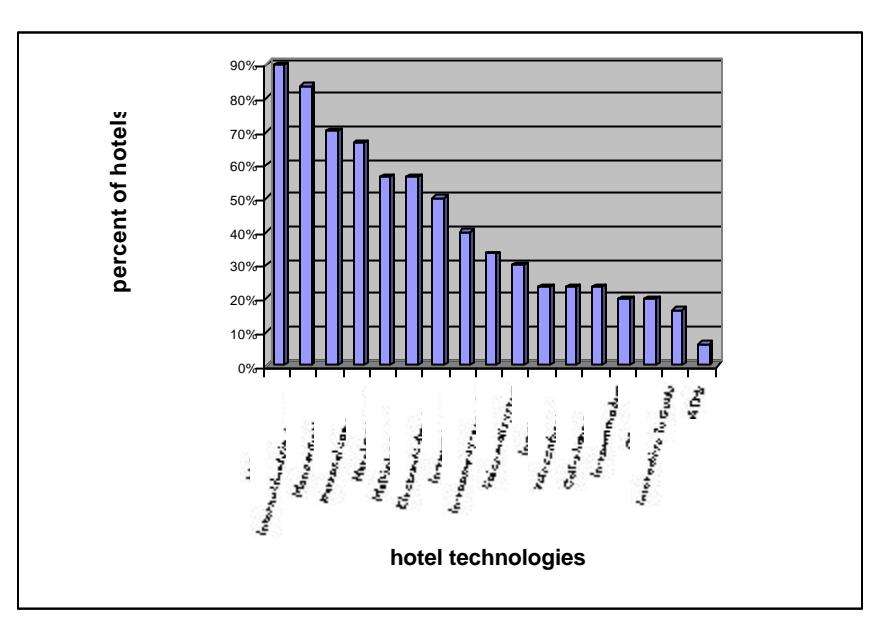
Figure 1 Extent of IT Adoption
Table 1 Reason for IT Adoption
| Statement | meana | Std. Dev. | T- Stat |
|---|---|---|---|
| 1. Technology appropriate with corporate strategy | 1.633 | 0.668 | 13.379* |
| 2. New IT offers relative advantage over old tech/ | 1.633 | 0.615 | 14.548* |
| product 3. Technology easy to use | 1.633 | 0.615 | 14.548* |
| 4. Benefits offered by the technology clearly visible | 1.667 | 0.711 | 12.836* |
| 5. Technology compatible with prevailing systems of the | 1.733 | 0.583 | 16.276* |
| hotel 6. Other hotels are using IT | 1.767 | 0.935 | 10.346* |
| 7. To generate profit | 1.800 | 0.961 | 10.256* |
| 8. To save on (labor) cost of doing business | 1.867 | 0.776 | 13.174* |
| 9. Benefits of IT exceeds cost | 1.900 | 0.662 | 15.726* |
| 10. Strong consumer demand | 1.967 | 0.718 | 14.994* |
| 11. To be technology leader in the market | 2.167 | 0.913 | 13.000* |
| 12. Hotel managers need not upgrade present skills to use | 2.200 | 1.243 | 9.695* |
| new IT 13. Meet government requirement | 2.367 | 1.033 | 12.544* |
| Cronbach's alpha: 0.8302 |
abased on Likert scale with 1=very significant, 5=very insignificant
* significant at á = 0.05
Reasons for adoption and non-adoption of information technology
After establishing the internal validity of the factors for adoption of IT (Cronbach alpha = 0.8302), we computed for the mean ratings. Results of the evaluation of reasons behind the adoption of IT are presented in Table 1. Technology's fit with corporate strategy, relative advantage over old technology, and ease of use appear as the most significant reasons why hotels adopt information technology. They all have mean ratings of 1.6333. Earning from the technology itself does not rank high with the hotels, as does generating savings. Following government requirement in terms of IT adoption does not seem so important to the hotels as it garnered only a mean rating of 2.3667.
Table 2 Reasons for Non-IT Adoption
| STATEMENT | MEANa | STD. DEV. | T-STAT |
|---|---|---|---|
| 1. Cost of IT exceeds benefits | 1.633 | 1.066 | 7.021* |
| 2. Lack of capital for IT investments | 2.200 | 1.540 | 2.845* |
| 3. Hotel managers need to upgrade present skills to use new IT | 2.200 | 1.400 | 3.131* |
| 4. No one in the hotel is able to use and/or control IT equipment | 2.333 | 1.539 | 2.373* |
| 5. Management perceives that they will be dependent on the trained staff | 2.400 | 1.276 | 2.576* |
| 6. Management do not fully understand the benefits of IT | 2.400 | 1.404 | 2.340* |
| 7. Hotel personnel is insufficiently trained | 2.400 | 1.499 | 2.192* |
| 8. Lack of consumer interest/demand For IT products | 2.400 | 1.380 | 2.382* |
| 9. Lack of government incentives To invest in Hotel ITs | 2.667 | 1.516 | 1.204 |
| 10. Established processes/procedures in the hotel will be disrupted | 2.667 | 1.446 | 1.262 |
| 11. IT standards are lacking or completely absent in the industry | 2.733 | 1.363 | 1.072 |
| 12. Hotel has no leverage to negotiate with suppliers and customers | 2.733 | 1.461 | 1.000 |
| 13. ITs are inappropriate for market segment or corporate strategy | 2.767 | 1.382 | 0.925 |
| 14. Technology too complex to handle | 2.767 | 1.455 | 0.879 |
| 15. New technology does not offer relative advantage over old IT | 2.833 | 1.555 | 0.587 |
| 16. Technology is incompatible with prevailing systems of the hotel | 2.833 | 1.487 | 0.614 |
| 17. Operation of hotel is very seasonal thus IT will be of limited use | 3.033 | 1.520 | 0.120 |
| 18. Management believes they will lose full control of the business | 3.133 | 1.502 | 0.486 |
| Cronbach Alpha: 0.9472 |
abased on Likert scale with 1=very significant, 5=very insignificant
From the results, intrinsic characteristics of the technology play greater roles in the decision of the hotels than other factors. This is reflected in the mean rating of statements 1 to 5, which all relates to the nature of the technology. External considerations (statements 6, 10,11 and 13) and cost/revenue matters (statements 7 and 8) play minor roles in the decision to adopt IT. Table 2 shows the results for non-adoption. Of the 18 statements asked, eight reasons for nonadoption of IT showed significant effects. Deeper probing reflects that these eight statements revolve in two reasons: cost of IT and the degree of personnel IT literacy. Statement 1 has the least mean with a very high t-stat (significant at ±=0.05) indicating high significance of the
* significant at a = 0.05
"cost" reason. This shows that cost and lack of capital sufficiently hinders Metro Manila hotels to adopt or even update their ITs.
The hotels also suffer from IT literacy issues as shown by the results of statements 3, 4 and 7 (all having t-stat greater than two and significant at alpha= 5 %). Looking at the results of statements 10, 14 and 16, it is noted that complexity or characteristics of IT is not a constraining factor. This suggests that hotel personnel are capable of addressing the literacy issue. In fact, IT characteristics (i.e. ease of use) proved to be a significant factor for adoption as shown by the result of statement 3 in Table 1.
Size and Affiliation
Table 3 summarizes the comparison between hotel size and adoption of technology. Data shows that in general, smaller hotels, that is, hotels with lower classifications had fewer information technologies than those with higher classification. As indicated in Table 3, deluxe hotels had 11.16 ITs compared to 7.5. in standard hotels. With regard to affiliation, the survey reveals that hotels on management contract or part of chain properties together possess more ITs than independent properties. As shown in Table 4, affiliated hotels collectively have 8.89 ITs compared to 6.33 of independent properties. Applying the three scale classification measure devised earlier, we also found affiliated hotels tended to be in the medium and high tech categories while independent properties tended to be in the low tech category.
Table 3 Hotel Size and IT Adoption
| Hotel Classification | Mean number of IT | N | Std. Deviation |
|---|---|---|---|
| Unclassified | 2.000 | 1 | |
| Standard | 7.500 | 2 | 0.707 |
| Economy | 5.466 | 15 | 1.995 |
| First Class | 7.833 | 6 | 2.483 |
| Deluxe | 11.166 | 6 | 1.722 |
| Total | 7.100 | 30 | 3.055 |
Table 4 Ownership and IT Adoption
| Type of ownership | Mean number of IT | N | Std. Deviation |
|---|---|---|---|
| Affiliated hotel | 8.890 | 9 | 2.848 |
| Independent hotel | 6.330 | 21 | 2.286 |
| Total | 7.100 | 30 | 3.055 |
Results of the ANOVA tests show that there is a difference in the mean number of adopted IT by the different hotel categories (see Table 5). Both tests on size (measured by hotel classification) and affiliation are significant at p<0.05.
Table 5 Analysis of Variance
| Sum of Squares | Df | Mean Square | F | Sig. | ||
|---|---|---|---|---|---|---|
| Hotel | Between Groups (combined) | 168.8 | 4 | 42.2 | 10.35 | 0.000043 |
| classification | Within Groups | 101.9 | 25 | 4.076 | ||
| Total | 270.7 | 29 | ||||
| Ownership | Between Groups (combined) | 41.144 | 1 | 41.144 | 5.019 | 0.033 |
| Within Groups | 229.556 | 28 | 8.198 | |||
| Total | 270.7 | 29 |
Both the t-tests on size and affiliation reveal significant results (Table 6). The mean number of IT of larger hotels differs from the mean number of IT of smaller hotels. The same results were derived for affiliation, i.e., there is also a significant difference between the mean IT of affiliated and non-affiliated hotels. The positive signs of the t-stats for both tests imply that the expectations are correct. Larger and affiliated hotels have greater number of adopted IT than the smaller and non-affiliated ones.
Table 6 T-Test
| Mean Number of IT | T-stat | |
|---|---|---|
| Deluxe and First Class | 9.5 | 4.554* |
| Standard and Economy+ | 5.5 | |
| Affiliated hotels | 8.89 | 2.240* |
| Independent hotels | 6.33 |
+ Includes the "unclassified" hotel as its characteristics hue close to this category
Table 7 presents the regression result to test if affiliation and size, as measured by total number of rooms, influence IT adoption. The result reveals that the number of rooms and the dummy variable for the chain properties significantly determines the number of information technologies of a hotel. This implies that size and affiliation affects the adoption of hotel IT.
Table 7 Regression Analysis
| Independent | Standardized | T-stat | P-Value | ||
|---|---|---|---|---|---|
| Variable | Coefficient | ||||
| Intercept | 6.54 | 0.000 | |||
| Affiliation* | 0.371 | 2.44 | 0.0216 | ||
| Total Number of Rooms | 0.474 | 3.118 | 0.0042 | ||
| Dependent Variable: Total Number of ITs | |||||
| Number of Observations: 30 | |||||
| R-squared: | 0.37655 | ||||
| Adjusted R-squared: | 0.33 | ||||
| F-stat: | 8.15379 | ||||
* base variable was independent property
* significant at a = 0.05
DISCUSSION
Philippine hotels own a mix of information technology to enhance productivity and efficiency, revenue and guest service. These technologies came in the form of hardware, software and hybrid systems. The hotels exhibit a wide variation in technology adoption, i.e., they straddle high-tech and low-tech categories.
Nonetheless, hotels are not die-hard technology buffs although they are quite receptive to technological changes as most of the hotels are categorized as medium tech. However, it takes some time before hotels actually acquire technology. Consider the in-room internet. Although early versions of it were already available in the country in 1986 (MSC Communication Technologies Inc., 1999), it was only recently that hotels introduced it in their rooms, and not all at that. Even Property Management Systems, considered as the cornerstone of hotel technology (O'Connor, 2000), is not available in all hotels.
In this sense, Metro Manila hotels share the trait of being laggards with their international counterparts. That they behave in a similar manner should not come as a surprise. As Buhalis (2003) noted, hotels are reluctant to use IT due to the IT illiteracy of their entrepreneurs and the cost of IT is often perceived as prohibitive. Philippine hotels also had to struggle with the same issues, as shown by the results of Table 2. A lot of hotel IT systems are proprietary and even if the Department of Tourism and Board of Investments provide fiscal incentives for the modernization of tourist accommodation facilities (see Executive Order No. 226 and Republic Act No. 7042), the cost would still be substantial for them to consider adopting the technology as soon as it becomes available. This would lead them to save on capital and postpone IT investments, until it has evolved into an advanced state with more capabilities yet easier to use and costs less money, and they have learned more about the information technology, i.e., until the benefits have become more apparent, and how it complements their organizational strategy has become clearer, as implied by the results in Table 1 statements 1 and 2.
That hotels in the country seem to give premium to ITs that enhance guest service than increase revenue is encouraging, as it reaffirms the role of hotels as hospitality firms. It also gives the impression that the hotels are expanding their market bases to include businessmen, who are heavy users of information technology. This has to be empirically verified, however, as the authors were unable to obtain complete data on market segments catered to by the hotels. It likewise looks from the study that the hotels give importance to intrinsic characteristics of ITs rather than external considerations. This seeming primacy of the properties of innovation, as perceived by the users, echo views by Rogers (1995), who said that these perceptions are significant in determining the rate of adoption of technology.
The preceding discussion manifests organizational rationalism on the part of Philippine hotels. From this point of view, firms adopt the technologies that are best for them, and they generally are able to implement and use them to their advantage (Iacono & Kling, 2001). This perspective has strong grounding in the resource dependence view of organizations (cf Pfeffer, 1987) and in the economic analyses of information flows along value chain (cf. Porter, 2001).
The study also found that following government policies did not rank highly among the reasons for IT adoption. This may be due to the fact that the Hotel Code has not been updated, and so has already been overtaken by technological developments. In terms of IT requirements, the Code only asks deluxe hotels to have a telephone in the room (with extension in the bathroom) with IDD capability, and telex service. It requires much less of hotels with lower classifications.
This suggests that in terms of IT adoption, hotels take their cue from other agents of change, like owners themselves or parent companies, as was observed in the study. The positive influence of ownership/management structure on IT adoption is consistent with predictions of institutional theorists and congruent with findings of Enz et al. (2000). In almost all cases, franchisers and management companies especially those imbued with foreign ownership, aim to provide consistent and standard service across all franchisees, whether domestic or international. DiMaggio and Powell (1983) explain that this pressures subsidiaries to adopt operating procedures, rules and structures compatible with the parent company. Enz et al. added that as the technologies are pilot-tested at the headquarters, and affiliated properties get to see the results, the latter's confidence in the technology are expected to grow, leading the franchisees to adopt the technology.
Broadly, the impact of stakeholders on hotel IT adoption behavior is recognition of the power of social and cultural forces to give different meanings to artifacts and so, strongly affect technological changes. These forces are seen to influence the selection of those designs that solve the problems of powerful interest groups and that fill their needs (Hughes, 1994). As actors propose, design, develop, implement and use information systems, they endow them with social meanings or interpretations which, in turn, help to shape the subsequent use of technology, somewhat independently of the technology's material properties (Hirschheim & Klein, 1989). This confidence in environmental factors has formed the basis of computerization moments (Iacono & Kling, 1996), isomorphism (DiMaggio & Powell, 1983) and the inclusion of macroeconomic factors, e.g., inflation, interest rates, type of legal regulation and their enforcement (Best, 1990) as explanatory variables in technology adoption in other industries. The study likewise established that hotel size affects adoption of technology. This result confirms similar findings in the manufacturing sector (Kamien & Schwatrz, 1975, as cited in Ferguson and Ferguson, 1994). Size hinders the capability of small properties to keep track of latest developments in IT, accumulate skills and respond to new pressures and opportunities. This behavior is a manifestation of Schumpeterian hypothesis popularly tested in the economics field. The upshot is that it raises the importance of enhancing absorptive capacity among small hotels, or developing an ability to understand an externally sourced technology and apply it internally (Cohen & Levinthal, 1989, 1990, cited in Mowery & Oxley, 1997).
CONCLUSION
Technological developments have made significant contributions toward improving and integrating hotel operations. The rapid advance of information technology ensures that it will revolutionize many aspects of the industry. The challenge is for laggards to catch up with the innovators to achieve greater effectiveness and efficiency. These hotels may find themselves at the losing end if they do not avail themselves of the transformative nature of information technology.
It is therefore necessary for them to define strategies that would address cost and IT literacy issues. To help manage the expenditures involved, independent hotels may consider forging cooperative arrangements and linkages among themselves and with other institutions of the industry. Aside from lowering risks by sharing costs, alliances confer direct benefits to members such as gaining access to new markets, technology, knowledge; circumventing or coopting regulatory barriers; absorbing a key competitor; and benefiting from a partner's political affiliation. Preble, Reichel and Hoffman (2000). Buhalis (2003) adds that greater IT support that comes from being part of a network could immensely increase the competitive position of companies. In terms of addressing literacy, the hotel should seriously consider hiring individuals with inclination towards information technology, periodically conduct training for personnel and outsource technological requirements. According to Enos (cited in Kumar & Siddhartan, 1997), these are fundamental components of technological capability and means that competence is not acquired merely from experience but also from a conscious effort to keep track of technological developments, accumulate skills and respond to new pressures and opportunities. For technology vendors, it would do well for them to emphasize how the intrinsic characteristics of their technology complement the hotel's strategies, be it enhancing guest service, increasing revenue or improving productivity. It would also be worthy to look into alternative installation and payment schemes that would not financially tax hotels. They could likewise sponsor training programs in information technology considering the need to educate hotel managers and personnel.
For academics, it might be of interest to theoretically explore the factors identified in this study and look into how they apply in other sectors of the tourism industry. It would also be good to analyze technology adoption behavior of hotels through time. The study gave insights into this, providing information as to the most mature technology and the most recent innovation. It would be worth while to look into how the priorities of management are reflected in the technologies that they employ. Enz et al. (2000) provides some ideas here in their analysis of technology adoption by US hotels.
Although this paper gave insights into the factors that influence IT adoption, it has limitations pertaining to the state of theory development in the area under investigation. Many variables that some authors consider as important like organization culture, leader characteristics, adopter industry competitive environment were not discussed. The paper also has limitation regarding the nature and size of the sample. Thus, the results must be interpreted with caution. The strength of the findings could be enhanced with a mixture of quantitative and qualitative measurements.