

INTRODUCTION
The hospitality and tourism industry is widely recognized as being economically important both nationally and internationally. From an international perspective, tourism is acknowledged as the world's largest industry (WTTC, 2001). The hospitality and tourism industry is of central importance to the continued success and development of many countries and is a major contributor to economic growth (Go & Pine, 2002). Nationally, the tourism sector continues to increase its importance as a major contributor to both Mainland Chinese and Taiwanese wealth.
Address correspondence to Ying-Zhi Guo, Tourism Department of Fudan University, Shanghai 200433, China. Tel/Fax: +86-21-~5051534, E-mail: yingzhig@sh163.net
Meanwhile more and more students choose tourism and hospitality management (HTM) as their subject. In both Mainland China and Taiwan, the number of students and programs in the hospitality and tourism field have been rapidly growing. As Table 1 indicates, the number of Mainland Chinesestudents in the HTM field was over 417 thousand in 2002, more than 1.99 times the number in 1995, at 139.26 thousand. The number of universities with hospitality and tourism management (including four-year university level, two-year college level as well as middle vocational school) was 1,113 or 1.68 times the number in 1995.
Table 1 Comparison of the Number of Universities with HTM Programs and Students in China
| Degree level | Number | 2002 | 2001 | 2000 | 1999 | 1998 | 1997 | 1996 | 1995 |
|---|---|---|---|---|---|---|---|---|---|
| Master's level 4-year university level | No. of universities with HTM program | 407 | 311 | 252 | 209 | 187 | 192 | 166 | 138 |
| 2-year college level | No. of students | 157409 | 102245 | 73586 | 54041 | 32737 | 28566 | 25822 | 20121 |
| Middle Vocational School with | No. of universities with HTM program | 706 | 841 | 943 | 978 | 722 | 744 | 679 | 484 |
| THM program | No. of students | 259613 | 240548 | 254352 | 222388 | 201060 | 192938 | 178441 | 119139 |
| Total Number | No. of universities with HTM program No. of students | 1113 417022 | 1152 342793 | 1195 327938 | 1187 276429 | 909 233797 | 936 221504 | 845 204263 | 622 139260 |
Table 2 Number of Universities with HTM Programs and Students in Taiwan
| Degree level | 2002 | 2001 | 2000 | 1999 | 1998 | 1997 | 1996 | 1995 | |
|---|---|---|---|---|---|---|---|---|---|
| Master's level | No. of universities with HTM programs | 6 | 5 | 4 | 3 | 2 | 1 | 1 | 1 |
| No of students | 125 | 104 | 77 | 62 | 50 | 34 | 35 | 34 | |
| 4-year university | No. of universities with HTM program | 27 | 20 | 17 | 12 | 8 | 5 | 5 | 5 |
| level | No. of students | 9378 | 7417 | 5984 | 4893 | 4033 | 3736 | 3430 | 2921 |
| 2-year college | No. of universities with HTM program | 16 | 16 | 16 | 14 | 13 | 12 | 9 | 8 |
| level | No. of students | 6119 | 6142 | 5347 | 5116 | 4578 | 3552 | 2737 | 2205 |
| Total Number | No. of universities with HTM program | 49 | 41 | 37 | 29 | 23 | 18 | 15 | 14 |
| No. of students | 15622 | 13663 | 11408 | 10071 | 8661 | 7322 | 6202 | 5160 |
Likewise, the number of students and programs in Taiwan have also increased. As Table 2 indicates, the number of Taiwan students and programs in the HTM field was 15.622 thousand in 2002, or over 2.03 times the number in 1995, at 5.16 thousand. The number of universities with hospitality and tourism management (including four-year university level, two-year
MOTIVATIONS FOR CHOOSING TOURISM AND HOSPITALITY MANAGEMENT
college level as well as masters level programs) was forty-nine, or 2.50 times the number in 1995, at fourteen.
Given this high and increasing interest in HTM, study was designed to investigate motivations of both Mainland Chinese and Taiwan undergraduate and postgraduate students in choosing a HTM program. It explored: (1) Why do Mainland Chinese and Taiwanese undergraduate students would like to study hospitality and tourism management; (2) Why they might want to study abroad after their graduation from HTM; and (3) What kind of policies and strategies should be adopted for both Mainland Chinese and Taiwanese education administrations in HTM?
LITERATURE REVIEW
There is a very limited published literature discussin the motivations of students who desire to study HTM. Reported research includes that of Bushell, Prosser, Faulkner & Jafari (2001); Huyton (1997); O'Mahony, McWilliams & Whitelaw (2001); Purcell & Quinn (1996); Schmidt (2002); and Zhao (1991). Some high school graduates or university graduates want an undergraduate or graduate degree in a HTM program because the HTM field provides benefits through its contribution to cultural enrichment and economic growth, and provides challenging and exciting career opportunities for people with a variety of talents and interests (Bushell et al., 2001). O'Mahony et al. (2001) identified motivations for choosing a HTM program amongst a sample of Australian students. Their findings showed major motivations included knowledge of and interest in the hospitality industry, the influence of their parents, and career counsellors. Schmidt (2002) reported that making a decision to study a HTM program was affected by four major factors, which were personal factors (unique to a particular person), demographic factors (e.g., sex, race, age), psychological factors (e.g., motive, perception, personality, lifestyle) and social factors (e.g., culture, social class, expectations of family or reference groups). According to Zhao (1991), students greatly prefer majoring in HTM because they believe that working for HTM leads to a respectable career. Huyton (1997) identified that a rapid increase in the need for HTM programs in China is consistent with an increase of HTM industry itself. Changes in the industrial system provide more job opportunities for HTM students. Some studies identified that HTM students' motivations tend to de about having a vocation rather than about HTM as a field of academic study (Purcell & Quinn, 1996).
Until now, efforts at examining students' motivations for going overseas to study hospitality and tourism have been limited. They include Adams & Chapman (1998); Barron (2002a); Diaz & Krauss (1996); and Zhao (1991). Zhao (1991) reported that Chinese students want to study abroad because they want to get a high quality tertiary education experience. Adams & Chapman (1998) found that the reasons why Asian students want to study overseas include lack of physical facilities and a lack of capability of faculty and staff in their local environment. According to Diaz & Krauss (1996), the supply of higher education facilities and faculty in Asian countries cannot meet the demand and thus Asian students have to choose to study overseas willingly or unwillingly. Some researchers (Barron, 2002b; Du, 2003) conclude that a mixture of the poor quality of facilities and faculty, excess demand on the limited supply of educational institutions, and future career development all motivate students to study abroad. There has been no published research on students' preferred study field when studying abroad.
Thus this study investigated student groups at the undergraduate levels in both Mainland China and Taiwan, and sought to explore both their motivation in studying HTM and their interest in studying abroad.
METHODS
Measurement
In this study a pool of twenty-three or thirty-nine items encompassing undergraduate students' motivations for choosing an HTM program was selected from the previous studies. The motivation items included interest in an HTM program, job-related or other benefits from studying HTM, and scholastic desire. Responses to the items were measured on 7 point Likert-type scales where "1 = strongly disagree," "4 = neutral," and "7 = strongly agree."
Thirteen items were used to measure motivations for studying an HTM program abroad. For example, one item was "I would like to make relationships with foreign professors and friends." Responses to the items were measured with 7-point Likert-type scales where "1 = strongly disagree," "4 = neutral," and "7 = strongly agree." Items on respondents' most preferred foreign country in the HTM field after graduation, most preferred study field in studying abroad, and most preferred job field after graduation were operationalized as open-ended questions.
Data Collection
In a survey for Mainland Chinese students, the City of Shanghai and the City of Xi'an were selected because China is so big that it is impossible to collect data from all universities with an HTM program. Xi'an is one of the six famous historic and ancient cities in Mainland China, whereas Shanghai is internationally well known for tourism, banking, business and trade. The two cities are among the top ten most visited tourism cities in Mainland China (CNTB, 2003). The reputation of the cities as tourism destinations makes universities there with HTM programs famous and helps to attract more students who hope to study an HTM program.
For the survey process, universities with an HTM program in Shanghai and Xi'an were divided into three groups on the basis of the scores of undergraduate students' university entrance exam. Then nine universities in Shanghai were randomly chosen for each of the three groups, while three universities in Xi'an were randomly selected for each of the three groups. Sixty questionnaires were then assigned to each selected university. Masters students were sent to collect data in a class under the supervision of professors who had been informed of the study by the authors. Out of 720 distributed questionnaires, 700 questionnaires were collected. A total of 678 questionnaires were used to conduct data analyses after 22 questionnaires with multiple missing values were excluded.
For data collection from an undergraduate student group in Taiwan, universities having HTM programs were divided into three groups on the basis of the scores of undergraduate students' university entrance exam. Six universities were finally selected for data collection (two universities per group). An on-site investigation procedure was utilized at each of the six universities. Questionnaires were distributed to the class with the assistance of the professor in charge of the class. In total, 600 questionnaires were distributed and questionnaires with incomplete answers, multiple missing values, and wrong answers for the open-ended questions were all excluded. Finally, 569 usable responses were obtained.
Data Analysis
The twenty-three items related to undergraduate students' motivations for choosing an HTM program were factor analysed separately in order to delineate the underlying dimensions. On the basis of Kaiser's (1974) criteria, only factors with eigenvalues greater than 1 were accepted, and only items with factor loadings and communalities of greater than 0.4, were included in the final factor structure. Reliability alphas within each domain were computed to confirm the factor's internal consistency.
A K-means clustering procedure was used with the grand means for each domain serving as input. As suggested by Aldenderfer and Blashfield (1984), the resultant algorithm was employed to group the responses using nearest centroid sorting. The number of cluster groups was subjectively decided on the basis of ease of interpretation and the number of cases contained within each cluster.
One-way ANOVA tests or t-test were conducted to identify significant differences of undergraduate student groups in terms of both motivations for choosing an HTM program and for studying abroad. When significant differences in one-way ANOVA tests or t-tests were found, Duncan's multiple range test was used to examine the source of differences across the respondent subgroups.
RESULTS
Demographic Profile of Respondents
Table 3 summarizes the demographic profile of both Mainland Chinese and Taiwanese student groups. For a Mainland Chinese undergraduate student group, 73.7 percent were female, 63.0 percent were under 20, about 94 percent were freshmen or sophomores, and 59 percent identified themselves as an influential person in choosing the HTM field. For the Taiwanese undergraduate student group, about 79 percent were female, 72.4 percent were age under 20, all students were freshmen or sophomores, and about 50 percent identified themselves as an influential person in choosing the HTM field.
Table 3 Description of Undergraduate Student Survey (N=1,611)
| Mainland Chinese undergraduate students (N=678) | Percent (%) | Taiwanese undergraduate students (N=569) | Percent (%) |
|---|---|---|---|
| Gender | Gender | ||
| Male | 26.3 | Male | 21.1 |
| Female | 73.7 | Female | 78.9 |
| Age | Age | ||
| Under 20 | 63.0 | Under 20 | 72.4 |
| Over 20 | 37.0 | Over 20 | 27.6 |
| Grade | Grade | ||
| Freshman | 60.6 | Freshman | 58.5 |
| Sophomore | 38.8 | Sophomore | 41.5 |
| Junior | 0.6 | Junior | 0.0 |
| Influential person in choosing the | Influential person in choosing the | ||
| hospitality & tourism field | hospitality & tourism field | ||
| Myself | 59.1 | Myself | 49.7 |
| Parents | 16.2 | Parents | 18.8 |
| Friends | 8.6 | Friends | 12.7 |
| Relatives | 5.3 | Relatives | 2.6 |
| Teacher or professor | 4.3 | Teacher or professor | 7.0 |
| Others | 6.5 | Others | 9.1 |
Factor Analyses for Motivations for Choosing an HTM Program
To examine the dimensions underlying the motivations for choosing an HTM program, a principal component factor analysis with varimax rotation was undertaken. The 23 items for the undergraduate students' motivations of choosing an HTM program produced five factors with eigenvalues greater than 1.0 (Table 4). These factors explained 56.26 percent of the variance and were labeled: "Easiness in studying"; "Attractive job opportunities"; "Better communications"; "More interests in field"; and "Scholastic improvement". All 23 items had factor loadings over 0.40. The reliability alphas, which are designed to check the internal consistency of items within each domain, were higher than or close to 0.70 indicating that Nunnally's (1978) criterion was met or nearly met.
Table 4 Principal Component Factor Analysis with Varimax Rotation on Undergraduate Students' Motivations for Studying an HTM Program (N=1,247)
| Motivation items | Factor loadings | Mean | S. D. | Commun ities |
|---|---|---|---|---|
| Factor 1: Easiness in studying (Eigenvalue=5.56; Variance=24.15; Reliability | ||||
| alpha=.72) | 1 | |||
| Compared to other fields, it is easy to study this field. | .71 | 3.40 | 1.81 | .60 |
| Recommended by others (e.g., parents, friends, teacher) | .68 | 3.62 | 1.91 | .57 |
| Compared to other fields, it is easier to get a professorship in this field. | .64 | 3.80 | 1.81 | .68 |
| Factor 2: Attractive job opportunities (Eigenvalue=3.26; Variance=14.24; | ||||
| Reliability alpha=.68) | ||||
| I believe that there is a variety of job opportunities. | .73 | 3.45 | 1.42 | .58 |
| I believe that the level of salary is high in this field. | .72 | 3.48 | 1.39 | .58 |
| Working in this field apparently looks good. | .61 | 2.59 | 1.33 | .50 |
| I believe that the percentage of employment is high after graduation. | .55 | 2.98 | 1.56 | .58 |
| Jobs in this field look attractive. | .51 | 3.71 | 1.51 | .60 |
| Scenes or pictures of the hospitality industry appearing in movies or TV | .43 | 3.02 | 1.52 | .39 |
| look attractive. | ||||
| I believe that this field has a growing potential. | .40 | 2.90 | 1.82 | .46 |
| Factor 3: Better communications (Eigenvalue=1.53; Variance=6.66; Reliability | ||||
| alpha=.70) | ||||
| Compared to other fields, it is possible to contact foreigners and | .78 | 2.38 | 1.37 | .68 |
| foreign cultures. | 1 1 | |||
| I would like to study more in this field. | .70 | 2.55 | 1.40 | .63 |
| I believe that I can have the opportunity to take more overseas business trips | .69 | 2.56 | 1.48 | .57 |
| or meetings in foreign countries. | ||||
| I like to serve others. | .50 | 3.15 | 1.46 | .40 |
| I like foreign languages. | .43 | 3.86 | 1.68 | |
| Factor 4: More interests in field (Eigenvalue=1.37; Variance=5.97; Reliability | ||||
| alpha=.67) | ||||
| This field suits my aptitude. | .71 | 3.08 | 1.54 | .62 |
| I believe that this field is practical rather than theoretical. | .70 | 2.85 | 1.55 | .60 |
| I have more interest in this field, compared to others. | .60 | 3.50 | 1.60 | |
| I would like to gain self-actualization. | .58 | 3.22 | 1.82 | |
| My score for university entrance exam qualified me for this major. | .48 | 4.05 | 1.78 | .36 |
| Factor 5: Scholastic improvement (Eigenvalue=1.21; Variance=5.25; Reliability | ||||
| alpha=.71) | ||||
| I would like to be a theoretical expert in this field. | .83 | 4.08 | 1.56 | .74 |
| I would like to be an excellent scholar in this field. | .72 | 3.45 | 1.73 | |
| Compared to other fields, this field provides more opportunity to be promoted. | .66 | 4.12 | 1.40 |
MOTIVATIONS FOR CHOOSING TOURISM AND HOSPITALITY MANAGEMENT
group cluster perceived medium level on all the five domains (cluster 2); a group who perceived high level on all the five factor domains (cluster 3); and a cluster was characterized as a group who perceived a low level on all five domains (cluster 4). Thus respondents in cluster 3 were likely to be highly involved with motivation on choosing a HTM field, while those in cluster 4 were likely to be less involved. Cluster 1 contained 25.7 percent of thesample, while cluster 2 included 32.0 percent, cluster 3, 20.6 percent and cluster 4, 21.7 percent.
In sum, according to the K-means clustering procedure using mean values of the five factors extracted as a result of factor analysis for undergraduate student motivations, the fourcluster solution appeared to be both coherent and interpretable.
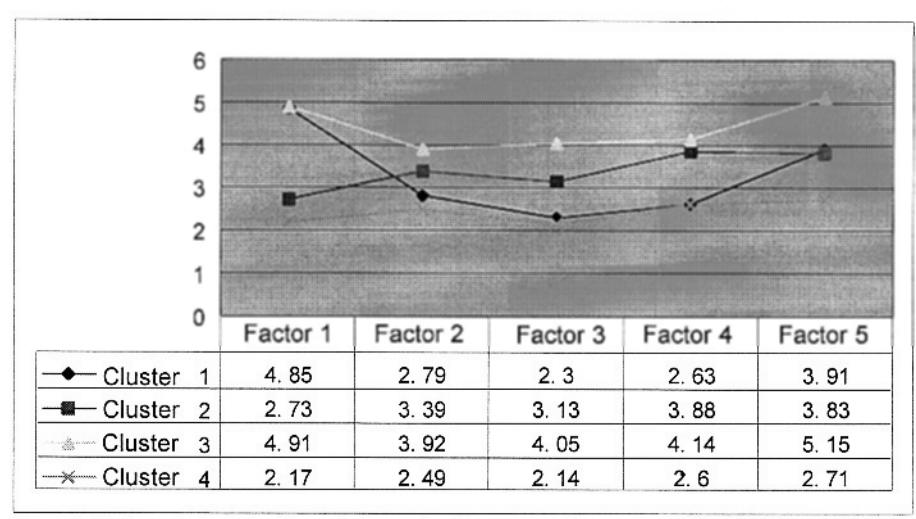
Figure 1 Cluster Centers of the Four Clusters for Undergraduate Students Groups
Comparison of Differences
A series of one way ANOVA tests was conducted to identity mean differences in motivations for choosing a HTM field from the different clusters. Detailed results are displayed in Table 5. Significant differences (p<0.05) were found in all the five factor motivations including "Easiness in studying", "Attractive job opportunities", "Better communications", "More interests in field", and "Scholastic improvement". Duncan's multiple range test was employed for the post hoc analysis.
It was discovered that cluster 3 (mean=4.97) and cluster 1 (mean=4.86) were significantly (p<0.05) more likely to be motivated by "Easiness in studying" in choosing a HTM field than all other clusters while cluster 4 (mean=2.18) and cluster 2 (mean=2.74) were significantly (p<0.05) less likely to be motivated by this. In regards to motivation for "Attractive job opportunities", cluster 3 (mean=3.92) and cluster 2 (mean-3.40) were significantly (p<0.05) more likely to be motivated by this than all other clusters, while cluster 4 (mean=2.50) and cluster 1 (mean=2.80) were significantly (p<0.05) less likely to be motivated by "Attractive job opportunities" than the other clusters. Cluster 3 (mean=4.05) were significantly (p<0.05) most likely to be motivated by "Better communications" than all other clusters, whereas cluster 4 (mean=2.l 52) and cluster 1 (mean=2.31) were significantly (p<0.05) less likely to be motivated by "Better communications" than the other cluster. Also, cluster 3 (mean=4.15) was the most likely to be motivated by "More interests in field" than all other clusters, while cluster 4 (mean=2.60) and cluster 1 (mean=2.64) were significantly (p<0.05) less likely to be motivated by this factor than the other clusters. Considering the motivation for "Scholastic improvement", it was found that cluster 3 (mean=5.15) was significantly (p<0.05) most likely to be motivated by this than all other cluster, while cluster 4 (mean=2.71) was significantly (p<0.05) least likely to be motivated by "Scholastic improvement" than the other clusters.
Table 5 ANOVA for Cluster Comparison of Motivations for Choosing an HTM Program by Undergraduate Student Groups
| The law of at att days ' water attention for town | Clus | English | Danalina | |||
|---|---|---|---|---|---|---|
| Undergraduate students' motivation factors | 1 | 2 | 3 | 4 | F-value | P-value |
| (1) Easiness in studying | 4.86a | 2.74b | 4.97a | 2.18a | 80.73 | .000 |
| (2) Attractive job opportunities | 2.80b | 3.40c | 3.92d | 2.51a | 21.03 | .000 |
| (3) Better communications | 2.31b | 3.14c | 4.05d | 2.15a | 42.67 | .000 |
| (4) More interests in field | 2.64a | 3.88b | 4.15d | 2.60a | 27.12 | .000 |
| (5) Scholastic improvement | 3.91b | 3.83b | 5.15c | 2.71a | 27.66 | .000 |
Comparison of Motivations between Mainland Chinese and Taiwanese Students
The mean scores in the undergraduate student groups on the six domains are given in Table 6 along with the outcome of t-tests. Significant differences (p < .001) were found for Mainland Chinese and Taiwanese undergraduate student groups on all five domains. Mainland ChiYtese undergraduate student groups showed the higher mean scores on the "Easiness in studying" domain (mean=4.64) than Taiwanese students. Taiwanese undergraduates indicated the higher mean scores on the other four domains except for the "Easiness in studying" domain (mean=4.56). In all, Taiwanese undergraduate students show higher levels of motivations on the other motivation domains with the exception of the "Easiness in studying" domain (mean=4.56). Conversely, Mainland Chinese undergraduates showed the lower level of motivations on the other four domains.
Table 6 T-test for Comparison of Motivations for Choosing an HTM Program by Mainland Chinese and Taiwanese Undergraduate Student Groups
| Undergraduate students' motivation factors | Chinese students | Taiwanese students | T-value | P-value |
|---|---|---|---|---|
| (1) Easiness in studying | 4.64b | 4.56b | 21.34 | .000 |
| (2) Attractive job opportunities | 4.97a | 5.35a | 19.52 | .000 |
| (3) Better communications | 4.11b | 4.42a | 182.7 | .000 |
| (4) More interests in field | 5.03b | 5.16b | 336.5 | .000 |
| (5) Scholastic improvement | 5.09b | 5.40a | 62.6 | .000 |
Comparison of Motivations for Studying Abroad between Mainland Chinese and Taiwanese Student Groups
Results of t-test conducted to explore the difference of undergraduate student groups on motivations in studying abroad in the HTM field are shown in Table 7. The Taiwanese graduate student group showed the higher mean score on the following items, "I would like to have an opportunity to learn a foreign language" (mean=6.27), "I would like to make relationships with foreign professors and friends" (mean=5.57), "I would like to take a teaching position easily in my country when I return with a graduate diploma from the foreign country" (mean=5.49), "There are more famous professors, compared to domestic professors" (mean=5.24), "I have more opportunities to publish papers for international journals" (mean=4.16), "I can get a better job or position in my country when I return with a graduate diploma from the foreign country" (mean=5.90), and "I would like to experience a new culture in the foreign country" (mean-6.35). However, Taiwanese students showed the lower mean score on "I would like to write a thesis or dissertation with higher quality" (mean=4.22), "I would like to live in a country that is not familiar to me" (mean=4.22), "The foreign country has a higher educational level than that of my country in the hospitality and tourism field" (mean=5.84), "The foreign country has better facilities than my country" (mean=6.01),"I would like to gain a job in the foreign country after I gain a graduate diploma" (mean=5.49), and "I would like to learn more practical than theoretical perspectives for my career development" (mean=5.68). This means that Taiwanese undergraduate students are more satisfied with their domestic undergraduate programs, compared to Mainland Chinese undergraduate students.
Meanwhile, Mainland Chinese undergraduate students showed the higher mean scores on "I would like to write a thesis or dissertation with higher quality" (mean=4.70), "I would like to live in a country that is not familiar to me" (mean=4.52), "The foreign country has a higher educationallevel than that of my country in the hospitality and tourism field" (mean=6.09), "The foreign country has better facilities than my country" (mean=6.06),"I would like to gain
Table 7 T-test for Comparison of Motivations for Studying the HTM Field Abroad by Mainland Chinese and Taiwanese Undergraduate Student Groups
| Motivation items | Mainland Chinese (N=458) | Taiwanese (N=411) | T-value | P-value | |
|---|---|---|---|---|---|
| 1. | I would like to have an opportunity to learn a foreign language. | 6.08a | 6.27b | 5.57 | .004 |
| 2. | I would like to make relationships with foreign professors and friends. | 5.45ab | 5.57b | 2.65 | .071 |
| 3. | I would like to write a thesis or dissertation with higher quality. | 4.70b | 4.22a | 23.72 | .000 |
| 4. | I would like to take a teaching position easily in my country when I return with a graduate diploma from the foreign country. | 3.85a | 5.49b | 134.19 | .000 |
| 5. | There are more famous professors, compared to domestic professors. | 5.05b | 5.24b | 7.05 | .001 |
| 6. | I would like to have more opportunities to publish papers for international journals. | 4.01b | 4.16b | 18.58 | .000 |
| 7. | I would like to live in a country that is not familiar to me. | 4.52b | 4.22a | 6.12 | .002 |
| 8. | I would like to get a better job or position in my country when I return with a graduate diploma from the foreign country. | 5.63a | 5.90b | 5.55 | .004 |
| 9. | The foreign country has a higher educational level than that of my country in the hospitality and tourism field. | 6.09 b | 5.84a | 5.08 | .006 |
| 10. | The foreign country has better facilities than my country. | 6.06 | 6.01 | 0.21 | .814 |
| 11. | I would like to gain a job in the foreign country after I gain a graduate diploma. | 4.59a | 5.49b | 36.72 | .000 |
| 12. | I would like to learn more practical than theoretical perspectives for my career development. | 6.01b | 5.68a | 7.94 | .000 |
| 13. | I would like to experience a new culture in the foreign country. | 6.30b | 6.35b | 9.51 | .000 |
a job in the foreign country after I gain a graduate diploma" (mean=4.59), and "I would like to learn more practical than theoretical perspectives for my career development" (mean=6.01). Mainland Chinese students showed the lower mean scores on the other motivation items.
CONCLUSIONS AND SUGGESTIONS
With the rapid development of the tourism and hospitality industry in both Mainland China and Taiwan, more and more students are choosing the hospitality and tourism field of study. Several conclusions about student motivation for choosing this field can be derived from this current research.
First, a factor analysis identified five factor domains for undergraduate students' motivations for studying HTM, labeled as "Easiness in studying"; "Attractive job opportunities"; "Better communications"; "More interests in field"; and "Scholastic improvement". The four-cluster solution appeared to be both coherent and interpretable.
Second, significant differences (p<0.05) were found amongst the clusters of students in terms of all the five factors summarizing motivations. Third, for the motivations for choosing an HTM program, students' motivations in choosing an HTM program for undergraduate students in Mainland China were relatively lower than that of Taiwanese student groups. Fourth, there were some important similarities between the motivations of students studying HTM in Mainland China and those studying in Taiwan, as well as some significant differences. Both groups gave greatest weight to the factor of "Scholastic improvement" and the lowest to "Easiness of studying" and "Better communications". Taiwanese students gave greater weight to "Attractive job opportunities" and "More interests in the field", however.
Fifth, for the motivations for studying an HTM program abroad, Mainland Chinese undergraduate students showed the highest level of desire to write a good thesis or dissertation and hope to study in foreign countries because of better education quality and facilities abroad. And they show lower interest in the job opportunities with HTM in the future after their education from abroad by comparison with Taiwanese students. Both groups gave great weight to experiencing a new culture in a foreign country and to the opportunity to learn a foreign language. Both groups tended to feel that a foreign country was more likely to have better facilities than their own. However, Mainland Chinese students were more likely to feel that a higher education level in HTM was available abroad.
From this analysis of why Mainland Chinese and Taiwanese students choose a tourism and hospitality management field, the following suggestions for both Mainland Chinese and Taiwanese educational administration can be put forward.
First, according to the advanced international rules and criterions, the corresponding international communication plans should be made up with the Mainland Chinese and Taiwanese actual practices. Second, the number of communication members should be enlarged between Mainland China and Taiwan. The training target, teaching program structures and teaching contents in tourism and hospitality management should be adjusted according to high level in the developed international levels by learning from the developed countries such as U.S.A and Switzerland. Third, the foreign language teaching degree should be strengthened in tourism and hospitality so that students could master one, two or even more foreign languages so that both Mainland Chinese and Taiwanese could benefit a lot from foreign countries. Fourth, the international knowledge, culture and techniques about the tourism developed countries such as U.S.A., Switzerland and U.K should be increased in the program activities and programs of both Mainland Chinese and Taiwanese in tourism
MOTIVATIONS FOR CHOOSING TOURISM AND HOSPITALITY MANAGEMENT
and hospitality management, especially for Mainland Chinese. Fifth, the fundamental constructions in tourism and hospitality management should be reinforced in the information communication and Internet journals, etc. for both Mainland Chinese and Taiwanese educational administration in tourism and hospitality management. Sixth, the teaching and research level, educational quality of Chinese faculty in tourism and hospitality management should be improved by learning from Taiwanese or some other developed foreign countries. Seventh, the conditions for the mutual admittance of degree certifications between Chinese universities and Taiwanese as well as foreign ones should be conducted. Eighth, the superior tourist industrial research directions should be supported so that tourism and hospitality management education for Mainland Chinese could be improved by learning from international educational brands and Taiwanese ones.
The purpose of this study was to investigate why Mainland Chinese and Taiwanese students choose a HTM program However, there are still some study limitations and further studies still need to be carried out. Although, the survey was conducted in several cities in both Mainland China and Taiwan, there are still be more cities to be covered so that the results could be broadened and be more widely representative of both Mainland China and Taiwan. The further studies could help make a better relationship between student motivations and the higher education programs in the field of tourism and hospitality management in both Mainland Chinese and Taiwanese educational administrations.
ACKNOWLEDGEMENT OF SUPPORT
The authors acknowledge the academic support of the Korea Foundation for Advanced Studies.