

BACKGROUND
History
Korea's history spans over 5000 years. Due to its strategic geographical location, neighbouring China, Japan and Russia, the peninsula has often been the field of battle of foreign powers and as now inextricably enmeshed in the global political climate (Figure 1). Japan occupied Korea from 1910 until the end of the Second World War whereupon the Russians tool the surrender in the North and the Americans to the South on the 38th parallel. Tension between the two halves-led to the outbreak of the Korean War, 1950-1953 which has left the country divided until the present day.
There has been no free come and go relationships between South and North Korea since the Korean Peninsula was divided by two regions. Many Eastern countries made step into opening their countries and went through major reforms due to the collapse of communism or socialism, but North Korea has still been isolated from around the world. In the Korean experience the relationship between tourism and peace was highlighted in a political aspect. Kim and Crompton (1990) discussed the role of tourism and its potential for unifying the two Koreas. They distinguished between two tracks in diplomacy. Track one is the official channel of government relations that have failed in Korea while track two, diplomacy, is the unofficial channel of people to people relations, friendliness, harmony and active cooperation
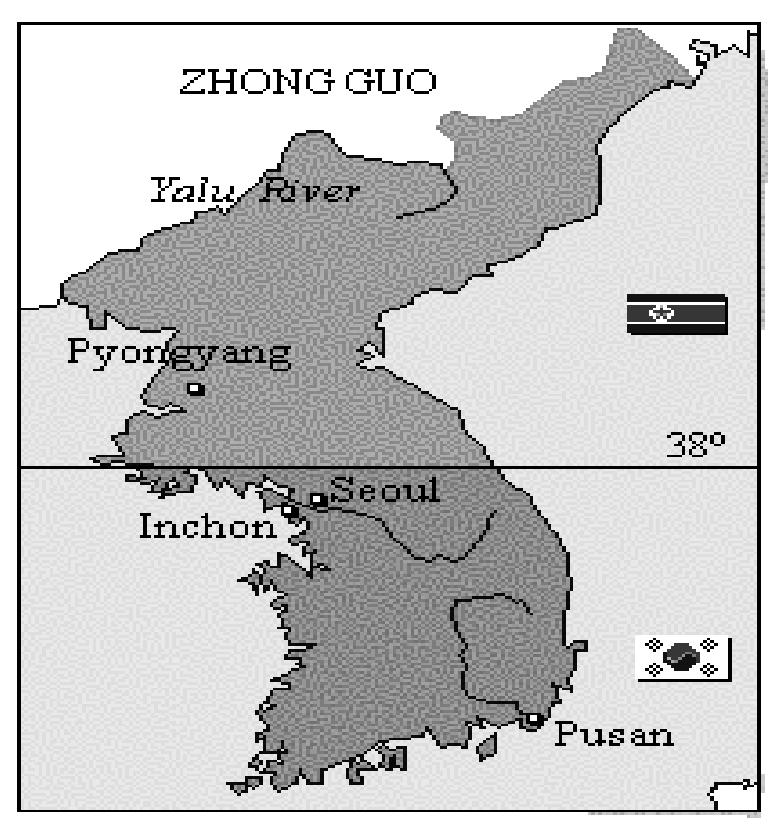
Figure 1 Korean Map
were found to e likely to emerge from a track two approach. Therefore this was recommended for Korea by the authors.
Government Involvement and Peace Process: Past and Present
In any country or region that wants to develop or expand tourism and especially in developing countries, the government performs a very active role in terms of adopting tourism policies, plans, and regulations (Inskeep, 1991). Decisions affecting tourism policy, the nature of the government involvement in tourism, the structure of organisations, and the nature of tourism development emerge from a political process (Hall, 1994). The importance of government involvement is well documented in the literature. It stems from the need to create employment, maxmise the net benefits to the host community, spread the benefits and costs equitably, provision of public goods and infrastructure, product tourism resources and environment, ensuring traveller safety and security and build the image of the country as a tourist destination (Cooper et al, 1995). "Understanding of the relationship between tourism and the state can best be achieved by identifying the main institutions which constitute the state." (Hall, 1994).
In North Korea, central government bodies represent the tourism industry. In South Korea, national tourism development plans have been drawn up in which government decides which sectors of the industry will be developed, the appropriate rate of growth, and the provision of capital required for expansion. The Ministry of Culture and Sports, a government organisation in charge of Korea's tourism industry, has had it name changed to "Ministry of Culture Tourism" and has also undergone structural changes on March, 1998. The changes reflect a commitment by the new government of President Kim Dae-Jung to encourage the tourism industry in the 21st century. This reorganisation is expected to make development of tourist attractions more systematically (KNTO, 1998). The Ministry of Culture Tourism is the main body, which is responsible for tourism planning and development. It operates through a number of regional organisations across the country. Its activities include the development of new sites, establishments of hotels, tourist services, and promotion.
After outbound travel was liberalised in 1989, various restrictions against the entire tourism industry were set in motion by the government. In an effort to slow the growth of outbound tourism, particularly its expenditure, under the presidency of Roh Tae-Woo, the whole tourism industry was characterised as a consumptive, luxurious and unproductive business (Pizam, 1994). A series of regulations was introduced and justified on social grounds. The tourist industry was argued to be a threat to social harmony. This is because social status was displayed through consumption of the sector's luxury services. For instance, hotels were told to close their entertainment facilities early in the evening and close their fitness centres once a week. Lack of government support especially financial support, also prevented the construction of an adequate number of new international quality hotels and associated tourism superstructure.
Following the 1992 election of President Kim Young-Sam, the potential of tourism was once again recognised. President Kim stressed that he would make tourism one of the strategic industries that would lead Korea into the 21st century. He followed through on that promise by lifting many of the restrictions on both inbound and outbound tourism. Thus, where outbound travel was once seen as squandering valuable foreign currency reserves, it was now seen as a necessary investment. His administration also developed programmes to support tourism with the goal of making Korea one of the world's top tourism countries by the year
2000 (McGahey, 1995). Furthermore, the major infrastructure schemes necessary to reach that goal are now underway. A new airport was built on an island near Inchon to replace Seoul's Kimpo International airport, which started operating in 2000. This new airport is expected to Asian's key hub (TTG Europe, 1996).
In addition, part from the government the private sector constitutes the primary engine for economic growth and development. However, the perceptions of risk by entrepreneurs even in the absence of military conflict is the primary constraint limiting their participation. Tourism development cannot be carried out by the private sector alone. It requires infrastructure support from the public sector and the maintenance of security and peace (Lee, 1987). The government role in this respect aims at creating a mechanism to facilitate private sector's entry by addressing political issues and mitigating non-commercial and foreign exchange risks. Since the peace accord, attention has been given in both countries, to foster economic cooperation. Among these bi-national ventures are a series of integrated projects in various sectors including tourism, transportation, communication, water, sewage, agriculture, energy and electricity. The peace process enables the creation of cross-sector and cross-border linkages, of which South and North Korea is the key location.
In this respect, On April 13-15, 2000 South Korean and North Korean leaders met in Pyongyang for a meeting of peace ending over fifty of hostilities. According to this meeting, South Korea and North Korea are believed to be among the economies most directly affected by the world peace process. This had a large effect on both countries in many aspects, socially, politically and economically. Under this peace meeting, tourism has been identified as one sector where discussion is most likely to occur. One of examples is the development of water-based activity holidays and cruising that promote the use of the Mt. Geumgang cooperation between the two Koreas (Table 1). Following in the footsteps of Mt. Geumgang, a historic city in Kaesong, North Korea was expected to open its doors to South Korean travelers. North Korea and a Hyundai Group subsidiary agreed to build a free trade economic zone in the city adjacent to the border (Koreaherald Daily, 2001). With increased interaction between the peoples of South Korea and North Korea, with the current political settlement remaining in place, the negative image people hold of the province may be slowly changed, thus opening up North Korea as a viable tourism destination on the periphery of Asia and Europe.
Table 1 Visitors to Mt. Geumgang
| Year | 1998 | 1999 | 2000 | 2001 | 2002 | 2003 | 2004 | Total |
|---|---|---|---|---|---|---|---|---|
| (until Oct.) | ||||||||
| Total | 10,543 | 147,460 | 212,020 | 58,833 | 87,414 | 77,683 | 228,248 | 822,201 |
Source: KNTO (Korea National Tourism Organisation), 2004
Bilateral Tourism Cooperation
At the national and regional levels, it is important to identify tourism's performance as an earner of foreign exchange, as an employer, and as a means of achieving economic diversification (Lee, 1987). Bilateral tourism cooperation in this area falls into two categories: national cooperation where joint activity is through the framework of government decisions and international agreements. On a regional basis cooperation is channeled through the regional institutions that operate in the area and on a local level both the municipalities of South and North Korea operate together or in an independent manner.
Joint Operation of Trans-boundary Attractions
Like South Korea, North Korea has some exquisite national parks, and the country is almost completely unexplored by commercial tourism and until its potential for tourism development was neglected. The establishment of trans-boundary attractions through private enterprises and foreign investors could provide a common comprehensive tourism product. This includes:
- South and North Korean common peace tourism
- "War attractions" battlefield visits
- Development of bilateral projects such as : "The final peace point of Earth" project in the boundary which would include joint eco-tourism, heritage/health tourism facilities, historical/archaeological sites and tourist centres.
- Collaboration in running "Package Tours" which specialise in mixed marketing of sites and attractions based on trans-border visits. This could include-direct flight from South Korea to North Korea, visits to Mt. Geumgang , Mt. Paedu, River of Daedong, etc.
Joint Tourism Infrastructure
The linking of the two countries through various means of transportation network will not only enable tourist transit but will open an alley for trade. This development is based on coordination in the use of existing infrastructure for tourism and future expansion of:
• Transportation
North Korea has only one international airport, which isolated near Pyongyang, the capital city. Several alternatives have been proposed: cooperation in the operation and use of new airport, construction of a planned South Korean airport, construction of a new common the East Sea airport with a runway on the border South and North Korea, two national terminals on both sides of the border, and a cooperation in the operation and use of new airport. In all these alternatives, a civil aviation and airport operation agreement in the East Sea area is obviously fundamental in any joint effort to market the region for international tourism. International co-operation in this field is expected to be on the following issues:
- Linking the airfield by shuttle routes for passengers and cargo between the terminals.
- Common co-ordinated air control
- Cooperation in matters of ground services and airfield operation
- Civil Aviation agreements
The benefits from joint cooperation in this field include: cost reductions and shorten flight distances. North Korea has about 60 rail networks and 5,059 km of rail line. The rail network is adequate but needs repair and upgrading and a major problem of the rail line is the availability of only singly track. This causes frequent delays. Furthermore, roads in North Korea need urgent repair and maintenance. The road distance is estimated at 34,000 km with paved roads at only 8.1% as of 1991 (KNTO, 1994). Thus, land network is facilitating of Border crossing points in the "Reunification Bridge" between South and North Korea are planned to permit a free passage of people and vehicles with easing of visa requirement. This will include crossing logistics, customs, health, emergencies, etc. Sea in South and North Korea needs cooperation in intra regional maritime shipping and transportation links; Triangular sailing and cruise ships between South Korea, North Korea, China; Joint port
related activities between South and North Korea. Besides, surprisingly, on 19th of September 2002, the southern side of the DMZ between the two Koreas, beginning to clear away mines in preparation of rebuilding of the final link in the North-South railroad that was shut down during the Korean War. This rail link as part of a vast network over which goods can move from South Korea through the North Korea to Russia and on to markets in Europe. Therefore, two Korean can expect the restoration of Kyoungwon and Kyoungwee track and renewal and operation of the track between South and North Korea in the near future.
• Accommodation
North Korea has about a 3,5000 room's capacity for foreign visitors, over 70% of which are concentrated in the capital city. Most hotels are of poor quality. The country has only one deluxe hotel which is located in the capital (KNTO, 1994). Thus, joint development of hotels, vacation villages, vacation homes, convention centres, restaurants and shopping centres at the DMZ areas.
Cooperation in Human Resource Development
North Korea has recently developed tour guide, hotel, airline training courses in some colleges and has improved the quality of foreign programmes for tourism human resources. Furthermore, in order to increase employment opportunities and enhance qualitative manpower, the following cooperative efforts were suggested by Hyundai group' integrated development for the Human Resources Sector to establish a joint training and educational framework. Therefore this includes: joint South-North Korea technical education programmes that include training funds sponsored by both governments, joint research & curriculum development centre, postgraduate programmes, distance learning programmes and a centre for promotion of small business enterprises. The combination of human resources development between two sides overcome some of the tension and move toward greater understanding and trust and can also lead to cooperative marketing. In other words, the tourism industries of both South and North Korea will benefit from cooperative marketing efforts, especially because they are at different stages of the tourist destination life cycle.
Barriers to Tourism Cooperation
As mentioned above, the Mt. Geumgang project between North and South Korea for future reunification is regarded as one of the most significant events in half a century old division of Korea. The Mt. Geumgang Project will also serve as a good milestone to promote further inter-Korean cooperation. The Hyundai Group has reached agreement with North Korea on building an automobile assembly plant and an indoor gymnasium in Pyongyang. Hyundai Group will pay $940 million in the next six years in return for the exclusive rights of tourism and development of the Mt. Geumgang (Unikorea, 2000). Moreover, the Korean government decided to extend financial support to the Hyundai Asan's Mt. Geumgang tourism project under the auspices of the Korean National Tourism Organisation (KNTO) because of its extensive experience and know-how in tourist promotion (Koreaherald, 2001). However, there are some barriers to tourism cooperation between South and North Korea as below:
- Disparity between scale of tourism development in South and North Korea despite the similar potential. This disparity together with uneven distribution of resources must be addressed if North Korea is to achieve the desired objectives of increasing its market share of regional tourism.
- Government structure- in North Korea the government is largely responsible and act as
- a dominant part of tourism enterprises, while South Korea is economically independent.
- Differences in tastes and preferences
- Technology- locational differences in technological know-how
- Training- unlike North Korea, the tourism industry in South Korea is highly efficient in all aspects of its operation- in particular in the support of training facilities.
Barriers to tourism cooperation described above need to be improved, so as to realize the maximization of tourism effects and benefits, which lead to achieve the goal of the tourism cooperation between South and North Korea.
CONCLUSIONS
This paper introduces the key characteristics and prospects of tourism development in South and North Korea. Tourism cooperation between the two countries could be in a form of complementary, where each country offers its relative advantages. South Korea can diversity its tourism product due to new regional attractions, while North Korea can benefit from increasing tourists, new jobs, and exploiting economies of scale while are crucial for North Korean economy. The conglomeration that would arise from joint tourism management can result in a successful tourism product. Such joint tourism development projects would serve as powerful systems of movement toward reconciliation. Consequently, progress towards peace though tourism is not an isolated process. It is part of a larger social change that begins with a recognition that the fundamental social and political order is changing. On a small country with limited resources as two Koreas, tourism can constitute a development tool, which may contribute to the long-term viability of the economy. In this context, tourism cooperation between South and North Korea can become not only the impetus for economic sustainability of two Koreas but also for political stability and peace. There should be better political relationships between the two Koreas for the development of tourism industry. Both South and North Korea need to further open discussions so that can find out better ways to succeed in the twenty-first century. This change in the external environment appears to offer an opportunity for tourism to be a vehicle for furthering the momentum towards reunification. Tourism cooperation of the two Koreas appears to be a viable way of opening a path to peace by eroding the seemingly unbreakable wall that has divided Korea.