

INTRODUCTION
The classical theories about city planning propose that there are four basic functions of employment, residence, transportation, and recreation in a modern city (CIAM Athens Charter, 1933). As the development of Chinese economy, the roles of different cities are characterized by their geographic, historical, and political conditions. As one of the seven ancient capitals in Chinese history, Hangzhou is a famous travel city for its scenery and historic culture. In 2004, the number of foreign visitors to Hangzhou reached 1.2 million person-times, with an increase of 43.3% more than the same period of 2003. The foreign trade from traveling industry reached $597 millions, with an increase of 41.5% more than the same period of 2003. The number of domestic visitors was 30 million person-times, with an increase of 8.7% more than the same period of 2003. Income from domestic travelling was $4,350 million, with an increase of 24.1% more than the same period of 2003. As the forerunner of the third industry, travelling industry shows its predominance
Address correspondence to Shi Jian-ren, Department of Civil Engineering, Saga University, Honjo 1, Saga City, Saga, 8408502, Japan. Tel: +81-90-3601-5141. Email: jrshi2002@163.com to be a new increasing point of local economy. Therefore, the local government insists on the principle of characterizing the unique tourism resources oriented by market economy. However, aiming at an international city of landscape and tourism, there is too much deficiency to be worthy of its fame, which is explained as follows:
Deficiency of tourism variety
Clark (2003) addresses that tourism is an economic behavior with cultural entertainment. The more cultural diversity of tourism resources is, the faster consumption of tourism industry becomes. For Hangzhou City, although its natural landscape has been always honoring the city with the West Lake Scenery Zone, the historic significance of Hangzhou to Jiang-Nan Culture (definition of the ancient civilization in south of Yangtze River) is getting faded seriously. In fact, the scenes of Hangzhou's mountains and waters are not absolutely unique around the world, especially in the eyes of the visitors from Europe and America where natural environment is much better than that of Hangzhou. To those foreign tourists, Hangzhou is charming with its historical accumulation settled since the ancient dynasties of Wu-Yue, Song, Ming and Qing. As an ancient capital of China, Hangzhou is endowed with the synthesis of landscape, politics, culture, folk-custom, and religion. This multi-component combination makes this city into an advantaged attraction to tourists. Unfortunately, due to the war during the 1930's and 1940's and the governors' neglect since the foundation of P.R.China until 1980, the relic resources of historic architectures have been badly damaged. Consequently, the city became a simply natural tourism city, only for the West Lake and the surrounding area.
Inanition of urban architectures
As the development of local economy, Hangzhou City, the capital of Zhejiang Province, is sufferring from deficiency of land and traffic problems. In the past few years, a large amount of old districts were removed and rebuilt for business purpose. At present, skyscrapers and highways become the image of the city, which is remembered as an elegant heaven in people's heart because of its natural conditions. In fact, the uneasiness of modern life and the density of modern city have replaced the historic and cultural attraction of Hangzhou.
In this research, the causes of the deficiency of urban culture are analyzed from the architectural viewpoint. Based on a case study of the historic block of Qing-He-Fang Street, the local history, culture and lifestyles are reviewed and are regarded as a resolution to preserve the urban culture. The principle of creating the interaction between economy and tourism is proposed to direct the re-design methods. In detail, the design methods of spatial layout and remedied technology are discussed to provide a support for historic feature survival. Fig. 1 shows the streamline frame of this research.
RELATIONSHIP BETWEEN HANGZHOU'S DEVELOPMENT AND ITS CULTURE
Cities and their culture
People's daily behaviors in a city consist of the following two aspects: one is conducted in the substantial environment constructed in a long period of time, such as urban pattern, palaces, temples, mansions, gardens, streets, residences and so on; the other is the soul, such as the social structure, value ideality, and lifestyle. These two aspects are combined and synthesized into urban culture. If the substantial environment is considered as the carrier of people's life, then urban culture is a conceptive expression of urban life, as something deep-seated in urban hierarchies.
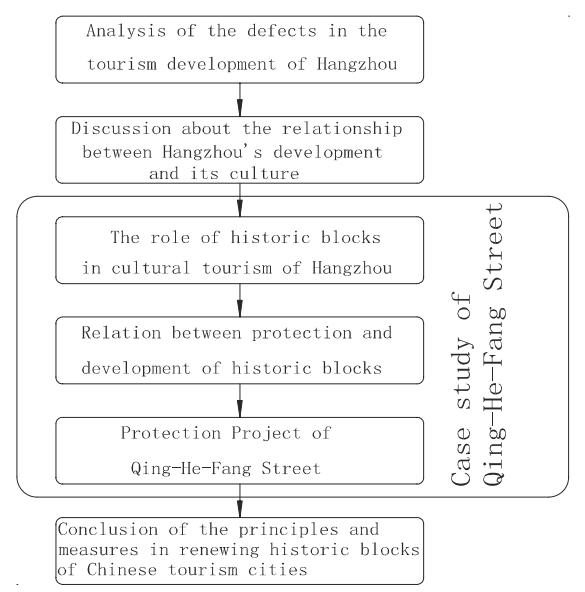
Fig.1 Frame of research about promoting tourism by renewing the historic blocks in Chinese modern cities
Wu Yanhai (1997) probes in the spirit of the cities from the viewpoint of urban planning. It is often commended that the scenes of old towns full of bridges, brooks and villas along the banks implicate subtle emotion that can not be expressed by words, instead understood by heart. The key spirit does not lie in the substance of urban facilities, but in the urban spatial layout and the contents inside buildings. The material carriers containing local lifestyles, cultural air and fun sympathize residents in soul. Therefore, a city is not only a technologic production, but also a cultural creation with deep philosophy. People will taste the beauty of life intentionally or unconsciously from their residential environment. Urban culture derives from people's daily life, which tells the essence of the city to all the tourists.
Cause of cultural loss in Chinese cities
While China has a long history and a famous culture as we have known, the current cities of China are facing some common problems during the fast economic development (Song Kun, 1997). Based on Hangzhou's conditions, one of them can be concluded a problem of environmental deterioration, both of natural resources and cultural resources. As for the latter, it shows in the following aspects:
(1) Power of technology
The industrialization symbolized with high technology magnifies the human power. Human beings can exploit the nature and transform the environment by their powerful technology. Nowadays the scale and speed of Chinese city construction are unprecedented. Meanwhile, unfortunately, natural environment is damaged and the resources of urban culture have been threatened unprecedentedly.
(2) Nexus of economy and culture
Under the current conditions where economy has become the focus, the development of urban culture is supported strongly by the economy. On the contrary, influenced partially by economy, urban culture is also struck intensively, even disregarded and destroyed by economy.
(3) Conflict between globality and localism
Modern society has set up unprecedented transportation, communication and trade, so accordingly the world relationship is more and more compact. Urban cultures are showing themselves with a tendency of globality. During this process, the collision and the amalgamation are inevitable. As a result, these cultures become gradually similar, without individual character distinction. It is no matter that people think of some cities unsensational. Zhou Huixian (1999) insists that the key problem lies in the loss of urban localism.
An example of Hangzhou City
Geographical location
Hangzhou, is the center of Zhejiang Province in politics, economy, culture, science and education. It is also an important national travel city affirmed by the State Council. Located at the southern wing of the Yangtze River Delta, the west end of Hangzhou Bay, the lower reaches of Qiantang River and the southern end of the Grand Canal (Beijing-Hangzhou), it is an important central city in the Yangtze River Delta and a hub of transportation in southeast China. The geographic position of the city proper is latitude 30°162†north and longitude 120°122†east.
Administrative districts and population
Hangzhou governs the 6 main districts of Shangcheng, Xiacheng, Jianggan, Gongshu, Xihu, and Binjiang, the 2 combined districts of Xiaoshan and Yuhang, and the 5 satellitic cities of Jiande, Fuyang, Lin'an, Tonglu and Chun'an with a total area of 16,596 square kilometers including an area of 3,068 square kilometers in the city proper. By the end of 2003, it had a registered population of 6.4278 million including the urban registered population of 3.9319 million.
Natural conditions
Hangzhou boasts the natural environment integrating rivers, lakes and hills. The hilly area of the city accounts for 65.6% of the total, the plain 26.4%, rivers, lakes, ponds and reservoirs 8%. Its west, middle and south belong to the hilly area of west Zhejiang and northeast to the plain of north Zhejiang. Hangzhou has long been reputed as the Land of Fish and Rice with lengthwise and sidewise rivers and densely scattered lakes. The Grand Canal (Beijing-Hangzhou), the longest cannel in the world and Qiantang River, noted for its huge tidal waves, run their ways through the city.
Urban Development
Hangzhou, a famous historical and cultural city, is also suffering from much impact of urbandevelopment. Building roads by stuffing rivers has been adopted prevalently in order to meet the need of modern urban transportation. This economic orientation has made the river network of Hangzhou almost dissapear. As a result, Hangzhou is getting farther away from its reputation as 'Water Country'. In the past 100 years, the scale of Hangzhou City was enlarged quite a few times and consequently the structure of urban texture has changed much (Fig. 2). Since the 1980's, the orientation of all-removing and all-rebuilding has been prevailing in China. During this period, a good number of historic blocks with many significant value have been brutally destroyed. What take place of them are many so-called 'modern architectures' of homogeneous appearance, without any cultural characteristic, which has brought about the crisis of urban identifiability of Hangzhou. Nowadays, although the seriousness of lack of urban culture has already been realized gradually, urban culture is irreproducible once it is destroyed. Therefore, the work of excavation, exploration, and protection is the most important task for the urban features of Hangzhou City.
Antonio P. Russo (2002) highlights how specific soft elements of the urban tourism product are the ones determining the attraction of a city for international visitors. He also identifies a number of "best practices" in tourism management, most of which are urban softwares, e.g. cultural products, activity organization and personal training. For Hangzhou, therefore, the cultural significance of urban environment must not be neglected by city planners.
QING-HE-FANG STREET AND HANGZHOU'S CULTURAL TOURISM Definition of historic block
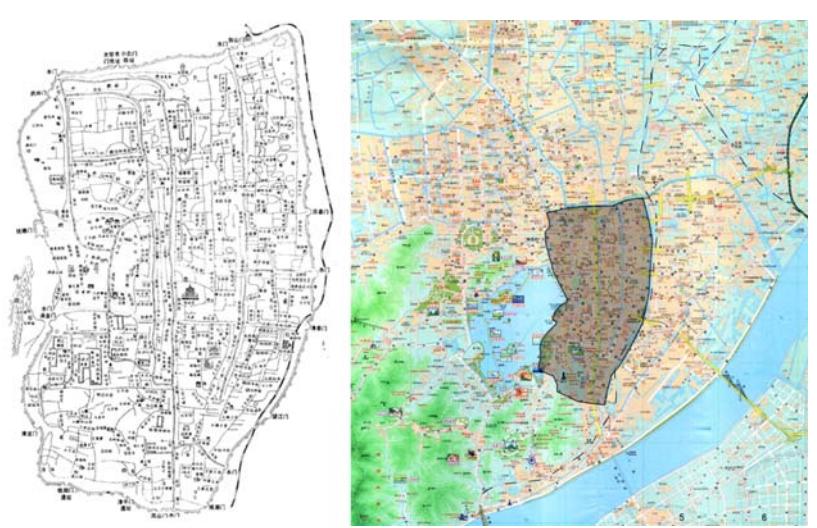
Fig. 2 evolvement of the urban area of Hangzhou City Left: the year of 1920, Right: the year of 2001
'Historic Block' is defined as an urban block that consists of a group of buildings with historic and cultural importance to the city and that sustains the context continuity in urban development. Any single building can possibly not reach the level of 'cultural relic'. As an integer, however, a historic block bears traditional features of local lifestyles and it is a lively witness of the history in this region.
Advantages of Qing-He-Fang Street for Hangzhou's culture
Protection of a building or a group of buildings cannot be justified only by their age. It is necessary to seek for a certain way of protection to go along with some vigors in the development of modern Hangzhou. The historic block of Qing-He-Fang Street has four realistic advantages as follows.
Location
The south of Hangzhou City was the cradle of old Hanzhou's prosperity and the center of politics and economy. In A.D. 591, Sui Dynasty set up the administrative city of Hangzhou. The local government office was located at the northeast foot of Wu Mountain. In A.D. 893, Wu-Yue Dynasty founded its capital at Hangzhou, and transformed the original government office into the palace. In the North Song Dynasty, the palace was reverted to the government office. In A.D. 1138, the South Song Dynasty settled its capital at Hangzhou, and built up its palace based on the original Wu-Yue Palace. Qing-He-Fang Street is also located at the south of Hangzhou City, to the south of the palace (damaged), and to the north of Wu Mountain. So, it was one of the first
developed regions in the city. Backdated to Sui Dynasty, there were a great number of citizens living there. After the foundation of the South Song Dynasty's capital, this region flourished. That established the basic pattern of this area (Fig 3).
Since the 1950's, along with the expansion of Hangzhou's urban area, the center has been moving to the north. As a result, Qing-He-Fang Street has lost its bloom of a commercial center in the past days. Until 1998, because of governor's neglect, the features of this historic area are almost broken down and withered away. Inevitably, the block of Qing-He-Fang Street wanes into a dilapidated area.
Gradually, people begin to realize that its unique value in urban landscape, history and culture cannot be replaced by any new building. Meanwhile, Hangzhou's urban area is enlarged to the south bank of Qiantang River so that the area from Wu Mountain to the Phoenix Mountain becomes immediately a large landscape belt in the urban heart. Thus, the Wu Mountain area is decided to be developed as one of the sites of landscape, leisure and tourism. In this area, Qing-He-Fang Street shows necessarily an important and indispensable component to the whole Wu Mountain Landscape Zone.
Mental recognization
The term 'Historic Block' in this paper mainly refers to a certain historic belt, commonly the relics of later Qing Dynasty and Republic of China. To some older residents who witnessed the great change of this block, their memory was a precious mental fortune. The block is the permanent attachment in their hearts. Most of the residents live there for generations and some traditional customs remain, which engender a steadily social structure, strongly spatial recognition and affiliation to the block. Especially in Wu Mountain area, the residents' daily life is linked closely with the historic block. In the 1990's, the disorganization of the close relation imposes a severe loss on the residents' psychology.
Traditional lifestyle
This block has been a commercial downtown area, where many old shops and institutions with a centuries of history were located, such as the Hu-Qingyu-Tang Drugstore. Although this block has been declining since the 1950's, these old buildings remain. If remedied, they will continue to serve the local residents. Therefore, renewing these old buildings is the key to the revival of this area.
Along with the promotion of people's living quality, tourism and leisure have become an indispensable index to assess residential environment. The core of leisure is to provide various places for lifestyle. Fortunately, the rich legacy of this area may meet this demand, such as the unique architectural features and spatial forms of Qing-He-Fang Street, especially the legends and historic figures left during the long history. This immaterially cultural legacy contains the attraction which the modern landscape can not provide.
Since the foundation as the capital of Wu-Yue State, the urban structure has been remaining its traditional formation, i.e. the axis of one river-one road and the expansion to the circumferential parts of the city, although quite a few dynasties have alternated during the past thousand years. Therefore, the old lanes and alleys with historic buildings are mainly distributed alongside the banks of the Middle Canal and its collateral roads, Zhongshan Road and Jianguo Road. In this area, a lot of folk houses, shops and restaurants place densely in rows.
If the folk houses and the old shops can be saved as the original appearance, the local lifestyle and urban traditional culture will be revived.
Historical context
In history, traditional blocks evolve alongside an organic way. During that process, all the factors come to a harmonious state with their mutual friction, and afterwards make up of the current spatial structure and texture. Nowadays, extensive development is inevasible and its mode is producing similar phenomenon that can be found everywhere. Through our practice on this historic block, it is a reasonable plan for the maintenance of urban features to take advantage of the small-size protection to make up for the shortage of large-scale constructions.
Tourists' psychological demands
Curiosity is the common psychology of all the visitors. For an international tourist city, it is necessary to consider the interest points of foreigners to Hangzhou. They usually focus on the native culture, ecology and unsophistication of tourist sites. Because of its long history, the fullbodied humanistic colors and folk-custom smells remain in the folk houses and the old streets around the city of Hangzhou.
The cultural features of Hangzhou consist of the architectural styles and the life styles. The architectural elements are two-story buildings, sloping roofs, wooden components, Chinese ornaments, wells, white walls, dark tiles, and red doors. The life episodes are teatime chat, snack party, souvenir deal, street show, and handicraft exhibition. For the foreign visitors who are traveling in those native environments, the humanistic folk-custom may tell them what it was ever during the past time. The relic of the old capital is unaffectedly harmonized into the cultural context of this modern city. Neither the visitors nor the citizens can enjoy the traditional life inside the city, instead of driving to countryside.
From the above discussion, the reasons for historic block protection are sufficient and the protection plays an important role in modern cities, such as Longhua Area and Chenghuang Temple in Shanghai and so on.
MERITS OF THOUGHT WAYS OF PROTECTION TO THE DEVELOPMENT OF THIS HISTORIC BLOCK
A historic block contains not only the buildings of materiality that are the substantial environment of a city, but also the culture of immateriality that is lying in the buildings. Fox example, some urban cultures, such as some conceptions of value, lifestyles, human relationships and folkcustom, have been shaped up among the people who live in the block for generations. In a way, the very immaterial culture may represent more value of this block. So 'Historic Block' does not mean commonly old districts. From now on, the conception of 'Historic District' should be distinguished from 'Old District' in the process of developing the tumble-down buildings for a long period. The bunkhouses or the slums should be removed that were used to accommodate a great deal of labors in the early industry society. In China, those 'old districts' mean commonly those temporary worker-communities which were built soon after the foundation of P.R.China (A.D.1949) until the 1980's.
Problems in historic blocks
Because of the development of social system, ideology, communal culture and lifestyle, there are a good number of problems in aging substance. The structure and function of the buildings in historic blocks are decaying increasingly. The main aspects are shown as follows, and Fig. 4, 5 record the visions of decline and dilapidation of Qing-He-Fang Street before the project.
- a. Miscellany of commercial, official and residential function, Intangibility of functional structure, Lack of united affinity;
- b. Depravation of building quality, Excess of building density;
Fig.4 Decline of Qing-He-Fang Street before the project
Fig.5 Dilapidated buildings before the project
- c. Unbalance of activities on streets;
- d. Lack of necessarily common space and greenbelt.
- e. Confusion of transportation, Lack of parking lots;
- f. Severe lack of communal facilities;
- g. Disorder of street landscape;
- h. Bad sanitation.
Fig.6 Re-design plan of Qing-He-Fang Street
Hierarchical structure of historic block protection
Protection of spatial pattern
The Street-Alley Pattern is the most vigorous element in Chinese historic blocks. The pattern of Qing-He-Fang Street remains the model since South Song Dynasty until Qing Dynasty. At present, it is the only example surviving in the whole city. The experience of this block and the memory in residents are irreplaceable, so the protection of its spatial pattern should be insisted on. Fig. 6 presents the site plan of the block of Qing-He-Fang Street.
Meanwhile, this block is in good harmony with the surrounding buildings not only on form but also on feature. They constitute the traditional features of this area together. It should be dynamic protection when protecting work for the traditional objectives is going on. With the precondition of the whole continuance of feature, it is necessary to partition functional sections, to expand new communal space for activities, to set up requisite fire-control channels and to arrange parking plots, meeting the need of modern functions.
Protection of architectural features of key buildings Cultural buildings represent architectural art and the pinnacles of local architecture in a historic blocks. Although the buildings are decrepituded and failed to meet modern needs, these buildings were historically the economic focuses of the block. So their revitalisation is the key to the renewal of the whole block. There are a good number of old shops and institutions with a century of history, such as Hu-Qingyu-Tang Drugstore and Fang-Huichun-Tang Drugstore (Fig. 7). The original repair and
Fig. 7 The entrance of Fang-Huichun-Tang Drugstore after remedy
renewal for these old shops may advance the cultural and economic renaissance of the whole block.
Resurgence of old-time custom
Immaterial culture is an important part of historic block protection. It contains stories, legends, historic figures and events. In the process of protecting the immaterial culture, there are a few practical measures, such as recovering relics of famous legends, setting up ancient marks, exhibition and so on. For example, Fig. 8 shows the wall with Hu-Qingyu-Tang Drugstore's magnificent mark. These measures can provide substantial supports for the local residents recalling the past with emotion, and for the foreign visitors retrospecting to local history.
Fig.8 The wall with Hu-Qingyu-Tang Drugstore's magnificent mark after remedy
Remedy of architectural components and facilities
In historic blocks, there are a good number of dwelling houses along the streets. The dwelling houses and the alleys are the substantial support for residential life and the real carrier for residential culture. They bear much significance both for the integrality of block features and for the continuance of local culture. In accordance to improve the building quality, remedying and rebuilding the houses can promote environmental quality, reduce residential density, and meet the demands of modern life (Fig. 9).
Fig.9 The work of remedying architectural components
Consideration of architectural renewal and local economy
Among the levels of substantial environment in historic blocks, the protection of the building patterns and cultural relics has achieved common understanding, and taken much effect in practical projects. However, the protection of dwelling houses has always been disputed because of some certain reasons.
- (1) Substantial factor: A great number of dwelling houses are the worst part in the decrepitude of historic blocks, such as high density of population, bad sanitation, lack of decent public facilities, disrepair of buildings and so on. They cannot meet the need of modern life. Meanwhile, the original width of historic blocks is usually small full of hidden trouble of fire. So rebuilding is necessary.
- (2) Economic factor: In the renewal and reconstruction of historic blocks, it is unavoidable to take the investment and the return of capital into account. To investors, a great deal of dwelling houses and alleys are their first objectives, where they encounter the minimum resistance and
As we have known, however, it is not the protection of cultural buildings that endows historic blocks with their characteristics, but the majority of the countless modest residential buildings along urban streets. The former are usually fragmental or isolated, while the latter are commonly continent and relative. Chinese traditional buildings set up their style by combination and cooperation. Their essence lies in the relation and spatial composition, which attracts people into these places and to experience life. Therefore, Chinese traditional cities and buildings attach much importance on the harmony between common customs and architecture.
ICOMOS Washington Charter (1987) points out that the protection of historical cities should be part of an overall policy of social and economic development. In order to make the protection successful, all the residents in the city must take part in it. Moreover, the conservation of a historic city or a district relates the residents living there. Protecting their residence should be one of the basic goals. If the residential houses must be rebuilt, the originally spatial organization should be respected. Additionally, the original value should be endowed into the new buildings.
PROTECTION PROJECT OF QING-HE-FANG STREET
Renewal principle of the historic block
To this protection project of the urban historic area, how to constitute a proper principle of redesign is the precondition to reach the final success. At present, it is a commonly acceptable understanding from the viewpoint of governors that the outstanding buildings of cultural relic should be saved and also be paid much fund into (Huang Yan, 1996). For the ordinary folk houses with decades of years, however, there is no enough care on their maintenance and renewal in the process of municipal planning.
The reason can be explained as a consideration of economic profitability, i.e. the ratio of fund investment to market benefit. On the one hand, generally, estate agents believe that building modern high-rises of business offices or dwelling apartments can bring out considerable profit instead of historic block renewal. On the other hand, it is more approachable for governors to transfer directly the access of land exploitation to estate agents than to take charge of historic block renewal and administrative management.
As mentioned earlier , this historic block is indispensable and significant to Hangzhou's traditional culture and folk-customs. Therefore, aiming at a reciprocal tradeoff between public cultural demands and economic benefits, the resolution of combining tourism economy and historic block protection is put forward. The principle of re-design consists of three aspects: (1) recovering original features; (2) renewing buildings and facilities; (3) enhancing social functions. These three aspects are discussed in detail in architectural measurements of protection and renewal below.
The feasibility of the principle may be represent as follows:
(1) Plenty of tourism resources can support the historic block. As mentioned in the part 2, there are numerous travel sites of natural landscape and famous buildings around Qing-He-Fang Street. The renewal of this historic block can integrate itself into the wholeness of the Southern Hangzhou Tourism Zone. The visitors show high interest in experiencing Chinese traditional shopping style and communicational lifestyle alongside this street. The consumption from shopping and snack can activate the local economy so that local owners and residents can be rewarded from the renaissance.
- (2) With the promotion of tourism reputation and economic activation after the protection project, the price of the land and house property is increasing accordingly. Before the project, the house price was only US$ 250 per square meter (floor area) in 1999. At present, the price reaches US$ 4,000 per square meter (floor area). Compared with the growing rate of Hangzhou's estate, e.g. 20 % per year, it is a striking contrast of 16 times to 3 times during the past 6 years. The increment of real estate encourages the estate agents to continue their business.
- (3) Historic block renewal protects the urban context. Those modest folk houses, jolly shops, and traditional daily lifestyle make up the loss of Jiang-Nan Culture (definition of the ancient civilization in south of Yangtze River) in the famous city, Hangzhou. Although the significant public buildings mark the image of the city, Chinese architectural spirit lives in the relationship of the composition of buildings and outdoor spaces. This traditional shopping street in the residential zone is one of the classical models in Chinese history. People live there
From 1998 to 1999, there was an intense argument about the choice between creating a new high-density modern residence and protecting the original block. Due to the above reasons, a project of protection and renewal became the final decision. The historic block of Qing-He-Fang Street was regarded as a keystone to embody the city image full of history and culture. Nowadays, the block is proved contributing to developing local economy and promoting tourism.
Architectural measurements of protection and renewal
Analysis of the original conditions In the historic block of Qing-He-Fang Street, the main architectural features of Hangzhou in the early 20th century, including variety of architectural styles. This block is regarded as a relic sample for researching the building technology, material, and structure in the late Qing Dynasty. They comprise:
Fig.11 A tea house after remedy
Fig.10 Tra and
- (1) The western style of eclecticism in the late 19th and the early 20th century. These buildings were made of mixed structure with brick, cement and wood. They were influenced by the colonialism at that time.
- (2) Chinese style of folk houses in Ming Dynasty and Qing Dynasty. Among the latter group of buildings, there are three architectural styles: (a) sloping roof and wooden-structure buildings along the street. (b) stone entrance and multi-depth buildings facing the street. (c) buildings with courtyard inside the block. They are the embodiment of the South Anhui Style and the North Zhejiang Style.
Remedy treatment
Although the mixture of architectural appearances and spatial styles make this block contributing to supporting architectural history research, the variety of differences in substantial condition and design thought troubles the remedy treatment for each building. The difficulties and their treatments can be concluded as two aspects:
Fig.12 The Four Corner Cross of local famous stores after remedy
(1) Dilapidated building structure and deficient facility. Because most of the buildings in this block were built in the early 20th century, their structures and appearances have been aged and dilapidated after decades of disturbance of wind and rain. Additionally, the original facilities were designed at the outdated level. As the development of social lifestyles and the improvement of living quality, the old facilities fail to provide satisfactory service.
In the process of the remedy treatment, some usable components are preserved as many as possible in order to continue the historic footprint from the original buildings. For example, the tiles, wooden windows and doors are preserved from old buildings, and the other components are collected from other historic blocks which have been broken and removed. As for the pillars inside the buildings, the technology of engrafting and transplanting new ones to old ones is practiced to repair them (Fig. 10). This combination of both the new and the old implies a meaning of historic resurgence.
Fig. 13 A photo of the entrance of Qing-He-Fang Street after the opening day
(2) Functional contradiction between spatial
layout and actual usage. Before the project, the function of this block was mixture of residence and shopping. According to the renewal planning, the government tries to extend its content by setting up some cultural exhibition for educational purpose. Due to the transition of residential preference and urban development, many local residents have moved to the new residential zones in the other areas. Therefore, the renewed block after the project are provided with three functions of shopping, exhibition and residence with an ordinal priority.
In the process of the transformation, some buildings along the street are re-arranged only for shopping and tea in order to accommodate more customers (Fig. 11). The others inside the block are assigned for staying residence or exhibition such as ancient books, traditional Chinese paintings and so on. There are also some important sites refreshed as symbolic memory, i.e. the Four Corner Cross of the eclecticism style (Fig. 12), Hu-Qingyu-Tang Drugstore, and Fang-Huichun-Tang Drugstore.
Development mode of multi-functional tourism
For the protection of the historic block of Qing-He-Fang Street, Hangzhou government invested in renewal and remedy since 2000 until now, and then obtained the profit by auctioning the tenure access of the shops to estate agents in Oct. 2002. The exciting auction price of more than $2500 per m2 confirms the success of the developing mode.
The planning of development area of Qing-He-Fang Street (including Drum-Tower and Da-Jing Lane) is 13.66 hectare, which has already been developed now. The part of the block of 460-meter length was opened on October 18th, 2001. Since 2000, Qing-He-Fang Street has been renewed continuously. It nearly keeps the pattern of the late Qing Dynasty and reappears the elegance of the past time (Fig. 13).
The interaction between shopping and exhibition advances the local development. Nowadays, there are 122 new shops in Qing-He-Fang Street. According to the business contents, there are 10 shops of silk dress and surface fabric, 2 of jewel, 39 of handicrafts, 4 of traditional Chinese medicine and drugstores, 1 of pseudo-classic furniture, 5 of tea, 18 of teahouse, 18 of antique calligraphy and painting, 21 of food and beverage (the snack and restaurant), 1 of cotton, 1 of cigarette and 1 of post office. There are also 7 private museums, including the Coin & Antique Museum of Zhejiang, Long-Quan Kiln, Ya-Feng-Tang Art, Beijing Rong-Bao-Zhai Stationer and other classical art museum of local authorities.
Since the opening of the street, with its unique style and feature of historic buildings, strong cultural characteristics, and charming native atmosphere, Qing-He-Fang Street welcomes large quantities of local citizens and foreign visitors. LIU Xiaowei (2003) proves the increase of shopping by the number of passengers per day is about 30,000-40,000 person-times, even up to 100,000 person-times in festival or holiday. In April of 2004, after Qing-He-Fang Street was determined as one of the key sites of Hangzhou, the number of visitors reaches 300,000 person-time at the rash hour. ZHU Houhuan (2002) reports that the fact has assessed positively the practice of protection project about the question: whether investments in culture and hospitality genuinely respond to the impulses coming from the market.
CONCLUSIONS
As mentioned above, this paper recorded the track of a historic block in a Chinese tourism city, Hangzhou City. The protection project was carried out to preserve its urban traditional culture. This can be regarded as an example for other modern cities with a long history in China. From this practice, some helpful conclusions are as follows:
- (1) As for a historic block, the value of each building doesn't merely depend on itself, but on the relationship between the immaterial space and the material components. Through the mutual relationship, traditional architectural features and residential lifestyles are proved of their unique importance to local culture. As a result, historic blocks should be protected in the process of city planning. The protection and development of the historic block of Qing-He-Fang Street is of much significance for the city image, and tourism as well. It is not only a precious fortune as a historic and cultural memory, but also an active force for urban modernization.
- (2) Some residents stay to live there for generations, and there is a steadily social structure, both of which have connected with each other and formed a strong spatial identifiability and psychological affiliation to this area. Many modern cities lack of this spirit. It is necessary for planners to consider how to provide a livable environment and how to enhance local economy concurrently. The proposed principle in this paper is: to renew historic blocks by preserving the traditional formation of spatial texture and remedying the dilapidated buildings and facilities.
- (3) It is a feasible way of extending the functions of a historic block to introduce cultural activities and folk-custom art into the block. The combination of shopping, exhibition and residence can build up an organic system for the future development of the region.
ACKNOWLEDGEMENTS
The authors wish to thank Professor DING Cheng-pu, (Department of Architecture, Zhejiang University, China), for his helpful comments and suggestions to the manuscript improvement.