

INTRODUCTION
The growth of tourism industry has developed several impacts generally to the country and specifically to the community. Impacts such as economic, environmental and socio-cultural are very common in the tourism sector. These impacts raised certain issues regarding positive and negative impacts of tourism. In fact, these issues also raised questions such as, when are we going to know that tourism would create such impacts? Are we prepared for the negative impacts that might occur in the future? Can the future be determined? If so, how can we determine the future and what can we do about it? The future potential of tourism
Address correspondence to Nurhazani Mohd Shariff, Faculty of Tourism, Hospitality and Environmental Management, University Utara Malaysia, 06010 Sintik, Kedah Darulaman, Malaysia. Tel: 04-9285251, Fax: 04- 9285975. E-mail: hazani@uum.edu.my
must be forecasted since the product is perishable that it would lead to unfulfilled demand and unsold inventory. In fact, the forecasting of tourism demand must be done in order for the country to make new investment and other strategic decisions.
For the purpose of forecasting the future potential of tourism, both public and private sectors need to project the future management of tourism industry by gaining information regarding the planning, management and resource allocation from the government. The information can be obtained by using a forecasting qualitative method known as the Delphi Method. Few scholars have stressed the application of the Delphi Method as a tool for predicting the future potential of tourism. According to Kaynak and Macaulay (1984), the method is very useful in order to generate rather than to test hypotheses and, to map out a field rather than to test relationship within it. Gearing et. al. (1976) also suggested that the method has tremendous potential for application in the tourism area even though it only relies on the experts' opinions.
Several aspects need to be given serious attention for the purpose of predicting the future potential of tourism industry. One of the aspects is the community value systems which consist of family value, educational value, work value, individualism, participation in decision making and acceptance of the changes occurred due to the tourism development. In a study undertaken by Kaynak and Macaulay (1984), they revealed that the community value systems did not influence the tourism industry in Nova Scotia. In fact, they also found that tourism development in Nova Scotia had no impact on its community value systems. However, another study by Kaynak et. al (1994) noted that the community value systems played important roles in the future tourism development. Another aspect that needs to be considered is the tourism structures which include accommodation, transportation, food and beverages and development of tourist attractions (Yong et. al., 1988).
The third aspect that needs to be taken into consideration in predicting the future potential of tourism industry is the activity or events/festivals which include items such as tourism/ hospitality programs, lower prices, economic incentives from the government, self-service in hotels restaurants, more holidays and a complete tourism data system (Kaynak and Macaulay, 1984; Yong et. al., 1988; Baron, 1979). Taking these aspects seriously, a study was undertaken in Langkawi Island, Malaysia in order to find out the status of tourism potential from 2003 through to 2010 by using the Delphi Method. This article intends to highlight the findings of the study which raised several questions:
- Is the Delphi Method an effective qualitative method for predicting the future potential of tourism in Langkawi?
- To what extent would the community of Langkawi undergo changes in their value systems from 2003 through to 2010?
- How would the Langkawi tourism industry undergo changes in its structure from 2003 through to 2010?
- What are the activities or events/festivals that would have potential impacts to the Langkawi tourism industry to the year 2010?
BACKGROUND OF THE STUDY
Located in a district of the State of Kedah, northwest in Peninsular Malaysia, Langkawi is comprised of 104 islands. The islands cover an area of 47,850 hectares and are separated from the mainland by the Straits of Melacca. Of the 99 islands at high tide, only four of them are inhabited - Langkawi Island, Tuba Island, Singa Island and Dayang Bunting Island. The name Langkawi derived form the words 'helang' as for eagle and 'kawi 'which is an old
Malay term for strong. Langkawi itself covers a total of 32, 180 hectares and spans about 25 km. It is divided into six 'mukim' or districts of Kuah, Padang Matsirat, Ayer Hangat, Bohor, Ulu Melaka and Kedawang.
In 1974, the Malaysian Tourism Promotion Board (MTPB) or previously known as TDC (Tourist Development Corporation) had prepared the Malaysian Tourism Development Plan in order to identify areas for tourism development. One of the areas was Langkawi and the MTPB was asked by the Federal Government to prepare a master plan for tourism to be developed. Langkawi was first developed as a major tourist destination in 1984. In January 1987, the Federal Government had declared Langkawi a duty free port for the purpose of transforming Langkawi's economic base from agriculture and fishery to an expanding international tourist destination. In order to involved directly in tourism development of Langkawi, Langkawi Development Authority (LADA) was incorporated by an Act of Parliament on January 1, 1990.
Today, Langkawi consists of several tourist attractions which become the main assets for its tourism industry. Such attractions are, Mahsuri Mausoleum, Legends Park, Paddy Museum, Crocodile Farm, Underwater World, Summer Palace, Air Hangat Village, Dayang Bunting Island, Galeria Perdana and Birds Park. The uniqueness of tourist attractions in Langkawi has led to the declaration of Langkawi as a Tourism City on March, 2001. Accordingly, the growth of tourism industry indicated a total of 866,197 tourists arrivals for the year 2003. From this figure, the total number of domestic tourist is 137,083 whilst the total number of the international tourist is 15,668 (LADA, 2003). In fact, tourist arrivals for the year 2010 is predicted to be 3.5 billion which in a way would reflect Langkawi as an international tourist destination.
LITERATURE REVIEW
Delphi Method
In the late 1940s, Rand Corporation developed a method to generate reliable consensus among people with exceptional knowledge about a particular subject consisted in a small group of people which known as the Delphi Method (Dalkey, 1969). The method basically represents a market research technique used to determine factors that will eventually alter the future of an industry. Thus, the method involves the procedure for organizing and sharing expert forecasts about the future. In simple terms, Helmer and Bescher (1960) defines the Delphi Method as,
".... a carefully designed program of sequential, individual interrogations (usually conducted through questionnaires....), interspersed with information feedback on the opinions expressed by the other participants in previous rounds "
The purpose of using the method is actually to narrow the answers of the respondents at each phase of questioning so that a consensus can be reached during the final phase. The concept of the Delphi Method is so simple that it can just be conducted in a series of surveys either through the mails, by telephone, by personal interviews, faxes or by e-mail. The unique of this method is that the panelists or expertise do not interact with each other directly. They are however, will be given an opportunity to see and react to each other's ideas in term that the sharing and the generating of the new ideas are based on an emerging consensus among them. Even though the method sounds simple, several steps are still required in order to apply the method efficiently.
In general, Frechtling (1996) listed four major steps that involved in the Delphi Method; selection of the judges or panel of expert judges, questioning the judges or panel of expert judges, asking for answers, and finally, obtaining the forecast. In another perspective, Clare (1994) pointed eight major steps in using the Delphi Method (Figure 1).
The method begins by developing the questions or issues regarding the area under study, selecting and contacting the respondents or panel of expert judges, developing the questionnaire, analyzing the questionnaire, developing the second phase questionnaire, analyzing the second phase questionnaire, preparing the final report and mailing the report to the respondents or panel of expert judges. These steps are important in order to determine whether the forecasting method has been accomplished or not. Nevertheless, the steps are also important for the purpose of achieving the consensus among the panel experts.
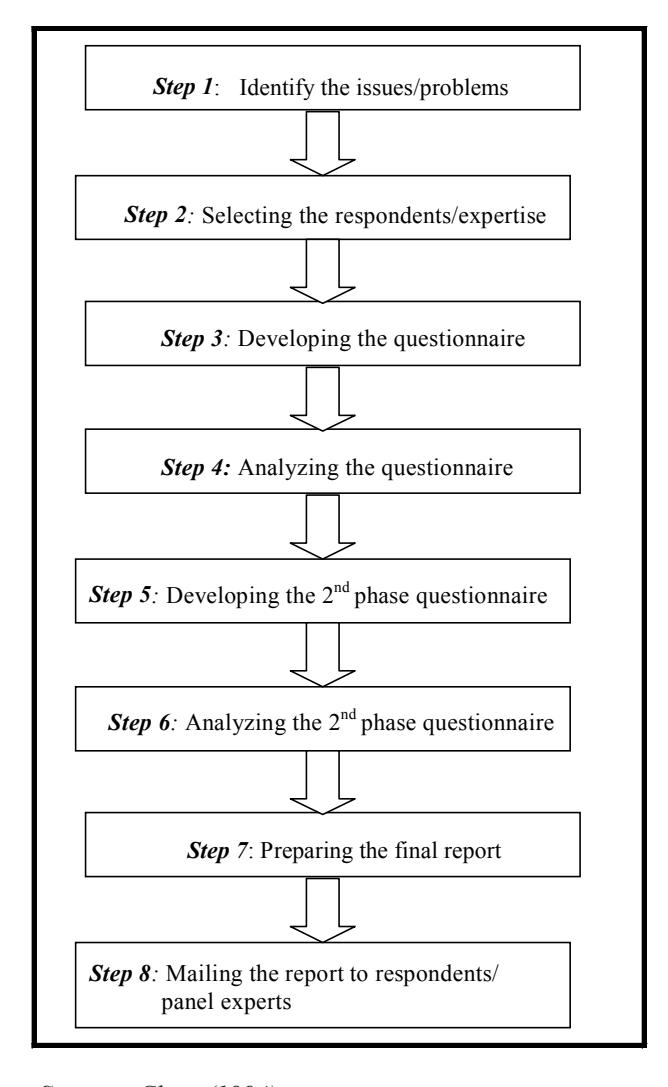
Source : Clare (1994)
Figure 1 The Procedure for the Delphi Method
Application of the Delphi Method in the Tourism Industry
Several studies were undertaken to predict the future potential of tourism by using the Delphi Method. In a study undertaken by Kaynak et. al. (1994) regarding the future of the South African tourism potential to the year 2010, they revealed that the Delphi Method was a suitable and efficient method that could be used for overcoming limitations of numerous quantitative methods. They had achieved their objective which was to convey the results and recommendations of an empirical study based on the Delphi research model. The study only needed two rounds to obtain opinion convergence from the panelists. In fact, data from the study also contributed to the formulation of the future national tourism strategies and strengthen the regional and national tourism database.
Furthermore, the used of the Delphi Method in . the study had also supported other opinion gathering in future studies and provided generalizations to other similar populations. Even though the method depended on time-series data, the information obtained through the used of the Delphi Method had benefited both the public and private sectors in the South African tourism industry in making decision more effective.
The Delphi Method was also used in a recent study by Abidin (1999) to identify criterion and indicators for a sustainable management of ecotourism in Taman Negara National Park (TNNP), Malaysia. The study involved three rounds of the Delphi Method and the findings revealed 15 criterion and 58 indicators of sustainable ecotourism development for the TNNP. The findings of the study also indicated that the Delphi Method provided a valuable framework for tapping experts' knowledge and public opinion on gathering and refining criterion and indicators of sustainability. The method had also contributed to the fact that it was a useful tool in conducting correspondence surveys with qualified people living in various locations throughout Malaysia. It had also eliminated committee's meeting activity that was considered as travel time burden. In accordance, the method used in the study was also found to be relevant with the issues of identifying criterion and indicators of sustainable ecotourism development in the TNNP.
In another study, Wen Kuo and Hwa Yu (1999) used the Delphi Method to analyze the proper factors to be contained in an evaluation system which could be used to assess areas for designating national parks in Taiwan. They found that the success of the Delphi Method was very much dependent on the design of the questionnaire and the selection of the panel members. By using the method, they also came out with six characteristics of a site; diversity, representativeness, naturalness, rarity, fragility and suitability. Another four characteristics were also noted as categories represented the potential for management objectives; conservation, research, education and other functions. In other perspective, the study also revealed that the Delphi Method was a reliable tool for predicting the future potential of the national park in Taiwan.
Baum et. al. (1997) used the Delphi Method in a study to develop and examine policies for human resource development in the tourism and hospitality industries in United Kingdom. They found that the Delphi Method was a significant tool for identifying and measuring gaps between the skills and wider human resource requirements in the tourism and hospitality industries. In fact, the study also indicated that the Delphi Method could be used to study the future and identify the educational and training priorities for the tourism and hospitality industries. Even though the method raised difficulties in terms of the definition and identification of an appropriate expertise and time commitment demanded of participants, the study found that the Delphi Method also developed potential breadth of the study and permitted reflection time for participants to tackle issues in a balanced manner.
Previously, Faulkner and Tideswell (1999) conducted a study on leveraging tourism benefits from the Sydney 2000 Olympics using the Delphi Method. The method was used to review the range of opportunities that exist for leveraging tourism benefits from major events of the magnitude. The findings of the study revealed that beyond the visitors, the event would attract in its own light. In fact, it was also found that the tourism industry in Sydney and Australia had the potential to benefit from a range of effects such as longer-term promotional spin-offs, pre-Games itineraries and infrastructures improvement. The study also indicated that the Delphi Method was a useful tool for predicting the future potential of tourism particularly toward market reactions and tourism sports markets.
The Delphi Method was also used to study the perceptions of the future teaching competencies from hospitality educators in the United States (Clark, 1997). The method was useful in a way that it added validation to the core of fundamental teaching competencies, provided information for the educators to understand how their peers perceived those core teaching competencies and in turns, prioritized their improvement for better teaching practices. In addition, a study using the Delphi Method was undertaken by Veal (1999) to develop an approach to leisure forecasting and planning at the local level. It was believed that the method could provide a basis for policy making and forecasting by convincing the local communities that they should build their own database.
Yong et. al. (1989) conducted a study on predicting the future factors affecting tourism in Singapore which concluded after three rounds of using the Delphi procedure. Furthermore, Kaynak and Macaulay (1984) conducted a study among the tourism stakeholders in Nova Scotia, Canada using the Delphi Method and reached consensus only through analyzing the means and standard deviations of the data.
METHODOLOGY
Research Design
Based on the steps suggested by Yong et. al. (1988), the study has been completed using nine steps in predicting the future potential of tourism inLangkawi (Figure 2). The first step was identifying the problems faced inthe Langkawi tourism industry. Items in the questionnaire were based onseveral interviews conducted among the people of Langkawi who were directly involved with tourism and several issues which were identified in the literature.
The next step involved the identification of the panel expert judges. From the relevant research literature, it is found that there is no fixed rule to the number of expert judges required and the choice actually depends on the nature, scope and importance of the study undertaken. In fact, Welty (1972) suggests that high levels of expertise are not necessary for a quality forecast.
For this study, 14 judges were identified based on their knowledge of the subject reviewed and they were from various fields; policy makers, academicians, transportation, accommodation, travel organizers and tourism operators. The 14 judges were not only based in Langkawi but from all over Malaysia. The third step involved the selection of the panel judges. Only ten judges were study as panel of experts. The other four were unwilling to spend their time answering the questionnaire since they considered themselves as not specifically expert in the Langkawi tourism industry. Based on the criterion suggested by Baum et. al. (1997), eight judges were finally selected for the study (Figure 3).
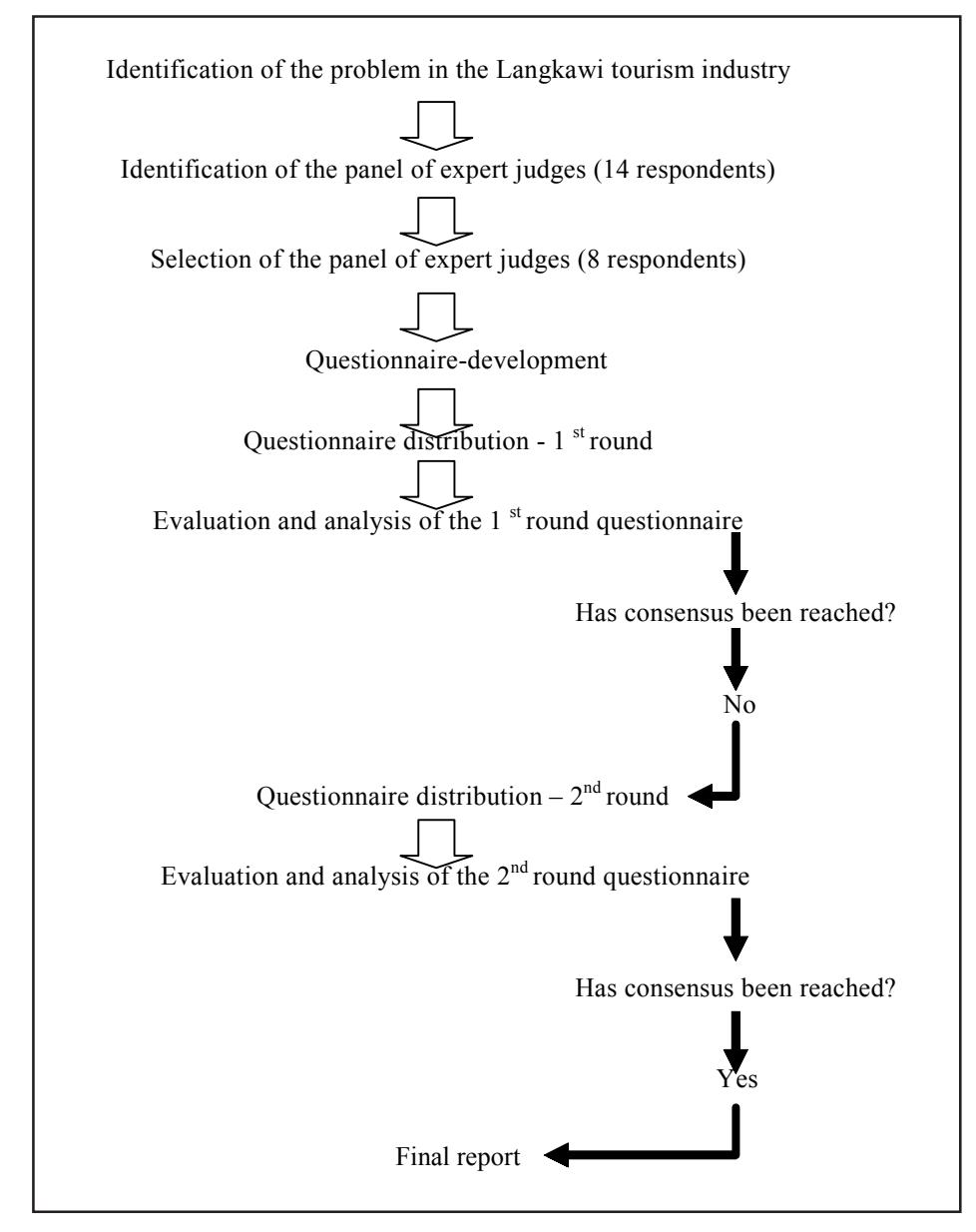
Figure 2 Model of the Delphi Method for Langkawi
Questionnaire Design
The first-round questionnaire was developed for the purpose of getting a consensus among the panel of expert judges in the subject under study. Questionnaires were mailed to the eight selected judges with cover letters stated the purpose of the study and the justification for the selected judges. The judges were given four weeks to complete and return the questionnaires using the stamped-envelopes provided. Within those four weeks, messages were sent via e-mail reminding them of the matter.
Hold upper-level management positions within their field
Serve in leadership positions in professional associations related to their field
Demonstrate familiarity with many different career levels within their sector
Demonstrate leadership and decision-making skills
Articulate trends impating their industry
Possess familiarity with tourism education and training in their world region
Source: Baum et. al (1997)
Figure 3 Panelist Criteria for the Delphi Method
The questionnaire consisted of six parts. Part I required the panel judges to indicate the changes of the items in the community value systems for the Langkawi tourism industry from 2003 through to 2010 by stating; 1= significant decrease, 2= slight decrease, 3= no change, 4 = slight increase and 5 = significant increase. The items were; the family value, the educational value, the work value, the individual participation in the tourism industry and the community acceptance towards the changes occurred due to the tourism development in their areas. Part II required the panel judges to indicate the importance of the items in the community value systems for the Langkawi tourism industry from 2003 through to 2010 by evaluating them from very important to less important.
Part III required the panel judges to indicate the changes of the items in the tourism structures for the Langkawi tourism industry from 2005 through to 2010 by indicating; 1= significant decrease, 2 = slight decrease, 3 = no change, 4 = slight increase and S= significant increase. The items were; demand on hotels, resorts, transportation services, tour guides services, travel agency services and tourist bus services; development of theme park, historical buildings and museums, government participation in the tourism industry and the establishment of tourism organizations. Part IV required the panel judges to evaluate the degree of importance of these items from very important to less important.
Part V expressed a number of activities or events/festivals statements and asked the panel judges to perceive the likelihood of occurrence of each activity or event/festival from "never happen " to "had happened". The panel judges were also asked to indicate the year the activities or events/festivals had taken place or would likely to take place. The statements were; the establishment of an international travel routes, economic incentives for the protection of wildlife and natural environments; the development of a fully automated data retrieval systems to provide travel information and also an international data bank with video communication for tourism information. These statements were also included in Part VI of the questionnaire where the panel judges were asked to indicate the degree of importance of the events from very important to less important. All the eight questionnaires were then analyzed by examining each questionnaire in order to determine the level of agreement and disagreement of the panel judges. A summary of the results was then used to develop the second-round questionnaire. The summary was based on some measure of control tendency such as means and standard deviations.
The second-round questionnaire consisted of two parts. The first part of the questionnaire asked the panel judges to indicate the degree of agreement towards the changes and the importance of the items in the community value systems and the tourism structures for the Langkawi tourism industry from 2003 through to 2010 by stating, 1= strongly disagree, 2 = disagree, 3 = no answer, 4 = agree and S= strongly agree. The items were based on the summary of Part I - Part IV in the first-round questionnaire which ended with 27 items.
Part two of the second-round questionnaire asked the panel judges to indicate the degree of agreement towards the activities or events/festivals which might occur in the Langkawi tourism industry to the year 2010 by stating, 1= strongly disagree, 2 = disagree, 3 = no answer, 4 = agree and S= strongly agree. 24 items were consisted in this part based on the summary of Part V - VI in the first-round questionnaire.
The second-round questionnaires were then distributed to the panel judges via mail with stamped-envelopes provided. The questionnaires were returned in four weeks which were exactly the time given for them to complete and return the questionnaire.
FINDINGS OF THE STUDY
The findings of the study were based on the consensus among the panel judges in answering the second-round questionnaire. Part I of the questionnaire examined all the variables in order to determine how the judges perceived the changes of the items in the community value systems and the Langkawi tourism structures. Based on the analysis of the means, the panel judges agreed that the community value systems would increase in parallel to the growth of tourism in Langkawi from 2003 through to 2010 (Table 1).
The panel judges agreed that the family value, the educational institution and systems and the work value systems among the community play important roles in the tourism development which eventually would lead to the community participation in the tourism activities. In addition, the item regarding community acceptance towards the changes was also found by the panel judges as important item in the Langkawi tourism industry from 2003 through to 2010. In accordance, the panel judges also agreed that the item regarding individualism among the community would increase in parallel to the growth of tourism in Langkawi from 2003 through to 2010 which lead to a negative impact of tourism.
Table 1 The Community Value Systems in the Langkawi Tourism Industry from 2003 through to 2010
| No. | Items | Means | Changes |
|---|---|---|---|
| 1 | Family value systems in the community | 4.625 | Increase |
| 2 | Educational institutions and | 4.375 | Increase |
| education systems in the community | |||
| 3 | W orking value systems in the community | 4.375 | Increase |
| 4 | Individual participation in the tourism | 4.25 | Increase |
| activities | |||
| 5 | Community acceptance towards the | 4.25 | Increase |
| changes occurred in the tourism industry | |||
| 6 | Individualism among the community | 1.5 | Increase |
The Langkawi tourism industry from 2003 through to 2010 would also play important roles in the tourism structures (Table 2). The panel judges agreed that tourism economic structures would increase in parallel to the growth of tourism such as; the demand on hotels, resorts, travel agents services, tour guides services, transportation and bus tour services. In addition, the panel judges also agreed that the environmental structures would also increase in parallel to the growth of tourism such as; the demand on the development of recreational parks and historical buildings. As for the socio-cultural structure, the panel judges found that the Langkawi tourism industry from 2003 through to 2010 would increase the demand on entertainment, demand on events and festival, government involvement and participation in tourism industry, development of cultural and educational attractions, development of theme parks and establishment of more tourism associations.
Table 2 The Tourism Structures in the Langkawi Tourism Industry from 2003 through to 2010
| No. | Items | Means |
|---|---|---|
| Economic Structure | ||
| 1 | Increased demand on hotels | 4.625 |
| 2 | Increased demand on resorts | 4.625 |
| 3 | Increased demand on travel agents services | 4.625 |
| 4 | Increased demand on tour guide services | 4.500 |
| 5 | Increased demand on transportation | 4.375 |
| 6 | Increased demand on bus tour services | 4.000 |
| Environmental Structure | ||
| 7 | Increased demand on the development of recreational parks | 5.000 |
| 8 | Increased demand on the development of historical buildings | 4.750 |
| Socio-cultural Structure | ||
| 9 | Increased demand on entertainment | 5.000 |
| 10 | Increased demand on events and festivals | 4.750 |
| 11 | Government involvement and participation | 4.750 |
| 12 | Increased demand on cultural and educational attractions | 4.250 |
| l3 | Increased the development of theme park | 4.125 |
| 14 | Establishment of tourism associations | 4.000 |
The panel judges also agreed that the growth of tourism industry in Langkawi from 2003 through to 2010 would not affect several items in its structures (Table 3). The items were; demand on food outlets, museum development, demand on Homestay programs, demand on duty-free shops, demand on gift shops, community involvement and participation in the tourism decision-making and individual self-expression among the community in the tourism industry.
Part II of the questionnaire consisted of 24 items which examined the future potential of tourism activities and events/festivals in Langkawi to the year 2010. All the judges agreed that tourism industry to the year 2010 would potentially create several activities (Table 4). The activities were; establishment of more businesses in tourism, more people of Langkawi traveling in the island itself, higher income in coming from the restaurant, development of tourism program/courses in the educational curriculum, establishment of more part-time jobs in the hotel sector, increment in the total number of international flight to the year 2005/2006, development of new tourism products such as space tourism and deep-sea world
tourism to the year 2006/2008, increment of more jobs in tourism,increment in the number of people working in the tourism industry to fulfill their free-time, allowances and incentives for people of Langkawi to travel and development of a tourism database system to the year 2005.
Table 3 Items which will not be affected due to the growth of Tourism in Langkawi from 2003 through to 2010
| No. | Items | Means |
|---|---|---|
| 1 | Demand on food outlets | 3.75 |
| 2 | Museum development | 3.75 |
| 3 | Demand on Homestay program | 3.625 |
| 4 | Demand on duty-free shops | 3.625 |
| 5 | Demand on gift shops | 3.625 |
| 6 | Community involvement and participation | 1.5 |
| in decision-making | ||
| 7 | Individual self-expression in the industry | 1.5 |
Table 4 Activities in the Langkawi Tourism Industry to the year 2010
| No. | Tourism Activities | Means |
|---|---|---|
| 1 | Businesses in tourism | 5 |
| 2 | Traveling in tourism island | 4.925 |
| 3 | Income coming from restaurant | 4.825 |
| 4 | Tourism program to the year 2010 | 4.725 |
| 5 | Part-time jobs in hotel's sector | 4.625 |
| 6 | Increase in international flight to the year 2005/2006 | 4.625 |
| 7 | New tourism products to the year 2006/2008 | 4.625 |
| 8 | Activities in tourism jobs | 4.55 |
| 9 | Working to fulfill free-time | 4.55 |
| 10 | Allowances and incentives to travel | 4.25 |
| 11 | Tourism data-based system to the year 2005 | 4.125 |
The panel judges also agreed that the Langkawi tourism industry to the year 2010 would potentially create several events/festivals (Table 5). They agreed that Langkawi has a potential to organize an international conference on ecotourism to the year 2004/2007. They also found that Langkawi has a potential to become a yacht-tourism destination and an international traditional activities destination to the year 2005/2008. In fact, the panel judges also agreed that Langkawi has a potential to organize a tele-conference and video-conference for tourism events/festivals to the year 2005. They also reached a consensus that in general, Langkawi would become an international tourism destination and international tourism events and conference destination to the year 2010.
The panel judges also agreed that theme park such as the 'Disneyland' has no potential to be developed in Langkawi to the year 2010. The findings of the study also revealed that all the judges agreed there would be several activities and events/festivals which would not be affected due to the tourism development (Table 6). The activities and events/festivals were;
the establishment of self-service in restaurant, lower prices due to the development of modern technology to the year 2005, involvement and participation of both government and private sector to the year 2010, education and training for hotel managers to the year 2004, economic incentives from the government and more holidays for people working in tourism sectors to the year 2007.
Table 5 Potential Events/Festivals in the Langkawi Tourism Industry to the year 2010
| No. | Events/Festivals | Means |
|---|---|---|
| 1 | Ecotourism conference and events tothe year 2004/2007 | 5 |
| 2 | Yacht-tourism destination | 4.625 |
| 3 | International traditional activities destination to the year 2005/2008 | 4.625 |
| 4 | Tele-conference and video-conference to the year 2005 | 4.625 |
| 5 | International tourism destination | 4.5 |
| 6 | International conference and events destination | 4.5 |
Table 6 Activities and Events/Festivals which would not be affected due to the growth of Tourism in Langkawi to the year 2010
| No. | Activities/Events | Means |
|---|---|---|
| 1 | Self-service in restaurant | 3.75 |
| 2 | Lower process due to modern technology to the year 2005 | 3.5 |
| 3 | Participation of both government and private sector to the year 2010 | 3.5 |
| 4 | Education and training for hotel's manager to the year 2004 | 3.5 |
| 5 | Economic incentive from the government | 3.5 |
| 6 | More holidays fro tourism workers to the year 2007 | 3.5 |
CONCLUSION
The study contributes to the methodological framework of using the Delphi Method as an effective qualitative method for predicting the future potential of tourism in Langkawi. This is based on the fact that the consensuses were reached only on the second-round of the questionnaire distribution. Thus, the findings indicate that the Delphi Method is an effective measurement tool in predicting the future potential of tourism. The findings also support previous study regarding the future potential of tourism industry in South Africa (Kaynak et. al., 1994).
The used of the Delphi Method in predicting the future potential of tourism in Langkawi from 2003 through to 2010 also indicate that the panel judges agreed tourism would lead to an increment in the community value systems and particularly to the tourism structures such as demand on accommodation, demand on transportation services and demand on the tour operators services. The findings are significance with a study undertaken by Kaynak et. al. (1994) on the future potential of tourism in South Africa. Furthermore, the study also revealed that the judges found tourism program/courses is important in developing the educational curriculum where the end results would lead to more workers who are educated and have good background skills in the tourism sectors. In accordance, this findings are significance with Kaynak et. al. (1994), Baum et. al. (1997) and Clark (1997).
The panel judges also found that Langkawi has a potential to organize an international tourism conference and to become an international tourist destination to the year 2010. This can be justified by the fact that Langkawi had successfully organized several events such as LIMA (Langkawi International Maritime and Aerospace Exhibitions), Le Tour de Langkawi, International Motor Show, World Powerboat Race, Langkawi International Endurance Marathon and Langkawi International Kayak Challenge. Recently Langkawi had also organized a yacht event named Royal Langkawi International Regatta. These activities eventually would lead to a complete data-based system for tourism industry in Langkawi to the year 2010.
Based on the discussion, it is suggested that the policy makers and tourism planners should consider and give full attention to all the items in the community value systems and the tourism structures in order to prepare and develop the future tourism plan for Langkawi. These items should be taken seriously due to the fact that they would determine community's acceptance toward tourism development in the area. The community positive attitudes would consequently lead to a positive development (Kaynak et. al., 1994). In accordance, strategies and policies should be better planned and implemented in the future by taking into considerations items which would not be affected due to the growth of tourism.
In addition, it is recommended in the future that tourism program/courses to be implemented in the educational curriculum besides offering more effective training for those who are interested to be involved in the tourism industry. Accordingly, the future studies should also be undertaken for the purpose of testing and implementing the Delphi Method as an effective qualitative method in predicting the future potential of tourism in specific areas.