

INTRODUCTION
A brand is an interesting and popular topic in global hotel industry. When there is a question about the importance of a brand for a hotel, then its position will automatically represent the hotel as a brand that is used for non-service product. In other word, brand existence is important. The basis understanding of a dynamic relationship between brand as an asset and operational management and marketing is the key of success of a hotel. A model has been developed to show this main relationship. To achieve brand integrity and consistency then a further approach should be prepared (Forgacs, 2003). A brand will always be connected to company identity which will be remain the consumer about its performance.
Based on the information from Express & Travel Tourism (www. expresstraveltourism.com) about hotel industry nowadays, an event was held to measure hotel brand performance by giving an award named Best Premier Hotel Brands which won by Taj Hotels, Resorts & Palaces. This hotel has 56 properties, where 39 from them are located in India and the rest are scattered at Maldives, Mauritius, Malaysia, Seychelles, England, America, Bhutan, Srilanka, Africa, and Middle East. Taj is the first hotel in India that has a dining package in India by introducing several international meals such as Sichuan, Thai, Italy, Mexican, and California. In fact, since 1972 , Taj is the first hotel which has 24 hours coffee shop. The measurement and criterion of Best Premier Hotel Brands award is divided into
Address correspondence to Leonid Julivan Rumambi, Faculty of Economy Petra Christian University Surabaya, E-mail: e-mail : scylics@petra.ac.id
The measurement and criterion of Best Premier Hotel Brands award is divided into 2 kinds which are objective criterion and subjective criterion. Objective criterion consists several factors such as :
- Number of properties.
- Operational revenue (rooms, F&B).
- Online reservation.
- Room inventory.
- Number of rooms sold across all properties.
- Revenue per available room.
- Average room rate.
- Number of employees.
- Gross operating profit.
As the subjective criterion consists factors such as :
- World class cuisine.
- In-house-service.
- Front office interaction.
- Back office interaction.
- Guest facilities
- Value for money promotion.
- Loyalty schemes.
- Marketing & communications
This award model is an example of how important a hotel brand is supported by its basic activities which consist of marketing and operational, in its effort to give the best service to its consumer. Other event was also held in slightly different view named Best Business Hotel Brands 2006 which was held in a series of Business Travel World Awards event in London. It was attended by 1.300 business practitioners especially those who works in travel industry. This award was won by City Inn which closely competing with Mandarin Orientals Hotel and Ritz Carlton.
From the existence of those awards mentioned above, we can see how consumer as individual or as businessman expects a better service each time. An award was initiated to illustrate consumer and travel businessman's appreciation to hotel performance and to describe an example of the most satisfying hotel standard these days. Sometimes a hotel which has a fairly good management needs balance and supporting synergy between its activities. Those activities are directed into the same word which gives a pleasing service to its consumer.
Most hotels assume that a strong brand is an important thing to attract and maintain their consumers, especially for branded hotels. Although the tendency of branded hotels in owning a strong brand is not necessary guaranteed based on the management standard and perception from their consumer. Moreover, branded hotels face many competitors among themselves by offering similar service standard with its advantage and disadvantage. Hotel service competition is a highly intense contest that always needs best efforts to serve and satisfy their consumer.
Source : Express & Travel Tourism's Website (http://www.expresstravelandtourism.com/200601/awards02.shtml)
Figure 1. Best Premier Hotel Brands Awards Finalist
LITERATURE
Brand is unseparated from world market nowadays. American Marketing Associations gives definitions of brand as a name, term, sign, picture or symbol or the combination of those mentioned before which proposes to identify a single or group of seller's product or service and to differentiate their product or service from its competitor. Giribaldi (2003) defines brand as a combination of attributes which is communicated through name or symbol which can influence consumer's mind in buying decision process.
Actually, brand's role is more than this. A brand is actually a promise given by the company to its consumer about what the product can give to the consumer. That is what makes a brand has an important role for a company in their effort to satisfy its consumer (Campbell, 2002). A research is needed to carry out in order to discover a company's brand position in their consumer's mind.
Perception, consumer's feeling and their experience with the brand is something that differentiate a brand of a product from its non-brand competitor. A brand can be well positioned by associate its name with its benefit. For example Toyota (can be trusted and family oriented), Sony (creative), Lexus (quality), and Raffles Hotel (mature and aristocrate). This positioning decision will be succeed if all the individual in that organization have the enthusiasm and the target market believe that the company is the best in giving those benefits. (Kotler et al, 2005).
BUILDING BRAND IDENTITY
The effort to build brand identity needs several decision which considers the name, color, tagline, and symbol. A brand is more than just marketing tools and tactics. Essentially, a brand is a marketer's promise to deliver several product features, benefits and consistent services to buyer. A marketer has to determine a mission for that brand and a vision about what it will become and what it can do. Marketer has to think that a contract is offered today to the consumer about how it will perform. That brand contract has to be an honest one.
Maximally, a brand campaign will only create a name recognition, brand knowledge, and even brand tendency. But no matter how much a company allocates campaign budget, an advertising campaign will not create a brand bonding. Brand bonding or brand attachment will only happen if a consumer experience a direct benefit which has been promised by the company. The fact is, a brand is not built by an advertising but by experience. Many companies create promises considering their brand but fail to train its employees to understand and give what has been promised in their brand. A company can educate its employees in order to make them understand, wish, and give the promise that has been delivered by the brand (Kotler, 2003).
IMAGE AND REPUTATION
An image is an important content which follows hotel brand besides its reputation. An image is a color, symbol, words and tagline that deliver a clear message, consistent, and not just a name (Berry et. al, 1988). When a customer remember a brand then the visualization will emerge in their mind as an image or reputation. It will show a brand positioning in comparison with its competitor. The comparison includes whether the service is better or worse, whether the quality is higher or lower etc. In some brand literatures, an image is also frequently mentioned as brand image. Consumer will need more a brand comparison with other hotel competitor because of the different image (Schiffman & Kanuk, 1991).
In marketing or selling quality product and maintaining high price will increase its reputation from a company and also to increase brand loyalty. In effort to build and maintain reputation, good and service quality which has been promised have to be fulfiled. Having a good reputation can increase selling, attract new consumer by word of mouth activities and reduce unsatisfied customer (Rogerson, 1983). More over, a recognize brand will help the consumer to accept new product (Aaker, 1991). A hotel that has high reputation because of its quality can sell its service with premium price (Tepeci, 1999).
DISCUSSION
This article argues a comparative discussion from an article which was written by Forgacs (2003) about "brand asset equilibrium in hotel management" which explained about the importance of balancing the hotel asset and management in hotel operations and marketing especially for strong branded hotel. Forgacs explained that most of big hotels with strong brands (branded hotels) commonly take leading position than others, especially in some performance measure indicators such as :
- 1. Average price.
- 2. Level of occupancy.
- 3. Revenue per available room.
- 4. revenue per available customer.
- 5. Return on investment.
Forgacs (2003) also said that brand performance actually can be linked with marketing and operations. In operations side, a well-managed brand can maximise the revenue, gives better training to its employees, and creates a consistency in delivering their service. In targetting segmented market more effectively, a hotel can build brand with existing resources, coordinates broader and more promotion, and develops a more advance product. In this case a brand can reach penetrated market stronger and offers a higher or premium price.
A brand becoming very important when its name has been well known, accepted and even favored. A hotel name can represent an image and status of the hotel as well as explaining its characteristics and attraction. This concept is known as brand personality. It will be unfair when we compare the available facilities between different hotel degree. For example, comparing 3 stars hotel with 5 star hotel. Hotel with strong brand obviously wins for its strong name compares to local hotel which has limited space to develop. It's like a giant fighting a weaker creature. The condition is not necessary the same when the local have un-replaceable uniqueness such as a distinctive concept to compete.
Source : Forgacs, 2003
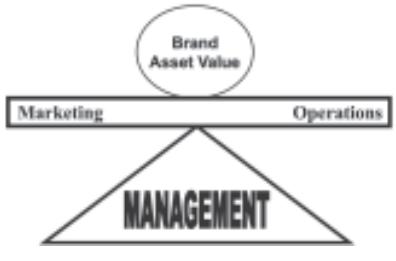
Figure 2 Brand Asset Equilibrium
How we can see there is a direct link between brand and hotel management? It can be explained at Brand Asset Equilibrium picture above. That figure shows a balance between marketing and operations. Hotel management as the basis which maintains a balance between two elements for preserving asset value in the form of economic value. A high and popular brand will give benefit from company's strong position to offer its product in premium price. Selling it will give a bigger benefit to the company than its competitor who offers the same facility with similar operational expense but in lower price.
The arrangement of the position also describes clearly both level and implication to one another. Why is brand in top position? Because it is the face and sound of the product. What is being presented in a brand will be seen by the consumer as a face which represents the image of a product. The words in a brand will become a sound which explains the character of the product. The power of a brand is supported by what the company offers which is usually called as marketing activities, and also being sustained by hotel ability in delivering its promised service which is implemented in operations activities.
Marketing and operation are balanced by management to make sure that role and function are preceeded as it should be. Both have to run equally good marketing is a promise to the consumer whereas operation is the evidence to make sure that the promise has been fulfilled. Unbalance of those two elements will create a negative impact to the brand both indirectly and directly. A brand image will fall and the consumer perception about the hotel brand will no longer strong. If a hotel promotes its ideal concept about facility, service and attributes which makes an advantage and attraction, but on contrary it gives unsatisfied service to its cunsumer, then hotel's image will become negative and create harmful effect to external side, which is the consumers. In this phase, a consumer will see that the hotel is over-promised, not well-managed, and fails to satisfy him/her.
Meanwhile, if the service is very good and different with what it is expected, then the consumer will think "what is wrong here?" A good hotel with a good service but has limited knowledge about marketing which is exemplifyed in umpromoted brand will lead to unpredictectable hotel performance and knowledge in the eyes of consumer. the consumer looks has no knowledge and prediction of brand performance measure, it is because this brand is not well promoted. Beside, the consumer can think that the hotel is experiencing financial problem or other problems which make the hotel has no fund to promote more. If it is promoted and marketed in a better way then it will increase the amount of the hotel visitors and increase hotel revenue.
Source : Forgacs, 2003
Figure 3 A Marketing – Heavy Model
This condition has to be reviewed carefully by the company because the disappointed consumer (due to operations or marketing problem) may not be willing to come again only to receive the same disappointment twice. In fact, if it is possible and worthy then he/she will switch to another hotel. Therefore it creates a high possibility of switching consumers due to unsatisfiying hotel performance. A condition which describes in the picture above, A Marketing – Heavy Model, illustrates how consumer can switch due to overprice. A condition as " An Operation – Heavy Model" will make a hotel undervalued.
An overpriced hotel happens because the consumer feels that what has been promoted is failed to be fulfilled. Consumer will feel that the price they have to pay is too high compares to its competitor. "A marketing – Heavy Model" happens if a hotel is too focus on marketing rather than operations. Undervalued condition also happens because hotel is less promoted and results in giving lower price than its competitor although both hotels are in same star category. Automatically, this effect will create a less positive condition for hotel's financial state. The internal effect seems to be bigger than external effect. "An Operational – Heavy Model" (figure 4) happens when the hotel is too focus on operational rather than marketing.
Source : Forgacs, 2003
Figure 4 An Operation – Heavy Model
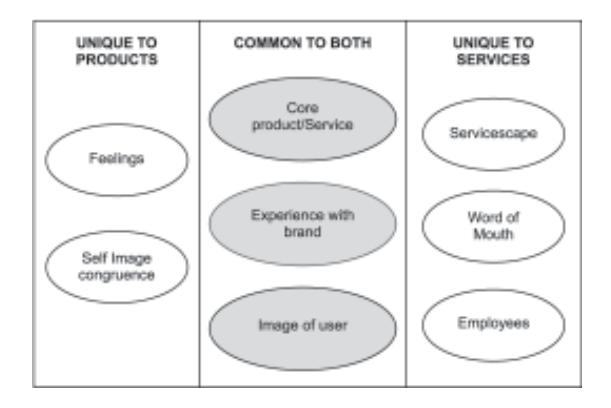
As review, an interesting concept is offered by Grace & O'Cass (2002) about key dimensions for branded product and services as seen in Figure 5. This concept is actually a continued model from important dimension concept by Keller (1993) especially for core product and service, and also image of typical user by Berry (2000) for experience relates with brand. In Grace & O'Cass research, this concept is used to associate brand with consumer's feeling and perception through interview method. This model fits to describe hotel attraction with combination of goods (room, facility, food, drink, atmosphere etc) and service ( hospitality, comfort, satisfaction, and concrete service scope as massage, spa etc).
Source : Grace & O'Cass, 2002
Figure 5 Key Dimensions for Branded Products and Services
In explaining more about the operational and marketing sides from Figure 2, the writer relates the connection between those two concepts with key dimension for branded products and services in Figure 5 with three important dimensions in company which are combination of good and service. The first part mentioned the applied category for good and service which are describe as follows:
- (1) core product/service, what prime product is offered by hotel, for example superior room with its facility in which fits consumer's willingness. The unique side of the product impresses the consumer (in the picture; feelings context), so he/she uses the product and tries to enjoy its benefit. The results will create brand experience, which he/she had already experienced. This impression will remain strong if the consumer starts to decide whether the product is satisfying or not.
- (2) Self image congruence is applied when consumer sees the product and gives an assessment about the fitness level to themselves, for example, a balance between his/her wish and existing performance. Perception of users also becomes one of assessment criterions. For example, a consumer of SES A who stays in a 5 star hotel which is frequently visited by middle class society with SES B will find that he/she doesn't fit with others, hence it makes a decision in switching hotel. This is in line with Ferrinadewi et. al (2003;2004) state that the perception influences consumer switching behavior.
Meanwhile, the judgement of service side (intangible) is based on: (1) service scope including its performance where experience of consuming the service has different effect compares to goods. If the experience of consuming goods usually takes form as an internal effect that is saved for themselves, then the experience of consuming service takes form as (2) word of mouth. It means, that experience tends to be shared to other or it also called as external effect. Automatically, the advantage of service
over good is more likely a free-promotion by customer. User's perception is also reflected from (3) hotel employees, such as a degree in confidence and cleanliness of its employees' appearance, professionalism, and the level of response and initiative in the service.
Marketing side will offer the specialty of the hotel's product and service, meanwhile the operations side will make sure that the offer will be fulfilled. The achievement of consumer's expectation on service is a satisfisying hotel operations. Therefore, hotel's image will positively move and influence the consumer's view of the hotel brand. Nevertheless, the most important thing to be remembered to distinguish a hotel identification is not determined by its location, facility, price nor other technical elements but the brand itself. For example Sheraton, JW. Marriot, Mandarin Oriental, Hilton etc.
CONCLUSION
Bateson (1977), Gronroos (1990), Zeithaml & Bitner (1996), in Tjiptono (2005) stated that commonly service is described in four unique attributes which are intangibility (not concrete), heterogeneous (many variations), inseperability (unable to separate), perishability (unable to store), and lack of ownership. In this case, availability of hotel service will also have same characteristics with the service at hospital, beauty parlour, spa etc. Consumer or customer has absolute need to be fulfilled in a good way and that demand will increase following how good a service in company and offer a solution to their need.
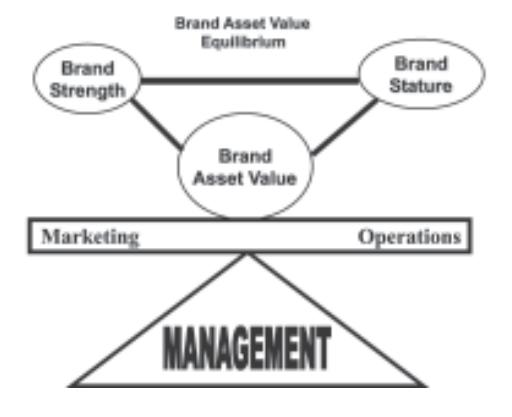
Brand equilibrium model (Figure 2) is developed further by Forgacs. He presents that brand asset value (Figure 6) consists of two important parts which are brand strength and brand stature. Based on the concept by Ackerman & Tong (1995), brand strength is something that is built on relevance (what is promised to the consumer) and differentiation (what is a distinguishable service owned by a company). Beside, brand stature is a consumer's knowledge about the brand, and esteem (the level of consumer's appreciation to the brand), as the results of brand popularity and quality perception which is offered by the brand.
Source : Forgacs, 2003
Figure 6 Sustainable Asset Model
Forgacs sees that brand asset value is still needed to be explored more from the other side. In this matter, brand strength can be seen as giving a strong image to the consumer from its service quality, facility, satisfaction and promise, which creates an advantage value which makes the hotel perceived as "more" than others. Brand stature shows other hotel's facet where consumer sees a favorable characteristic apart from its main power which is a brand name. What is actually felt or known by the customer or their future customer about the hotel brand? Source of perception could be from the news media, interaction with the customer itself, promotion, or even from other customer's experience. Brand stature emphasizes more on the consumer as an external attraction side while brand strength relies on hotel brand as an internal side. This condition is clearly describes on A Sustainable Asset Model (Figure 6).
The final conclusion is brand asset value has to be managed with strong and continued foundation, especially in the hotel operation management and marketing. A company has to avoid over-promised or under-valued situation (Figure 3 and 4), to create a positive atmosphere both to the customer and consumer. An operation-heavy model and a marketing-heavy model are pilot projects of the effect of badly managed of operations and marketing. The hotel image takes the burden of this effect and the hotel brand will no longer as strong as before. Or in other word, the image will decline. Bad hotel image will hit the hotel occupancy which will get lower and the price will be set low to compete its competitor. The hotel management become other key to the hidden power. Management has to ensure that promise will be well delivered through its marketing and service to its customer.
Good performance will become a standard to judge, for example, if a consumer lost his digital camera in the hotel and the employee managed to find and return it to him in a short time, he will satisfy with hotel service. On the contrary, when the same consumer stayed in another hotel and lost his other item in that hotel, then the latter's performance in finding and returning item will be measured by their experience at the first hotel. In other word, the first hotel performance will become the standard for the second hotel. But when the second hotel gave a better service and satisfaction then the new measurement standard has been set.
A satisfied consumer will become a success standard and also become a free promotion for the hotel. The more satisfy consumers then the more positive message they will spread to their friends, family and colleagues. Forgacs wrote, that marketing and operations have to keep their balance to avoid a gap between "say" and "do". Consistency and integrity in service will fulfill consumer's expectation to receive a better service. A consumer's satisfaction can't be valued with money, in this case the key success is the balance between "sustainable asset model" which will build positive brand image that will be remembered by the consumer.