

INTRODUCTION
The quality of environment, physical and socio-cultural, provides a sustainable basis of competitive advantage for tourism destinations and firms. Environmental resources provide one of the most basic ingredients, a critical production factor, for the production of touristic experiences. They include natural scenery, islands, beaches, back waters, coral reefs, mangroves, mountains, valleys, waterfalls, ancient monuments, traditional and picturesque towns and villages and many more. They offer settings for the tourists to enjoy, live in, and relax. Tourism's relationship with the environment involves many activities that can have both adverse and beneficial environmental impacts. Many of these impacts are linked with the construction of general infrastructure such as roads and airports and tourism facilities including resorts, hotels, restaurants, shops, golf courses, and marinas. The negative impacts of tourism development can gradually destroy the environmental resources based on which it depends. Conversely, properly managed, tourism has the potential to create favorable effects on the environment by contributing to environmental protection and conservation. The natural resource base which supports tourism is heavily stressed in and around the major tourist destination areas.
The problem is that these areas now support large transient populations with high-income lifestyles and these impacts harm both the environmental quality of the destination areas and the people; i.e.,
Address correspondence to Babu P. George.Tourism Studies, School Of Management, Pondicherry University, India. E-mail: myselfgeorge@gmail.com the tourists as well as the local communities. Changes in the physical, spatial, and socio-economic structure of a tourist area as well as the existence of several, sometimes burdensome, environmental problems testify to the presence of these conflicts and the crying need for evolving appropriate strategies to manage the environmental quality, especially in the third world countries like India (Singh, et.al. 1989). Yet, policy makers in such countries prejudice that the demand for environmental quality is low due to issues like poverty and the governmental policies largely ignore any voice calling for a better environment. Not only that, even in Kerala, the most advanced of all Indian states, any opposition to large-scale, polluting tourism projects by environmental and labor activists is often dealt with by the governmental machinery through totally undemocratic means (Sreekumar& Parayil, 2002). At present, the Indian Tourism Development Corporation (ITDC) and the State Tourism Development Corporations invariably restrict themselves to the tasks of setting up infrastructure, promoting holidays, etc. These organs of the state make only ad-hoc efforts to improve the environmental quality. This is self-evident from the "tell-tale symptoms" or "indicators" of degradation in environmental quality such as garbage dumps, foul smell, and exorbitantly high rates of all sorts of pollution in popular destination areas. One important reason why environmental conservation is perceived by the tourism industry stakeholders as antithetical to tourism development is the sheer lack of awareness about the unique and sustainable competitive advantage that a quality environment present at a destination region could provide to the tourism industry there (Hassan, 2000).
The present paper is conceptually weaved together with inputs mainly from the eco-tourism literature to throw light upon the interface between tourism and environmental quality. The paper argues that under certain conditions tourism and environmental quality are natural partners: properly managed, tourism can enhance rather than lower the environmental quality of a destination area. Two case studies are presented: one to show how tourism produces inferior environmental quality and the other to suggest a practical means to overcome the apparent contradiction between conservation and development.
TOURISM AND ENVIRONMENTAL QUALITY LINKAGE
Environmental quality related issues have already become a major area of investigation for environmental psychologists, tourism ecologists, and geographers (Altman & Wohlwill, 1983; Blangy et.al., 1993; Bourassa, 1990; Daniel, 1990; Demick & Wapner, 1990; Höge, 1990;). Of late, interest in the topic has grown quite markedly which brought out in-depth analyses like the one provided by Davies & Cahill (2000). In their report, employing a framework developed from industrial ecology, these authors analyze the environmental impacts of tourism industry in the United States, where it is the third largest, behind only automotive dealers and food stores. According to most of the available studies, environmental quality refers to the quality of air, water, and landscapes that are aesthetically important attributes for attracting tourists.
Tourism's demand for environmental resources is not so simple to identify and analyze as it might appear at the first thought (Hawkes &.Williams, 1993). This is because tourism is not a single economic activity with a rather standard pattern of input requirements and a standardized output. Tourism is a complex of interdependent and inseparable activities (that include travel, lodging, shopping, recreation, and services), each one with its own demand for inputs and characteristic outputs. The demand for the products of tourism is ultimately a holistic synthesis (not a mere addition) of these individual demands. Hence, the analysis of tourism demand for environmental inputs involves analysis of the demands made by its constituent activities as well as the interrelationships among these individual demands.
This demand analysis is important for two reasons:
- 1. Tourism development of an area must take into account the availability of local resources (ecological, cultural, heritage, and human) that are necessary for its growth and maintenance; and,
- 2. Tourism-related activities are to compete for the environmental resources of an area among themselves and with other economic activities (agriculture, industry, trade, transportation, etc) and conflicts among different uses/users are natural to arise. Depending on the developmental context, these conflicts result either in the deterioration of the quality of the tourist product and consequently bring losses to the tourism industry or culminate in a struggle for the domination of the most economically profitable activity.
The use of an area's environmental resources for tourism has two important consequences. Firstly, the quantity of available resources diminishes and sets limits to further tourism development in the area. Physically or economically non-augmentable resources like beaches and sites of natural or archaeological interest become limiting factors in this respect. For other types of resources, planning and managerial interventions must be made to maintain their quantity at levels necessary for continued tourism activity. Secondly, the quality of resources deteriorates with possible negative effects on tourism itself. This is because with increasing exploitation, the tourist product offered will become of inferior quality and the quantity of superior quality products available (which was the original reason for tourism development in that region) gets shrunk.
Tourism produces a variety of unwanted by-products that are disposed, intentionally and unintentionally, to the environment and adulterate it in that process; they are collectively called as the externalities by traditional economists. Moreover, as noted above, in the name of providing quality holiday experiences, tourism uses up and modifies natural resources affecting their quantity and quality available for tourism purposes themselves. It is an irony that developmental initiatives aimed at tourism ultimately detracts the tourists and destroys the tourism industry itself. Thus, sustainable tourism development depends in many important ways on the proper handling of the relationships between tourism and the environment. In 1996, in an effort to integrate tourism into the broader sustainability discussions, World Tourism Organization, World Travel & Tourism Council, and the Earth Council released their own action-plan, Agenda 21 for the Travel and Tourism Industry, outlining key priorities for governments, the industry, and others. (Inskeep, 1991; WTTC, WTO, and the Earth Council, 1996).
In spite of the revolutionary strides in the technological realm and our lofty claims about progress, we have trapped ourselves in a vicious circle of self-deception by adopting the typical "boom and bust" tourism paths. The question is whether we, in the blind pursuit of rapid economic growth and more foreign exchange earnings can afford to sacrifice the higher environmental quality upon which tourism so strongly depends. Though we have already learnt many bitter lessons, we tend to overlook them due to the higher short-term gains from neglecting them and the longer gestation time for the negative impacts to manifest themselves.
THE AESTHETICS OF ENVIRONMENTAL QUALITY
Tourists are attracted to destinations of higher Environmental quality (Hull & Revell, 1989; Viljoen, et. al., 1988). Many top ranking destinations in the world are blessed with a variety of natural attractions such as tropical climate, unspoiled beaches, forests, country side, chilly hill tops with rolling grass lands, clear coastal waters, bewitching back waters, fresh flowing rivers, lush vegetation, and other scenic landscapes besides another set of destinations that are known for their ethnic diversity, arts and crafts, and architectural splendor (Schroeder, 1991). According to Inskeep (1991), even in the case of those attractions where poor environmental quality is an integral part of the authentic tourism product, tourists preferred a staged version of the same product with better environmental quality features even though doing so would introduce some degree of inauthenticity. This was particularly noticed by one of the present researchers in the case of tourists visiting a declining industrial city wherein they experienced the objects of their gaze sitting laid back upon air-conditioned carriages rather than coming out and walking amidst pollutions of sorts (George & Mekoth, 2004). This is a special instance of the general class of tourist-destination encounter methodology which Cohen (1979) named the 'environmental bubble'.
The presence of natural outdoor environments in their authentic state is of utmost importance to psychological well-being (Godlee & Walker, 1991). Destinations that maintain low environmental quality are offensive, both visually and conceptually. According to Moore & Scott (2003), destinations of high environmental quality provides a set of positive meanings, beliefs, symbols, values, and feelings in the visitor and generates in them what these authors call as destination attachment, which is a sense of oneness or belongingness with the environment. In any outdoor tourism activity, human experience, knowledge, expectation, and socio-cultural context interact with environmental elements as entities to produce an outcome that affects both the humans and the environment (Pitt & Zube, 1987).The visual characteristics of landscapes that enhance the attraction of the destination areas such as moderate complexity and depth; moderately even ground surface; deflected vistas here and there; mystery elements though without an appraised threat; etc., are hence important for any tourism activity (Zube, et al., 1975; Schroeder & Daniel, 1980).
Since such scientific landscaping is almost unheard in developing countries, their destinations suffer from great degrees of aesthetic pollution. Live Indian examples can be cited from Kashmir in the North to Kannyakumari in the South and Kovalam in the West to Calcutta in the East; even remote mountains like Himalayas and islands such as Andaman and Nicobars are not spared from degradation in environmental quality, thanks to poor tourism developmental practices. In coastal regions, the main causes of aesthetic pollution are large concrete constructions, unclean public toilets, haphazard arrays of street vendors, noise, plastic and sewage derived litter, dead animal bodies, scum, oil, etc. The recreational waters in many of the beaches have an exceptionally inferior turbidity, odor, and color over their natural backgrounds. In countries like India that offer extensive outdoor recreation opportunities, since the majority of visitor hours are spent in outdoor activities, the impacts associated with aesthetic pollution are likely to be worse.
Researchers from a variety of disciplines, using different perspectives on landscape aesthetics and psychological benefits, and focusing on different levels of human functioning, have provided consistent findings that natural landscapes in their unspoiled form, and especially in the case of a visible or known water presence, elicit higher aesthetic ratings than any other kind of landscape that has so far been investigated, together with consistent reports of highly restorative psychological benefits (Altman & Wohlwill, 1983; Balling & Falk, 1982; Brown & Daniel, 1987; Daniel, 1990; Fiedeldey, 1995; Herzog, 1985; Knopf, 1987; Purcell et.al.,1994; Ulrich, 1981). Among the diverse landscapes available, natural landscapes, especially the wilderness with visible or known water presence, attract the largest number of tourists, both national and international (Viljoen, et al. 1988). These authors describe wilderness areas as invariably rugged and undeveloped: there must be mountains and trees as well as an absence of people and manmade objects; and the area must be remote and access to it difficult. Rossman & Ulehla (1977) also investigated the psychological reward values associated with the use of natural areas and found that most of the rewards were rated in terms of the fulfillment of the desire for tranquility, emotional and spiritual experience, adventure, natural beauty, and escape from the hectic urban pace.
One of the paradoxes in aesthetic design is that the technical and touristic experiential definitions of environmental quality need not always be one and the same. Also, not all tourists hold similar aesthetic views on what make up a high or low quality environment. A survey conducted by one of the coauthors of this manuscript revealed that the exhibition of nudity of any sort by the tourists at the beachside is perceived by the local residents as disgusting; the domestic tourists were ambivalent to this, while the foreign tourists in general felt it as an integral part of the beach tourism experience (George, 2004). The public at times perceives the quality of recreational waters to be somewhat different from its actual microbial and chemical quality (Philipp, 1994). However, even though good aesthetics does not mean a high-quality environment, bad aesthetics always mean a low-quality environment (Dinius, 1981), meaning that the tricky task could greatly be simplified into choosing one of the many appealing alternative aesthetic formulations that is technically superior as well.
The above discussion on the aesthetics of environmental quality makes one think that the beauty and grandeur of the destination environment could be one of the fundamental push factors for tourists. Putting differently, it is in nobody's interest to deplete the environmental resources for immediate and short-lived gains. On the other hand, sustainable advantages for the destination enterprises become possible only by making use of the rents obtainable from fostering environmental quality.
DEGRADATION OF ENVIRONMENTAL QUALITY: TOURISM RELATED CAUSES
It is not that tourism is the sole culprit in the degradation of environmental quality. In fact, impacts from other industries often have a more dramatic effect on the environment and can seriously affect tourism, which often depends upon unspoilt environment for its survival as a viable business. Some examples of this sort of effects are: pollution and the destruction of local marine and land species caused by oil spillages in seas; water pollution and algae booms due to agricultural run off or industrial discharges; and, destruction of corals due to destructive practices such as fishing with blasts and poisonous chemicals. But, these in no way mitigate the harm to environmental quality caused by tourism. The following are the principal causes of environmental degradation, which arise due to uncontrolled mass tourism activities:
- · Inadequate sewage, solid waste treatment, and disposal facilities; deteriorating soil and water quality, causing visual pollution and bad odour.
- · Storm water discharge due to inadequate drainage facilities, transporting silt and pollutant into water bodies.
- · Shore line construction and dredging causing beach erosion and reef damage.
- · Deforestation, aggravating flood damage, and siltation.
- · Unplanned development and illegal encroachment contributing to the destruction of wetlands, important as fish nurseries and wildlife habitats and as buffers against water pollution and coastal erosion; degradation of agriculturally fertile areas and wildlife habitats; ill-planned road network and its impacts on natural resources and the traffic itself.
- · The big advertisement boards on highways to attract tourists cause visual blight in scenic landscapes; they destroy the natural scenic beauty, wilderness experience, outdoor recreation opportunity, and visibility values.
- · Intentional and unintentional introduction of exotics and monocultures, thus decreasing the diversity of local germs.
These processes eventually affect the tourism industry by degrading environmental quality. Most of these negative impacts are constantly affecting the common property resources (CPRs), such as air, groundwater, and community lands. The CPRs are subject to individual use but not to individual
possession. Yet, in the era of ultra-commercialization in everything, the necessity for the community cooperation to manage these vital resources on a sustainable basis is dismally ignored. Since the commons, especially the open access commons, are being overexploited by a majority of the stakeholders themselves due to the "free riders" syndrome, no significant voice exists there to bother about the commons that are essential for maintaining the ecological and socio-economic sustainability of the destination areas. Tragedy of the commons has become inevitable due to the unsustainable modes of tourism development like the uncontrolled and unplanned construction of buildings and allied infrastructures; especially the roads, bridges, and multi-storied buildings in highly sensitive areas, as well as illegal encroachments. Hence, we urgently need sustainable, alternative strategies for tourism, necessarily rooted in community-based approaches or community-controlled strategies.
TOURISM AND ENVIRONMENTAL QUALITY: TWO CASE STUDIES
Given below are two contrasting case studies that demonstrate how radically different outcomes could be produced by tourism-environment interactions depending upon the sort of developmental intervention strategies adopted. In the first study, tourism is cited as the prime culprit in destroying the environmental quality of a region namely, Goa in India. In the ultimate analysis, tourism in Goa in on a suicidal path; the saddest part is that while killing itself, it kills the nature and culture as well. The second study provides an example of how to creatively overcome the seemingly inherent contradiction between tourism development and the preservation of environmental quality. The Responsible Tourism System is a mechanism wherein those tourism and hospitality enterprises that responsibly manage environmental resources and preserve environmental quality are rewarded with appropriate ecolabels. This certification is an independent and trusted third-party assurance about the quality standards and the environmental ethics being practiced by an establishment to the customers that deal with it, and hence a vital competitive marketing plank.
Case study 1. Beach Tourism and Environmental Impacts in Goa
Since costal regions are already fragile ecosystems, the additional impacts generated by the human action associated with tourism, which often represents an exploitative relationship between man and environment, may cause to ring the death knell for these regions. This case study presents how tourism has negatively affected the environmental quality in Goa over the last quarter-century and discusses what measures can be adopted to bring the situation back under normalcy. It summarizes the environmental impacts of tourism development in Goa in the overall perspective of the provision of superior quality experiences to the visitors, which is the only certain way to retain them and regenerate more demand (Fleischer & Felsenstein, 2000). The matter presented here is culled out partly from the case-studies conducted by the postgraduate students of Goa University and partly from a review of literature. This study will be a valuable addition to the extant case-based literature on environmental quality related issues in tourism emerging from different national contexts (Price, 1981; Akama, 1996; Gartner, 1987; Spenceley, 2005).
A vast majority of incoming tourists to India invariably visits coastal regions and Goa is the Indian state with the most concentrated coastal tourism activities. Goa is a small coastal region on the west coast of India located between the Western Ghats and the Arabian Sea, where tourism began as an economic activity in the late 1960s, when western hippy travelers discovered its pristine beaches, idyllic villages, welcoming people, and of course the easy availability of drugs (Newman, 2001). Goa was under the Portuguese rule for four centuries until 1961 when it was finally handed over to India which was a decisive influence upon the territory's identity and its unique selling proposition in the post-colonial era.
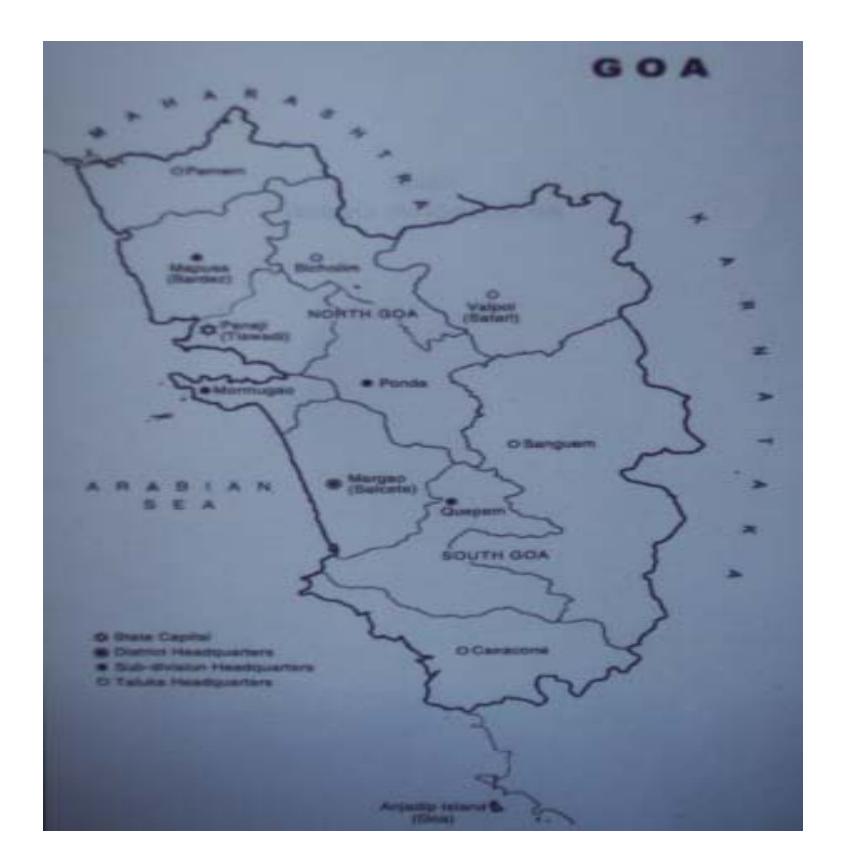
Figure 1. Map of Goa
However, with the packaging of Goa as a major international tourist destination that began in the mid-1980s, the floating population of visitors exceeded the number of residents and the ill-effects of tourism became all the more visible. The state started to gain an unwanted reputation as a den of drugs, all-night partying, and nudism. In addition to the international tourists, domestic tourists too increasingly began to flock to Goa to have a gaze at the debauched foreigners.Under the economically powered hi-discourses, Goa has lost almost all traces of its rich past except in the inauthentic artifacts staged for conspicuous consumption, laments McCabe & Stocks (1998). These authors note that the region's non-tourist related economic activities like agriculture, salt-pan industry, aquaculture, and shellfishery have totally been lost to tourism.
Sawkar & Noronha (1998) lists out the multitudes of environmental woes associated with tourism development in Goa: beach degradation due to improper waste management by tourists; groundwater depletion and water scarcity due to over-exploitation for tourism industry; groundwater pollution the tourism influx, it is high time to evolve an integrated approach to protect the environmental quality of the region and improve the socioeconomic conditions of the coastal communities.
The bitter realization that society, culture, and environment can no longer continue to be maidservants of conceited economic objectives is rampant all across the state now (Harding & Thomas, 2003). Goans have no blanket opposition to tourism, since their livelihoods are dependent upon it and since
it has somewhat become ingrained into their social identity (Wilson, 1997). Rather, it is the nature of tourism development wherein they have little voice with regard to even those matters that directly affect their future that causes rebellion. The want preserve the pristine quality of their environmental resources that are the raison d'etre for quality tourism to Goa. Their nominal involvement in the environmental planning and policy decision-making generates in them a strong sense of alienation. Nevertheless, interestingly, instead of nurturing sustainable forms of development in order to minimise the negative impacts caused by tourism and to bring in the local population into confidence, the government of Goa continues to concentrate its full attention upon merely curbing the negative publicity so that even more multinational investments and tourist flows shall take place (Breda, 2005). It has a history of using even agencies like the World Tourism Organization (WTO, 1994) to further this end at all costs (Burns, 1994). The recent initiative of the present government to concentrate more upon promoting up-market tourism is touted as having the effect of minimizing the negative impacts of mass tourism; yet, the same could significantly jeopardise the structure of the Goan tourism industry which as of now is catered by small and medium scale enterprises where, at least in principle, local entrepreneurship is possible.
Tourists are attracted to Goa mainly for its unique natural and cultural resources. If care is not taken to preserve the natural habitat, that part of the industry which believes in quality tourism may ultimately be forced to withdraw from the state. Small patches of vegetation that now exist in isolated regions should be developed into dense natural parks, which is a sure means to earning some extra revenue too. Similarly, activities like fostering estuarine mangrove vegetation greatly add to the beauty of the coastline and can attract genuinely responsible tourists. Nobody can refute that the existence of healthy coastal habitats like wetlands, beaches and dunes, sea grass beds, mangroves, coral reefs, and estuaries is important to coastal recreation and tourism. Plantation of local species by hotel owners should be made compulsory. Constructions in the coastal belt should not be permanent, as these can disturb the water table and the ecosystem. For beach restoration, softer solutions like natural beach nourishment with flora could often be better than harder solutions like building seawalls. Foreign tourists and the recreating domestic public stop going to areas where the waters are polluted or fishes are tainted and significant improvements in water quality is to be achieved by controlling both point and non-point sources of pollution.
Case studies conducted by Noronha et al. (2002) in Goa demolish the assumption that preventing tourist movements and controlling the intensity of impacts associated with these movements are one and the same. This means that while the recognition that tourism in Goa sustains upon a set of delicate resources is definitely to be reflected in the existing rules, the solution is obviously not in curbing all sorts of tourism activities. What is to be checked are the concentration of population and the associated increase in the density of infrastructure and facilities in certain ecologically sensitive areas. Also, policy measures should encourage the harmonization of tourism with more sustainable ways of livelihood like the traditional agriculture, which itself can be promoted as a unique tourism product. Future research in this region should target the development of contextually rich environmental quality markers that would enable the identification and quantification of environmental problems and act as monitors of ecological changes associated with tourism.
Case study 2. The Responsible Tourism System in Spain
Spain has been consistently maintaining a leadership position in terms of visitor numbers and revenue and tourism contributes to one-tenth of its GDP. Millions of tourists travel to Spain every year to enjoy the sunshine, heat, and other attractions that make it a favorite destination. While Spain is highly appreciated for hospitality, visitors complain that it scores poorly on environmental aspects with noise, dirty towns and cities, degradation of beaches and of sea animals and plants, among others. Some of the problems which Spain suffer due to tourism, either directly or indirectly, are: land speculation and mass urban development in rural areas; invasion of pristine natural zones and interiors; poor sanitary infrastructure; depletion of non-renewable resources; traffic congestion; alternations to traditional lifestyles; and so on. These problems are compounded due to the seasonality aspect of tourism to areas already under pressure from other activities such as farming, fisheries, and industrial development (Barke, 2004). In sum, the diversification which has resulted in the environment becoming a resource and the competition posed by rival destinations with better-preserved environments represent a threat to Spain's continued success in the tourism industry.
In this context, the Responsible Tourism System (RTS) was conceived after the World Conference on Sustainable Tourism (Lanzarote, Spain, 1995) as an independent system to provide hospitality and tourism enterprises with incentives to improve the quality of their installations voluntarily by adopting strategies for responsible management for quality tourism experiences and the conservation of natural and cultural assets. Responsible tourism management includes the conservation of environment and cultural assets; satisfying tourist expectations about the destination; and enhancing the quality of life of the host population, among others. The Institute for Responsible Tourism (IRT), Spain, is the non-governmental body that manages the RTS measures, resources, and procedures.
There has always been a need for external and visible recognition to distinguish the efforts made by tourism establishments in the direction of advancing ecological ethics. The fact that tourism lacks universally accepted and objectively measurable parameters of quality of business practice has led to the booming up of many tourism enterprises advertising green holidaying opportunities. Alongside, quality control agencies established by the industry associations began to sell the rights to use quality assurance labels with the same business zeal, even without requiring or verifying that the recipient is truly committed to improving the environment Such labels, thus became a mere marketing strategy for the "greenwashing" firms. In the midst of these fraudulences, the Institute of Responsible Tourism stands apart and promotes tourism models that actively contribute to maintaining and protecting the cultural and natural assets of tourist destinations. Its ultimate objective is to promote sustainable development in the tourist industry and encourage the use of the endogenous skills of each destination and host community.
The IRT is most credited for its environmental quality certification initiative. The Biosphere Hotels seal of environmental quality provided by RTS is a form of accreditation for those hotels that take the environment into account in terms of energy and water savings, the use of cleaner forms of energy, waste management, minimal air pollution, promotion of ecological principles, and conservation of natural surroundings. The establishments that receive the seal must also meet an array of other requirements. As an incentive, a hospitality property following the guidelines and getting the RTS certification will be permitted to operate even in sensitive areas like the "Biosphere Reserves" (Biosphere Reserves generally include any area, region or territory that implicitly or explicitly complies with the requirements established at the Rio Earth Summit, 1992).
The IRT holds that responsible tourism establishments—that saves non-renewable sources of energy by minimizing their consumption, that have policies to minimize negative environmental impacts, that strengthen local economies and societies, that pledge to preserve cultural assets, and that live up to the expectations of responsible customers—need to be given proper incentives for them to reinforce the same behaviour. According to the RTS, environmental quality standards in the context of tourism could be operationalized in terms of the following:
- · Environmental Quality: This set of criteria includes several physical factors within the environment, both inside and outside the establishment and in its activities, as well as the products and services it offers. The IRT studies how the hotel affects the health, safety and comfort of its customers and employees and how well their expectations are met in terms of quality and natural surroundings.
- · Quality Tourism: These standards are related to the truthfulness of the establishment's advertising, its efforts towards customer satisfaction and other criteria involving customer service.
- · Resource Conservation: The goal is to minimize the consumption of resources, especially those that are finite, through the use of conservation systems and other efficient ways of using resources. This category involves the actual physical components and systems used and the activities performed during basic hotel management processes, for both direct services provided to guests and for indirect services, such as internal affairs and management.
- · Environmental Efficiency: Conscientious, responsible ways of managing the establishment should be used so that its activities play a proper role within its environmental protection policy. This category basically includes a set of criteria that ensure a minimal impact to the environment.
- · Sustainable Development: These criteria will be applied to ensure compliance with the principles and objectives established at the many forums on sustainable tourism.
The RTS standards are customized depending on where they are applied; the different standards place special emphasis on specific issues like conservation of bio-diversity, the behavior of tourists in sensitive areas, architectural heritage related criteria, or criteria concerning ethnographic resources. For each of these standards, different quality assurance labels are given and currently, there are four such labels: "Responsible Tourism"; "Quality for Life"; "Heritage for Life"; "Animal Embassy".
Figure 2. Examples of quality assurance labels
The IRT certification is absolutely voluntary and the process of application is simple and straightforward. Once a firm decides to join RTS, it will be offered an initial round of counselling plus the set of guidelines and other documents. The firm is encouraged to introspect and then to perform an internal audit to see how much it complies with the RTS requirements. If this process generates optimistic results, the firm can offer itself for a third party audit by IRT. If the audit proves successful, the firm is awarded the appropriate Biosphere Hotels label, with the condition that the firm is willing to undergo re-examinations any time. Otherwise, IRT will offer the firm proper counseling to improve those aspects that did not come up to the required standard. The IRT has invested heavily in the continual development and dissemination of practical instruments for implementing a responsible tourism policy, especially in the accommodation establishments. This means that the industry receives accurate guidelines and points of reference in raising awareness of sustainable development projects and eco-friendly solutions in the tourist industry.
Thus, the first case study from India portrays the most common instances of the negative impacts of uncontrolled mass tourism upon environmental quality and the impacts of a deteriorating environment upon the tourism industry. Goa is not the only destination in India where environmental quality has been badly affected as an impact of tourism. Other beach destinations like Kovalam and Varkkala in Kerala and a number of hill stations especially in the Himalayan ranges have also been the victims of unchecked tourism development. The second case study from Spain, on the other hand, points out that improved environmental quality by the introduction of quality control systems has to potential to promote long term sustainable tourism in the region. While India can provide many such negative case studies, the more positive ones are emerging from other countries, especially those in the Western Europe (see, Ashley, et.al., 2001; Goodwin et.al., 1998). However, models developed for the developed world need not necessarily apply in the case of underdeveloped and developing countries. The influence exercised by the NGOs in the underdeveloped and developing countries can at its best only match the lead initiative taken by the governments in these countries. In a developing country like India, there is a limit as to how much power an NGO like IRT can hold. Nothing can really be accomplished without the endorsement of the government (The present authors thank the anonymous reviewers for this valuable comment).
In the recent years, the labeling of eco-friendly products has been introduced in a number of developed countries to assist in the protection of the environment. Tourism in the developing countries is a highly fragmented and heterogeneous industry and hence for the successful implementation of an eco-labeling scheme, the effective coordination of a number of agencies is sine qua non. Consumers, as well as manufacturers, have to be educated about the long term benefits of the scheme, and trustworthy non-governmental organizations have to take the mantle of certification. A study conducted in India by Santhakumar (2003) reveals that institutional deficiencies in the country become the major-most bottleneck in raising its environmental standards. Existing property right structures are the next culprit in producing a suboptimal environmental quality control regime (Cooter & Ulen, 2000). In such contexts, citizens' actions like civil disobedience movement may have to be advanced to meet the unmet demand for environmental quality.
TOWARDS A QUALITY ENVIRONMENT: ALTERNATIVE OPTIONS
Synchronized efforts to reach a sustainable balance between tourism activities and environmental quality are necessary for the quality of our environment and the quality of our lives. Based on the issues discussed here and elsewhere, we outline the following policy alternatives for the tourism industry (adapted from Inskeep, 199l, and Mastny, 2001):
- · Catalyze participatory research, planning, implementation, and monitoring strategies for community based tourism.
- · Restructure tourism operations and management along environmental lines: this means reducing consumption of water, energy, and other resources; introducing environmentally sound methods of transportation; improving management, handling, and disposal of waste; and so on.
- · Accelerate the transfer of environmentally sound technologies, practices, facilities, and management tools to the destination regions.
- · Encourage the organizations in tourism to subscribe to environmental guidelines by a system of incentives (like subsidies, tax holidays, soft loans and awards) and disincentives (like fines, pollution taxes and in extreme cases ban/closure).
- · Match tourism strategies with environmental quality, social equity, community empowerment, cultural integrity and economic efficiency to promote responsible forms of tourism activities.
- · Enhance historical towns and revive the arts and crafts through tourism.
- · Evolve pluralistic but integrated regional tourism policies with special emphasis on community based or community /govt. or community /private or community /private /govt. partnerships for long-term sustainable development.
Further guidelines aimed at the enhancement of environmental quality may be borrowed from the available knowledge databases. For instance, UNEP (1995) has prescribed a sophisticated set of environmental codes of conduct for tourism. Gonsalves (1991) has brought out a set of important guidelines for alternative tourism with reference to the third world. Mastny (2001) from the World Watch Institute has provided a few vital policy guidelines with lessons for quality tourism. The Green Globe program (WWF, 2000), the ECOTEL Certification awarded by HVS Eco Services, Certification Programs for Sustainable Tourism and Eco-tourism (Honey & Rome, 2001), Exemplary Practices by Canadian Tourism Commission (1999), and the National Eco-tourism Accreditation Program of the Eco-tourism Association of Australia and the Australian Tourism Operators Association are some of the noteworthy initiatives that aspire to practice these guidelines.
In fact, many of these policy alternatives have already been subsumed in the newly emerging paradigm of eco-cultural tourism (ECT) and it is a valuable framework to organize the environmental quality discourse. Because of the many forms in which ECT activities are offered by a wide variety of operators and because it is practiced by an even larger array of tourists from multiple backgrounds, there is no great deal of consensus about what it is. While there is no single universal definition for ECT, the present authors attempt to summarize its general characteristics in a way that would still enlighten its potential connections with the guiding principles of sustainable tourism (See also Wight, 1993; Ceballos-Lascurain, 1996; Goodwin et al., 1998):
- · It includes all nature-based forms of tourism in which the main motivation for the tourists is the observation and appreciation for admiring, enjoying or studying nature as well as the traditional cultures and heritage (both past and present) prevailing in relatively undisturbed or uncontaminated natural areas
- · It contains participatory, interactive, educational and interpretation features
- · It is generally, but not exclusively organized for environmentally /socially conscious small groups by specialized and small, locally owned businesses. Foreign operators of varying sizes also organize, operate and/or market ECT tours, generally for small groups
- · It minimizes negative impacts upon the natural and socio-cultural environment
- · It supports the protection of natural areas and the revival of culture by: generating equitable economic benefits for host communities (by providing alternative employment and income opportunities), organizations and authorities managing natural areas with conservation purposes, and adding value to local heritage, cultural and natural resources through sustainable tourist access to those resources and thus provides incentives for protecting them increasing awareness towards the conservation of heritage, natural and cultural assets,
One of the foremost attempts to bring in the spirit of responsibility to ecotourism can be seen in the broadening of its ambit to include the relevant elements of the socio-cultural environment. Thus, the concept of eco-cultural tourism is introduced as a superior alternative to the conventional definition of eco-tourism: it imbues 'eco' with 'cultural' and has in its ambit something beyond the natural environment, which is a pragmatic addition too. Extending responsible business practices beyond the environmental agenda to address the local economic and social aspects builds reputation, particularly for those tourism enterprises that want to establish a leadership role. The market is gradually shaping itself to reflect socially, environmentally, and culturally aware holidaymakers. These market trends require sumptuousness that goes beyond the confines of a truncated experience. There is market advantage and repeat business to be secured by enabling clients to enrich their experience and this will increase the local economic benefit, too (Neto, 2003). It is extremely plausible that, properly conceived and implemented, eco-cultural tourism could offer a panacea for many an ailment associated with the current tourism practice. But, since people rarely know how to properly conceive and implement, it fails too often.
CONCLUSION
What sorts of tourism products are promoted and how, what is bought and consumed, how the wastes are handled, how the travel is made, and how the locals are involved – all these issues have their associated environmental impacts on the destination areas. As noted by Ashworth (1995), because tourism represents a series of heterogeneous products and services consumed in stages often from fragmented suppliers, quality of tourism experiences can not be measured by any single index modeled after the traditional economic analysis. Due to the complexity of the factors involved it may not be fully realizable to trace the root causes of environmental problems arising out of tourism activities in isolation and there exists a dearth of solid scientific evidence, which is used as an excuse in downplaying the impacts (precautionary principle). Yet, it is imperative and consensually agreed that tourism-environmental quality linkages occupy a central position in determining the limits to growth of tourism activities.
In the face of current human population increases and serious ecological degradation, intact and healthy ecosystems are becoming rare. Vested opinion sources make people believe that while attracting tourists seems difficult enough in the first place, talking of ecological and cultural sustainability and the economics of it would only drive the prospective tourists away and discourage the tourism promoters. The "its-not-in-my-face-yet and any how, we-need-the-foreign exchange" attitude is widely held (Wapner, 1987). Not only that an informed understanding of the urgent necessity in integrating environmental conservation into our tourism promotion strategies is mired in propagandas, but also in casualty are a number of related concerns like recognizing the inseparable links between poverty, environmental quality, and sustainable tourism (Ashley et.al., 2001). It is high time to realize that as the impacts of tourism continue to spread, it is increasingly important to steer it onto a more sustainable path—economically, culturally, and environmentally.
A broad range of stakeholders—including the tourism industry, governments, international organizations, nongovernmental groups, host communities, and tourists themselves—will need to be involved in engineering deep structural changes for a comprehensive quality revolution at all levels. Fortunately, representatives from many of these groups are already moving forward on some of the key issues. For instance, while concerns about tourism merely hovered at the fringes of discussions at the 1992 U.N. Conference on Environment and Development in Rio de Janeiro, these have been moved to the center of preparations for the follow-up World Summit on Sustainable Development in September 2002. Though still very few in numbers, hotels, tour operators, and other tourism businesses have already taken the preliminary steps to incorporate environmental and social sustainability measures into their daily operations, including reducing resource use and improving the treatment and handling of waste. They are embracing a wide range of voluntary initiatives, from developing environmental and social codes of conduct for their staff and clients to working to meet benchmarks for a diversity of tourism certification efforts. Yet industry action alone is not enough to ensure sustainable tourism development.
Governments at the national, regional, and local levels can supplement industry initiatives by implementing a wide range of policies and regulatory measures, from restricting environmentally damaging constructions to limiting the number of visitors allowed at sensitive sites. And they can work with citizens' groups and other NGOs to help local communities take charge of their own futures, providing them with the training and resources they need to oversee and manage local tourism developments. Despite certain intrinsic disadvantages as noted by Ashworth (1995), local governments can act as the most effective agents of quality assurance in tourism since they are closer to the problem areas and are likely to have the support of the local communities than anyone else. Meanwhile, tourists themselves can play a valuable role in steering tourism onto newer and qualitatively better paths. Visitor education programs can spur important changes in travel choice and behavior by helping tourists to become more aware of the impacts of their own activities on local environmental quality, economy, and culture (Mastny, 2001).
Synergizing tourism and environmental protection is impossible unless each understand the other's objectives and demarcate areas of intersection between them. Engineering an environmental quality revolution is a deeply challenging task that requires changing attitudes and priorities both at the higher levels in the policy making circles, as well as at the local levels. In the same vein of Marx, the present authors bring this paper to a close by noting that while we have had enough of studies and interpretations on environmental quality, what has gone unattended is the pressing need to really advance it.