

INTRODUCTION
Tourism industry is among the highest contributor to Malaysia's Gross Domestic Product (GDP) after manufacturing (Hamzah, 2004). The meetings sector of the tourism industry is one of the most competitive and lucrative of market segments (Crouch and Louviere, 2004; Weber and Chon, 2002). The meeting market is actually the least susceptible to seasonal fluctuations compared to the leisure tourism sector (Cai et al., 2001; Go and Zhang, 1997). In addition to that, meeting or business tourists are normally classified as "quality tourists"- tend to stay longer and spend more money than other types of tourists (Ariffin et al., 1999; Bailey, 1991). In light of the growing importance of the corporate meeting and its enormous impact on tourism and hospitality industry, more research efforts are needed to better understand the behavior of this market.
The two main player in this lucrative meeting market; associations and corporate organizations, acts as a major revenue generator in the tourism and hospitality industry. The corporate market represents the majority of the events held while the associations market accounts for the highest delegate numbers (Leask and Hood, 2001). Comparing the two sub-sectors, the association meeting is gaining far more attention from the researchers (Choi and Boger, 1998; Go and Zhang, 1997; Oppermann, 1996; Weber, 2001). The reason is because as opposed to the corporate organizations, associations are
Address correspondence to Ahmad Azmi M. Ariffin, School of Business Management, Faculty of Economics and Business, Universiti Kebangsaan Malaysia, 43600 UKM Bangi, Malaysia. E-mail: azmi ukm@yahoo.com
claimed to be relatively flexible with respect to choosing their meeting destination while in the corporate sector, business locations and headquarters are claimed to be commonly determined the selected meeting destination (Oppermann, 1996; Weber, 2001).
RESEARCH BACKGROUND AND ISSUES
Interestingly, recent development indicates that there is a growing interest among corporate organizations to hold their meetings in a less conventional or novel setting (Callan and Hoyes, 2000; Leask and Hood, 2001), far away from the area of their business locations. This observation has lead to the major issue that this research mainly attempts to address - "What are the consumption factors that drive the choice of corporate meeting planners on meeting destination with respects to its novelty setting?"
Although several researchers (Callan and Hoyes, 2000; Leask and Hood, 2001) have recently investigated the characteristics and the nature of novel meeting destination offerings, they did not explicitly explain the underlying behavioral reasons behind such decisions. The development of rural, second-tier or regional tourism associated with novel destinations can help to increase employment opportunities, to generate economics activities as well as to provide a better environment in the rural areas (Lapping et al., 1989; Luloff and Swanson, 1990; Middleton, 1982; Oppermann, 1996; World Tourism Organization, 1998). The novelty-seeking behavior in relation to pleasure travel has been studied by several researchers in the past (Basala and Klenosky, 2001; Bello and Etzel, 1985; Lee and Crompton, 1992) while its significance has not yet been investigated in the business travel such as in the meeting market. Novelty-seeking is widely reported as a key travel motive (Crompton, 1979; Leiper, 1984) where people travel because they want to experience something new and different. Novelty preference in this study is defined as the extent to which a corporate meeting planner prefers a destination setting that creates an unusual, unique and exciting meeting travel experiences (adapted from TNS, 2004).
According to Um and Crompton (1990), value is one of the most important dimensions that act as an input variable in the destination choice process. Consumption factors which are value-based in seen as a more complex construct in tourism setting with functional dimensions interacting with socio-psychological dimensions (Barbin and Griffin, 1994; Bolton and Drew, 1991). The value construct describes the benefits customer seeks from the consumption. Past research has long noted that the basic notion underlying the construct of novelty seeking appears to be through some internal drive or motivating force the individual is activated to seek out (Farley and Farley, 1976; Hirschman, 1980).
CONSUMPTION VALUE AND MEETING DESTINATION SETTING
Among the fundamental factor which drives human behaviour and, specifically, consumption patterns is a person's system of value priorities (Feather 1996; Kahle 1996; Rokeach 1973; Schwartz 1996). This shift in the thinking about the nature of human values has been largely influenced by the work of Milton Rokeach (1973). Rokeach defined the value concept as "an enduring belief that a specific mode of conduct or end-state of existence is personally or socially preferable to an opposite or converse mode of conduct or end-state of existence". Rokeach Value Survey (RVS), an instrument which was designed by Rokeach to operationalize the value concept, has been used as an instrument for measuring personal and social values. The RVS distinguishes two kinds of values: instrumental, referring to modes of conduct and reflecting behavioral characteristics that are seenas socially desirable and terminal, referring to end states of existence or ultimate modes of living which have been idealized.
Feather (1991) revealed that within the intercorrelations of the instrumental values, there were three value domains, which were largely consistent with the motivational domains as described by Schwartz and Bilsky (1987): self-directed competence, restrictive conformity and pro-social concern. Within the intercorrelations of the terminal values Feather discriminated five value domains namely positive affiliation, universal pro-social, mature accomplishment, comfort/stimulation and security/salvation.
It is posited in this study that the destination choice will be influenced by the consumption factor pertaining to the destination characteristics itself. Based on Woodruff (1997), consumption factor in this study is defined as a meeting planner perceived preference for and evaluation of meeting destination attributes, attributes performance and consequences arising from the use that facilitates and achieves their goals and purposes.
Value concept was utilized in this study because value has become an area of paramount important in marketing. It appears as a main determinant of decision choice, purchase intention and behavior (Bolton and Drew, 1991; Hightower et al., 2002; Sheth et al., 1991; William and Soutar, 2000). Surprisingly, this variable and its role in marketing are not getting enough attention by the researchers especially in the organizational buying context. In the service sector, sociological and psychological aspects may be more important because of the simultaneous interaction between producers and consumers and the heterogeneous nature of the service experience (Holbrook, 1994; William and Soutar, 2000). The concept of destination value is extremely crucial in tourism marketing because it is highly related to the destination images held by travelers in their minds and these images will affect the decision-making process on the destination choice (Kotler and Barich, 1991; Tapachai and Waryszak, 2000). The value construct describes the benefits customers seek from the consumption of a product or service and image of a destination is established based on these benefit or exchange value. Thus, values are seen as one of the important socio-psychological dimension that acts as an internal input variable in the destination choice process (Um and Crompton, 1990).
Tourism is essentially a service industry or more accurately, an amalgam of service industries (Otto and Ritchie, 1996). Therefore, the consumption experience is considered as intangible, dynamic and subjective in nature (Botterill and Crompton, 1996; Jayanti and Ghosh, 1996). Although functional value seems to be the key influence on choice, Sheth et al. (1991) found that other value dimensions are also influential in some situations. It is argued that perceptions of value in such situations may differ from perceptions of value for products due to the risk and uncertainty consumer feel when considering such services (Murray and Schlacter, 1990). The nature of tourism induce higher levels of perceived risks by the decision maker as a consequence of which they may depend more on a subjective evaluation of benefits offered by service (Jayanti and Ghosh, 1996).
In this study, the theory of consumption value as proposed by Sheth et al. (1991) was employed as the internal motivating drive to explain the choice between conventional and novel meeting destinations. The consumption value theory by Sheth et al. (1991) was the best typology to be employed in this study because of its multidimensional properties composed of both objective value (functional) and perceptual values (epistemic, emotional, social and conditional) attributes. However, this present study only includes four out of the five dimensions as the independent variables. The four factors employed were functional, epistemic, emotional and social factor. The fifth dimension, conditional value dimension was found to be more appropriate to be incorporated as the moderating variable. This is due to the nature of the conditional value that often influences the choice maker to deviate from his or her typical or planned pattern of behavior (Sheth et al., 1991). However, it is beyond the scope of this report to discuss such issue.
Since alternatives acquire functional value through the possession of salient utilitarian attributes (Sheth et al., 1991) such as reliability, convenient and price, conventional destination is expected to be influenced primarily by the functional factor and is said to be "utilitarian-oriented consumption". On the other hand, emphasis on the nonutilitarian dimension is associated with the inclination to select a novel meeting destination. A novel meeting destination may be selected because of its epistemic value (a change of environment), social value (relationship building) and/or emotional value (security). According to Otto and Ritchie (1996), even when tourism sectors have a clear functional component to them, experiential benefits will remain a critical part of the process evaluation. Based on the underlying economic utility or "rational economic man" theory pioneered by Marshall (1890) and Stigler (1950), functional values concept is acknowledges as the primary driver of choice in a traditional context. The value is derived from its characteristics or attributes such as reliability, durability and price. According to Sheth et al. (1991), highly visible products and goods or services to be shared with others are often driven by social value. Even products generally thought to be functional or utilitarian are frequently selected on the basis of their social value. Research in advertising and atmospheric has suggested that marketing and promotional mix variables arouse emotional responses that may be generalized to marketed products (Holbrook, 1983; Park and Young, 1986). Emotional value is often associated with aesthetic alternatives. However, more tangible and seemingly utilitarian products also possess emotional value. Entirely new experiences certainly provide epistemic value. However, an alternative that provides a simple change of pace can also be imbued with epistemic value. The alternative may be selected because the consumer is bored or satiates with the present brand, is curious or has a desire to learn.
RESEARCH FRAMEWORK, QUESTIONS AND HYPOTHESES
A research model developed to investigate the influence of the various dimensions of consumption value on novelty preference for destination choice is presented in the following Figure 1.
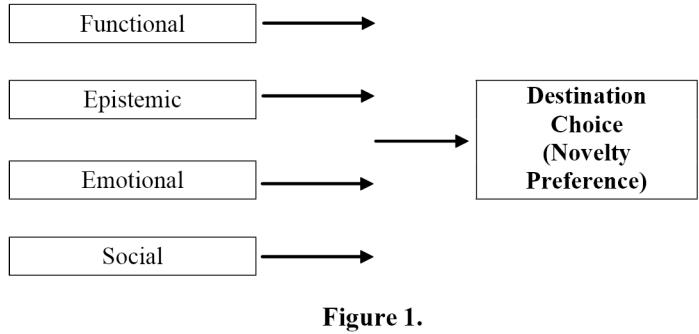
Research Model
Even though the earlier discussion on the consumption value involved four consumption value, only three were used in the hypotheses formulation. This is because the exploratory factor analysis performed on all the items involving the four values only produced three factors labeled as functional, epistemic and psychosocial. This procedure was fully explained in the methodology section latter in this report. The new factor, psychosocial value mainly comprise of items related to the emotional and social value. Following are the two key questions and the related hypotheses developed for this study.
Research Question 1: How does the consumption value of meeting destination relate to the novelty preference for destination choice?
Functional value is defined as the perceived utility acquired by a destination setting as the result of its ability to perform its functional, utilitarian or physical performance (Sheth et al., 1991). This is the position advanced by utility theory in economics and popularly expressed in term of "rational economic man". A destination acquires functional value through the possession of salient functional, utilitarian or physical attributes. Thus, among the functional items in the context of meeting destination are those related to the destination accessibility, performance of the meeting facilities, services, foods and cost. Based on the above, it is logical to anticipate that:
- Hypothesis 1(a): Functional value is negatively correlated with novelty preference for meeting destination choice.
- Hypothesis 1(b): Functional contributes negatively to the prediction of novelty preference for meeting destination choice.
Epistemic value is defined as the perceived utility acquired by a destination setting as the result of its ability to arouse curiosity, provide novelty and/or satisfy a desire for knowledge (Sheth et al., 1991). A destination acquires epistemic value through its capacity to provide something new or different experience. According to Sheth et al. (1991), many leisure activities are pursued for the sake of curiosity. The "something new and different" in the context of this present study is related to the conditions of destination physical and geographical environment, services and meeting facility. Therefore, it is hypothesized in this study that:
- Hypothesis 2(a): Epistemic value is positively correlated with novelty preference for meeting destination choice.
- Hypothesis 2(b): Epistemic value contributes positively to the prediction of novelty preference for meeting destination choice.
As mentioned earlier, the psychosocial dimension is mainly comprised of the emotional as well as social value. Emotional dimension is defined as the perceived utility acquired by a destination setting as the result of its ability to arouse feelings or affective states (Sheth et al., 1991). A destination acquires emotional value when associated with specific feelings or when it facilitates or perpetuates feeling. The "feeling" in the context of this study not only refers to the feelings of the meeting planner but also the participants who actually attended the meeting. Both sources need to be considered by the planner in order to select the right destination.
Social value is defined as the perceived utility acquired by a destination setting as a result of its associations with specific social groups in its internal and external social environment (Sheth et al., 1991). Meeting planners driven by social value select destinations that convey the social image they wish to project about themselves as well as their corporations in the corporate world. Social value exists when products come to be associated with positively perceived social groups. The choice of products and activities to share with others such as meeting destination is often driven by social value. Therefore, it is anticipated in this study that:
- Hypothesis 3(a): Psychosocial value is positively correlated with novelty preference for meeting destination choice.
- Hypothesis 3(b): Psychosocial value contributes positively to the prediction of novelty preference for meeting destination choice.
Research Question II: What is the most important consumption value in explaining novelty preferences for destination choice?
The epistemic value is expected to be the most influential factor on the novel destination choice as it is related to the destination ability to arouse curiosity by providing something new and different (Sheth et al., 1991). Therefore, it is hypothesized in this study that:
Hypothesis 4: Epistemic value is the most influential consumption value in explaining novelty preference for meeting destination choice.
RESEARCH METHODOLOGY
Sampling
The population of this study is defined as internal corporate meeting planners employed by services/ trading corporations listed on the main board of Bursa Malaysia and involved in the final decision of meeting destinations. Public listed corporations are chosen because of their relatively higher number of professional expertise, larger material and human resources and good financial standing compared to smaller corporations (McAdam, 2000; Thong and Yap, 1995), which enable them to undertake innovative programs (Gray et al., 2003) including human resource practices. This study also focuses on services-based corporations because they are shown to be committed to effective management of human resources practices (Lovelock et al., 2002) which covers the corporate meetings.
A total of 32 corporations were found to have fulfilled all the requirements to be included in this study. To determine the estimated number of meeting planners per corporation, five of the corporations, each from different sectors (telecommunication, health, tourism, financial and trading) were contacted by phone. In average, the number of meeting planners for a single corporation is found to be five persons. Therefore, the estimated size of the population for this study is 160 (32 X 5) meeting planners. Meeting planners included in this study were those in the middle and top management levels. Due to their tight working schedules, it was anticipated that the response rate would be very low. Thus, based on the fact that it is relatively difficult to obtain good responses from the organizational or managerial level respondents, only a total of 100 corporate meeting planners (from 20 corporations) or 62.5 percent of the total population were targeted for this study. The size of the sample was relatively higher than those of past research on corporate meeting planners in the similar field. For example, the sample sizes in the study conducted by McCleary (1978) to determine the needs of corporate meeting planners was 15 while Callan and Hoyes (2000) used only 50 meeting planners to investigate the novel meeting destination consumption among corporate organizations.
Concentrating on a small and more specific population such as the large service corporations would increase the managerial value of a research for targeted marketing decisions rather than a wide population but with a very low anticipated response rate. When the population is small and sample comprises a significant proportion of that population then the standard error can be adjusted to reflect this. Moriarty (1983) argued that because of the complexity of organizational buying decisions and the number of people involved, large-scale data collection efforts can be exceedingly time-consuming and costly.
The sampling process in this study consists of two stages. The first stage was pertaining to the selection of the 20 participating corporations followed by the identification of the five meeting planners from each corporation in the second stage. A simple random probability sampling using SPSS procedure was employed to select the 20 corporations from the sampling frame of 32 corporations listed under the services/trading counter in the Bursa Malaysia. Then, the five meeting planners representing each corporation were selected based on their substantial involvement in the decision-making process of meeting destinations within the year of 2002 and 2003.
Data Collection Method
The data of this study was actually derived from a larger study focusing on the various determinants of novelty preference for meeting destination choice. Apart from consumption value, other independent
variables incorporated in the original study were personality, organizational structure as well as perceived risk and budget. The data for this study was collected using mail questionnaires that were distributed to a cross section of organizations. In order to obtain the required sample size of 100 corporate meeting planners from 20 corporations, a larger amount of questionnaires were distributed. A total of 125 questionnaires were distributed to 25 randomly selected corporations from the sampling frame. All the 25 corporations were randomly selected from the list comprises of 32 corporations listed under the services/trading counter in the Bursa Malaysia. The completed questionnaires were then collected and returned to the researcher by the appointed liaison officer at each corporation.
Measurements
Dependent Variable: Novelty Preference. An initial pool of items for the measurement of novelty preference was generated from available measures, extensive literature search, construct domains, and the context in which the measures were to be used. In addition, protocol analysis was employed to generate items that are more specific to the context of corporate meeting market. The protocol analysis technique involves placing a person in a decision-making situation and asking the person to verbalize everything he or she considers when making a decision. The technique is also a practical method considering the hectic schedule of corporate meeting planners to be pooled together such as in a focus group session.
A total of 25 items were generated after taking into account identical or equivalent items. The initial items were refined and edited for content validity by a group of three expert judges who are academicians with research interest in services and tourism. Under this procedure, three of these items were discarded from further analysis. The construct of destination choice (novelty preference) was measured by calculating the mean responses to all items along a six-point scale, where 6 depicted a very strong novelty preference for meeting destination while 1 depicted a very weak novelty preference. The scale recorded an excellent Cronbach's reliability coefficients of 0.91.
Independent Variables: Consumption Value. Apart from the review of literatures on meeting travel experience, the same protocol analysis technique described earlier was also employed to develop the content for each of the four value measurements. To increase the content validity of the measures, the same group of three expert judges were asked to eliminate any ambiguous and similar items. This resulted in 35 items being retained from the 41 items originally assessed. Next, exploratory factor analysis was performed on all the items for the four dimensions to ascertain whether the measurements have construct validity. Two items were eliminated as they recorded factor loadings of less than 0.40. After deleting the two items, a clean factor structure with three factors emerged following six iterations. The three factors that explained 53.6 percent of total variance were labeled as epistemic, functional and psychosocial value.
Each of the four scales was measured by calculating the mean responses to all the items along a six-point scale, where 6 depicted a very high score for the value while 1 depicted a very low score. The Cronbach's alphas for the scales were 0.91 (epistemic), 0.83 (functional) and 0.82 (psychosocial).
Data Analysis
The Pearson correlation analysis was performed to test the hypotheses 1(a) through 3(a). Correlation analysis was also conducted among the three dimensions of consumption value to check on the multicollinearity. A multiple regressions analysis was performed to gauge the independent relations of the three dimensions of consumption value to novelty preference. Specifically, the regression model was computed to test the hypotheses 1(b) through 3 (b) as well as the final hypothesis (hypothesis 4). The independent variables in the regression model were; (1) functional, (2) epistemic, and (3) psychosocial value while the dependent variable was destination choice (novelty preference). To examine the independent effect of each independent variable on dependent variable, the statistical significance of the beta coefficients (from zero) were determined using a t-test.
RESEARCH FINDINGS
A total of 76 meeting planners from 17 corporations returned the surveys, representing a response rate of 60.8. One of the returned questionnaires was eliminated as the respondent had systematically marked the scale's extreme points of the novelty preference. After eliminating the unusable response, 75 responses were coded and used for data analysis. Missing data were reduced as much as possible by checking all the questionnaires at time of collection. When any questions were found unanswered, it was immediately brought to the attention of the related respondents.
Profile of the Respondents
The respondent's profiles are summarized in Table 1. The sample shows a balance combination between the males and females. The majority of the respondents were middle-aged (i.e., 31-45 years) followed by those in the age group of 46 and above (30.7%). The completed sample was composed of well-educated individuals. Large majority (72%) of them are holding a bachelor's degree while the other 20 percent had completed postgraduate studies. For the position in the corporations, the largest percentage (46.7%) was those in the top level of management as the respondents were those who have the final authority to make the decision on the meeting destinations. 38.7 percent or 29 of the respondents were in the middle management while only 14.6 percent or eleven respondents were in the lower management level.
Table 1. Profiles of the Respondents
| DEMOGRAPHIC CHARACTERISTICS | N | Percent | |
|---|---|---|---|
| Gender | Male | 35 | 46.7 |
| Female | 40 | 53.3 | |
| Age | 30 and less | 15 | 20.0 |
| 31- 45 | 37 | 49.3 | |
| 46 and above | 23 | 30.7 | |
| Ethnic | Malay | 38 | 50.7 |
| Chinese | 28 | 37.3 | |
| Indian | 09 | 12.0 | |
| Educational | Diploma | 06 | 08.0 |
| Level | Bachelor | 54 | 72.0 |
| Postgraduate | 15 | 20.0 | |
| Position | Top Management | 35 | 46.7 |
| Middle Management | 29 | 38.7 | |
| Lower Management | 11 | 14.6 | |
Results of Hypotheses Testing: Hypotheses 1(a) - 3(a)
As presented in Table 2, the results of the Pearson correlation analysis showed that all the three value dimensions were significantly correlated with novelty preference for meeting destination choice at 0.05 level. With correlation coefficient of -0.34, functional value was found to be negatively correlated with novelty preference, marginally supporting hypothesis 1(a) at 0.05 level. However, the strength of the association was considered as only at a moderate level. As expected, epistemic value was showed to be positively correlated with novelty preference at 0.01 level, highly supporting hypothesis 2(a). The correlation also appeared to be strong as it recorded a coefficient of 0.74. The results of Pearson correlation also indicated that psychosocial value was positively correlated with novelty preference for destination choice at 0.05 level, supporting hypothesis 3(a). With the coefficient value of 0.20, the strength of the association was considered to be moderately low.
Table 2. Result of Pearson Correlations
| CONSUMPTION | NOVELTY | |
|---|---|---|
| FACTOR | ||
| Functional | Pearson Correlation (r) | -0.335** |
| Sig. (2-tailed) | 0.038 | |
| Epistemic | Pearson Correlation (r) | 0.743* |
| Sig. (2-tailed) | 0.000 | |
| Psychosocial | Pearson Correlation (r) | 0.199** |
| Sig. (2-tailed) | 0.026 | |
* Significant at 0.01 level, ** Significant at 0.05 level
Results of Hypothesis Testing: Hypotheses 1(b) through 3(b), and Hypothesis 4
The results of the multiple regressions analysis was presented in Table 3. Overall, the regression equation was significant at 0.01 level (F = 30.201, p = 0.000, \(R^2\)= 0.56). The resulting multicollinearity diagnostics also revealed that the VIF scores were all below 10, indicating that multicollinearity was also not a problem in this regression model. Furthermore, the correlation matrix among the three value dimensions also indicated that the absolute values of the correlation coefficients were lower than the acceptable cut-off point of 0.8 (Benny and Feldman, 1985). Out of the three value dimensions, only epistemic and functional values were found to contribute significantly to the prediction of novelty preference for meeting destination choice. With \(\beta\) = 0.75 and p = 0.000, epistemic was strongly and positively related to novelty preference for meeting destination choice, significant at 0.01 level.
On the other hand, functional value reported a standardized beta coefficient of -0.13 and p = 0.041, exerted a negative effect on novelty preference for meeting destination choice, significant at 0.05 level. Thus, the results showed that only hypotheses 1(b) and 2(b) were supported in this study. With the highest value of beta coefficient, epistemic value is the most influential consumption value in explaining novelty preference for meeting destination choice, supporting hypothesis 4.
Table 3. Result of Multiple Regression Analysis
| Independent | Standardized | t | Sig. | VIF |
|---|---|---|---|---|
| Variables | Beta Coeff. | |||
| Functional Factor | 125** | -1.192 | .041 | 1.048 |
| Epistemic Factor | .735* | 6.145 | .000 | 2.314 |
| Psychosocial Factor | 008 | 071 | .943 | 2.270 |
| R: .750 | ||||
| R Square: .563 |
Dependent Variable: Novelty Preference
* Significant at 0.01 level, ** Significant at 0.05 level
DISCUSSIONS AND IMPLICATIONS
The results of Pearson correlation conducted on the consumption value traits showed that only epistemic value was highly significantly correlated while the remaining were marginally significantly correlated with novelty preference for destination choice. All the resulted relationships were also shown to be in the predicted directions. The all significant results produced by the correlation analysis implied that corporate meeting destination choice is a function of multiple value dimensions and according to Sheth et al. (1991), these dimensions make varying contributions in different choice situations. These findings also implied that the greater the weight given by the meeting planners to the functional value in the meeting destination decision making process, the more likely a conventional setting will be selected. On the other hand, the more important the epistemic and psychosocial value, the more likely a novel setting will be chosen for meeting destination.
Interestingly, the results of the subsequent multiple regression showed that only two out of the three consumption value were significantly and strongly related to novelty preference for destination choice. Epistemic was found to be contributing significantly to the prediction of novelty preference. Apart from that, the results also revealed that epistemic value is the most influential consumption value in explaining novelty preference. This result is expected as epistemic value fundamentally refers to the perceived utility acquired from an alternative's capacity to arouse curiosity and provide novelty (Sheth et al., 1991). In the context of corporate meetings, a destination with dominant epistemic value would enable a new or different meeting travel experience be provided to the participants. In fact, the concept of epistemic value itself has been primarily influenced by several theories closely related to novelty such as exploratory and variety seeking motives. These motives have been suggested to activate product search, trial and switching behavior (Hirschman, 1980; Howard and Sheth, 1969).
The overall findings also suggested that even when meeting tourism sector has a clear functional component such as the quality of meeting facilities and destination accessibility factors, experiential benefits such as those created by the physical environment will remain a critical part of the process evaluation (Otto and Ritchie, 1996). This result also confirmed that the decision-making process of meeting destination is not a totally rational process in its orientation that sees a corporate meeting planner as a machine. Attributes related to economic utility such as reliability, quality and price are not the primary driver of a novel meeting destination choice.
Another significant finding was the inversely effect of functional value on novelty preference. In other words, this means that functional value is highly associated with the choice of commonplace or conventional destination setting. Based on Strahilevitz and Myers (1998), the greater importance of functional value could be associated with utilitarian consumption, which refers to those that are more cognitively driven, goal oriented and accomplishes a functional or practical task. Thus, utilitarian-oriented meeting planners are mainly concerned with the achievement of the meeting's task objectives which are basically rational oriented, and therefore, do not pay considerably much attention on the subjective side of the meetings including the impacts of a destination atmosphere or setting might have on the meeting outcomes. In this case, meeting planners are interested mainly on what can be gained from the physical characteristics or technical performance of the meeting offerings.
Salient utilitarian attributes such as accessibility of the destination, convenient location, good meeting room and reasonable price are their first priority. Utilitarian functions focus on what the product does (Snepenger et al., 2004) while the non-utilitarian function captures the esthetic, intangible, and subjective aspects of consumption. A common meeting place such as an adjacent hotel or even their office's meeting rooms would be adequate for this purpose. Tversky and Griffin (1991) and Shafir et al. (1993) proposed that decision makers search for reasons and arguments to justify their choice. In line with this view, Bohm and Pfister (1996) showed that contexts that foster justification enhance preference for utilitarian features. As a consumption of a novel destination is relatively hard to justify than a conventional destination, the above arguments provide another point of explanation on the negative relationship between utilitarian orientation and novelty preference for meeting destination choice.
The nonsignificant effect of psychosocial dimension indicated that emotional value and social value are not fundamentally important in explaining novelty preference for meeting destination choice. The destination's capacity to arouse feelings or affective states as well as the destination's association with one or more specific social group (such as the managements) are significantly unrelated in the process of the making the choice on corporate meeting destination setting. Sheth et al. (1991) pointed out that social value normally drives the decisions on highly visible products or services to be shared with others.
The findings of this study are of utmost importance to managers and administrators in the tourism and hospitality industry, particularly the meeting services providers or marketers. The information on the relationships between consumption factor and novelty preference would help to enhance the understanding on the actual benefit sought by the corporate meeting planners. The managerial implication of this study is primarily related to the development of market segmentation approach in the corporate meeting market. It is suggested that the Malaysian corporate meeting market is best segmented using a two-stage segmentation approach. The geographical base is the most suitable to be employed as the primary segmentation as different locations are associated with different level of novelty.
Under this segmentation, the meeting market will be divided into groups of corporate organizations that share the same geographic location. At the second stage, the market could be further subdivided using a second segmentation which is suggested to be the behavioral segmentation of benefits sought. Under this second stage of segmentation which is basically based on the two dimensional value of "epistemic-functional", the market will be eventually separated into two large segments; novelty-seekers and novelty-avoiders. The segment of novelty-seekers (epistemic-oriented), which is described as high in novelty preference is associated with the novel destination. On the other hand, the segment of novelty-avoiders (functional-oriented), which is described as low in novelty preference is associated with the conventional destination.
Secondly, closely related to the first implication, the findings of this study are also important for the development of the market positioning strategies. A product's position is the way the product is defined by consumers on important attributes – the place the product occupies in consumers' mind relative to competing products (Kotler et al., 1999). As this study provide some evidences that consumption value is paramount important in the determination of meeting destination choice, it is suggested that the meeting services be positioned based on the benefits they offer or value. Based on the positive influence of epistemic value on destination choice, this type of value should be emphasized for the segment of novelty-seekers. On the other hand, functional value should be focused for the segment of novelty-avoiders as this value is found to be negatively related to novelty preference for destination choice.
SUGGESTION FOR FUTURE RESEARCH AND CONCLUSION
It would be fascinating to conduct a nationwide survey on meeting destination choice to understand the value or benefits sought by the corporate meeting planners in selecting their meeting destinations.
In this present study, the respondents were drawn only from those organizations located in the Klang Valley area. A comparative study between internal and independent corporate meeting planners or between services and manufacturing organizations could also be another interesting study to be carried out in the future. Extending this kind of research to a larger population would help ascertain the significant influences of the epistemic value and functional value as well as the non-significant effects of the psychosocial value on novelty preference for meeting destination choice.
In general, the findings of this study supports the argument by Um and Crompton (1990) that consumption value is a very important product-specific factor that acts as an input in the destination choice process. The result also seems to be in agreement with the common notion that value is a complex construct in tourism with functional attributes interacting with socio-psychological attributes (Bolton and Drew, 1991; Holbrook, 1994). These interactions make different contributions to overall consumption experiences (Addis and Holbrook, 2001) which could be explained in terms of its degree of novelty preferences for meeting destination setting in the context of this study. The findings were interesting as it showed epistemic value was positively related to the preference for novel setting while functional value was associated with the preference for a more conventional destination. The results of this study were important in providing valuable inputs for the formulation of the segmentation approach for the corporate meeting market.