

INTRODUCTION
The development of internet technologies has intensely altered the way in which customers interact with service providers (Patricio, Fisk & Cunha, 2003). The use of internet technologies and services such as websites, email, and online communication as part of a strategic marketing package has opened new possibilities for interaction with customers (Baker & Wearne, 2002). While it is noteworthy that the advances in the development of internet technologies have created new avenues for the hotel industry, embracing internet technologies does not necessitate the success of any hoteliers (Wan, 2002). From a customer perspective, ability to access more information meant that service providers such as hoteliers need to meet increasing demands to fulfill expectations (Nadiri & Hussain, 2005). Since, consumers with more knowledge will feel more powerful (Foucault, 1972); failure to adopt internet technologies would begin to erode the competitive edge against rivals (Zhou, 2004). The internet is changing the way which customers access travel information, and purchase tourism products and services. It is imperative that the hotel industry must constantly adapt to environment changes such as meeting the demands of customers utilizing innovative technology. While most hoteliers would agree that using the internet creates benefits for the customers, little is known about the mechanisms in generating customer satisfaction on the internet (Zafiropoulos, Vrana, & Paschaloudis, 2006). This study will provide reasons that influenced internet users' satisfaction in the hotel industry and identify new directions of the internet for the hotel industry. Interactive relation between customers' satisfaction and repurchase will be diagnosed.
Address correspondence to Keith Ng, Graduate College of Management, Southern Cross University, PO Box 157, Military Road, Lismore, NSW 2480, Australia. Email: keithynng@gmail.com.
In this paper, a brief overview of the Singapore hotel industry will be presented. This is followed by a review of literature on the main mechanisms generating satisfaction on the use of the hotel internet service. Next, the research methodology used is explained, followed by a discussion of our findings. Finally, the paper concludes with implications for the industry.
OVERVIEW OF THE SINGAPORE HOTEL INDUSTRY
Singapore has prospered from its advantageous location and free market economy. Singapore's location at the centre of Southeast Asia, combined with a concerted effort by its government to build the most important travel "hub" city in the region, rivaled only by Hong Kong to the north. Member countries of the association of Southeast Nations (ASEAN), Japan, Taiwan, Australia, the United Kingdom and the United States were the main visitor-generating markets. Some 59% of the visitors came to Singapore on holiday, with the remainder coming for business and other purposes.
Singapore is known as city-country tourist destination in Asia. The number of visitor arrivals in 2005 and 2006 is 8,942,408 and 9,748,207, respectively (Singapore Tourist Board, 2006; 2007). Singapore government's target it to attract 17 million tourist by 2015 (hotelmarketing.com, Singapore Hotels needed to meet tourism goal). The growth of tourism leads to the expansion of many services that include hotel, restaurant, food and shopping. The number of room nights by the end of 2004 is nearly 10.2 million (Singapore Tourist Board, 2004), the hotel industry is one of supporting service in tourism. As such, the development of this industry will not only sustain current tourism levels but also contribute significantly to future national revenue generation.
Although previous researches (such as Zafiropoulos, Vrana & Paschaloudis, 2006; Baloglu & Pekcan, 2006) have studied the hotel internet service and customer satisfaction in other countries, so far no previous research has analyzed about the impact of hotel internet service on customer satisfaction of Singapore hotel establishments. While researches in the hospitality and tourism industry have demonstrated that the internet contribute significantly to the delivery of products, services and brand image (such as Perdue, 2001), other studies conducted in Greece, Taiwan and Turkey have found that hotels were not effectively leveraging on the internet (Zafiropoulos, Vrana & Paschaloudis, 2006; Sigala, 2001; Wan, 2002). Because customer satisfaction is considered essential due to its positive effects on the long-term profitability, this study is also beneficial from a managerial perspective given the implications in assisting the owners, operators and marketers of Singapore hotels to better understand what internet marketing strategy can be included in their web sites. Particularly specific features identified in this paper can help increase the efficiency of their homepages as internet marketing tools. Hoteliers aspiring to improve their competitive advantage should not ignore website utilizing as an important part of the marketing strategy. This paper examines the constructs that impact hotel internet users' satisfaction.
LITERATURE REVIEW
Previous studies have identified the benefits of keeping the customer satisfied (such as Skogland & Siguaw, 2004; Barsky & Labagh, 1992; Kandampully, 2000) For instance, the longer a customer stays with an organization the more utility the customer generates (Reichheld & Sasser, 1990). Research also suggests that satisfied customers add value to the organization by not only buying frequently and paying higher prices but also exhibiting the willingness to provide positive word-of-mouth recommendations to others (Poon & Low, 2005). Therefore generating satisfied customers is essential for any sustainable business and this applies equally to online elements of a business (Chaffey, Ellis-Chadwick, Johnston & Mayer, 2006). In agreement, Gilbert and Powell (2000) argue the hotel industry must use the full potential of the internet to facilitate the development of relationships with customers.
Internet technology has enabled information on customers to be used for marketing applications (Stone, Abbott, Buttle, 2001). The main advantage is providing an inexpensive yet effective platform in meeting the needs and expectations of the customers (Smith & Wheeler, 2002; Parets, 2002; Baloglu & Pekcan, 2005). Accordingly, the hospitality industry has embraced this new innovation of communication technology for better positioning (Liang & Law, 2003; Gratzer & Winiwarter, 2003). Merrill Lynch (2007) reported at least a third of all hotel bookings will be generated from the internet and by the end of 2010 over 45% of all hotel bookings will be completed online.
The hotel industry in Singapore, it is presumed, has accepted the use of commerce in the internet. Many hotels here have established web sites and servers not only to encourage bookings through the web but also offer internet and web services to their customers. However, the provision of internet services is not a guarantee of success or a competitive advantage unless the corresponding e-service provided is of sufficient quality to make the difference in customer satisfaction levels.
It may be in such a context that Van Riel, Liljander & Jurriens (2001) has proposed that e-services architecture consists of five basic components: core services, facilitating services, supporting services, complementary services and the user interface through which the customer accesses the services. Moreover, Santos (2003) has provided an all-encompassing model to study the role e-service quality in a virtual environment in two dimensions. The two dimensions relate to the incubative and active aspects of approaching e-service quality. Santos (2003) linked the incubative dimension to the developmental stage of web design, including its ease of use, appearance, linkage, structure and layout, and content. The active dimension consists of the active maintenance which a web site can provide its customers, including assurance on reliability, efficiency, support, communication, security, and incentives. An abridged version of the e-service model proposed by Santos (2003) is here constructed as a vehicle to organise literature on the internet and consumer satisfaction (see Figure 1).
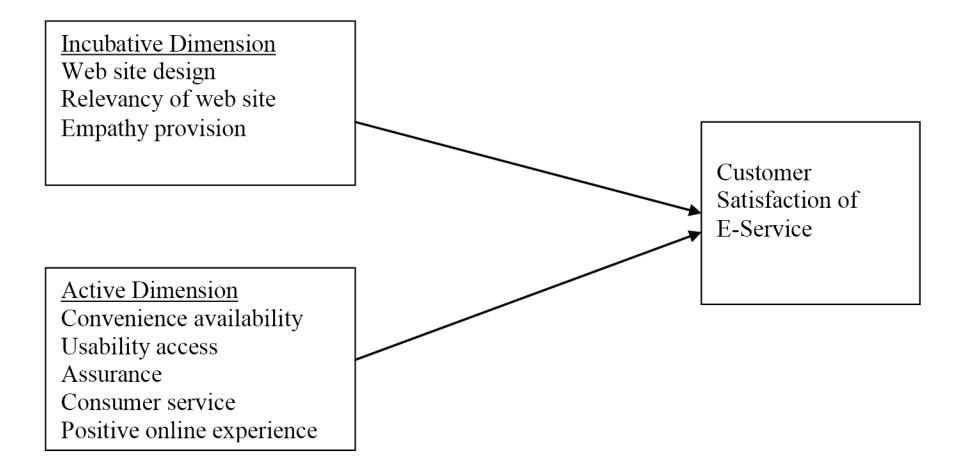
Figure 1. E-Service quality landscape
Discussion on the incubative aspects of the hotel internet e-service covers the following considerations:
Website Design
Website design, as a cognitive landscape, is vital to consumers depending on whether its constructs are effective (Rosen & Purinton, 2004). Forrester Research (cited in Nielsen, 1998) estimates that 'poor web design will result in a loss of 50 per cent of potential sales due to users being unable to find what they want, and a loss of 40 per cent of potential repeat visits due to initiate negative experience' (Cunliffe, 2000: 297). Empirical researches (such as Fogg, Soohoo, Danielson, Marable, Stanford & Tauber, 2003; Szymanski & Hise, 2000) listed several important factors that included design look, simplicity, style tone, readability, motive and identity of site sponsor could have significant impact on customer satisfaction on the use of the hotel internet. In essence the ambience of the website design and how it functions could determine whether consumers are satisfied with their online experience. It is therefore imperative that hoteliers intending to attract more customers should differentiate their products and services from competitors by incorporating website features that lead to a more pleasurable experience (Mullen, 2000).
Relevancy of Hotel Website
In an exceedingly aggressive market such as the hospitality industry, the hotel internet services must keep pace with the ever-changing interests of the consumers (Rosen & Purinton, 2004; Skogland & Siguaw, 2004). Gilbert, Powell and Widijoso (1999) iterate the need for web applications to not only target at specific online customer groups but also be relevant to the target customer. Unless the content of the website meets the needs of the intended users, it is unlikely that any relationship could be initiated (Bevan, 1999). Swaminathan, Lepkowska-White and Rao (1999) further proposed that the greater the perceived usefulness of information, the greater the likelihood of positive influence occurrences. In other words, customers must understand and buy into the proposition of the site; otherwise they will leave (Gleisser, 2001). The challenge for hoteliers is to monitor customers' interests and to be adaptable in responding to their varying needs.
Empathy Provision
Empathy is an important dimension in the evaluation interaction of customer satisfaction (Parasuraman, Berry, & Zeithaml, 1988). It is the level of commitment perceived by customers that hotels are prepared to be flexible and go beyond consumer needs (Zeithaml, Berry, & Parasuraman, 1987). However, in the virtual environment, individual care and attention accomplished differently – through customization and awareness of the customer needs (Van Riel, Liljander & Jurriens, 2001; Joseph, McClure & Joseph, 1999). Provision of personalization facilities within the hotel's website is an indication of empathy. Chaffey and Edgar (2000) suggest the use of emails while others (Kolesar & Galbraith, 2000) advocate the use of toll free numbers and contact points for enquiries.
How website design services will be evaluated is dependent on customers' expectations and these relate to literature on the active dimension landscape which includes, among other things, the following issues:
Convenience Availability
One essential service of ensuring the satisfaction of customers, it appears, is the convenience that the hotel internet provides. Convenience is often found to be the most important determinant why consumers selected particular service providers (Berkowitz, Walker, Walton, 1999; Cox & Rich, 1964;
Ernst & Young, 1999; Gillett, 1970; Kalakota & Whinston, 1996; Pew, 2005). Time savings appears an important aspect of the convenience of online services (Bellman, Lohse & Johnson, 1999; Dellaert & Kahn, 1999). Researchers identify convenience as a 'fundamental objective' related to online shopping (Keeney, 1999; Torkzadeh & Dillion, 2002). Accordingly Ranganathan and Ganapathy (2002) suggested that websites should be designed with the consumers in mind; minimize time finding the product or information. Hotel websites should therefore make it more convenient to buy standard or repeat purchase items. Convenience includes the overall ease of finding a standard product, promotions offers, and complete range of the hotel product offerings.
Usability Access
With the proliferation of information on products and services, customers are given more choices than ever (Matzler, Waiguny & Füller, 2007). Some researchers argue that the internet helps customers analyze large amount of product-related information for comparison that leads to better decision making (Evan & Wurster, 1999). The influence of a website on buying behavior has shown that perceived usability; how easily user interfaces are to use, can strongly influence the purchasing behavior (Flavián, Guinalíu & Gurrea, 2006; Pavlou, 2003). Studies indicated that logical structure of the website, availability of search engines to find the web pages easily and, navigation necessities such as the absence of broken links and 'under-construction' pages provide positive influences on customer satisfaction (Rosen & Purinton, 2004; van der Merwe & Bekker, 2003). Indeed, Kim and Eom (2002) concluded that usability is of critical importance in achieving the satisfaction of the consumer. In line with user friendly interfaces, research in psychology (e.g. Miller, 1956) also concluded that the processing capability of the human memory is limited to only seven (plus or minus two) chunks of information. Any addition information would significantly impair the decision making process (Haubl & Trifts, 2000). This meant that hoteliers attempting to satisfy their customers would need to provide easy access and information retrieval. Certainly, customers today do not just buy the core quality products and services; they also buy a variety of added value and benefits. Therefore the hotel's website must also make available facilities for reservation, automated payment, booking services and other added benefits to attract the customers to the electronic marketplace (Calogne, 2001).
Positive Online Experience
De Chernatony (2001) postulates that positive consumer experience heightens purchase and urges for incorporation of customers' involvement. Research on customers' involvement indicated that the inability to take charge of the exchange may negate negative experiences on the service encounter (Namasivayam & Hinkin, 2003). According to Skinner (1995), both choice and ability to influence the service provider facilitate the perception of control. In short, customers who believe that they are in control dictate their positive online experience, and ultimately satisfaction (Dailey, 2004). Similarly, Dabholkar (1996) believes that a strong positive effect of enjoyment improves the overall online experience. Customers who have fun and memorable experience using the hotel web sites will inevitably invoke positive experience which leads to ultimate fulfillment (Kolesar & Galbraith, 2000). In addition, previous studies on loyalty programs (such as Balabanis, Reynolds & Simintiras, 2006; Shankar, Smith & Rangaswamy, 2003) invoke positive influence on consumers' online experience.
Customer Service
Schiffman and Kanuk (2004) postulate that customer satisfaction is one's perception of the performance of the product or service in relation to expectations. As such, customers not only expect to receive products and services that are of a higher standard (Hall, 1995; Pearce, 1998; Weaver & Oppermann, 2000), but also respond to their beliefs and thoughts about the outcomes of purchasing (Arnould, Price & Zinkhan, 2005). Cooper, Fletcher, Gilbert & Wanhill (1996: 172)
further added: "customers are travelling more widely, returning with new ideas and new standards regarding accommodation provision." This means that hotel customers are becoming much more discerning and demanding. Competition has thus increased in the hotel industry around the globe, and this has forced hotels to offer better amenities, superior service, and loyalty programs at a price that reflects value (Chaisawat, 1998). In short, increase levels of service are needed to meet rising demands. This level of satisfaction also varies depending on other options the customer may have and other products against which the customer can compare the organization's products (Karp & Hanan, 1989). Ultimately, satisfied customers repurchase, recommend to others, and pay less attention to competing firms (Kotler, 1990).
Assurance
Similarly, financial security and other assurance aspects also affect the overall customer satisfaction (Szymanski & Hise, 2000; Zeithaml, Parasuraman & Malhotra; 2000). Customers concerns about internet security, privacy and trust have been noted by many researchers (such as Miyazaki & Fernandez, 2001; Gefen, Jarahanna & Straub 2004; Nissenbaum, 2004). Because online purchase presents customers with few payment options (typically via credit cards), the perception of risk in completing a purchase over the internet is very high (Kolesar & Galbraith, 2000). This substantially reduces the conversion rates of online visits to purchases (Katz, Larson & Larson, 1991). In order to reinforce assurances to customers, it is crucial to establish facilities to positively influence customer risk perceptions. The inclusion of secure communication channels for credit transactions, alternative payment modes, secured bookings guarantees, unequivocal product return policies, easy-to-use return mechanisms, secured bookings and on-line tracking of customers orders (Smith & Chaffey, 2005).
Little is known about how these varied influences affect customer satisfaction in Singapore's hotel industry. Presumably, these factors will have an impact on customer's re-purchase behavior; with implications for practitioners to better align their internet marketing strategy. The present study was designed to evaluate the customer-centric contributions of the incubative and active dimensions of the hotel internet service.
METHODOLOGY
The Instrument
The questionnaire used in this study comprises three sections as illustrated in Table 1. The first section captures the respondents' personal details that included demographic features such as gender, age, educational level, occupation and monthly income. To measure the hotel internet service, questions relating to the information of the hotel's facilities, reservation, loyalty program, newsletters circulation, feedbacks and customer service were included in section two. The third section of the questionnaire determines customer satisfaction and re-purchases levels. Respondents were asked to rank components of the internet service on a Likert scale ranging from 1 (Absolutely No) to 5 (Absolutely Yes). In addition, one item requiring respondents to indicate whether they routinely stay at the same hotel was included as an actual repeat-purchase behavior.
Sample
The questionnaire was pretested on 20 undergraduate students who participated in focus groups to test the feasibility of the questionnaire. After permissions were obtained from the management of the hotels, the definitive questionnaire was subsequently self-administered involving 250 hotel guests. A breakdown of the questionnaire is provided in Table 1. Some questionnaires were not answered with a total of 220 valid surveys questionnaires returned, which represents an 88 percent response rate from the original sample of 250. Demographic features are divided by gender, age, education level, occupation, and income in this study.
Table 1. Questionnaire design (developed for this research)
| Section 1 | Personal detail | Demographic features are divided by gender, age, education level, occupation, and monthly income. |
|---|---|---|
| Section 2 | Hotel internet service | Categories: Relevancy of Hotel Website, Usability Access, Convenience Availability, Positive Online Experience, Empathy Provision, Customer Service, Website Design and Assurance. All categories include subordinate three to six questions. |
| Section 3 | Customer Satisfaction | Evaluate customers' satisfaction based on Hotel Internet Service components and the possibility of re-purchase |
Data Analysis Techniques
The statistical process of the collected data was analyzed according to the SPSS WIN11 package program. The reliability of the instrument was analyzed by the reliability quotient of Cronbach's (1951) alpha. Coefficient alpha is commonly used and accepted means for assessing the reliability of a multi-scale measurement scale (Hair, Bush & Ortinau, 2005). As a standard of reliability, Nunnally (1978) suggests that a coefficient of 0.50 to 0.60 is satisfactory in the early stages of research. Hair et al (2005) suggest that a coefficient alpha of 0.6 is satisfactory for most research purposes. In addition, item-to-total and item-to-item correlations were used to test the homogeneity of the instrument. In other words, it is a measure of the degree to which all items are measuring the same thing (DeVellis, 1991; Davis, 2005). The criterion for item-to-total and inter-item correlations used are >0.50 and >0.30 respectively (Hair, Anderson, Tatham, & Black, 1998: 118).
Principal component analysis (PCA) was used to determine the underlying components influential in accounting for maximum variance in the data. The varimax rotation was applied to the PCA so that axes are rotated to accurately reflect the underlying structure of the data in which the sum of the variances of the loadings is the maximum possible. Items with a low factor loading of 0.4 were deleted (Malhotra, 2007).
The next step was the use of multiple regression analysis to verify the resultant factors between hotel internet service and customer satisfaction. The multiple linear regression provides an index of the relationships between the set of variables taken as a single multidimensional variable and produces the multiple correlation coefficient (R). The square of this value (R<sup>2</sup>) provides a more easily interpretable index, as it represents the proportion of variance in hotel internet service satisfaction explained by the set of variables (McClave, Benson & Sincich, 2005). In this study, if p<0.05 we consider the multiple correlation coefficient R to be significant and judged that multiple correlation is likely to exist within the larger population.
FINDINGS
Reliability and Principal Component Analyses
Analysis of the response of 220 respondents demonstrated that the 48 item survey instrument display a high degree of reliability as illustrated in Table 2. For each respondent, the mean across all items were calculated to form new composite variables which represented satisfaction on the hotel internet service. Item-to-total correlations and inter-item correlations were calculated. Using the criteria presented by Hair et al. (1998), all item-to-total correlations are all greater than 0.50 (ranging from 0.594 to 0.977) and all inter-item correlations are all greater than 0.30 (ranging from 0.311 to 0.963).
In an attempt to identify a set of components representing dimensions that would summarize the customer satisfaction on internet service of our sample, a PCA followed by a varimax rotation was conducted.
| rabie 2. | |||||
|---|---|---|---|---|---|
| Reliability analysis | |||||
| Factor | No. of Items | Cronbach Alpha |
|---|---|---|
| Relevancy of Hotel Website | 6 | 0.9727 |
| Usability Access | 3 | 0.6571 |
| Convenience Availability | 3 | 0.6759 |
| Positive Online Experience | 3 | 0.5941 |
| Empathy Provision | 3 | 0.7508 |
| Customer Service | 6 | 0.9497 |
| Web Site Design | 6 | 0.8894 |
| Assurance | 4 | 0.7392 |
The PCA extracted 13 components (eigenvalue >1) accounting for 77.01% of the variance. As the number of components extracted from 48 items would generally be expected to lie in the range of 10 – 15 (Tabachnick & Fidell, 1996: 672), the extraction of 13 components represents a good solution as shown in Figure 2. All items displayed loadings greater than the minimum criterion of 0.50 as specified by Hair et al. (1998) and are used as explanatory variables for hotel internet service on satisfaction. Only the first 8 of 13 components extracted were judged to be interpretable.
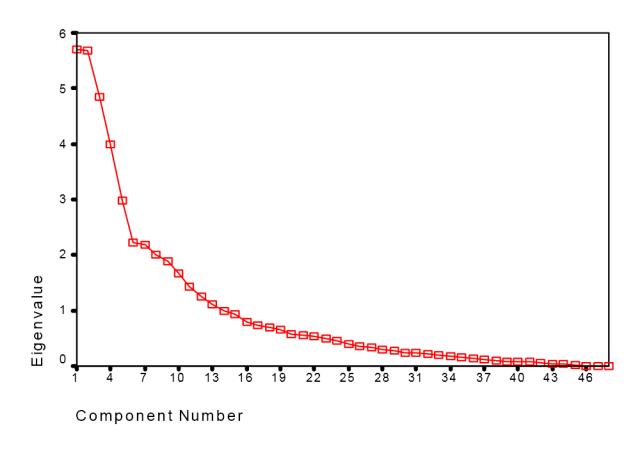
Figure 2. Component matrix scree plot (13 components extracted)
Factors Influencing Hotel Internet Service
Table 3. Factors influencing satisfaction on hotel internet service
| Factor | Factor Interpretation | Loading | Variables Included in the Factor |
|---|---|---|---|
| (% of variance explained) | |||
| C1 | Relevancy of | 0.972 | Information Content |
| Hotel Website | 0.952 | Product Information | |
| (11.9%) | 0.950 | Up-to-date Information | |
| 0.920 | Detail of Information | ||
| 0.916 | Usefulness of Information | ||
| 0.887 | Information Clarity | ||
| C2 | Usability Access | 0.963 | Website easy to use |
| (10.7%) | 0.963 | Reservation system is straight forward | |
| 0.863 | Access user friendly | ||
| 0.858 | Search feature availability | ||
| 0.808 | Accept automated payment | ||
| 0.798 | Navigational necessities | ||
| C3 | Convenience | 0.966 | Fast and easy to get around the web |
| Availability | 0.966 | Minimum time to find products | |
| (8.4%) | 0.932 | Minimum time to find promotional offers | |
| 0.825 | Enables Product Comparisons | ||
| 0.783 | Enables Price Comparisons | ||
| 0.733 | Supplementary offers | ||
| C4 | Positive Online | 0.896 | Enjoyable online experience |
| Experience | 0.869 | Presence of loyalty programs | |
| (7.7%) | 0.797 | Ability to get what you are looking for | |
| 0.756 | You dedicate the amount of information | ||
| 0.748 | received | ||
| 0.731 | Hassle-free experience | ||
| Absence of broken links & 'under- | |||
| construction' pages | |||
| C5 | Empathy | 0.829 | Personalization facilities |
| Provision | 0.797 | Availability of sources for redressing | |
| (6.2%) | 0.686 | Correction of online reservation arranged | |
| 0.610 | quickly | ||
| Contact points for enquiries | |||
| C6 | Customer Service | 0.798 | Service meets expectations |
| (4.7%) | 0.776 | Service exceeds expectations | |
| 0.754 | Repurchase and recommend to others | ||
| C7 | Web Site Design | 0.894 | Ambience of web site |
| (4.6%) | 0.802 | Readability | |
| 0.697 | Multimedia and video | ||
| C8 | Assurance | 0.933 | Availability of secure credit transactions |
| (4.2%) | 0.909 | Availability of other payment modes |
Table 3 displays the factor loadings for 34 items that have their primary loading on the first 8 components. Component 1 accounted for 11.9% of the variance and was labeled Relevancy of Hotel Website. This component was composed of items relating to the content of the web site, availability of product information, newness, detail, usefulness and clarity of the information. Component 2 accounted for 10.7% of the variance and was labeled Usability Access. This component was composed of items relating to the characteristics of the web site and relating to the level of ease with which the website could be navigated. Component 3 accounted for 8.4% of the variance and was labeled
Convenience Availability. This component was composed of items relating to how fast information could be obtained. This included time taken to find information and making comparisons on products and price. Component 4 accounted for 7.7% of the variance and was labeled Positive Online Experience. This component was composed of items relating to previous online experience whether negative or positive. Items related included enjoyable experience, presence of loyalty programs to enhance the experience and absence of negative experience such as broken links and 'under-construction' web pages. Component 5 accounted for 6.2% of the variance and was labeled Empathy Provision. This component was composed of items relating to the degree to which the organization is prepared to be customer focused. They included facilities to personalize exchange, contact points for redressing and enquiries and how rapid corrections can be made. Component 6 accounted for 4.7% of the variance and was labeled Customer Service. This component was composed of items relating degree of fulfilling customers' expectations. They included service levels meeting or exceeding their expectation and the willingness to repurchase and make recommendations to others. Component 7 accounted for 4.6% of the variance and was labeled Website Design. The component was composed of items relating to the overall outlook of the website. They are ambience, readability and presence of multimedia. Component 8 accounted for 4.2% of the variance and was labeled Assurance. The component was composed of items relating to financial security. They are availability of secure credit transactions and other payment modes.
Multiple Linear Regression
A standard multiple regression was performed between the hotel internet service as the dependent variable and relevancy of hotel website (C1), usability access (C2), convenience availability (C3), positive online experience (C4), empathy provision (C5), customer service (C6), website design (C7) and assurance (C8) as independent variables. The multiple correlation coefficient (R=0.886) was significantly different from zero, F(8,211) = 96.64, p < 0.0005, and 78.6% of the variation in the dependent variable was explained by the set of independent variables (R<sup>2</sup> = 0.7865). Relevancy of website, \(sr^2 = 0.4\), t = 12.597, p < 0.0005, Usability Access, \(sr^2 = 0.32\), t = 9.999, p < 0.0005, Convenience Availability \(sr^2 = 0.21\), t = 6.53, p < 0.0005, Positive Online Experience \(sr^2 = 0.2\), t = 6.243, p < 0.0005, Empathy Provision \(sr^2 = 0.30\), t = 9.261, p < 0.0005, Customer Service \(sr^2 = 0.3\), t = 9.552, p < 0.0005, Website Design \(sr^2 = 0.32\), t = 9.904, t = 9.904, t = 9.904, t = 9.904, t = 9.904, t = 9.904, t = 9.904, t = 9.904, t = 9.904, t = 9.904, t = 9.904, t = 9.904, t = 9.904, t = 9.904, t = 9.904, t = 9.904, t = 9.904, t = 9.904, t = 9.904, t = 9.904, t = 9.904, t = 9.904, t = 9.904, t = 9.904, t = 9.904, t = 9.904, t = 9.904, t = 9.904, t = 9.904, t = 9.904, t = 9.904, t = 9.904, t = 9.904, t = 9.904, t = 9.904, t = 9.904, t = 9.904, t = 9.904, t = 9.904, t = 9.904, t = 9.904, t = 9.904, t = 9.904, t = 9.904, t = 9.904, t = 9.904, t = 9.904, t = 9.904, t = 9.904, t = 9.904, t = 9.904, t = 9.904, t = 9.904, t = 9.904, t = 9.904, t = 9.904, t = 9.904, t = 9.904, t = 9.904, t = 9.904, t = 9.904, t = 9.904, t = 9.904, t = 9.904, t = 9.904, t = 9.904, t = 9.904, t = 9.904, t = 9.904, t = 9.904, t = 9.904, t = 9.904, t = 9.904, t = 9.904, t = 9.904, t = 9.904, t = 9.904, t = 9.904, t = 9.904, t = 9.904, t = 9.904, t
1.015 + 0.117(C1) + 0.06412(C2) + 0.06329(C3) + 0.06715(C4) + 0.09857(C5) + 0.06707(C6) + 0.117(C7) + 0.112(C8)
Table 4. Multiple linear regression output
Model Summary
| Model | R | R Square | Adjusted R Square | ||
|---|---|---|---|---|---|
| Estimate | |||||
| 1 | .886 | .786 | .777 | .08497 | |
a Predictors: (Constant), Assurance, Web Site Design, Customer Service, Empathy Provision, Positive Online Experience, Convenience Availability, Usability Access, Relevancy of Hotel Website
ANOVA
| Model | Sum of Squares | Df | Mean Square | F | Sig. | |
|---|---|---|---|---|---|---|
| 1 | Regression | 5.582 | 8 | .698 | 96.641 | .000 |
| Residual | 1.523 | 211 | .007 | |||
| Total | 7.105 | 219 |
a Predictors: (Constant), Assurance, Web Site Design, Customer Service, Empathy Provision, Positive Online Experience, Convenience Availability, Usability Access, Relevancy of Hotel Website b Dependent Variable: Customer Satisfaction
Coefficients
| Model | Unstandardized Coefficients | Standardized | t | Sig. | Correlations | ||||
|---|---|---|---|---|---|---|---|---|---|
| В | Std. Error | Coefficients Beta | Zero-order | Partial | Part | ||||
| 1 | (Constant) | 1.015 | .093 | 10.897 | .000 | ||||
| Relevancy of Hotel Website | .117 | .009 | .422 | 12.597 | .000 | .379 | .655 | .402 | |
| Usability Access | 6.412E-02 | .006 | .335 | 9.999 | .000 | .180 | .567 | .319 | |
| Convenience Availability | 6.329E-02 | .010 | .209 | 6.529 | .000 | .232 | .410 | .208 | |
| Positive Online Experience | 6.715E-02 | .011 | .207 | 6.243 | .000 | .258 | .395 | .199 | |
| Empathy Provision | 9.857E-02 | .011 | .305 | 9.261 | .000 | .432 | .538 | .295 | |
| Customer Service | 6.707E-02 | .007 | .311 | 9.552 | .000 | .355 | .549 | .304 | |
| Web Site Design | .117 | .012 | .322 | 9.904 | .000 | .332 | .563 | .316 | |
| Assurance | .112 | .011 | .345 | 10.686 | .000 | .332 | .593 | .341 | |
a Dependent Variable: Customer Satisfaction
IMPLICATIONS FOR SINGAPORE HOTELESTABLISHMENTS
The findings of this study contribute to the recent, albeit relatively sparse existing knowledge about customer satisfaction of hotel internet service. No previous academic research has so far examined the satisfaction processes of the hotel internet services. While few articles have attempted to study consumers purchasing patterns (such as Poon & Low, 2005; Bader, 2005), this study contributes new knowledge by providing empirical data in the Singapore context. The findings of this paper endorsed some of the recommendations suggested by Zafiropoulos et al. (2006) such as the need to include salient features of contact information, facilities and online reservations. However, this is where the similarity ends. The positive influences of the identified factors on customer satisfaction meant that Singapore hoteliers not only require the incorporation of sophisticated techniques to capture
customers' service touch points but also necessitate the personalization online experience of customers. Therefore hotel marketers will need to constantly upgrade both their hardware and software to provide hassle-free access to their customers. Personal blogs, guest book, discussion board, information on promotional events and packages, and newsletters should be used to personalized customers' positive experience.
CONCLUSION
This study focuses specifically on hotel internet service and customer satisfaction in Singapore. While the outcomes may be adapted and modified for hotel internet services in other countries and other related industries. The researchers do not make specific claims of its applicability other than the current research context. However, this research study can be used as a stepping stone for future researches to validity and inform the current findings. While the researchers are advocates of using hotel internet service, this study is not seen as promoting the replacement of other traditional promotion activities but rather enhancing existing ones.
The hotel industry is one that is competitive and requires continual improvements in order to succeed in the long-term. Hotel internet service is a strategy that could potentially be used to draw customers and therefore increased the hotelier's presence. Not including this as part of a wide array of marketing strategies is myopic. For any hotelier, the need for a virtual presence is not only a requirement but also an essential necessity.