

INTRODUCTION
Tourism is widely regarded as the world's largest industry that contributes significantly to the economies of many countries (APEC, 2002). It is also considered as an information-intensive industry in which electronic commerce is expected to play a very significant role thus this phenomenon has raised several issues pertaining to the acceptance, usage and its impact on the industry especially on developing countries like Malaysia (UNCTAD, 2000). Online transaction in the travel and tourism industry has grown continuously even during the economic downturn in the 1997 to 2000. Werthner and Ricci (2004) stated that travel industry becomes the leading industry in the application of business to consumer (B2C). Travelers are not only using the web for information gathering but they also use the web for transaction purpose such as booking/ordering. Tierney (2000) and Shankar et al. (2000) claimed that published research in the context of tourism websites effectiveness and factors influencing Internet
Address correspondence to Norzalita Abd Aziz, Faculty of Economic & Business, National University of Malaysia (UKM). E-mail:norzalita@yahoo.com / eita@pkrisc.cc.ukm.my.
usage rates is still very limited. Most of the research on web sites are based on personal opinion or experience (D'Angelo and Little, 1998). Identification of antecedent conditions of intrinsic and extrinsic motivation in technology acceptance is important in order to understand what factors determine this construct/concepts and therefore actual use of a system. However, the antecedents have been tested in different contexts and only a few studies examined the antecedents of extrinsic and intrinsic motivation in the technology acceptance model particularly in the tourism area. Therefore, it is crucial to understand what factors determine the effectiveness of travel web sites from consumer perspective that might encourage extrinsic and intrinsic motivation.
This study applied Technology Acceptance Model (TAM) constructs by using data from a field survey of web travel service use among potential travellers/internet users in order to fill the gaps especially in the information technology and tourism marketing literature. TAM has emerged as a powerful model in investigating the acceptance and use of information technology. Specifically, this study aims to identify the user's perception and their expectation from the travel website and to investigate the relationship between the travel web effectiveness and technology acceptance in terms of intrinsic motivation as well as extrinsic motivation.
LITERATURE REVIEW
Website Effectiveness Features
According to Yang et al. (1996) the effectiveness of a web site is defined as marketing results weighted by the company's ability to customize their site to the predictors that customer's value. Aladwani and Palvia (2002) defined website quality as users' evaluation of websites' features meeting users' needs and reflecting overall excellence of the web site. Through extensive evaluation and validation, they developed 25 items that measures four dimensions of web quality: specific content, content quality, appearance and technical adequacy. Organizations are encouraged to improve information and service quality and their web site design that should be customer oriented.
Moreover, cultivating hedonic pleasures on the web site can motivate users to participate, create excitement and concentration as well as increasing enjoyment among consumers in visiting the web (Liu and Arnett, 2000). Security and privacy that directly related to trust are also important components of effective commercial web sites (Wang et al., 2000; Reicheld and Scheter, 2000), while, focus on speed, navigation efficiency, simplicity and elegance with emphasize on customer orientation (Gehrke and Turban, 1999). In short, the success of a web site depends on the system use, system design quality, information quality and playfulness.
A travel web site needs to change to meet travellers' needs and should be focused on personalized tools such as providing value added services for example self-check-in of hotel/airline gues, provide recommendation/advise, currency conversion, translation and others (Werthner and Ricci, 2004). A travel web site should not be a reproduction of a brochure but animation/voice features are used in making the site more tangible and informative. Availability of search features and email with personalization service can improve travel site functional value and interactivity (Hanna and Millar, 1997). The information provided in the web must be consistent as well as current and accurate. Web users or general surfers might enjoy general information about a destination while shoppers or potential travelers are interested with detailed information about hotels, restaurants, attractions, transportation, car rentals (Bonn, Fun and Susskind, 1998). Law and Leung (2000) concluded that internet security, price range and user-friendliness are considered the most crucial elements in influencing travelers to purchase online air ticket.
Extrinsic and Intrinsic Motivation in Technology Acceptance
Extensive research, such as done by Agarwal and Prasad (1999), Davis et al. (1989), in the information system and information technology fields provides evidence of the significant effect of perceived usefulness and perceived ease of use on usage intention. Lederer et al. (2000) tested the TAM model for different technologies such as ATM, email, Internet, etc. and considered beliefs about perceived ease of use and perceived usefulness as the major factors influencing intentions to use. This implies that perceived ease of use and perceived usefulness have a positive influence on users' interaction with travel web. According to Teo et al. (1999), intrinsic motivation can be referred to as the performance of an activity for no apparent reinforcement other than the process of performing the activity per se. Perceived usefulness is as an extrinsic source of motivation and perceived enjoyment is as an intrinsic source of motivation for the use and usage of microcomputer in organizations (Davis et al., 1992).
Intrinsic motives are considered an important part in any computer usage and if the system is easy to use and users are enjoying using it, it will increase the likelihood of adoption (Chung and Tan, 2004, Ndubisi and Jantan, 2003 and Pikkarainen et al., 2004). Perceived enjoyment is in the concept of flow and is a crucial determinant in encouraging users to utilize a system (Chen, Gillenson and Sherrell, 2002). In the web site context, characteristics such as content, speed, ease of use, variety, navigation, and feedback are considered the antecedents of perceived playfulness/enjoyment (Chung and Tan, 2004).
Schmidt (1996) suggested that cultivating hedonic pleasure and creativity in web site design is an important aspect to increase system usage. Moon and Kim (2001) explained perceived playfulness/enjoyment as the extent to which the individual perceives that his or her attention is focused on the interaction with the world wide web; is curious during the interaction; and finds the interaction intrinsically enjoyable or interesting. They extended the TAM by including perceived enjoyment as another intrinsic motivational variable besides perceived ease of use and concluded that perceived playfulness as part of TAM that had a significant positive relationship with attitude toward using the WWW.
Teo et al. (1999) defined the extrinsic motivation as the performance of an activity because it is perceived to be instrumental in achieving valued outcomes that are distinct from the activity itself. Most of past research stated that perceived usefulness has a strong relationship with information technology and system usage such as stated by Davis (1989). Perceived usefulness and perceived ease of use are TAM motivational variables that mediate the effect of system design features on the attitude toward use (Liu et al., 2003). This revealed that standard navigation usage behavior is intrinsically motivated because users' who are familiar or experience will enjoy the process of using them not only because they are extrinsically rewarded for the performance of usage.
Teo et al. (1999) indicated that usefulness is generally more important than perceived ease of use and perceived enjoyment. They viewed that the continued usage of the web without any specific purpose may decline over time when the novelty effect of website wears off. Thus, from tourism perspective this may imply that systems that may seem easy to use and informative in the end maybe ignored if they do not provide functionality like reservation and booking services. Shopping on the web produces hedonic experience besides its utilitarian function that is related to extrinsic and intrinsic rewards (personal and emotional gain) and these can increase customer satisfaction (Jarvenpaa and Todd, 1997).
RESEARCH MODEL & HYPOTHESES
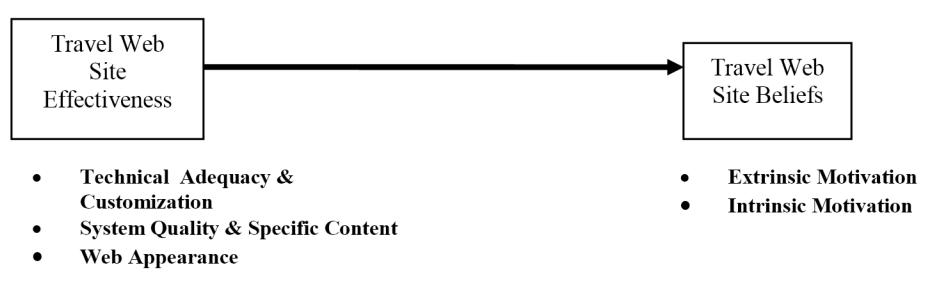
Figure 1.
Research Model adapted from Technology Acceptance Model from Davis et al. (1992). This study focus on the variables stated in Figure 1 above.
The model of Technology Acceptance Model (TAM) illustrated the evidence concerning the relation between intentions and behaviour regarding to the information technology usage and acceptance. The usage of the WWW is apparently being influenced by fundamental beliefs, perceived playfulness/enjoyment have significant effect on behavioural intention (Moon and Kim, 2001). Hsu and Chiu (2003) suggested that Information Technology or Information System practitioners must reflect extrinsic and intrinsic motivation in user interface and functionality design of electronic service and to improve consumer's subjective assessment of uncertainty and adverse consequences of using service on the Internet. Ghose and Dou (1998) found that the more interactive a website, the more likely that the site will be visited because it makes it easier for consumer to navigate and find what they want.
According to Teo, Lim and Lai (1999), perceived playfulness reflects an individual's intrinsic belief in IT acceptance. Chung and Tan (2004) indicated that intrinsic motivation is important part in computer usage and they will keep using it if they are enjoying using it. Meanwhile, Ndubisi and Jantan, (2003); Pikkarainen et al. (2004) emphasized on the computer system, if the system is easy to use (intrinsic motivation) and require less user's effort, the adoption and usage will increase. Through content analysis, Chung and Tan (2004) discussed several antecedents which are related to web site characteristics such as content, speed, ease of use, expectation, variety of navigation and feedback. These factors affect the acceptance of general web sites. Additionally, the study's findings show that web site characteristics and perceived usefulness play a dominant role in allowing users to experience perceived enjoyment. Playfulness/enjoyment is considered a crucial determinant in encouraging users to utilize (Chen et al., 2002). Jung and Butler (2000) found that useful information and ease to use were among the most important variables for successful web site design in the tourism industry. Several antecedents related to web site such as content, variety of navigation, feedback affect the acceptance of general searching site of Internet users (Chung and Tan, 2004). Chen et al. (2002) noted that perceived information quality, system quality and service quality significantly affect user acceptance of electronic shopping. Thus, in line with the above literature the following hypotheses are formulated.
H1: Travel web site effectiveness factors in terms of a) technical adequacy & customization, b) system quality & specific content c) web appearance are positively related to extrinsic motivation.
H2: Travel web site effectiveness factors in terms of a) technical adequacy & customization, b) system quality & specific content c) web appearance are positively related to intrinsic motivation.
RESEARCH METHODOLOGY
Sample and Procedure
The population of this study is defined as individual consumers or potential travellers (working adults) in Klang Valley because it is the largest metropolitan areas that support the largest heterogeneous individuals as well as homogenous group of people, economically feasible, and representing different social class, lifestyle and culture. Klang Valley is located within the state of Selangor and Federal Territory of Kuala Lumpur and it is the most densely populated area in the country. As reported by Malaysian Statistic Department, states with high proportions of urban population in census 2000 were Federal Territory of Kuala Lumpur (100%) and Selangor (87.6%). The individuals in this study are employees from organizations located in selected primary areas in Klang Valley and were chosen through multistage cluster sampling. Only those who indicated that they had used the Internet as well as they had travelled or planned to travel for vacation were chosen. This study selected office workers who have Internet/WWW experiences as subjects to investigate their perception and willingness in using travel web for travelling/vacation purposes because many office workers access the Internet/ WWW to search for information and communicate with other people or organizations (Shih, 2004). Furthermore they are considered more familiar with the Internet as well as they can be viewed as potential travellers since they have more chances to view or shop via and have capacity in purchasing travel related product (Shih, 2004). Researching the actual consumer groups allow more valid and reliable explanation because employees/office workers have buying power and responsible in making decision especially involving vacation (Cacioppo and Petty, 1979).
A pre-test of the questionnaire (including all constructs) was conducted using 5 experts in the related area of study as well 5 test respondents were drawn from the population to assess logical consistencies, ease of use understanding, sequence of items and task relevance. Overall they indicated that the questionnaire was relatively clear and easy to complete. Prior to administering the survey, a pilot study was conducted to test the validity of the instrument involving 50 part-time MBA students in the University Kebangsaan Malaysia and University of Malaya. The sampling choice for the pilot test insured the inclusion of people such as employees from various organizations with Internet literacy. The pilot study was to gain additional feedback about the questionnaire instrument to determine whether the instruments were capturing the phenomena desired in this study. Several items were reworded after the pilot test to improve the readability and clarity of the instrument.
Survey is the predominant research methodology used in this study. The data for this study was collected using self-administered questionnaires that were distributed to individual workers/ adult members of the population in the firms/organizations in the identified central business districts through out five primary areas of Klang Valley. To collect the data this study followed the dropping off method introduced by Fowler (1993). A senior employee was selected as representative to distribute and collect the questionnaire. Generally, respondents were given two to three weeks to fill in the questionnaire. To increase the response rate, monetary rewards were given to all identified enumerators/organization representatives, meanwhile small gifts were distributed as incentive to the respondents that have participated. Based on the table for determination of sample size with desired accuracy proposed by Reaves (1992), a minimum sample of 399 are required for the population of 500,000 and above. Lewis (1984 stated that in quantitative research, the larger the sample, the smaller the sampling error and the more accurate the survey. A total of 800 questionnaires were distributed to organizations within the identified precincts. After 3 months, the exclusion of responses from incomplete questionnaires resulted in a total of 679 usable questionnaires (a net response rate of 84.8 %).
Instrument
Churchill (1979) stated that the development of better measures should involve in identify and generate items that capture the identified constructs. Thus, this step is involved with generating related items that represent the conceptual framework under consideration. In ensuring the content validity of identified research constructs, this study is based on representative item from large base of pastrelated literature and empirical studies. Travel website effectiveness measured in terms of the level of agreement among respondents. Twenty-six statements were derived mainly from constructs developed by Aladwani and Palvia (2002) whereby the items in each construct of the study have undergone extensive evaluation and validation. However, other related studies such as Wong and Law (2004), Tierney (2000) were referred to in order to ensure those items are suitable in the context of travel website. The extrinsic (perceived usefulness) items were adapted from previous research by Chen et al. (2002) and Moon and Kim (2001). Intrinsic motivation (perceived ease of use and perceived enjoyment) was adapted from Davis et al. (1992), Chen et al. (2002) and Moon and Kim (2001). Modifications were made to all the items in order to make them suitable for a travel website situation. For the aforementioned measures, a 6-point Likert type was used with anchors ranging from strongly disagree (1) to strongly agree (6) to avoid the clustering of responses at the neutral point and remain non-committal (Benckendorff, 2006 and Quee, 2002).
FINDINGS
In terms of gender, the sample indicates a somewhat balance between male and female and all of them are above the age of 18 with the average age of Internet users is 31.49 years old. It appears that the majorities of the respondents were educated and have tertiary education. The results show that the Internet users continue to be young and well educated. The breakdown of the study sample in terms of ethnic groups could be considered representative of the population of Malaysia. With respect to household income, the monthly household incomes of the respondents indicate a wide dispersion ranging from below RM 1, 500 to above RM 10, 500. Friends/relatives are the main source of travel information followed by the Internet. While, school holidays is chosen as the best time to travel followed by year-end. More than half of the respondents indicated they use Internet several times in a day.
To establish construct validity, principal component analysis with varimax rotation is carried out and items are retained based on the value of factor loadings. The cut-off value of 0.5 and higher is assigned such that only items with loadings of at least 0.50 are retained in order to obtain a power level at 80% at 0.05 significant levels (Hair et al., 1998). Items with loadings exceeding 0.50 on two or more dimensions are removed and have to be retested (King and Teo, 1996). In addition, reliability analysis is carried out to eliminate items that are not strongly related to other items in the construct and construct reliability was assessed using Cronbach's alpha. Nunally (1978) suggested that a reliability of a construct between 0.6 and 0.8 is acceptable. The results of the factor analysis with the eigenvalues of all factors exceeded 1.0 are presented in Table 2 & 3. The Kaiser-Meyer-Olkin measure of sampling adequacy was 0.95, confirming the appropriateness of proceeding with the analyses. The factor loadings of all measures on their underlying constructs exceeded 0.5. The reliabilities of all constructs are between 0.89 and 0.90, thus passing the test of construct reliability. The factor analysis shows that only three factors are justified: they are labeled as F1: Technical Adequacy & Customization, F2: System Quality & Specific Content and F3: Web Appearance.
Table 1. Profile of the respondents
| Characteristics | Frequency | Percentage |
|---|---|---|
| Gender | ||
| 318 | 46.8 |
| • Female | 361 | 53.2 |
| Ethnicity | ||
| Malay | 387 | 57.0 |
| • Chinese | 211 | 31.1 |
| 64 | 9.4 |
| • Others | 17 | 2.5 |
| Age | Mean = 31.4 | 9, SD=6.306 |
| Level of education | , | |
| High school certificate | 60 | 8.8 |
| Diploma | 163 | 24.0 |
| Bachelor degree | 348 | 51.3 |
| Master degree | 72 | 10.6 |
| Professional | 27 | 4.0 |
| • PhD | 9 | 1.3 |
| Monthly household income | ||
| Below RM1,500 | 47 | 6.9 |
| 182 | 26.8 | |
| • RM1,500 - RM3,000 | 152 | 22.4 |
| • RM3,001 – RM4,500 | 121 | 17.8 |
| • RM4,501 - RM6,000 | 59 | 8.7 |
| • RM6,001 – RM7,500 | 39 | 5.7 |
| • RM7,501 – RM9,000 | 25 | 3.7 |
| • RM9,001 – RM10,500 | 54 | 8.0 |
| • Above RM10,5001 | 0.0 | |
| Main source of travel information | ||
| 223 | 32.8 |
| 54 | 8.0 |
| 108 | 15.9 |
| 58 | 8.5 28.6 |
| • Internet | 194 | |
| 36 | 5.3 |
| • Others | 6 | 9.0 |
| The best time to travel | ||
| 223 | 32.8 |
| Middle of the year | 122 | 18.0 |
| Beginning of the year | 28 | 4.1 |
| During festival holidays | 94 | 13.8 |
| • The end of the year | 139 | 20.5 |
| • Others | 73 | 10.8 |
| Internet usage rate | ||
| Several times in a day | 452 | 66.6 |
| Once a day | 85 | 12.5 |
| A few times a week | 125 | 18.4 |
| 17 | 2.5 | |
| Once a month | | 17 | 2.5 |
Table 2. Results of principal components analysis – Travel web effectiveness
| Measures/Scale Items | Factor 1 | Factor 2 | Factor3 |
|---|---|---|---|
| F1: Technical Adequacy & Customization | |||
| Provide personalised/customized service | 0.74 | 0.20 | 0.24 |
| Provide many interactive features (i.e. currency converters, maps) | 0.73 | 0.21 | 0.24 |
| Provide fast downloading response time | 0.70 | 0.39 | 4.415E-02 |
| Provide adequate search facilities (i.e. searchable database/search functions – attractions, activities) | 0.63 | 0.40 | 0.15 |
| Provide sites that are easy to access | 0.61 | 0.44 | 0.27 |
| Provide comprehensive content | 0.58 | 0.46 | 0.28 |
| Provide hyperlinks to related sites | 0.58 | 7.952E-02 | 0.43 |
| Provide price comparison | 0.57 | 0.28 | 0.26 |
| Provide information related to customer policies/privacy | 0.50 | 0.32 | 0.38 |
| F2: System Quality & Specific Content | |||
| Provide online booking facilities | 0.26 | 0.75 | 0.10 |
| Provide secure transactions online | 0.40 | 0.70 | 3.562E-03 |
| Provide contact information (i.e. email contact details) | 0.28 | 0.68 | 0.31 |
| Provide online payment by credit card | 6.796E-02 | 0.68 | 0.34 |
| Provide accurate information | 0.48 | 0.65 | 0.14 |
| Provide product/services details (i.e. itinerary,schedule) | 0.47 | 0.56 | 0.34 |
| Provide clear instructions for navigating the website | 0.49 | 0.52 | 0.22 |
| F3: Web Appearance | |||
| Proper use of colours/background | 9.483E-02 | 0.18 | 0.86 |
| Proper use of fonts/icons/headings | 0.13 | 0.23 | 0.81 |
| Provide multimedia features | 0.28 | -7.563E-03 | 0.80 |
| Provide attractive visual/images | 0.36 | 0.21 | 0.68 |
| Provide general information (i.e. corporate information) | 0.20 | 0.23 | 0.65 |
| Provide well-standardized structure/format | 0.38 | 0.43 | 0.52 |
| KMO – 0.95 | |||
| Eigenvalue | 11.8 | 2.07 | 1.04 |
| Total variance | 22.7% | 20.1% | 19.2% |
| Cronbach's Alpha | 0.90 | 0.89 | 0.89 |
As shown in Table 3, The Kaiser-Meyer-Olkin measure of sampling adequacy was 0.96. The reliabilities of all constructs are 0.95 and 0.88 respectively, thus passing the test of construct reliability.
Table 3. Results of principal components analysis – Beliefs
| Measures/Scale Items | Factor 1 (Extrinsic Motivation) | Factor 2 (Intrinsic Motivation) |
|---|---|---|
| F1: Extrinsic Motivation | ||
| Using travel websites is clear/understandable | 0.82 | 0.15 |
| Easy to use travel websites | 0.80 | 0.22 |
| Easy to find travel information | 0.79 | 0.19 |
| Helps to fulfill travel arrangement effectively | 0.77 | 0.37 |
| Using travel websites is pleasant | 0.75 | 0.35 |
| Makes travel arrangement easier | 0.73 | 0.41 |
| Makes quick travel arrangements | 0.73 | 0.32 |
| Have more accurate information | 0.73 | 0.32 |
| Access a lot of information | 0.70 | 0.37 |
| Access to the latest information | 0.69 | 0.34 |
| Provides with information that lead to better decisions in traveling | 0.67 | 0.40 |
| Reduces costs in making travel arrangements | 0.66 | 0.31 |
| Saves times | 0.61 | 0.39 |
| F2: Intrinsic Motivation | ||
| Travel websites arouses imagination | 0.19 | 0.79 |
| Do not realised the time has elapsed | 0.17 | 0.76 |
| Travel websites stimulate curiosity | 0.31 | 0.72 |
| Using travel websites in arranging travel/vacation is fun | 0.37 | 0.71 |
| Using travel websites is interesting | 0.40 | 0.71 |
| Lead to exploration of travel related product/services | 0.39 | 0.68 |
| KMO – 0.96 | ||
| Eigenvalue | 10.7 | 1.51 |
| Total variance | 39.8% | 25.1% |
| Cronbach's Alpha | 0.95 | 0.88 |
The multiple regression analysis is performed to test empirically the hypotheses postulated in the study. It enables us to better assess the contribution of independent variables to extrinsic and intrinsic motivation. The results of the analysis are presented in Table 4 below.
Table 4. Regression results- intrinsic motivation & extrinsic motivation and travel web site effectiveness factors
| D/V | I/Vs | B Coefficient | Beta | T | Sig. (p-value) | VIF |
|---|---|---|---|---|---|---|
| Extrinsic | Constant | 1.857 | ||||
| Motivation | Twea2 | 0.270 | 0.249 | 4.502 | 0.000 | 2.883 |
| Twea3 | 0.185 | 0.181 | 4.267 | 0.000 | 1.706 | |
| Twea1 | 0.175 | 0.174 | 3.006 | 0.003 | 3.156 | |
| R squared = 0. | 286 Sig.F = 0.00 | ) | ||||
| Intrinsic | Constant | 1.552 | ||||
| Motivation | Twea3 | 0.387 | 0.369 | 8.511 | 0.000 | 1.658 |
| Tweal | 0.159 | 0.154 | 3.543 | 0.000 | 1.658 | |
| R squared= 0. | 232 Sig.F=0.000 | ) |
The variables of extrinsic and intrinsic motivation were regressed on all independent variables. Thus, it is necessary to investigate multiple correlations among the variables, which reflect interaction effects as well as simple correlations. Two of the most widely used measures for assessing multicollinearity are the 'Tolerance' and the 'Variance Inflation Factor' (VIF). Those statistics are obtained through regression analyses. A low tolerance value means a high degree of multicollinearity among the corresponding variables. On the contrary, the VIF is inversed (reciprocal) of the tolerance, so large VIF values indicate a high degree of multicollinearity. A rule of thumb is that a tolerance value less than 0.10 or a VIF value more than 10.0 is regarded as evidence of statistically significant multicollinearity (Hair et al., 1998). The significant F value is less than 0.01, which indicates that the model has 99% confidence in the ability to explain the dependent variable and from VIF values indicate that high multicollinearity does not exists. The regression output shows that all the independent variables have significant impacts on extrinsic motivation and hypotheses H1a, H1b, H1c are supported. With exception of System quality & specific content, the results displayed in table 4, indicates that Web appearance and technical adequacy & customization have significant impacts on intrinsic motivation. Thus, only hypotheses H2a and H2a are supported.
DISCUSSION & CONCLUSIONS
The purpose of this study was to explore the travel website effectiveness features with regard to the travellers' acceptance of this technology for traveling/vacation purpose. Understanding travel website effectiveness roles is important because the attributes are considered internal factors that can be managed by the company. However, the influence of consumer beliefs and demographic characteristics are considered external factors. The empirically validated travel website effectiveness factors emerged in this study helps to answer one of the research questions "what are the major factors determining travel web site effectiveness"?. The results of the investigation uncovered three important dimensions of perceived travel website effectiveness. Another contribution is that while past web effectiveness research focuses mostly on the perspective of web developers and design, the current study targets the web users. In this era of intense competition and customer responsiveness, the users are major stakeholders and should not be ignored. Consumer information search is crucial to understand for developing effective marketing communication in order to provide information and to influence consumers' decisions (Shdmidt and Spreng, 1996; Wilkie and Dickson, 1985). From the results, the major factor/items determining travel web site effectiveness consists of three main factors with 22 items of web site design as shown in Table 2. These factors are labeled as Factor 1: Technical adequacy & Customization, Factor 2: System & Specific Content Quality and Factor 3: Web Appearance. Thus, travel marketers can assess their web sites based on those items in order to create business-toconsumer web sites that can effectively attract and retain consumers such as online purchases, web visitor satisfaction and repeat visits. If travel marketer finds itself lacking in any dimensions, then it may need to identify areas that need improvement.
Factor 1: Technical Adequacy & Content Customization
The item under this factor technical adequacy & content customization emerged as the best predictor in this study. Providing personalized service with interactive features—seem to be important way in which online travel merchants can attract more customers to their websites. Motivation to find and search is influenced by consumer's involvement and cognition. By providing personalized and customized service, customer involvement and need for cognition can be increased. Furthermore, customization allows internet users to experience and gives value added to travel web visitors. In addition, with interactive features and fast downloading, hyperlinks, adequate search facilities help increase online travellers' ability to search because these factors allow travel web users to reach desired information quickly and efficiently (Turban et al., 1999). Furthermore comprehensive content, easy to access, and easy to understand will increase travel web users' perceived benefit vs. cost advantages in their information search over travel web sites. Fast downloading and adequate search facilities will increase reliability and flexibility that lead users to elevate their trust in travel websites (Lee et al., 2005).
Factor 2: System & Specific Content Quality
The items such as secure transaction, system and contact information, company information help to increase customer's trust in travel web sites. Thus, maximizing trusts and minimize perceived risks of online transactions is necessary for travel web sites to be effective. Besides that accurate information as well as product and service, details can also facilitate consumers to justify their decision and lower their perceived risk of purchasing travel related product online. Travel related products such as destination, accommodation are considered as high risk. Payment method, booking facilities as well as clear instruction for navigating may provide online travellers convenience and the help that may need by travellers. Travel B2C web sites will have to take adequate steps to provide travellers' need of security.
Factor 3: Web Appearance
Web appearance dimension emerged as the third best predictor of travel web site effectiveness attribute. The results indicate that web appearance plays, as a necessity of any websites and it can be one of the key factors that differentiate competing web sites. Designing the travel website to facilitate enjoyment is relevant to effective travel web sites. According to Webster et al. (1993), internet users are being mesmerized during interactions with computer. While, Bloch and Richins (1983) indicated that satisfaction also gains from intrinsic and emotional reward besides extrinsic reward of purchasing product. Thus, attractiveness and appeal of various visual or images of travel web sites can lead to perceived enjoyment.
The empirical results show that travel web site effectiveness factors significantly affected travellers' beliefs of electronic tourism marketing. 'System Quality & Specific Content' has the strong significant influences on extrinsic motivation followed by Web Appearance and 'Technical Adequacy & Customization' respectively. Travel web sites need to provide enough navigation mechanism so that travellers can reach the desired information with accurate as well as reliable information that will affect the internet users' satisfactions and intention to purchase. Maximising trusts and minimizing consumers' perceived risks by providing secure and reliable transactions conducted over the web is necessary for travel related companies. Moreover, the effective travel web site should consider providing company information to help establish credibility and providing secure online payments method such as using credit card as the major payment method. In addition, regulations or rules of the transactions should be employed and clearly stated.
Meanwhile, Factor 3 has strong influence on intrinsic motivation followed by Factor 1. As explained by Moon and Kim (2001), perceived enjoyment in intrinsic motivation is based on the concept of flow and user will become engaged in a web site if he/she experiences the effects of flow (Hoffman and Novak, 1996). Web appearance consisting of various design and layouts of various visual elements, consistent presentation, concise information provided on the travel web page may affect to its understandability. Furthermore, aesthetic appeal i.e. pleasing colours/background, attractive images etc., customization of travel site's content, hyperlinks may lead web users to perceive that visiting the particular website is intrinsically interesting. Thus, it is important for travel related companies to include intrinsic and extrinsic motivational factors in user interface design that can improve travel web site usability.
In addition, the first model explained 28.6% of the variance in extrinsic motivation of travel web sites; the second model explained 23.2% of the variance in intrinsic motivation of travel web sites. The figure implies that our model might miss some important factors that have direct and indirect effects on travellers' beliefs in travel web sites. Therefore, there is a need for further investigation on other factors because the external variables are based on the perceived travel web sites effectiveness attributes of users that are subjective and may be influenced by individual characteristics such as internet self-efficacy, age, education level, etc. The findings presented in this study provide helpful market strategies that tourism market players can use to enhance travellers' intention to use travel web sites.
Furthermore, the results give managerial implications to tourism market players regarding how to develop proper travel websites. Lin and Lu (2000) indicated that applying inappropriate strategy with web sites would dampen the business image. Managers of travel related companies should monitor and try to improve their travel web sites usability by providing technical adequacy, enhancing specific content and system quality as well the web appearance. Hence, companies involved in tourism need to ensure their websites provide the right content and should focus on the web site features because quality attributes can enhance and help the organization to gain competitive advantage in the market (Gilbert, Powell-Perry and Widijoso, 1999). Travel companies should carefully consider ways to treat their customers or visitors to their web site due to the increasing number of travelers booking their trips online. Effective companies should assess the multi-dimension attributes of their web site by focusing users and technology at the same time.