

INTRODUCTION
World Health Organization defines disability as individuals who have restriction on the performance of an activity, resulting from impairment, in the manner or within the range considered normal for human being (Burnett and Baker, 2001). The impairment limits one or more major activities of life at given point of time, and could be physical, mental, hearing and visual (Abeyraine, 1995; Darcy and Daaruwalla, 2001; Burnett and Baker, 2001).
Globally, there are over 600 million disabled individuals (Burnett and Baker, 2001). In Malaysia alone, the number of disabled individuals is estimated to reach 1 million, which constitutes five percent of the national population (Musa, 2004). The figure however, is expected to grow synchronously with the increasing number of motor vehicle accidents, increasing life-span, improved medical technology, and lower child mortality. The growing number of the disabled community represents a huge challenges as well as opportunities for services sectors and tourism industries in the way of finding investors to develop facilities suitable for the mobility of the disabled people. Among facilities that post constant obstacle to this community's mobility are poor physical layout, architectural barriers, lack of basic equipments, and poor service deliveries (Yau et al., 2001).
Address correspondence to Ghazali Musa, Faculty of Business and Accountancy, University of Malaya, Kuala Lumpur. Email: ghaz8zz@gmail.com.
Burnett and Baker (2001) state that, the enactment of the 1995 American with Disabilities Act has called for attention to the dilemma of disabled people, especially from service providers and the tourism industry. Under this act, the service provider is responsible to alter their premises in order to accommodate people with disabilities. The implication of the enforcement of the act has leaved a significant impact on tourism sectors. The removal of physical barrier to facilitate access for example incurs a considerable cost. Service providers face dilemma of whether to carry out the task as required or suffer the financial consequences in their operation. However, at every level of the society, it is generally accepted that the move is crucial for the integration of the less fortunate people into the society.
To date, various literatures have discussed the issues of disabled people in tourism from different angles (Philips, 2002; Israeli's, 2002; Burnett and Baker, 2001; Ray and Ryder, 2002; Heukland, 1990; Shaw, 2002; Smith and Hughes, 1999; Shaw and Coles, 2003). However, all these research are carried in west and the issues and problems faced by the disabled people there may not reflect the Malaysian society. Thus, a research with local context is indicated.
The aim of this study is to examine travel behaviour among the disabled people in Kuala Lumpur. This will be achieved through the following objectives.
- 1) To identify the demographic profile of disabled tourists
- 2) To examine travel motivation among disabled tourists
- 3) To explore travel difficulty among the disabled tourists
- 4) To elicit the destination preference among disabled tourists
- 5) To explain the relationships between demographic profile, travel motivation and travel difficulty with destination preference
- 6) To suggest some management implications of the research.
LITERATURE REVIEW
Disabled People in General
Historically people with disabilities have often been treated unfairly by many societies (Darcy and Daruwalla 2001). Darcy and Daruwalla (2001) state that the disabled people have often been excluded from the public scene, in order not to cause nuisance to society and embarrassment to the family. In the Asia and Pacific region they are regarded with 'pity' (Takamine 2003), while in Malaysia, some regard them as "welfare" cases constantly in need of handouts (Khor 2002). As the result, many of the disabled people possess low self-esteem which subsequently reflected in low participation rates among them in all aspects of community life such as education, training and employment (Takamine, 2003). Khor (2002) states that 80% of the disabled people in Malaysia who are willing and able to work are unemployed. Even when they do work, the salary is minimal (Hutchison, 2000). Thus it comes to no surprise when Takamine (2003) claims that 40 percent of 160 million persons with disabilities in the Asia and Pacific region are living in poverty.
If the disabled person is a woman, the hardship magnifies. According to Henderson et al. (1995) and Lim and Devaraj (2000), women with disabilities experience numerous constraints to leisure and other aspects of life as a result of the double jeopardy related to gender and disability. They are also at high risk of being abused physically and mentally and sometimes by those within the household (Takamine, 2003). The problems of disabled people are compounded by the fact that 80% of the disabled people in the Asia and Pacific region live in rural areas which lack basic facilities and infrastructure (Takamine, 2003).
In Malaysia, the number of disabled individuals is uncertain. Among the explanation to this fact are under-reporting, under-diagnosed and the lack of an agreed definition of the disability. Statistics for June 2003 showed there are a total of 126,194 disabled people registered with the Welfare Department (3.9% of Malaysian population) (Malaysian Chinese Association 2005). However, only 5,000 of them are employed in the private sector.
Malaysia believes that the family is the basic unit of society and the primary source of nurturing and caring as well as providing support for the sick, the disabled and older persons (Sulaiman 2002). Tunku Mohd Rus (2000) adds that in view of the increasing number of nuclear families and longer life expectancies, steps have been taken by Malaysia to ensure that family ties are maintained and caring for the elderly continues to be the responsibility of the family. However there is an indication that the traditional method of caring for the disabled member has placed a heavy burden upon the family, and the solidarity among family members has weakened (http://www.fao.org/sd/PPdirect/PPre0042.htm).
Currently the government is instituting a total rehabilitation program, medically, socially and vocationally for the disabled community. The effort is collaboratively carried out by four major ministries: the Ministry of Unity and Social Development; the Ministry of Education, the Ministry of Health and the Ministry of Human Resources (Ismail 2003). The program is guided by the National Welfare Policy 1990 which emphasizes the attainment of self-reliance, equal opportunities and the fostering of caring culture. Under the policy, early detection and the necessary facilities are to be made available for the treatment, rehabilitation, education and training of persons with disabilities, so that they could be integrated into society.
Malaysia's commitment to improve the quality of life among its disabled population is further ensured through the signing of the Proclamation on the Full Participation and Equality of People with Disabilities in the Asia and Pacific Region on May 16 1994 (Habib et al., 2002). The signing of the Proclamation provided fresh impetus to the meeting of the Agenda of Action for the Asian and Pacific Decade of Disabled Persons (1993-2002).
The Disabled Tourist Difficulties
As early as in the late 1970s' concern for the disabled tourist issues has been articulated. "Holidaysthe Social Need" a joint paper represented by the Trades Union Congress and the English Tourist Board (Trade Union Congress, 1980), which highlighted problems faced by disabled tourists has led to the establishment of Holiday Care in 1981, a charity which now provides holiday information for the disabled tourist (Holiday Care, 2002). Furthering this thought, the English Tourist Board has conducted several studies pertaining to the disabled tourist and their difficulties, which has resulted in the report of Tourism for All (English Tourist Board, 1989). A number of recommendations have been suggested to the industry, advice businesses to improve accessibility and facilities catered for disabled people. Smith (1987) has identified three main barriers that constitute to the tourist difficulties. These are environmental, interactive, and intrinsic barriers
Although various studies and reports have been published during the period of 1970's to the 1990s', it could only serve as a suggestive change in the absence of firm legislation. The enforcement of the 1995 American with Disabilities Act (ADA) has attracted attentions of society to the needs of disabled people. With the enforcement of the Act, disabled people in the USA expect that businesses, public buildings and public transportations systems be accessible to individuals with physical disabilities. The enforcement of the Act receives a positive feedback from service providers, especially tourism industry, with largely revolved around economic perspectives. Nevertheless, Holly (2001) indicates that only 36% of hotels in USA are compliant with the ADA as at 1998. Shaw and Coles (2003) cite
accessibility within the accommodation and transport to the holiday destinations as major problems encountered by disabled tourist in UK. The finding duplicates another study carried out by the National Disability Authority (2003) which discovers that transportation and accommodation are major traveling difficulties for disabled tourists. They report that there are very few hotels which offer disabled-friendly accommodation (e.g. wide entrance, low level switches).
In Malaysia, the "Uniform Building By-Laws" has been introduced in 1993, in an effort to protect the rights and interests of the disabled people. Despite the legislation enacted, disabled people in Malaysia continue to struggle to gain their rights while waiting for the planned Act to be enacted by Parliament of Malaysia. In Kuala Lumpur, Musa (2004) reports that in several occasions, disabled tourists are often rejected by taxi drivers. High curbs, stairs, inaccessible toilets and the absence of lifts are also identified among the difficulties faced by disabled tourists (Musa, 2004). The policy of AirAsia, the national low-budget airline for not accepting a completely disabled person has created an unfriendly services and difficulties among disabled tourists in Malaysia. With regards to Airline Company, Yau et al. (2004) indicate in their study that tourists who used wheelchairs encounter problems during flight journey. The flight crews are reported as lack of proper training in handling the wheelchair. A disabled tourist experiences a misfortune of losing a wheelchair, while others report that their wheelchairs arrive with missing parts and improperly assembled (ibid).
Disabled Tourist Demographic Profiles and Market
The English Tourism Council (2000) has laid out the economic potential of the market for disabled tourists by emphasizing on the size of the market. The Body claimed that there are approximately 9.4 million disabled adults, which constitute of people of working age who have long term disabilities or health problems. In the year 1993, a study conducted by Deloitte Touch has identified a potential spending around 17 Billion pounds from disabled tourists holidaying within Europe. Seventy-five percent of disabled people considered holidays to be important, while 66% had been on holiday in the previous year. More recent study done by the English Tourism Council (2000), indicates that there are 2.7 million disabled people taking domestic holiday in England. One common feature shared among them was that the majority are unemployed. Ray and Rider (2003) observe that a great number of disabled tourists with mobility impairment are between 60 to 70 years old. This implicate that the growing numbers of disabled tourists is due to the aging of the general population.
Disabled Tourist and Their Travel Motivation
Various reasons are found to motivate the disabled people to travel. Shaw and Coles (2001) reveal that sense of freedom, time for new experience and relaxation are some of the reasons cited by the respondents. Although the motivations recorded are found to be similar with able-tourists, there are significant variations. The respondents in the study also emphasize on rest and relax for everyone as well as time for carer within the family to be partly relieved of their duties. The finding is similar with the results of Smith and Hughes (1999) on disadvantaged families, which suggest that the term holiday for them means 'escape from normal routine' and 'strengthening family ties' for disabled people.
According to Ray and Rider (2003), disabled tourists in their samples are found to be interested with activities that involve nature such as landscape, mountains, rivers, whitewater rafting, whale watching, sailing, and beaches. Activities such as gambling, hunting or visiting amusement parks are not favored by them. Surprisingly, the samples from the study ranked 'being physically active' as higher than samples from Eagles (1992), which focused on able-tourists. This may reflect the relatively inactive life among the disabled people which propels the need to be physically active. Similar with Shaw and
Coles (2001), Ray and Rider (2003) also state that 'social motivations' is equally important. Being together as a family and visiting friends and relatives are among the main motives of travel by the respondents in this study.
Disabled Tourist and Their Destination Preference
Living with disability creates a unique challenge for disabled tourists to participate in in tourism activities. According Yau et al. (2004), disabled tourists often engage in specialty tours organized for people with disabilities. To this community, holiday pre-planning is often required at a greater detail compared with their non-disabled counterparts. Holiday destinations that provide accessibility to scenic spots, transportation arrangement and personal assistants are deemed to be the ideal hotel destinations. Turco et al. (1998) further suggest that people with disabilities are more likely to visit the same destination, providing the service providers and travel agents have served their needs and provided positive experience.
Shaw and Coles (2001) report mixed choices of holiday trips among disabled tourists. While half of the respondents indicate that they usually joined organized trips, the other half of the respondents state that they often organize their trips independently, based on their previous experiences and information gathered from able-community. On the other hand, respondents in the study by Ray and Rider (2002) loathed that previous bad experiences deter them from joining trips organized by travel agents. Having accommodation personally inspected is suggested as an important point they would consider in travel booking. Interestingly, the study also cites that disabled tourists are also keen in holiday destinations which welcomed pets.
Burnett and Baker (2001) state that tourists with moderate and severe disability prefer to travel to quiet and peaceful countryside destinations. This finding echoes in the study by Ray and Rider (2002) who found travel to nature such as lakes, streams, mountains, beaches are ideal holiday destinations among the disabled tourists.
METHODOLOGY
With reference to the literature review, the following research model is developed. Referring to Figure 1, three independent variables to be measured are demographic profiles, travel motivation and travel difficulties, while destination preference is the dependent variable.
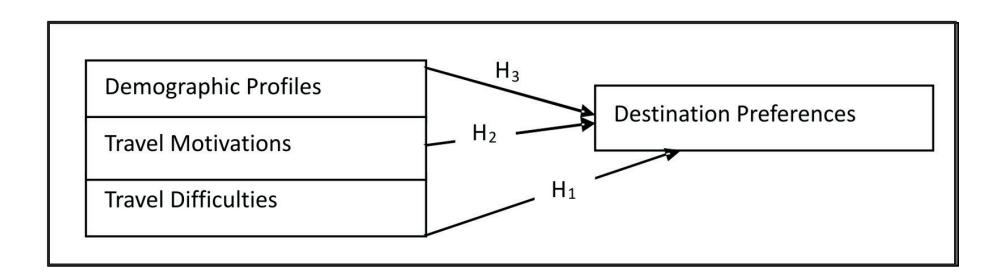
Figure 1. Research Framework
Based on the literature review discussed earlier, three hypotheses are proposed.
- H1. Travel Motivations are significantly related to destination preferences of disabled tourists.
- H2. Travel difficulties are significantly related the destination preferences among disabled tourists.
- H3. Demographic Profiles are significantly related to the destination preferences among disabled tourists.
Similar with previous studies (Shaw and Coles, 2001; Ray and Rider, 2002; Yau et al., 2004), this study also employs a mixture of qualitative and quantitative methods. The multiple uses of data collecting methods allow a more complete representation of the problem under interrogation (Taylor-Powell 1996; Curnaan et al. 1998; Laws 1998). In this study, focus group discussion, in-depth interviews and questionnaire survey are employed. However, only the result from questionnaire survey will be presented.
Before formulating the survey questionnaires, two focus group discussions and nine in-depth interviews were carried out among the disabled people in Kuala Lumpur. The questions asked during focus group discussion and in-depth interview are travel motivation, travel difficulty and destination preference. The results of this research were presented in Musa (2004). Based on this study the survey questionnaire was then formulated.
Questionnaire survey has its superiority in terms of achieving a large and representative number; thus the findings could be generalized to a whole population. (Whitney, 1972). In this survey, the questionnaire comprises of five main sections: travel profile, demographic profile, travel motivation, travel difficulty and destination preference. A 5-point Likert scale was used to anchor all items ranging from strongly agree to strongly disagree. Pilot test was first conducted on twenty-two respondents in an effort to ensure the validity and reliability of the questionnaire. The results from the pilot test showed that majority of the disabled people in Malaysia do not possess a good command of English, which reflects the low level of educational achievement among them. The questionnaire than was made available in Bahasa Melayu for the actual data collection.
Several methods of distributing questionnaire were performed. First, hospitals with rehabilitations units were contacted and questionnaires were distributed to the medical officers in-charged. Secondly, disabled society organizations such as Damai Disabled Person Associations of Selangor and Wilayah Persekutuan, Beautiful Gates and Society of the Chinese Disabled Persons were requested to help in distributing the questionnaires. Apart from that, two research assistants were consistently vigilance in searching and attending the various functions organized by the disabled communities. Among these functions were the disabled basketball match in Kuala Lumpur General Hospital, the Disabled Day in Berjaya Times Square, and the Charity Performance organized by the Beautiful Gates, all of which were organized in December 2005. The questionnaires were completed by respondents at the field with the help from research assistants. Some of the questionnaires were returned in the pre-paid post envelopes. Follow-up calls were made among those with contact numbers in order to improve response rate. Out of 400 questionnaires distributed, 176 questionnaires were returned, giving the response rate of 44%.
FINDINGS AND DISCUSSIONS
Demographic profile
Out of 176 respondents, 68.2% are males while 31.5% are females. The result may indicate that disabled males are probably more active in various activities organized by the disabled organizations, or more likely to respond to the questionnaire. The finding is consistent with the fact that 75.2% of the POCAM (People with Disability Association of Malaysia) are males in 2005.
The majority of the respondents are within the age of 21-30 years old (36.6%). This is follow by the age group of 31-40 years old (28%), and 41-50 years old (17.7%). Half of the respondents (50.3%) are students, unemployed or retired. The low rate of employment among disabled people may be due to the negative perceptions towards disabled people as suggested by Takamine (2003) or simply because the workplace is inaccessible (Khor, 2002).
Approximately 12% of the respondents are engaged in trading and self- employment, while 10.9% involved in service and sales sector. Only 6% of the respondents are professionals, legislators, administrators and managers. As expected, the majority of the respondents (43.2%) are earning below RM500. Approximately 30% of the respondents are earning between RM500-RM999, while 16.9% of the respondents are earning between RM1000 – RM1999. Consistent with the type of employment, only 13 respondents are found to be earning above RM2,000. The results also show that 58 respondents did not respond to the question of income (missing values). Thus, the numbers of disabled people who live with financial constraints is likely to be as high as two thirds of the respondents. However, since the Malaysian disabled community is likely to be looked after by their family members (Sulaiman, 2002), the hardship could be shared among them.
In terms of level of disability, the majority of the respondents (67.7%) belong to moderate level of disability, while severe disability and mild disability constitute 17.6% and 14.7% respectively. Despite being disabled, 85.6% of respondents engaged in domestic traveling, while 25.9% involved in international traveling within the last three years. Disabled tourists prefer to travel with either family members (44.5%) or friends (43.4%). However, 12.1 % of the respondents travel alone. The result lends credence to Sulaiman (2002), who states that Malaysians believe that a family is the basic unit of society and should provide support for disabled people. In terms of travel arrangement, majority of it was made by family (55%), followed by friends (35.8%) and self (28.9%). Inline with previous study conducted by Pfenning (2002), this study also finds that the majority of the respondents prefer cars as their main mode of transportation compared with 23.8% buses and 22.1% airplanes.
Travel Motivation
An analysis on travel motivation was carried out to examine the travel motivations among disabled people (Table 1). The result shows that the main travel motivation among disabled people in Kuala Lumpur is to see new places, (mean=1.77). They also travel with the main aims to rest and relax (mean=1.85) and to experience the feel of traveling (mean=1.87). During the European Disability Forum (EDF), it was noted that the disabled and their families value the opportunity to go away on holiday particularly to relax and recuperate (http://www.edf.feph.org). Disabled tourists also wish to learn new things (mean=1.88). Similar with Ray and Rider (2002), this study finds that "social motivation" is favorably voted among disabled tourist in Malaysia. Among the reasons are "meeting with friends and relatives"(M=1.99), "being accepted as a part of the groups" (M=2.03), and "attending family functions and gathering (M=2.27). Malaysian disabled tourists are also motivated to prove their independence and capabilities by traveling. Despite their impairments, disabled people also travel in order to "prove to themselves" (M=2.15) and "to prove to others" (M=2.27) of their capabilities and independence in traveling.
Table 1. Travel motivation among the disabled people in Kuala Lumpur
| Std. | |||
|---|---|---|---|
| Motivators | N | Mean | Deviation |
| To see new places | 171 | 1.77 | 0.663 |
| To rest and relax | 169 | 1.85 | 0.673 |
| To know how if feels to travel | 170 | 1.87 | 0.701 |
| To learn new things | 171 | 1.88 | 0.710 |
| To be with friends and relatives | 169 | 1.99 | 0.748 |
| To get involved in healthy physical activities | 171 | 2.01 | 0.655 |
| To be accepted as a part of society | 172 | 2.03 | 0.834 |
| For sightseeing and excursion | 171 | 2.06 | 0.795 |
| For personal challenge and a sense of adventure | 170 | 2.09 | 0.783 |
| To feel free and less disabled | 169 | 2.14 | 0.794 |
| To prove to myself my own capability and independence | 171 | 2.15 | 0.879 |
| To experience a sense of personal achievement | 168 | 2.18 | 0.864 |
| To release physical and psychological stress | 171 | 2.19 | 0.894 |
| To be accepted as a member of my group | 171 | 2.20 | 0.809 |
| To prove to others I could function like normal person | 171 | 2.26 | 0.955 |
| To attend family function and gathering | 170 | 2.27 | 0.820 |
| To show others my capability and independence | 170 | 2.27 | 0.959 |
| To get away from everyday stress | 170 | 2.34 | 1.004 |
| To meet new people | 171 | 2.35 | 0.777 |
| To feel less alienated | 169 | 2.39 | 0.983 |
| To forget my disability and limitations | 169 | 2.44 | 1.029 |
| For health treatment | 168 | 2.60 | 0.917 |
| To escape from daily routines | 168 | 2.62 | 0.990 |
| For business reason | 168 | 3.08 | 0.985 |
Scale: 1=Strongly Agree, 2=Agree, 3=Neutral, 4=Disagree, 5=Strongly Disagree
Destination preference
Inline with the objective of the study, an analysis was also performed to investigate the preference travel destinations among disabled tourists (Table 2) Beaches (M=1.76), and recreational parks (M=1.93) have been selected as the most preferred travel destinations, followed by lakes and waterfalls (M=2.04), holiday resorts (M=2.05) and zoo or animal safari (M=2.05). The results highlight that the majority of disabled people in Malaysia prefer to visit nature and semi-nature destinations. The finding mirrors the observation by Burnett and Baker (2001) and Ray and Rider (2002).
Table 2. Travel destination preferences among the disabled tourists
| Destinations | N | Mean | Std. Deviation |
|---|---|---|---|
| Beaches | 173 | 1.76 | 0.812 |
| Recreational Parks | 173 | 1.93 | 0.846 |
| Lakes | 171 | 2.04 | 0.897 |
| Waterfalls | 171 | 2.04 | 0.996 |
| Holiday resorts | 172 | 2.05 | 0.913 |
| Zoo or Animal Safari | 169 | 2.08 | 0.862 |
| Theme Parks | 171 | 2.15 | 0.879 |
| Shopping Havens | 172 | 2.17 | 0.951 |
| Historical Sites | 172 | 2.22 | 0.924 |
| Religious Sites | 171 | 2.23 | 0.897 |
| Villages | 171 | 2.24 | 0.918 |
| Forests and National Parks | 169 | 2.28 | 0.994 |
| Entertainment Venues | 168 | 2.33 | 0.965 |
| Rivers | 170 | 2.35 | 1.017 |
| Towns and Cities | 173 | 2.38 | 0.948 |
| Sports Events/Venues | 171 | 2.39 | 1.014 |
| Cultural Events | 169 | 2.41 | 0.991 |
| Health/Spa Destinations | 170 | 2.49 | 0.968 |
| Mountain/Mountain Resorts | 170 | 2.53 | 1.173 |
| Conferences/Seminars/Workshops | 169 | 2.67 | 1.056 |
Scale: 1=Very Attractive 2=Attractive 3=Neutral 4=Unattractive 5=Very Unattractive
Travel Difficulty
In addition to the preferred travel destination and the travel motivation, the study also attempts to examine travel difficulties (Table 3) that are faced by disabled tourists. The results show that accessibility (M=3.8) is the main barrier to travel. The result comes to no surprise as many other authors such Shaw and Coles (2003), Yu et al. (2004) and Musa (2004) all of whom discuss this major impediment to travel among the disabled people. To support earlier demographic finding on the financial hardship of the disabled people, financial situation (mean=2.84) is rated second as the main difficulty which hinders their travel. It would be interesting to find out how they finance their holidays.
Society is crucial in providing a better life to disabled tourists. However, disabled tourists receive insufficient assistance from society (mean=2.80) and having to endure the negative perception from them (mean=2.78) during their vacation. Members of the public should change their negative perception towards disabled tourists and view them as possessing the same rights in the society (Tan, 2004) and the same right to travel ((http://www.edf.feph.org). Disabled people also incur some difficulties in terms of holiday entitlement (mean=2.65) and the availability of travel companions (mean=2.65).
Table 3. General Difficulties Encountered by the Disabled Tourist
| Std. | |||
|---|---|---|---|
| General Difficulties | N | Mean | Deviation |
| Accessibility in general | 172 | 3.08 | 0.979 |
| Your financial situation | 174 | 2.84 | 0.891 |
| The assistance from society | 171 | 2.80 | 0.956 |
| The negative perception of so ciety | 171 | 2.78 | 0.846 |
| Your holiday entitlement | 167 | 2.65 | 0.821 |
| The availability of travel companions | 172 | 2.65 | 0.952 |
| Your health | 173 | 2.33 | 0.748 |
Scale: 1=Very Good 2=Good 3=Neutral 4=Bad 5=Very Bad
Despites their disabilities, disabled tourists rate their health as the lowest variable of travel difficulty (mean=2.33).
With regards to travel difficulty, a deeper exploration revealed that buses and taxis are the most inaccessible public transportation reported by the respondents. Among the specific problems facing the disabled tourist are bus doors which are not in level with the pavement, taxi drivers' attitudes that are reluctant to take disabled tourists as their passengers and higher fares charged by taxi drivers. The absent of lifts and lack of adequate and suitable pavement for pedestrian walkways poses great challenges to the disabled tourist who wishes to use train services (monorail and light rail transport). In addition, some of the toilets designed for disabled people are inappropriate as it is found to be too small for the wheel-chair to go in and poorly maintained. Disabled tourists also expressed their disappointment with the theme parks such as Sunway Lagoon and Genting Highlands, in which they are not granted permission to patronize.
Factor analysis of travel motivation and travel destination items
Factor analysis is performed in order to identify the underlying constructs of travel motivation (Table 4). Principal axis factoring is carried out, followed by varimax rotation with Kaiser Normalization. Four motivation components are derived with the variance explained at 53.844%. The motivation components are renamed into "to prove", "to relax and experience", "to get away" and "social'. Cronbach's alphas are strong on all the components especially 'to prove' (0.902) and 'to relax and experience' (0.827) which signifies a strong contribution of the items for the components.
Using the same technique as that previously conducted on travel motivation, 20 items of destination items are factor analyzed. Three destination components are derived with variance explained at 53.826%. These factors are named as 'urban attractions', 'nature' and 'parks and heritage sites'. Cronbach's alphas of all components (0.861, 0.846 and 0.77) are high which signify a strong contribution of all the items in the components (groupings).
Table 4. Factor Analysis of Travel Motivation
| Yariables Components | ||||
|---|---|---|---|---|
| To | Experience | Get | ||
| prove | and relax | away | Social | |
| To be accepted as a part of society | 0.748 | |||
| To show others my capability and independence | 0.739 | |||
| To prove to myself my own capability and independence | 0.738 | |||
| To be accepted as a member of my group (friends or | ||||
| relatives) | 0.737 | |||
| To prove to others I could function like normal person | 0.726 | |||
| To experience a sense of personal achievement | 0.705 | |||
| To be with friends and relatives | 0.682 | |||
| To feel less alienated | 0.660 | |||
| To feel free and less disabled | 0.659 | |||
| To forget my disability and limitations | 0.625 | |||
| To know how it feels to travel | 0.807 | |||
| To learn new things | 0.794 | |||
| To see new places | 0.746 | |||
| For personal challenge and a sense of adventure | 0.673 | |||
| For sightseeing and excursion | 0.664 | |||
| To rest and relax | 0.549 | |||
| To get involved in healthy physical activity | 0.424 | |||
| To get away from everyday stress (it all) | 0.798 | |||
| To release physi cal and psychological stress | 0.756 | |||
| To escape from daily routines | 0.658 | |||
| For business reasons | 0.771 | |||
| For health treatment | 0.765 | |||
| To attend family function and gathering | 0.423 | |||
| To meet new people | 0.411 | |||
| Cronbach's Alpha | 0.902 | 0.827 | 0.680 | 0.550 |
The relationships between demographic profile, travel motivation and travel difficulty with destination preferences
A further analysis was performed using Pearson-Correlation Test to determine the relationship between demographic profiles, travel motivation and travel difficulties, with destination preference. The results reveal that the disabled tourist who traveled with motivation 'to prove' and to get away' prefer to choose 'natures', 'parks and heritage sites' as their travel destinations (refer Table 6). On the other hand, disabled tourists who traveled with 'social' motivation are more likely to choose all types of destinations. The correlation between motivation components and destination components suggests that travel motivations have significant effects on the destination preferences. Thus H1 is supported.
Table 5. Factor Analysis of Travel Destinations
| Components | |||
|---|---|---|---|
| Urban Nature Park and | |||
| Heritage sites | |||
| Conferences/ Seminars / workshops | 0.775 | ||
| Health/spa destinations | 0.740 | ||
| Sports Events/venues | 0.689 | ||
| Holiday Resorts | 0.677 | ||
| Towns and cities | 0.671 | ||
| Shopping Havens | 0.656 | ||
| Cultural Events | 0.613 | ||
| Theme Parks | 0.442 | ||
| Entertainments venues | 0.425 | ||
| Waterfalls | 0.812 | ||
| Lakes | 0.806 | ||
| Mountains/mountain resorts | 0.770 | ||
| Beaches | 0.762 | ||
| Rivers | 0.630 | ||
| Recreational Parks (e.g. Lake Gardens) | 0.781 | ||
| Religious Sites | 0.652 | ||
| Zoo or Animal Safari | 0.546 | ||
| Historical Sites | 0.534 | ||
| Villages | 0.501 | ||
| Forests and National Parks | 0.411 | ||
| Cronbach's Alpha | 0.861 | 0.846 | 0.777 |
Table 6. Relationship between Travel Motivation and Destination Preference
| Destination Components | ||||
|---|---|---|---|---|
| Motivation | Parks and | |||
| components | Urban | Nature | heritage sites | |
| To Prove | Pearson Correlation | 0.136 | 0.221(**) | 0.241(**) |
| Sig (2-tailed) | 0.101 | 0.006 | 0.003 | |
| N | 146 | 153 | 149 | |
| Experience | Pearson Correlation | 0.295(**) | 0.278(**) | .215(**) |
| and | Sig (2-tailed) | 0.000 | 0.000 | 0.007 |
| Relaxation | N | 156 | 161 | 158 |
| Get Away | Pearson Correlation | 0.084 | 0.307(**) | 0.245(**) |
| Sig (2 -tailed) | 0.299 | 0.000 | 0.002 | |
| N | 155 | 163 | 158 | |
| Social | Pearson Correlation | 0.374(**) | 0.173(*) | 0.310(**) |
| Sig (2-tailed) | 0.000 | 0.029 | 0.000 | |
| N | 153 | 159 | 156 | |
A Pearson Correlation Test is also performed in order to examine the relationship between travel difficulty and destination preference. Referring to Table 7, the disable tourist who have 'health' and 'financial' problems prefer to choose 'urban', 'parks and heritage sites' as their travel destination. This implies that travel difficulty has a significant effect on destination preference. Thus H2 is supported.
Table 7 Relationship between Travel Difficulties and Destination Preference
| Destination Components | ||||
|---|---|---|---|---|
| Travel | Parks and | |||
| difficulties | Urban | Nature | heritage sites | |
| Pearson | ||||
| Your health | Correlation | 0.366(**) | 0.144 | 0.206(**) |
| Sig. (2-tailed) | 0.000 | 0.063 | 0.008 | |
| N | 158 | 166 | 162 | |
| Your financial | Pearson | |||
| situation | Correlation | 0.366(**) | 0.100 | 0.304(**) |
| Sig. (2-tailed) | 0.000 | 0.199 | 0.000 | |
| N | 159 | 167 | 163 | |
Independent t-tests are performed to examine the relationship between demographic profile of respondents and destination preferences. However, the results show no significant relationships between demographic profiles (gender and personal income) and destination preferences. Thus, H3 is not supported.
DISCUSSION AND CONCLUSIONS
In Kuala Lumpur, disabled males are generally more active in going out and getting involved in social and sport activities. This is evidenced from the number of respondents in this survey as well as the statistics provided by the Disabled Association of Malaysia (http://pocam.org/). However, there are no statistics available on the actual number of disabled people according to gender. It may be that there are more disabled males in Malaysia. It may be that the statements by Henderson et al., (1995) and Lim and Devaraj (2000) hold true about women with disability that they experience numerous constraints to leisure and other aspects of life as a result of the double jeopardy related to gender and disability. To address the issue education and awareness at all level of the society (the disabled people themselves, their family members and society) needs to be carried out in order to motivate the disabled people regardless gender, to go out and get involved in social and occupational activities. Most of the respondents are relatively young. Again the older age disabled may be experiencing the same issue as the female disabled.
A great majority of the disabled people in Kuala Lumpur is not working and those who are working are earning less than RM500. The finding should alert the government to look further into the welfare of disabled people. It is not fair to assume that the responsibility of looking after the disabled people should be carried out by the family as stated by Sulaiman (2002) and Tunku Mohd Rus (2000). Over dependence on family creates the sense of 'pity' in them (Takamine 2003). This negative self-perception results in low self- esteem among the disabled people, which later leads to low participation rates in all aspects of community life including education, training and employment (ibid).
Family and friends remain the most important groups who support people with disability in their daily activity. In this survey, they are not just making travel arrangements for a great majority of the disabled people, but also accompanying them. This finding supports Blum's (2001b) statement that almost two thirds of tourists with disabilities travel with family or friends. Thus, providing for the disabled person does not just attract the disabled people themselves but also attracts their friends and relatives. The observation by Pfenning (2002) that the majority of the disabled people travel by car is also a finding of this study. It may not be wrong to assume that the cars belong to their friends and relatives, judging from the financial status of the respondent. If this is true, the fact enhances further the close dependence of disabled people in Kuala Lumpur on their family members. The next common modes of transportation are buses, taxis and airplanes. However, disabled people do not give a favourable experience of using these transportations. Much needs to be done by way of improving accessibility in Kuala Lumpur, either on the infrastructure or in society itself. As mentioned by Khor (2002), in Malaysia, sometimes the building is accessible, but disabled people are not well received in them.
From this study, travel motivation among disabled people could be grouped into four categories: 'to prove', 'to get away', 'to experience and relax' and 'social' reasons. The last three motivation components are commonly found in many motivation studies of travel motivation. However similarly to the finding by Shaw and Coles (2001) and Eagles (1992) who found that there are uniqueness in the travel motivation of the disabled people; this study offers an additional dimension which has not been discovered by other studies. The motivation 'to prove' is unique among the disabled tourists in Malaysia. The fact may be explained by perhaps the disabled people in Kuala Lumpur is not yet gaining enough confident in themselves to go out there. They still have the need to prove to themselves and others about their capability.
In this survey, the majority of the disabled people prefer to travel to 'nature'. This observation lands support to other authors such as Burnett and Baker (2001) and Ray and Rider (2002) who found the disabled people prefer to visit peaceful, quiet and easily accessible destinations. However, respondents in this survey lamented the hardship of getting access to these places. The question to be considered by the government will be, is Malaysia willing to invest on a huge spending of providing accessibility to the disabled community to enjoy nature, when even in the capital city of Kuala Lumpur, the issue is still not effectively resolved.
Travel motivation components display significant relationships with the destination choice components. Respondents with travel motivation 'to prove' and 'to get away' prefer to travel to 'nature' and 'parks and heritage sites'. Respondents with the travel motivation of 'to experience and relax' and 'social' are likely to visit all the destination components. Those respondents with health and financial difficulties prefer to travel to 'urban areas' and 'parks and heritage sites'. This information could be used in order to segment the disabled market, so that they could be reached more effectively.
The limitation of this study lies on the method of quantitative survey. Data was collected using convenience sampling. The result cannot be generalized as a true picture, because respondents who answered the questionnaire are those who are actively going out in public. A great many of the disabled people in Malaysia may never leave their houses for the reason mentioned by Darcy and Daruwalla (2001). The sample is a cross sectional observation in the city. As mentioned by Takamine (2003), 80% of the disabled people in Asia Pacific region live in rural areas. In rural areas in Malaysia, where accessible facilities are almost unheard of, the life of the disabled people must be much harder than in the city. However, the good aspect of it is that the family integrity in rural areas may well be stronger than in the city.
Future studies in tourism and disability should attend to explore in depth the factors which cause low participation of disabled women in holiday and recreational activities. Attempts should also be made to obtain accurate demographic profiles of the disabled people, so that the magnitude of the issues and problems faced by the disabled people could be examined with minimum bias.
CONCLUSION
Kuala Lumpur provides a useful picture of the life reality among the disabled community in a developing country. The majority of the disabled people in the area live with either minimum income or without any job. The responsibility of looking after the disabled people not only imbued in the Malaysian culture, but also openly relayed from the government to the family members. This fact should however not be used as a reason for the government to delay the plan of integrating the unfortunate members into the society. The presently low self-esteem among them and their reluctant to take part in all aspect of community life lies on the fact that little is provided in way of accessibility either physically or psychologically by the government and society. Disabled people in Kuala Lumpur are still struggling to be accepted in the community, to be hired for a secure and reasonably paid job, to gain access to public infrastructure and recreational sites. The disabled people's preference to commune with nature provides further challenge to the government in providing adequate access to these destinations. An awareness campaign on the disabled people needs to be directed to society as well as to the disabled themselves in order to make sure both understand their respective roles in providing for a disabledfriendly society.