

INTRODUCTION
The study of backpacking began when Cohen (1972) described the drifter of the 60's to discuss the differentiation between non-institutionalized and institutionalized tourists. In Cohen's classic typology of tourist, institutionalized tourists refer to organized group tourists who are likely to travel within the "environmental bubble" provided by the tourism industry. On the other hand drifters, non-institutional tourists, are defined as "off-the-beaten-track" travelers who seek adventurous destinations with no set itinerary. Academic and institutional interest in backpacking tourism has remarkably increased since then (Maoz, 2007).
Recently numerous studies on backpackers' travel behaviours have been conducted (Loker-Murphy & Pearce, 1995; Maoz, 2006, 2007; Mohsin & Ryan, 2003; O'Reilly, 2006; Richards & Wilson, 2004; Riley 1988; Sorensen, 2003) and the market characteristics of backpackers was identified in terms of gender, age, popular travel destinations, travel activities and motivations (see Table 1).
Address correspondence to Aram Son: School of Tourism Management, Zhongshan University, Zhuhai Campus, Zhuhai, Guangdong Province, China.
Many observations in the field and longitudinal surveys of travellers in Australia have indicated an even distribution of female and male travellers (Mohsin & Ryan, 2003; Slaughter, 2004) although some recent studies found a predominance of women in their samples of backpackers (Speend & Harrison, 2004; Newlands, 2004).
Table 1. The Market Characteristics of Backpackers
| Gender | There is an even distribution of male and female (Mohsin & Ryan, 2003; Slaugther, 2004; |
|---|---|
| Party size | Backpackers are likely to travel alone or with just one other companion. (Murphy, 1997; Mohsin & Ryan, 2003) |
| Age | Majority of backpackers are aged under 30 years. (Maoz, 2004; Newland, 2004; Richards & Wilson, 2004) |
| Nationality | Major backpacker markets are Western countries especially northern European countries including the United Kingdom, Ireland and Scandinavia.(Maoz, 2007; Noy, 2004;O'reilly, 2006) |
| Destinations | Backpackers tend to avoid touristy places and seek the more rural and off-the-beaten path areas. (Elsrud, 2001; Murphy & Pearce, 1995; Riley, 1988) |
| Activity | Backpackers' activity patterns are fairly similar to other tourists but they tend to undertake more different and wider range of activities during their trip (Richards & Wilson, 2004) |
| Motivation | Backpackers are more likely to be motivated by seeking such goals as self-development and novelty, rather than escaping factors. (Binder, 2004; Noy, 2004; Murphy & Pearce, 1995; O'Reilly, 2005) |
A few studies on the backpacker market found that unlike other types of tourists, backpackers are likely to travel alone. In Murphy's study of backpackers in Australia (1997) for example, indicated that more than one-half of respondents usually traveled alone and over one third of the respondents were likely to travel with just one other companion. In Murphy's study only 11 percent of the respondents answered that they had traveled with a large group of people whom they met in Australia. The findings of Mohsin & Ryan's study (2003) were similar as those of Murphy's. In their study, 46% of the respondents were solo travellers, 37.2% were traveling with their partner or spouse and 16.8% were traveling as part of a group.
Another distinguishing characteristic of backpacker market is that backpackers are comparatively young travellers. While recent research found the backpacker market is beginning to attract older backpackers (Maoz, 2004; Newlands, 2004) most of studies on the backpacker market indicated that more than 70% of backpackers are aged under 30 years (Mohsin & Ryan, 2003; Newlnds, 2004; Slaughter, 2004). Richards & Wilson's (2004) world-wide survey of backpackers in 2002 also had similar findings and they concluded that this age profile is typical for studies of backpackers. Although the number of Asian backpackers is increasing (Muzaini, 2006) backpackers are still predominantly of Western origin and culture (Maoz, 2007; Noy, 2004). According to O'Reilly (2006) the majority of backpackers come from European countries including the United Kingdom, Ireland and Scandinavia. Australia, New Zealand and Israel are also significant backpacker-producing countries (O'Reilly, 2006).
The segment of the backpacker market in general tends to travel more extensively than other tourists in search for new places, people and cultures. The comparison of the differences between the two markets, organized group tourists and backpackers, has been discussed in the academic research and it is pointed out that since backpackers seek the experience of adventure, risk and authenticity (Noy, 2002) they are likely to travel off the beaten track (Kontogeorgopoulos 2003; Murphy & Pearce, 1995). Riley (1988) found from her fieldwork that backpackers tend to avoid touristy places and as 'antitourists' they claim to have the more 'authentic' experience.
Elsrud's study of backpackers' behaviour in Australia (2001) noted that some backpackers even avoid visiting major tourist sights such as Uluru - not because they are not interested in them but in order to avoid the tourists themselves. In Richards & Wilson's study (2004) there was also some evidence of differentiations between backpackers and other tourists in terms of preference for travel destinations. Their study indicated that relatively 'mature' destinations in North America and Europe were dominated by tourists while Southeast Asian countries such as Indonesia, Thailand and Vietnam had the high proportions of backpackers.
In spite of the argument that backpackers are keen to distinguish themselves from other tourists, recent studies found that their activity patterns are fairly similar to their counterpart (Mohsin & Ryan, 2003; Richards & Wilson, 2004). Mohsin & Ryan (2003) explored backpackers' travel behaviour in the Northern territory of Australia and noted that both backpackers and tourists tend to visit the same types of places and experience similar travel activities. Richards and Wilson's study (2004) also had a similar finding. Compared to other tourists, backpackers tended to undertake more different and wider range of activities during their trip even when controlling for length of stay. In general, however, the preference for travel activities of backpackers and other respondents were not different. The activities mentioned most frequently by both groups of respondents were visiting historical sites, walking, and sitting in cafes and restaurants.
Although both backpackers and tourists participate the same activities the meaning behind them might be different since their fundamental travel motivations are different. According to Iso-Ahola (1982), escaping of routine or stressful environments and seeking opportunities or certain psychological rewards are the basic motivational dimensions of travel behaviour. By escaping the everyday environment, a person can leave behind their personal and interpersonal world. Individuals are also motivated by seeking authentic experiences and the development of skills and special interests. Using Iso-Ahola's (1982) concepts of escaping and seeking, numerous studies found that backpackers are more likely to be motivated by seeking such goals as self-development and novelty, rather than escaping factors (Binder, 2004; Newlands, 2004; Murphy & Pearce, 1995; Riley, 1988). For example, Richards and Wilson (2004) explored travel motivation by different traveller types and their study indicated that backpackers tended to emphasise items related to experience seeking including novel seeking, learning experience and interpersonal encounter with local people as well as fellow travellers while tourists tended to emphasise relaxation-related motives.
Recently backpackers have become a crucial market for certain destinations (Maoz, 2007). For example, in Australia, as the international backpacker segment has been identified as a significant target market, international visitor survey does have backpackers as a specified category and a considerable amount of research has been carried out in relation to backpacker motivations and behaviours (Speed & Harrison, 2004). However the backpacker segment of the tourism market has not always been welcomed by Third World regional or national governments (Scheyvens, 2002). According to Hampton (1998), while the development of international mass tourism or segments such as the MICE market (meetings, incentives, conventions and exhibitions) has been emphasised in most Southeast Asian countries, the backpacker market is still greatly underestimated or at worst actively discouraged.
A key reason behind the negative attitude of Third World governments to backpackers has been the perceptions that backpackers' budget-conscious spending behaviour means they bring little revenue to the tourist destinations. This perception has been, however, challenged by research in Australia which found that international backpackers actually spent more money than any other tourist categories (Murphy & Pearce, 1995). Although the average daily spend of backpackers relatively low compared to other types of tourists in terms of total spend, backpackers make an important contribution to the economy of the destination they visit. According to international study of Bureau of Tourism Research in Australia (2000), international backpackers stayed in Australia for an average duration of 66 nights, and their average expenditure was $A6139 compared with $A4005 for all visitor. Furthermore, backpackers spread their money over a wider geographic area and bring benefits to remote regions since they tend to travel widely to experience authentic host culture (Hampton, 1998; Visser, 2004).
Another economic benefits of backpacker market is that backpackers can contribute significantly toward local economic development because backpackers' expenditures go to locally owned businesses such as local markets, small hotels and restaurants. Riley (1988) discussed backpackers' travel motivations and their travel behaviours and argued that since backpackers' major travel motivation is seeking authenticity they are not so concerned about high standard of facilities and services. They are also more likely to stay in cheap accommodation provided by local people to get closer to the life of the locals compared with mass tourists who prefer to stay in a big hotel owned by foreign firms (Hampton, 1998). Therefore, local communities can provide services and products demanded by backpackers without the need for large amounts of start-up capital or sophisticated infrastructure (Scheyvens, 2002; Wilson, 1997).
As the economic benefit of the backpacker market has become obvious, more recently academic and institutional interest in backpacker tourism has increased. In China however, the backpacker market has been given little attention by the tourism industry. Research on the backpacker market is still at an embryonic stage and due to the lack of reliable quantitative data on backpackers it is difficult to identify the characteristics of the backpacker market in China. Although their numbers are relatively small in comparison to other types of tourists, their socio-cultural as well as economic impacts towards the local communities should not be overlooked. This study, therefore, attempts to explore backpackers' travel behaviours and their backpacking experience in China.
METHODOLOGY
A self-administered survey was conducted for this study. The questionnaire contained a combination of open and closed ended questions covering many aspects of backpackers' travel behaviours, including travel motivation and travel activities that they had experienced in China. Respondents were asked to rate the degree of satisfaction based on seven items about service quality such as accommodation, public transportation, and shopping by using a 5 point Likert scale ranging from 1 (not satisfied at all) to 5 (very satisfied).
The critical incident technique was applied to measure backpackers' travel experience in China. The critical incident technique was originated by Flanagan (1954, cited in Callan, 1998) as a means of identifying a significant or critical behaviour that contributes to the success or failure of some human event in military training. Marketing researchers have adapted it to gain an understanding of specific consumer behaviour situation (Bejou et al., 1996; Burns et al., 2000). The critical incidents technique has been applied to service research and interaction situations, and has become a tool for assessing customer dis/satisfaction (Roos, 1999).
The critical incident technique has been also considered to be an effective method in tourism research. A number of researchers such as Jackson et.al. (1994) and Pearce and Caltabiano (1983) used it to investigate travel experiences. In their studies, participants were asked to describe vivid events that they remember as being meaningful in their travel experience. The study found that the critical incident technique is a more useful tool than standardized measures since it allows respondents to freely choose their own descriptive words to describe their travel experience. In the present study, respondents were asked to describe one of the best experiences and one of unpleasant experience
they had while traveling in China. Finally, the last section contained questions asking for respondents' demographic characteristics, such as gender, age, nationality and length of stay.
Data in this study were collected from backpackers staying at youth hostels in Xi'an. To administrate the survey, the researcher contacted the managers in youth hostels in Xi'an and asked for cooperation in distribution and collection of the survey. Participants were approached during mornings or late afternoons when they were either breakfasting or having a rest in a lounge of the youth hostel after returning from trips. A total of 252 questionnaires were collected and after 19 incomplete questionnaires had been discarded, a total of 233 questionnaires were analysed using SPSS (Statistical Package of Social Science).
RESULTS
Profile of Respondents
The demographic profile of the respondents is presented in Table 2. In general the profile is similar to that found by other researchers (Reiley, 1988; Sorensen, 2003). There were slightly more females (53.7%) than males (46.3%) in the sample of respondents. In terms of age, more than 70% of respondents were under 29 years of age. The 21-29 age category was the largest age group(63.7%), which is consistent that backpackers are relatively young tourists. As can be seen in Table 2, when nationality is compared across major regions, Europe accounted for the largest portion of respondents although respondent nationalities were widely spread over more than 20 countries. The findings were similar as those of other surveys conducted in Australia and New Zealand showing European countries especially the United Kingdom is a major backpacker market.
In terms of travel party size, the finding of this study was somewhat different from that of previous studies on backpackers. Unlike other studies such as Murphy's (1997) and Mohsin and Ryan's (2003), which found that backpackers have a tendency to travel alone, more than 74 percent of the respondents traveled with either one other or more than one other. Length of stay in China varied from 1 week to 1 year. More than one half of respondents (54%) stayed in China for between 30 and 60 days and the average length of stay was approximately 5 weeks.
Trip Characteristics and Preferences
The following section will preset the major findings of this study pertaining to respondents' trip characteristics including expenditure patterns, travel motivations and activity participation. As illustrated in Table 3, respondents' trip in China (excluding international airfares) would cost an average of Y 12,118 (US$1515). Approximately one half of the respondents expected to spend between Y 5,000 and Y 10,000.
Table 2. Profile of Respondents
| Categories | Frequency | Percent | |
|---|---|---|---|
| Gender (N=233) | |||
| • Male | 124 | 53.7 | |
| • Female | 107 | 46.3 | |
| Age (N=215) | |||
| • 20 years old or younger | 16 | 7.4 | |
| • 21 - 29 years | 137 | 63.7 | |
| • 30 - 39 year old or older | 45 | 20.9 | |
| • 40 year old or older | 17 | 7.9 | |
| Nationality (N=226) | |||
| • UK | 59 | 25.3 | |
| • France | 40 | 17.1 | |
| • Australia | 14 | 6.0 | |
| USA • | 14 | 6.0 | |
| • Spain | 11 | 4.7 | |
| • Canada | 10 | 4.3 | |
| • Italy | 9 | 3.9 | |
| Sweden • | 9 | 3.9 | |
| • Holland | 9 | 3.9 | |
| • Other* | 52 | 25.8 | |
| Length of stay in China (N=225) | |||
| • Less than 30days | 88 | 39.1 | |
| • 30 – 60 days | 121 | 53.8 | |
| • 61 – 90 days | 13 | 5.7 | |
| • 91 or longer | 3 | 1.3 | |
| Travel party size (N=219) | |||
| • alone | 56 | 25.6 | |
| • one other | 111 | 50.7 | |
| • more than one other | 52 | 23.7 | |
*Other: Austria, Belgium, Croatia, Denmark, Finland, Germany, Ireland, New Zealand, Poland, Russia , Switzerland
The highest estimated expenditure for the previous day in an individual category was for transportation (Y 134.8) followed by sightseeing tours (Y 101.7). The categories most frequently purchased in were food in restaurants (93.7%), food or drinks from stores (86.6%) and accommodation (78.9%). In several expenditure categories the majority of respondents made no purchases at all on the previous day. Least frequent purchases were on entertainment (15.2%) and souvenirs (3.6%). The average daily expenditure on food was relatively low. The average 'yesterday' expenditures on food in restaurants and food from stores were Y 48.5 and Y 28.4 respectively. However it is important to realize that total expenditure on food over their trip can become considerable since food is purchased repeatedly.
Table 3. Expenditure Patterns
| Frequency | Percent | Mean | |
|---|---|---|---|
| Estimated trip cost (N=193) | |||
| ¥4999 or less | 15 | 7.8 | |
| ¥5,000 – ¥10,000 | 97 | 50.3 | |
| ¥10,001 – ¥15,000 | 45 | 23.3 | |
| ¥15,001 – ¥20,000 | 21 | 10.9 | |
| ¥20,001 or more | 15 | 7.8 | |
| ¥12,118 | |||
| Estimated "yesterday's" expenditure (N=223) | % who purchased | ||
| food in restaurants | 93.7 | ¥48.5 | |
| accommodation | 78.9 | ¥71.7 | |
| souvenirs | 3.6 | ¥90.5 | |
| food or drinks from stores | 86.6 | ¥28.4 | |
| transportation | 77.1 | ¥134.8 | |
| sightseeing | 62.3 | ¥101.7 | |
| entertainment | 15.2 | ¥70.9 |
(Approximately US$1=¥8)
In order to identify why the travellers selected China as their destination, respondents were asked a free response question, where multiple responses were permitted. The results confirmed that backpackers are strongly motivated by seeking factors and they can be described as cultural tourists. As can be seen in Table 4, approximately 49 percent of respondents answered that 'to experience Chinese culture' was an important reason for travelling China. The second most important motivation was 'to visit famous travel attractions' such as the Great Wall. and 'to experience different culture' was ranked third. The finding also indicated that China has not been clearly positioned as a must see backpacking destination in some of respondents' mind. More than 10% of the respondents answered that the reason for traveling China was that either it was a relatively cheap travel destination or it was a part of their Asian trip.
Table 4 Reasons for Choosing China as a Travel Destination
| Motive | Frequency | Percent |
|---|---|---|
| To experience Chinese culture | 93 | 48.4 |
| To visit famous tourist attractions | 64 | 33.3 |
| To experience different culture | 50 | 26.0 |
| To see the natural scenery of countryside | 34 | 17.7 |
| It is a relatively cheap travel destination | 26 | 13.5 |
| It is a part of my Asian trip | 22 | 11.5 |
| To see my friends or family members | 16 | 8.3 |
| To enjoy various Chinese food | 16 | 8.3 |
| To see the development of China | 8 | 4.2 |
N=165
Respondents' preferred activities while traveling in China were also identified. Table 5 shows respondents' actual participation in activities. According to the mean score the most highly-rated activities were those that involved historical and cultural attractions. More than one half of the respondents (55.5%) answered that they had visited temples 4 times or more and approximately 89% of them had visited a history museum at least 1-2 time during their trip. Some city-based travel activities such as visiting parks, sitting in cafes, and going to the pub also had high preference score while there was relatively low preference and participation for nature-based activities including visiting farms and camel riding.
The finding of the study indicated that backpackers' preferred travel activities are heavily influenced by travel destinations. Murphy's study (1997) on backpackers in Australia found that backpackers had a great interest in seeing natural tourist attractions such as the Great Barrier Reef, the outback, and Kakadu and they were likely to have higher participation rates in travel activities including swimming, scuba diving, and bushwalking. On the other hand, respondents in this study were considerably less likely to be interested in adventurous activities and preferred to participate culturebased travel activities and guided tours to visit famous tourist attractions.
Table 5. Activity Preferences
| Activity | Mean | SD | never | 1 time | 2-3 times | 4 times or more |
|---|---|---|---|---|---|---|
| visiting temples (n=229) | 3.44 | .720 | 4 (1.7%) | 19 (8.3%) | 79 (34.5%) | 127 (55.5%) |
| visiting parks (n=228) | 3.10 | .825 | 8 (3.5%) | 43 (18.9%) | 95 (41.7%) | 82 (36.0%) |
| sitting in cafes (n=229) | 2.97 | 1.03 | 26 (11.4%) | 48 (21.0%) | 62 (27.1%) | 93 (40.6%) |
| visiting history museums (n=227) | 2.78 | .977 | 26 (11.5%) | 61 (26.9%) | 78 (34.4%) | 62 (27.3%) |
| going to the pub (n=229) | 2.40 | 1.16 | 70 (30.6%) | 55 (24.0%) | 46 (20.1%) | 58 (25.3%) |
| taking guided tours (n=228) | 2.06 | .983 | 81 (35.5%) | 74 (32.5%) | 51 (22.4%) | 22 (9.6%) |
| biking (N=228) | 2.01 | 1.00 | 90 (39.5%) | 67 (29.4%) | 49 (21.5%) | 22 (9.6%) |
| mounting climbing (N=225) | 1.94 | .917 | 86 (38.2%) | 81 (36.0%) | 43 (19.1%) | 15 (6.7%) |
| going to the night club (N=228) | 1.73 | 1.01 | 135 (59.2%) | 41 (18.0%) | 31 (13.6%) | 21 (9.2%) |
| visiting botanical garden (N=227) | 1.69 | .854 | 119 (52.4%) | 70 (30.8%) | 28 (12.3%) | 10 (4.4%) |
| visiting local people in their home (N=223) | 1.66 | .900 | 129 (57.8%) | 51 (22.9%) | 32 (14.3%) | 11 (4.9%) |
| attending festivals (N=225) | 1.45 | .949 | 158 (70.2%) | 47 (20.9%) | 16 (7.1%) | 4 (1.8%) |
| taking a cruise (N=224) | 1.41 | .642 | 151 (67.4%) | 56 (25.0%) | 16 (7.1%) | 1 (.4%) |
| visiting zoos (N=225) | 1.29 | .562 | 169 (75.1%) | 48 (21.3%) | 6 (2.7%) | 2 (.9%) |
| visiting farms (N=224) | 1.25 | .544 | 180 (80.4%) | 32 (14.3%) | 12 (5.4%) | 0 (0%) |
| hanging out on the beach (N=225) | 1.23 | .590 | 189 (84.0%) | 23 (10.2%) | 10 (4.4%) | 3 (1.3%) |
| camel riding (N=223) | 1.14 | .432 | 197 (88.3%) | 21 (9.4%) | 4 (1.8%) | 1 (.4%) |
| visiting aquariums (N=224) | 1.13 | .390 | 197 (87.9%) | 25 (11.2%) | 1 (0.4%) | 1 (0.4%) |
Satisfaction with Service Quality
Respondents were asked to evaluate the quality of the services provided in China as a tourist destination. Figure 1 visualizes a summary of respondents' travel satisfaction in terms of seven criteria including facilities at the tourist attraction, facilities of accommodation, restaurant hygiene, information service, public transportation, shopping experience on bargaining, and toilets in general.
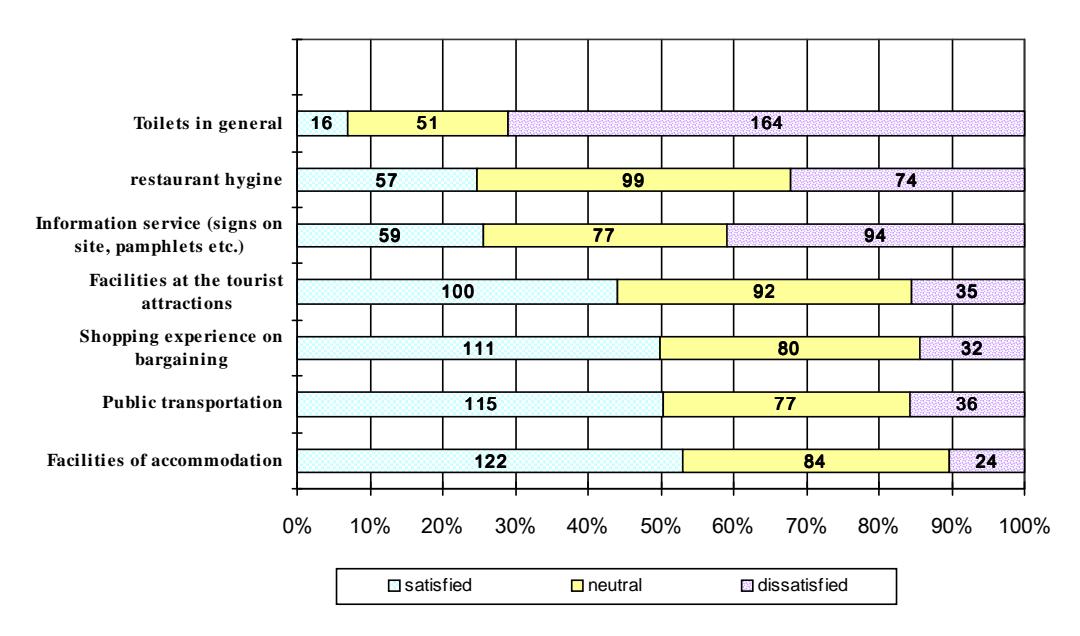
Figure 1. Respondents' Travel Satisfaction in 8 Items of Service Quality
In general respondents were not satisfied with service quality. According to Hanan and Karp (1987) it can be considered that visitors are satisfied only if more than 85 percent of them are providing scores on the top two levels of the rating scale being employed. However the result of the study indicated that none of the item was rated at 4.0 or more (on a 5 point scale). Respondents were somewhat satisfied with facilities of accommodation (mean = 3.53), with approximately 53% rating it as good and they were relatively pleased with the shopping experience on bargaining (mean=3.45), public transportation (mean=3.42) and facilities at the tourist attractions (mean=3.32). On the other hand most of the respondents answered that they were not satisfied with restaurant hygiene (mean=2.89) and information service (mean=2.80). The result also indicated that majority of the respondents considered the facilities of toilets in major tourist attractions and public areas poor. One hundred sixty four respondents (71%) answered that they were not satisfied with the condition of the public toilets while only sixteen (6.9%) respondents were satisfied with it.
Travel Experiences in China
To identify travel experiences in China respondents were asked to state both positive and negative episodes. To allow the sample to respond more freely about their travel experience, an open-ended question was provided. The responses were content analysed to develop a coding scheme. A response that contained more than one theme was multi-coded. When asked what they enjoyed most while in China not surprisingly majority of respondents mentioned visiting famous tourist attractions
such as the Great Wall and major travel destinations including Beijing, Pingyao, Yangshuo and Tibet (see Table 6). The results of this study confirmed that backpackers tend to avoid tourists and as 'anti-tourists' they seek more 'authentic' experience. A few respondents mentioned that walking on the remote part the Great Wall was more enjoyable since it was not 'too touristy.' For example a 31 year old British male replied that,
"Walking on remote part of Great Wall – away from tourists, very nice!"
and a 27 year old Australian female,
"Great wall. Something that I've wanted to see for a long time. I was very impressed that our walk from Jingshaling to Simatai was not too touristy. Plus we had great weather and a fantastic day."
Table 6 Positive Experiences Mentioned by Respondents
| Rank (N=217) | Activities |
|---|---|
| 1 | Visiting tourist attractions |
| 2 | Talking to local people |
| 3 | Relaxing in the countryside |
| 4 | Experiencing Chinese culture |
| 5 | Taking a long distance train |
| 6 | Having local Chinese food |
| 7 | Climbing a mountain |
As discussed in the introduction part, various studies on backpackers found that understanding different cultures and social interaction with local people are primary motivations (Maoz, 2007; Murphy, 1997; Riley, 1988). Participating in the daily environment (e.g. buying food at a market, talking with local people at a restaurant and taking a public bus) can be a good way of learning the host culture as well as a memorable and authentic experience during their backpacking trip. Some respondents in this study also chose talking to local people and experiencing Chinese culture as the most enjoyable experience. Some examples mentioned are as follows,
"Cycling around the Hutong in Beijing – Liked to see how the locals live." (33 year old British female)
"Hiking Huashan. There were only local tourists not foreigners. It was a very 'Chinese' experience." (20 year old American female)
"My best experiences are always when interacting with local people-eating a meal + having a beer!" (33 year old British male)
"The very best experience was spending time with a farmer's family in Guizhou province. We met a your student in the train from Guilin to Kunming. He invited us to his house. So we spent few days in his family. They live in a mountain. People were so nice and it was interesting to experience their daily life." (27 year old French male)
In addition, relaxing in the countryside, having various local Chinese and climbing a mountain were mentioned as pleasant experiences while traveling in China.
Respondents negative travel experiences were also content analysed. A list of elements mentioned more than 10 cases is shown in Table 7. The finding was consistent with the result of travel satisfaction in this study. When asked to describe unpleasant experience while in China, communication problem was most frequently mentioned. When backpackers travel to a tourist destination that has different cultural background from their country they might have some communication problem. Especially if people in the host country use different language they could face more serious communication problem. Approximately 30% of the respondents in this study answered that they had some difficulty because it was hard to communicate with local people who cannot understand English. For example a 28 year old Belgian male complained,
"Communication! I can never get the same information. It's difficult to communicate if you don't speak Chinese. Not many people understand English."
Table 7 Negative Travel Experiences Mentioned by Respondents
| Rank (N=203) | Aspects | |
|---|---|---|
| 1 | Communication problem | |
| 2 | Poor service quality (unfriendly service workers and taxi drivers, poor tourist information) | |
| 3 | Public toilet | |
| 4 | Being cheated | |
| 5 | Booking train ticket | |
| 6 | Poor hygiene | |
| 7 | Poor public etiquettes (spitting, no queue, smoking in public area) | |
| 8 | Local food | |
| 9 | Air pollution | |
| Other: Crowded streets, heave traffic, pickpocket, poor condition of public buses | ||
Another common theme mentioned often as an unpleasant experience was related to poor service quality. Meetings between frontline service employees and tourists are a critical component of the host-guest encounter and the service of frontline employees at restaurants, hotels and train or bus stations could influence tourists' satisfaction level. A few of the respondents answered that because of the poor service of frontline employees they had some unpleasant experiences. In addition, some of them pointed out that booking train tickets was quite troublesome and inconvenient. Some examples of responses are as follows,
"Poor/rude service at some restaurants in Beijing. Not allowing us to order the food we want." (25 year old Canadian female)
"I have found the poor service at hostels or tourist information spots. They seem very unwilling to leave their computer to help us even if I am trying to spend my money with them. " (27 year old Australian female)
"Very frustrating that you can't book train tickets for further journeys. It is unbelievably difficult to get train tickets and English speaking persons at the strain stations. They are very unfriendly and not very helpful." (25 year old Danish female)
Low standard of hygiene and using public toilets in major tourist destinations as well as public areas such as train stations and restaurants were also often mentioned as an unpleasant experience while traveling in China. Another unpleasant experience mentioned by the respondents was related to public etiquette such as no queuing and smoking at a restaurant. It seems that cross-cultural differences and dissimilarities in social customs made some of the respondents develop negative feelings on local customs. A few respondents complained about people smoking at a restaurant and suggested that smoking area and non-smoking area should be separated.
It was found that the respondents had two contrary opinions toward local Chinese food. Local food in tourist destinations plays an important role as a major attraction since trying the local food can be an important part of the authentic experience of travel. As Cohen (1972) notes, however, most tourists still need a certain degree of familiarity to enjoy their authentic travel experience. Some respondents answered that they enjoyed various local Chinese dishes and tying authentic local food was one of the best experiences they had in China. The others, on the other hand, mentioned that having certain local dishes was an unpleasant experience due to the unfamiliar taste.
CONCLUSION AND DISCUSSION
This study sought to explore the characteristics of backpackers and their travel experiences in China. The profile of the backpackers and travel behaviour in this study generally supported Murphy and Pearce's (1995) definitional criteria. It was identified that majority of the backpackers in this study were primarily young and European and they were likely to travel alone or with just one other companion. The results indicated that the average length of stay was approximately 5 weeks and their trip in China (excluding international airfares) would cost an average of Y 12,118 (US$1515).
The findings of the study also provide insights regarding respondents' activity preference and their travel experience in China. Tourism marketers might be able to use this information to target backpackers more successfully. For example, respondents were likely to participate culture based travel activities such as visiting history museums and temples and they were highly motivated by a desire to meet local people. Therefore experiencing authentic Chinese culture and meeting local people can be highlighted to attract international backpackers.
Based on the results of this study, in general backpackers were not pleased with service quality and tourist facilities. The major issues pointed out by respondents were low standard of hygiene and public toilets, unfriendly frontline service employees at restaurants and train stations, booking train tickets, lack of English menu, and bad signs for the street name and tourist attractions. All those points at issue should be improved to reach international standards and to satisfy international backpackers. Especially customer service training should be emphasised in major tourist destinations since the tourist-service employee interaction is critical when evaluating tourist satisfaction.
In order to deliver better service, a clear understanding of the cultural background of international backpackers is also essential. As Reisinger and Turner (1998) noted the biggest cultural differences are between Asian and Western societies. Serving Western tourists could create problems for Chinese service workers due to the large cultural differences in rules of behaviour, and verbal and nonverbal communication. The interaction difficulties could lead to misunderstanding and consequently, tourist
dissatisfaction. It is important, thus, for all service providers in the tourism industry to understand the international backpackers' cultural background.
This study attempted to explore the characteristics of backpackers in China and their travel experiences. While the findings of this study could provide useful information to develop marketing strategies for the international backpacker market they may not be directly generalized to the entire backpackers in China. For more precise information on the backpacker market a nationwide survey with a larger sample size should be needed. Since previous research found that the backpacker market is not a homogenous group (Maoz, 2006; Murphy & Pearce, 1995; Murphy, 1997; Uriely et al., 2002), further research about backpackers' images of China as a travel destination and their travel behaviours including travel activity and tourist destination preference and travel patterns based on travel motivation, age and cultural background would be also worthwhile for a deeper understanding of the backpacker market in China.