

INTRODUCTION
It has long been acknowledged that service differentiation through effective market segmentation ensures survivability of the firm in the long run (Chan, 2000a). Much literature have propounded the importance of service differentiation and market segmentation to appeal to groups of buyers for profitability (such as Aaker, 2008; Johnson et. al.,2008). A business must recognize that it cannot appeal to all customers in the marketplace. It has to identify the groups of buyers with similar needs and requirements so that it can serve each group separately and effectively. To add on, resources availability to firms is often limited (Lynch, 2000) and this necessitates market segmentation to better target customers needs. Gilmour, Borg, Duffy, Johnston, Limbek and Shaw (1994) further iterate the need not only to differentiate the market but also the service requirements administered. This is
Address correspondence to Keith Y.N. Ng: Southern Cross University, Military Road, East Lismore NSW 2480 Australia. Email: keith.ng@scu.edu.au, keithynng@gmail.com.
SHAFIQUR RAHMAN & KEITH NG
achieved in bridging the gap between the firm's assortment of product attributes and those targeted specifically at customers' needs. While scale economies do not have an overall impact in this instance, tailoring services increases the number of options available to the firm so that more can enjoyed a customerised variety (Larissa and Myroslaw, 1994). The results are often greater price negation and long term profitability for firms competing to gain greater market shares.
New ways of positioning products or innovative market segmentation are constantly sought after as industries evolve (Zahra et. al., 2005). For example, the seniors market or "Grey Tourism" has recently surfaced as a significant segment for the tourism industry (Littrell, 2004). The main reason was the ageing of Generation X who has traditionally influenced market dynamics over the last two decades. Directly related to Grey Tourism is the need to fulfill the aspirations of senior people who may have disabilities, whose travel needs have been described as barrier-free tourism (Vignuda, 2006). While there were ample studies conducted on segmentation (such as Clemons and Weber, 1994; Mazzeo, 2003) and providing service differentiation (such as Gustafsson et. al., 1999; Rose et. al., 2005) little previous research work was done in the context of the airline industry. This paper will contribute significantly to understanding the needs of the physically challenged individuals and suggest that meeting the needs of these individuals provide sustainable competitive advantage for those who dare to adapt their strategy. It is envisaged that barrier-free tourism will offer new opportunities for those organizations that merges the access requirements of senior persons and disability markets. In this respect, information provision, presentation, promotion and marketing of easy access facilities can provide competitive advantage for the airlines if it can meet the needs of the physically challenged persons.
This paper suggests that segmenting and meeting the needs of physically challenged persons is a sustainable proposition for the airline industry. Given the little previous researches were conducted in the identification of this potential group of customers, it is no wonder the airline industry is myopic and ill-prepared in meeting the needs of this viable group of customers. This study is also beneficial from a managerial perspective given the implications in assisting the airline operators and marketers to better understand this group of customers and their needs. Particularly specific features identified in this paper can help increase the overall position of airline operators that would appeal to this growing segment.
Who are the Physically Challenged Individuals?
There are a wide variety of definitions on the disability in the literature. According to the Centre for An Accessible Society (2000), physically-challenged individuals are those with Impairment (such as the loss of psychological, functional or anatomical structure), Disability (such as inability to perform activities within the range deemed normal usual for a person) and Handicap (such as a disadvantage resulting from an impairment or disability that restricts a person for performing a role that is normal). The World Health Organization (WHO) further distinguishes between an impairment, disability, and handicap. Impairment is one that has a permanent or transitory psychological, physiological, or anatomical loss or abnormality of structure or function. A Disability is one restricted or prevented from performing an activity, resulting from impairment, in the manner or within the range considered normal for a human being. The terminology on Handicap states the disability that constitutes a disadvantage for a given individual in that it limits or prevents the fulfilment of a role that is normal depending on age, sex, and social and cultural factors for that individual (Burnet and Baker, 2001).
International Civil Aviation Organization (ICAO 1999) in Article 37 of the Convention on International Civil Aviation, inter alia, Annex 9 contains provisions on facilitation of the transport of passengers requiring special assistance. Chapter 1 of Annex 9 defines "Person with disabilities" or a person with
THE PARADOX OF MARKETING TO THE PHYSICALLY CHALLENGED INDIVIDUALS
reduced mobility (PRM) as "Any person whose mobility is reduced due to a physical incapacity (sensory or locomotor), an intellectual deficiency, age, illness or any other cause of disability when using transport and whose situation needs special attention and the adaptation to the person's needs of the services made available to all passengers." In other words, while there was a wide range of disparity in the meanings regarding a physically-challenged individual, the similarity was that people with disabilities, are not sick; they just happen to have a disability.
Is there a Sustainable Market for the Physically Challenged?
Recreation and tourism have long been part of the United Nations' declarations (Veal, 2002). The declarations deemed tourism as a social right of the physically challenged individuals. The physically challenged persons are becoming a significant group of consumers for travel and leisure-oriented products and services (Vignuda, 2006). The Disability Discrimination Act (DDA) of different countries protects all people with a disability from unfair and unfavourable treatment arising from their disability (United Nations, 1993). It was found that 15 % of every country's population have disabilities; indicating that there were at least 610 million people with disabilities worldwide (Elwan, 1999). Data from the United Nations indicate that around 10 % of the world's population, or 650 million people, live with a disability (Factsheet on Persons with Disabilities, 2008). This would constitute the world's largest minority. Given the current life expectancies of 70 years, individuals will spend an average of 8 years, or 11.5% if their life span living with disabilities. With the current advances in medical technologies on prolonging lives, this figure is expected to mushroom in the years to come. Mont (2007) indicated significant prevalence of disability in many countries as illustrated in Table 1.
A major study conducted by Open Doors Organization (2003) indicated that people with disabilities could spend at least US$27 billion per year, if certain criteria were fulfilled. These include preferred seating for airlines and a "meet and greet" at the airports as top priorities. Other criteria include the need for amenities and accommodating staff members for these physically challenged individuals. These adaptations if implemented could increase the expenditure of this group substantially (Durgin, Lindsay and Hamilton, 1995; Ross, 1994; Darcy, 1998; English Tourism Council, 2000).
Table 1. Prevalence of Disability in Selected Countries, adapted from Mont (2007)
| Prevalence of Disability in Selected Countries | |||||
|---|---|---|---|---|---|
| Censuses | Surveys | ||||
| Country | Year | Percent of population | Country | Year | Percent of population |
| with a disability | with a disability | ||||
| United States | 2000 | 19.4 | New Zealand | 1996 | 20.0 |
| Canada | 2001 | 18.5 | Australia | 2000 | 20.0 |
| Brazil | 2000 | 14.5 | Uruguay | 1992 | 16.0 |
| United Kingdom | 1991 | 12.2 | Spain | 1986 | 15.0 |
| Poland | 1988 | 10.0 | Austria | 1986 | 14.4 |
| Ethiopia | 1984 | 3.8 | Zambia | 2006 | 13.1 |
| Uganda | 2001 | 3.5 | Sweden | 1988 | 12.1 |
| Mali | 1987 | 2.7 | Ecuador | 2005 | 12.1 |
| Mexico | 2000 | 2.3 | Netherlands | 1986 | 11.6 |
| Botswana | 1991 | 2.2 | Nicaragua | 2003 | 10.3 |
| Chile | 1992 | 2.2 | Germany | 1992 | 8.4 |
| India | 2001 | 2.1 | China | 1987 | 5.0 |
| Colombia | 1993 | 1.8 | Italy | 1994 | 5.0 |
| Bangladesh | 1982 | 0.8 | Egypt | 1996 | 4.4 |
| Kenya | 1987 | 0.7 | |||
SHAFIQUR RAHMAN & KEITH NG
A follow-up poll conducted by Harris Interactive®, confirms Open Door Organization's (ODO) study on the spending trends and market scope of U.S. adults with disabilities. The results indicated a strong disability travel market with more than 21 million adults with disabilities traveled for pleasure and/or business. The 2002 ODO study revealed that approximately US$13.6 billion were spent by physically challenged individuals on travel annually. It is believed that expenditure arising from this segment could easily double if certain needs were met.
What are the Needs of Physically Challenged Individuals?
Buhalis, Eichhorn, Michopoulou and Miller (2005) suggest that the needs for the physically challenged individuals vary depending of the severity of the impairments. Figure 1 indicates the key variations of demand types for the disabled and the aging population requiring accessibility. The elderly, who have low to moderate access needs, make up the vast majority of the whole range of those with any sort of access need. In addition, the physically challenged persons might travel alone or in the company of able-bodied assistants, friends or family member, illustrating the real market size. The demand types identified and illustrated have different level of requirements ranging from severe to low or mild.
People with all kinds of access requirements represent a combination of challenges and opportunities for the airline industry. Serving these market segments requires considerable efforts resulting from diverse requirements and information needs. As such, it necessitates inclusive design on the one hand and good market segmentation on the other. Dividing the market into distinct groups of people with similar needs and wants allows airline planners and marketers to appreciate what really matters for physically challenged individuals and to create unique offerings. By targeting these groups, they have the chance to achieve competitive advantages through differentiation.
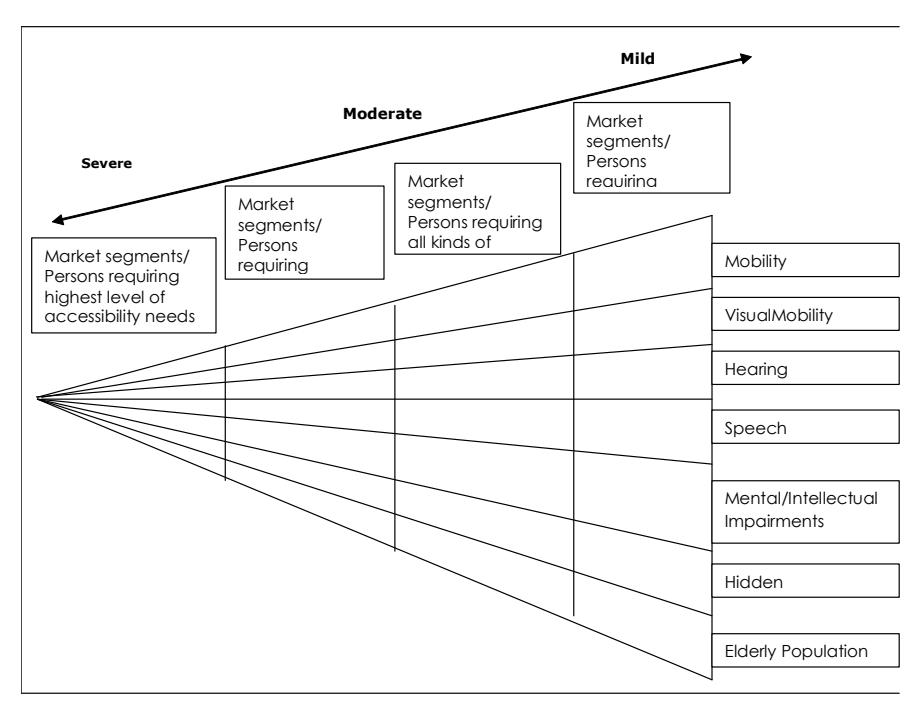
Figure 1. Pyramid of Demand Types: The Continuum of Abilities Adapted from Buhalis, Eichhorn, Michopoulou and Miller (2005)
THE PARADOX OF MARKETING TO THE PHYSICALLY CHALLENGED INDIVIDUALS
Why then the Paradox?
Despite the potential market size for physically challenged persons, several limitations can be identified that thwart the realization of the full potential of this market. These limitations require the Airlines industry to adopt a more proactive approach in addressing the needs of these physically challenged individuals. These include:
Inaccessible Facilities
Physically challenged individuals are often confronted with limited options or accessibility issues that drive them to put up with more expensive arrangements than the rest of the group. The United Nations Economic and Social Commission for Asia and the Pacific (2003) identified the major infrastructure limitations in aircrafts/airports. These problems consist of airport ground services, convenient drop-off points and ample support services within the airports (such as toilets/changing rooms, phones and autobank). To add on, wheelchair-bound travellers are often constraint in embarking and disembarking the aircraft, changing flights and accessibility of airplane restrooms. Locating and retrieving luggage becomes additional burden for the visually impaired. The long-haul travel in economy class seat for those with stiff limbs or arthritis, the sheer size of modern airports for those with mobility problems and endless forward planning for all are some of the challenges still facing travellers with disabilities.
Inadequate Training
It was established that travel and booking agencies and airline staffs were ill-prepared in rendering pre-booking assistance (The Department of Transport, 2006). Despite regulatory requirements of disability equality and training provisions for all personnel working at the airport, including those providing direct assistance to disabled people, professional and appropriate services were found to be inadequate. 37% surveyed had experienced problems with staff attitudes onboard planes (Laidler, 2007). While airlines have progressively added more user friendly services to the average travellers, some problems still persist from time to time, such as luggage misplacement and flight delays. These mishaps might seriously inconvenience travellers with disability, such as the damage and loss of wheelchairs on airplanes, leading to diminished propensity of travel altogether.
Incomplete Information
A consequence of inadequate training of employees and airline staffs, airline websites rarely provide sufficient information for disabled customers. To make matters worse, disabled customers hardly ever were allowed to book assistance online. In order to have companions such as caregivers, these individuals often have to make many concessions in terms of destination, time, and date of the travels (Yau, McKercher and Packer, 2004). The ability of travel agents in serving the disabled customers is compromised by poor, inaccurate or incomplete information. McKercher, Packer, Yau and Lam (2003) point out three main factors contributing to the general lack of information. Firstly, many travel agents do not understand the specialized needs of physically challenged individuals. Secondly, the general lack of product knowledge and lastly the limited information provided by the airlines themselves.
Inconsistent policies
Governments need to standardize and update the policies on accessibility in air travel, as evidence shows that it has failed to have enough positive impact on the experiences of disabled people, and that the air industry has not always fully complied with the guidelines. Given existing DDA specifications on equality treatments for disabled persons, inclusion of DDA specifications into aircraft designs should be mandatory. The Civil Aviation Conference of different regions would be required to play a proactive role than merely providing recommendations on the design of aircraft. This is an area that requires continued pressure to ensure the industry makes significant changes in
SHAFIQUR RAHMAN & KEITH NG
the near future (Laidler, 2007). Governments will therefore need to update the voluntary code of practice on accessibility in air travel as current practices lack credible legislative power due to low enforcement.
CONCLUSION
While the Disability Discrimination Act (DDA) and the United Nations charter stipulate the protection of all physically challenged individuals from unfair and unfavourable treatment, there are still many airlines that discriminate these persons (United Nations Economic and Social Commission of Asia and the Pacific, 2000). Some of these reasons may due largely to ignorance of the needs of such disable persons and the lack of proper infrastructure to cater this market segment. Given that disability affects 15-20% of every country's population, not meeting the needs of these physically challenged individuals is myopic. It is thus imperative that Airlines and tourism industry do more to address and accommodate those needs target this growing market for sustainable competitive advantage in the long run.