

INTRODUCTION
China has become one of the important tourist destinations as a result of the rapid development in its tourism industry. NTAC (2004) calculated that China received 91.66 million inbound tourists in 2003 and earned US$17.41 billion, which is 12 percent of the world's total tourism receipts. In addition, the domestic tourism of China keeps growing and the number of total domestic tourists reached 0.87 billion in 2003. NBSC (2004) reported that the direct output of Chinese tourism industry accounted for 6.5 percent of the GDP in 2003. The information reveals that tourism has undoubtedly become a major industry in China.
Shanghai is an industrial province of China located 31'14' north latitude and 121'29' east longitude. The total land area of Shanghai is 6,340.5 square kilometres including three islands Chongming, Changxing and Hengsha. Shanghai plays an important role in China's socio-economic development. Shanghai's tourism industry has been developed quickly in the last two decades. Shanghai has become one of the world's most important tourist destinations. NTAC (2005) reports that Shanghai received about 5 million inbound tourists and earned foreign exchange of US$ 3.0 billion in 2004. The direct output of the
Address correspondence to Dr. Mohammad Samaun Safa, Department of Economics, Faculty of Business Management, UiTM. Email: dearsafa@gmail.com
tourism industry accounted for 18.79 percent of Shanghai's GDP in 2004 NTAC (2004). In contrast, the total domestic trips reached US$ 16.34 billion in 2004. Hare (1994) reported that initially the Shanghai government only focused on international tourism while domestic tourism was less focused and affected by political issues. Afterward the Shanghai government realized that although international tourism can bring considerable foreign exchange, it is fragile having influenced by political and economic environment. No matter international or domestic tourism, Shanghai tourism seems growing fast and contributing to the national income. Since it is a growing industry, a set of questions- what is the present development of Shanghai tourism industry? Does it really contribute to Shanghai's economic development? - required to be answered to examine the potential macroeconomic variables and the trend of contribution. Thus, the present study attempted to respond to the above questions by analyzing the issues such as contribution to the national income, national tourism policy, tourism activities and so on. The study of these variables put some light on further development of the industry. Besides, the main component of tourism industry- tourist and number of visit – has been emphasized to develop necessary supportive policies.
The study initially discusses the relevant literature that shows the contribution of tourism to national development followed by a method section in which the tools discussed that used to reach a conclusion on the contributions of Shanghai's tourism industry. A results and discussion section is followed by a brief discussion on policy and recommendation at the end.
LITERATURE REVIEW
Benefits of International and Domestic Tourism
The development of tourism has become an important means to earn foreign exchange for many countries. Cooper et. al. (2005) stated that tourism is a service industry, comprising a number of tangible and intangible components. The tangible elements include transport systems - air, rail, road; hospitality services - accommodation, foods and beverages; and related services such as banking, insurance and safety and security. The intangible elements include rest and relaxation, culture, escape, adventure, new and different experiences.
International tourism provides greater opportunities for tourists to know about different cultures and physical environment of other countries (Var and Ap, 1998). Tourism provides an opportunity to exchange cultural elements and traditional thoughts and ideas along with the new one across the boundaries of nations and groups. Tourism also can bring people into contact with each other and explore the socio-cultural relationships between hosts and guests (Satani, 2003). In addition to this, socio-cultural exchange, international tourism has a wide range of positive impacts on the economic spectrum. Pearce (1991) classified the socio-economic impacts as the benefits of international tourism on national or regional economy as balance of payment, regional development and diversification of the economy, government revenue and employment opportunities. Tourism could contribute directly to sales, profits, jobs, tax revenues, and income in the primary tourism sectors such as hotel, restaurant and transportation industries (Satani, 2003). International tourism can increase foreign exchange earnings and contribute to government revenues because tourists' consumption and the import and export of related goods and services generate revenue to the economy of a host country and promote further investment.
World Travel and Tourism Council reported that tourism also could affect most sectors of the economy through the changes in economic activity from subsequent rounds of re-spending of tourism money. Host country is also benefited by the infrastructures and services such as airports, better roads, hotels and restaurants developed for tourism. Consequently, the development initiatives improve the quality of life that leads to improvement in living standard. A study on the tourism industry of 15 developing countries conducted by Brohman (1996) reported that tourism facilitates the process of poverty alleviation and income distribution, too. Tourism also benefits the expansion of non-traded commodities that are usually not exported. Tourists from the developed country who are relatively rich travel various places including less developed countries. Since tourists commonly consume goods that are not traded internationally, an expansion of tourism is equivalent to an increase in the exports of the non-traded goods (Chi 2005). On the other hand, domestic tourism can make a significant contribution in promoting regional economic growth, improving local economic structures, driving the development of related industries, enhancing employment opportunities and activating domestic demands.
Generally, the development of tourism begins with the development of domestic tourism. In this regard World Tourism Organization (2005) reports that the proportion of domestic tourists to the total tourists which is expected to be 90 percent is very vital for sustainable tourism development. The report also gave several examples, in the U.S the proportion of inbound tourists person-times to total tourists person-times was 1 percent; in U.K the proportion was around 1.2 percent. Generally, the instability of economy and politics has negative influence on international tourism. In the event of uncertainties, domestic tourism can regulate and remedy the low utilization ratio of tourism facilities. Thus, benefit from domestic tourism is a considerable issue in tourism industry.
Impacts of Tourism on Macroeconomic Variables
The economic impacts of tourism have been recognised by many countries. Dwyer et. al. (2004) analysed how a change in the tourism sector will impact the overall economic activities and related aspects of the economy. The economic benefits as well as resource constraints and drawbacks are recognized in the study. A boom in tourism may bring some benefits, such as foreign exchange earnings, employment opportunities for the locals, improve the infrastructure of the country and so forth. But at the same time, it also may cause shortage on resources, which may limit production. Flourishing inbound tourism also may forbid the development of other export industries since the demand for the home currency increases. Although tourism creates jobs for local workforce, the increase of demand for any particular skilled labour may lead to the increase in wage.
In most countries, tourism is an important source of employment, especially for the less educated and unskilled labour force. Tourism directly and indirectly generates and supports 214 million jobs globally reported by the WTTC. This is equivalent to 8.1 percent of the world's workforce and is forecast to rise to over 259 million jobs in 2014 (WTTC, 2004).Tourism is a labour-intensive industry that needs many personal services, thus it can provide an effective means of generating employment opportunities and the local destination would benefit from the employment created by tourism. After analyzing the tourism atmosphere in Malaysia, Basiron (1994) reported that tourism has heavily influenced the employment of indirect-related industry such as restaurants, handicrafts, taxis and car hiring company. However, Cooper et. al. (2005) argued that the contribution of tourism to long-run development might be questionable. Overdeveloped tourism may result in reverse effects. For example, the tourism facilities and infrastructure could not match the steep rise in tourists leading to some pollution problems.
METHODOLOGY
Secondary data have been used in this study to examine the growth in the variables affected by the tourism activities in Shanghai. There are 9 variables have been included to examine namely 'tourism
receipt', ' domestic tourist arrival', 'international tourist arrival', 'foreign exchange earning from the international tourism', 'income of domestic tourism', 'per capita tourism expenditure,' 'ratio of employment in total labour force', 'change in accommodation' and 'number of travel agencies'. The relevant information on the variables was collected for the year 2001-2004 from the National Bureau of Statistics of China and Bureau of Statistics of Shanghai. Figure 1 shows the map of China indicating Shanghai.
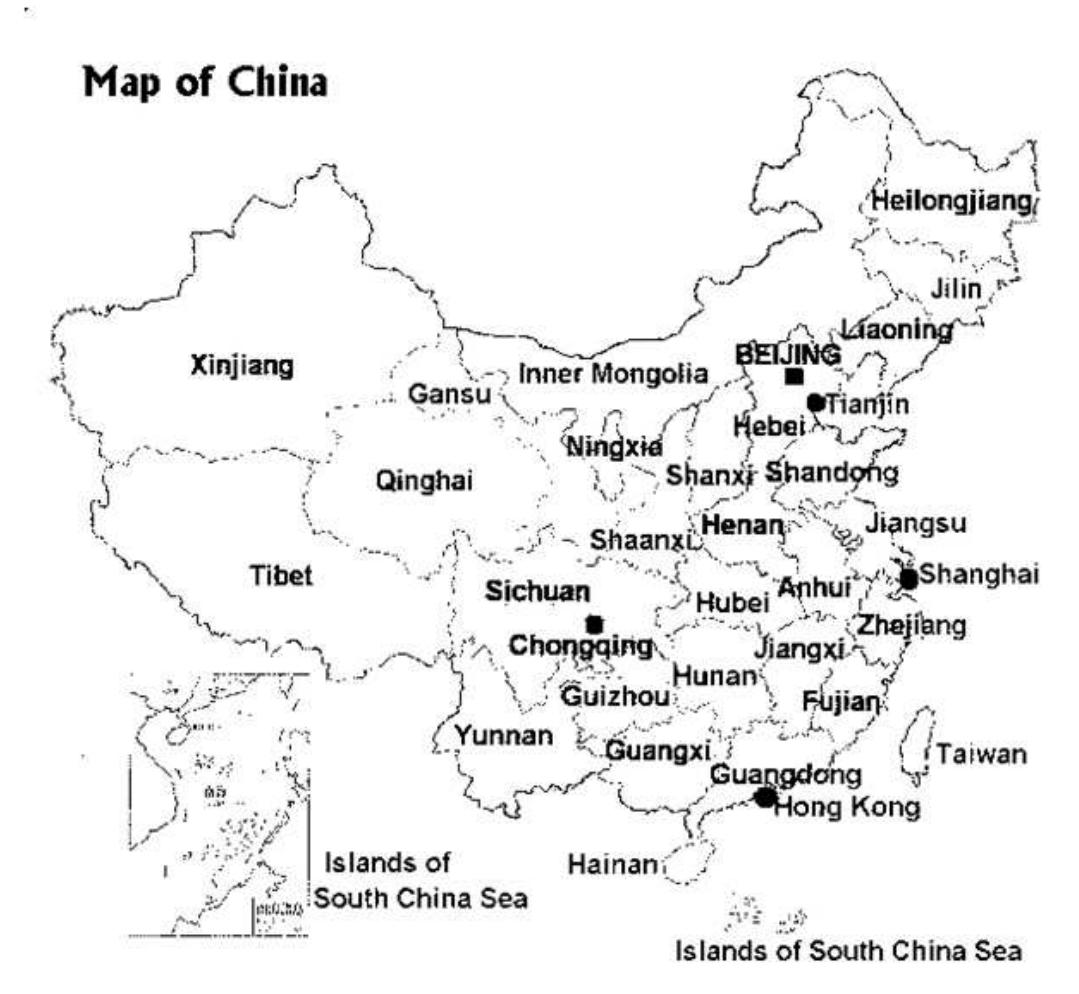
Figure 1. Map of China (pointed area is Shanghai)
In order to evaluate the growth of the variables of Shanghai tourism industry, percentage change between two subsequent years has been calculated for the five-year period of time. In some cases the contribution of a variable on total receipt has been considered for more synthesis. The following formula has been used to generate some further information to articulate a better picture of development trend.
- (1) Total tourist arrivals = domestic tourist arrivals of Shanghai + international tourist arrivals of Shanghai
- (2) Total tourism receipts = foreign exchange earnings from international tourism + domestic tourism income
- (3) The proportion of total tourism receipts to GDP = total tourism receipts/GDP
- (4) The contribution of tourism industry to employment = manpower in tourism industry/ total manpower of Shanghai
RESULTS AND DISCUSSION
Development of New Types of Tourism in Shanghai
In order to attract more domestic and foreign tourists the Shanghai government has launched five new types of tourism namely industrial tourism, sports tourism, agricultural tourism, festival tourism and meeting tourism. Industrial tourism is a special tourism product which main attraction is the exploration of corporate culture and advanced technology. Presently, the main tour scene spots of industrial tourism are "Bao Gang", "GM" and other twenty industry-related museums in Shanghai. 'Bao Gang' is the largest steel industry in China, where tourists can experience the process of steel making. "GM" is one of the largest joint venture automobile manufacturers of Shanghai, where tourists can visit the most advanced assembly line in the world. Industrial tourism not only earns profit from tickets and souvenirs but also increases the reputation of these corporate organizations. Holding international meeting is another type of fast growing tourism. According to the BSS (2005), in 2003 Shanghai held 202 international meetings and exhibitions, and in 2004 the figure raised to 348. In 2002, APEC was the most important international conference held, which not only increased the amount of tourists but also raised the reputation of Shanghai in the world.
Contributions of Tourism Activities to Shanghai Economy
In order to examine the contribution of tourism industry to Shanghai economy, the proportion of tourism receipts to Gross Domestic Production (GDP) of Shanghai was analysed. Table 1 shows the tourism receipts and GDP of Shanghai, the proportion of tourism receipts to GDP, and the growth rate for the year 2000 to 2004. The average growth of GDP was 13 percent for these five years. The growth was highest in 2002 and lowest in 2003 because of SARS. The total tourism receipts was US$ 11 billion in 2000 that increased up to US$ 17.78 billion in 2004 showing a steady growth in tourism industry. Over these five years the proportion of tourism receipts to GDP was about 20 percent and almost uniform that shows the stability of Shanghai tourism industry. The tourism receipts of Shanghai contributed to about one-fifth GDP of Shanghai which indicates that tourism is one of the vital industries of Shanghai.
Table 1. Contribution of Tourism Industry to GDP of Shanghai
| Year | Tourism Receipts | GDP of Shanghai | Tourism Receipts/GDP | ||||
|---|---|---|---|---|---|---|---|
| RMB (Billion) | Change* (%) | RMB (Billion) | Change* (%) | (%) | Change* (%) | ||
| 2000 | 90.86 | - | 455.12 | - | 19.96 | - | |
| 2001 | 95.73 | 5.35 | 495.08 | 8.81 | 19.34 | -3.11 | |
| 2002 | 118.26 | 23.54 | 540.88 | 9.25 | 21.86 | 13.03 | |
| 2003 | 125.02 | 5.72 | 625.08 | 15.57 | 20.00 | -8.51 | |
| 2004 | 147.18 | 17.73 | 745.03 | 19.19 | 19.75 | -1.25 | |
| Mean | 115.41 | 13.09 | 572.24 | 13.21 | 20.18 | 0.04 | |
Source: BSS, 2005
Development of Tourism Industry
Table 2 shows that the number of domestic tourists increased from 78480 thousand in year 2000 to 85050 thousand in 2004. The average number of tourist over this period was 81944 thousand. In these five yeas there was a positive growth in the number of domestic tourist except in 2003. The negative growth of 2003 was caused by SARS. Number of tourists increased by 11.86 percent from the SARS affected year to the following year. It seems that the recovery in getting the domestic tourism industry back to its normal condition was very prompt and successful.
The number of international tourists increased from 1814 thousand people in 2000 to 4919 thousand people in 2004, which was at a total growth rate of 171.17 percent. The total number of tourists was also increased by 12.05 percent in 2004 than that of 2000. The information shows that there was a great fall in number of outbound tourists in 2003 that caused by the same incident of SARS. In 2004 the impact of SARC was recovered and number of outbound tourists reached at a reasonable status again.
The table shows that Shanghai's tourism industry experienced a stable growth from 2000 to 2002; the average annual rate of increase was about 6 percent. But in 2003, due to the impact of SARS, Shanghai's inbound and outbound tourism experienced an abrupt decrease. The number of total tourist (inbound and outbound) decreased by 13.22 percent. The growth of Shanghai's domestic tourism in 2004 reached 11.86 percent compared with that of 2003. The international tourist arrivals to Shanghai achieved 4919 thousand people in 2004, increased by 101.02 percent over year 2003. The restoration was benefited by the government and whole tourism industry took a series of recovery measures. For example, the Shanghai government launched various activities to promote Shanghai as a tourism destination in several countries such as Japan, New Zealand, and USA after the World Health Organisation removed China from its list of SARS-infected areas in June 2003.
Table 2. Tourist Arrivals and Change in 2000 -2004
| Year | Domestic Tourist Arrivals of Shanghai | International Tourist Arrivals of Shanghai | Total Tourist Arrivals | |||
|---|---|---|---|---|---|---|
| Tourist Arrivals ('000) | Changes (%) | Tourist Arrivals ('000) | Changes (%) | Tourist Arrivals ('000) | Changes (%) | |
| 2000 | 78480 | - | 1814 | - | 80294 | - |
| 2001 | 82550 | 5.19 | 2042 | 12.57 | 84592 | 5.35 |
| 2002 | 87610 | 6.13 | 2725 | 33.45 | 90335 | 6.79 |
| 2003 | 76030 | -13.22 | 2447 | -10.2 | 78477 | -13.13 |
| 2004 | 85050 | 11.86 | 4919 | 101.02 | 89969 | 14.64 |
| Mean | 81944 | 2.49 | 2875 | 34.21 | 84733 | 3.41 |
Source: BSS, 2005
Table 3 shows that the foreign exchange earnings obtained from tourism industry increased from US$1.61 billion in 2000 to US$3.09 billion in 2004, the rate of total increase was 91.51 percent from 2000 to 2004. The table also indicates that the income of domestic tourism increased from US$ 9.37 billion to US$14.67 billion from 2000 to 2004. The average increase rate was 11.39 percent during the five years.
Table 3 also reveals that the ratio of domestic tourism income in international tourism income of Shanghai was 5.81 times in 2000 and it decreased in 2001 and 2002. In 2003, the inbound tourism has suffered from the serious impact of SARS, the receipts of inbound tourism dropped widely. As a result, the ratio of domestic tourism income in international tourism income rose up to 6.36 times dramatically. In 2004, the ratio decreased to 4.76 times. During the five years, the ratio could not reach the international normal ratio of 8 times. It shows that the performance of Shanghai's domestic tourism did not achieve the international standard.
Table 3. Ratio of Domestic Tourism Income in International Tourism Income
| Year | Foreign Exchange Earnings from International Tourism | Domestic Tourism Income | Domestic Tourism Income / International Tourism Income | |||
|---|---|---|---|---|---|---|
| (US$-Billion) | Change (%) | (US$-Billion) | Change (%) | Times | ||
| 2000 | 1.61 | - | 9.37 | - | 5.81 | |
| 2001 | 1.81 | 12.08 | 9.74 | 3.97 | 5.39 | |
| 2002 | 2.28 | 25.83 | 12.02 | 23.34 | 5.28 | |
| 2003 | 2.05 | -9.76 | 13.06 | 8.65 | 6.36 | |
| 2004 | 3.09 | 50.47 | 14.71 | 12.64 | 4.76 | |
| Mean | 2.17 | 19.66 | 11.78 | 12.15 | 5.52 | |
Source: BSS, 2005
Table 4 shows the tourism expenditure generated by inbound tourists in shanghai. The average tourism expenditure of inbound tourist was US$ 889.96 in 2000, and the amount decreased progressively in the following two years. The tourism expenditure of inbound tourists in 2003 reached US$839.06, only raised 0.48 percent compared with the year 2002.
Table 4. Changes in Inbound Tourists' Tourism Expenditure in Shanghai
| Year | Tourism Expenditure per Capita (US$) | Change (%) |
|---|---|---|
| 2000 | 890 | - |
| 2001 | 885 | -0.56 |
| 2002 | 835 | -5.65 |
| 2003 | 839 | 0.48 |
| Mean | 862 | -1.91 |
Source: BSS, 2005
Table 5 shows the per capita expenditure of domestic tourist in Shanghai. The tourism expenditure per capita was US$ 150.91 in 2000. In 2003, the amount of expenditure was increased by 29.19 percent and reached the peak over the five years. The possible reason behind the high growth may be the various 2004, the employment increased further up to 2.98 percent. During the five years, the number of people who employed in tourism industry increased from 118604 in 2000 to 249452 in 2004.
Table 5. Expenditure of Domestic Tourists in Shanghai
| Year | Tourism Expenditure per Capita (RMB) | Change (%) |
|---|---|---|
| 2000 | 150.91 | - |
| 2001 | 147.88 | -2.00 |
| 2002 | 137.12 | -7.28 |
| 2003 | 177.15 | 29.19 |
| 2004 | 172.91 | -2.39 |
| Mean | 157.19 | 4.38 |
Source: BSS, 2005
Employment of Tourism Industry
Tourism industry is a labour-intensive industry. With the repaid growth of tourism activities the industry has provided a wide range of employment opportunities for Shanghai's labour market in the studied period. In terms of the contribution of employment opportunities, food and beverage industry, travel operating business and hotel industry which are supportive industry for tourism were the main employment generating entity for the Shanghai labour market.
Table 6 shows that the total labour force of Shanghai was 7452400 of which 118604 (1.59 percent of the total labour force) worked in tourism industry in 2000. In the following two years, the ratio did not change widely because the total manpower and the number of people who employed in tourism industry were climbing at the same speed. In 2003, the tourism industry achieved the level of labour force of 190485 and increased up to 2.34 percent. In 2004, the employment increased further up to 2.98 percent. During the five years, the number of people who employed in tourism industry increased from 118604 in 2000 to 249452 in 2004.
Table 6. Ratio of Employment in Tourism Industry to Total Employment of Shanghai
| Item | 2000 | 2001 | 2002 | 2003 | 2004 |
|---|---|---|---|---|---|
| No. of labour in tourism industry | 118604 | 120490 | 125667 | 190485 | 249452 |
| No. of total labour in Shanghai | 7452400 | 7522600 | 7920400 | 8130500 | 8368700 |
| Labour in tourism industry / | 1.59 | 1.6 | 1.59 | 2.34 | 2.98 |
| total tmployment (%) |
Source: BSS, 2005
The Development of Related Industry
The growth of tourism industry created excellent opportunities for the supportive industries such as hotel, travel, food and beverage industry. The supportive industries generated additional income and employment to the shanghai economy with the main benefit of tourism industry.
There are various types of hotels in Shanghai with the sole purpose of satisfying tourists' various wants and needs. Table 7 shows that in 2004, the supplies of accommodation were 114900, increased by 9.95 percent compared with the year 2001. Mostly, the increase of rooms was caused by the optimistic anticipation for the future development of Shanghai tourism industry. For example, the MICE (Meeting, Incentive, Conventions, and Exhibitions) is a latest and synthesized tourism that include the arrangement of exhibitions, expositions, trade fairs, seminars, culture and sport events and so on. An estimate showed (BSS, 2005), there were 202 various international conventions held in shanghai in 2003 which reached a number of 348 in 2004. The rate of increase in MICE was 72 percent over these two years. Such huge international summits pushed the development of Shanghai hotel industry especially for those luxurious hotels. One of the norms that could be used to evaluate the performance of the hotel industry is the rate of room occupancy. According to Table 7, in 2001, the room occupancy rate was 56.1 percent. In the following year, the rate climbed up to 62.1 percent. However, in 2003, the rate dropped to 57.2 percent because of the impact of SARS. But the fall did not last for a long time and recovered in the following year by raising rate of occupancy up to 62.9 percent. The total revenue also increased 37.75 percent compared with that of 2001. The growth of hotel industry insisted Chinese government to welcome foreign investors to introduce their advanced management skill and modern facilities to local hotel industry as if local hotel industry could be able to compete with the international standard.
Table 7. Changes in the Supply of Hotel Rooms and Room Occupancy in Shanghai (2001-2004)
| Year | No. of Rooms | Changes (%) | Rate of Room Occupancy (%) | Changes (%) |
|---|---|---|---|---|
| 2001 | 104500 | - | 56.1 | - |
| 2002 | 106400 | 1.82% | 62.1 | 10.70% |
| 2003 | 115400 | 8.46% | 57.2 | -7.89% |
| 2004 | Source: BSS, 2005 114900 | -0.43% | 62.9 | 9.97% |
| Mean | 110300 | 0.032833 | 59.575 | 0.0426 |
Travel agencies are one of the main sources of generating income for the tourism industry. Generally, travel agencies are responsible for gripping some activities related to tourism such as booking accommodation, arranging transportation and organizing trip for local and foreign tourists. In other words, travel agencies are the intermediaries between hotels, transportation industry, entertainment businesses, and other direct and indirect related industry and tourists.
Table 8 shows that there were 548 tour agencies in 2001, which entertained 974.2 inbound tourists and 3027.2 domestic tourists. In 2003, the number of travel agencies increased to 588, but the total tourists received decreased by 1059.2 thousand person/times compared with the year 2002. The decrease was caused by the blast of SARS, and which also brought US$ 3.39 million deficits for Shanghai tourism agencies. Fortunately, after removal of China's name from the list of SARS affected country by the World Health Organization and lifted the travel advisory against China, the number of domestic tourists received by tourism agencies reached the peak in 2004 over the five years. And the total profit also broke the records achieving US$ 21.89 million. However, the number of inbound tourists still could not keep up with the performance of year 2002 and year 2001 although it made a quick recovery.
Table 8. Impact on Tourism Business
| Year | No. of | Travel Agency | No. of tourists received by Travel Agency ('000) | |||||
|---|---|---|---|---|---|---|---|---|
| No. | Changes (%) | Domestic Tourist Inbound Touri | Total | Changes in (%) | ||||
| 2001 | 548 | - | 3027.2 | 974.2 | 4001.4 | - | ||
| 2002 | 541 | -1.28 | 4093.9 | 1283.7 | 5377.6 | 34.39 | ||
| 2003 | 588 | 8.69 | 3803.6 | 514.8 | 4318.4 | -19.7 | ||
| 2004 | 678 | 15.31 | 5550.7 | 784 | 6334.7 | 46.69 | ||
| Mean | 588 | 7.57 | 4118.85 | 889.18 | 5008.03 | 20.46 | ||
Source: BSS, 2005
OVERALL PICTURE OF DEVELOPMENTS IN SHANGHAI TOURISM
Figure 2 shows the indicators namely 'Tourism Receipt', 'Domestic Tourists Arrival', 'International Tourists Arrival', 'Foreign Exchange earning from International Tourists', 'Income from Domestic Tourism', 'Per Capita Expenditure on Tourism', 'Employment in Tourism over Total Labor Force', 'Change in Hotel Accommodation', Number of Travel Agent' together. In 2001 the contribution of shanghai tourism was comparatively lower than that of 2004. In 2003, there was a fall in every activities related to tourism. But in 2004, the industry recovered and reached a steady growth. Among these five years (2000-2004) 2004 shows the highest achievement in all variables.
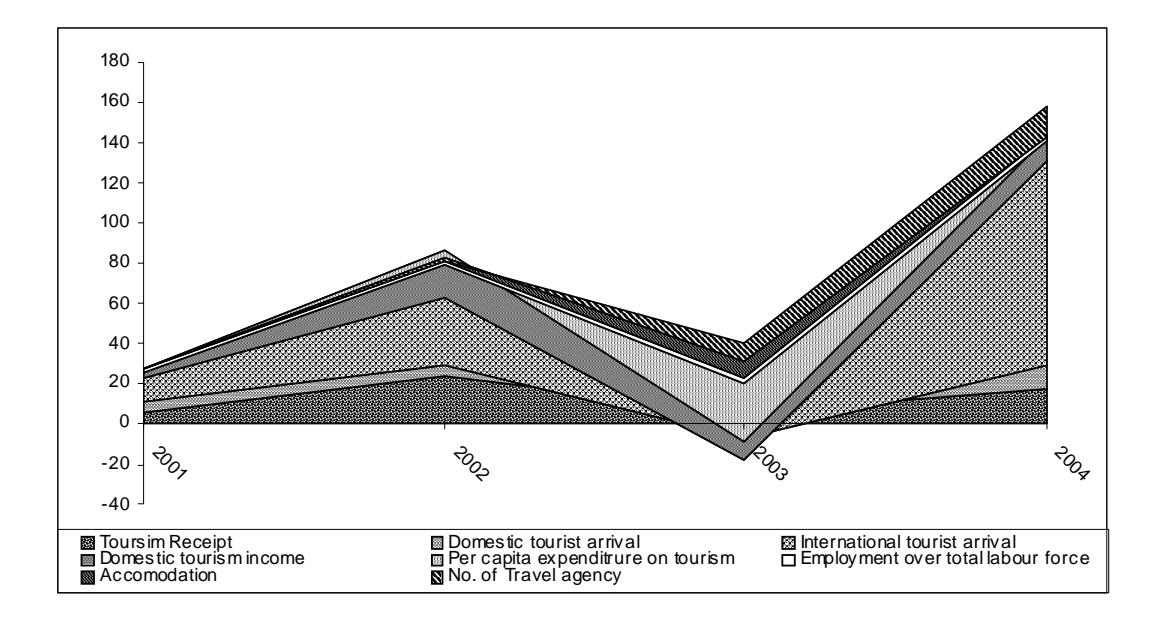
Figure 2. Comparative Growth in Different Variables of Tourism
CONCLUDING COMMENTS
With the emergence of open-door policies and concept of globalization national boundaries have been liberal for facilitating economic activities such as international trade and tourism. Tourism is in the vanguard of this trend involving the international movement of people, international payments, and cross-fertilization of culture. The findings of the present study showed that the tourism industry has not just only played an important role to stimulate the economic growth but also placed Shanghai at an international position in the world.
The tourism industry contributed to the economic development of Shanghai substantially. The proportion of the tourism receipts to Shanghai's GDP maintained the level of 20 percent during 2000 to 2004, which indicated that the growth pace of tourism industry was stable and sustained. The developments of tourism industry in shanghai also generated employment opportunity as well as boosted other supportive industry. In terms of both tourism receipts and tourist arrivals, there was a high-speed progress over this five-year period time except year 2003. The increase in supply of accommodation and the raise of room occupancy rate in Shanghai hotel industry also indicated the brisk growth of tourism industry. Although the foreign exchange earnings kept increasing over 2000 to 2004, it was due to the contribution of increase in the number of foreign tourists. However, these foreign tourists did not expand their expenditure during the days of stay in Shanghai. On the other hand, the rise of income of domestic tourism was contributed not only by the increase of the number of domestic tourist arrivals but also the gain in expenditure per capita. Based on the findings of the study, the following recommendations have been made:
- a) Shanghai government should implement diversified strategies to expand its international tourism market as well as domestic market. New types of tourism should be launched to attract various tourists
- b) Increasing the number of days of stay in Shanghai and to encouraging tourists loyalty to revisit Shanghai are the two efficient and effective way to expand the tourism income should be emphasized by the national tourism authority
- c) The tourism infrastructure should be improved to satisfy rapid growth of tourists' demand. The goods and services and facilities should be provided by all parties of tourism industry as well as other related industries.
- d) Since Shanghai lacks of natural resources, tourism authority is required to take some initiatives to develop some resorts. In order to increase the service quality Shanghai tourist authority should introduce modern architecture in building works.