

INTRODUCTION
Cultural heritage protection is a key issue around the world today (Salazar and Marques, 2005). Based on the practice of the Qing-an and An-lan Hall Project, this paper explores the technologies and methods of protection and remedy for historic buildings according to two principles of minimal intervention and maximum authenticity. Firstly, the so-called authenticity emphasizes on preserving the valuable historical information from architectural heritage, including its initial conditions and subsequent remedy (Zhou, 2001; Ruan et.al, 2008). Secondly, the principle of minimum intervention emphasizes on no any adding unless they would not debase its relevant parts, traditional layout, spatial balance and relationships with the surroundings (Chen, 2006). In fact, the principle of minimum intervention is a reflection of the authenticity in a specific practice that can ensure maximum authenticity.
Traditional architecture is a microcosm of the history. It reflects the life, environmental, economic and social development of the times. It's an important carrier for people to understand the history and traditional culture. However, with the time eroding, ancient buildings are destroyed with human and natural factors. The process which based on minimal intervention and maximum authenticity repaired with technology, materials and other aspects of ancient buildings in accordance with their own situation. It can protect original appearance and features of traditional architecture in greatest degree. Meanwhile, it can make traditional architecture become a sign during the city's cultural development, image building project. Based on the two principles, this paper made a scientific analysis on the concrete remedy and
Address correspondence to Shi Jianren: College of Tourism and Urban Administration, Zhejiang Gongshang University, Xia-Sha, Hangzhou 310018, China. Phone:+86-13858156678. Fax:+86-571-28008571. Email: jrshi2002@163.com.
protection project of Qing-an and An-lan Hall in the processes of carpentry engineering and masonry engineering.
THE GENERAL INFORMATION OF QING-AN AND AN-LAN HALL
Qing-an and An-lan Hall, also known as "Yong Dong Tian Hou Palace," is commonly called Matsu Temple in Taiwan and Fujian. It is located at the east of the estuary of Fenghua River, Yong River and Yuyao River. Qing-an and An-lan Hall is a religious palace and a place for businessmen who are sailing on the sea to gather and entertain (Figure 1, Figure 2).
Figure1. Status quo of the Hall Source: Taken by Team Members of Research Program
Figure 2. Remedy Plane of Ningbo Qing-an and An-lan Hall
Qing-an and An-lan Hall is a wooden structure building with a rectangle plane layout, covering an area of 5,000 m<sup>2</sup>. The whole building stretches from east to west and mainly consists of screen wall, water pavilion, palace gate, ceremonial gate (with stage), main hall (with stage), rear palace, side rooms, auxiliary rooms and managers' residences. The palace gate has three bays (notes: Bay denotes the standard width of a room in an old-style house about 10 chi, the length of a purlin) with a flush gable roof. Its horse-head walls are on the north and south sides, and some decorative patterns of two dragons with a pearl are carved on both sidewalls. A horizontal inscribed board with a logo "Tian Hou Palace" hangs on the middle of the gate building. On both sides of it, numerous patterns of figures, flowers and beasts are engraved. The ceremonial gate has five bays with a double gabled roof and a stage. The main hall is the theme building, which has five bays and a gabled roof. A pair of curling dragon pillars in the center bay and a pair of phoenix-peony pillars in the lateral bays are more than four meters high, and have exquisitely carved pillar base of orange shape. The frontal hall has horse-head walls, each of which containing a 1.5 meters high and wide bass-relief where landscape of Hangzhou and ten sceneries of the West Lake are carved. In front of the walls, there is an eight-character screen and plum stones. The stage behind the main hall has a double gable and hip roof covered by pan tiles. Its ceiling is decorated with raoluo caisson, which is commonly known as the "cage-top" style. Meanwhile, its beams and architraves are decorated with red golden wooden carvings. The rear palace is of flush gable roof style, and has horse-head walls. Originally, there are Buddha statues placed both upstairs and downstairs. Annual conferences of trade and industry are usually held upstairs. Side rooms are located at the east and the west. The water pavilion has been destroyed.
The traditionally architectural decoration techniques include red wooden carving, brick carving and stone carving. These are the greatest features of the buildings, which make the building splendid and magnificent. Meanwhile, the building witnesses the maritime traffic history of ancient China. An-Qing Hall not only advanced to the development, harmony and benefits of the merchant fleet, but also promoted the maritime trade and exchange in Ningbo City.
CARPENTRY ENGINEERING
Wooden frame construction system, which is unique in China, was formed out of 5000 years of Chinese natural and cultural phenomena as well as the ancient architectural feature, structure and art. As the key to traditional Chinese wooden frame construction, wood has different functions when acting as different parts. For instance, it constitutes the buildings' load-bearing beams system when acting as pillars, beams and purlins. However, when acting as windows, doors and sashes, it becomes decorative elements implying national culture. Qing-an and An-lan Hall is a typical building of Qing Dynasty, and its wooden structure and decorative feature reflect the excellent culture, science and technology of ancient human society. However, after long-playing impact due to natural and man-made factors, its wood components encounter varying degrees of decay and damage such as deformation, subsidence, splitting, skew, tenons dislocation and beams rolling caused by overload and loosened mortise and tenon joints. Therefore, it is necessary and urgent to do the carpentry remedy of the historical ancient buildings. The remedy should be done according to their authenticity, and measures should be taken to ensure fire prevention, pest control and other protective processes.
Remedy of Roof Frame
Damages to ancient buildings are usually caused by wind, rain, war, human and other factors as history changes. In severe cases, such as the east part of Qing-an and An-lan Hall, the roofs
have collapsed. As to the less severe cases, such as the second lateral bays' roof and the vertical roof frame, most parts are decayed. Also the roof's leaking has caused the decay of rafter eaves (Figure 3).Through observation and study, the damage extent is so large that we have to combine the building with lifting beam brick-wood structure to ensure its safety. This structure requires main beams, on which short pillars hold up secondary beams, to hold up purlins during the construction. And secondary beams, on which short pillars hold up tertiary beams, hold up secondary purlins. The rest can be done in the same manner. Finally, ridge is held up by short pillars on tertiary beams.
Figure 3. Former Look of the Hall
Replace the ridge with three tiles drum roof of the same size, and entirely remedy the collapsed second lateral bay by making new hardwood purlins and cedarn rafters of 90cm diameter. Facing south, the building roofs are covered by small gray tiles. And their eaves are of a gentle slope, while their ridges are of a steep slope. Usage of large timber makes the roof looks beautiful, grand and decent (Figure 4).
Figure 4. Roof Upward View: (a) Internal Roof; (b) External Roof
Measurement of Tilted Beams
During the remedy of Qing-an and An-lan Hall, wood materials are reinforced, and also sophisticated methods are used to measure cultural heritage sites and buildings following the principle of minimal intervention so as to prevent the building continuing to tilt left. The detailed processes are as follows: use theodolite to ascertain orientation, and staking out "distance piles", the distance between which is less than a full foot long, according to the ascertained direction line; mark top of the piles with cross, and make sure the vertical line of the cross is parallel to the direction line, the horizontal line is perpendicular with the direction line and the intersection of the cross is located right at where the section spot is; respectively measure the distance between the distance piles, the elevation and the temperature of the piles' top with precision distance-measuring methods, and measure the final section after computed. Record foot length, temperature and calculate the tilt correction. Finally, take corresponding measures according to specific reasons to remedy the tilt.
To finish the entire remedy, several pillars should be remedied at the same time, and both directions should be remedied separately under normal circumstances. The so-called "metal hook connection" remedy is to relieve the load of components, to lift the wooden beam system, and to relocate them when the beam tilts, rolls or the tenons are loosened. Finally, a connecting board is usually added between the pillars' head and the architraves to prevent the potential skew.
Reinforcement of Tenons Loosened Wooden Components
Chinese traditional wooden structure often experiences deformation, subsidence, damage, splitting, skew, tenons dislocation and other phenomena caused by overload. And for this reason, Qing-an and An-lan Hall have experienced various tenons dislocation in places of penetrating ties, cornices, etc. Therefore, careful inspections and identifications should be done to establish appropriate reinforcements and trimming processes. To insure safety of new wooden components, the tenons should be large rather than small to fulfill the assembled specifications and fully meet the load demand. Meanwhile, the surface of the mortise and tenons should be rough enough to tenon tight.
Reinforcement of Pillars
As important components in a large wooden structure, pillars play a role of supporting beams, as is shown in Figure 5. Through many years' wet and dry factors, pillars, especially those wrapped in walls, are often split and decayed. Therefore, the pillars should be replaced, swapped or cast by chemical materials be reinforced according to different conditions. But for those can not be used any longer, they should be considered to do new ones. As the British art theorist John Ruskin said that "When it loose, use a metal hoop to hoop it up. Ugly as is looked, having a crutch is better than lost a leg" (Ruan and Li, 2008).
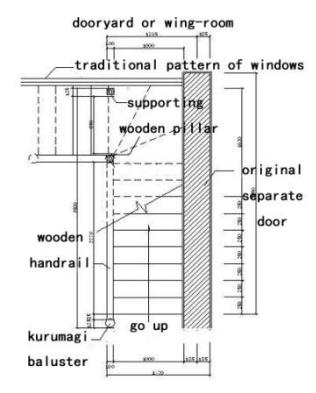
Figure 5. Typical Wooden Stair Plane
To ensure the security of heritage is the premise to continue its value. For those wooden buildings which are apt to be worm eaten, inflammable, yielding and decayed, they should firstly be reinforced to ensure their security. Otherwise the historical information and artistic value they carry will be missing if they collapse completely.
In the remedy of Qing-an and An-lan Hall, the piers connecting, replacement and reinforcement of minor worm eaten and decayed pillars should be done in different ways following the principles of minimal intervention and maximum retention. That is to say, for those thin pillars, nail them up with long nails and for those relatively thick ones, reinforce them with iron hoops which are flush with the pillars' surface when embedded in, and then fix them with wood screws. As for those thick pillars, hidden tenons should be made to prevent the sliding of the connected pillars, as is shown in Figure 6.
The connecting length of the pillars shall not exceed 1/3 of the pillars' height, as is shown in Figure 8. But for those pillars severely damaged and with security risks in the eastern part of the building, they should be replaced by new fir in order to ensure their safety. (Zhao et.al, 2005).
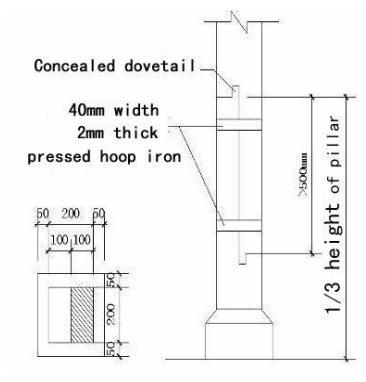
Figure 6. Sketch of the Pier
Treatment of cultural heritage should focus on its authenticity rather than its perfection. Apart from fully respect the original material, the remedy must be able to distinguish and identify the new components from the original ones. (Ruan and Li, 2008) Seen as part of the heritage, the remedied part will integrate into the historical information and will last with cultural heritage sites. Its recognition and the identity of the real information also well interpret the principle of authenticity.
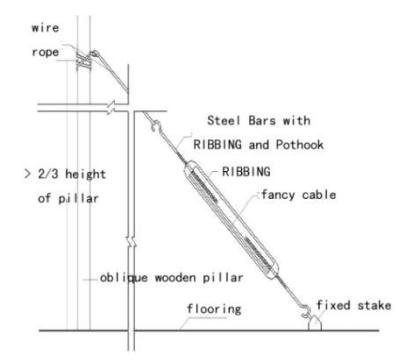
Figure 7. Sketch of the Timber Beam Frame
Remedy of Doors, Windows and Partition Doors
The remedy of doors and windows should be based on historical evidence. For those buildings still have sashes, the original sash style should be remained, and reinforcement, replacement and rework should be done in accordance with the damage extent of wood, mortise and tenon joints; For those which have missed sashes, the remedy of the missing doors and windows should be done referring to the surviving historic buildings or borrowing ideas from certified historic door and window examples in styles and size.
Through observation and study, it is confirmed that the original doors and windows of Qing-an and An-lan Hall site have missed. Thus, in order to recover and last the objective and real features of heritage buildings in history, society, science, technology and art, we should firstly take steps to excavate traces of the original details. Then use original technology to recreate the ancient hardwood wooden doors and windows basing on the historical records, among which six new ancient doors in size of 800cm * 2100cm and four ancient windows in size of 1200cm * 1500cm are to be made according to the two projects shown in Figure 8a. And the remedied door and window patterns are shown in Figure 8b. Take the construction technology of traditional window as an example: Template and staking-out → Production and assembly → wooden window frame installation → wooden window sashes installation → Painting.
- a. Template and staking-out: a plan of template and staking-out should be set out by experienced carpenter according to drawings of the ancient building, and high-quality dry wood should be reasonably selected.
- b. Production and assembly: high-level carpenters should be sent to do the processes such as sawing, planning and mortising in the carpentry workshop and to do the assembly according to the plan.
- c. Wooden window frame installation: install the wooden window frame around the reserved hole and do the anti-corrosion process in all junctions. Install the suspension wire and mark the elevation meeting the design requirements.
- d. Wooden window sash installation: When installing the sashes and sash glass, the glass should be fixed and marked as soon as it is located, and protection work should be done with the finished ones.
- e. Painting: paint the sashes and frames according to the design requirements, guarantee the high quality of painting to avoid peeling off, and ensure doors and windows well remain their ancient styles.
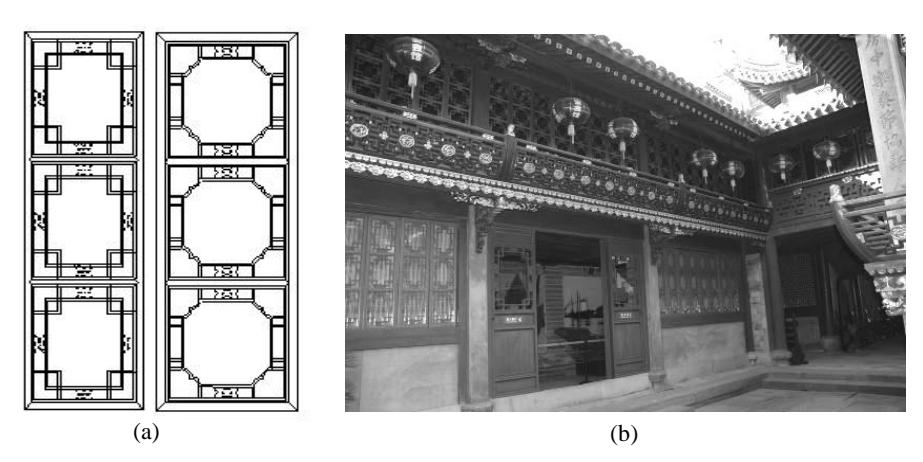
Figure 8. Doors & Windows: (a) Lantern Frame Style; (b)After Remedy
Material Selection and Wood Processing
In the remedy of cultural heritage sites, wood with no corruption, scars, worm-eat, discoloration, splitting and wound pattern are used when considering the cultural heritage sites quality and the integration with their original components. The position of huge wood must be labeled complying with the unified standard, and they should be clearly written on the phrase "Biao Zhu Li Pi." Design requirements, construction standards and "the original law of the creation" are needed in the wooden structure processing, and traditional style should be taken into consideration. Material Selection must be strict, design specifications must be controlled and repeatedly planed wood is needed to ensure its smooth surface and avoid irregular edges. Meanwhile, the wood must be dry in order to prevent the potential cracks. The tenon specification should be tight and large rather than small to fully meet the load demand while the mortise surface should be rough. Meanwhile, special attention should be paid to carrying, loading and unloading of wood to avoid damage. During the installation, the joint should be tight, horizontal and seated by numbers to assure that the elevation meets the requirements. The work should be done strictly following the bottom-up construction procedures, i.e. complete a process, accept a process and then process the next one. Measures, especially the prevention of ants at the mortise and the treatment of the antiseptic on wood component, concrete and brick interface, should be taken after the carpentry installation to prevent fire and ants, and to eliminate the two major public nuisances of the ancient wooden structure buildings.
MASONRY ENGINEERING
Most remedy measurements of major heritage buildings rely on masonry engineering, such as remedying the platform base, dismantling and building brick walls, uncovering and paving floors, overhauling roofs and so on. Like other remedy project of this ancient building, it is essential to remain its original architectural style and avoid mixing up different styles in different periods, especially to avoid it from blending the later architectural styles with the early ones.
Remedy of Collapsed Walls
Tilt, crisp base, bulging and cracks imply the damage of walls. According to the extent of damage, measures such as the optional renovation, partial dismantling, partial patch and plastering should be taken. For instance, as for the collapse of the eastern wall of Qing-an and An-lan Hall, its remedy should be done base on the principle of the authenticity. The remedy should be done referring to the style, size and masonry technology of the surviving walls. Figure 9 is the Collapsed Walls after Remedy.
During the wall remedy, dismantling and building project often plays a role in the following situations: first, suffer from the broken brick walls, the degree of skew is equal to or greater than 8 cm. Taking the condition of hollowing into account, the area of the partial hollowing is equal to or great than 2 square meters, and the extent of bulge is equal to or greater than 5 cm; the hollowing makes the wall become two layers; the degree of skew is equal to or greater than 4 cm with crack accompanied; the thickness of lower and humid alkali is equal to or greater than 1/3 thickness of the wall; the width of crack is equal to 3 cm, while considering the cause of damage; second, suffer from the whole brick walls, the degree of skew is equal to or greater than 1/6 thickness or 1/10 height of the wall; the degree of brick sagging is equal to 1/10 length of the wall's span or the width of crack is greater than 0.5 cm. Other situations are the same with broken brick walls.
As for the walls of the building, as long as the new full bricks are used, the whitewash is rarely plastered. Almost every piece of brick can be seen extremely clear. Same as the wooden structure, bricks are not only an indispensable part of the structure, but also a decoration. As a result, they have rigorous and rounded rules. In view of the disordered specification of bricks and tiles in late Qing dynasty, the materials need to be selected and matched in associated with the local conditions.
Figure 9. Collapsed Walls after Remedy
As the old saying goes, "walls would fall now or never", the intensity of walls is related to the bricks' moisture content rate and the amount of plaster. Thus, in case that the bricks are too dry, wet them before use.
Remedy of Roof
Most black tiles in Qing-an and An-lan Hall have decayed by wind and rain, and most eaves tiles have fallen off. Some tiles even completely disappear as a result of beams' collapse, which has been proved by part of tiles on eastern roof. Meanwhile, the breakage of tiles reduces the waterproof function of the roof, and rainwater seeps into the wooden components. Over many years, it results in decay, split and even break off, which endangers the using safety of the building. (Zhao et.al, 2005) The refurbishment project of roofs is on the basis of the actual situation of the roof tiles' serious damage. After replacing by the Ø90cm cedarn rafters, the shedthinstile of 12cm thickness on roof bases, the waterproof linoleum layers, the battens and the grout of 50cm thickness are all need to be rebuilt, and then pave the small black tiles in a traditional way. Remedied roofs are shown in Figure 10 and 11. In the replacement of components, please preserve the original materials as much as possible, and make use of the original black tiles of better quality as small tiles for repaving (Zhao et.al, 2005), which interpret the authenticity and achieve the goal that "remedy a thing as it is".
As tiles on the historic building's roof are influenced by numerous small components, the quality of the process, to a great extent, affects the water repellency, integrity and firmness of roof. Experienced people usually treat tiles as "lay tiles", which indicates the relationship between the selective remedy technology and the roof's life span. In order to ensure that the value of historic building can be extended permanently, it is essential to attach importance to the quality of the roof's selective remedy. In terms of remedying roof, more attention should be paid to weeding, cleaning the roof drains and patching the leakage.
Figure 10. Theater Stage Roof after Remedy
Figure 11. Horse Head Walls after Remedy
CONCLUSION
Historic buildings have been keeping in good conditions in all ages. They have become historic treasures after the constant and pointed remedy of different scales (Liu, 2008), which are continuing its historical value. As for Chinese wooden structure buildings, they need to be remedied in three years and overhauled in seven years (Ruan and Li, 2008). It is necessary to formulate and implement a systematic regulation in the sphere of protection and management of the archaeological heritage with the dynamic social development (Kamal, 2005).
Archaeological information once destroyed is destroyed for ever (Geoffrey B. Q. C., 1996). As a highly specialized and comprehensive work, the protection and remedy of historic buildings aim at preserving and displaying their aesthetics and historical values of heritage. To achieve this goal, the processes, including collecting and identifying the historical information, appraising the conditions of the defective components, drawing blueprints which reflect the situation, designing the remedy and construction, must be well prepared (Zhao et.al, 2005). Up to the present there have been many developments in documentation of cultural heritage (Yilmaz et.al, 2007). The underlying question of historical timber frame structures is: how can we assess the current state of safety of a structure which has several centuries of existence, and is likely to undergo new loads for various reasons? (Alain et.al, 2007) In order to ensure the safety and practicality of buildings, using some new materials and methods in the premise of the authenticity and minimal interference can be feasible. No matter what factors are taken into consideration, the original materials and certain documentations are the foundation of the remedy undoubtedly. The original shape of buildings and the valuable information left by series of remedy can offer a large amount of evidence, but the remedy must be stopped in the event of speculation. Even the intervention is inevitable for remedying the deficiencies, following the principle of minimal intervention is also essential. To assure its objective authenticity (Chen, 2006), it is necessary to remain the harmony without misrepresenting heritages' original artistic characteristics and historical values, while being different from the originals. That is also a way to guarantee the authenticity and integrity of cultural heritages.
ACKNOWLEDGEMENT
This study is supported by the Natural Science Fund of Zhejiang Province (Y1090989), the Ministry Education Oversea Returned Researcher Fund (Jiaowaisiliu [2009]1001), and the Ministry Education Humanities and Social Science Fund (10YJCZH235), China.