

INTRODUCTION
The hotel industry has become very competitive and is considered to be in the mature stage of its lifecycle (Bowen and Shoemaker, 2003). As such, hotel services are becoming commodities as the distinctions between the services offered by hotels in similar star rating levels shrinks. A common strategy to counter this trend is the development of a loyalty program such as a frequent-guest program (Mattila, 2006). However, these programs can be copied by others and usually spread rapidly to other hotels. Early adopters of such a loyalty program may gain a period of competitive advantage, but this is lost once competitors imitate the program (Palmer et al., 2000). Also, hotel guests adjust their search to include best price and richest rewards. In the absence of an emotional bond with the hotel brand, loyalty programs have achieved little in determining the nature of brand loyalty and the consequences for management (McMullan and Gilmore, 2003).
Having customers' brand loyalty based on an underlying emotional attitude is critical for the survival of a company in a competitive environment such as the hotel industry. Besides being difficult to copy, brand loyalty programs based on an underlying emotional attitude can increase business performance (Keiningham et al., 2008) due to lower sales and marketing costs, increased price premiums, referrals and revenue growth (McMullan and Gilmore, 2008; Reichheld, 2003). Further, loyal consumers have fewer reasons to engage in an extended information search among alternatives, thus reducing the probability of switching to other brands (Gounaris and Stathakopoulos, 2004). With this 1Address correspondence to Dwi Suhartanto : Jurusan Administrasi Niaga, Politeknik Negeri Bandung Jl. Gegerkalong Hilir, Ds. Ciwaruga, Bandung, Indonesia Phone/Fax: +62 22 2013789/+62 22 2013889 Email: dsuhartanto@hotmail.com
obvious managerial relevance, numerous studies have been devoted to understanding brand loyalty phenomena. However, little work has been done to advance the understanding of brand loyalty across brand origin.
Brand origin, i.e., "the place, region, or country to which the brand is perceived to belong by its target consumers" (Thakor, 1996, p. 2), is an important factor affecting consumer purchasing behaviour (Zhuang et al., 2008). Customers, in addition to price, warranty and brand name, use origin of brand (international and domestic brands) as an extrinsic cue when making a purchasing decision (Batra et al., 2000; Zhuang et al., 2008). Considering the importance of origin of brand in affecting consumer purchasing behaviour, many studies have examined this issue in tangible product contexts (Batra et al., 2000; Kinra, 2006; Lee et al., 2008) but studies focusing on this issue in services contexts, especially in the hotel industry, are scant. How consumers perceive the competitive positioning of international and domestic service brands is still unknown and further study to understand local brands relative to international brands has been suggested (Schuiling and Kapferer, 2004).
This study adds to the brand loyalty and brand origin streams of research by examining the structure and drivers of brand loyalty across international and domestic hotel brands. Conducting such a study is a necessary because hotel brand marketing strategies must go head-to-head not only with domestic brands but also with international brands (Palumbo and Herbig, 2000). Understanding these brand loyalty issues will help the marketing managers of international and domestic hotels develop an appropriate competitive strategy.
Literature and Hypotheses
Brand Loyalty
The framework of brand loyalty studies commenced with a behavioural and attitudinal approach. Further development of brand loyalty adopted both approaches simultaneously into a composite approach. However, recent studies on brand loyalty have challenged the two dimensional approach and proposed a multi-dimensional approach (Back, 2005; Han et al., 2008; Oliver, 2010). Oliver (1999, p. 34) defined (brand) loyalty as "a deeply held psychological commitment to re-buy or re-patronise a preferred product/service consistently in the future, thereby causing repetitive same-brand or same brand-set purchasing, despite situational influences and marketing efforts having the potential to cause switching behaviour". This definition underlines that attitude formulation not only leads customers to future repurchases but also resists competitor marketing efforts. Oliver's (1999, 2010) conceptualisation of brand loyalty implies that loyalty is a sequence: cognitive loyalty, followed by affective loyalty, to conative loyalty (or intention loyalty), and, finally, the actual purchase (action loyalty or behavioural loyalty).
Oliver's (1999, 2010) multi-dimension conceptualisation of brand loyalty is considered the most comprehensive evaluation of brand loyalty constructs (Harris and Goode, 2004) and an important concept to explain complex loyalty behaviour (McMullan and Gilmore, 2003). However, recent studies examining the dimensionality of brand loyalty resulted in divergent results. Some studies reported the existence of Oliver's four loyalty stages (Back and Parks, 2003; Harris and Goode, 2004; McMullan and Gilmore, 2003). Other researchers reported two loyalty stages (Li and Petrick, 2008) or three loyalty stages (Lee et al., 2007).
Following the recent development of multi-dimensional models of brand loyalty, specifically Lee et al.'s (2007) model, this study conceptualises brand loyalty as a threedimensional construct comprising: attitudinal loyalty, conative loyalty and behavioural loyalty. The adoption of the three dimensional model of brand loyalty is due to these three loyalty stages being consistent with Ajzen's Theory of Planned Behaviour (Ajzen, 2005) and the Theory of Trying (Bagozzi and Warshaw, 1990). These theories postulate that attitude is one of the independent determinants of intention and intention is the immediate antecedent of behaviour. Although these theories have been widely acknowledged to explain the relationships between attitude, intention, and behaviour (De Cannièrea et al., 2009; Eagly and Chaiken, 2007), little attention has been given to the adoption of this theory to explain a customer's loyalty behaviour.
Scholars (Back and Parks, 2003; Breckler, 1984; Oliver, 2010) have suggested that attitude has three components: cognitive, affective and conative. However, the idea of three components of attitude has often been overstated (Eagly and Chaiken, 2007). One concern is that the three components have frequently failed to appear as neatly separable in a straight factor analytical test (Breckler, 1984; Li and Petrick, 2008). Thus, it is not necessary that measuring an attitude includes all three components: cognitive, affective and conative. Attitude can be formed or expressed primarily or exclusively on the basis of any one or a mix of these components (Eagly and Chaiken, 2007). As there is no agreement on the measurement of attitudinal loyalty (Bennett and Rundle-Thiele, 2002), following Shankar et al. (2003), this study treats attitudinal loyalty as a single dimension consisting of cognitive and affective aspects of attitude. In addition, the path between attitudinal loyalty and behavioural loyalty is included because this relationship is widely supported theoretically and empirically (Bandyopadhyay and Martell, 2007; Dick and Basu, 1994; Li and Petrick, 2008). This study proposes that brand loyalty formation exists among attitudinal loyalty, conative loyalty and behavioural loyalty. Attitudinal loyalty is expected to influence conative loyalty and behavioural loyalty, and conative loyalty is expected to influence behavioural loyalty. The proposed brand loyalty model and its four antecedents: service quality, perceived value, customer satisfaction and brand image, in both international and domestic hotel brands is presented in Figure 1.
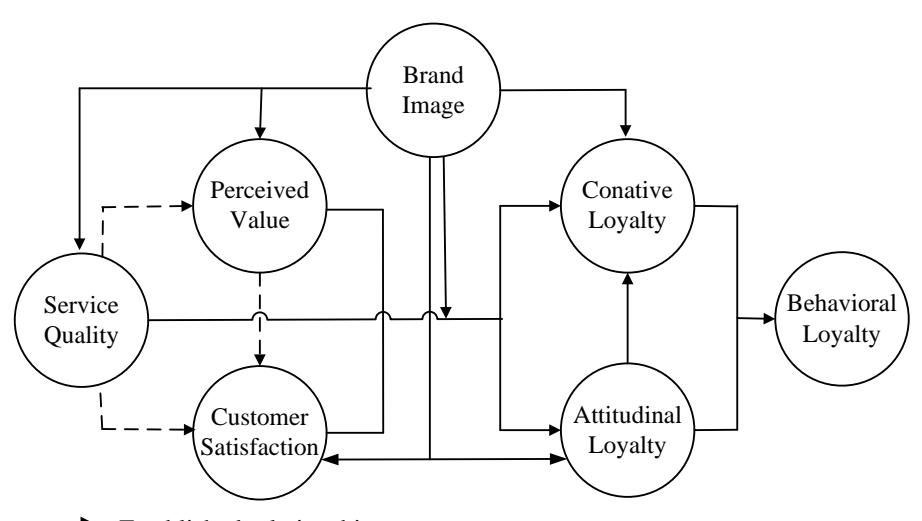
Established relationship
Figure 1: The Proposed Brand Loyalty Model
Based on the proposed model, hypotheses on the relationships between attitudinal loyalty, conative loyalty and behavioural loyalty are as follows:
Hypothesis 1: Attitudinal loyalty directly affects (a) conative loyalty and (b) behavioura loyalty, in both international and domestic hotel brands
Hypothesis 2: Conative loyalty directly affects behavioural loyalty in both international and domestic hotel brands.
Loyalty Determinants Effect
The identification and examination of the factors that drive consumers' brand loyalty and, more specifically, customer purchase behaviour, have been critical foci of service research (Brady et al., 2005). Though much attention has been given to this issue, the dominant brand loyalty drivers have been service quality, perceived value and customer satisfaction (Cronin et al., 2000; Oliver, 2010). These constructs have also been considered the building blocks of loyalty (Lovelock and Wirtz, 2007). Another important construct widely acknowledged as influencing brand loyalty is brand image (Andreassen and Lindestad, 1998; Back and Parks, 2003).
Service quality, a consumer's judgment about the overall superiority of a product or service (Zeithaml, Bitner, & Gremler, 2009), is an essential strategy for the success and survival of any business. Fundamentally, researchers (Brodie et al., 2009; Chitty et al., 2007; Zeithaml et al., 1996) agree that service quality is an important factor in influencing customer satisfaction and perceived value. In terms of the relationship with brand loyalty, some studies report an insignificant relationship (Kandampully and Hu, 2007; Kim et al., 2008) and others report that only some service quality dimensions significantly affect brand loyalty (Kayaman and Arasli, 2007). The negative effect of service quality on brand loyalty has also been reported (Zeithaml et al., 1996). In spite of the insignificant and negative effects, most studies identify a positive effect of service quality on brand loyalty. Thus, this study proposes that service quality affects conative loyalty and attitudinal loyalty for both international and domestic hotels.
Hypothesis 3: Service quality will have an effect on (a) attitudinal loyalty and (b) conative loyalty, for both international and domestic hotel brands.
Perceived service value, a consumer's evaluation of service received compared with price, is fundamental in marketing activities (Nasution and Mavondo, 2008). Considering the importance of perceived value in influencing a consumer's behaviour, considerable attention has been given to this construct in the services context. Most empirical studies in this industry confirm the link between perceived value, service quality and customer satisfaction. Further, empirical studies provide evidence that customer loyalty (measured by intention loyalty) has been empirically identified as the consequence of perceived value in broader research contexts (Brodie et al., 2009; Cronin et al., 2000). Since perceived value directly affects intention loyalty, a similar effect on attitudinal loyalty and conative loyalty is also expected for both international and domestic hotels.
Hypothesis 4: Perceived value will have an effect on (a) attitudinal loyalty and (b) conative loyalty for both international and domestic hotel brands.
The marketing literature conceptualizes satisfaction as an attitude similar to judgement based on the levels of performance customers experience during a transaction (Oliver, 2010). Researchers (Clemes et al., 2010; Cronin et al., 2000) agree that service quality and perceived value are determinants of customer satisfaction. However, other scholars (Harris and Goode, 2004; Oliver, 1999) maintain that research is still unable to convincingly explain the complex relationship between customer satisfaction and customer purchasing behaviour. In the hotel context, studies report a positive relationship between customer satisfaction and conative loyalty (Chitty et al., 2007; Kandampully and Hu, 2007), and cognitive loyalty, behavioural loyalty (Back and Parks, 2003) and overall brand loyalty (Han et al., 2008). Given these studies, it is expected that customer satisfaction will affect both conative loyalty and attitudinal loyalty for both international and domestic hotels.
Hypothesis 5: Customer satisfaction will have an effect on (a) attitudinal loyalty and conative loyalty for both international and domestic hotel brands.
Brand image, the perception about the brand held in consumers' memory (Keller, 1993), has long been recognized as one of the central tenets of marketing research. In the service industry, where competing services are perceived as virtually identical in terms of performance, price and availability, such as in the hotel industry, brand image has an important role as an alternative strategy to product differentiation (Kim and Kim, 2005) and is an important determinant in developing brand loyalty (Back and Parks, 2003; Gronroos, 2000; Lai et al., 2009). Oliver (1999) advocated that loyalty is not only about product superiority and satisfying customers, loyalty is also about having customers who can defend the brand. If the firm cannot develop, support and maintain brand uniqueness and perceived brand equity, then it is not possible to expect the development of brand loyalty. Thus, having a strong and positive brand image will strengthen perceived quality, perceived value and customer satisfaction and assist in the development of brand loyalty (Chitty et al., 2007; Lai et al., 2009). Accordingly, the hypotheses on the relationship between brand image, service quality, perceived value, customer satisfaction and brand loyalty in both international and domestic hotels are as follows:
- Hypothesis 6: Brand image will have an effect on (a) service quality, (b) perceived value, (c) customer satisfaction, (d) attitudinal loyalty, and (e) conative loyalty, for both international and domestic hotel brands.
- Hypothesis 7: Brand image will moderate the relationship between (a) service quality and attitudinal loyalty, (b) perceived value and attitudinal loyalty, and (c) customer satisfaction and attitudinal loyalty, for both international and domestic hotel brands.
- Hypothesis 8: Brand image will moderate the relationship between (a) service quality and conative loyalty, (b) perceived value and conative loyalty, and (c) customer satisfaction and conative loyalty, for both international and domestic hotel brands.
Measurement of Constructs
The conceptualisation of and items for measuring the constructs in the model were developed by drawing on the literature (Back and Parks, 2003; Chitty et al., 2007; Han et
al., 2008). These constructs were developed using multi-item scales adapted from previous studies mainly from the hospitality context. The items used in this study were measured using a 7-point Likert type scale anchored by 1 (strongly agree) and 7 (strongly disagree). Attitudinal loyalty is defined as a degree of dispositional commitment in terms of some unique value associated with the brand (Chaudhuri and Holbrook, 2001). Four items were adapted from Back and Park's (2003) and Han et al.'s (2008) studies to measure this construct. Conative loyalty is viewed as a loyalty state that contains what, at first, appears to be the deeply held commitment to buy (Oliver, 1999). Three items were adapted from Kayaman and Arasli's (2007) and Zeithaml et al.'s (1996) studies to measure this construct. DeWulf et al. (2001) defined behavioural loyalty as a consumer's purchasing frequency and amount spent at a provider compared with the amount spent at other providers. Based on this definition, behavioural loyalty was measured with three self-reported behaviour items adapted from Han et al.'s (2008) study. Three items were used to measure customer satisfaction; two items were adapted from Back (2005) and one was from Chitty et al. (2007). Perceived value was gauged with three items based on measures from Nasution and Mavondo (2008) and Chitty et al. (2007). Four items adapted from the work of Kayaman and Arasli (2007) were used to measure brand image. Finally, service quality was measured with four items adapted from Han et al. (2008) and Cronin et al. (2000). The survey instrument was inspected by academics and hotel practitioners to improve the face validity of the constructs. Finally, before collecting the data, a pilot test of the questionnaire indicated that all items were accurate representations of the construct under investigation.
Sampling
Brand loyalty theory has been developed primarily in western cultures using samples of North American consumers (Han et al., 2008; Ostrom and Iacobucci, 1995). Dabholkar et al., (1996) maintained that culturally idiosyncratic characteristics could result in different patterns and strengths of the variable relationships. Shoemaker and Lewis (1999) suggested examining loyalty creation across different cultures. Thus, this study analyses the brand loyalty model in a developing country (Indonesia) where research in this area is sparse. The sample population in this study consisted individuals who stayed at two fourstar international hotels (from developed countries) and two four-star domestic hotels (local/national hotels). The difficulty in identifying the total population of hotel guests and the inequality in being chosen as participants made it impossible to apply pure random sampling. Thus, the author decided to use convenience sampling. As the main purpose of this study was to test the brand loyalty model in both international and domestic hotel brands, non-probability sampling was considered an acceptable method (Reynolds et al., 2003). Self-administered questionnaires were distributed to 334 hotel guests from April 6 to July 6, 2009, using the personal approach; hotel guests were requested personally to respond the questionnaire. Of the 238 questionnaires returned, 7 questionnaires were excluded for analysis due to missing data and outlier reasons.
Data Analysis
Checking skewness and kurtosis indicated that the data were not normally distributed. These non normal distributed data caused a violation of the assumptions for using covariance-based structural equation modelling. Thus, the estimation of the measurement model and structural model were conducted by means of partial least squares (PLS). This method was used because of its ability to handle non-multivariate normal data, multicollinearity among independent variables, and small samples (Daryanto et al., 2010;
Hair et al., 2010). A bootstrapping method, on the basis of 500 runs, was used to determine the stability and significance of the parameter estimates.
Results
Description of the Respondents
Of 231 sample respondents, 93 respondents (40.3%) stayed in the international hotels and 138 respondents (59.7%) stayed in the domestic hotels. The demographics of the respondents are given in Table 1.
Table 1 Demographic Characteristics of the Respondents
| Variable | Category | Frequency | % |
|---|---|---|---|
| Purpose of Stay | - Business | 99 | 42.9 |
| - Pleasure | 108 | 46.8 | |
| Gender | - Male | 141 | 61 |
| - Female | 73 | 31.6 | |
| Age | - Under 25 years | 19 | 8.2 |
| - 25 to 35 years | 95 | 41.1 | |
| - 36 to 45 years | 76 | 32.9 | |
| - 46 to 55 years | 32 | 13.9 | |
| - Over 55 years | 2 | 0.9 | |
| Education | - High School | 18 | 7.8 |
| - Diploma | 60 | 26 | |
| - Bachelor | 114 | 49.4 | |
| - Post Graduate | 30 | 13 | |
| Occupation | - Professional | 56 | 24.2 |
| - Businessman | 70 | 30.3 | |
| - Civil servant | 51 | 22.1 |
Measurement Model
The measurement model was assessed by evaluating the reliability and validity of the constructs. Table 3 shows that the composite reliabilities of all constructs are above the cut-off level of 0.60 (Bagozzi and Yi, 1988). In addition, the Cronbach's alpha of the model constructs ranged from 0.703 to 0.930 (see Table 2). Thus, the constructs are considered reliable for both international and domestic hotels.
Anderson and Gerbing (1988) maintained that convergent validity can be assessed by determining whether each indicator's estimated coefficient on the underlying construct is significant. Table 2 shows that all constructs satisfy the minimum variance extracted value of 0.50 (Bagozzi and Yi, 1988). Further, all items have a factor loading greater than 0.70 and were significant at p < 1% (see Table 2), indicating that the items measure the construct they were expected to measure. Thus, the convergent validity requirement of the constructs was satisfied. The discriminant validity between two constructs is demonstrated if the average variance extracted is greater than the squared correlation between constructs (Fornell and Larcker, 1981).Table 3 shows that all constructs tested for both the international and domestic hotel data satisfy the criteria suggested by Fornell and Larcker (1981). Thus, the discriminant validity of the constructs was satisfied.
Table 2 Measurement Construct Properties
| Construct Item | Loading* | ||||
|---|---|---|---|---|---|
| Attitudinal Loyalty: Cronbach's α = 0.806 (0.893) | 0.771 (0.908) | ||||
| - No other hotels perform services better than Hotel. | 0.771 (0.908) | ||||
| - I consider Hotel as my first choice when I need | 0.773 (0.864) | ||||
| lodging in this city. | |||||
| - I like Hotel more than other hotels. | 0.813 (0.829) | ||||
| - I feel better when I stay at Hotel. | 0.825 (0.887) | ||||
| Conative Loyalty: Cronbach's α = 0.833 (0.795) | |||||
| - Even if other hotels were offering a lower rate, I would | 0.900 (0.909) | ||||
| stay atHotel. | |||||
| - If Hotel were to raise the rate, I would still continue to | 0.880 (0.886) | ||||
| stay in the hotel. | |||||
| - I intend to continue staying at Hotel in the future. | 0.815 (0.725) | ||||
| Behavioural Loyalty: Cronbach's α = 0.863 (0.930) | |||||
| - When I visit city, I always stay in Hotel. | 0.848 (0.936) | ||||
| - I have stayed more often at the Hotel than the | 0.926 (0.952) | ||||
| others. | |||||
| - Compared with other hotel, I have spent more money | 0.863 (0.922) | ||||
| at Hotel. | |||||
| Service Quality: Conbach' α = .703 (.867) | |||||
| - The facilities of Hotel are modern. | 0.691 (0.861) | ||||
| - The appearance of Hotel is visually appealing. | 0.700 (0.767) | ||||
| - The Hotel staff understand my individual needs. | 0.743 (0.856) | ||||
| - Overall, Hotel provides excellent service quality. | 0.753 (0.906) | ||||
| Perceived Value: Cronbach's α = 0.731 (0.895) | |||||
| - I consider the price ofHotel services to be reasonable. | 0.701 (0.929) | ||||
| - The service of Hotel was excellent compared to what | 0.890 (0.911) | ||||
| I had given up. | |||||
| - Hotel offers good value for money. | 0.815 (0.888) | ||||
| Customer Satisfaction: Cronbach' α = 0.797 (0.917) | |||||
| - I had a pleasurable stay at Hotel. | 0.757 (0.945) | ||||
| - I did the right thing when I chose to stay atHotel. | 0.902 (0.937) | ||||
| - I feel Hotel service is better than my expectation. | 0.867 (0.900) | ||||
| Brand Image: Cronbach's α = 0.816 (0.851) | |||||
| - Hotel has a good reputation. | 0.793 (0.888) | ||||
| - Compare to other hotels, Hotel is a unique hotel. | 0.858 (0.927) | ||||
| - Hotel is comfortable hotel. | 0.780 (0.803) | ||||
| - I feel special when staying at Hotel. | 0.794 (0.711) | ||||
*: All significant at p = 1%; values in parentheses represent domestic hotels
Table 3 Correlation, Variance Extracted, and Composite Reliability
| AL | CL | BL | BI | CS | PV | SQ | VE | CR | ||
|---|---|---|---|---|---|---|---|---|---|---|
| Domestic Hotels | ||||||||||
| Attitudinal Loyalty | ||||||||||
| (AL) | 1 | 0.790 | 0.677 | 0.758 | 0.800 | 0.686 | 0.694 | 0.761 | 0.927 | |
| Conative Loyalty | ||||||||||
| (CL) | 0.572 | 1 | 0.640 | 0.710 | 0.690 | 0.652 | 0.670 | 0.712 | 0.88 | |
| Behavioural Loyalty | els | |||||||||
| (BL) | łot | 0.616 | 0.678 | 1 | 0.548 | 0.510 | 0.460 | 0.456 | 0.878 | 0.956 |
| Brand Image (BI) | International Hotels | 0.572 | 0.473 | 0.523 | 1 | 0.870 | 0.838 | 0.829 | 0.700 | 0.902 |
| Customer | ono | |||||||||
| Satisfaction (CS) | ıati | 0.661 | 0.558 | 0.568 | 0.682 | 1 | 0.815 | 0.810 | 0.860 | 0.946 |
| Perceived Value | teri | |||||||||
| (PV) | In | 0.537 | 0.490 | 0.509 | 0.663 | 0.603 | 1 | 0.822 | 0.827 | 0.935 |
| Service Quality (SQ) | 0.503 | 0.447 | 0.444 | 0.632 | 0.583 | 0.580 | 1 | 0.721 | 0.911 | |
| Variance Extracted | ||||||||||
| (VE) | 0.633 | 0.750 | 0.774 | 0.650 | 0.713 | 0.649 | 0.521 | - | - | |
| Composite | ||||||||||
| Reliability (CR) | 0.873 | 0.900 | 0.911 | 0.881 | 0.860 | 0.846 | 0.813 | - | - | |
All correlation coefficients significant at P = 1%; italicized numbers denote domestic hotels
Structural Model
The percentage of explained variance (R²) of brand loyalty to international hotels is less than that to domestic hotels. The R² of attitudinal loyalty, conative loyalty and behavioural loyalty for international hotels are 0.49, 0.42 and 0.55, respectively, but for domestic hotels are 0.67, 0.66, and 0.49, respectively. In terms of service quality, perceived value and customer satisfaction, the R² of international hotels are 0.40, 0.48 and 0.53, respectively, but for domestic hotels are 0.69, 0.75 0.80, respectively. In addition, the Goodness of Fit index of the international hotels model is 0.57, but for the domestic hotels model it is 0.73. Using the criteria of the effect of the sizes for R² (small, 0.02; medium, 0.13; large, 0.26) proposed by Cohen (1988) and the Goodness of Fit index (small, 0.02; medium, 0.25; and large, 0.36) as suggested by Daryanto et al. (2010) indicates that both international and domestic hotel models perform well. These findings indicate that the proposed model for domestic hotels has a better fit to explain the data than that for international hotels. Table 4 presents the estimation results for the hypothesized conceptual framework for both international and domestic hotel brands.
Table 4 Result of PLS Regression
| Tuble | Result of | Estimate (t-value) | ||
|---|---|---|---|
| Hypothesized Path | International Hotels | Domestic Hotels | SD |
| H1a: Attitudinal Loyalty => Behavioural Loyalty | 0.270 (3.308**) | 0.451 (2.732**) | ** |
| b: Attitudinal Loyalty => Conative Loyalty | 0.300 (2.270*) | 0.596 (4.376**) | ** |
| H2 : Conative Loyalty => Behavioural Loyalty | 0.449 (4.024**) | 0.278 (1.734) | ** |
| H3a: Service Quality => Attitudinal Loyalty | 0.079 (0.606) | 0.139 (1.056) | ** |
| b: Service Quality => Conative Loyalty | 0.077 (0.705) | 0.140 (1.033) | ** |
| H4a: Perceived Value => Attitudinal Loyalty | 0.133 (1.404) | -0.052 (0.329) | ** |
| b: Perceived Value => Conative Loyalty | 0.150 (1.019) | 0.077 (0.722) | ** |
| H5a: Customer Satisfaction => Attitudinal Loyalty | 0.430 (3.774**) | 0.565 (3.618**) | ** |
| b: Customer Satisfaction => Conative Loyalty | 0.195 (1.234) | -0.098 (0.587) | ** |
| H6a: Brand Image => Service Quality | 0.632 (7.907**) | 0.829 (22.416**) | ** |
| b: Brand Image => Perceived Value | 0.494 (5.826**) | 0.501 (5.062**) | ns |
| c: Brand Image => Customer Satisfaction | 0.416 (3.773**) | 0.546 (5.553**) | ** |
| d: Brand Image => Attitudinal Loyalty | 0.123 (0.951) | 0.274 (1.898) | ** |
| e: Brand Image => Conative Loyalty | -0.003 (0.021) | 0.170 (0.918) | ** |
|---|---|---|---|
| Established Relationship: | |||
| Service Quality => Perceived Value | 0.268 (3.089**) | 0.406 (3.954**) | ** |
| Service Quality => Customer Satisfaction | 0.196 (2.275*) | 0.195 (1.993*) | ns |
| Perceived Value => Customer Satisfaction | 0.214 (1.989*) | 0.198 (1.971*) | ** |
*: significant at 5%, ** significant at 1%, ns: not significant, SD = Significant Differences
Hypotheses 1 and 2 postulated the relationships between three brand loyalty dimensions: attitudinal, conative and behavioural loyalty. The effect of attitudinal loyalty on conative loyalty and behavioural loyalty is significant for both hotel types. However, the coefficient estimates of attitudinal loyalty on conative loyalty and the behavioural loyalty to domestic hotels are higher than those for international hotels. The effect of conative loyalty on behavioural loyalty is significant only for international hotels.
Hypotheses 3 to 5 investigate the effect of service quality, perceived value and customer satisfaction on attitudinal and conative loyalty. Among the hypothesised relationships, only customer satisfaction has a significant effect on attitudinal loyalty for both international and domestic hotel brands with coefficients of 0.43 and 0.57, respectively, (significant at p < 0.01). Considering the significant effect of service quality and perceived value on customer satisfaction, these findings imply that the effect of service quality and perceived value on attitudinal loyalty and conative loyalty is mediated by customer satisfaction.
Hypothesis 6 postulated that effect of brand image on service quality, perceived value, customer satisfaction, attitudinal loyalty and conative loyalty. The results show that brand image has a significant effect on service quality, perceived value and customer satisfaction for both hotel types. In contrast, the effects of brand image on attitudinal and conative loyalty are not significant for both hotel types. This study confirms the established relationships between service quality, perceived value and customer satisfaction since their coefficient estimates are significant for both hotel types.
The results of testing the brand image moderation effect on the relationships between service quality, perceived value, customer satisfaction and attitudinal loyalty (Hypothesis 7) and conative loyalty (Hypothesis 8) are presented in Table 5.The results show that, for both hotel types, brand image is not a moderating factor because all coefficient estimates are not significant. The empirically validated brand loyalty model of both international and domestic hotels is presented in Figure 2.
Table 5: Results of the Brand Image Moderation Test
| Hypothesized Brand Image Moderation | Estimate (t-value) | SD | |
|---|---|---|---|
| International Hotels | Domestic | ||
| Hotels | |||
| H7a: Service Quality => Attitudinal Loyalty | -0.051 (0.375) | 0.241 (0.8710 | ** |
| b: Perceived Value => Attitudinal Loyalty | 0.020 (0.175) | -0.159 (0.611) | ** |
| c: Customer Satisfaction => Attitudinal Loyalty | -0.062 (0.474) | 0.060 (0.207) | ** |
| H8a: Service Quality => Conative Loyalty | 0.053 (0.258) | -0.017 (0.074) | ** |
| b: Perceived Value => Conative Loyalty | -0.081 (0.485) | 0.098 (0.511) | ** |
| c: Customer Satisfaction => Conative Loyalty | -0.087 (0.511) | -0.065 (0.280) | ** |
SD = Significant Differences, ** significant at 1%,
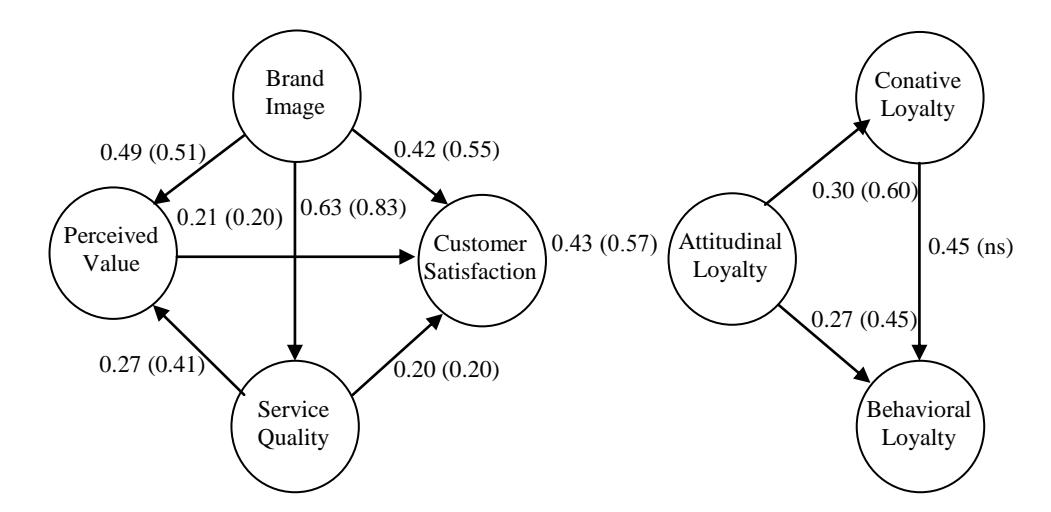
Note: values in parenthesis represent coefficient estimate of domestic hotels; ns: not significant.
Figure 2: The Empirically Validated Brand Loyalty Model of International and Domestic Hotel Brands
To check whether group specific path coefficients between international and domestic hotels differ significantly, PLS multigroup analyses were conducted as recommended by Chin and Dibbern (2010). The results of the PLS multigroup analyses (Tables 4 and 5) show that, except for the paths between brand image and perceived value and between service quality and customer satisfaction, all coefficient paths are significantly different. These results indicate that, overall, the relationships between the constructs differ between international and domestic hotels.
Discussion
The results of this study support the proposed model that brand loyalty consists of three dimensions, attitudinal, conative and behavioural loyalty. However, the relationships between these dimensions differ between international and domestic hotels. International hotel guests develop attitudinal loyalty before conative loyalty and then behavioural loyalty. Domestic hotel guests develop attitudinal loyalty before behavioural loyalty. This finding suggests that hotel guests' attitudes and intentions to stay in the hotel are major determinants for guests to re-stay in an international hotel. In contrast, guests' attitudes and intentions to stay in a hotel are not major determinants for guests to re-stay in a domestic hotel.
The attitudinal loyalty indicators of this study suggest that a loyal customer, in an attitudinal sense, believes the favoured hotel has better service than other hotels, considers the hotel as a first choice, and feels more affection towards the hotel than to others. These indicators reflect customers' attitudes towards the hotel they stayed in, compared with their attitudes about other hotels. This finding indicates that attitudinal loyalty is an attitude towards the brand relative to competitor brands rather than attitude towards both the brand and the brand relative to competitor brands as suggested by the literature (Back and Parks, 2003; Chaudhuri and Holbrook, 2001; Jones and Taylor, 2007;
Lee et al., 2007). The importance of attitudinal loyalty in influencing behavioural loyalty confirms the conceptualisation that relative attitude is a strong indicator of repeat patronage (Dick and Basu, 1994).
The results of testing the brand loyalty model confirm that customer satisfaction has a central mediation role in the relationship between service quality and perceived value on brand loyalty (Chitty et al., 2007; Han et al., 2008). In addition, in contrast to previous studies (Faullant et al., 2008; Kandampully and Hu, 2007; Kayaman and Arasli, 2007; Lai et al., 2009), this study reveals that brand image has no significant direct effect on attitudinal loyalty and conative loyalty. This study also uncovers the fact that brand image has no mediating role on the relationships between service quality, perceived value and customer satisfaction on attitudinal and conative loyalty. As brand image has a significant effect on service quality, perceived value and customer satisfaction, these findings suggest that brand image is a strengthening factor of loyalty building blocks rather than the determinant of brand loyalty.
Another important finding revealed in this study is the mediation of attitudinal loyalty in the relationship between customer satisfaction and behavioural loyalty for international and domestic hotels. This finding suggests that, for both hotel types, satisfied guests will not automatically become loyal guests in a behavioural sense (i.e., re-stay in the future) unless they perceived that the hotel performs better on key attributes than other hotels. Similarly, dissatisfied guests will not automatically switch to another hotel unless they perceive that another hotel is able to perform better than the hotel where they stayed. This finding indicates that, for both types of hotel, satisfied consumers defect to other providers because they perceive that the other provider may provide a better service. Thus, this study reinforces Oliver's (2010) contention that satisfaction is a necessary, but not sufficient, condition for loyalty.
Implications and Future Research
Testing the structure of brand loyalty models reveals that attitudinal loyalty is a more important determinant of behavioural loyalty than conative loyalty. This suggests that researchers and marketers should not rely on behavioural intention (conative loyalty) as an indication of a customer's future loyalty as suggested by literature (Cronin et al., 2000; Kandampully and Hu, 2007; Zeithaml et al., 1996). Further, this study provides evidence that hotel guests develop brand loyalty differently for international and domestic hotels. This finding implies that analysing brand loyalty should be conducted separately between international and domestic hotels rather than by combining these hotel types.
The importance of attitudinal loyalty revealed in this research indicates that hotel guests develop their attitude towards a hotel compared with other hotels. This finding implies that the development of true brand loyalty goes beyond providing excellent service quality, high perceived value and customer satisfaction. Though they are important, the results of this study suggest that four-star international and domestic hotel managers should offer a service that is better than that of other hotels. To maintain relative performance over other hotels, hotel managers need to regularly evaluate their service performance and compare it with the service of other hotels in the same class.
Scholars have noted a need to validate models created in one setting by examination in other settings (DeWulf et al., 2001). Further research is necessary in order to determine whether the theoretical relationships identified in this study can be generalized to other types of hotel. The replication of this research within economy class hotels (such as onestar and two-star hotels) and in luxury class hotels (such as five-star hotels) would be valuable to provide an understanding of the research issues in the wider hotel industry.
This study has a limitations related to the measurement of behavioural loyalty that was based on the respondents' recall of their purchasing history. The respondents may respond inaccurately about, or just guess, the frequency of their visits to the hotel. Hence, the behavioural data collected may not be as accurate a measure of a guest's past behaviour as obtaining actual data from a hotel's database. Future research should collect actual data in cooperation both with respondents and hotels.