

INTRODUCTION
Thailand is one of the favorite tourist destinations in the Southeast Asian region being equipped with charming and attractive destinations ranging from mountains in the North, white sandy beaches in the South and the East with cultural heritage and ethnic diversity in every region. It also offers tourists exotic and delectable cuisines and fruits and the exquisite hospitality of the local people. Tourism is heavily promoted and tourism infrastructure has been put in place and well maintained. The industry creates more new jobs and generates a hefty share of national income. The National Information Center Report reveals that the tourism industry sector generated more than 500,000 million baht in 2009. In 2008, the Tourism Authority of Thailand (TAT) reported that the revenue from overseas visitors was 604,968.37 million baht while that from domestic tourists was 386,487.11 million baht.
The tourism industry sector has been continuously promoted nationally and internationally. Tourism campaigns are the responsibility of TAT, which was established in 1960. The organization provides information and data on tourist areas to the public, publicizes Thailand with the intention of encouraging local and overseas visitors to travel in and around the country, conducts research studies to establish development plans for 1Address correspondence to Chalermchai Chaichompoo : Faculty of Humanities and Social Sciences Chiang Mai Rajabhat University, 202 Chotana Road, Chang Phuak, Muang, Chiang Mai, Thailand 50300 Tel. 66-879-779-665, Fax. 66-538-85709, Email: <nongmor@hotmai.com>
tourist destinations, and collaborates with and supports the production and development of human resources in the field of tourism.
The tourism infrastructure in Thailand is basically solid with low-priced guesthouses for low-budget travelers and five-star hotels for luxury visitors. Travel agencies are helpful, friendly and easily available; and transportation is affordable as well as convenient. Travelling within the country is so pleasant, reliable, fun-filled, safe, convenient, and low cost that the Travel & Leisure Magazine of America voted Bangkok and Chiang Mai the first and second places for the World's Best Award in 2010 (www.travelandleisure.com)
As the capital city of the ancient Lanna Kingdom (1296-1558) located in the mountainous region in the Upper North of Thailand, Chiang Mai offers tourists the experience of both cultural heritage and natural outdoor activities. There are over one hundred old and new Buddhist temples in the city center alone. Downtown sightseeing in the old walled section of the city can be done on foot or by bicycle. A visit to the cottage industries and elephant camps as well as orchid and butterfly farms can be arranged as a half-day tour.
The charming diversity of ethnic tribes, the elephant camps, cooking and massage schools, various outdoor activities, a variety of handicraft workshops, exotic cultural performances, and breathtaking scenery make Chiang Mai one of the most attractive tourist destinations in Asia. In fact, it was voted into second place after Bangkok for the 2010 World's Best Award by the Travel & Leisure Magazine in 2010.
Besides centuries old archeological sites and ruins and fabulous shopping opportunities, Chiang Mai is blessed with pristine natural resources including the highest mountain in the country, Doi Inthanon Mountain, as well as waterfalls, and rivers. Hilltribe trekking, often combined with river rafting and elephant or ox-cart riding, has always been one of Chiang Mai's greatest tourist attractions.
Furthermore, visitors can visit workshops where they can learn about the production of silk or silver, and purchase memorable hand-crafted souvenirs. With such a diverse range of attractions and an equally huge selection of eating and accommodation options, Chiang Mai is a place where both backpackers and luxury tourists can enjoy their memorable and unforgettable holiday experiences in Thailand.
SUSTAINABLE TOURISM
Sustainable tourism is defined as the type of tourism that is committed to making a small impact on the environment and on local culture, while helping to generate future employment for local people. The aim of sustainable tourism is to ensure that development brings positive benefits to the local people, tourism companies and the tourists themselves (wikipedia.com).
Sustainable tourism is where tourists can enjoy their holiday and at the same time respect the culture of the local people as well as the environment. It also ensures that local people get a fair say about tourism activities in their area and receive monetary benefits from these activities.
The Cape Town Declaration designates that sustainable tourism should have the following characteristics:
- 1. It should minimize negative economic, environmental, and social impacts.
- 2. It should generate greater economic benefits for local people, enhance the wellbeing of host communities, and improve working conditions as well as allow local communities to participate in the tourism industry.
- 3. It should involve local people in decisions that affect their lives and life opportunities.
- 4. It should make positive contributions to the conservation of the world's natural and cultural heritage and to the maintenance of the world's diversity.
- 5. It should provide more enjoyable experiences for tourists through more meaningful connections with local people, and a greater understanding of local cultural, social and environmental issues.
- 6. It should provide access for physically challenged people, and
- 7. It should be culturally sensitive, engender respect between tourists and hosts, and build local pride and confidence. (icrtourism.org/capetown)
Furthermore, sustainable tourism should make optimal use of environmental resources that constitute a key element in tourism development, maintaining essential ecological processes and helping to conserve natural heritage and biodiversity. It should also respect the socio-cultural authenticity of host communities, conserve their built and living cultural heritage and traditional values, and contribute to intercultural understanding and tolerance. Additionally, sustainable tourism should ensure viable, long-term economic benefits that are fairly distributed to all stakeholders. It should provide stable employment, income-earning opportunities and social services to host communities, as well as contribute to the alleviation of poverty. (unwto.org)
THE ANG KHANG ROYAL PROJECT
The Ang Khang Royal Agricultural Station, in Fang District, Chiang Mai Province, was set up in 1969 as the Royal Project's plant research station, based on the concept of selfreliance and the sufficiency economy. The station was established to encourage the local hill-tribes to abandon their destructive slash-and-burn farming techniques and traditional cultivation of opium poppy by offering them alternative methods and crops that would increase their earnings and improve their quality of life. The station is now a fertile area, having cultivated more than 12 types of fruits, 60 varieties of temperate vegetables, and 20 kinds of flowers. It is located at 1,400 meters above mean sea level, covering an area of approximately 26.52 square kilometers. The climate is cool throughout the year with an average temperature of 16.9 Celsius, the maximum at 32 Celsius in April and the minimum at -3 Celsius in January.
THE PALAUNG ETHNIC GROUP
The Palaung ethnic group is one of the ethnic minority groups residing in Shan State, Myanmar, and in southern Yunnan, China. In Myanmar, the ethnic group's settlement is in close proximity with that of the Shan. Hence, cultural influences of the latter over the former are relatively evident. The group has its own native language and is fluent in Shan as well. Like the Shan, they are Buddhists and animists. Except for women, their traditional costume is that of the Shan. Men who have entered the monkhood are literate in the Shan script and use the script to record their native language.
Palaung is classified under the Palaung-Wa branch of the Mon-Khmer sub-family in the Austroasiatic Language Family (Diffloth, 1982). The Palaung at Nor Lae Village is categorized as a West Palaungic language under the Palaugn-Riang Branch.
The ethnic group at Nor Lae Village on the Thai-Burmese border in the Ang Khang Royal Project migrated from Doi Lai, a small town between Keng Taung and Muang Pan in Shan State. Their migration took place between 1982 and 1984 to escape fighting between the Burmese and various ethnic groups and political suppression in Myanmar.
In 1984, the ethnic group, initially about 200 people, was granted a permanent settlement at the village by His Majesty the King Bhumibol. To maintain a decent livelihood, the villagers were put under the supervision of the Ang Khang Royal Project, since their movement was restricted due to their immigrant status. As a consequence, each family was allocated a small plot of land to grow temperate vegetables and fruits with full support from the royal project regarding seeds, products, and marketing. As of April, 2010, there were 180 families with a total population of 1,100. Of this number, 166 residents were granted Thai citizenship, 156 held alien status and the rest were categorized as stateless.
The villagers are Buddhists, but animism is also widely practiced. There is a village temple and most young boys whose parents cannot afford to pay for their formal education are ordained as novices in order to have an opportunity to further their studies in the secondary education level in schools for monks. Many traditions and customs are still kept alive, such as planting rituals, New Year, Village Guardians Appeasement Ritual, or the ceremony of closing and opening the village gate. Women and older men still wear traditional costumes. Women wear rattan and silver waist hoops, making them distinct from other ethnic groups. Nevertheless, traditions and beliefs related to rice cultivation are no longer practiced, because arable land is extremely limited as the population increases. This is because the village as well as the royal project itself is located in a mountainous border area. Land and water have become more scarce.
The village is approximately seven kilometers from the valley where the headquarters of the royal project is situated. At a height of 1,350 meters above sea level, it is cool all year round and ideal for the cultivation of temperate vegetables, fruits and flowers. The high tourist season is in winter (October-February). Tourists usually include the village in their itinerary when visiting the royal project. The trip can be arranged in one day and if visitors wish to stay overnight, there are inexpensive but comfortable resorts at the royal project.
Although it is a transit point for visitors, tourism in the village does not generate much income generation despite the village having the potential to be developed into a sustainable tourist attraction. If the development can be carried out concretely, tourism will provide the villagers with another income source that would improve their quality of life and reduce the poverty rate and the hardship of these ethnic people.
SUSTAINABLE TOURISM POTENTIAL FOR THE ETHNIC GROUP IN THE VILLAGE
The data needed for developing the potential of the ethnic group for sustainable tourism were collected from a series of group discussions with the village head and members of the village council over a period of three months from March to May 2010. The initiative stemmed from the needs to generate supplementary incomes for the villagers in the face of various internal and external factors. A major internal factor is population growth. As the village is situated in a mountainous region, land is extremely limited, making it
difficult for the establishment of new households to accommodate new families. Consequently, there is more than one family residing in the same household, usually those of siblings or close relatives. Furthermore, arable land for agriculture is also limited and the royal project is not be able to allocate land plots for new families indefinitely, leaving many without work and steady incomes. Additionally, freedom of movement is restricted for those residents with alien and stateless status. Hence, seeking jobs elsewhere beyond the legally imposed boundaries is impossible, increasing the rate of joblessness in the community. The situation is harsh for the youths whose future is uncertain and bleak, enhancing their frustration with life which may result in unexpected social problems.
Bearing these foreseeable problems in mind, the village chief and council members have held several meetings to find solutions. One possible way is to promote sustainable tourism activities by exploiting existing cultural resources.
One objective of sustainable tourism is that it should not be destructive to the environment, local or ethnic ways of life, cultures, or natural resources. Furthermore, it should promote the conservation of nature and of local cultures in order that human beings can have a peaceful coexistence with nature. These man-made and natural resources can be sustained for a long run without drastic changes. Cultural roots are strongly maintained with the assistance of community empowerment while local people are exposed to the outside world for the purpose of tourism promotion. Such a promotion should be based on a win-win perspective with benefits equally distributed to all stakeholders. The exploitation of culture and nature for the tourism industry should be carefully planned and executed with full and democratic participation from all parties involved (Swarbrooke, 1999 and Weaver, 2006).
Sustainable tourism potentials for the Palaung ethnic group at Nor Lae Village are in the forms of cultural and agri-tourism. These potentials include ethnic identity, ethnic textiles, traditional music and dance, and organic farming. Details of each topic can be elaborated as follows.
1. Ethnic identity
Ethnic identity entails the cultural characteristics that make a group of people distinct from others, such as language, dress or tradition. The Palaung language is vigorously used in all domains despite the group having direct contact with the mainstream Thai language. Although the village is an isolated community exposed to the mainstream culture through formal education, mass media and daily activities, the language is unlikely to become endangered, since it is used in the family and community domains. Classified under the Mon-Khmer Branch of the Austroasiatic Family, it still preserves its linguistically distinctive features like non-tonality and contrasts between voiced and voiceless nasal and approximant consonants (Chaichompoo, 2011: 31). Preserving their ethnic language is a way of maintaining their ethnic identity, which is part of the diverse cultural tapestry of the multicultural Thai society.
Ethnic dress is another distinctive aspect of Palaung identity. The clothing of the ethnic group, particularly women, always attracts the attention of visitors. Palaung women wear hand-woven red sarongs, decorative and brightly-colored blouses, head scarves, and rattan and silver hoops around their waists. The legend of the hoops has it that "Roi Ngoen", an angel who came down to earth with her sisters, was captured by a Lisu hunter who used hoops to restrain her from escaping to heaven. Considering themselves to be descendants of the angel, Palaung women, both adults and young girls, wear waist hoops to remind them of their origin and to protect them from evils and bad luck. Women wear traditional costume on a daily basis, and this is considered a genuine cultural attraction.
Palaung are religious Buddhists, which is a cultural influence of the Shan. However, they also practice animism with the village shaman as their spiritual leader in charge of carrying out rituals. The main rituals are the appeasement of the Village Guardians, the closing and opening of the village gate, New Year, and the meritmaking ceremony of the "Village Heart". These rituals and ceremonies are still actively conducted and regarded as crucial for community unity and relationships. They are interesting and exotic to outsiders. When tourists are exposed to these events, it will bring about intercultural understanding and tolerance among peoples of different cultural backgrounds.
Palaung costumes of man and woman
2. Ethnic textiles
Palaung textiles are unique in the production process. The cotton-based textiles are hand-spun and dyed with plant-based colors, which is friendly to the environment and to consumers. Colors are extracted from various local plants and different parts of trees available in nearby forests. The entire process is labor-intensive, using simple tools and wood-fuelled fires. Back-strap looms are used for weaving; therefore the width and length of the cloth are relatively limited. The cloth is then cut into sarongs, blouses, head scarves, shawls, shoulder bags, table cloths, and other household items. These items are practical and used in their daily lives (Deepadung, 2009: 21).
Nevertheless, products from the ethnic textiles need to be improved in terms of variety and design. The products available at the moment are for their daily consumption and the surplus is sold to tourists. They are practical in the ethnic contexts but not suitable as souvenirs. There is a limited variety of products and designs are simple and unsophisticated to attract visitors. It is recommended that concerned state and private agencies assist the ethnic group in product and production improvement.
Another problem for the textile products is the inadequacy of the sales outlet. Currently, the military base sets aside a corner for the villagers to establish a makeshift bamboo stall from which to sell their products. Most sellers are old women who set up back-strap looms for demonstrations of weaving as well as of the production steps.
Traditional dress of the Palaung ethnic group
3. Traditional music and dance
Like the music of other minority ethnic groups, Palaung music is simple, produced by four kinds of instruments. They include a guitar-like three-string instrument called the ding, a woodwind instrument called the vor, a gong and a drum. In the old days, the ding was played during courtship when young men visited young women at night (Sitapong, 2009: 49). Nowadays, the music is performed at festivals and other special events. During festivals, the music is usually accompanied by improvised singing by a group of female participants.
It is noted that only a few older men are capable of playing the ding and the vor. In the age of television and radio, the two instruments are overwhelmed by mainstream Thai music. The role of traditional music is exclusively limited to traditional festivals. Young generations no longer see the significance of their ethnic music. If the role of the ethnic music is expanded into the tourism arena, it will be an effective means of revitalizing and maintaining the music, slowing down the process of its demise. Young people will be more involved in the revitalization process; thus raising their awareness of preserving their ethnic heritage. Fortunately, the ethnic music is performed at local and national events, particularly at ethnic music festivals.
The most important Palaung dance is called Roi Ngoen Dance, inspired by the legendary angel who came to visit the earth. All dancers are females and in brightly colored traditional dress with intricate silver decorative jewelry that gives out rhythmic sounds in accordance with their body movements. With graceful postures and exotically decorated costumes, the dance can be awe-inspiring to tourists. The dance is performed at their traditional New Year, which falls in mid-April, and to celebrate the harvest. Accompanied by traditional music, the performance can be organized for tourists visiting the village or the royal project. If carried out, the performance would be another attempt to revitalize, maintain and preserve this aspect of their cultural heritage.
Palaung musical instruments Palaung traditional dance
4. Organic farming
The farming activities of the ethnic group is under the supervision and assistance of the Ang Khang Royal Project. Each family is allocated a plot of land to grow either temperate vegetables, fruits, flowers or tea. The project provides the villagers with seeds, organic fertilizers and marketing with a minimum fee. Examples of the produce include rhubarb, Brussels sprouts, strawberries, persimmons, peaches, roses, chrysanthemums, and tea.
Temperate vegetables and fruits could attract local tourists as they would find them intriguing and charming. Due to the height and cool climate of the village, the villagers can grow them all year round, with smaller amounts during the summer time when water can be scarce. Visitors can buy the produce at the farms, so that supplementary income can be generated for the residents. This practice is a form of agri-tourism, which is not detrimental to the ethnic culture and the environment.
The potential for sustainable tourism for the Palaung ethnic group can be summarized in the following diagram.
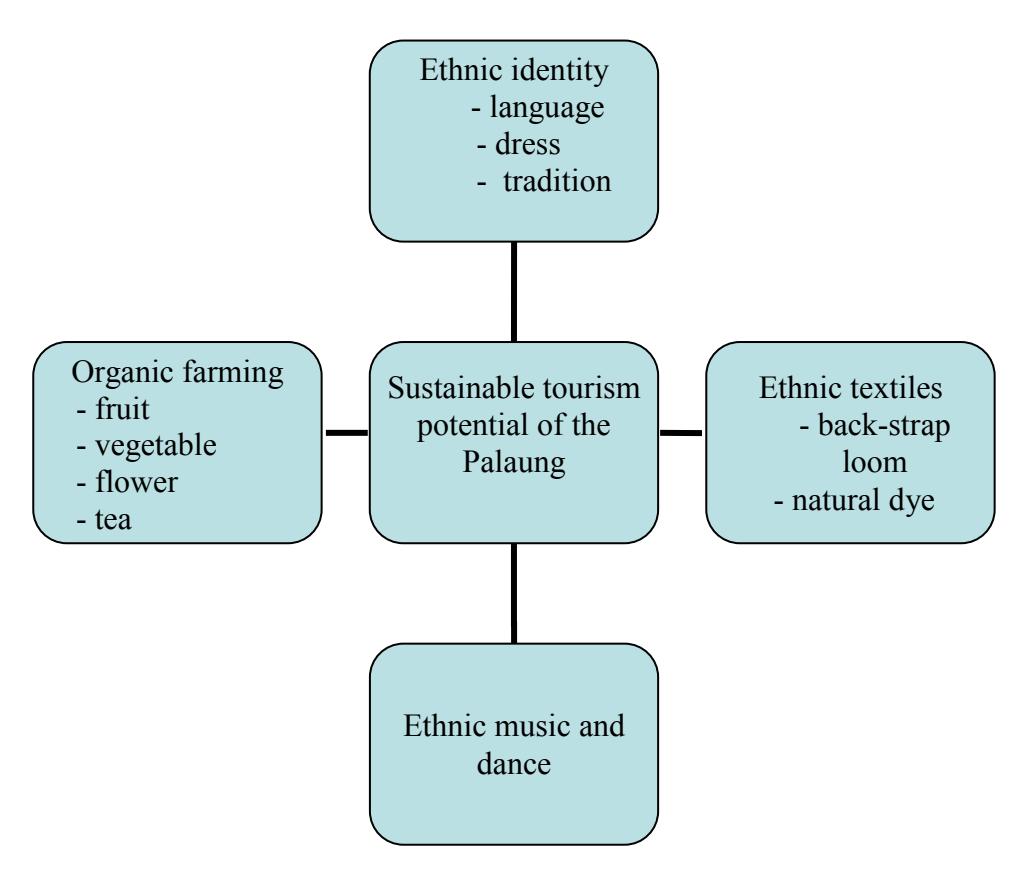
The sustainable tourism potential for the Palaung ethnic group at Nor Lae Village, Fang District, Chiang Mai, Thailand
A GUIDE FOR SUSTAINABLE TOURISM OF THE ETHNIC GROUP
To develop and improve sustainable tourism activities for the Palaung ethnic group at Nor Lae Village, the following guidelines are recommended.
- 1. Establishing a cooperative as a handicraft sales outlet For the sales of the ethnic handicraft products to be more systematic, a cooperative should be established with the active involvement of all stakeholders in the village. There should be an administrative board in charge of management and an accountant responsible for financial affairs. Prices of the products should be standardized in order to calculate for cost and benefit. Every household should be encouraged to become members of the cooperative, so that price cutting can be prevented and benefits can be evenly shared. A more permanent building should be constructed in place of the current makeshift stall.
- 2. Coordinating with concerned state and private agencies for assistance The administrative board of the cooperative should collaborate with concerned state and private agencies for assistance regarding production improvement, product
quality, product designs, and marketing. Since current products are simple in design and impractical in their usefulness for tourists, they need to be redesigned so as to be in line with current consumer needs. The board should request assistance from vocational and educational institutions as their personnel are knowledgeable and professional. Interested residents should be trained to introduce product quality and variety in order to provide tourists with more options. As for marketing and product designs, the Hilltribe Handicraft Center, a non-governmental organization, should be asked to coordinate because the center specializes in ethnic handicrafts and it is operated in collaboration with foreign agencies.
3. Forming interest groups for community empowerment
The villagers should form interest groups with clearly designed goals or objectives for a more power to negotiate. Group formation enables the villagers to receive financial support from local state agencies like the Tambon Administration Organization, which supervises a designated cluster of villages. Each group can submit to the organization proposed projects to be undertaken for each fiscal year. If a project is approved, a budget for the project activities will be allocated. When each interest group is more focused, activities and outcomes are more satisfactory and concrete. One particular group that should be formed is a Music and Dance Group. More young people should actively participate in this group, since very few older people can play the ethnic musical instruments nowadays. The participation of young people ensures the revitalization and maintenance of the ethnic music. The music is vulnerable to becoming moribund because its roles in current Palaung society have become extremely limited. If the revitalization process is not undertaken, its demise would be foreseeable in the near future. One role of sustainable tourism is to conserve the cultural heritage of local communities. When interest groups are actively involved in their activities, they will bring about the community empowerment of the Palaung ethnic group.
4. Promoting sustainable tourism for the ethnic group
Once the sustainable tourism activities of the ethnic group are established, they should be publicized to the outside world. Collaboration with state and private agencies in public relations campaigns should be sought. Some of the agencies may include the royal project, the provincial office, local radio stations and the Tourism Authority of Thailand.
SUMMARY
The aspect of sustainable tourism of the Palaung ethnic group at Nor Lae Village in the Ang Khang Royal Project can be concretely developed with the collaboration from external agencies and from the villagers themselves. If the development of these aspects were made possible, the benefits would not only be about material gains and a better quality of life for the villagers but also about the revitalization and maintenance of the ethnic cultural heritage and wisdom as well as of the traditional lifestyle of these minority people.