

INTRODUCTION
Tourism is a very dynamic sector that is growing rapidly. Not only the number of tourists has grown but also the tourist attraction is increasing diversely. Today, tourism activity has become a right or a part of the lifestyle for many people. The trend of changes and new developments in the tourism sector has began in the period of the 1990s, which manifested from the form of tourist involvement in outdoor activities, awareness of environmental issues and preservation, development of knowledge and education, emphasis and appreciation for the aesthetical values, need for self-development and a desire to interact with the community (WTO, 1998).
World Tourism Organization (WTO) stated that the number of international tourists increased from about 25 million in 1950 to 682 million in 2000. In 2010, the number rose to nearly 900 million people. Tourism 2020 Vision forecasts that international tourists will exceed 1.6 billion by 2020 (WTO, 2011; Goeldner and Ritchie, 2009). The number of foreign tourists who visited Indonesia also increased from approximately 86.1 thousand in 1970 to 2.18 million in 1990, 5 million in 2005, 7 million in 2010, and more than 8 million in 2011 (Ministry of Tourism and Culture, 2006; Ministry of Tourism and Creative Economy, 2012). However, it experienced a decline due to the influence of the security factor (riots in May 1998, the Bali Bombing I and II, etc). It is predicted that number of 10 million foreign tourists will be reached in 2014. The number of domestic tourists also experienced a rapid growth, in which about 245 million people (domestic tourists) in 2011 have travelled to visit tourist attractions in the country with several of motivations (Ministry of Tourism and Creative Economy, 2012).
The term Scientific Tourism is used to describe a type of tourism which include sciences in their travel, such as to observe or study the diversity of flora and fauna in the forest, journeys to observe the behavior of animals or marine creatures, watching the stars and the universe in the observatory, visit the gallery of science and technology, geological excursions or trips to the volcano area, etc. However, this definition has not been supported by a clear scope of scientific tourism. In general, scientific tourism is a form of tourism whose motivation is the interest in science or the need for study and scientific research (http://scientifictourism.blogspot.com). Some examples of scientific tourism in Indonesia were visiting the Boscha observatory (Bandung-Indonesia) to observe planets or space objects and learning tools, visit the farm garden (agrotourism), protected areas, etc.
One of the examples is Operation Wallacea (OpWall), a scientific tourism agency (a tourism research organization) that provide services for young scientists (volunteers) to conduct scientific research in tropical rain forest which has a high biodiversity and rich in culture. Opwall has grown to become the largest agency of scientific advice in Europe that able to recruit more than 1000 volunteers each year for the trip across five countries (Indonesia, Honduras, Egypt, Cuba and South Africa) (http://www.owt.or.id /index.php/en/article/build-ecotourism/ market-travel-fiction).
Bandung, as the capital city of West Java province and is located close to Jakarta (the capital city of Indonesia), has long been known as a tourist city for its natural beauty, the comfort of the air, the hospitality, and the great heritage of historic buildings and works of art. Tourism is one of the main economic sectors of Bandung city, especially since the development of a major tourist attraction in the form of factory outlet shopping, and culinary tourist attraction in some parts of the city. In the constellation of West Java tourism, Bandung together with the Bandung Regency (Regional Development Planning Board of West Java Province, 2006) is one of the main tourism regions in the province, which consist of Bandung urban tourism and education. While in the constellation of national tourism, the city of Bandung is a national tourism destination as well as strategic areas of national tourism and MICE tourism major destinations in Indonesia (Ministry of Culture and Tourism, 2010).
In the Bandung City Spatial Development Plan (2011-2031) and Bandung City Tourism Development Plan/BCTDP (2012-2025), it is also stated the role of Bandung city in service sector, with tourism as one of the main sector. In Bandung City Strategic Plan (2004-2008) by Bandung Tourism Board and also confirmed by BTDP, it is stated the vision of Bandung City Government to make tourism as a strategy to increase city revenue. Based on data from City of Bandung (2004), tourism sector was able to provide a substantial contribution, amounting to 35% of total revenue of Bandung city (Regional Development Planning Board of Bandung City/RDPBBC, 2006). The contribution of tourism sector had increased to 48.4% in 2010 (Bandung City Tourism and Culture Agency, 2012). The number of tourism's contribution to regional income is always above 40% since 2004, except in 2005 (33.3%). The figure represents the largest contributions compared to the contribution of other sectors in Bandung. Based on the contribution to GDP, tourism contributed about 4% -7% (year 2003-2011), which originated from hotels, restaurants, and entertainment services /recreation. This contribution was relatively small compared to the contribution of other sectors, but it has a higher growth rate, which was between 10% to 20% up to year 2010 (Adriani, 2012).
The tourism attraction in Bandung city is very diverse and can be classified as follows (Bandung City Tourism and Culture Agency, 2012):
- 1. Heritage (Heritages).
- 2. Shopping and Fashion.
- 3. Education.
- 4. Entertainment and Recreation (Nature, Culture, Artificial).
- 5. MICE (Meeting. Incentive, Convention, Exhibition).
The diversity of tourism attraction has increased the demand for Bandung urban tourism. Data showed that number of tourists staying in the city of Bandung in 2005 were 1.8375 million of domestic tourists and 91,350 foreign tourists, with growth in the number of visits reached 9.5% for domestic tourists and 6% for foreign tourists (Bandung City Tourism and Culture Agency, 2006). During 2001-2011, the growth of guests staying in the city of Bandung showed a high growth, which is 18.8% per year. The highest growth was in 2003, reaching 76.3% compared to that in 2002, increasing from 946,344 to 1,688,724 guests. Lowest growth occurred in 2006, the number of hotel guests decreased 0.2% from the previous year. The number of hotel guests staying in Bandung in 2011 reached 4,077,072 guests, consist of 3,882,010 domestic visitors and 195,062 foreign visitors, with an average growth over the last three years was 7.5% per year for domestic visitors and 16,4% per year for foreign visitors (Bandung City Tourism and Culture Agency, 2012).
The function of Bandung as education city, especially higher education, is potential for the development of activities with scientific nuances or knowledge nuances. Tourist attraction for the city of Bandung with educational nuance are not only because of the presence of higher education institutions (Institute of Technology Bandung, Padjadjaran University, Parahyangan University, Maranatha University, Islamic University of Bandung, Institute of National Technology, Indonesia Computer University, University of Harapan Bangsa, High School of Tourism, etc.) and various institutions organizing courses but also educational support such as museums (Geological Museum, Postal Museum, Museum of Asia Africa, etc.), a boarding religious school (Daarut Tauhid), City garden (traffic garden, zoo, etc.) and other high-tech industries.
The opening of Cipularang toll road in 2005, which further reduced the time travel of Jakarta-Bandung from 4-5 hours to 1.5-2 hours, had encouraged many population of Jakarta and its surrounding area to visit Bandung, whether to stay or not, and so the number of visitors to Bandung was increasing continuosly. During the period of 2008- 2011, the average growth of traffic through the main gate of Bandung (Pasteur toll
entrance) had reached 29.6% per year, while the growth of hotel guest was 18.8% per year and visitors to the tourist attraction was 3.2 % per year for the period of 2001-2011 (Bandung City Tourism and Culture Agency, 2012). The growth of visitor demand was accompanied by the growth of businesses in tourism and others that related to tourism, which was also high, and some even more than 50%, such as factory outlets, shopping centers, and karaoke. The growths of other tourism businesses were also quite high such as spa, pub, hotel, and restaurants (Adriani, 2012).
Theoretical Review of Scientific Tourism.
Scientific tourism is not a new form of tourism. A clear definition of scientific tourism has been found in a few literatures. The term of scientific tourism is also widely used by the public, even though their activities are often carried out mainly by students from an elementary schools to a high school as well as college students. In recent years, this type of travel is experiencing a growth, which is performed by not only students but also workers.
Definition of Scientific Tourism.
Table 1: Basic Prinsipal of Scientific Tourism To understand the meaning of Scientific Tourism, one should pay attention to the basic principles contained in the terms of "tourism" and "scientific" which based on their definitions from various sources. Basic rules contained in both terms can be divided into two components, namely the objective component and the requirements of component (see Table 1).
| SCIENCES - | Objectives To find an explanation about a certain phenomena | ||
|---|---|---|---|
| TOURISM | correctly Requirements - Logic, Systematic, Methodic, Emphirically proven | ||
| Objectives | Objectives of Scientific Tourism | ||
| - Aims at refreshing or entertainment and | Seeking refreshment/entertainment of a journey | ||
| enjoying the existing tourism attractions | undertaken by doing an activity or visiting the | ||
| existing tourism object to get an explanation of | |||
| Requirements | certain phenomenon properly and broaden the | ||
| - A travel from a certain area to other areas | knowledge for travelers. | ||
| outside of daily routinities both recidence and | Requirements of Scientific Tourism | ||
| workplace | Travel from one place to another place outside the | ||
| - Temporary | daily routine (both residence and work) for | ||
| temporary, to do activities or go to the tourism object | |||
| that presents a logical knowledge with certain | |||
| methods, systematic and empirically provable. | |||
Deduction analysis which based on both components concludes that the Scientific Tourism is a temporary traveling from one place to another places outside the daily routine, to conduct activities or to visit an object that presents a logical knowledge, with a particular method, systematic, and can be proved empirically for the purpose of entertainment as well as improve a knowledge for tourists.
Characteristics of Scientific Tourism.
In particular, characteristics of scientific tourism would be much simpler if it is considered from the tourism components, namely:
- 1. The objectives of tourism is for pleasure, entertainment or refreshment of the journey, by doing an activity or visit to the tourism object/attractions, receiving the correct explanation of certain phenomena which broaden the knowledge and experience of travelers/visitors.
- 2. Tourist attractions or destination has a scientifics element which usually packaged and supported by a variety of explanations, understanding or learning about a particular science.
- 3. Tourist activities are characterized by activities which has scientific nuanced or otherwise, and intended to increase specific knowledge for tourists while touring.
- 4. Most scientific tourists are groups of children and youth (students of elementary schools, high schools, and undergraduate students) as well as certain professionals either individually or in a group.
- 5. The final result of scientific tourism is refreshment, insight and experience as well as increase knowledge for tourists.
The scope of Scientific Tourism.
Scientific tourism covers not only a trip towards the object/tourist attraction that physically shows a scientific merits, but also travel to the object/other tourist attraction that actually has a scientific meaning. A trip or tour packages can be categorized as scientific tourism without relying on the object. Scientific tourism has characteristics as follows:
1. Physical Characteristics.
Physical characteristics are associated with conditions of tourism objects such as landscape, environment, panoramic views, available infrastructures and facilities. Physically, a certain tourism activity can be categorized as a scientific tourism if the attractions or objects have a scientific contents or scientific significance, although it is not specifically packaged into a tourism package with a variety of scientific activities. For example, a visit to the museum, monument or historic buildings, to forests, to the area with a specific geographycal/geologycal characteristics (such as karst, caves, sand dunes, estuaries, volcano etc.).
2. Non Physical Characteristics.
Non-physical characteristics are related to the type, materials and tutorials provided in the activity or packages. Tourism attractions which did not seem to exhibit scientific tourism can also be regarded as scientific tourism when it is performed in an activity or package that is supported by a variety of explanations or study to the visited objects in a logical, clear and systematic ways. For example, visiting national parks, flower gardens, fruit gardens, city parks, etc.
A scientific tourism might not refer to the attractions sites that characterized by scientific characteristics, but rather to the activities which will be done by travelers such as training, learning, and scientific understanding of something. Modern tourism which resembles the actual types of tours is also part of the scientific tourism. The combination of both will give a scientific meaning and greater benefits to the insight improvement and knowledge of tourist.
Figure 2 shows some type of tourim that explicitly and clearly belongs to the scientific tourism, types within the main loop are Geotourism, Science and Technology tourism, Space Tourism, and volcano tour, while some types of tourim that are not included in the scientific tourism is Religious Tourism, Shopping tourism, Nightlife tourism. There are also several types of tourism, which are commonly known in community as well as in literatures, as a part of the scientific tourism such as Ecotourism, Education Tourism, Nature Tourism, Agro Tourism, and City Sight, depend on the condition of objects and activities conducted or packaged trip.
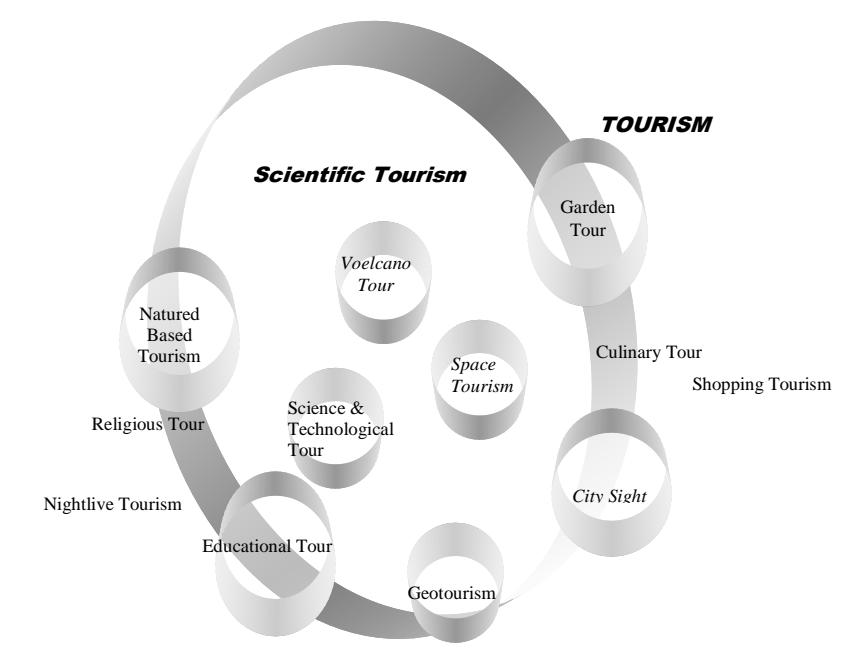
Figure 2. Position of Scientific Tourism and other forms of tourism
Sources: Results of Analysis.
Classification and Criteria of Scientific Tourism.
Tourism can be categorized as a scientific tourism when the content of each tourism element and scientific elements are almost equal (50% of tourism element and 50% of scientific elements) or the scientific elements is greater than the tourism element. Figure 3 shows that the far right position of tourism object/activity is heavy on the scientific sense and, otherwise, the far left position of tourism object/activities is to the more usual tourism activities. However, scientific tourism is not in the most right point (5), and it is not in the most left point (1), because the most right boundary is a scientific activity without any element of tourism at all while the most left boundary is tourism without the slightest scientific elements. When a line in figure 3 is divided into five points, the scientific tourism is not only at point 3, but also at point 2 and 4.
Figure 3. Classification of Scientific Tourism

Objects of scientific tourism could be viewed from three main criterias, which are:
- Objectives and function of tourism attractions development.
- Main tourism attractions.
- Dominant activity of the visitors as a justifications of tourism attraction to generate the activity of visitors.
The activitiy of scientific tourism also could be viewed from three main criterias:
- Purpose of travel/visit.
- Activities during travel.
- Packages of travel.
Each of these criteria was classified into three classifications of scientific tourism, based on the existing content of tourism elements and scientific elements. Object or acitivities of scientific tourism at point number 2 in Figure 3, is known as Object/Activity of Scientific Tourism Type 1, where the tourism element is more dominant than the scientific element. Furthermore, at point 3 is Scientific Tourism Type 2 with tourism and scientific elements are relatively balanced. At point 4 is Scientific Tourism Type 3, where the scientific element is more dominant than the tourism elements.
Identification of Scientific Tourism Objects in Bandung City.
In principle, nature itself have the scientific/knowledge meanings, so there are many phenomena in nature which can be something scientific if the package contains various rules discussed earlier, although until recently there are still many things that can not be scientifically proven. To clarify them, the scientific sights usually have specific link to a particular science or have a special uniqueness in the field of science. In the next development, tourism objects which currently are not categorized as a scientific tourism objects, one day might be potentials for scientific tourist attraction. The results of analysis of the existing tourist attraction in the city of Bandung indicated that there were at least 13 major scientific tourist attractions, and there were many more that could be utilized for the development of tourism in the future. The identification of these scientific tourist
attractions were based on the characteristics of the existing various tourist attraction recently (Table 2).
Table 2. Scientific Tourism Attractions In Bandung City
| No | Classiification of Scientific | Scientific Tourism of Bandung | ||||
|---|---|---|---|---|---|---|
| Tourism Objects | ||||||
| 1. | Type 1 | Traffic Garden | ||||
| Udjo Bamboo Musical Gallery | ||||||
| 2. | Type 2 | Sabuga Galery of Knowledge and Technology | ||||
| Forest Garden of Juanda | ||||||
| Zoological Park | ||||||
| Geological Museum | ||||||
| Cultural Museum of Sri Baduga | ||||||
| Museum of Mandala Wangsit | ||||||
| Museum of Indonesian Post | ||||||
| Museum of Asia and Africa Conference | ||||||
| Grand Mosque Tower of West Java | ||||||
| 3. | Type 3 | Indonesian Aerospace Industry | ||||
| Centre of Industry for Army (PINDAD) | ||||||
| Bandung Institute of Technology | ||||||
Sources: Result of Analysis, 2012; Regional Development Planning Boards of West Java Province-2010; Bandung City Tourism and Culture Agency, 2012
Scientific Tourism Type 1.
Based on above criteria, the tourism facilities in scientific tourist attractions type 1 was more than the facilities with scientific nuances. The facilities consisted of playground facilities, parks, entertainment facilities and others. The facilities which related to scientific explanation might be consisted of a demonstration and an explanation on the application of science, function of reading rooms and books, museums and so on.
In general, the condition of tourism attractions on this type was managed fairly well, the number of visitors also relatively large so that managers could obtain adequate funding to manage the tourism objects. Specifically, direction of development of this type of tourist attraction depended on the characteristics of each tourist attraction which has a unique and different problems in each attractions, such as parking problems, site plan, management, cleanliness, and others. However, the sustainability of this type of scientific tourism will not face a significant problems.
Scientific Tourism Type 2
Conditions of the second type of scientific tourism was somewhat diverse, in one case the condition and ongoing development at some tourist attractions were very well maintained by the management, while in some other cases were stagnated and even regressed. Some tourist attraction seemed to be less developed due to the lack of tourist interest, so that managers did not have sufficient funds to make improvements or development, even the existing management was still subsidized by a variety of sources such as the salaries of managers and related agencies.
But in some scientific tourist attraction type 2 showed that tourist facilities was relatively balance such as found in the Zoo. Based on the aspect of function and zoo visitors, it showed that there was a clear trend in the type 2 of scientific tourist, where it functions as a tourist attraction and a means of learning science was evident, and visitors were not only the students but also the public. The other type 2 of scientific tourist had no adequate tourism facilities, but the function and character of the visitors could justify functions not only as the object of study but also as tourism objects/sites.
In some of tourism attractions with a low visitors, the sustainability and development of tourism obyects might face a problem if there was no subsidies, such as in the Indonesia Postal Museum, Mandala Wangsit Siliwangi Museum, Asian-African Conference Museum, Museum of Science and Technology in Sabuga Gallery. Therefore, the management should focus on improving the facilities, attractiveness, promotion and cooperation among similar tourist obyects through certain travel package or a company and other related institutions.
Scientific Tourism Type 3.
The condition of the third type scientific tourism objects, in general, was very well maintained, that was because tourism object was usually in the form of a company engaged in both industry and education. The number of tourist arrivals was still very limited, as the purpose and function of the object was not intended for tourism, so the policies was not directed to tourism development. Thus, the low number of visitors was not because the low interest of tourists to visit, but there was indeed a policy of limiting/setting the number of visitors and the schedule of visits so it did not disturb the main activity. In general, visitors were from a very specific groups such as students and professionals in related fields.
Related with the function of facilities, the scientific tourism of this type was usually dominated by a various attractions related to the core business, in this case more on facilities and science-related to industries. Therefore, the development should be directed to develop a tourism as a new side business and to increase a new tourist facilities.
The activity of Scientific Tourism.
Scientific activity is basically seen as a process or an activity, therefore the object of scientific tourism generally shows the existence of a process of scientific thinking and provides the opportunity for visitors to conduct a scientific activities, and would be more meaningful if someone doing the scientific tourism activities in scientific tourist sites. It has been discussed earlier that the scientific tourism are associated with two things, which are scientific tourism objects and scientific tourism activity, so if both are combined there will be three combinations of products, namely: (1) A tourism travel with scientific activities although the targeted object does not belong to the categories of scientific tourism, (2) a journey through a variety of scientific activities in the scientific tourism site, (3) A purely tourism trip, without a scientific nuances, to scientific tourism attractions.
Activities of scientific tourism would be optimal if they visit the scientific tourism objects, because of the existence of scientific attractions and amenities. However, it can also be done in a few other places without having to rely on the objects that are included in the category of scientific tourism obyects.
Table 3. Identification of Scientific Tourism Activities
| No. | Classification | Scientific Tourism Activities in Bandung City | ||
|---|---|---|---|---|
| 1. | AWI Type 1 | - Exploring urban forest | ||
| - City Sight Seeing | ||||
| - Outdoor Training | ||||
| 2. | AWI Type 2 | - Observe flora, fauna and endangered species | ||
| - Observe architectural sites | ||||
| - Observe archaeology sites | ||||
| - Observe heritages and cultural sites | ||||
| 3. | AWI Type 3 | - Visits and observe laboratory and education facilities | ||
| - Visits to centre of research and high tech industries | ||||
Result of Analysis, 2012;
Table 3 showed that various scientific tourism activities could be identified in each type of scientific tourism. Based on the table, it appeared that quite a lot of scientific tourist activities could be done in Bandung. The development of existing scientific tourism in Bandung was also influenced by the condition of community, that were rich in creativity. Related agencies, such as the Local/District Tourism Agencies or tourism-related associations could provide an innovations, inspire a motivation and enhance creativity in the community to conduct tourism activities while improving insight/knowledge by conducting scientific tourism activities.
Typology of Tourists
Number of tourists visiting Bandung city had increased from 4,495,745 visitors in 2008 to 6,712,824 visitors in 2011. In 2011, every weekend there was an increase amounted to about 125,000 vehicles come to Bandung. This figure had increased by more than twofold compared with the figures for the year 2009, approximately 60,000 vehicles (Statistical Bureau of Bandung City, 2012 and Adriani, 2012). Based on data from the 13 scientific attractions that had been identified, the highest number of visitors was in Bandung Zoo (484,180 visitors), while the number of visitors on other scientific sights on average was less than 10%. About 85% of foreign tourists who visited the scientific tourist attraction mostly visited the scientific tourism of Udjo Bamboo Musical Gallery (Bandung City Tourism and Culture Agency, 2011).
Number of Visitors to Tourism Attractions of Bandung City, 2010
| Number of Visitors | ||||
|---|---|---|---|---|
| Tourism Objects/Attractions | Domestic | Foreign | T O T A L | |
| Zoo | 768.462 | 1.026 | 769.488 | |
| Traffic Garden | 228.030 | - | 228.030 | |
| Karang Setra | 112.901 | - | 112.901 | |
| Zoology Museum | 397.154 | 3.574 | 400.728 | |
| Geological Museum | 31.554 | 180 | 31.734 | |
| Indonesia Post Museum | 153.059 | 9.557 | 162.616 | |
| Asia Africa Conference Museum | 6.782 | 76 | 6.858 | |
| Museum of Mandala Wangsit | 163.801 | 754 | 164.555 | |
| Museum of Sri Baduga | 49.729 | 173 | 49.902 | |
| Udjo Bamboo Musical Gallery | 107.759 | 24.064 | 131.823 | |
| Daarut Tauhid (*) | 7.044 | 117 | 7.161 | |
| Total of Visitors | 2.026.275 | 39.521 | 2.065.796 | |
(*) data of 2009
Sources: Bandung City Tourism and Culture Agency, 2011.
The public visit, however, was still relatively very small. Their visit to scientific tourism attractions were due to common entertainment facilities and possibilities for recreational activities or refreshing. Therefore, the scientific tourism attraction visited by many people was usually scientific tourism type 1 and some of scientific tourism type 2 such as Zoo, while a scientific tourism obyect type 3 was rarely visited by the public.
Based on the typology of tourists, it seemed that most visitors were primarily from group of students, so students was and is still the main market of scientific tourism objects. There were about 1800 schools in Bandung (2006) ranging from kindergarten through
high school and vocational. In addition, there were 86 universities and colleges which consisted of 8 public universities and 78 private universities (Statistical Bureau of Bandung City, 2007). With so many educational institutions, there were hundreds thousands of students who might become a potential visitors for scientific tourism, including the schools in the regency of Bandung, the city of Cimahi, West Bandung regency and surrounding area, as well as the growing community who interested in scientific tourism.
Facilities needed to support scientific tourism in Bandung. Accessibility, Infrastructure and Transportation.
In general, the city of Bandung has a good accessibility, especially through land. Public transport facilities is available with a variety of transport modes such as bus, city transportation, taxis, and trains. Bandung can also be reached by air transportation although the flight route and frequencies are still limited in both the number of departures and destinations. Recently, international flight (Bandung-Singapore and Bandung-Kuala Lumpur) was opened, thus providing convenience and accessibility for tourists from Malaysia and Singapore to come to Bandung. Accessibility to Bandung by road was also increased, especially after the construction of Purbaleunyi or Padaleunyi toll roads. Service of transport in terminals and train stations with adequate number of bus as well as train are available from and to Bandung. Based on the availability of roads, the length of roads in the city of Bandung in 2001 was 1071.198 km, which increased compared to the previous year (2000) with 932.701 km road length, i.e., a growth of 0.2 to 0.5% of the road network per year. In 2005, the total length of roads in the city of Bandung reached 1.221.69 km, and in 2010 increased by 0.2 percent per year or become 1,236.48 km (Statistical Bureau of Bandung City, 2010).
In 2006, availability of parking space in Bandung city was 238 locations of public parking locations consisting of on-street parking, parking building, and parking lot. That number decreased compared to conditions in 2003. The area of parking plot decreased continuesly until 2010 which was only 228 locations (Statistical Bureau of Bandung City, 2011). The decreased of parking plot was caused by parking restrictions on certain roads, utilization of parking lot for other purposes, and land-use change to other functions.
Availability of facilities and infrastructure affected the volume and frequency of movement to the city, particularly for the tourists who come to the city of Bandung, and movement in and around the city of Bandung. Based on the volume of vehicles entering the city of Bandung, the number of vehicles (cars) that enter Bandung through Pasteur toll gate was 7 million units in 2005 (Statistical Bureau of Bandung City, 2005), and then increased to nearly 50% in five years later, which was 10 million (Statistical Bureau of Bandung City, 2010). It was estimated about 2.5 million of tourists coming to Bandung in 2006 (Bandung City Tourism and Culture Agency, 2006), and then increased to 6.7 million in 2011 (Bandung City Tourism and Culture Agency, 2012). The amount was greater than the population of the city of Bandung, which was nearly 2.4 million people in 2010 (Statistical Bureau of Bandung City, 2011).
The number of vehicles in the city of Bandung reached 1.196.813 units with a growing number of vehicles reaches 9.4% per year during 1999-2010. The ratio between roads increased per year with number of vehicles in the city of Bandung was about 1: 6. The road area was only 2% - 4% used for the movement of vehicles, while ideally was about 10% to 30% of the city area have to be allocated for the movement of vehicles (Statistical Bureau of Bandung City, 2010). According to Bandung City Spatial Plan period of 2011- 2031, the availability of roads in Bandung was still less than 3% of the city area, whereas the ideal area for roads in a region should reach 15% -20% of the total area (Adriani, 2012). Incompatibility in availability of road infrastructure with the volume of vehicles was one of the main causes of congestion in the city of Bandung. Most of the existing road infrastructure was also not optimally used for traffic, since part of the road was often used for parking, markets spill over and street vendors. This certainly reduced the road capacity which was already low.
Therefore, one of the main problems faced by the city of Bandung and will influence the development of tourism of the city was traffic congestion, especially on weekends and holidays. This congestion was partly due to the volume of traffic had exceeded the capacity of roads, lack of land or parking facilities in major tourism areas, lack of discipline in driving, etc. These eventually will affect the number of tourist arrivals to Bandung. In 2008, it was estimated that there were 42 congestion points or traffic jam in the city of Bandung (Yudiawan, 2008) where nearly half of them was the locations of urban tourism development activities of Bandung city. Furthermore, according to the Office of Bandung Police that in 2011 there were 532 congestion points and 12 prone congestion roads. Apart of Cibiru district, these eleventh-prone congestion roads were located in areas with a very low to a very high concentration of the elements of tourism product.
Accommodations and Supporting Urban Tourism Facilities of Bandung.
In 2011, the number of hotels in the Bandung city was 298 units which consist of 206 units of non-stared hotels and 92 units of stared hotel (Bandung City Tourism and Culture Agency, 2011). Most hotels were concentrated in the development region of Cibeunying
(40%). The availability of different types of accommodation could provide an access for visitors or tourists who wanted to stay in Bandung. Restaurants and food stalls were also numerous and diverse, ranging from restaurant which serves local (Sundanese) cuisine, and China, Japan, Korea, as well as Padang cuisine restaurants, seafood and others. The abundance number and diverse of places to eat as well as food variety made Bandung also known as a tourist destination for culinary.
In 2011, there were more than 120 tourism bureaus which spread across various parts of the city, and two tourist information centers (Bandung City Tourism and Culture Agency, 2012). In Bandung city, there were also many kinds of handicrafts and souvenirs shops which had a uniqueness or characteristics and become an attraction for visitors, such as the presence of leather handicraft industry at Cibaduyut area, jeans and clothing trade area of Cihampelas, and various souvenir shops and art galleries in other tourist areas.
The level of comfort of Bandung City.
Besides accessibility, accommodation facilities and restaurants, the convenience and safety of a tourist destination also affects the interest of tourists to visit the city. Although comfort in the city of Bandung was still generally high, it could decrease if it was not followed by the efforts to manage various tourism components. Based on the safety conditions, the city of Bandung was one of metropolitan cities that quite safe, which could be seen from the stability of security conditions and a relatively low in violence rate. However, symptoms in decreasing of security condition may appear, which could be seen in the increase of crime rate in the last few years.
At first, Bandung city was planned as a garden city which could be occupied by a limited number of people (200,000 inhabitants). However, in year 2000, the city with an area of 167.67 km2 had population of 2,141,837 person, and increased to 2,394,873 inhabitants in 2010 (Bandung City Tourism and Culture Agency, 2012). The population growth of Bandung city (1.86% per year during the 1980-1990 period, and less than 1% per year in the period of 2000-2010) was relatively low if it was compared to other large urban population growth in Indonesia. However, the mobility of people from surrounding Bandung city, especially from the district of Bandung, the city of Cimahi, West Bandung regency, were relatively high which then caused the number of population of Bandung city during the day was much larger than the actual population of Bandung.
The function of Bandung city as a center of growth and activity had generated and pulled the traffic and people as well as good and services from surrounding areas. The function of Bandung city as a rest area or tourism city also generated a traffic and movement from Jakarta, mainly during weekends and holidays. High number and density of population had resulted in inconvenience in Bandung such as traffic congestion, hotter air
temperature, difficulty of finding jobs, etc. could cause growth of population decreased significantly.
Air temperature in Bandung is getting hotter now, which is observe in the continue rise of average temperatures in Bandung. Deterioration of the air quality in Bandung might be caused by decreasing of green open space, in particular decreasing of city parks, which then increased air pollution. Bandung air pollution levels was around 70% due to transportation activities, the rest was from non mobile sources such as industry and waste incineration. Air pollution that caused by transportation was getting higher due to traffic congestion which was getting worse.
Strategy of Scientific Tourism Development.
Planning and development of city tourism is influenced not only by the condition of the existing tourist attraction but also by other factors associated with urban conditions such as urban infrastructure, safety, comfort, etc. Therefore, strategy to develop a sustainable scientific tourism needs to involve other related sectors.
Tourism Attractions Development Strategies.
- Enriching the knowledge element on any existing attractions with more innovative and variations without ignoring the existing entertainment elements, and it is packed attractively based on each uniqueness.
- Develop, empower and explore a variety of potential scientific tourism objects or attraction.
- Explore an investment opportunities for the development of scientific tourist attraction and provide an opportunity for investors to invest.
Promotion Strategies.
- Socializing and promoting a Scientific Tourism through various means or media.
- Building a positive image in the community about opportunities to improve insight and knowledge through tourism.
Management Strategies.
- Improve and reinforce the government's role as a prime mover rather than as a manager of a tourism object.
- Managing scientific tourism by considering social, economic and physical sustainability, and involving communities.
Spatial Strategies.
- Providing and developing a route to scientific tourism obyects such as travel packages to nearest tourism obyects.
- Optimizing an existing road networks by increasing road capacity, through road widening and building a new road, as well as managing informal traders along streets or street vendors.
- Improving accessibility and facilities of Bandung city.
Supporting Strategies
- Build a cooperation among members of scientific tourism objects and group potential markets such as schools and colleges or universities and other educational institutions.
- Strengthen and build an institution, involving all existing stakeholders which consist of manager of a tourist attraction, tourism associations, government agencies as well as travel agencies.
- Improve comfortability and environment quality of Bandung together with the community, i.e.through various programs in environmental management, such as maintaining the trees and the city park.
- Prepare a scientific tourism development policy of Bandung.
Conclusions.
Tourism sector is growing rapidly, not only in developed countries but also in developing countries, including Indonesia. Tourism activity has become a part of the lifestyle for many people. Number of tourists, both international and domestic, are also experiencing a rapid growth. Types of tourist attractions are more diverse, including scientific tourism.
In principle, scientific tourism can be divided into two forms, namely 1) as a scientific tourism activity and 2) as a tourist attraction. The activities undertaken should reflect an understanding process or a scientific learning while traveling. Tourism attractions should have a meaning and explanation about various scientific knowledges.
Tourism in Bandung city is also experiencing a rapid growth, especially in the last ten years when Purbaleunyi toll road (connecting Jakarta to Bandung) and flyover in the city has been operated. The number of tourists to Bandung is still dominated by domestic tourists, especially those from Jakarta. In Bandung city, there are also several scientific tourist attractions, but numbers of visitors are still relatively small. Some of the factors that cause small number of tourists visited tourist attraction in Bandung were a low interest of tourist on scientific tourism, unattractive packaging, limited supporting facilities, lack of promotion. Scientific tourism that had a high number of visitors was scientific tourism that had high content of recreational aspects such as the zoo and the park traffic or those which attractively displayed such as Geology museum, while most scientific tourism that had a low recreational content usually had a low number of visitors.
Strategies and program for development of sustainable scientific tourism in Bandung city needs to involve other related sectors. Those strategies include promotion, improve a packaging, cooperation with educational institutions (schools), improve the quantity and quality of facilities, and improve the quality of human resources, management, and other important supporting programs.
REFERENCES:
- Adriani, Yani (2012), Perception and Preference of Urban Community for Bandung Tourism Development Planning. Final Project, Graduate Program in Tourism Planning, Schools of Architecture, Planning and Policy Development, Institute of Technology Bandung.
- Alwi, Hasan (2002), Kamus Besar Bahasa Indonesia. Edisi ketiga. Balai Pustaka: Jakarta
- Bandung City Tourism and Culture Agency (1997, 2006, 2011, 2012), Bandung Tourism Development Plan.
- Dahlan, E. N. (2003), Forest Resources as a Science and Research Objects. Graduate Program, Bogor Agricultural University.
- Department of Education and Culture (2002), Dictionary of Indonesian Language. Balai Pustaka Jakarta.
- Geological Research and Development Centre (2001), Geotourism of Bandung and it surrounding areas.
- Gie, The Liang (2000), Introduction to Philosophy of Science. Liberty Yogyakarta.
- Goeldner, Charles R and J. R Brent Ritchi (2009), Tourism; Principles, Practices, Philosophies. Eleventh Edition. John Wiley and Sons.
- Kodhyat (1996), Development of Alternative Tourism. Boards of Indonesian Tourism Study.
- Manktelow, James (2004), SWOT Analysis-Undestanding Strengths, Weakness, Opportunity and Threat, www.mindtools.com
- Ministry of Tourism and Creative Economy (2011, 2012), Statistics of Tourists 2010, 2011, 2012.
- Ministry of Tourism and Culture (2006, 2010), Statistics of Tourists 2006, 2010.
- Nasoetion, Andi Hakim (1999), Introduction to Philosophy of Science. Litera AntarNusa.
- Page, Stephen J and Michael Hall (2003), Managing Urban Tourism. Prentice Hall.
- Pikiran Rakyat (2002), www.pikiran-rakyat.com, Monday, 4 November 2002.
- Regional Development Planning Board of Bandung City (2006), Regional Development Working Plan of Bandung City, 2006.
- Regional Development Planning Board of Bandung City (2011), Spatial Development Plan of Bandung City, 2011 – 2031.
- Regional Development Planning Board of Bandung City/RDPBBC (2006). Bandung Tourism Development Plan.
- Regional Development Planning Board of West Java Province (2010), Spatial Development Plan of West Java Province.
- Republic of Indonesia (2009), Regulation Number 10, Year 2009, Tourism.
- Republic of Indonesia, Directorate General of Tourism (1993), Tourism Data and Statistics.
- Republic of Indonesia, Ministry of Culture and Tourism (2006, 2010), Tourism Data and Statistics.
- Rosyidie, Arief (1994), City Tour for Bandung Urban Tourism. Journal of Regional and Urban Planning, January, Vol 9.1.
Scientific Tourism Course, www.planetativo.org
Scientific Tourism in Trieste, www.triestetourim.it
Scientific Tourism, www.sanluis.gov.ar
Space Tourism-How to Get to Space, www.spacefuture.com
Statistical Boards of Indonesia (2012), Visitors Arrival to Indonesia.
Statistical Bureau of Bandung City (2002, 2005, 2007, 2010, 2011, 2012), Bandung City in Numbers, 2002, 2005, 2007, 2010, 2011.
UNWTO (1999), Global Code of Ethics for Tourism, Department of Culture and Tourism, Jakarta.
UNWTO (2011), UNWTO Annual Report 2011.
Webster's New World College Dictionary, 1202.
World Tourism Organisation (1998, 2000, 2011, 2012), Annual Report.
Yoeti, Oka A. (1996), Introduction to Tourism. Angkasa Bandung.
Yudiawan, (2008), Study of Traffic Congestion in Bandung City. Script Undergraduate Program in Education, Indonesian University of Education, Bandung.
Scientific Tourism, Food, and Nature (2010), Definition of Scientific Tourism. http://scientifictourism. blogspot.com.
http://www.owt.or.id /index.php/en/article/build-ecotourism/ market-travelfiction).