

INTRODUCTION
Assam is a part of mega biodiversity hotspots of the world. It also fo rms parts of two endemic bird areas, viz. eastern Himalayas and Assam plain (Choudhury, 2000). Nameri National Park is a part of the north bank landscape designated by WWF and also a part of Eastern Himalayan biodiversity regime rich in endemic biota of the world.
The study region covers Nameri National Park of Assam located in 26o50/48//N to 27o03/43//N Latitudes and 92o39/E to 92o59/E Longitudes covering an area of 200 km2 in the northern bank of river Brahmaputra, in Sonitpur district of Assam. Nameri is covered by tropical evergreen, semi-evergreen, moist deciduous forests with cane and bamboo brakes and narrow stripes of open grassland along rivers. Grassland comprises of less than 10 per cent of the total area of the park while the semi-evergreen and moist deciduous species dominate the area. The park is enriched with threatened plants and animal species under International Union for Conservation of Natures (IUCN) Red List categories (Barua et al. 1999). Parts of the area were declared as Naduar Reserve Forest (Present East Buffer) in 1876 and Nameri Wildlife Sanctuary in the year 1985. The Nameri National Park was formed in the year1998.
During the British period this rserve forest was designated as Game Centuary for hunting of animals. Presently no village is sitauated inside the core area of the park. There are
* Corresponding author, email: das_niranjan2002@yahoo.com
1 Tezpur University, Sonitpur (Assam), INDIA
4(four) forest villages and 1(one) agriculture farming corporation has been situated in the west buffer of the park. Similarely 5(five) forest villages are located in the east buffer. There is a total of 18(eighteen) revenue villages situated outside but along the southern and south-western boundary of the park. The villagers in the south buffer area are dependent on the park for sustainance of their livelihood. They have been traditionally engaged in collection of NTFP (non timber forest produce) and grazing of livestock. A sizable proportion of local populace is also engaged in ecotourism activities as tour guide, providing local accomodation, selling handicraft, engaging in the ecocamp, etc for their livelihood (Bhattacharya, 2003).
The Assam (Bhorelli) Angling & Conservation Association (ABACA) in the park has been organizing white water rafting with the assistance and cooperation of the department of sports; department of tourism and department of environment and forest, Government
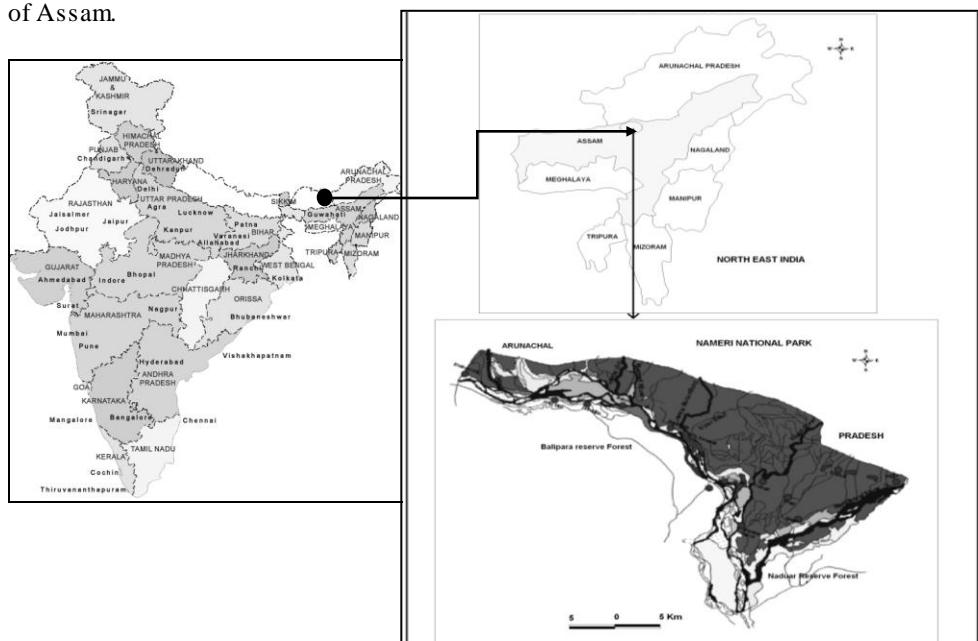
Figure 1. Location Map of Nameri National Park
LITERATURE REVIEW
Studies on tourism and livelihood are of recent origin and the available literature/ records in this field are rather few. However, much of the studies done earlier are mostly confined to the areas outside India. Such studies are inherent in analysis pertaining to tourism industry itself.
Gossling (1999) suggests that nature-based tourism is derived from the existence of natural areas with no specific concern for their protection, whereas ecotourism is concerned with the protection of natural areas (Naidoo, 2005). Typical services offered at ecotourism destinations might include local arts and crafts, guided hikes and wildlife viewing, publications, natural history lectures, photography, and local food. Revenues are generated from fees for these services, as well as natural area user fees and local expenditures for hotels, restaurants and bars, and transportation services (Seidl 1994).
Orams (1995) argues that ecotourism must provide more than mere enjoyment; it must foster changes in the attitudes and behavior of tourists about the protection of natural resources. Researchers also have discussed ecotourism in the context of the tou rism life cycle (Butler 1980).
Measuring the economic impacts of tourism and outdoor recreation has received considerable attention in academic literature (Eadington and Redman 1991, Frederick 1992). Economic impacts generally are examined within a cost benefit framework (Dixon and Sherman 1990, Walsh 1986) with the benefits measured by using expenditure surveys combined with input-output analysis (Briassoulis 1991, Propst 1985). Travel cost or contingent valuation methods also are commonly used to place dollar values on natural areas or marginal changes in their characteristics (Bostedt and Mattsson 1995, Durojaiye and Ikpi 1988, Echeverria and others 1995, Forster 1989, Lee 1997, Lee and others 1998, Loomis 1989, Moran 1994). Measuring economic impacts or values derived from tourism necessitates differentiating between the economic benefits derived from the various forms of tourism. One of the problems in determining the economic impact of ecotourism, for example, knows what is meant by the term (Tisdell 1996). Differentiating between economic benefits derived from ecotourism and those derived from general tourism can depend on how each is defined (Goodwin, 2002). When ecotourism is defined less restrictively, as simply tourism derived from nature preserves, parks, or refuges, researchers tend to assume that all economic impacts derived from those natural areas are ecotourism-derived impacts (Boo 1990). Economic impacts are measured by using expenditure surveys of tourists visiting those areas. Tourism expenditures assumed to be generated by a particular natural area may be reported for a well-defined geographic area (English 1992). An alternative to surveying tourists is surveying local businesses (Kangas and others 1995) and residents (Lindberg and others 1996). When ecotourism is defined more restrictively and confined to particular types of tourism activity or particular types of tourists, researchers attempt to segment tourists into the categories of ecotourist and general tourist
ETHNIC IDENTITIES OF LOCAL POPULATION
The forest villages located in the area acquire culture of different ethnic groups. The Mising, Garo, Karbi, Bodo, Napali, Adivasi and other groups of indigenous community resides in the south buffer area.
The Mising people, a rivirine community resides in the forest villages of both buffers as well as in the revenue villages of south buffer. There are 2 (two) villages of native Mising community in the area. They are tribal people with their own identity as 'Pile dwellers' (house with elevated floor from the ground on posts) made of wooden or bamboo posts, floor and walls and thatch or palm leaf roof covering. Rearing cattle for agriculture farming, poultry and pigs are the main source of livelihood of the community. People belong to the community weave their clothes in their traditional loom for their dresses as well for selling them to earn. Traditionally Misings are good in bamboo and cane crafts. The Karbi people also 'Pile dwellers'. But now a day they have constructed their house on plinth level (modified house). They also rear cattle for their agricultural purpose.
Karbi people rear poultry and pigs for their economic benefit. Weaving of clothes in their traditional loom is a long drawn process of the communities' tradition, but their population is limited in the forest villages.
There is one Garo forest village in the west buffer. Earlier they were 'Pile dwellers'. But at present they are gradually shifting to plinth houses. They also cultivate in the paddy
field and rear cattle, poultry and pigs. They use to collect their agricultural implements locally.
Four Bodo forest villages are situated one each in both east and west buffers. They are having their own customs and culture. They also construct their dwelling houses mostly by locally collected building materials. Bodo people rear cattle for farming and also rear poultry and pigs. They are good in bamboo and cane crafts.
The Napalese are traditionally cattle rearer. They also cultivate their land and some of them rear poultry and pigs. They are very much dependent on the forests for rearing cattle. Napalese are good in dairy products.
The Adivasis (ex tea garden labourers) are mostly cultivators. Some of them are dependent on forests for collection of wild tubers and roots for their con sumption, other household materials and implements. They work in their paddy fields or village agricultural labourer. Adivasis have their social customs and traditions of community hunting, which is now very much limited.
The other communities of the locality are mostly cultivators. People also rear cattle and poultry and good in bamboo and crafts. Relationship of these people with forests is not very close as they are deprived of grazing of their cattle; collection of firewood and other agricultural implements has been stopped since constitution of the National Park. Though bamboos are locally grown but cane and thatch were collected from the forests, which are now being stopped by the park authority. All these have aggravated the people, as they do not have alternative source for their requirements.
STATUS OF ECONOMY, LAND USE AND FOREST RESOURCES
The forest villagers mostly depend on agriculture. There is no industry nearby for employment. Most of the villagers are below poverty line and as such they depend on the well to do households of the villages for their employment as seasonal agricultural labour. The vocations of the villagers are limited to cottage industry particularly cane and bamboo crafts, carpentry etc. Some people are adopting dairy farming with the traditional system and indigenous cattle variety. Earlier some people used to work in riverbed sand and gravel quarry in the park, but due to creation of national park the same has been stopped and the unemployment has increased.
The lands in possession of the villagers are used mostly for their small homestead where they marginally grow areca nut, banana, bamboo and other vegetables. Very limited people have fuel wood in their homesteads. The paddy lands are cultivated for one crop only due to lack of irrigation facilities. People use to collect their firewood and agricultural implements and house construction materials from the forests of and the buffer area. Grazing has been done in these areas. Seasonally some villagers do take up cottage industry of weaving bamboo and cane crafts.
The land use pattern of the locality is gradually changing by way of increasing horticulture, fishery etc. The irrigation facility and acceptance of modern agriculture improves the economic condition of the people. Due to high dependency of the people on the resources of the forests the conservation of the park has become difficult as the community land reserved for the villagers is insufficient and has been utilized for agricultural and other developmental works. The fallow land near by the areas has been decreases due to encroachment.
Objectives
The objective of the present study is:
- i. To highlight the resource base of the Nameri National Park; and
- ii. To evaluate the ecotourism on livelihood intervention of the community in the park.
RESEARCH METHOD
The present reserach is based on data collected between Januaray and April 2013 using semistructured interviwes, and update using information gathered during successive local meetings. A process of tringualtion was ensured where by key informants and focus group were interviewed and different sites (e.g. homestead, ecocamp, village market, river bank and in the forest) visited. Snowball sampling procedure was used. This is a procedure where the researcher start off with one informant who in turn introduces the next person considers usefull to the investigation. Interview questions touched on livelihood options, wildlife conservation, and tourist resource management. The operation of ecocamp and the management committee was also invesitigated. A total of 28 individuals (10 local tour guide, 6 women group, 4 boatmen, 4 cultivtor and 4 four forest personal) interviewed during the visit.
ECOTOURISM ACTIVITIES IN THE PARK
Protected areas have great potential for recreation and ecotourism. Recreation and ecotourism have been introduced into protected areas which have helped to reveal the ecological value and fragility of the area (Brechin, et. al. 1991). The impression of Nameri National Park on tourists and visitors has always been associated with outdoor recreation. Despite being small in area, it has a significant array of landscape, scenic beauty and cultural variety of the communities residing near the park. This natural setting also embraces a variety of ecological habitats and various animals and plant species, essential for the development of ecotourism (Bhattacharya, 2004).
As mentioned in the previous section, Nameri National Park and its adjoining areas are rich in culture with different communities inhabiting there. Ecotourism tries to preserve cultural integrity because human value cannot be separated from natural value. Most potential ecotourism sites are inhabited by ethnic minorities (Nepal, 2000). The principle of 'encouraging community participation in ecotourism activities' create income and maintain cultural identity of the host community. These communities have a deep understanding of traditional festivals, cultivation and land use customs, culinary culture, traditional lifestyle and handicrafts including historical places (Zurick, 1992). Ecotourism highly depends on the elements available in a particular tourist destination. The strength of these elements directly affects the flow of tourists into the spot (Gee, 1959). The following pleasure seeking activities attracts tourist to Nameri National Park.
Rafting
Rafting is one of the recreational activities available in the park's rivers. This is usually done on whitewater or different degrees of rough water, in order to thrill and excite the riders. The development of this activity as a leisure sport has become popular since the mid 1980s.
Table 1 Rafting Graded in Jia-Bhoreli Rivers
| Grade: I | Small, easy waves; mainly flat water | |||
|---|---|---|---|---|
| Grade:II | Mainly clear passages; some areas of difficulty | |||
| Grade:III | Difficult passages; narrow in places and with high waves | |||
Source: Association of Adventure Sports, India-2003
The Jia-Bhoreli River has been included to Nameri National Park and is well looked after by the Department of Forest (Wildlife), Government of Assam. A stretch of 20 Kms. in length of Jia-Bhoreli River from 16th mile point to Potasali is included for rafting. Tourists may avail a shorter distance in this route starting from other rafting points from 13th mile area. Rafting period starts from 1st November to 31st March. It is a popular tourist activity in the park which is preferred by 10.47 per cent and 9 per cent of domestic foreign tourist respectively (Dept. of Forest, 2012). Large number of boatmen is engaged for rafting from amongst the local people who also earn for their livelihood from this activity.
Trekking
Trekking is one of the best ways to view the landscape of a particular tourist destination. Nameri National Park offers some of the most awesome trekking opportunities to the tourists. It has breathtaking trekking trails all across, from north to south and from east to west.
The trekking season in the park starts from late spring to late winter and covers almost the whole year. The park also offers a considerable bonanza for trekkers that range from moderate to strenuous treks and which takes about 3 to 5 days. Though the season starts from October to March the ideal trekking time is between the months of October to May. However, trekking can also be done in the summer months. This activity attrac ted 4.76 per cent of and 4 per cent of domestic and foreign tourists (Dept. of Forest, 2012).
Table- 2: Potential Trekking Route in Nameri National Park
| Trekking Route | Distances | Duration (Day) | Altitude (Meters) | |
|---|---|---|---|---|
| 1. | Bhalukpung-Confluence of Diji River | |||
| (trekking along the bed of the Diji River | 53 | 3 | 130 to 270 | |
| (14 km.) Rafting along Jia-Bhorelli to | ||||
| Bhalukpung –26 km. | ||||
| 2. | Bhalukpung- confluence of Nameri | |||
| river (trekking along the bed of the | ||||
| Nameri River (12 km)-confluence of | 102 | 5 | 130 to 263 | |
| Papu river rafting along Jia-Bhorelli up | ||||
| to Bhalukpung (53km.). | ||||
| 3. | Potasali- Confluence of Khari River | |||
| (trekking along the bed of the Khari | ||||
| river – (8km.) - Trekking along the bed | 36 | 2 | 96 to 113 | |
| of the Jia-Bhorelli River to Sijussa | ||||
| camp. | ||||
| 4. | Potasali- Trekking along the bank of | |||
| Jia-Bhorelli to Owbari, Morisuti and | ||||
| Trekking Route | Distances | Duration (Day) | Altitude (Meters) |
|---|---|---|---|
| Koroibari to Rangajan Chapori to | 17 | 1 | 87 to 103 |
| Potasali camp. | |||
| 5. Sijussa- trekking along the bed of the | |||
| Bogijuli Nala (14km.) Confluence of | |||
| Bogijuli Nala to Potasali camp (23km.). | 46 | 3 | 110 to 230 |
| 6. Tourists rout approximately 17 km. | |||
| length from Seijosa to Khari River via | |||
| Bogijuli camp. | |||
| 18 | 1 | 79 to 104 |
Source: SOI Topographical Maps and Researcher field visits 2012-2013
Elephant Safari
Elephant safari helps the visitors to travel through difficult terrains and also provides suitable mode of wildlife viewing in the inaccessible part of the park. Elephant safari is ideal in and around the wild regions where riding the elephant can give easy access for viewing the wildlife. In Nameri National Park elephant safari is the best option for exploring the wildlife distributed all along the park, about 9.84 per cent domestic and 13 per cent foreign tourist enjoyed the trails (Dept. of Forest, 2012). It offers an opportunity to view some of the rare and endangered animals occasionally migrated from the adjacent Pakhui Wildlife Sanctuaries of Arunachal Pradesh.
Bird Watching
Nameri National Park is famous for avian species. The most active time of the year for birding is during the spring, when a large variety of birds are seen. On these occasions, large number of birds travels north or south to wintering or nesting locations (Choudhury, 2000). Certain locations in the park such as the forest, rivers and wetlands may be favoured according to the position and season. Nameri National Park is gifted with more than 337 species (Baruah, 1999) of both resident and migratory birds. The tourist can enjoy a long season of bird watching during winter (November to March). During the season, 21 per cent and 13 per cent of foreign and domestic tourist enjoy bird watching (Dept. of Forest, 2012).
Table- 3: Major Bird watching areas of Nameri National Park
| Locality | Resident Bird | Migratory Bird | Grassland Bird | Hill bird in winter | Hill bird round the year | |
|---|---|---|---|---|---|---|
| 1. | Potasali (Watch tower) | a | a | a | a | na |
| 2. | Kurua Beel | |||||
| 3. | Borghulli Beel | a | a | na | a | a |
| 4. | Magurmari beel | a | a | a | a | na |
| 5. | Balipung area | a | a | na | a | na |
| 6. | Along the bed of the | a | a | a | a | na |
| Jia-Bhoreli river | a | a | a | na | na | |
| 7. | Near Bogijuli Nala | na | a | a | a | a |
Source: Check List of Birds of Nameri National Park prepared by Pankaj Sarmah and Mann Baruah, 1999 and Authors field visit, 2012-2013 (a: available, na:not-available
IMPACT OF ECOTOURISM ON LIVELIHOOD
The Assam (Bhorelli) Anglers and Conservation Association (ABACA) is a joint venture between the local community and the tourism entrepreneur. Since its inception in 1956, ABACA has contributed to livelihood opportunities and natural resource management initiative to the local community in Nameri National Park in different way. The community has been benefitting from a fee that is paid by ABACA for the lease of land. About 2 hecter of land have been leased at a fee of Rs. 94,000 per year. Over and above the community receives amounts ranging between Rs.3000 per year as bed charges (local accommodation) paid by the tourist who visits the area. The community uses these earnings to support different community livelihood initiatives such as the provide money to self-help group, construction of schools, community houses, roads and expanses for community festivals.
Eco-camp provide eco friendly accommodation in the park and pays monthly salaries to 18 members of staff, drawn from the local community who serve at the camp. The workers include security guard, camp attendants, maintenance and clerical stuff as well as cultural troops (performing local dances in the camp during tourist seasons) from nearby villages. More and more local people are complementing their sources of income with payments receive as casual workers. Up to 15 casual workers are absorbed by ecocamp especially during construction and repairs. Individual households benefit from the sale of firewood and charcoal and the different organic food stuff that are sold at the camps and tourist. Earnings received from ecotourism are used in various ways, including purchase of livestock; land as well other necessary item, initiatives that are contributing towards livelihood in general and local food security in specific.
There are limitations with these gains, which include dominance by a few households and unwillingness of the private developer to rely on locally available alternative materials and goods. Most people lack exposure to the outside world. It is found that there is a lack of awareness among the local people on how tourist demand dictates the type of goods and materials purchased at the camp.
The community reside nearby the park is benefitting from improved infrastructural systems. These include over 8 km earth road network that has been constructed by the forest department in the conservation area and outside. The all weather road has improved community accesses to outside markets. To increase the resident wild life and bird, the community constructed five small barrages on the tributaries and planted fruit bearing trees and trees which is most favourable for wildlife habitation. These water sources and plantations have reduced competition for grazing resources between livestock and wildlife. The camp authority allowed to the community to use grazing especially during drought. Access to the new water sources has reduced community vulnerability to drought related disasters. Community contact to the outside world has improved following access to electricity and telephone line provided by ecocamp authority and forest department.
More benefits to the local community come in a form of contribution from the department of forest and environment, Government of Assam. The forest department has been involved in the establishment of ABACA and also facilitated negotiations between the community and ABACA through workshops and exposure tours, helped to build trust for the project among the members of the community. Amounts are paid to local people in the area who have livestock and have agreed to share grazing resources with wildlife. This contribution is meant to offset the costs incurred by the communities for living with wildlife and, build trust and ownership of wildlife resources among the local people. The positive impact of this contribution, notwithstanding, the beneficiaries have expressed disappointment over this amount, pointing out that it is too little compared with the costs incurred. This is partly associated with poor negotiation skills by the ABACA coupled with limited knowledge of market value of resources involved and the implications of the lease agreement on the local economy. The major investment of ecotourism-related earnings is used for livelihood because there is no other foremost means of income generation.
The affected individuals called for diversification of the investment of wildlife -related earnings beyond community projects. The women's groups have, for instance, approached the ABACA for funding to improve their small-scale business opening selfhelp group. Awareness and mobilization workshops that were funded by department of forest and ABACA have improved the capacity of individuals working in different sectors. The members have been empowered through exposure tours organized to surrounding areas. Selected members were exposed to different ecotourism complementary technologies in the other parts of the states like Kaziranga, Dibru - Saikhowa, Mazuli River Island and Manas National Park etc. Tour participants identified organic fodder production, handicraft, local cuisine eco-friendly accommodation and beekeeping as ecotourism complementary packages suitable to the local setting and conditions. A proposal has been developed and resources are being mobilized to implement selected packages.
Following exposure tours and consultative meetings local members have identified various forums for sharing information on technological innovations and possible funding. Tour participants have been instrumental in facilitating negotiations on wildlife related conflicts, using experience gained as they listened to narration by host institutions during the tours.
Despite the different gains, reports from consultative meetings point to negative effects of ecotourism on livelihood. It is clear, for instance, that only a few members and/or institutions benefit. While the 'empowered few' help to mobilize locally available resources and create awareness among the rest of the members to participate in ecotourism initiatives, the same members marginalize the rest of the community in benefiting from ecotourism related gains.
IMPACTS ON NATURAL RESOURCE MANAGEMENT
Impacts on natural resource management on ecotourism initiatives have made little positive impact on natural resource management. This is primarily because of lack of a national policy to integrate the initiatives with resource management and conservation. Conservation is still being influenced by the premise that wildlife needs to be protected to avoid overutilization and/or through competition with livestock. Despite this orthodox practice, there is evidence that the numbers of wildlife (including charismatic species) in the park have either remained stable or increased. The number of White Winged Wood Duck (cairina scutulata) stands at 424, having risen from almost few at the time of project inception in 1981. Elephant, bird species and bush-loving wildlife have more than doubled following the increase in biomass and anti-poaching campaigns spearheaded by community reside near by the park. ABACA has plans to introduce certain floral species to meet 'customer demand'. Following exposure tours, the community has expressed interest to introduce an orchid sanctuary, vermicomposting plant and an organic orchard. Through exposure tours and consultative meetings, the community member has been sensitized to the need to reduce livestock numbers. The membership consists of individuals who are promoting cultivation along buffers in the Nameri National park. To reduce pressure on natural pastures and dependence on forest most of these members use complementary pastures such as nappier grass and maize stalks. Improved maintenance of community pond, dependence on piped water and the construction of private water pans/barrages over tributaries have reduced competition between livestock and wildlife over water resources. Consequently, formerly degraded sites around community watering points are regenerated. Pressure on grazing resources has also reduced following the construction of ponds and development of grassland under eco-restoration programme in the conservation area funded by Department of Forest and Environment, Government of Assam.
The different interventions have reduced competition on resources available for livestock, especially from resident wildlife species. Abject poverty, improved contact with the outside world and increased numbers of resident wildlife have contributed to poaching. This situation leads to either the community losing valuable sources of income or the numbers of the specific animal species exceeding the ecological limit leading to environmental degradation. Respondents confirmed that poaching was caused by individuals who feel that they do not own ecotourism initiatives. In a way, this reaction reflects a problem that ecotourism has either failed to address or one that is beyond its scope in the context of existing institutional frameworks.
Measures in place to restrain wildlife poaching/interference have met with resistance. They include antipoaching patrols by forest personnel, the local administration and the community. Following such encounters with poachers, the community has become reluctant to perform their duties leading to increased wildlife molestation outside the protected area. The situation is worsened by low motivation due to poor remuneration, and delay in payment of salaries. Salaries for local people engaged in protection of the park are paid by the department of Forest and Environment, Government of Assam.
CONCLUSION
This paper has established how pilot ecotourism initiatives under the Assam (Bhorelli) Angling and Conservation Association (ABECA) have changed local practices and attitudes towards wildlife and natural resources. The impacts that include accumulation of savings by individuals are leading to social differentiation beyond traditional realms further marginalizing the already impoverished groups/individuals at the expense of the elite. Young well-to-do local who are increasingly controlling power in the community following their exposure to the outside world and the wealth they have accumulated, are eroding long-established settings. This new form of marginalization have to be addressed, especially through empowerment of individuals and are motivated to actively participate in emerging livelihood options.
ACKNOWLEDGEMENT
I take the opportunity to express my deep gratitude and acknowledgement to my supervisor Prof. Mrinmoy. K. Sarma, Department of Business Administration, Tezpur University, who induce me to pursue the present research problem. I am thankful for his uninhibited guidance and encouragement and constant monitoring of the progress of my work and his untiring help in preparation and completion of this manuscript. I am also thankful to forest officials of Nameri National Park for their help and cooperation du ring my visit for data collection.