

INTRODUCTION
Rural tourism is chosen because the tourists need alternative not only a mass tourism but also something that has uniqueness. Rural tourism usually offer rural uniqueness especially its rural lifestyle and culture (Travel Info India, 2009 cited from Ahmad, 2011: 83). There are various attractions which offered by tourism villages, such as natural environment and its culture. As Lane 1994 stated in Page and Getz (1997: 9) and Chuang (2010:1314), tourism villages uniqueness can be seen from their traditional characters and their economy, environment, history, and location representations. In addition, local food is also offered into the tourists due to its attraction, especially in food tourism, and local people culture (Bertella, 2011; Li, 2011).
Previous research stated that in-situ local food consuming today is developing as new lifestyle, especially for the recently harvested reason, besides of healthy quality and affordable price (Hjalager, 2013). In addition, Hjalager (2013:420) also explained that local food as one of rural products could be seen from "economic, social, and cultural"
*Corresponding author, email dodi.widiyanto@ugm.ac.id
1Paper presented at the International Academic Conference on Tourism (INTACT), Yogyakarta Indonesia, September 15 – 17 th 2014
2Researcher at the Center of Regional Development Planning Studies Universitas Gadjah Mada and Lecturer at the Faculty of Geography Universitas Gadjah Mada, Indonesia
3 Student at the Regional Development Study Programme, the Faculty of Geography Universitas Gadjah Mada, Indonesia
aspects. In festival, tourists could spent at least 80 % of their expenditure on food and beverage (Hu, 2013). Meanwhile, different research found that tourists could spend onethird from their total expenditure on food (Mak et al. 2012 cited by Giampiccoli and Kalis 2012). Rural tourism also attract tourist because they looked for such as a relax situation, healthy food (Pesonen and Komppula, 2010). The importance of food on tourism could be seen on Sim's (2009) explanation. She explained that there are three factors why food is important on sustainable tourism, namely 1) economic due to its multiplier effect role; 2) environmental consideration due to its ability to reduce the distance on transporting its local food; and 3) competition among tourism sites in order to attract the visitors (Sims, 2009). In addition, it can be seen that because of the role of online media promotion and food talk push tourist to travel in order to have experience on food tourism (Sharples, 2003 cited by Sims, 2009).
There are various reasons why people choose to buy local food (McEntee, 2010). Based on McEntee, 2010 there are five reasons why people eat and buy local food, namely 1) healthy food because of its nutritious content and freshnest; 2) environmental consideration because of its food miles; 3) emotional reason because of its close relation to the farmers; 4) preserve land use; and 5) local economy consideration. In addition, McEntee (2010) expanded his explanation on local food into two concepts: contemporary and traditional local. Contemporary local was explained by McEntee due to its standardised from the local food tenant therefore there is no different quality on their local food products wherever the local food are sold. Meanwhile, traditional local concept are explained on its motivation to get "fresh and affordable food" (McEntee, 2010:790). Finally, McEntee (2010) could differ motivation concept based on the contemporary and traditional local. The different motivation on McEntee's (2010:790) concepts are 1) to sustain the environment; 2) to support local economy, 3) to obtain healthier products; 4) to support the people who plant and grow local food; and 5) to conserve rural identity for the contemporary local concept; and to receive low price and easy to get the local food for the traditional local concept.
Then, motivation of tourists can be divided into two factors: push and pull factors (Rid, Ezeuduji, and Pröbstl-Haider, 2014). The push factors are consisted of looking for relax condition, visiting other place with their family, and adding knowledge (Crompton, 1979 in Rid, Ezeuduji, and Pröbstl-Haider, 2014). Meanwhile, the pull factors are price, the easiest way to be visited, a safe place to be visited, and the natural and heritage circumstance (Jang & Wu, 2006 cited by Rid, Ezeuduji, and Pröbstl-Haider, 2014). The explanation of why food could be seen as the pull factor on tourism were explained by Pratt (2013). Based on previous various research, Pratt (2013) explained that food acts as the pull factor on tourism due to its attraction on "culinary and travel experience reasons" (Pratt, 2013: 1148).
Motivation is important to be explored based on Tarrant et al, 1999 in Rid, Ezeuduji, and Pröbstl-Haider, 2014 statement because it could inform what someone needs. This research will identified motivation from supply side , namely tourism village actors, why they present local food and also it obstacles and prospects. In Sleman Regency, there are more than 30 tourism villages. Every tourism village has their uniqueness as their attraction, especially on their natural environment, cultural values, and local food. Rural tourism is developing in Sleman Regency. It can be seen from the tourism statistical report that noted in 2012 the visitors of Sleman's tourism villages totally 137,281 tourists who came from domestically are 106,194 tourists meanwhile who came from abroad: 31,087 tourists (Dinas Pariwisata Daerah Istimewa Yogyakarta, 2013). So, it is important to explore the prospects of rural tourism in Sleman regency. How the rural tourism actors respond this opportunity need to be explained. Meanwhile, identification regarding to its
prospects and obstacles are also considered in order to develop rural tourism. Therefore, an explanation on what kind of the rural tourism actors motivations on presenting local food, its prospects and obstacles will be presented in this paper.
METHODOLOGY
This paper describe motivation of tourism village's actors, obstacles, and development prospects in several Sleman's tourism villages. The tourism villages which chosen as the unit analysis are selected based on information that was provided by Sleman Tourism Office website and several travels websites such as http://gudeg.net and the tourism villages own websites. Researchers collected the information and based on their potents and attractions then choose purposively eleven (11) tourism villages as the samples (figure 1), namely Brayut, Dukuh, Gabugan, Grogol, Kelor, Ledoknongko, Nawung, Pulesari, Rumah Domes, Tanjung, and Trumpon. This research apply a qualitative approach. The source of its data was primary data that was collected from 1) in-depth interviews with eleven (11) tourism villages' keypersons, for example interview with the tourism village managers, and 2) field survey notes.
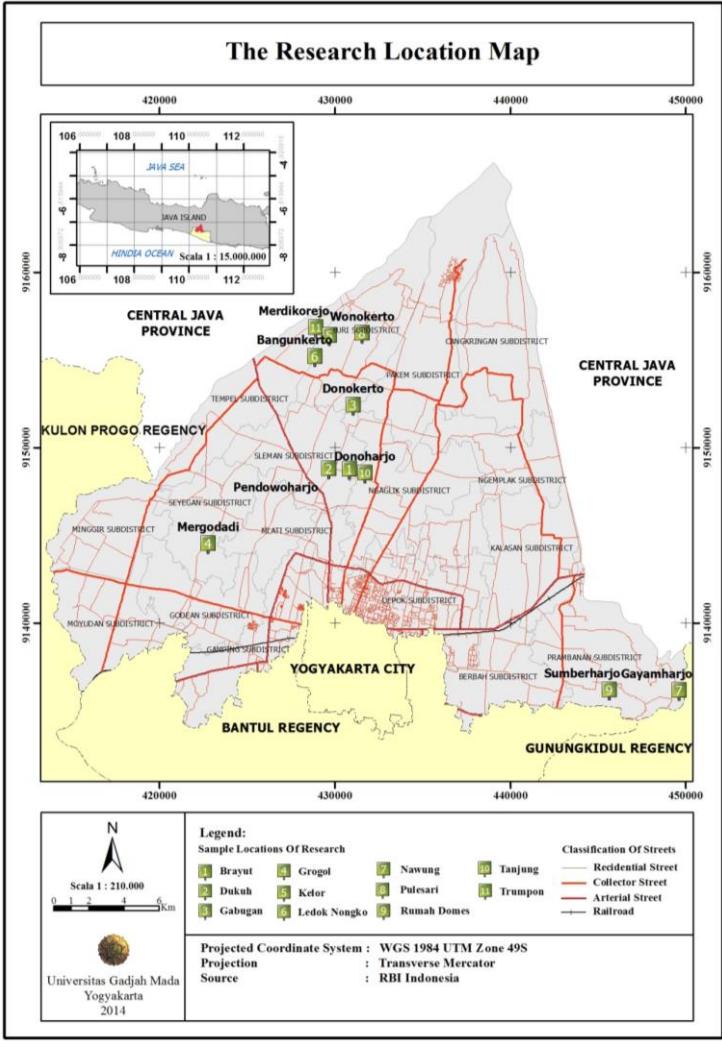
Figure 1. The Map of Research Area
DISCUSSIONS
Research Areas Profiles
Brayut Tourism Village (Desa Wisata Brayut) locates in Pendowoharjo Village, Sleman District. It has a distance at least 1.5 kilometres from the capital of Sleman Regency or takes 10 minutes from the capital regency to this tourism village. This tourism village offers legondo, klepon, sagon, apem, kacang godog, cemplon, lemet, combro, lodeh, brongkos, sop, kenduri, sayur asem, rawon, wedang secang, wedang serai, wedang jahe as it traditional food to the tourists beside its rural nuance as the main attraction of this tourism village. It can be seen from the traditional Javanese houses, joglo. In this tourism village, there are three joglo that are supported tourism activities.
Dukuh Tourism Village (Desa Wisata Dukuh) locates in Pendowoharjo Village, Sleman District. This tourism village has two main tourism attractions, namely education and cultivation tourism. There are traditional local food that are offered by this tourism village: snacks, cethil, ampyang, buntil, arem-arem, wedang serai, wedang jahe, kue berbahan ketela, and sego wiwit.
Gabugan Tourism Village (Desa Wisata Gabugan) locates in Donokerto Village, Turi District. It takes at least 45 minutes from the central of Yogyakarta municipalities. This tourism village has main attraction for the vistors such as agricultural and cultural potents. Meanwhile, it has kacang rebus, pisang godhog, nogosari, klepon, bakwan, wedang jahe, secang, wedang salak as the local food which are offered to the tourists.
Grogol Tourism Village (Desa Wisata Grogol) locates in Margodadi Village, Seyegan District. It takes at least 30 minutes from the Yogyakarta municipality. It offers natural and cultural tourism. Meanwhile, there are various local food that are offered to the visitors for example: gethuk, cethil, krowotan (kacang-kacangan), begono (sejenis urap ada nangkanya), gudangan, urap, nasi wiwit, sengek, tahu tempe, sambal ijo, sambal belut pedas.
Kelor Tourism Village (Desa Wisata Kelor) that located in Bangunkerto, Turi District potentially has cultural attraction such as jathilan. In addition, this tourism village also has food attractions which are called nasi pondoh, sayur lodeh, urap, and several snacks such as cothot, nogosari and food that are made from cassava. Ledoknongko Tourism Village (Desa Wisata Ledoknongko) locates in Bangunkerto Village, Turi District. It has main attraction for the tourists: snakefruit (salak) garden. It also has local food that are offered to the visitors such as kacang tanah, singkong, pisang, kimpul, salak.
Nawung Tourism Village (Desa Wisata Nawung) locates in Gayamharjo Village, Prambanan District. It locates in the south-eastern part of Sleman Regency. It has a potential natural tourism attraction, namely river and hilly areas. This rural tourism villages also offers local food such as chips made from banana, cassava, and garut/arrowroot, pati ganyong/edible canna starch, criping talas/taro chips, krecek ganyong, emping mlinjo/gnetum gnemon chips, pati garut/arrowroot starch, belut daun singkong, nasi urap (gudhangan).
Pulesari Tourism Village (Desa Wisata Pulesari) locates in Wonokerto Village, Turi District. It has a 28 kilometres distance from the central of Yogyakarta municipality. This tourism village offers natural and cultural tradition as its main tourist attractions. Meanwhile, this village offers local food to the tourists such as sayur asam, sayur jipang, pepaya, dong jindal (daun singkong), jaeser (jahe and serai/ginger and lemongrass), food made from salak/snake fruit, krowotan (ketela/cassava, kacang rebus/boiled bean, pisang rebus/boiled banana).
Rumah Domes Tourism Village (Desa Wisata Rumah Domes) can be visited at the Nglepen hamlet of Sumberharjo Village, Prambanan District. It locates at the southern part of Prambanan Temple. This village has a unique house as the main attraction. In addition, this rural tourism village also offers kacang godhog/boiled bean, pisang godhog/boiled bean, getuk, combro, kathul beras merah, emping garut/arrowroot chips, singkong tae, gembili godhog/boiled air yam, kimpul godhog, wedang jahe, sereh, secang, and steak bonggol pisang.
Tanjung Tourism Village administratively consist of three hamlets namely Banteran, Panasan, and Bakalan, Ngaglik District. It has a 10 kilometres distance from the capital of Yogyakarta municipality. This village offers education and local culture tourism. In addition, this village also offers lemper, sagon, and mendut as its local food attraction to the tourists.
Finally, Trumpon Tourism Village locates in Merdikorejo Village, Tempel District. In order to visit this village, the tourists take 45 minutes from Yogyakarta municipality. Natural, arts and cultural are the main attractions of this tourism village. Meanwhile, this tourism village also offers local food such as kacang, pisang, klepon, nogosari, oseng salak, lodeh, salak asam manis to the tourists.
Motivations of Tourism Villages' Actors to Present Local Food as Their Rural Tourism Attractions
It can be identified that the motivations of why the tourism villages present local food as their tourism attractions are environmentally-friendly, economy, diversification, shows the own products to the tourists, offers local food as an attraction to the tourists in order to show the local wisdom, cultural restoration, uniqueness, offers rural nuance, introducing cultural and rural lifestyle, and empowering surrounding areas.
Environmentally friendly is the first motivation. It can be seen at the Dukuh Tourism Village. It can be seen from the citation that the use of pandanus leaf for colouring the local food and using leaves to wrap the food rather than the paper box.
"At least it can be used to increase their economy, also for natural preserve, most of the visitors did not know previously, it also without preservative, the colouring of the cuisine is also natural such as by using pandanus leaf." (Paling tidak untuk warganya bisa meningkatkan perekonomian mereka mas, melestarikan budaya juga mas, banyak yang tidak tahu sebelumnya untuk pengunjung disini, tanpa bahan pengawet juga kan mas, pewarnanya juga alami seperti daun pandan. - DWD).
"Sometimes the ladies ask regarding the food's presentation, I said to use leaves to wrap the food rather than use paper box or other materials, to be environmentally friendly we use leaves and convert the leaves into "pincuk" (a food plate that is made by a leaf)." (Kadang-kadang ibu-ibu disini menanyakan tentang penyajiannya, saya bilang pakai daun saja, tidak usah pakai kardus atau bahan lain, untuk ramah lingkungan ya dengan daun yang di"pincuk" saja - DWD).
The second motivation that is collected from the informants namely economic motivation that can be found at the five tourism villages: Brayut, Dukuh, Gabugan, Nawung, and Tanjung. As the explanation from the informants regarding on economic motivation for presenting local food as their attraction can be seen below:
"The motivation is to support, introduce, popularise the local food. So they have valueadded and be an icon, add the economy too, or could reduce the poverty rates, create employment, and could reduce the urbanisation rates." (Motivasinya yaitu untuk mengangkat jenis makanan tadi, mengenalkan, mempopulerkan makanan tadi. Supaya punya nilai tambah. Supaya menjadi ikon, menambah ekonomi juga, syukur-syukur mengurangi angka kemiskinan juga, ada lapangan kerja, motivasi lain supaya menekan angka urbanisasi" - DWB)
"Least to support the people and could increase their economics. (Paling tidak untuk warganya bisa meningkatkan perekonomian mereka - DWD)
"Actually, we want to introduce many kind of snakefruit processing, especially "pondoh" snakefruit, when harvest season the price is very cheap, when it is processed probably can give value added so can increase the economy rather than we sell them in a raw condition." (Sebenarnya kita ingin lebih mengenalkan jenis-jenis pengolahan buah salak, terutama salak pondoh, ketika panen raya kan harganya sangat murah, ketika sudah diolah kan mungkin bisa untuk menambah ekonomi, ketimbang hanya dijual dalam bentuk buah saja ke pasar - DWG).
"For our residents, so these food are presented not only by me, it means our neighbours follow our group, so the value added of the raw materials which they have could increase economically. Because if the ingredients sell in a raw condition the value of the products not increase." (Untuk warga, jadi kan makanan-makanan ini tidak disajikan oleh saya sendiri, dalam arti tetangga-tetangga kami kan ikut dalam kelompok, supaya nilai jual dari bahan baku yang mereka miliki naik. Karena dulu saat bahan-bahan dijual mentah harganya segitu, setelah diolah dapat naik - DWN).
"To sold the farmer's products. For example, we made snacks for a welcome drink we cook tahu, we cook it differently, incidentally there is a tahu maker here, tahu is fried and then add with onion and salt dough and then fried it without flour then put it on a small tray, add soy sauce, like that it can be said different and that is produce here. So it could develop the economy." (Supaya produk-produk petani laris terjual kan. Jadi semisal kita buat snack untuk welcome drink kita buat tahu, kita buat yang beda, kebetulan disini juga ada pengrajin tahu, tahu digoreng dengan adonan bawang dan garam kemudian goreng saja tanpa tepung, lalu ditaruh di nampan kecil, kemudian pakai sambal kecap, seperti itu kan sudah beda,dan ini produk dari sini. Jadi kan menghidupkan perekonomian - DWT).
The third motivation that can be collected from the rural tourism manager is diversification. It can be found at the Rumah Domes tourism village based on the informant explanation that if they could diversify the local food crops. The informant said that he believe that it could promote the local food to the visitors. The explanation can be seen below:
"Our first motivation is presenting diversification. What food that we have could be consumed by the tourists. From that entry point we can also promote, what traditional food that we have, then the advantages, such as edible canna chips could reduce uric acid. The second motivation as the attraction, that is the uniqueness here so we can make the tourists impress. It can be used as the rural tourism strategies" (Motivasi yang pertama adalah kita itu memunculkan keanekaragaman yang ada di sini. Contoh makanan kalau disini. Apa saja yang kita punya supaya bisa dinikmati oleh pengunjung yang datang disini. Dari situ kita bisa promosi, dalam hal makanan khas yang ada disini, kemudian keunggulan-keunggulan, seperti emping garut dapat mengurangi asam urat. Untuk motivasi yang kedua sebagai daya tarik, untuk khasnya disini kan seperti ini. Sehingga membuat pengunjung terkesan. Itu juga menjadi strategi bagi desa wisata"- DWDo).
Another motivation is to show their own products that can be found at the Trumpon tourism village. It can be seen from the explanation from the informant below:
"To show our own products, especially the special local food. So that the tourists will know... (Untuk memperlihatkan produk sendiri, terutama makanan khas sini. Biar wisatawan juga tahu – DWT).
The fifth motivation is to introduce local wisdom and cultural at the tourism village. It can be seen from the explanation below:
"We promote our local wisdom, we do not need to look for from other areas, food that we had could be sell." (Kita itu kan yang dijual itu kearifan lokal, kita tidak usah mencari di luar yang sulit-sulit, makanan yang di desa aja ada, kenapa harus makanan yang ada di luar itu. - DWB).
"Certainly our reason base on traditional food, so we need to introduce our culture and rural lifestyle." (Alasan dari kami yang jelas itu makanan tradisional, sehingga mengenal budaya dan kondisi desa seperti ini. - DWK).
"For food tourism attractions that are presented naturally and unique, which not offered in different village, probably for arrowroot, banana's chips, there is no edible canna product." (Untuk daya tarik wisata makanan yang bentuknya alami, dan khas sini. Yang mungkin tidak ditawarkan/ada di desa lain seperti ini, mungkin ada untuk jenis garut, criping pisang, tapi untuk olahan ganyong tidak ada - DWN).
"Clearly we want to introduce rural lifestyle, because the tourists came from urban areas, so we provided rural cuisine. It is unique and can not be found in urban areas. From the beginning that was our concept" (Yang jelas kita ingin mengenalkan suasana pedesaan, karena wisatawan yang datang kebanyakan dari perkotaan, jadi kami menyediakan makanan ala pedesaan. Terutama unik dan tidak terdapat di kota. Dari awal memang konsepnya seperti itu. - DWP).
The last motivation is empowering surrounding area which has local food resources. It can be seen from this transcript:
"Temporarily, we take from surrounding environment, we empower our surrounding areas. Including other inhabitants from other hamlets, in those hamlets there are lesser yam (uwi), kimpul, and bean. Here, especially there is snakefruit (salak). We face limitation on land availability, so we empower other people's land". (Untuk sementara ini kita mengambil dari lingkungan sekitar, kita memberdayakan lingkungan sekitar. Termasuk warga di lain dusun, ada di situ uwi, kimpul, dan kacang. Khusus sini agronya salak. Lahan kami memang terbatas untuk itu (tanaman bahan makanan krowotan), sehingga kami juga memberdayakan lingkungan warga sekitar. - DWP).
As has been described by McEntee (2010) that there was two concepts of local food: contemporary and traditional local. It can be seen that in the eleven tourism villages in Sleman regency are implementing the concept of contemporary local food crops to develop their tourism villages. This phenomenon is in lined with the previous concept that is developed by McEntee (2010). Based on the informants statement, the selected tourism villages in Sleman regency tend to offers their food tourism village in a contemporary way rather than in a traditional way.
| No. | Tourism Villages | Attractions | Limitations | Local Food Offered | Motivations |
|---|---|---|---|---|---|
| 1 | Desa Wisata Brayut | Education, agriculture attraction for the tourists: planting culture, feeding of the livestock, jathilan | Legondo, Klepon, sagon, apem, Kacang godog, cemplon, lemet, combro. Lodeh, brongkos, sop, kenduri, sayur asem, rawon, wedang secang, wedang serai, wedang jahe | Offers local food as an attraction for the tourists in order to show local wisdom; Economic motivation in order to reduce the urbanisation rates, poverty rates, and to add employment | |
| 2 | Desa Wisata Dukuh | Education, jathilan, terbangan, gamelan | Sustainability of local food (lack of creators), difficulty to get original | Snacks, cethil, ampyang, buntil, arem-arem, wedang serai, wedang jahe, kue berbahan ketela, sego wiwit | Economy, cultural restoration, environmentally friendly |
Table 1. Profile of Tourism Villages
| No. | Tourism Villages | Attractions | Limitations | Local Food Offered | Motivations |
|---|---|---|---|---|---|
| 3 | Desa Wisata Gabugan | Education, natural track on snake fruit garden, fish pool, paddy | ingredients Not all of the guests are like to consume the offered local food | Kacang rebus, pisang godhog, nogosari, klepon, bakwan, wedang jahe, secang, wedang salak | Uniqueness, and add economic reason |
| 4 | Desa Wisata Grogol | field Traditional ceremony (Kirab Tuk Sibedug) once a year | Local food resource availability | Snacks: gethuk, cethil,krowotan (kacang kacangan) Meals: begono (sejenis urap ada nangkanya), gudangan, urap, nasi wiwit, sengek, tahu tempe Inovation: sambal ijo, | Offered local food, offered rural nuance |
| 5 | Desa Wisata Kelor | Jathilan, cultural attractions | Some of international tourists were unwilling to eat the local food | sambal belut pedas Nasi Pondoh, Sayuran Lodeh, Urap, Cothot, Nogosari, food made from cassava | Traditional food, introducing cultural and rural lifestyle |
| 6 | Desa Wisata Ledoknongko | Snack fruit garden tourism | Has no field to plant Local food resource are gain from the traditional markets | Kacang tanah, singkong, pisang, kimpul, salak | Back to the previous traditional food |
| 7 | Desa Wisata Nawung | Riverbanks (river tourism), kerajinan batu dan bambu/ stones and bamboo arts | Land availability, need skillfull people to cook local food. Tidak setiap saat ada wisatawan | Chips made from banana, cassava, and garut/arrowroot, pati ganyong/edible canna starch, criping talas/taro chips, krecek ganyong , emping mlinjo/gnetum gnemon chips, pati garut/arrowroot starch, belut daun singkong, | Economic reasons |
| 8 | Desa Wisata Pulesari | River tracking, outbound, traditional ceremony | Land availability (uwi, kimpul, kacang/bean) | nasi urap (gudhangan) Sayur asam, sayur jipang, pepaya, dong jindal (daun singkong), jaeser (jahe dan serai/ ginger and lemongrass), food made from salak/snake fruit, krowotan (ketela/cassava, kacang rebus/boiled bean, pisang rebus/boiled | Empowering surrounding areas and rural lifestyle |
| 9 | Desa Wisata Domes | Tracking to the hill, ronda tehteh art tradition | Tourism awareness | banana) Kacang godhog/boiled bean, pisang godhog/boiled bean, getuk, combro, kathul beras merah, emping garut/arrowroot chips, singkong tae, gembili godhog/ boiled air yam, kimpul godhog/, wedang | diversification |
| No. | Tourism Villages | Attractions | Limitations | Local Food Offered | Motivations |
|---|---|---|---|---|---|
| 10 | Desa Wisata Tanjung | Education, agricultural | Not all of the tourists | jahe, sereh, secang, steak bonggol pisang Lemper, sagon, mendut | Local wisdom, to sell the farmers' |
| activities, learn how to batik, learn how to dance | (children, tourists) only eat the local food in a small portion | products | |||
| 11 | Desa Wisata Trumpon | River tracking, Merapi mountain view | Does not have an area to plant the local food crops Techiques and knowledge how to cook gain from the collaboration with the | Kacang, pisang, klepon, nogosari, oseng salak, lodeh, salak asam manis. | Shows the own products to the tourists |
Source: primary data (analysed from observation and in-depth interview), June 2014
Obstacles to Develop Food Tourism in Tourism Villages of Sleman Regency
However, in order to keep those tourism village could continously present local food it will be important if some issues regarding of local food in tourism villages also be identified. Based on our interview, it could be collected that there are problems such as the availability of original ingredients of local food products, availability of the cookers, professionallism on preparing local food, willingness of the skillfull inhabitants to teach others how to produce local food,tourists appetizing and tourism awareness. Nowadays, the tourism village manager mentioned that quite difficult to find original ingredients such as brown sugar (gula merah) because they felt if they bought at the market so they must choose the original and be careful when they bought it.
"Yes, besides the cooker, the ingredients would not have been available, such as original brown sugar that is difficult to find." (Iya mas, selain orangnya, bahannya juga tidak pasti ada, yaitu gula merah yang asli itu kadang-kadang susah. - DWD).
Lack of local food cookers could be as the future issue. For example, Dukuh tourism village could face a problem of availability of ampyang due to the sustainability factor. Ampyang is stopping to be produced due to age of the maker. Meanwhile, in order to provide local food such as arem-arem, and cethil today only made by order. Economic motive is the main reason why these local food could not present regularly. It quite different if these local food (arem-arem and cethil) are compare with buntil and ampyang which could sell to the market.
"The local inhabitants produce ampyang, in this village at least once of 4 – 5 days the ampyang are always produced to sell to Turi market. The package is still in all traditional manner such as klaras (dry banana leaf), there is also traditional tempeh that produce not by using yeast but by using usar leaf (daun usar). The process how to cook is similar only yeastless. So it is only wrapped by that leaf". ("Ampyang orang sini yang membuat, kalo desa sini kan kebanyakan 4 – 5 hari sekali itu selalu buat untuk dijual di pasar turi. Dan itu pengemasannya masih tradisional semua seperti "klaras" (daun pisang kering), sama ada lagi tempe tradisional yang tidak terbuat dari ragi, tetapi memakai "daun usar" yang berfungsi sebagai pengganti raginya. Proses membuatnya juga caranya sama, Cuma tidak memakai ragi. Jadi hanya dibungkus dengan daun itu saja" - DWD).
"If buntil regularly produce few days because to be sold to the market, but for ampyang, it was stopped this a few days due to the producer is too old, so its only sometimes be produced, only regularly be produced formerly. For arem-arem just made by ordered, and then for cethil, the producer's child was married so it only made by order, it is different in the past when it was made for children financing." (Jika buntil rutin beberapa hari sekali karena untuk dijual di pasar, tetapi jika untuk ampyang, beberapa hari ini berhenti karena orang yang sering membuat makanan tersebut sudah tua, jadi kadang-kadang saja, kalau dulu rutin mas. Kalau untuk arem-arem memang di saat ada pesanan saja, terus untuk cethil ini anak dari pembuat cethil menikah jadi dibuatkan saat ada pesanan saja, beda sama dulu yang memang sehari-hari membuat untuk membiayai anak-anaknya.- DWD).
In addition, there is another issue when the tourism village manager plan to create one step ahead on how to present local food profesionally. The human resources of the cooker that dominantly by the ladies are still ashame to have a role as waiters.
"Obstacle that we feel today, the human resource of our ladies to stepping into a professional, it means that professionalism of tourism village. We just start our process. It means that how they must act like kampoong waiters, must be clean. But our people quite reluctant to do that. For example, if we had an order to be presenting at the middle of the garden, our people will be surprise because why eating must be at the garden. We must work hard to wake in our people". (Kendala yang kami rasakan saat ini, SDM dari ibu-ibu untuk melangkah ke tingkat profesional, dalam artian profesional yang kita kemas desa wisata memang baru akan belajar. Kita kan sekarang baru memulai proses. Dalam artian bagaimana mereka harus berpenampilan layaknya seorang (pelayan) resto tapi di kampung, harus bersih. Tapi kan masyarakat sulit untuk melakukan itu. Misalnya kami mendapatkan pesanan di tengah kebun, warga disini kan gumun (heran), makan kok di kebun. Hal seperti itu kan kami harus bekerja keras untuk memberikan pemahaman ke warga. - DWP)
On the other hand, there is a tourism village that faced sustainability issue such as willingness of other inhabitants on teaching to produce local food, and not be visited weekly by the tourists.
"The problem is not every week there are tourists, secondly for skillfull people who can produce local food unwilling to teach the others to learn how to produce it. Whereas, I had decided who will do this task, this job will do by whom, so it could evenly distributed". (Kendalanya itu tidak setiap minggu ada wisatawan, kedua untuk beberapa orang yang sudah terampil mengolah makanan lokal, tidak bisa mengajak orang lain untuk belajar bagaimana cara mengolah. Padahal saya sudah mengeplot untuk orang yang mengerjakan bidang ini siapa, bidang ini siapa, jadi biar merata - DWN).
Taste or appetizing from the tourists is also faced bt the tourism village operators when they are presenting their local food. Some tourists, for example the children or urban people are reluctant to eat some local food. It can be seen from the information below:
"The obstacle is sometimes not all of the visitors enjoy the local food, they are just know those local food." (Kendalanya kadang belum tentu tamu itu mau menikmati, baru tahu atau kenal kan jenis makanan itu - DWG).
"The obstacle is, sometimes the visitors who came from urban area do not like local food that are offered by the grandmothers." (Kendalanya itu, kalau orang-orang kota itu kurang suka untuk jenis makanan dari para simbah-simbah - DWK)
There is also another obstacle in presenting local food as an attraction in a tourism village, namely tourism awareness.
"Here our people have not a tourism awareness feeling yet. Sometimes, we must look for the people, although we had rotate they could not to prepare."(Kalau disini
warganya masih belum sadar wisata. Kadang itu kita cari orangnya, walaupun sudah digilir, kadang pas gilirannya itu tidak bisa.-DWDo)
Future Prospects to Develop Food Tourism in the Tourism Villages of Sleman Regency
There are some factors that potentially could keep tourism villages succeed, for example their spirit to solve jealousy, their spirit when they sell local food as their attraction, the practice of environmentally friendly, innovation, collaboration with other agencies, and their cultural phylosophy. It can be seen from many responds from tourism village actors. In order to solve jealousy, there are many beliefs from tourism village actors such as their initiative to distribute the skills of producing local food.
"This is because of jealous, if it is possible we will propose again, I had proposed into Mrs. Ning at the tourism office, if formerly we had proposed a training for 40 people, how if we propose a training again for other people, could or not?. Possibly by propose a training proposal again. In order to be evenly distribute, the one had produced could be more skillful the one could not will have a new skill how to produce local food"( Ini kan masalah iri, kalo bisa ya mengajukan lagi, saya sudah mengajukan ke Bu Ning bagian pariwisata kalo misal dulu sudah mengajukan pelatihan untuk 40 orang, "bagaimana jika mengajukan lagi untuk orang lain, bisa atau tidak?' bisa dengan mengajukan proposal lagi untuk pelatihan. Supaya bisa merata, yang sudah bisa bisa makin maju, yang belum bisa jadi bisa. - DWN).
In addition, the spirit of the local people to offer local food must be appreciated on how they produce local food seasonally and complementary help others:
"Spirit, but the spirit is dependently on the season due to the availability of the local food raw materials, if it is entering the season, there are people who produce so they have excited to produce local food especially for whom have skills." (Semangat mas, tapi semangatnya musiman karena memang bahan bakunya musiman, semisal sudah musim, pasti ada yang mengolah itu, berarti dia antusias bagi yang punya keterampilan.-DWN)
"It is common for our people, they were very excited and also helpful especially on preparing the material of cethil that should be complemented". (Kalau warga biasa mas, antusias sangat tinggi dan juga saling membantu seperti halnya dalam menyediakan bahan baku olahan cethil yang cenderung saling melengkapi. - DWD)
An environmentally friendly spirit is also a prospective attraction in a tourism village, for example in presenting a local food they used to use leaf.
"Sometimes our ladies asked on how to present, I said that we used leaf, do not use box or other materials, to be more environmentally friendlly we used "pincuk", a leaf that converted as if a plate to eat the local food."(Kadang-kadang ibu-ibu disini menanyakan tentang penyajiannya, saya bilang pakai daun saja, tidak usah pakai kardus atau bahan lain, untuk ramah lingkungan ya dengan daun yang di"pincuk" saja. - DWD)
Meanwhile, the tourism village like Brayut has been implemented environmentally friendly practice by limiting the number of visitors in order to protect their environment and carrying capacity. The environmental practice has been done in order to reduce the negative impact to the environment. The detail information regarding the carrying capacity of Brayut Tourism Village can be seen below:
"Until now, in order to support the carrying capacity of Brayut tourism village, we need to think in a long term, how about its impacts on the environment, culture, and behaviour, a month we limit only accept 10 visitation. To support the carrying capacity, the negative impacts, so it will longer. If we do not limit the visitors it will give a negative impact. (Sampai sekarang untuk menjaga daya dukung desa wisata brayut, kita kan berfikir panjang, untuk dampak lingkungan, dampak budaya, dampak
perilaku, sebulan itu maksimal kita hanya bisa menerima 10 kali kunjungan. Supaya daya dukung alam, untuk dampak negatifnya itu kita bisa lebih panjang. Kalau kita menerima berapapun jumlah tamu, kan itu berdampak negatif. - DWB)
Another potentials capital that can be identified in the tourism village is innovation. Some tourism village usually facing some problems regarding on the taste or appetizing. Therefore, some of the tourism village managers are creatively combine the presentation of local food not only in a traditional presentation. However, they also innovate on offering new menus and avoiding wastefulness by applying order local food by using email.
"Over time, there is an innovation. We offers a lot to the visitors, this rice, this rice, if the visitors interested in then we will provide it." (Bertambah seiring jalannya waktu, kan ada inovasi juga. Kita memberikan banyak tawaran kepada pengunjung, nasi ini, nasi ini, kalau pengunjung tertarik ya kita sediakan. - DWG)
"The first important thing is the taste, if there is a comment regarding of the taste we will correct it. Presentation and the menu also need to be noticed. For the presentation we combine it, so it is not too traditional or too modern. Sometimes if present the local food very traditionally then the visitors do not eat them." (Yang pertama jelas rasa, jika ada komentar tentang rasanya, itu juga sebagai koreksi kita. Penyajian dan menu juga diperhatikan. Kalau untuk penyajian kita ada kombinasi mas, jadi tidak terlalu tradisional, juga tidak terlalu modern. Kadang jika kita menyajikan makanan tradisional banget, kadang-kadang tamu malah tidak mau memakannya.- DWG)
"The strategy is usually by combining the vegetables such as urap, with the meals: chicken or opor." (Strateginya biasanya dikombinasikan dengan sayur seperti urap, biasanya lauknya dengan ayam atau opor. - DWK).
"We offer the menu first, so we offer the menu before the guests arrive, sometimes via email, then the guests be asked to choose, in order to avoid wastefulness. (Kita sodorkan dulu menu, kita tawarkan dulu sebelum tamu datang, jadi kadang lewat email, disuruh milih. Supaya tidak mubadzir. - DWT)
Tourism villages collaborate with other agencies such as travel agencies and catering. They could receive advantages by conducting a collaboration, for example when they collaborate with a catering, they could receive a new knowledge on how to improve the taste and presenting the local food more beautifully.
"After that we collaborate with travel agencies, but so far like up to now. Nowadays, we have more linkages (Setelah itu kita bekerjasama dengan biro perjalanan, tetapi tidak sejauh seperti yang sekarang ini. Sekarang kan link-nya sudah semakin banyak – DWB)
"The obstacles can be found on the technique and knowledge how to cook and presenting, and create good taste for the local food. Then we solve the problem by cooperate with one of catering from Godean. Then the cheff from this catering teach us how to cook and presenting." (Kendala biasanya teknik dan pengetahuan bagaimana cara memasak, dan penyajian serta rasanya menarik itu bagaimana. Kemudian cara mengatasinya kita bekerjasama dengan salah satu katering di Godean. Kemudian cheff dari katering tersebut memberi pelatihan kepada ibu-ibu bagaimana cara memasak dan menghias yang bagus itu seperti apa? – DWT)
Finally, keeping tradition as their philosophy is also important to offer local food. Philosophically, tourism villages managers have a concept of what is the term of tourism village, by developing a hamlet as a tourists destination. In addition, to develop tourism village need time and commitment. It can be seen from how a tourism village, like Kelor still offer their tradition menu unless some of other tourism villages choose to combine the menus. The explanation of keep tradition can be seen below:
"For list of menu we never reduce, we must keep offer those because those are our tradition, sold or not sold we keep sell them." (Untuk list menu tidak pernah kami kurangi, harus tetap ditawarkan karena itu tradisi kita, laku tidak laku kami tawarkan. - DWK).
"The paradigm of a tourism village is like an object: Borobudur, Prambanan, Kraton etc. Had no idea if a hamlet (a village) could be a tourism destination. Starting from the idea then Brayut could develop." (Paradigma sebuah desa wisata kan adalah sebuah obyek, seperti Borobudur, Prambanan, Kraton, dll. Tidak tahu kalo dusun itu ternyata bisa menjadi destinasi. Nah dari situ makanya Brayut bisa berkembang – DWB).
"Operating a tourism village I think do no necessarily involves all of the community. Here we have 425 inhabitants is it important to involve all of them? All could be the managers however they must have an commitment and time." (Pelaksanaan desa wisata itu tidak serta merta melibatkan seluruh komponen masyarakat. Disini kan penduduknya 425 jiwa. Masa semuanya harus dilibatkan. Semuanya boleh masuk jadi pengurus, tetapi mereka harus punya komitmen. Dan selain komitmen, mereka punya waktu atau tidak? – DWB).
CONCLUSIONS
The motivation of presenting local food in the selected tourism villages in Sleman Regency is dominated by the economic motive. It can be seen from the statement from five of eleven tourism villages. On the other hand, some tourism villages face problem on the quality of the human resource to act profesionally, improve the taste and appetizing of the visitors, and natural ingredients. Meanwhile, the tourism villages have potentials assets such as environmentally-friendly practices, innovation, their cultural philosophy. In future, others research that describe more deeply about a process on how to explain local food on a social, cultural, economic, and environmental issues.
ACKNOWLEDGEMENT
The writers would like to say many thanks to the informants who gave valuable information therefore we have an opportunity to write this paper, and to Institute for Research and Community Services (LPPM or Lembaga Penelitian dan Pengabdian kepada Masyarakat) Gajah Mada University (UGM) that funded this research under a Junior Lecturer research grant Number: LPPM – UGM/ 1143/ LIT/ 2014.