

INTRODUCTION
The Australian Department of Resources, Energy, and Tourism (2008), in a paper entitled, 'Tourism and Climate Change – A Framework for Action' stated that the impact of climate change on the natural environment and infrastructure has the potential to affect the tourism industry, in general, specifically in the most vulnerable countries including the Philippines. This could result in social and economic impacts in regions with a high dependency on tourism as a source of income and employment (2008: 1).
The Philippines is one of those countries that are both dependent on tourism and highly vulnerable to the effects of climate change. The Department of Tourism has signified that it intends to attract 10 million tourists by 2016 (DOT, 2011) and has pushed for more aggressive promotions abroad and infrastructure development domestically.
But due to the increased prevalence of tropical typhoons, sea level rise, as well as increase in temperature, tourism in highly vulnerable areas like the Philippines will greatly be affected. In the Davos Declaration developed by the World Tourism Organization (WTO), United Nations Environment Programme (UNEP) and the World Meteorological Organization (WMO), it was stated that it was highly likely that 'future tropical typhoons and hurricanes will become more intense, with large peak wind speeds and heavier precipitation associated with ongoing increases in tropical sea surface temperatures' (2007).
* Corresponding author, email: marckbryan.david@gmail.com/marck_bryan.david@upd.edu.ph
1 Paper presented at the International Academic Conference on Tourism (INTACT), Yogyakarta Indonesia, September 15 – 17 th 2014
The importance of climate to tourism and tourism activities cannot be disregarded. The tourism sector is highly 'climate-sensitive' (WTO, et. al., 2007), due to its close connections to the environment and climate, similar to agriculture and energy. Therefore, the Davos Declaration (WTO, et. al., 2007) emphasized that climate change will become an increasingly pivotal issue affecting tourism.
Last September 2011, Pedring (International Code Name: Nesat), one of the strongest typhoons to hit Metro Manila (Ramirez, 2011) pummeled the Manila Bay-area sending huge storm surges to the area. Among the hardest hit establishments were the hotels and other accommodations that line the scenic Manila Bay. Ramirez (2011) emphasized that Sofitel, a 5-star hotel, was one of the hardest hit properties in the area due to the storm surge.
This exploratory paper was created to (1) look at the possible impacts of climate change, particularly sea-level rise, on a selected Manila-Bay area hotel; (2) explore possible changes in the operational systems of this hotel and propose changes into these systems; and (3) propose possible monitoring programs and policies aimed at mitigating the impact of climate change, particularly in the most vulnerable areas to climate change like the Philippines.
It was clamored that after this research, the problem: climate change, specifically climate change impacts such storm surges, affect the operational systems of hotels in Manila Bay, be answered.
The paper would be of great importance to the following:
- 1. The government in generating responses and actions to mitigate the impacts of climate change, especially in the hospitality business.
- 2. Hotels and resorts highly vulnerable hotels and resorts need to craft responses to climate change impacts; hence, this paper will be a useful tool.
- 3. Future researches this exploratory study could be useful to future researches on the impact of climate change to the tourism and hospitality industry.
In general, this study was generated as an exploration into the impacts of climate change to the tourism industry, which the author believes is a topic least explored by researchers in the country. This is critical because, as has been stated, the Philippines is one of the most vulnerable areas in the world to the extreme impacts of climate change.
LITERATURE REVIEW
Climate Change and Tourism
Climate change poses a serious challenge to social and economic development in all countries, with developing countries being particularly vulnerable (Organization for Economic Co-operation and Development, 2013). The impact of climate change on the natural environment has the potential to affect the tourism industry. The impact could lead to social and economic costs in places with a high dependency on tourism as a source of income (Australian Department of Energy, Resources and Tourism, 2008).
The World Tourism Organization (WTO), United Nations Environment Programme (UNEP) and the World Meteorological Organization (WMO) consider climate change as an increasingly pivotal issue affecting tourism development and management (2007: 3).
With close connections to the environment and to climate, tourism is considered to be a highly climate-sensitive economic sector similar to agriculture, or energy (WTO, et. al., 2007). The Davos Declaration (WTO, et. al, 2007) stated that in the last five years, the tourism community has increasingly been concerned with the challenge of climate change.
Climate affects a wide range of environmental resources critical for tourism, such as water levels and quality (WTO, et. al., 2007). Climate also has an important influence on environmental conditions that can deter tourism activities such as extreme events like tropical cyclones. According to the Inter-governmental Panel on Climate Change 'climate change is unequivocal' (as cited by WTO, et. al. 2007). One of the major effects of the increase in global temperatures is the widespread melting of the glaciers and ice caps leading to increases in sea water levels; other effects are increased probability of extreme weather events such as stronger storms and extreme drought (IPCC as cited by WTO, et. al., 2007).
Climate is a principal resource for tourism, as it codetermines the suitability of destinations for tourism activities; hence it dictates the operating costs to be incurred. Tourism has been known to be a highly seasonal industry (Chon and Maier, 2010). Thus, changes in the length and quality of climate-dependent tourism seasons could have considerable implications for the competitiveness between destinations and therefore the profitability of tourism resources. Changes in climate could also have an impact on Philippine tourism, as there has been two pronounce tourist seasons in the country: wet and dry. Because of changes in climate, tourism establishments will find it hard to distinguish one from the other.
The Inter-governmental Panel on Climate Change (IPCC) (as cited by WTO, et. al., 2007) has concluded that changes in a number of weather extremes are probable as a result of projected climate change such as greater tropical storm intensity and peak winds and more precipitation events over land areas. Such will affect the tourism industry through increased infrastructure damage, additional emergency preparedness requirements, higher operating expenses, and business interruptions (WTO, et. al., 2007).
The Second International Conference on Climate Change and Tourism, which produced the Davos Declaration, agreed that the tourism sector must rapidly respond to climate change if it is to grow in a sustainable manner. This must include action to adapt tourism businesses and destinations to changing climate conditions (WTO, et. al, 2007). The Davos Declaration also warned that the IPCC has already confidently concluded that climate change would impede the ability of nations to achieve sustainable development (WTO, et. al., 2007). The biological response to continued increases in global temperatures, as the Davos Declaration stated, would be the continued warming of oceans and sea level rise (WTO, et. al., 2007).
The WTO, et. al. (2007) has already declared that it is likely that future tropical typhoons and hurricanes will become more intense, with large peak wind speeds and heavier precipitation associated with ongoing increases in tropical sea surface temperatures. Mountain, island, and coastal destinations are considered particularly sensitive to climateinduced environmental change (WTO, et. al., 2007).
Because of these, climate change will impose costs on the tourism industry due to tourism's dependence on natural assets and the built environment, which are both vulnerable to the effects of climate change (Australian Department of Resources, Energy, and Tourism, 2008). The impacts of these costs will also flow in the form of financial risks with rising insurance premiums, changes for business financing, and the need for business to manage the potential risks of climate change going forward as a business model (Australian Department of Resources, Energy, and Tourism, 2008).
Sea Level Rise in the Philippines
The World Wildlife Fund (as cited by indymedia.org, 2011) highlighted that the Intergovernmental Panel on Climate Change 4th Assessment Report found that the Philippines was vulnerable to climate change with:
- 1. Increase in mean annual, maximum and minimum temperatures by 0.14°C between 1971-2000. Increase in annual mean rainfall since 1980s and in number of rainy days since 1990s;
- 2. Increased occurrence of landslides and floods in 1990 and 2004;
- 3. On average 20 cyclones cross the Philippines Area of Responsibility (PAR) with about 8-9 making land fall each year; with an increase of 4.2 in the frequency of cyclones entering PAR during the period 1990-2003;
- 4. Decrease of rice yield associated with increase of temperature (0.35 °C and 1.13°C for maximum and minimum respectively during 1979-2003).
Figure 1. Projected Seawater Rise in Metro Manila
Source :
http://www.google.com.ph/imgres?um=1&sa=N&biw=1024&bih=624&hl=en&tbm=isch&tbnid=OJMa1Qw McpZd3M:&imgrefurl=http://getrealphilippines.com/blog/2012/08/much-of-metro-manila-may-soon-bepermanently-underwater/&docid=WU-zQ5wiv6LIjM&imgurl=http://getrealphilippines.com/blog/wpcontent/uploads/2012/08/metro_manila_sea_level_rise.jpg&w=460&h=298&ei=MoRJUvaYCenJiAf0wYDoD Q&zoom=1

Being an archipelago, sea level rise will impact many low lying populated and agricultural areas of the Philippines (indymedia.org, 2011). The large storm surges of typhoons Nesat (Pedring) and Nalgae (Quiel) and the widespread flooding that followed is an indicator of what global warming has in store for developed and developing countries alike. Of 16 regions in the Philippines, only one is not vulnerable to sea level rise; the mountainous Cordillera Administrative Region, is instead highly at risk from typhoons, mudslides and variability in precipitation (PAGASA, as cited by indymedia.org, 2011). In a World Bank (2010) report entitled, Climate Risks and Adaptation in Asian Coastal Megacities, Asia's urban population was set to grow from 1.36 billion in 2000 to 2.64 billion by 2030. Much of this growth, their report added, would happen in coastal and urban settlements (2010). The megacities of Dhaka, Mumbai, Manila, Shanghai, Jakarta, all lying within the `low elevation coastal zone', are at risk (World Bank, 2010). The report added that significant sea-level rise could ultimately de-urbanize major population centers in the region (World Bank, 2010). Further, the report showed that Manila sank by 40 meters in the 20th century (World Bank, 2010).
A 2007 Greenpeace report - The Philippines: A Climate Hotspot Climate Change Impacts and the Philippines - said that with "a one-meter rise in sea level, it is projected to affect 16 regions, 64 out of 81 provinces, covering at least 703 out of 1,610 municipalities, inundating almost 700 million square meters of land and potentially displacing at least 1.5 million Filipinos" (as cited by indymedia.org, 2011).
The article continued that together with seawater rise many populated areas around Manila Bay are subject to ground subsidence attributed to groundwater extraction (indymedia.org, 2011). It cited a Greenpeace report that said: 'An increase in sea level will accelerate and worsen flooding in the northwest delta plain of Manila Bay which is already experiencing subsidence at an alarming rate of at least three centimeters a year due to groundwater extraction. This situation is similar in key cities such as Legazpi City, Davao City, and Jolo which are experiencing subsidence at a rate of 5.9 mm per year, 3.2mm per year, and 0.4mm per year, respectively.' Greenpeace, 2007 (as cited by indymedia.org, 2011).
Storm Surges
One of the indirect impacts of climate change are storm surges. Lin, et. al. (2012) describe storm surges as generated by tropical cyclones that affect exposed coastlines, bays and estuaries and cause flooding in low-lying regions, often penetrating inland and flooding areas far from the coast. The authors added that most extreme storm surge events occur when relatively intense and large tropical cyclones make landfall at the coast (2012). In their study, Lin, et. al. (2012) emphasized that 'local bathymetry can exacerbate these effects, making certain regions more susceptible to storm surge.' Storm surges, the authors suggested cause loss of life, destruction of property and damage to ecosystems.
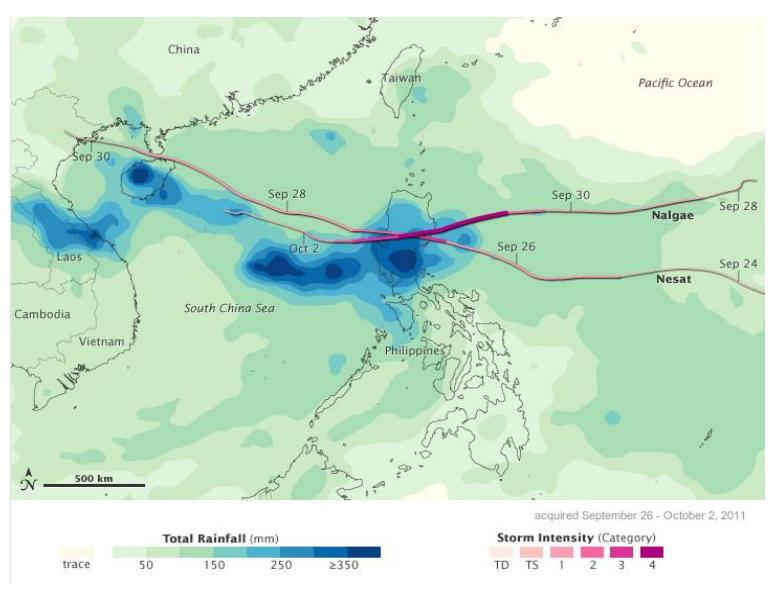
Figure 2. Amount of Rainfall during Pedring
Source : http://indymedia.org.au/2011/10/07/philippines-calls-for-progress-in-climate-talks-in-typhoondevastation-aftermath
Last September 2011, Metro Manila, specifically the Manila Bay area was hardly hit by storm surges generated by Typhoon Pedring (Bautista, 2011). The storm surges affected all establishments in the Manila Bay area, including the famed Sofitel Philippine Plaza (Ramirez, 2011). According to indymedia.org (2011), about 2.85 million people were directly affected by Pedring (Nesat) in several provinces, including Metro Manila.
During the height of the storm surge, guests of the hotel were forcedly evacuated due to the surges that reached the main hotel lobby, destroying the hotel's famed restaurant, including Spiral, covering in mud the pool area, and converting the underground garage into a lap pool (Ramirez, 2011). During the height of the onslaught, the hotel had a sixtyfive percent (65%) occupancy (Ramirez, 2011).
Climate Change Adaptation and Mitigation
According to the OECD, in its report in 2013, climate change impacts are already beginning to be felt in some developing countries. Even where climate change impacts are not yet visible, projections of future climate risks underline the importance of adaptation planning, therefore, it is crucial to establish coherent responses to climate change, to integrate adaptation into projects and investments that will be vulnerable to future climate impacts, and to avoid development pathways that lock in vulnerabilities or increase exposure to climate risks (OECD, 2013).
The OECD's analysis identifies a number of priorities for better incorporating adaptation within development policies, plans and projects (2013). These include (1) making climate information more relevant and usable for the development community as a basis for decisions on mainstreaming; (2) developing and applying screening tools to help screen development activities for climate risk and prioritize responses; (3) identifying and using appropriate entry points for climate information, such as humanitarian aid, poverty reduction, economic development, and natural resource management; (4) shifting emphasis to implementation, as opposed to developing new plans; and, (5) meaningful co-ordination and sharing of good practices (OECD, 2013). The report added that a key priority is to forge successful links between mainstreaming initiated under the United Nations Framework Convention on Climate Change (UNFCCC) and the more bottom-up risk management initiatives by national and sectoral planners (OECD, 2013).
The Climate Lens Model adopted by the OECD is almost the same model formulated by the International Union for the Conservation of Nature and Natural Resources (IUCN, 2009). Based on the IUCN report, authored by Marshall, et. al. (2009), the IUCN proposed the following measures to adapt to climate change:
- 1. Determine ecological vulnerability, from ecological/resource surveys
- 2. Determine sensitivity to climate change across scales (individuals, industries, communities, regions)
- 3. Combine the information above to determine potential impacts
- 4. Assess adaptive capacity across scales
- 5. Assess opportunities to reduce social vulnerability
The United Nations Development Programme (UNDP) also developed a framework that provides four guiding principles for adaptation that are highly relevant for tourism (UNDP, 2005, as cited by UNEP, 2008). These were:
1. Place adaptation in a development context – the adaptation process should be places within a broader context taking into account the impacts and adaptations on other sectors.
- 2. Build on current adaptive experience to cope with future climate variability a wide range of tourism stakeholders need to be involved in adaptation process to take full advantage of their diverse experience and expertise with adapting to current climate variability.
- 3. Recognize that adaptation occurs at different levels in particular at the local level adaptation can be adopted nationally but the implementation should be local.
- 4. Recognize that adaptation is an ongoing process most frameworks recognize that adaptation is repetitive and will evolve in the course of the future.
The United Nations Environment Programme (UNEP) described adaptation to climate change as an adjustment in natural or human systems in response to actual or expected climatic stimuli or their effects, which moderates harm or exploits beneficial opportunities (as cited from IPCC, 2007). The UNEP further added that adaptive capacity is the ability or potential of a system to respond successfully to climate variability and change, and includes the adjustments in both behavior and in resources and technologies (2008).
The Australian Department of Resources, Energy, and Tourism (2008) said that adaptation strategies would require long-term actions to respond to the challenge of climate change to manage risks, adjust economic activity, reduce vulnerability, and improve business and investment certainty. In the report, Climate change adaptation and mitigation in the tourism sector: Frameworks, tools, and practices, the UNEP stated that developing countries and small-island states have been identifies as particularly vulnerable to the effects of climate change (2008). WTO, et. al. (2007) signified that this was due to the fact that developing countries, like the Philippines, have less adaptive capacity, and this will be a challenge for their tourism destinations and communities.
Because of this, the Davos Declaration stated that governments should also implement policy, regulatory, financial, managerial, educational, and behavioral, diversification, research and monitoring measures for effective adaptation and mitigation. These policy responses are designed to manage costs while responding to the effects of climate change (WTO, et. al, 2007). The Davos Declaration stressed that tourism can and must play a significant role in addressing climate change as part of its broader commitment to sustainable development (WTO, et. al., 2007). Tourism industry and destination must establish targets and indicators to monitor progress. The role of governments is critical, as the Davos Declaration emphasized, that governments must provide technical, financial, and training support to tourism operators and destinations in developing countries to ensure that they can participate in the global climate response framework (WTO, et. al., 2007)
The WTO, et. al. (2007), in the Davos Declaration, stated that it was essential to emphasize that regardless of the nature and magnitude of climate change impacts, all tourism businesses and destinations will need to adapt to climate change in order to minimize associated risks and capitalize upon new opportunities, in an economically, environmentally, and socially sustainable manner. The capacity to adapt to climate change varies considerably between sub-sectors, destinations, and individual businesses within the tourism industry (WTO, et. al, 2007). The tourism sector has been adapting its operations to climate zones worldwide, using a diverse range of technological, managerial, educational, policy and behavioral adaptations to deal with climate variability. Yet, the WTO, et. al. (2007) cautioned that this has been limited to certain sectors.
The UNEP (2008) stressed that adaptation and mitigation can be complementary, substitutable, or independent of each other (citing Rogner, et. al., 2007). But ideally, destinations, businesses, and tourism organizations should seek to address mitigation and adaptation simultaneously (UNEP, 2008). Further, the UNEP (2008) added that there is no single 'correct' adaptation procedure to undertake climate change adaptation in the tourism sector.
Systems Approach
According to Spears (2010), the concept of organizations being systems has evolved from earlier management theories. The scientific management, human relations, and operational research theories all led to the systems approach. The new approach, as Spears (2010) stated, placed greater emphasis on the organization's relationship with its environment and is based on the assumption that performance can be improved by aligning the mission and design of an organization with environmental constraints and demands.
The key concept in the systems theory is the state of 'dynamic equilibrium' (Spears, 2010). This is the ability to react to changes and forces both internal and external that create new balance. Hospitality organizations could very well be described using the systems approach. A new hotel, for example, needs to take into account, its competitors, prospective market, and socio-economic or political limitations (external); as well as its ability to produce or accumulate capital, size of workforce, or competitive advantage (internal), before it can operate properly. Spears (2010) enumerated four benefits that the systems approach brings. These were:
- 1. More effective problem solving
- 2. More effective communication
- 3. More effective planning
- 4. More effective organizational development
In summary, a system cannot be understood as a function of its isolated parts; hence, one must understand how a system fits into the larger system in which it is part.
Conceptual Framework
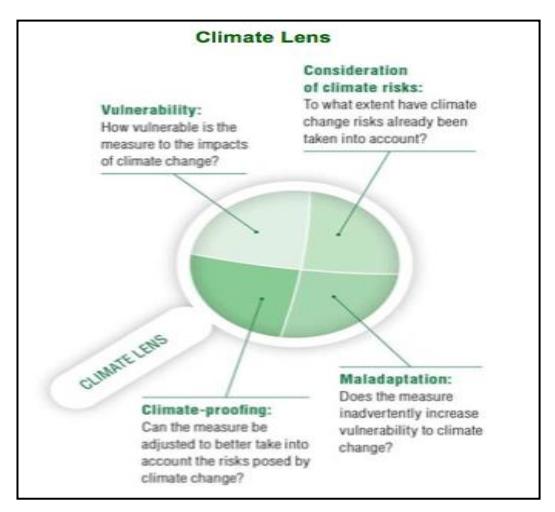
Figure 3. Climate Lens
Source: OECD, 2009, as cited by OECD, 2013
The researcher adopted the Climate Lens Model (OECD, 2009, as cited by OECD, 2013), in conjunction with the systems model, as frameworks for this study. Accordingly, the climate lens prompts questions about the proposed or existing measure on vulnerability, climate risk, climate proofing, and maladaptation. Application of the climate lens enables policy makers, including governments and even managers in the tourism industry, to decide whether a policy, plan or program is at risk from climate change. The OECD (2013) stated that for an intervention not at risk, no further action is needed; however, for an intervention at risk, measures are required to identify the extent of the risk, assess climate change impacts and adaptation responses, and identify possible recommendations and "downstream" actions.
Further, the Policy Guidance stipulated in this 'lens' recommended moving the coordination of adaptation activities into central bodies, and incorporating long-term climate risks in national planning processes and budgets.
This tool is very useful and easy to use not only for governmental agencies responsible for climate change adaptation policies but also for organizations, such as those in the tourism industry, to examine operational systems being undertaken in their respective businesses.
METHODOLOGY
Study Area
A 5-star luxury resort hotel in Manila was selected as the topic for this case study. It is an iconic property standing amid an expansive tropical setting. In September 2011, the hotel was the hardest hit accommodation establishment by the storm surges in the Manila Bayarea caused by Pedring (Nesat) (Ramirez, 2011). Due to the impact of the storm surge, the hotel was closed for nearly a month (Esmaquel II, 2011). This is precisely the reason why the property was used as the study area for this research. Besides the fact it was hardly hit by the effects of the storm surge, a lot of accommodation establishments, both existing and in the pipeline, are found near coastal areas, not only in Metro Manila but also in other top destinations in the country such as Cebu and Boracay.
Data Gathering Procedure and Analysis
This exploratory study used a case study research method to analyze the research problem. Data from secondary sources were gathered such as graphs, journals and online news articles were collected to provide basis for the analysis. The secondary data collected were analyzed using the framework described above. The Climate Lens Model (OECD, 2013) is a useful and easy tool for an examination into the impacts of climate change, specifically storm surges, to the operational systems of a hotel in Manila Bay.
The documentary analysis provided basis for the testing of the research problem. Unfortunately, only the researcher encountered a few news articles. Also, not many journal articles were generated specifically on the impact of storm surges in the Manila Bay-area, although a lot of journal articles and studies were obtained focused on climate change and tourism, adaptation or mitigation frameworks. The researcher tried to obtain documents from the study area itself, unfortunately, the representative of the hotel, refused to provide such, as the representative said these documents were confidential and exclusive only to the said establishment.
This documentary analysis was done to (1) provide concrete data on the direct impacts of the storm surge, an indirect impact of climate change, to the operational systems of the hotel, (2) know the changes in the operational systems conducted directly after the surge, (3) and to see the link between this climate change impact and the need to have hotel operational systems that are adaptable to the direct or indirect impacts of climate change. During the online research, only substantive and verified news reports, journals, and/or clippings coming from reputable websites were used to ensure the validity of the data gathered.
DISCUSSIONS
In presenting the findings of the study, taking into account the Systems Model, the researcher used the Climate Lens (OECD, 2009, as cited by OECD, 2013) as framework for the presentation of gathered data.
Vulnerability – How vulnerable is (are) the measure(s) to the impacts of climate change?
The hotel is directly located in an area facing the Manila Bay. As to the vulnerability to the impacts of climate change, the hotel would be highly vulnerable. According to the Greenpeace Report in 2007 (as cited by indymedia, 2011) an increase in sea level will accelerate and worsen flooding in the Manila Bay-area which is already experiencing subsidence at an alarming rate of at least three centimeters a year due to groundwater extraction. This decrease in land level and the continued rise in sea level, which is projected at 20 meters with a temperature increase of 2% (at the projected level) (IPCC, 2005, as cited by the WTO, et. al., 2007), will lead to increased probability of flooding in the area. Also, severe weather conditions, such as Pedring(Nesat) caused also by global warming, will make it highly likely that storm surges, like the one experienced in 2011, will become common in the future (Greenpeace Report, 2007, as cited by indymedia, 2011). Therefore, the hotel, along with many other Philippine accommodations, is highly vulnerable to the effects of climate change.
Consideration of climate risks – To what extent have climate change risks already been taken into account?
Directly after the storm surge in 2011, the hotel adopted the following measures (Baga-Reyes, 2012):
- 1. The hotel contracted foreign engineering experts to reinforce climate-change defenses and prevent further flooding;
- 2. Putting up additional walls around the area to protect the property;
- 3. Ensured that drainage is open and clear;
- 4. Constructed a trench canal to enable water coming in the hotel to be diverted back to Manila Bay;
- 5. In the case of strong typhoons, ten (10) submersible pumps are ready to redirect flowing water to Manila Bay; and,
- 6. Putting up of an onsite weather station to measure wind speed, direction and rainfall intensity, which provides hotel management sufficient information to determine the necessary level of action during bad weather.
- 7. Renovation of the main restaurant, pool areas, and other hardly hit areas for P800 million (Ramirez, 2011).
These measures, the researcher believes, were reactions to the onslaught and not precautions. Climate change, and its impacts are highly unpredictable (IPCC, as cited by WTO et. al., 2007). Recent major events have showed that adaptations can be overwhelmed by events unexpected and beyond the range of experience of the tourism sector (WTO, et. al., 2007). Hence, the mitigating measures adopted were temporary. It is important that the adaptation and mitigation measures follow the model proposed by the OECD, IUCN, or the UNEP, in close coordination with governmental agencies (UNEP, 2008; IUCN, 2009; OECD, 2013).
Maladaptation – Does (do) the measure(s) inadvertently increase vulnerability to climate change?
Although the measures undertaken by the hotel directly after the storm surge in 2011 were commendable, these measures are deemed short-term. As stated, climate change impacts are unpredictable and dynamic; hence, measures to mitigate them should also be dynamic. Long-term solutions entail long-term planning, that includes using a diverse range of technological, managerial, educational, policy and behavioral adaptations to deal with climate variability (WTO, et. al., 2007). Measures should also be sought in close coordination with governmental agencies, destinations, businesses, and tourism organizations to address mitigation and adaptation simultaneously (UNEP, 2008).
Climate proofing – Can the measure/s be adjusted to better take into account the risks posed by climate change?
Definitely the measures undertaken by the hotel can be adjusted. Adopting measures that are not only short-term but also long-term can do this. The measures undertaken, as stated, were results of the damage done by the storm surge. The researcher believes these measures, although these help mitigate future effects of storm surges, are short-term precisely because climate change and its impacts are dynamic. Hence, mitigating measures to be adopted should take into account the future repercussions of climate change. Also, besides long-term mitigating measures, the government must take the lead in crafting policies that adapt to the impacts of climate change, especially in the most vulnerable areas in the country. As stated in the review of literature, the role of governments is critical, as the Davos Declaration emphasized, that governments must provide technical, financial, and training support to tourism operators and destinations in developing countries to ensure that they can participate in the global climate response framework (WTO, et. al., 2007).
Based on the systems model, the external environment directly impacts the internal system (Spears, 2010). This is clearly shown in the study. Due to the impact of climate change, the hotel's operation stopped for almost a month (Esmaquel II, 2011). Because of this, aside from loss in revenue, the hotel also established other measures to help mitigate the future impacts of climate change, specifically storm surges.
As stated in the review of literature, climate change will impose costs on the tourism industry due to tourism's dependence on natural assets and the built environment, which are both vulnerable to the effects of climate change (Australian Department of Resources, Energy, and Tourism, 2008). The impacts of these costs will also flow in the form of financial risks with rising insurance premiums, changes for business financing, and the need for business to manage the potential risks of climate change going forward as a business model (Australian Department of Resources, Energy, and Tourism, 2008).
Also, aside from direct impacts, the Australian Department of Resources, Energy and Tourism (2008) added that consumer demand may also be affected by perceptions of climate change, perceive or real, and the responses of businesses and governments. Based on the systems model, an effective feedback mechanism needs to be in place, to gauge the readiness of future customers to experience extreme situations.
CONCLUSIONS
Based on the above-stated facts, it can be concluded that the hotel, as well as most hospitality establishments in the Manila-Bay are, are highly vulnerable to the impacts of climate-change, specifically the impacts of sea level rise such as constant flooding or storm surges. The hotel, and other related establishments, should craft adaptation and mitigation measures that are long-term, taking into account a diverse range of technological, managerial, educational, policy and behavioral adaptations to deal with climate variability (WTO, et. al., 2007). Taking into account the fact that the entire Manila Bay-area will submerge underwater in 5-10 years, based on the increasing sea level as shown in the Image in the review of literature (Greenpeace Report, 2007 as cited by indymedia, 2011), the establishments in the area, including the selected hotel, may consider transferring to an area, less vulnerable to the more drastic impacts of sea level rise and storm surge.
The researcher deems that the measures implemented by the hotel are short-term. As stated, climate change impacts are unpredictable and dynamic; hence, measures to mitigate them should also be dynamic. Long-term solutions entail long-term planning, that includes using a diverse range of technological, managerial, educational, policy and behavioral adaptations to deal with climate variability (WTO, et. al., 2007). Hence, the hotel, along with other establishments, must ensure the establishment of measures that are long-term and includes all stakeholders. As emphasized by the UNEP, measures should be sought in close coordination with governmental agencies, destinations, businesses, and tourism organizations to address mitigation and adaptation simultaneously (2008).
The government, both national and local, has failed to clearly and systematically enact policies mitigating the impacts of climate change. The role of governments is critical, as the Davos Declaration emphasized.Governments must provide technical, financial, and training support to tourism operators and destinations in developing countries to ensure that they can participate in the global climate response framework (WTO, et. al., 2007).
In summary, although the hotel initiated mitigating measures and changed operational systems to prevent future impacts of storm surges brought about by climate change, it was shown that these measures were only temporary and therefore would not be effective in a climate change environment. Climate change impacts have been known as unpredictable and dynamic; therefore for the measures to be deemed effective, these must consider a lot of factors, including close coordination with government policies.
ACKNOWLEDGEMENT
The researcher would like to thank the inputs of Dr. Shirley Guevarra, Dr. Corazon Gathalian, and Prof. Raymund Gerard Guerrero of the Department of Hotel, Restaurant, and Institution Management, University of the Philippines – Diliman in the crafting of this paper.