

INTRODUCTION
The tourism industry in Indonesia currently at the stage of rapid development and growth. Tourism sector's growth can be seen from the number of tourist arrivals, tourism infrastructure development and the growing number of the travel services provider in Indonesia. With the support of a program from the Ministry of Tourism Republic of Indonesia, with the tagline "Wonderful Indonesia" and "Visit Indonesia", the number of tourist arrivals both from international and domestic visitors who travel within and to Indonesia are increasing.
As a main tourist destination in Indonesia, the province of Bali famous for its natural beauty, landscape, and culture. Diverse nature attractions become the reason for tourists, both domestic and international tourists, to come and visit this island. Moreover, not only its natural attractions, Balinese lifestyle which strongly associated with cultures from Hinduism also became one of the charms that this island offers to their visitors.
Based on data from the Ministry of Tourism and Creative Economy of the Republic of Indonesia, (2012) Bali is the most visited place by tourists both domestic and international tourists in Indonesia. With the high number of tourists who come to Bali, rapid development and growth in tourism sectors not only happening in urban areas but also happening in rural areas. This kind of development could give a positive impact on entrepreneurs or business actors that have their commercial activities in the tourism industry and also the community around tourism areas. However, in other hand, the tourism sector also gives negative impacts
* Corresponding author, email: ariefrosyidie@yahoo.com
2 Bandung Institute of Technology in a region where is the location of tourism sector development occur, especially in some rural areas that usually live from agricultural sectors. The impact from tourism sectors could be in social life, land use change, and also in the surroundings environment.
Tourism sectors in Bali are the main sector that can drive the Bali's economy growth. As mentioned in previous paragraph, the development in tourism sectors does not only give the positive impacts but also the negative impacts. In one side, if we see the increasing number of tourists that come to Bali, both domestic and international, in the economic way it can create and generate the benefits of the tourism industry. From the increasing numbers of visitors it can increase local revenues from the tourism industry and as a result tax revenues that are received from the tourism sector also increasing.
However, these benefits go side by side with the negative impacts of tourism industry, one of them is the decreasing numbers in agricultural areas because of the demands of the tourism sector in the use of land for new construction project in order to support the tourism sector. Moreover, tourism development, enhancement in the economic sector, employment, lifestyle and social changes, all come together, and they are closely related to what happened in the physical changes in the environment within the society.
Ubud is a small city located in the Regency of Gianyar, Bali. Ubud becomes one of a popular tourism destination in Bali among the traveler. Ubud area situated in the highlands of Central Bali and have been developed as a tourist destination for a long time. Nowadays, this area often visited by both international and domestic visitors that come to see a natural attraction (landscape, culture, et cetera).
The travelers that come to this place always crave for tourist attraction in the form of sightseeing unique landscape of Ubud, traditional architecture in their local houses, the natural environment which is still beautiful, shrine / temple, arts and culture performance, museums, galleries. Visitors also like to involve directly with the social and cultural life of Ubud's people that already famous for their hospitality.
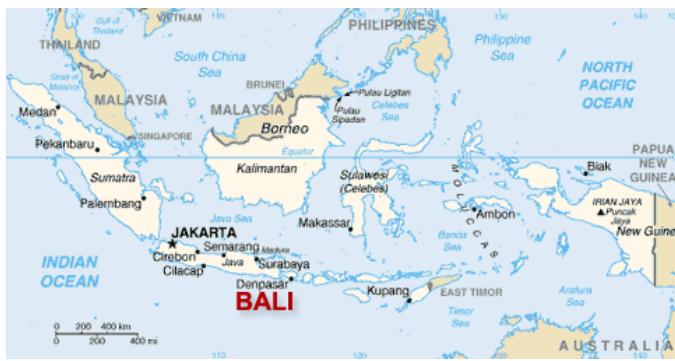
Figure 1 The map of Bali
Source: http://vietsciences.free.fr/lichsu/lichsucacnuoc/images/bali.gif, accessed on 30 May 2015

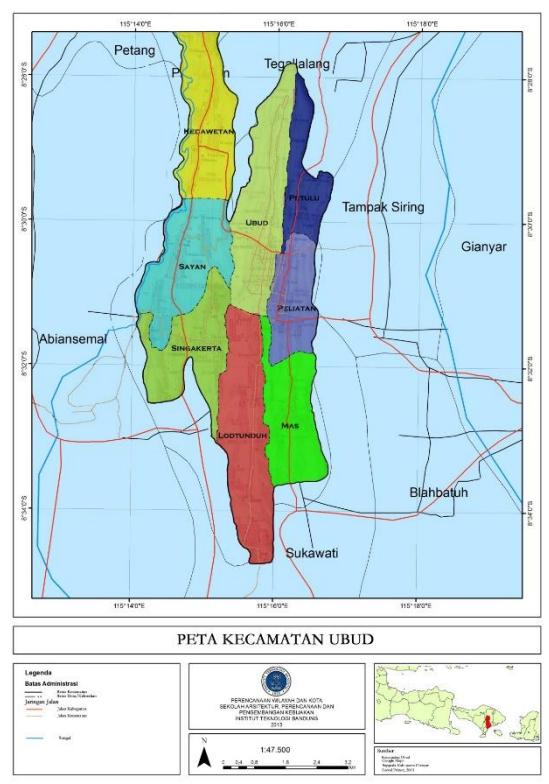
Figure 2 The map of Ubud source: Pratama, 2013
Moreover according Pujaastaw (2005: 17), natural landscape in Ubud's rural areas such as cliffs, ravines and streams of pristine water, terraced rice fields, "Subak3 ", shrubs, and the of their typical traditional houses in Ubud can provide tranquility and inspiration for visitors. As the appreciation of the natural and socio-cultural beauty, many painters in Ubud create and spread this beauty through painting media. The famous Ubud's painters are Blanco, Han Snell, Bonet, and many another name, moreover the beauty of Ubud also portrayed through books like Covarrubias who create "Balinese Top Less Girl", as well as through the media that promote the tourism in Ubud.
As the main tourist destination in Bali, Ubud already has their supporting facilities and infrastructure to support the tourism activities that occur in Ubud. Visitors can easily find money changers, restaurants, bars, tourist information, post offices, car rent services, hotels, et cetera.
From a brief general description above, Ubud, one of the favorite destinations for tourists who visiting Bali, have the impact of land use changes as a result of the growth and development of tourism activities that occur in this place. It that can be seen from the many new villas and new lodgings that have been sprung up. Furthermore, there are also many new constructions of shops and restaurants as well as the need for tour operators to accommodate and indulge the visitors that come to this place. Physical development due to tourism activities will certainly lead to changes in land use in the region, especially agricultural land, and also the social culture of the local citizen.
3 Subak is the name of Bali's irrigation system which has been included in the UNESCO cultural heritage.
LITERATURE REVIEW
The definition of travel by to International Recommendation for Tourism Statistics (IRTS, 2008) is an activity of travelers meanwhile a traveler is someone who moves between different geographic locations, for any purpose and any duration. Moreover from the same source, "a visitor is a traveler taking a trip to a main destination outside his/her usual environment, for less than a year, for any primary purpose (business, leisure or other personal purpose) other than to be employed by a resident entity in the country or place visited". In Indonesia, a tourist is a person that is doing the tourism activities.
A person is called a tourist if they are doing a journey more than 80 kilometers or 50 miles from their house for the purpose of recreation. According to United Nations in IRTS (IRTS, 2008) the definition of tourism is "a subset of travel and visitors are a subset of travellers" Moreover Goeldner (2011) in his book named "Tourism: principles, practices, philosophies" mentioned that tourism is an industry that have a relationship between four actors which are tourist, host government, host communities, and business suppliers and interact with each other.
Tourism is a human activity with the purpose to find a calm atmosphere that is different with their daily activities. According to Law Number 9 of 1990 on tourism in Indonesia, tourism activities have five purposes to be achieved which are: (a) introducing, utilizing, conserving, and improving the quality of objects and attractions; (b) fostering a sense of patriotism and enhance the International relationship between the countries; (c) expand and equally spread the opportunities for business and open the jobs opportunities within the countries; (d) increase national income in order to improve the welfare of the people; (e) encourage the utilization of domestic products.
To achieve the purpose of tourism activities, the development of tourism objects and attractions must consider these factors:
- a. The capabilities to encourage and increase the environment and human development.
- b. Economic and socio-culture life.
- c. Religious values, customs, and some views and values within the society.
- d. Preservation of cultures and environment quality.
- e. The continuity of tourism business itself.
World Tourism Organization is giving a different definition of tourist and excursionist based on the length of their journey. According to United Nations in IRTS (IRTS, 2008) "a visitor (domestic, inbound or outbound) is classified as a tourist (or overnight visitor), if his/her trip includes an overnight stay" and "A visitor (domestic, inbound or outbound) is classified as a same-day visitor (or excursionist) if his/her trip does not include an overnight stay."
The government and private sectors, in order to keep and provide the facilities and infrastructure in tourism destination, have to pay their attention to supply and demand factors in tourism activities. Supply in tourism sector cover everything that will be over to the visitors. According to Wahyono (2006) supply in tourism sectors included the tourist attraction that can be natural and man-made, services, and also goods that expected will attract the people attention so they will visit that tourist object in the future. Supply in tourism is something that should be there to attract people, covering everything that can be offered to visitors, these supply can be man-made or naturally exists without human intervention. According to Turgut (2002) supply components in tourism industry consists of attraction, transportation, service, promotion, and information.
Demand components in the tourism sector are everything connected with the number of visitors quantitatively. According to Wahab (1995) demand in the tourism sector can be divided into potential demands and actual demands. The potential demand is the number of people or visitor who potentially and considered to be able to travel and visit the tourist destination. While the actual demand is some people, who visit a tourist destination. According to Vanhoe (2010) potential demand can be affected by determinants, motivations, and also buyer behavior.
Direct impacts from the tourism industry in Ubud can be seen in the increasing numbers of land use change from agriculture into physical land use such as hotel, restaurant, bar, and villa. The process of land conversion according was influenced by two factors first because of the institutional system and non-institutional system. Both these factors also reinforced by the regional development strategy towards urban development with basis on economic growth, the development have prioritized on the construction industry. This strategy led to the change of structure and socio-culture life from rural to urban development.
According Sumaryoto et. al (2013) revealed that the pattern of land conversion can be seen from several aspects. According to the actors of land conversion, land conversion can be divided into two. First, the transfer function directly by the owner of the land in question. Typically, there are three motives for action: (a) to meet the need for housing, (b) in order to increase revenue through the transfer of business, (c) a combination of (a) and (b) such as to build a dwelling house which once used as a place business. Conversion pattern like this happens in any place, small and scattered. The impact of the conversion of the existence of the surrounding paddy fields will be significant for the long term. Second, the transfer function that begins with the transfer of ownership Owner sells to another party who will use it for non-agriculture business based or to the broker. Land conversion can happen in the broader area, concentrated and generally correlated with the process of urbanization.
From the socio-economic view, a land conversion that occurs in Ubud changes the structure of employment and source of income of local communities. In one hand, some of them can improve their welfare, especially for owners of the land. In other hand, for the lower classes (especially agricultural laborers and peasants/farmers who cultivated fields less than 0.5 ha) experience a different way. Most of them are not able to automatically switch the work / venture into the non-agricultural sector, so they are facing a limited choices and conditions of business opportunities. At the same time, there are cultural changes from an agrarian based society to a culture of urban-based society.
METHODOLOGY
This research started from the identification phase development of tourism activities in Ubud Tourism Region. It was selected to answer the background why this research conducted, which is the numbers of land use change that are high in Ubud tourism area as a result of tourism activities. To achieve the objectives of the study, there are several research objectives to be achieved, which determine the development of tourism activities in the area of the tourism area in Ubud, knowing and identify the area of agricultural land use change occurring in Ubud Tourism Region in the 2004-2011 period. Furthermore, identifying the factors that are driving the land use change that took place in this study area.
From data collection technique, data that will be needed in this research consist of primary data and secondary data. The collection of primary data is conducted in a direct field survey by doing an in-deep interview and also distributing questionnaires to obtain and collect information on the impact of the development in tourism development sectors. Secondary data is needed in order to gain more information about what happen in Ubud.
The primary survey is conducted by these actors and stakeholders that can be seen below:
- 1. The owners or managers of tourism businesses to obtain information on the establishment of tourism, active and passive land area of tourism and its ownership.
- 2. The owners of existing tourism businesses support in the vicinity area of the main attractions, to obtain information about the activities carried out, the location, land area, and ownership.
- 3. Farmers who have agricultural land or farm workers who do not have agricultural land in the vicinity area of Ubud tourist attraction, to obtain information about land ownership and also plans to be carried out on existing agricultural land.
- 4. Local Government which include relevant agencies such as Bappeda4 , Disbudpar5 , BPN6 , BPS7 , Department of Agriculture and local governments (sub-district offices and villages) with conducting in-deep interviews regarding the issues that are being investigated and the extent of the influence of tourism development Ubud to changes land use occurs.
Meanwhile from the secondary data collection, the data obtained from the multiple government agencies such as: Bappeda, BPN, Department of Spatial Planning, DPU Bali, Disbudpar, Regional Archives, the District Office, and the village office.
From the analysis method, this research has been conducted in a descriptive-explorative way. Descriptive analysis analysed the physical characteristics of Ubud tourism area, explaining and outlining the facts, describe field observations, information and state of the object of study through the descriptions of the systematic statement delivery.
Correlation analysis was used in this research to determine the level of correlation / relationship between data and information, especially in order to know the relationship of two independent variables that relate to the land conversion in Ubud. Correlation analysis can explain an event that has a causal relationship if there is a theory or a reference that supports the existence of a causal relationship between variables. The correlation coefficient for the two pieces of variables X and Y with the amount of data amounting to N, can be calculated using the formula developed by Karl Pearson, which is:
\[r = \frac{N\Sigma XY - (\Sigma X)(\Sigma Y)}{\sqrt{N\sum X^2 - (\sum X)^2} \sqrt{N\sum Y^2 - (\sum Y)^2}}\]
In general, the numeric significance that was utilized in this research are 0.01; 0.05 and 0.1. The reason are based on the level of confidence (confidence interval) desired by the researcher. Figures significance of 0.01 has an idea that the degree of trust of 99%. If significant numbers of 0.05, then the level of trust is 95%. If significant numbers of 0.1, then the level of trust is 90%. In tests using SPSS the criteria that become a base for the analysis are:
- 1. If the number of significance "r < 0.05", there is a significant relationship between both variables.
- 2. If the number of significant r > 0.05, there is no significant relationship between both variables
7 BPS: Badan Pusat Statistik (Central Bureau Of Statistics)
4 Bappeda: Badan Perencana Pembangunan Daerah (Regional institution for planning and development)
5 Disbudpar: DInas Kebudayaan dan Pariwisata (Department of Culture and Tourism)
6 BPN: Badan Pertanahan Nasional (National Land Agency)
An overview of social economy and tourism condition in Ubud
As an overview, the population in Ubud tourism area in 2011 was 70.408 inhabitants with the largest population in the village of Mas of 13.325 people (18.93%), then the village of Ubud of 11.044 people (15.69%) and the village Singakerta of 9.559 people (13.51%).
The population density in the village of Lod Tunduh and Peliatan is in line with the conditions that both villages are the villages which have a tendency having the urban characteristics with non-agricultural sector activities. Moreover, both villages are located on the main road that crosses the path of Ubud area so it increase the numbers of people to stay and settle in that place. As for the village of Ubud, Mas and also Singakerta, according to the existing condition, the villages located in the centre of people activity in the Ubud tourism area supported by the main road through Ubud area as well as social and public facilities are mostly located in the area which increase the attractiveness for migrants to live and settle in this area.
The population in Ubud Tourism Region mostly working in the industrial sector with the number up to 10.063 people. While the population that is living from the trade sector was next in line with some 7.275 people, a population that living in the energy and water sectors is the smallest group of 9 persons.
Because previously we cannot find any data that shows the tourism condition in Ubud. we use the data from the province of Bali as for analysis. Based on the data obtained from the Bali Province Tourism Office in 2004-2013, the number of international tourists and domestic tourists who come to Bali showed an upward trend. Particularly in the last ten years (2003-2012) has increased quite rapidly, from 993.029 foreign tourists and 1,993,029 domestic tourists become 2,891,019 international tourists and 6,063,558 domestic tourists. In this period almost every year, the numbers of tourist that visit Bali is increasing except in 2005 and 2006 tourist arrival was decreased due to Bali bombing II. The largest growing number occurred for foreign tourists in 2004, namely 465.280 people, or approximately 46.85% from 2003's visitors. For domestic travelers, the highest increase occurred in 2010 in some domestic tourists that visit Bali are 1,125,208 people, or increased about 31.96% compared with 2009.
FINDING AND ANALYSIS
The agricultural land area in Ubud have not only a function as a rice producer but also become one of a main tourist attraction to visit Ubud. Although the number of agricultural lands area converted to the non-agricultural area is small, but the impact is quite large. If this event does not become a concern for the relevant agencies in the region, it can be bad for the development of tourism in Ubud because it can reduce the number of tourists to come and enjoy the natural scenery of rice fields in Ubud. Moreover, the impact also hit the farmer that have their life from the agricultural land.
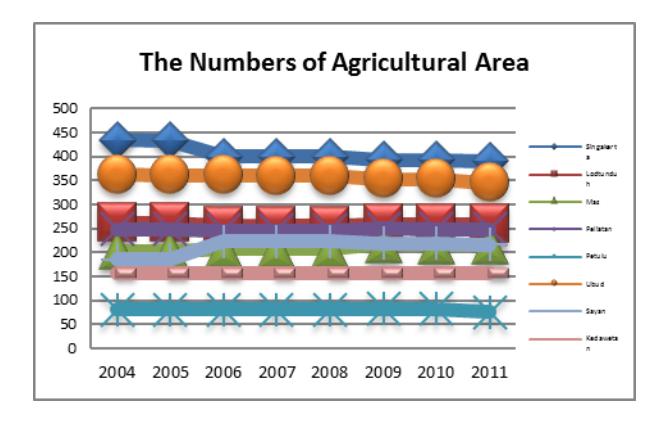
Figure 3 The numbers of agricultural area. (Pratama, 2013)
Based on the figure above, the numbers of agricultural area in Ubud, in general, is decreasing from year to year. According to an in-deep interview in Ubud, the decreasing numbers of the agricultural area happened because of tourism activities. As the numbers of visitors that come to Ubud is increasing, the needs of tourism activities also increase. As it can be seen in the time-series data below, the numbers of visitors increase every year with the majority of day-trip visitors. The green line shows the information on the total visitors that come to Ubud, meanwhile the red line shows the data of day-trip visitors that came to Ubud and for the blue line is the data of visitors that visit and stay in Ubud.
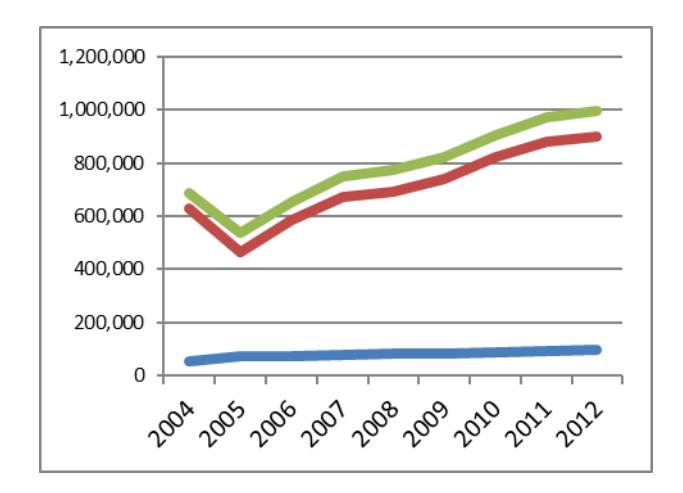
Figure 4 The numbers of visitors in Ubud (Pratama, 2013)
Furthermore, from the same data we have got from the year 2004-2012, we got the average percentage of the increasing visitors that came to Ubud every year, from the day-trip visitor the average percentage of increasing visitors is 7,93%. Meanwhile from the average percentage of the increasing number visitor that come just for one-day trip to Ubud is 5,61% and as a total average percentage is 5,53%. From the data, it can be seen that the needs of the tourism facilities and infrastructure in order to match the tourism development in Ubud, especially for the tourist that want to visit and stay in Ubud.
The increasing numbers of visitors that came to Ubud give the benefit of the economic sector in Ubud region. However, in other hand, if we see from the agricultural and social side, this event give a negative impact on both sides. From the agricultural side, there is an area that change from agricultural area become a built area in Ubud. From the data that we obtained from the field in Ubud, an increase in the number of tourist arrivals are side by side with the growth in the number of land use and physical development of tourism facilities in the Ubud region. The construction of tourism facilities that occurred in the district of Ubud, mostly located in the vicinity area of existing tourism attractions. The facilities growth that took place in Ubud consists of accommodations, restaurants, bars, cafes, and other tourism facilities (shops, banks, post offices, art shops, and communication centers).
Table 1: Correlations of number of visitors with the numbers of accommodations in Ubud
| Number of Visitors | Hotel Occupancy | Number of Accommodations | ||
|---|---|---|---|---|
| Number of Visitors | Pearson Correlation | 1 | .909** | 823** |
| Sig. (2-tailed) | .001 | .006 | ||
| N | 9 | 9 | 9 | |
| Hotel Occupancy | Pearson Correlation | .909** | 1 | 855** |
| Sig. (2-tailed) | .001 | .003 | ||
| N | 9 | 9 | 9 | |
| Number of Accommodations | Pearson Correlation | 823** | 855** | 1 |
| Sig. (2-tailed) | .006 | .003 | ||
| N | 9 | 9 | 9 |
**. Correlation is significant at the 0.01 level (2-tailed).
Source: Pratama (Pratama, 2013)
From the result of SPSS application above, there is a correlation between the numbers of visitors in Ubud with the numbers of accommodation in Ubud. Moreover, this correlation shows us a tendency of the increasing in numbers of accommodation if the number of visitors is also increasing. Correlation is displayed by the numbers -0,909 and -0,823, which means according to the theory there is a correlation or relationship in the strong category as it approaches 1. The amount of correlation that exists between variables is 0909 and -0823. Whereas the number sig. (2-tailed) was 0.001 and 0:06, so it is still much smaller than the critical threshold α = 0.05 means there is a very significant or strong relationship between the two variables (0.001 <0.05). The same story also happened in others tourism facilities in Ubud. With same analysis method, the result of the analysis is a strong correlation between numbers of visitors with the numbers of tourism facilities in Ubud.
If the need of facilities growing keep increasing each time, the number of agricultural area in Ubud could be decreasing and turn into built area. Furthermore, if the number of agricultural areas is declining, it could bring an impact to the society that dependent their life on agricultural products and agricultural activities. Moreover, the increasing in tourism activities could give an effect in the social structure of the society in Ubud.
From the field survey that was conducted in 2013, the impact of social and culture of the society in Ubud are changing from the agricultural based society into a trade and tourism based society especially in the area that tourism activities take place in Ubud as can be seen in the maps below with the dotted red area.
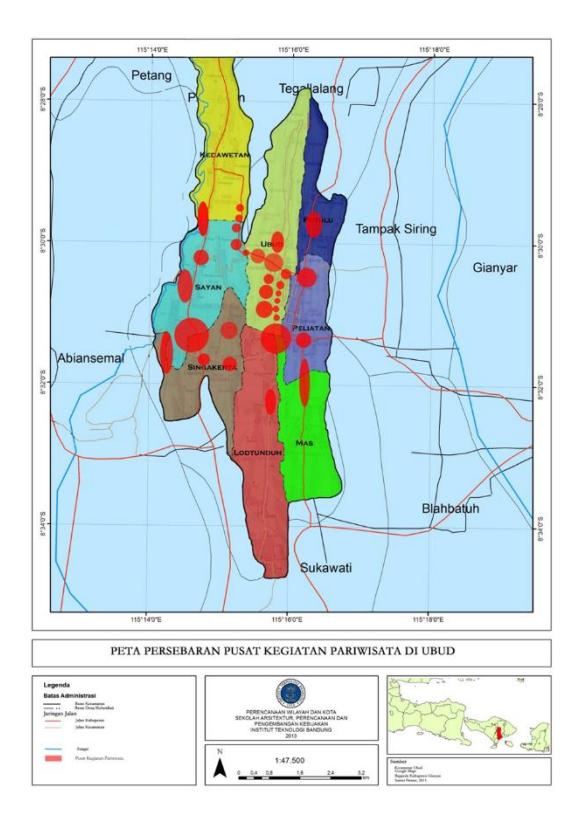
Figure 5 The map of tourism destination centre in Ubud, (Pratama, 2013)
Moreover, as the economic laws happen in this area when the needs of an area to support the tourism facilities development but the open land supply is in a static amount, the price is rise according to the market price. From the primary data we have find in the field survey, the price of the land is increasing with an average of 450% during 5 years' time (2008-2013). As a result, many agricultural landowners want to sell their land and get instant profit. But the impact of this activities are the farmers lost their jobs as before and many of them change their jobs into a trader in a souvenir shop or tourism destination in Ubud or being a tourist guide in Ubud. Moreover, the number of agricultural areas is decreasing and the society in Ubud have to search another sources in other area or region to fulfil their agricultural products need that bring a cost in transport and increase the price of agricultural commodities.
Furthermore, in Ubud still can be found traditional customs and cultures of Bali, one of them is the distribution of inheritance. Many farms area in Ubud which eventually divided into a smaller area and bequeathed to their descendants. Many of them finally sell their agricultural land in Ubud and purchase another agricultural land in another area where the price of land is still relatively cheaper compared to those in Ubud tourism area. Finally, the person who sold his land at a high price in Ubud can get a larger farms area than previously owned.
More impact on the social side is, the original citizen that previously stay and settle in Ubud, have to move to another district around Ubud because they cannot afford the higher living cost because of tourism activities and replaced by migrants that come from Java island or another area in Bali.
CONCLUSIONS
The purpose of this study was to identify the impact of tourism development on agricultural land in Ubud. Moreover, we want to identify the effects on social, culture and economy as the decreasing number of farmland in Ubud is still happening. To get this result of analysis first we conducted an analysis in the development of tourism activities in Ubud, then we conducted an analysis of the development of the construction of tourism support facilities that directly impact the land use change occurring in Ubud.
The analysis on the development of tourism activities in the District of Ubud found that an increase in the number of tourists who come to Ubud. Although the pace of growth in the number of tourists who come to this area are slowing down, but the "rate of growth" in the number of tourists remained in the high category. The impact of the increasing number of tourists visiting the District of Ubud caused a continuing impact (trickling-down effect) to the development of tourism activities in Ubud. An increasing number of people are also caused by increased tourism activity in the region that directly also increase activity in existing economic sectors.
Furthermore, as a result of an increasing tourism activity in Ubud, there is also an increasing numbers in the need of tourism facilities such as accommodations, restaurants, art galleries, shops that selling daily needs and souvenirs shops. The increased need for tourism facilities can be seen from the increasing number of existing accommodation, the growing number of restaurants and cafes that exist, as well as an increasing numbers of other tourism support facilities (art galleries, shops, banks, etc). The direct impact of the land use change occurring in Ubud Tourism Region is a result of the increasing need for tourism facilities.
From the social, economic, and cultural side, the impact from land use change activities that happen in Ubud, change the local society habits. As they are original as a farmer, nowadays they start to leave their job and become a traders or tour guide, even begin to open a tourism business in restaurants, cafés, and small accommodations. Moreover, as the living cost in Ubud gets higher than before, many citizens move to another area that cheaper than Ubud.
Tourism industry in Ubud act like a two-sided knife, on one hand they give a benefit to some people, especially to people who have their business in tourism industry, but in other hand, tourism activities give negative impacts for those who do not live in tourism industry. For example, farmers who do not have land usually work for another man and work in his land, after the owner of the land sells his land to private sector that want to build a tourism facilities like hotel or restaurant, the farmers do not have their jobs as before and they have to find another land to work on it or have to change their jobs as the majority farmers take.
For conclusions, this problems could bring the society that settled in Ubud into a worse condition if the government cannot guarantee or make sure that the land-use change activities to be banned in the agricultural land that have an enormous impact on the farmers society. The government should manage and control the tourism growth and development in Ubud, so the preservations of the agricultural land are still manageable and maintained. If there is a damage in the agricultural area, the continuity of tourism industry in Ubud may be disturbed as subak system that located in the agricultural area is one of main attraction for tourist to come and visit Ubud.