

INTRODUCTION
Indonesia is the largest archipelagic country in the world, consisting of 17,508 islands. A country surrounded by the sea, the area of the waters exceeds the land area; around 5.8 million km2 is the ocean, from 7.1 million km2 of the total area, and the coastline length exceeds 81,000 km (BPS, 2014). This makes Indonesia dubbed as a maritime and archipelagic country. In the oceans, biological biota and marine ecosystems must be sustained by the natural balance of the ecosystem. Indonesia as a country rich in natural resources, will require in-depth study and deliberative planning in the management of marine resources, to be preserved and utilized for the welfare of its people (Sager, 2002). Indonesia dominant foreign exchange originating from oil and gas; textiles; tourism; and followed by other economic sectors. The construction sector is a priority of the current government is the sector of infrastructure development; maritime; energy; food; and tourism. Development of the sector is very appropriate, if Indonesia wants to improve the competitiveness of the nation, especially on infrastructure (Arismayanti, 2015). In the tourism sector, the government is currently working to continue to develop the village and attempt to explore the potential of the village with village building program reinforced by the issuance of legislation village. Construction of the village is expected to meet the needs and interests of grassroots and provide prosperity for the entire community. Forward the necessary synergy between the maritime sectors of the tourism sector, if it happens of course it is a new breakthrough that can accelerate the pace of development in the two sectors.
In the field of tourism, Indonesia continues to increase the number of tourist visits. The target of foreign tourist arrivals to Indonesia in 2016 is expected to reach 12 million visitors and in 2019 the target is expected to reach 20 million visitors (Ministry of Tourism, 2015). However, this is a high motivation to continue to increase state revenues from the tourism sector, but it should also be contemplated, the success of the tourism sector and an increase in revenue not only seen from the number of tourist visits but more emphasis on the quality of tourist visits. Quality means, in tourist arrivals to Indonesia needs to pay attention to the quality of tourists visiting classes; long stay at a destination or tourist attraction; and the amount of money spent on the destination or attraction. Mass tourist arrivals are not always the right solution at several tourist destination areas in Indonesia. Bali for example, as a relatively small island with limited resources, space and carrying capacity of the environment, has targeted to increase the number of tourist arrivals, it was not the right development approach (Arismayanti, 2010). If the emphasis quantity of foreign tourists who visited and supported by government policies, such as providing visa exemption for short visits to 169 countries, of course it will have implications on the kind of tourists who will visit. Types of travelers tend to bulk, instead of rating quality. Mass travelers tend to provide benefits that are not significant and spend more resources in tourist destination areas. In some cases occur after these policies were tourists who come, instead of spending their money in tourist destination areas, but looking for work and open a business in tourist destination areas, such as opening a business tattoos, the property business, being a chef, and so forth (interview with Mr. Chatur, the Immigration officer in Bali Ngurah Rai International Airport, FGD 3 Great Indonesia, July 22, 2016).
Marine and coastal are the best tourist attraction that could be developed especially in the field of tourism to attract tourists to visit. Existing maritime potential if developed will be able to create new activities in the field of tourism with specific market share. Maritime potential is seen not only from nature, but also about the culture of the people living in coastal areas. Culture coastal communities are unique and vary in each region is a great potential for the development of new in the field of maritime travel. The presences of tourism in coastal areas are expected to provide economic benefits and conservation occurs in marine and coastal areas towards sustainable tourism. The development of marine ecotourism has the principle of preserving the natural environment; community-based; their education and experience; sustainable; and managed properly for the welfare of society. The strategy in the development of sustainable marine ecotourism is expected to ensure the sustainability of economic, social and cultural, as well as the environment. Marine tourism development effort requires the synergy of all the stakeholder's as well as management and development strategy is planned and sustainable. The development of marine tourism is expected to provide great benefits for the community. Coastal communities that will be in direct contact with the growing tourism in their area, but also the wider community. It certainly can be done, given the nature tourism multipliers effects are interrelated and need tourists can not only be met by a single industry. The development of marine tourism will be able to create new business development and employment opportunities are substantial, given that tourism is a labor-intensive industry that requires substantial amounts of human resources to deliver services to many travelers.
Tourism has expanded and diversified in various fields as well as being one of the largest economic sectors and fastest growing in the world. Despite the global crisis occurred several times, the number of international tourist trips continued to show positive growth. However, to realize the sustainability of marine and coastal areas; public welfare; reduction in poverty; and tourists are satisfied. For that strategy is needed in the development of marine tourism. One of these alternative types of tourism can be developed in marine and coastal areas are ecotourism. Ecotourism has a concern for the preservation of the environment and involve the local population in development, and there are elements of education. The travelers who come to enjoy the natural surroundings and also to study it to increase in knowledge or experience in the destination. The benefits of the development of marine tourism are closely related to the economic development in Indonesia, especially in coastal areas, so that the involvement of local communities is crucial in the process of tourism development. The development of tourism in the region may have a positive impact for the region, because it can create jobs that are wide enough for the local community and surrounding areas. Tourist arrivals in the region indirectly will appear new demand and expanding market segment will be the results of marine products and handicrafts, as well as the chances for educational institutions to produce qualified human resources in the field of maritime and tourism management.This research aims to:1) Identify the potential for marine ecotourism located in Indonesia;2) To analyze the internal and external environment marine ecotourism in Indonesia;3) To analyze the development strategy of sustainable marine ecotourism in Indonesia.
LITERATURE REVIEW AND CONCEPTUAL FRAMEWORK
Tourism Development Strategy
The strategy is a means to an end. A strategy can be developed to cope with external threats and seize the opportunities that exist. Marpaung (2000: 52) defines that: "The strategy as a process of determining the value of choice and decision-making in resource utilization leads to a commitment to the organization concerned to actions that lead to the future". "The strategy can also be interpreted as a general integrative plan that is designed to enable tourism organizations to achieve its objectives through the allocation of appropriate resource utilization by although finding many obstacles from the competitors". Chandler (in Rangkuti 2004: 3) imposes limits that: "The strategy is a means to achieve its goals in relation to long-term goals, follow-up programs, as well as the priority allocation of resources". While Argyris, Mintzberg, Steiner and Miner (in Rangkuti 2004: 4) defines that: "The strategy is a response (continuous and adaptive) against external opportunities and threats and internal strengths and weaknesses that can affect the organization".
The development of tourism is strongly influenced by travelers and travel conducted to a place or destination or to a country's overall development and progress. Stages of development of tourism are the life cycle stages that occur in the development of tourism, since a newly discovered tourist destination (discovery), then developed and eventually decline (decline). Stages of the life cycle of the tourist areas proposed by Butler (1980 Cooper and Jackson, 1997) can be seen from Figure 1.
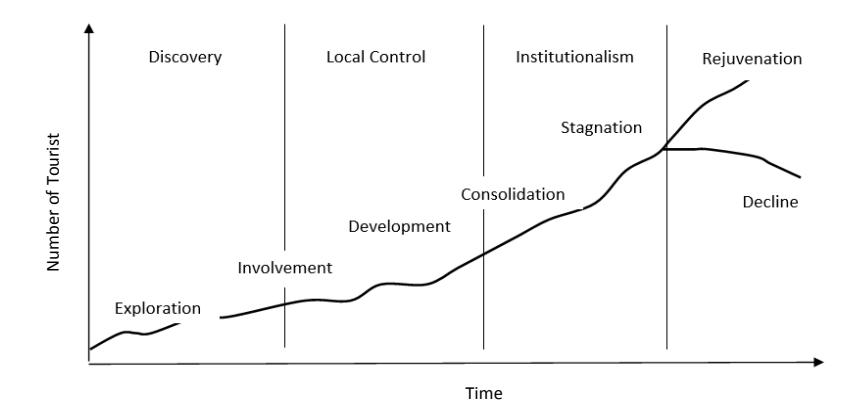
Figure 1. Tourism Life Cycle (sources: Butler (1980 in Cooper and Jackson, 1997))
Butler (1980, Cooper and Jackson, 1997) states that there are six (6) levels or stages in the development of tourism, there are:
1) Exploration
At this stage a relatively small number of adventurous travelers. Travelers tend to be exposed to the natural and cultural beauty unspoiled tourist destination. In this stage, the small number of touriststo come and also coupled with the facilities and services that are less good. At this stage, the tourist attractions in the area have not been changed by tourism and contact with the local community will be high.
2) Involvement
At this stage, local community initiatives to provide tourist facilities, and the promotion of the tourist area started with the help of government involvement. The results of this stage that increasing number of tourists.
3) Development
At this stage, the number of tourists who come to rise sharply. At the peak tourist season usually equaled, even outnumber the local population. Outside investors flock to renew the facility. In line with the increasing number and popularity of the area of tourism, the problems of the destruction of the facility began. Planning and control of national and regional be needed, not only to solve problems that occur, but also for international marketing.
4) Consolidation (consolidated and interrelation)
At this stage, the growth rate has begun to decline, although the total number of tourists is still relatively increased. In this stage the experienced tourist areas around the problem and the likelihood of a very strong monopoly.
5) Stagnation
At this stage, the number of tourists who come in peak season, tourists are no longer served by tourism destinations. It was realized that replicates the visit of tourists and business utilization and other supporting components are needed to maintain the number of tourists who visit. A tourist destination may encounter environmental issues, social and economic.
6) Decline (loss of quality) or Rejuvenation (new birth)
At this stage, the visitors lost tourist destination known to the original and becomes the 'resort' new. 'The Resort' is to be dependent on geographic catchment areas smaller for daily trips and weekend visits. Ownership strong opportunity for change, and tourism facilities, such as accommodation will change its utilization. Finally policymaking admits at this stage and decided to be developed as a 'new birth'. Next, there were new policies in various fields, such as the use, marketing, distribution channels, and reviewing the position of the destination.
On the development of tourism can be identified five approaches (Page, 1995: 120), four of which were proposed by Getz (1987). The approaches to tourism development are:
- 1) Boos term approach, which is a simple approach that sees tourism as a positive attribute for a place and its inhabitants. But local people are not involved in the planning and the carrying capacity of the area is not considered thoroughly.
- 2) The Economic Industry Approach, namely economic approach to tourism destinations would take precedence over social and environmental goals and make the visitor's experience and level of satisfaction as the main target.
- 3) The physical Spatial Approach, that this approach is based on the tradition of "land use" geographical. The strategy development based on different planning through the principles of spatial.The example, the grouping of visitors to the region and the solutions to avoid potential conflicts. Only drawback of this approach is less considering the social and cultural impact of tourism floating.
- 4) The community approach, the approach that emphasizes the importance of maximum involvement of local communities in the tourism development process.
- 5) Sustainable approach, namely sustainable approach and interest in the long future as well as on the resources and the effects of economic development on the environment which may cause the strengthening of cultural and social patterns of life and lifestyle of the individual.
Additionally, Suwantoro (1997: 88-89) states that the object development and tourist attraction in detail the need to consider some of the following:
- 1) Trading facilities and other facilities are not allowed to be built too close to the object and tourist attraction, so the quality of the object is not polluted.
- 2) Commercial facilities are built to be integrated with a parking lot.
- 3) Planning of commercial premises oriented to the pedestrian, pay attention to things best when it would take a lot of stalls (circular path).
- 4) Parking at least 50 meters of the object and tourist attraction and covered with greening
- 5) Sell unique souvenirs of local attractions, such as crafts, painting, and agricultural products.
Ecotourism
The term ecotourism translated into eco-tourism, which is a type of tourism that is environmentally sound. That is, through activities related to nature, invited tourists to see nature up close, enjoy the authenticity of nature and the environment, thus making it inspired to love nature. All this is often referred to as back to nature (Yoeti, 2000: 35). Ecotourism is responsible travel to natural areas that protect the environment and improve the welfare of local residents. Ecotourism is also said to be a matter of creating and satisfying a desire for nature, of exploiting the potential of tourism for the conservation and development as well as on preventing adverse impact on the ecology, culture and beauty (Hawkins, 1995).
In contrast to what we know about familiar tourism, ecotourism in its implementation does not require the availability of modern accommodation facilities or glamor that comes with equipment which is too fancy or building artificial excessive. Basically, ecotourism in its implementation is done with simplicity, maintaining the authenticity of nature and the environment, maintaining the authenticity of art and culture, customs, habits (the way of life), creates peace, silence, maintaining the flora and fauna, as well as the preservation of the environment, so as to create a balance between human life with the natural surroundings.
In ecotourism there are four elements that are considered very important, namely pro-active element, concern for environmental conservation, involvement of local residents, and educational elements. The travelers that who come to enjoy the natural surroundings and to study it as an increase in knowledge or experience. Wisdom tourism development can be seen from the scope of national interest, as described Laws and regulations governing government policy on the development of ecotourism as follows (Yoeti, 2000: 39):
- 1) Law No. 4 of 1982 on Basic Provisions of the Environment.
- 2) Ministry of Tourism, Post and Telecommunications No. KM.98 / PW.102 / MPPT-1987 on Business Conditions attractions.
- 3) Decree of the Director General of Tourism No. Kep.18 / U / 11/1988 on the Implementation of Business Conditions attractions and attractions.
- 4) Joint Decree of the Minister of Forestry and the Minister Parpostel No. 24 / KPTS-11/89 and No. KM.1 / UM.209 / MPPT-1998 on Improving the Coordination Agency for Developing Two Objects Nature as the attraction of the Tour.
- 5) Law No. 5 of 1990 on Conservation of Biological Resources and Ecosystems.
- 6) Law No. 9 of 1990 on tourism.
- 7) Act No. 24 of 1992 on the room arrangement.
- 8) Law No. 5 of 1994 on Ratification of Biodiversity Conservation.
- 9) Government Regulation No. 13 of 1994 on hunting animals Buru.
- 10) Government Regulation No. 18 of 1994 on Nature Management in the Use Zone Nature Conservation Areas.
- 11) Government Regulation No. 67 of 1996 on the Implementation of Tourism.
Basically, the tourism development policy should be guided by the following (Yoeti, 2000: 39):
- 1) In the construction, infrastructure and facilities are highly recommended in accordance with needs, not excessive, and using materials found in the area.
- 2) Organize the use of technology and modern facilities to a minimum.
- 3) Development and activity in the project by involving the local population as closely as possible with the aim of increasing the local community economy.
- 4) Local people are urged to maintain the customs and habits of everyday without affected the arrival of tourists who visit.
The guidelines in the implementation or management of an area to be used as ecotourism, must pay attention to the five elements which are considered the most decisive, namely education (education), protection or defense (advocacy), the involvement of local communities (community involvement), surveillance (monitoring), and conservation (conservation). Ecotourism development has specific criteria. There are several aspects that need to be considered as a material consideration in formulating the policy of tourism development; important amongst these are ways of managing, utilization, providing the necessary infrastructure and facilities. Other criteria for the development of ecotourism locations should consider the following matters (Yoeti, 2000: 42-43):
- 1) Market feasibility and capacity of the visit.
- 2) Availability of adequate accessibility to the area.
- 3) The potential of the area to be used as ecotourism.
- 4) Can support the development of other regions in the area.
- 5) Provide opportunities for the development of social, economic, and cultural center for the local community.
- 6) has a great possibility to mutually support the development of tourism in the local area.
- 7) Can support each other for the development of forest areas for the conservation of the area.
Ecotourism as a logical part of sustainable development requires the approach of various disciplines, planning carefully (both physically and management) and the guidelines and strict regulations to ensure the implementation of sustainable, only through the involvement of a cross-sectorial ecotourism will really achieve its objectives. Martha (2008) definite Ecotourism is travel to fragile, pristine, and usually protected areas that Strives to be low impact and (often) small scale. It helps educate the traveler, Provides funds for conservation, directly benefits the economic development and political empowerment of local communities, and fosters respect for different cultures and for human rights. Real ecotourism, then, has the following seven characteristics:
- 1) Involves travel to natural destination
- 2) Minimizes the impact
- 3) Builds environmental awareness
- 4) Provides direct financial benefit for conservation
- 5) Provides financial benefits for local people and empowerment
- 6) Respects local culture
- 7) Supports human rights and democratic movements
Ecotourism demands a more holistic approach to travel, in the which one of participants strive to respect, learn about, and benefit both the environment and local communities. Although not explicitly part of The International Ecotourism Society's definition, giving economic benefits and showing cultural sensitivity to local communities cannot be separated from understanding Reviews their political circumstances. In many developing countries, rural Populations living around national parks and other ecotourism Attractions are locked in contests with the national government and multinational corporations for control of the assets and their benefits.
The main principles of ecotourism can also be applied for marine tourism including ecotourism part of this can be seen in Minister Regulation No. 33 Year 2009 on Guidelines for Ecotourism Development in the Region in Article I and in Article II has a principle:
- 1) Environment.Ecotourism relies on the natural environment, culture relatively unspoiled or disturbed.
- 2) People. Ecotourism must give the benefit of ecological, social, economic and directly to the public.
- 3) Education and Experience. Ecotourism should be able to improve the understanding of the natural environment and culture with their experience possessed.
- 4) Sustainable. Ecotourism can provide a positive contribution to the ecological sustainability of the environment, both short term and long term.
- 5) Management. Ecotourism must be managed properly and ensure the sustainability of the natural environment, a culture that aims to improve the welfare of present and future generations.
Marine Toursim
Marine tourism are all activities undertaken to create a fun, challenges, new experiences, health can only be done in the territorial waters. Marine tourism is not alone - the eyes of obtaining
entertainment of various treats attractions and treats natural coastal and marine environment but also the expected visitors can participate directly to develop environmental conservation and their deep understanding of the intricacies of coastal ecosystems, forming awareness of how to behave to conserve coastal areas in the present and in the future. Attraction type utilizing marine coastal and marine areas are directly or indirectly. The direct activities there are boating, swimming, snorkeling, diving, and fishing. The indirect activities there are beach sports, picnics to enjoy the atmosphere of the sea (Nurisyah, 1998).
The concept is based on a view of marine tourism, unique nature, ecosystem characteristics, particularities and characteristics of cultural arts community as the basic power possessed by each region. Mark (2002) states marine tourism includes Reviews those recreational activities that involve; travel away from one's place of residence and the which have as their host or focus on the marine environment (where the marine environment is defined as Reviews those waters roommates are saline and tide-affected). While Orams (1999 in Cater, 2007) defines marine tourism as Including Reviews those recreational activities that involve; travel away from one's place of residence and the which have as their hosts are focus on the marine environment is defined as Reviews those waters roommates are saline and tide affected).
Keraf (2000: 2) states marine tourism is an activity to enjoy the beauty and uniqueness of the natural tourist attraction in the coastal and marine areas near the beach and other recreational activities that support. Sarwono (2000: 2) marine tourism is tourist activities that exploit the potential of marine nature as a tourist attraction as well as container activities that do travel well above sea level in the region that cannot be separated from the existence of ecosystems rich in diversity of marine species. Successful implementation of marine tourism if it meets the various components associated with the preservation of the natural environment, the welfare of the inhabitants of the region, visitors who enjoy the satisfaction and integration with the community development area. Pendit (2003: 41) states marine tourism is a type of tourism that is associated with the water sport activities all the more in a lake, river, beach, bay or the open sea, such as fishing, sailing, diving while taking the picture, surfing competitions, rowing, etc. , The marine activities can be found in the area of Bunaken in North Sulawesi, Wakatobi, Gili Air, GiliMeno and GiliTrawangan, Lombok, the Raja Ampat Islands in West Papua and some coastal areas of the island of Bali.
Sustainable Tourism
Sustainable tourism is defined by UNWTO as "tourism that takes into account the full impact of the economic, social and environmental present and future, address the needs of visitors, industry (tourism), environment and host communities". Why sustainable tourism is so important to Indonesia, a country with thousands of islands of various sizes, is rich in natural resources and culture, extends along the equator. But not all residents are able to enjoy the benefits of the development of tourism. Sustainable tourism practices are not only meant to consume natural and cultural resources, but also environmental conservation; not only benefits a few people, but aims to distribute benefits more widely among stakeholders and the community. Sustainable tourism is a comprehensive concept, intended for all kinds of tourism businesses, both in urban and in rural areas, large and small, public and private. Sustainable tourism development is an important public agenda for all stakeholders at all levels. Sustainability principles refer to the environmental aspects, economic and socio-cultural development of tourism, and an appropriate balance to ensure the long-term sustainability. Thus, sustainable tourism should:
- 1) Utilize environmental resources become a key element in tourism development optimally, maintaining essential ecological processes and help conserve natural heritage and biodiversity.
- 2) Respect the socio-cultural authenticity and the host community, home-made preserve heritage and cultural life of the present, traditional values, and contribute to intercultural understanding and tolerance.
- 3) Ensure the ongoing long-term operation, which provides socio-economic benefits to all stakeholders equitably distributed, including stable employment and opportunities for host communities to receive revenue and social services, as well as contribute to the elimination of poverty.
Sustainable tourism development requires the participation of all stakeholders informed, as well as strong political leadership to ensure wide participation and consensus awakening. Sustainable tourism is a continuous process and it requires constant monitoring of impacts, introducing preventive measures and / or corrective action when necessary. Sustainable tourism should also maintain a high level of tourist satisfaction and ensure a meaningful experience for tourists, raises awareness about sustainability issues and promoting sustainable tourism practices amongst them. Policies that more decisive and practical commitment to sustainable tourism is expected to improve the quality and competitiveness of tourism in Indonesia today and the quality of the development of tourism in the future to not only satisfy the tourists but provide much benefit as possible for the people of Indonesia, especially for local communities. It is also expected that a sustainable tourism approach will improve the performance of tourism in contributing to national development, but also may play better in the eradication of poverty, create jobs, protect the environment and improve the welfare of local communities.
Referring to Law Number 10 Year 2009 on Tourism which states that the performance of tourism development should not only be evaluated based on their contribution to economic growth, but also on the contribution to increase social welfare, reduction of unemployment and poverty, preservation of natural resources and environment, cultural development, an improvement over the image of the nation, patriotism, national identity and unity and international friendship. The World Sustainable Tourism Criteria (Global Sustainable Tourism Criteria) reflects part of the tourism community response to the global challenges of the Millennium Development Goals (MDGs). Poverty eradication and environmental sustainability including climate change are issues that cross-sectorial referred to in these criteria. As advised by the World Sustainable Tourism Board (Global Sustainable Tourism Council), the criteria are an attempt to reach a common understanding on sustainable tourism and become the minimum requirements that any tourism business should aspire to reach. Such criteria, grouped into four main themes: 1) effective sustainability planning; 2) maximizing social and economic benefits to local communities; 3) strengthening of the cultural heritage; and 4) reducing negative impacts on the environment. Although the criteria are initially intended for use by the sectors of accommodation and tour and travel operations, the criteria can be applied to the entire tourism industry or destinations.
Use of criteria include: 1) Use as a basic guideline for all sizes to become more sustainable, and help businesses to choose sustainable tourism programs that can meet these global criteria; 2) The use as guidance for travel agencies in choosing suppliers and sustainable tourism programs; 3) To help consumers identify sustainable tourism program and a healthy business; 4) Use as a common designation for the media information about sustainable tourism providers; 5) Help certification and other voluntary programs to ensure they are fulfilling a basic line that is widely accepted; 6) Offer a starting point for developing sustainable tourism
requirements in the program of sectorial programs of government, non-government and private sector; 7) Used as basic guidelines for education and training institutions, such as schools and universities hospitality.
In 1992, the United Nations Conference on Environment and Development -the Earth Summitin Rio de Janeiro, formulated a comprehensive program of follow up to the 21st century called Agenda 21, which was later adopted by 182 countries including Indonesia conference participants. Agenda 21 is a blueprint to ensure the sustainable future of the planet and is a document that gets a very broad international consensus, implying a global consensus and political commitment at the highest level. At the level of international tourism, Rio meeting followed by the World Conference on Sustainable Tourism in 1995 which recommends governments and regions to immediately prepare an action plan for the sustainable development of tourism and to formulate and promote and propose a Charter for Sustainable Tourism.
The principles and objectives of the charter is that:
- 1) Development of tourism should be based on sustainability criteria, can be supported ecologically in a long time, economically viable, ethically and socially equitable for local communities.
- 2) Tourism should contribute to sustainable development and be integrated with the natural environment, culture and people.
- 3) The Government and the competent authorities, with the participation of nongovernmental organizations and local communities must take action to integrate the planning of tourism as a contribution to sustainable development.
- 4) Governments and multilateral organizations should prioritize and strengthen assistance, directly or indirectly, to tourism projects that contribute to the improvement of environmental quality.
- 5) Spaces with the environment and culture that are vulnerable now and in the future should be given special priority in terms of technical cooperation and financial aid for sustainable tourism development.
- 6) Promotion / support for alternative forms of tourism in accordance with the principles of sustainable development.
- 7) The government should support and participate in the creation of a network for research, dissemination of information and transfer of knowledge about tourism and sustainable tourism technologies.
- 8) Establishment of sustainable tourism policies and management systems need support environmentally friendly tourism, a feasibility study for the transformation of the sector, and the implementation of pilot projects and the development of international cooperation programs.
In international policy statement has been accepted and endorsed by UNWTO (Agenda 21 for Travel and Tourism, and the Code of Ethics for Tourism), successive national governments have tried to raise awareness of the need and benefits of sustainable tourism development. Nevertheless, the fact that the Indonesian government is committed to the policy guidelines including those related to decent and productive work, in conditions of freedom, equity, security and dignity, does not automatically guarantee that all the concepts and principles have been successfully implemented across the country. The concept of sustainable tourism in Indonesia already be reflected in the policies and laws, but does not need to be implemented by international minimum standards have been agreed. The fact that a wide range of sustainability issues have been mentioned in the Act of Tourism of the old, No. 9 in 1990, which was amended into Law on Tourism No. 10 of 2009, indicating an awareness of the concept of sustainable development, which multidimensional aspect: environmentally friendly, economically can benefit, socially culturally acceptable, and puts the community as a core subject in development. Indonesia tourism destination internationally known, namely Bali, already has a long experience in implementing sustainable tourism practices which are based on local cultural wisdom, namely the Tri Hita Karana - the harmonious relationship between Nature, Man, and the Creator. The concept has even been brought to the international level and in 2002 and has received recognition UNWTO and leading regional industry organizations such as the Pacific Asia Travel Association (PATA). Currently, many components of the tourism industry (hotels, restaurants, resorts) that has been awarded the Tri Hita Karana, as an expression of concern for the environment, culture and social welfare. Tri Hita Karana is a model that can be modified and adapted in the tourism industry in other regions of Indonesia. It is also an example of sustainable tourism practices framework and policy development to be studied by local and provincial governments are issuing permits.
RESEARCH METHOD
This study analyzed by descriptive qualitative data analysis and SWOT analysis. Presentation of the results of the data analysis is done formally (in tabular form) or informal (in narrative form). A tool used to prepare the strategic factors is the SWOT matrix. This study is to explore, and formulate policies and programs based on internal conditions, such as strengths and weaknesses that are owned and external situation, such opportunities and threats. Referring Rangkuti (2004), a SWOT analysis is a way to systematically identify the various factors in order to formulate a strategy. This analysis is based on logic can maximize the strengths and opportunities, but simultaneously can minimize your weaknesses and threats. SWOT Analysis considering and comparing the external factors, such as the opportunities and threats to internal factors, such as the strengths and weaknesses, so that the results of the analysis can be taken a decision strategy of sustainable marine ecotourism development in Indonesia.
The process of making SWOT analysis can be done through the eight stages of defining a strategy through SWOT matrix. The stages are: 1) create a list of objects internal strength; 2) establish the internal weakness of the object; 3) Make a list of objects external opportunities; 4) establish the internal threat objects; 5) Interpret of a combination of strengths and opportunities, and then record the results in the cell SO strategy (Strengths Opportunities); 6) interpreted from a combination of force and threat, then record the results in the cell strategy ST (Strengths Threats); 7) interpreted from a combination of weaknesses and opportunities, and then record the results in cells WO strategy (Weaknesses Opportunities); 8) interpreted from a combination of weaknesses and threats, then record the results in cells WT strategy (Weaknesses Threats).
ANALYSIS
Indonesia is the Reviews largest archipelago in the world with 17,508 islands, of which 6,000 are inhabited. The country has the second highest biodiversity with extensive rainforests on the island of Sumatra, Borneo, Sulawesi and New Guinea. It is blessed with a large natural endowment, but also cursed by 76 active volcanos, regular Several Earthquakes and the resulting tsunami. Indonesia is densely populated with 940 people per square kilometer. It has the fourth Reviews largest population in the world: 251 million people. 44% lives in cities. The four major Cities are on the island of Java, Including the capital Jakarta with more than 9 million citizens. The official language is Indonesian, which is a modified form of Malay. However, there are more than 742 languages spoken in Indonesia, Including Javanese, Dutch and English. Similar There is diversity in ethnic groups, though the Javanese form with 40.6% the Reviews largest group. There are six official religions, but the country is predominantly Muslim (86.1%) (The World Factbook, 2016).
Indonesian human development is one of the strongest assets. A country with 251 million people, nearly 45 million people is a member of the consuming class (Oberman, Dobbs, Budiman, Thompson, & Rossé, 2012). The density of the Population is dispersed with 53% of population living in Cities throughout Indonesia. However, they produce 74% of the GDP, contributing a Hefty 55 million skilled workers living in the Indonesian economy. However, there is a disadvantage of having a large population, particularly in the areas of education and poverty. The human development index (HDI), an indicator launch by the United Nations (UNDP, 2013) denotes that Indonesia has a low 5.8 years of mean schooling by people ages 25 and older, ranking the country 121st globally. The country is also caught in a net of poverty with 18.1 percentage of the population living below the international poverty line $ 1.25 (in purchasing power parity terms) a day.
Indonesia is a country that is very dependent on its natural resources. As seen in the export bubble chart, Indonesia's exports are heavily weighted on coal, oil and gas, agriculture, and metal, mining and manufacturing, and to a lesser extent, on fishing, forestry, and tobacco. One highlight (and indeed the focus of this report) is the small yet important cluster of Hospitality and Tourism. Lately, the types of coastal marine tourism or small islands are in great demand by foreign tourists. It can be seen from the increasing number of activities in the tour done in coastal areas, conservation areas or marine protection, such as marine reserves and National Parks Nature Sea. Activities undertaken in particular tourism in small islands has economic impacts improvement of the standard of living, both directly and indirectly to coast and surrounding communities. Natural scenic beauty, white sand and underwater beauty is a major asset in the activities undertaken travelers.
The Internal and External Environment Factors of Marine Ecotourism
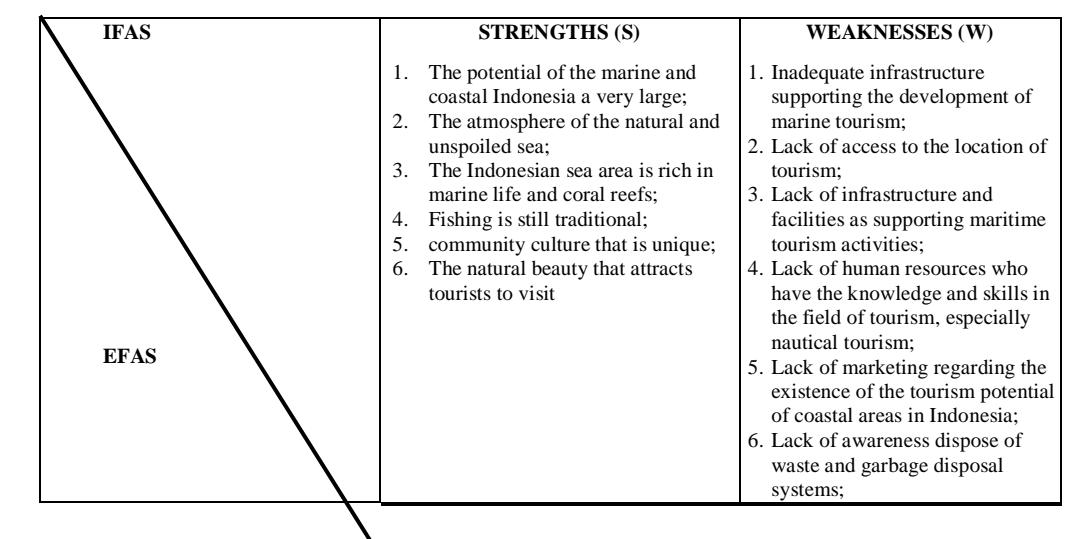
The internal environment of sustainable marine ecotourism development in Indonesia can be seen from the factors strengths and weaknesses. Factors strengths there are:
- 1) The potential of marine and coastal Indonesia is very large. Indonesia is very fortunate to have very many islands and the natural beauty of the sea is very charming, like the islands of Bunaken, Wakatobi, Rajaampat, Bali and Lombok. The beauty of the beaches, underwater and maritime is tourism potential activities to be developed in Indonesia.
- 2) The ambiance of natural and unspoiled sea. Marine tourism in Indonesia has yet to develop optimally, so that development efforts can still be well planned, so that the negative impact that may result from the development of the travel can be minimized. 3. The Indonesian sea area is rich in marine life and coral reefs. Sea area in Indonesia grew various types of marine life and coral reefs as places to live marine ecosystem, even the coral reefs of Bunaken Islands greatly admired foreign tourists. The first step that can be done by clustering marine tourism potential that can be developed, potential for development, and the types of activities that may be conducted on each marine region.
- 3) Fishing is still traditional. Coastal communities in Indonesia do activities fishing still in traditional. This method is certainly not damaging if compared to fishing with explosives. In the development of marine tourism traditional way can be used as a tourist attraction and marine tourism product that can be introduced, studied, and performed by tourists who visiting.
- 4) The community culture that is unique. The islands of Indonesia are surrounded by ocean. Each region is inhabited by people with their own cultural. Each region has its own culture with local wisdom and uniqueness. The uniqueness of this culture can be introduced to tourists as the appeal of local and local wisdom that can be learned by tourists.
- 5) The natural beauty that attracts tourists to visit. Coastal areas of Indonesia were amazing. Most of unspoiled beaches and overgrown of coconut trees and mangroves. Part of the area of tourism has developed; many investors invest to set up a kind of resort accommodations and maritime tourism activities, such as diving and snorkeling.
The weaknesses factors of sustainable marine ecotourism development in Indonesia, there are:
- 1) Inadequate infrastructure supporting the development of nautical tourism. The infrastructure support development of marine tourism is still very minimal. Infrastructure is the basic thing that is required to build and develop marine tourism in Indonesia. Infrastructure development will facilitate the access of tourists to the tourist destination.
- 2) Lack of access to the location of marine tourism. The coastal area in Indonesia not all have adequate access is easier for tourists to visit. Access roads and signage are very rarely found in coastal areas, including in Bali tourism is growing.
- 3) Lack of infrastructure and facilities as supporting maritime tourism activities. The development of nautical tourism in a region requires commitment and support for the development of supporting infrastructure, traveled activity undertaken in the region. The infrastructures there are namely roads (roads and footpaths), water (systems, network and installation of water management), electricity, telecommunications (networks and communication devices), and drainage channels, sewage treatment (system and sewer). Means of supporting the tourism activity, namely security (police shore, rescuers beach, evacuation, security posts, depth stop, post First Aid), an information center (tourism information centers, road signs, signpost, brochures, leaflets, booklets emergency number can be contacted), lodging (hotels, resorts, villas, homestay), a shopping center (shops, art shop, restaurants, souvenir shop, shop equipment maritime activity), shower / toilet, carts / bins, places of worship, money changer, a variety of facilities for traveling (canoes, surfboards, swimwear, buoys, diving equipment).
- 4) Lack of Human Resources who have knowledge and skills in the field of tourism, especially nautical tourism. Human Resources needs to be done coaching, training, and education in an effort to increase the competence and competitiveness of labor will be absorbed in various maritime tourism activities. Human Resources needs related to business travel agents, workers in the accommodation, the manager of the appeal of nautical tourism, Tourism Information Centre officer, management of environmental cleanliness and garbage, the tourism industry.
- 5) The lack of participation of local communities in tourism activities and household industries. Not maximal of marine tourism development in Indonesia certainly has implications for the least number of local people who are involved in the tour. But along with the development of tourism in the coastal region, would be increasing the participation and local community participation in the activity. Local communities must equip themselves with skills and knowledge, so that the future does not compete with the workers outside.
- 6) Lack of marketing regarding the existence of the tourism potential of coastal areas in Indonesia. Marine tourism product marketing activities need to be carried out continuously and sustainably. Step-by-step marketing activities carried out by knowing in advance the potential for marine tourism owned, knowing market segments, target markets, and positioning, and to develop product differentiation marine tourism region
- to region, conducting research on a regular basis against tourists who visit to assess the needs and the traveler wishes, based on the research results were then compiled marketing mix nautical tourism in each region. Other marketing efforts also need to be done, namely tourists visiting the building loyalty and branding strategy.
- 7) Lack of public awareness dispose of waste and garbage disposal systems. Need to be pursued socialization and action to raise public awareness to maintain the cleanliness of the environment, not littering, and make the waste management system in the coastal region. This is important, because the plastic waste is very dangerous, difficult to unravel, and if caught can damage coral reefs.
- 8) Lack of maritime travel packages offered by travel agents. Marine tourism as an activity that started to develop certainly has not been a lot of travel packages offered by travel agents to travelers. But if the future all support facilities and the demand is increasing travel, travel agents will surely make nautical tourism as a mandatory package offered to tourists who come to visit.
The external environment of sustainable marine ecotourism development in Indonesia can be seen from the factors of opportunities and threats. Opportunity factors there are:
- 1) There is a tendency towards a world tourism alternative tourism and special interests. The type of tourism that develops today leads to alternative tourism, such as ecotourism. Mass tourism is slowly becoming obsolete by visiting tourists. Tourists and the public is increasingly aware of the importance of quality of life and environmental quality. Ecotourism is able to create awareness of tourists and the community in the tour. Ecotourism development tries to achieve economic sustainability, social, cultural and environmental. In addition to alternative tourism, has now developed a special interest tours, there is nautical tourism. Nautical tourism has the specificity in terms of tourist sites and activities (something to see, something do, something to buy, something to learn and something to eat) in the tourist destination.
- 2) The existence of technological progress, information technology, transportation, and machinery. The technology advanceslike a double-edged knife. If utilized properly, it would be very helpful, and vice versa. Advances in information technology, such as the internet with social media applications can be used to promote and build branding faster. However, the service in tourism industry is very subjective. Good service will spread quickly, and vice versa. Progress increasingly facilitates mobility transport tourists to travel to the destination without spending a lot of time. It would be more supportive of tourism activity and the quantity of tourists visits the destination as well as a tourist attraction.
- 3) Increased global economic growth, especially in highly industrialized countries and countries of Asia Pacific. Improved economic growth in a country implicated in increased revenue. Increasing one's income, it will bring a higher requirement. Needs traveled today is no longer a need for tertiary / luxury.
- 4) Increased cooperation in business relationships with actors other tourism services. The tourismbusiness makes the opportunities and industry. The arrival of tourists at a tourist destination has implications for the demand for tourism products to meet the needs and desires of tourists. The traveler needs and desires may not be met by one type of industry, but rather a variety of industries that are complementary to one another. It requires close cooperation between actors of tourism services.
- 5) Social mobility society that is more dynamic. The development of sophisticated technology capable of eliminating the barriers of distance and time. It has implications for the level of social mobility society increasingly high and dynamic without hindrance of distance and time.
6) Cultural communities in each region has its uniqueness and distinctiveness of each. Cultural society develops in place of the community settled. Local wisdom culture, taught in every generation to maintain and preserve the environment, particularly the coastal areas.
Factors threats there are:
- 1) Potential to bring in more tourists, this will exceed the carrying capacity of the region. The development of tourism in the region will create demand for travel products in the region. The more attractive tourist attraction that is supported by a component of the development of tourism will certainly have implications for the number of tourists which will increase in number. In order not to cause a negative impact and problems in the future, the necessary management of a tourist attraction since the early and analysis of environmental carrying capacity.
- 2) Potential negative impact on environmental damage, particularly in relation to coral reefs, pollution, and garbage. Travel activity cannot be separated from the relationship between the host and guest environments. The tourist activity if not made policy on preservation of the environment and efforts to arouse public awareness and tourists who come; it will potentially damage the environment.
- 3) The tendency of going over the land surrounding waters. The development of tourism will have an impact on the increasing use of land as a place of business to meet the needs and desires of tourists. It has implications for the land conversion around the area of tourism development.
- 4) Potential changes related to the exploitation of natural development of mass tourism. Tourism development must be plan and the regulatory implications for the exploitation of nature. Moreover, coupled with the development of mass tourism without seeing the environmental capacity and inventory of existing resources, it can be barging and threaten the sustainability of the environment and tourism itself.
- 5) Potential increase in criminal activity in coastal areas. Wherever developing tourism, the supply and demand will always be there. The high demand to meet the higher cost of living in the area of tourism, which can lead to criminal acts that can harm people, tourists, and threatening images of the tourist destinations.
Tabel 1. Matrix SWOT Analysis ofthe Development Marine Ecotourism Sustainable in Indonesia
| OPPORTUNITY(O) 1. There is a tendency towards a world tourism alternative tourism and special interests; 2. The existence of technological progress, both information technology, transportation, and machinery; 3. Increased global economic growth, especially in highly industrialized countries and countries of Asia Pacific; 4. Increased cooperation in business relationships with actors other tourism services; 5. Social mobility society that is more dynamic; 6. Cultural communities in each region has its uniqueness and distinctiveness of each. | S-O STRATEGY 1. Strategic development of the area and marine ecotourism product through the empowerment of local communities. 2. The development strategy networking marine industry and tourism. | 7. Lack of maritime travel packages offered by travel agents. W-O STRATEGY 1.The development strategy of infrastructure (infrastructure and means of supporting the principal and marine tourism). 2.The development strategy marine ecotourism product marketing. |
|---|---|---|
| THREAT (T) | S-T STRATEGY ST | W-T STRATEGY |
| 1. Potential to bring in more tourists that would exceed the carrying capacity of the region; 2. Potential negative impact on environmental damage particularly in relation to coral reefs, pollution, and garbage; 3. The tendency of going over the land around water areas; 4. Potential changes related to the exploitation of natural development of mass tourism; 5. Potential increase in criminal activity in coastal areas. | 1. Strategic planning coastal areas towards sustainable tourism. 2. The strategy for improving the security of marine tourism. | 1. Strategic planning coastal areas towards sustainable tourism. 2.The strategy for improving the security of marine tourism. |
Source: Research Findings, 2016.
Development Strategy of Sustainable Marine Ecotourism in Indonesia
SO strategy is a strategy that uses the power to take advantage of opportunities.
- 1) Strategic development of the area and marine ecotourism product through the empowerment of local communities.
- Based on the potential of the natural beauty of Indonesia and supported local culture that exist on each island in Indonesia. The steps taken is identified, excavated and made cluster development of marine ecotourism area with the characteristic uniqueness of nature and culture that exist in the region. Criteria for the development of ecotourism locations must consider things: market feasibility and capacity of the visit; the availability of adequate accessibility to the area; the potential of the area to be used as ecotourism; can support the development of other regions in the area; provide opportunities for the development of social, economic, and cultural center for the local community; has great possibilities for mutual support the development of tourism in the local area. Marine ecotourism products can be developed is water (diving, snorkeling, boating), and conservation, breeding and the release of hatchlings, village of fishermen, coastal typical local culinary.
- 2) Networking development strategy marine industry and tourism. Tourism development of coastal areas requires the cooperation and network interconnected between the marine industries and fishing to tourism. Synergy can be realized with the cooperation of the mobility of travelers use the port, sea transportation (ships, yachts), provision of tourism products for tourist consumption.
WO strategy is a strategy that minimizes weaknesses to exploit opportunities.
- 1) Strategic development of the infrastructure (infrastructure and means of supporting the principal and marine tourism).
- This strategy is an attempt to overcome inadequate infrastructure prepared for this type of marine tourism. The construction and infrastructure development will facilitate tourist mobility and access to tourist destinations. Infrastructures, namely roads (roads and footpaths), water (systems, network and installation of water management), electricity, telecommunications (networks and communication devices), drainage channels, sewage treatment (system and sewer). Means of supporting the tourism activity, namely security (police shore, rescuers beach, evacuation, security posts, depth stop, the post First Aid in Accidents), an information center (tourism information centers, signage, directions, brochures, leaflets, booklets emergency number can be contacted), lodging (hotels, resorts, villas, homestay), a shopping center (shops, art shop, restaurants, restaurant, souvenir shop, shop equipment maritime activity), shower / toilet, carts / bins, places of worship, money changer, a variety of facilities for traveling (canoes, surfboards, swimwear, buoys, diving equipment).
- 2) The development strategy marine ecotourism product marketing. Marine tourism product marketing activities need to be carried out continuously and sustainably. Step-by-step marketing activities carried out by knowing in advance the potential for marine tourism owned, knowing market segments, target markets, and positioning, and to develop product differentiation marine tourism region to region, conducting research on a regular basis against tourists who visit to assess the needs and the traveler wishes, based on research to travelers prepared nautical tourism marketing mix each region. Other marketing efforts also need to be done, namely tourists visiting the building loyalty and branding strategies, as well as improving the competitiveness of marine ecotourism product.
ST strategy is a strategy that uses the power to overcome the threat.
1) Strategic planning coastal areas towards sustainable tourism.
Prior to the construction and tourism development of coastal areas is done, should be done spatial planning and utilization of coastal areas coastal border complete with the designation. Planning should involve all relevant sectors and all stakeholders. It is important to avoid the problems that arise in the future and for the sake of well-organized development in coastal areas. Realizing the coastal region towards a sustainable tourism requires a commitment to run that thing already is planned can embodied. Sustainable development refers to the utilization of the existing potential and maintains availability for generations to come, so its use should be judicious.
2) The strategy for improving the security of marine tourism. Tourism development of coastal areas have a lot of security risks associated with the facilities provided for tourists and the community as well as related to user security facilities and maritime tourism activities. Security facilities provided for tourists and people need a facility that has a standard of security and supervision of security officers and rescue workers beach. User security facilities and maritime tourism activities required information, socialization, signage, rescue workers beaches, tourism police, security personnel, and the community care about. Efforts to create a sense of security are very important to foster trust and satisfaction of tourists who visit. Travelers who are satisfied tend to be loyal to the visits and repeat purchases of the marine tourism product.
WT strategy is a strategy that minimizes the weaknesses and avoids threats.
Strategies for the Development and Human Resources Marine and Tourism.
One of the most important assets in the development of a nation is Human Resources. If a country wants to go forward, if an area wants to develop, then wake of Human Resources. Tourism is a labor-intensive industries and service industries that require a lot of manpower and qualified in the field. It is very necessary for educational institutions, educational and training institutions, organizations and industry are working together in an effort to increase the competence and expertise of the workforce, mainly local labor. The development of tourism sector in the region is expected to travel to empower local communities, reduce poverty, communities benefit with the development of tourism in the region and provide welfare to society.
CONCLUSION
Indonesia is a country that is very dependent on its natural resources. Type of coastal marine tourism or small islands are in great demand by foreign tourists. It can be seen from the increasing number of activities in the tour done in coastal areas, conservation areas or marine protection, such as marine reserves and National Parks Nature Sea. Activities undertaken in particular tourism in small islands has economic impacts improvement of the standard of living, either directly or indirectly on coastal communities and surrounding areas. Natural scenic beauty, white sand and underwater beauty is a major asset in the activities undertaken travelers.
The strength of its internal environment of sustainable marine ecotourism development in Indonesia consists of: the potential marine and coastal Indonesia a huge, natural atmosphere and ocean pristine; Indonesian waters are rich in marine life and coral reefs, fishing is still traditional; culture that is unique, natural beauty to attract tourists to visit. While the vulnerability factors consist of: the lack of adequate infrastructure, supporting the development of marine tourism; lack of access to the location of tourism; lack of availability of supporting
infrastructure and facilities as a maritime tourism activities; lack of human resources who have the knowledge and skills in the field of tourism, especially nautical tourism; lack of marketing of the existence of the tourism potential of coastal areas in Indonesia; lack of public awareness dispose of waste and garbage disposal systems; and the limited marine tourism packages offered by travel agents.
The external environment of sustainable marine ecotourism development in Indonesia can be seen from the factors of opportunities and threats. Opportunity factors consist of: the tendency toward the world tourism alternative tourism and special interests; advances in technology, better information technology, transportation, and machinery; increasing global economic growth, especially in highly industrialized countries and countries in Asia Pacific; increasing cooperation in business relationships with actors other tourism services; social mobility society that is more dynamic; culture of each region has its uniqueness and distinctiveness of each. Factors threat consists of: the potential to bring in more tourists that would exceed the carrying capacity of the region; the potential negative impact on particular environmental damage associated with coral reefs, pollution, and garbage; the tendency of going over the land around water areas; potential changes related to the exploitation of natural development of mass tourism; potentially increasing criminal activity in coastal areas.
The strategy can be applied related to the development of sustainable marine ecotourism in Indonesia, namely: strategy of regional development and marine ecotourism product through empowerment of local communities; strategy of developing a network of marine industry and tourism; Infrastructure development strategy (infrastructure and supporting facilities for general tourism sectors and including marine tourism ); strategy of marketing development marine ecotourism product; strategy of coastal areas planning; strategy for increasing the security of maritime tourism; and strategies for institutional development and human resources for marine tourism. Sustainable marine ecotourism development should be planned and managed properly, so that it can directly and positively contribute to the community welfare, poverty reduction, rural development, preservation of culture and society, and environmental protection.