

1. INTRODUCTION
In the hospitality industry, expressing a cheerful and enthusiastic attitude coupled with an ever present smile is believed to have a direct impact on revenues, repeat business, and customer loyalty. Hence, suppression of felt emotions in order to display customized emotions at workplace has become a sellable commodity having economic value of its own. This in turn can be exchanged for financial gains like salaries, bonuses and tips. Hence, almost all the hotels and restaurants while recruiting, lays on the table an irreversible condition of emotional display befitting the service standards of the organisation. Display of 'felt' emotion is widely discouraged under the condition of "industry standard" and "professional demand". Particularly in the hospitality industry, it is believed that being nice and friendly to people adds value to the product that the employees are providing to the customer (Schneider & Bowen, 1995). Also, the intangible, heterogeneous and variable nature of service makes interaction with customer and service provider a critical component of the whole system. Interaction with the customer tends to have a great impact on the customer in creating a perception about the quality of service (Bowen et. al., 1989).
An employee with a service organisation like a hotel or a restaurant needs to put up a cordial behaviour accompanied by a smiling face to the customers. The demeanour, which the employee exhibits become utmost important in line with the organisational as well as the industry norm of being hospitable and cordial to customers. In doing so, they most often have to exert some amount of effort or labour to create a congruence between their original feelings
1 Email : sanjay_bhattacharya@scmhrd.edu Symbiosis Center for Management & HRD, Symbiosis International (Deemed University), Pune,India.
and emotional state in order to meet the norms (Morris & Feldman, 1996). More often they have to put up a façade of happiness in order to ensure that the customer gets her/his value for money when it comes to hospitable behaviour from the service providers. Regulation and management of feelings and emotions and display of appropriate emotions which at times can be unfelt, for greater goals of the organisation can be termed as Emotional Labour (Grandey, 2000).
As Goffman (1959) had explained as to how we match our clothes, accessories, hairstyle to a social event to present a particular aspect of our own self. Similarly, the employees in the service sector have to do the same with their emotions and feelings to present a conducive, cheerful and enthusiastic picture of their organisation. Depending on the demands of the profession and expectations of the organisation, the extent of emotional labour and its nature will vary. It is believed by many employers that a smiling face has a high degree of direct proportionality to revenue (Ash 1984; Peters & Austin 1985; Rafaeli & Sutton 1989), immediate improvement in sales and increased repeat business (Hochschild 1979; Rafaeli & Sutton 1987; 1989). This largely prevalent belief has in a sense transformed the personal emotional display of employees from a private affair to an act of public display which is monitored and modified under the supervision of the management. Hochschild (2003) coined the term 'emotional labour' to explain this act of managing emotions to commercial demand. According to her - emotional labour is sold for a wage and therefore has exchange value (p. 7).
2. EMOTIONAL LABOUR
Hochschild (2003) in her seminal work "The Managed Heart – Commercialization of Human Feeling" coined the term 'emotional labour' (EL) for the first time. In doing so, she says that there lies a labour which is beyond physical and mental labour. A labour that requires coordination between mind and feelings; something that is as deep rooted and integral as our individuality itself (p. 6-7). She defines it as the management of feeling to create a publicly observable facial and bodily display (p. 7). According to her, EL is a commodity which is sold for a wage especially in the service industry. Hence, it has an exchange value.
In her work, she also takes the reference of the concept of deep and surface acting as enumerated by Constantine Stanislavski. She infers that in disposing off their duties, service personnel, especially flight attendants and other hospitality professionals, end up manipulating their emotions to such an extent that they are filled with a sense of emotional dissociation. This happens due to the excessive expression of emotions which are unfelt from within. It can also be inferred from her book that the class difference amongst employees play a major role in their successfully managing and displaying emotions at work. According to her, it is a transmutation of emotional systems prompted by the profit motives of individual organisations and its social engineering process (p. 19).
Ashforth & Humphrey (1993) critically examined and further expanded the work of Hochschild (2003) and gave some refinement to the concept of EL. As per them it is about displaying the appropriate emotions in conjunction with the idea of managing the overall impression of the organisation. They downplayed the idea of management of feelings by an individual. Instead, they insisted on identifying EL as an observable behaviour. They argued that routine display of a particular set of behaviour at work may in turn become an effortless act for the employee. Hence, they posit that a conscious effort may not be a mandate for EL.
They agree with Hochschild on the premise that the emotions expressed by the employee at work, has to be genuine. If not, then the employee may feel the urge to dissociate him/herself from it, causing a state of emotional dissociation leading to burnout.
Morris & Feldman (1996) defined EL as "the effort, planning, and control needed to express organizationally desired emotion during interpersonal transactions" (p. 987). In doing so, they seemed to have concurred with both Hochschild as well as Ashforth & Humphrey. They also proposed that EL has four dimensions: 1) frequency of emotional display, 2) attentiveness to required display rules, 3) variety of emotions expressed, 4) emotional dissonance (p. 993). They argued that there exists a strong relationship between the frequency and variety of emotions that an employee is expected to display. An excess of which may lead to a sense of inner conflict between the 'real' and expected emotions. This, they say, may go on to affect the job satisfaction level of the employee. However, they also say that some employees may not feel very unpleasant in expressing unfelt emotions. They may simply go to a state wherein they feel a sense of 'emotional numbness' while expressing unfelt emotions as desired by the organisation.
Wharton (1999) went onto lay more stress on EL being an important part of the job for those engaged in client and customer interaction roles and hence were organisationally sanctioned as far as the display of emotions were concerned (p. 60). At times it becomes as Rafaeli & Sutton (1987) state as "faking in good faith" (p. 32) when the employee is convinced about the acting being an important part of the job. This essentially makes way for either deep or surface acting to take centerstage as had been narrated by Hochschild (2003). According to her, the benefits of such acting can get manifested differently for different employees.
Grandey's (2000) description of EL is pretty much a medley, echoing the thoughts of Hochschild (2003), Ashforth & Humphrey (1993) and Morris & Feldman (1996). She does go on to say that situational settings play a major role in EL and its regulation by an employee. She also highlights that fact that organisationally accepted behaviours may have a good impact on the overall performance of the organisation. But, it may also have an adverse effect on the motivation, work attitude and health of the employee. Employees may even suffer from withdrawal symptoms at work.
Table 1: Seminal Works on Emotional Labour (EL)
| Author (Year) | Findings/Propositions |
|---|---|
| Hochschild (2003) | Management of feeling to create a publicly observable facial and bodily display / requires effort/ involves deep or surface acting/ feelings are commoditised in labour market |
| Ashforth & Humphrey | Appropriate emotions for impression management/ |
| (1993) | routine & effortless due to repetition/ Observable |
| behaviour/ Positively related to task effectiveness | |
| Morris & Feldman (1996) | Social setting is the prime determinant/ dialectic tension between discrepant emotions (felt & displayed)/ frequency, duration, variety and dissonance / job dissatisfaction and emotional exhaustion are outcomes of dissonance |
| Grandey (2000) | Situational setting contribute to EL/ EL may result in good performance of organisation/ Negative health consequences/ Deep & surface acting related to burnout, withdrawal and negative work attitude/ personal and organisational characteristics are main factors on level of EL performed/ Dimensions of EL – Emotional Effort & Emotional Dissonance |
3. PERFORMING EMOTIONAL LABOUR
According to Hochschild (2003), it is all about performing emotional labour at work in order to ensure that one adheres to the organisationally expected display standards of emotions. She goes on to argue that the display standards are an outcome of a set of expectations commonly shared by both the organisation and the customers. Expectations pertaining to which emotion should be expressed in public and which to be hidden (Ekman, 1973). Performing emotional labour not only has an exchange value in terms of money (Hochschild, 2003), but in a way it leads to surrendering one's own felt emotions to organisational control at workplace. Relinquishing one's own independence over expression of emotions to the organisation (Paules, 1991). Employees essentially have to adhere to prescribed, advised or proscribed display rules as laid down by their employing organisations. It can either be integrative, differentiating or masking, depending upon the type of job (Jones & Best, 1995; Wharton & Erickson, 1993).
Hospitality service personnel generally have to display integrative emotions like sympathy and happiness (Grandey, 2000). Now, whether an employee is 'faking in good faith' or 'faking in bad faith' (Rafaeli & Sutton, 1987), they either resort to deep acting or surface acting and both requires lot of effort to be put in (Hayes & Kleiner, 2001; Hochschild, 2003).
Both deep and surface acting involves deceiving. Only difference is that in surface acting one doesn't deceive oneself; whereas in deep acting one deceives one's own self about what he/she feels (Hochschild, 2003, p. 33). Deep acting is more about either trying to exhort the desired feeling by evoking or suppressing it; or by using trained imagination (Hochschild, 2003, p. 38) to conjure up the desired feeling by reminiscing about a past event associated with that feeling. Surface acting is simply expressing the desired emotion at a surface level, without putting in the effort to feel it from within (Hochschild, 2003). Thus a discrepancy is created between the felt and the displayed emotion (Ashforth & Humphrey, 1993). According to Hochschild (2003), deep acting by employees may lead to a sense of satisfaction and achievement amongst them. Whereas, surface acting, she feels may lead to a sense of guilt and dissatisfaction. The more people fake their emotions at a surface level, the more they feel a sense of depersonalisation and distance from their customers. Whereas, deep acting helps an employee to enhance his/her sense of self efficacy at work (Brotheridge & Grandey, 2002).
Hochschild (2003) posited that in the process of performing emotional labour, an employee may feel a sense of alienation from his/her own feelings. This may in turn have a detrimental effect on the overall psychological well-being of that person. She goes on to say that it may result in substance abuse and absenteeism as well. However, various research studies have failed to concur with that proposition in a straightforward manner (Adelmann, 1989; Erickson, 1991; Wharton, 1993). It is believed that emotional labour can bring in the element of predictability in work situations which reduces uncertainty. This, in turn, can help employees to avoid getting stressed by simply distancing themselves psychologically from that situation (Ashforth & Humphrey, 1993). Genuine and spontaneous emotion regulation arising out of a voluntary effort may lead to a sense of job satisfaction amongst employees (Sass, 2000). Morris & Feldman (1997) established that the frequency of emotion work is positively correlated to job satisfaction. Moreover, hospitality service being an interactive process, the frequency of emotion work and constant display of positive emotions may end up invoking the desired response from the customer. This, in turn, may then cultivate genuine feelings in the employee (Zapf, 2002). Zapf (2002) goes on to say that positive emotions directed towards the customer can affect him positively, thereby enhancing the organisational performance.
However, the constant interplay of discrepancy between felt and displayed emotions may also stand to create a sense of emotional dissociation and burnout in the employees (Hochschild, 2003; Pugliesi, 1999; Zapf, 2002). Burnout can manifest itself variously through emotional exhaustion and reduced sense of personal accomplishment (Cordes & Dougherty, 1993; Maslach, 1982) as well as energy depletion and fatigue (Grandey, 2000). This will have definitive impact on organisational performance and turnover (Singh, Goolsby, & Rhoads, 1994; Wright & Cropanzano, 1998). Surface acting also has a spill-over effect on an employee's personal life after work. It may lead to insomnia, anxiety and strained family relations (Wagner et. al., 2014). Wagner (2014) goes on to argue that lack of sleep and strained relations at home may have its spill-over effect at work and can manifest itself through loafing or unethical behaviour.
4. EMOTIONAL LABOUR IN HOSPITALITY SERVICE
In the Indian context, ancient scriptures and age old tradition directs one to treat his/her guest as God. The Katha Upanishad (Indian scripture) symbolises a guest as fire. It goes on to say that the guest should be treated with extreme care and caution. In order not to end up dissatisfying the guest. The Manu Smriti (ancient India treatise on conduct of life) states that if the guest is not properly served (like a God), the ramifications will be very high for the host. Probably, to the tune of losing one's entire wealth. Hence, being hospitable comes with cultural connotations in Indian hospitality service sector. In fact, being hospitable has been found to be one of the defining features of human morality across religions (Lashley, 2015). However, it has its own share of commercial connotations attached to it. Wherein, guests would be hosted and taken care of as long as they are able to pay for it (Ashness & Lashley, 1995). Though
biblical, Islamic and other religious texts tend to dissociate hospitality from a commercial perspective. In fact, it is believed that a true believer in God offering hospitality to a stranger does so as a mark of respect and honour for God (Jafari & Scott, 2014) and not for any reciprocal gains (Meehan, 2013). However, along with its moral and cultural connotations, a strong commercial connotation in hospitality does exist (Pechlaner et. al., 2016). Especially, in post-industrial societies where it doesn't necessarily occupy a central position in the societal value system (Lashley, 2015). So, it is evident that the social construct of hospitality has gone through a transition from ancient times to post-industrial modern times.
Hospitality is a human exchange process which is voluntary and contemporaneous in nature and is mutually beneficial (Brotherton, 1999). It is a humane process wherein an exchange occurs and there is the element of simultaneous production and consumption of service. Service is very intangible and non-physical in nature and hence it becomes tough for customers to judge the quality of service being provided by the service staff (Augustine & Joseph, 2008). It is experiential in nature both for the guest as well as the service performer (Powers & Clayton, 2006). That's why hospitality service organisations prefer to maintain uniform standards of expected and acceptable behaviour for their employees. This aids them in ensuring a relatively higher customer loyalty which is highly dependent on the interpersonal relationship developed between the customer and the service performer (Macintosh & Lockshin, 1998). Hence, it becomes very important for the front-line employees to work towards that direction with unction. As enhanced customer loyalty would mean a greater competitive advantage for the company (Zeithaml et. al., 2006) through repeat business. However, it doesn't come so easy. Customer loyalty is a function of accumulated satisfaction over multiple positive experiences by the customer from the service provider (Olsen, 2002). So, a concerted effort aided by perseverance is the key for any organisation towards that end. That's where standardisation plays such an important role towards customer's perception of service quality which is positively associated with customer satisfaction (Myrden & Kelloway, 2015). Any deviation from the standards may be construed as below par service and may lead to various ramifications including bad word of mouth publicity (Sharma et. al., 2015). Emotional labour is the elemental component of interactive service roles and requires a high degree of emotional control in order to maintain cordial relations with customers (Brotheridge and Grandey, 2002). Hence emotional labour, its consequences and most importantly its knowledge is so important in service interaction roles such as hospitality (Leidner, 1999). This argument is based on the premise that customers who receive service are costly to acquire and their loss may heavily jeopardise the well-being of the service provider (Oliver, 1999). So, it can be fairly inferred that satisfaction is an indicator of the customer's loyalty (Padin and Svensson, 2014) which translates to the service provider's profits (Heskett et. al., 1994). Service-profit chain suggests that customer satisfaction, repeat purchase orientation, referral by word-of-mouth leading to a good impact on the company's performance can be determined and ensured by providing high quality service (Myrden & Kelloway, 2015). So, it becomes crucial for the service providers to adequately maintain the hospitality processes in order to retain the loyalty of its customers and make them repeat receivers of service (Bitner, 1990; Edvardsson, 1992, 1998; Edvardsson & Roos, 2001). Since, hospitality is a human exchange process (Brotherton, 1999), that's why emotion regulation and display of organisationally acceptable behaviour (Hochschild, 2003; Grandey, 2000) becomes so important in this context.
The illustration below is a theoretical model derived from the literature studied. Any modern day hospitality service organisation is governed by various antecedent factors to determine its own set of expected behavioural displays at work. Which then serves as the input variable to the construct of emotional labour. The employees are expected to follow these guidelines at work either through surface or deep acting (Hochschild, 2003). This in turn contributes to the outcome of the entire process i.e. meeting/not meeting a customer's service expectations. Also, affecting various aspects of an employee and the organisation's life. This is where a proper person-job fit becomes a necessity for such organisations. In order to avoid any chances of turnover intention that is slated to occur if there is a lack of congruence between individual characteristics of the employee and the behavioural requirements of the job (Dawis and Lofquist, 1984).
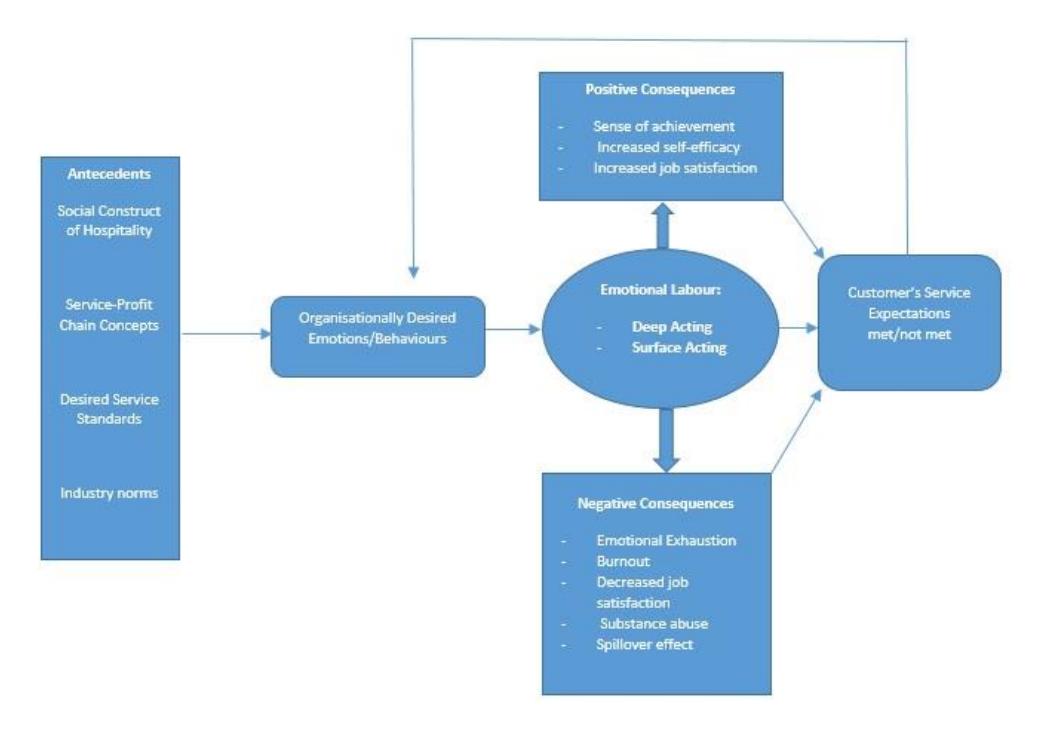
Figure 1: A Theoretical Model of Emotional Labour - its antecedents and consequences in Hospitality Service
5. CONCLUSION & SCOPE FOR FUTURE RESEARCH
As a concept, EL has been a fairly well discussed and a debated topic ever since Arlie Hochschild (2003) coined the term in her seminal work. Since then lot of thought has gone in discussing the commercialization of human feelings having monetary value in exchange (Hochschild, 2003) to impressions management of the organisation by the employee (Ashforth & Humphrey, 1993). It has also been suggested that EL may be an effortless work by the employee due to its repetitive nature (Ashforth & Humphrey, 1993). However, they also suggest that it may well lead to emotional dissonance and loss of his/her own sense of authentic self (Ashforth & Humphrey, 1993). Depending on which type of acting is one resorting to (deep or surface acting). Morris & Feldman (1996) went on to suggest that the frequency, variety, attention to detail too has a bearing on EL. Almost all the research on emotional labour from a hospitality service point of view has been primarily directed towards an antecedentconsequence framework. Enabling a causal explanation of emotional labour and its various antecedents and consequences both for the employee and the organisation. It has been fruitful in helping to build a conceptual model of the expected consequences of EL that might affect employees and their productivity. A large body of research also indicate towards spillover of the effects of EL from work to home as well. Which means that the experiences at work influences an employee even after they are away from workplace (Eby, Maher, & Butts, 2010; Ilies, Wilson, & Wagner, 2009).
However, a gap exists in the arena of trying to understand the phenomenon of emotional labour through the meaning that is attached to it by those living it on a daily basis. The lived experience of the employees and the meaning they attach to it as a part of their lifeworld. As enumerated in the above sections, not much of research has been done in the Indian context in the domain of EL (Harini, 2013) with only 1% of them being empirical (Modekurti-mahato et. al., 2014). Be it the antecedents and consequences or EL as a phenomenon. Not much has gone into the consequences and impact of EL on Indian people with a collectivist outlook to life, work and social identity. Deeper understandings of various aspects of EL still remain unanswered. For instance, how do the employees in the hospitality service organisations cope with the demands posed by EL? How do they leverage the positive outcomes of EL? How does the spill-over affect their family life? What role do their organisations play in their coping with EL as a part of their job role? What meaning do they attach to EL, which is an ever-present phenomenon in their life world?
A deeper look into the lived experiences of the employees in the hospitality service organisations will definitely lead us towards a better understanding of these relatively unexplored layers. The lived experience of the employees with respect to EL as a phenomenon is expected to contribute more depth and vividity as compared to what people already think it is. Also, as result of the dominant causality research of EL, we have not been able to manifest a real time picture of the lived experience of EL and how are people coping with and/or leveraging the consequences arising out of EL at work.