

1. INTRODUCTION
The tourism sector has been proven able to contribute to global economic growth. This contribution is mainly greatest in Asia, Africa, Latin America and the Caribbean (Ivanov, 2013). In this regard, Ivanov states that the actual contribution of tourism to economic growth will be higher in countries where tourism accounts for a greater share of GDP. The increasing number of visitors, in this case, can have implications for increasing economic interests and investment growth in mobility and transportation infrastructure (Freytag and Bauder, 2018). Such conditions are also the case in Indonesia where tourism and economic growth have a reciprocal causality relationship that is mutually beneficial to one another (Nizar, 2011).
The explosion of tourism more specifically can encourage urban development initiatives (Hayllar et al., 2008). This phenomenon is what we know as 'touristification'. The term touristification is used to describe the process of urban transformation led by tourism in which areas that are often independent of public-led planning initiatives such as residential areas and other small parts in urban areas also develop into tourist zones (Balampanidis et al., 2019). Nowadays touristification has become a phenomenon in various countries with different processes and approaches. Fabrication, in this case, can be seen as a model multidimensional and complex that represents the relationship of various actors and local interesting to be studied in different country contexts (Freytag and Bauder, 2018).
1Associate Professor in Regional and City Planning – School of Architecture, Planning and Policy Development – Bandung Institute of Bandung (ITB), Indonesia.
2Urban and Regional Planning Study Program - School of Architecture, Policy Planning and Development – Bandung Institute of Bandung (ITB), Indonesia.
The phenomenon of touristification also occurs in Indonesia. The clearest example that can be seen from the development of this phenomenon is the touristification that occurred in Bali. Bali is one of the main attractions of Indonesia which is worldwide. There is a concentration of tourists both domestic and foreign in this region has its own implications for urban transformation. On the one hand, the development of modern tourism massively carried out on some sides of this region which on the other hand has triggered the development of community-based tourism on the other side of the region such as the emergence of a Balinese tourism village which ultimately has an impact on the expansion of the zone and tourism activities there (Picard, 2010).
Besides Bali, the phenomenon of touristification can also be seen in the city of Yogyakarta. This city being aggressively developing regional tourism. In the tourism industry, Yogyakarta is famous as the cradle of Indonesian culture. It is also home to one of the most influential empires in Java (Sörensson, 2008). In this case, the phenomenon of touristification that occurs in the city of Yogyakarta is interesting to study because it has different characteristics. The purpose of this study is to examine the differences in the characteristics of the phenomenon of touristification that occurs in the city of Yogyakarta and the impact it has on the development of tourist villages and tourist villages. The objectives are: a) identify visible changes in function and environment visually; b) identify changes in function and environment that are seen non-visually; c) identify changes in tourism activities; d) comparing touristification that occurs in the city of Yogyakarta with other cities in foreign countries. The study area is tourism in the city of Yogyakarta and its surroundings. The discussion focuses on the variables forming touristification in the context of the city of Yogyakarta which specifically discusses the phenomenon of tourist village as a form of touristification that occurs in the city of Yogyakarta and its surroundings.
2. DATA AND METHOD
The study area is tourism in the city of Yogyakarta and its surroundings. The discussion focuses on the variables forming touristification in the context of the city of Yogyakarta which specifically discusses the phenomenon of tourist village as a form of touristification that occurs in the city of Yogyakarta and its surroundings. The type of data used in this study is secondary data which are obtained through a literature review of journals, research reports, and other related literature that can be obtained online. Secondary data obtained through literature review includes theories about touristification and urban transformation along with the processes occurring in various foreign countries and also the development of touristification in Indonesia and in the city of Yogyakarta in particular.
This research basically uses qualitative analysis which emphasizes on explorative and comparative descriptive analysis. This method aims to describe the characteristics of touristification that occur in the city of Yogyakarta and examine/explore further the differences with the process of touristification in foreign countries. This study focuses on exploring the characteristics that shape the process of touristification in three aspects i.e. visible changes in function and environment, changes in function and environment that are seen non-visually, and changes in tourism activities.
In the second phase, this study focuses on comparing the processes and characteristics of touristification that occur in Yogyakarta with those that occur in foreign countries. In making this comparison. The comparative analysis is done by comparing several existing contexts which are then presented in tabular form.
3. LITERATURE REVIEW
According to Balampanidis et al. (2019) and Kagermier and Stors (2013), the term touristification is used to describe the process of urban transformation led by tourism, where urban housing areas and other small parts of urban areas are often independent of public-led planning initiatives developed into a tourist zone. Renau (2018) further states that the concept of touristification has further led to two processes of globalization and localization embedded in the rebuilding of cities because tourism is characterized by international global actors (including digital platforms), while at the same time investing at the local level by developing local culture, products and places for consumption that will attract visitors. In this case, touristification can be seen as a different bottom-up process at each location, as a model multidimensional and complex that represents the relationship of various actors and locations (Freytag and Bauder, 2018). Below can be summarized some examples of the process of the occurrence of touristification in two European cities, they are Paris and Copenhagen, as in Table 1.
Table 1. Touristification Process in Paris and Copenhagen
| Variables | Result | Characteristics |
|---|---|---|
| City of Paris | ||
| Changes in function and environment visually (seen from the space and the main tourist activities) | The Central Tourist District (CTD) as a centre of tourism and spatial concentration of activities, it is not homogeneous (as separated by boundaries non-tourism area) spread and more and more. Visited by tourists. Major attractions more frequently visited by tourists than by the locals and also dominated by amenities for travelers' needs. Roads where tourists doing activities,regarded as areas devoted for tourists. | In the beginning (the second half of the century, 19th) the city development is top down with the greatest influence brought by urban planner Georges Eugene Haussmann. In the 19th century there was the complete destruction and rebuilding of the City of Paris. At present, initiatives are more bottom up with involving tourists and residents. Development of tourist areas is seen as a result of the activities of visitors. Tourism activities are not only carried out in tourist areas but also forms of tourism that carry visitors are closer to the experience of the locals, creating a meeting and closeness feeling of spatial and social of the two worlds. |
| Nonvisual change of function and environment (seen from the effect of accommodation in changing the surrounding environment) | There is a role for private accommodation, Airbnb, which appears bottom-up affecting the vast housing environment; Many houses and apartments in the urban areas of Paris function as accommodations using the Airbnb platform, compared to other large cities such as London and New York; Airbnb has made tourist accommodation locations more widespread, where previously the hotel's location was only centralized, encouraging tourists to travel in places that were not originally tourist attractions; The existence of Airbnb changes the behavior of tourists into residents so that it has implications for tourists' concern that can ultimately encourage urban transformation; Airbnb have a positive impact, such as sharing benefits with local residents as property owners, closer relations between tourists and locals, activities and the atmosphere of the neighbourhood are lively. |
Tourism activities (seen from mobility)
- The tendency of urban mobility of pedestrians and motorbikes has the potential to grow bottom-up tourists connected to various tourist hotspots and accommodation locations;
- Walking is an important activity for tourist. The tourists get more experience which is different from residents who prefer to use the metro;
- The use of bicycles (Velib bike-sharing system) is city policy that encourage cyclists;
- The cycling habit provide a different atmosphere and connect with other placessuch as commercial and residential areas.
Mobility can also shape tourism activities and expand the tourist area.
City of Copenhagen
Changes in function and environment visually
- The development of the Vesterbro area which was originally a meat-packing district, where the front is still heavily influenced by pornography, drug prostitution, but most ofthis area has been transformed into a new designer clothing store, modern style restaurant and a large infrastructure of life and now it is home to artists, galleries, bars, restaurants and is known as a party venue, in addition to accommodating shops related to the wholesaler animal processing industry, food stores, butchers and fish markets;
- Also the development of the Norrebro region which is the smallest district in Copenhagen but has a unique atmosphere because of its dense population and ethnic diversity so asto create a distinctive local character perspective as well as
Nonvisual change in function and environment.
- Residents have a positive attitude towards having a large number of visitors coming to their district.
- Local stakeholders such as shop or restaurant owners do not make a difference to all visitors who come even to the Vesterbro area they do not want to be part of tourists so this area seems closed to tourists but this is precisely what they want to explore;
- All interest groups in the two regions hardly invest money in marketing campaigns but rely solely on product quality and repeated wordof-mouth communication;
- In this case, the stakeholders want to make the impression that they are in business for themselves, and not for tourists or other people. And this is the aspect that makes this area attractive to all types of visitors - both locals and tourists.
- The existence of urban transformation was initiated by urban reform initiatives undertaken by government with a view to renovating and rebuild old building stock;
- Urban renewal project has resulted in a partial replacement of the population, the emergence of diverse and interesting new offers from tourism changes in the image of the region;
- Despite the urban transformation that indirectly made two regions namely Vesterbro and Norrebro become a tourist zone outside the city centre, the city government and most city councillors chose not to transfer this potential on a tourist areas;
- The potential of the two regions which offers a lively, interesting life, vibrant, and also trendy, is ignored.
Sources: Modified from Freytag & Bauder (2018); and Stors & Kagermeier (2013).
4. DISCUSSION
The discussion in this study will explain in more detail the characteristics of the phenomenon of touristification in Yogyakarta that can be seen from three things namely changes in function and environment visually, changes in function and environment in a non-visually and changes in tourism activities. In addition, the last part of this chapter will discuss also the difference in characteristics of the touristification process that occurs in the city of Yogyakarta compared to cities in other countries as identified in the literature review.
4.1 Visual Function and Environmental Change
Initially, the City of Yogyakarta was built by Sultan (King) Hamengku Buwono (HB)-1 based on social, state and functional concepts as shown in Figure 1 (Suryanto et al., 2015). These concepts are currently forming the structure, spatial patterns and also the image of the city of Yogyakarta today. This concept is also the forerunner of the Yogyakarta-culture based tourism as what is known today. These concepts include:
a. The Sagotra Chess Concept
This concept is a Javanese cosmology that implies 4 components of life in a single space. The four components include the palace, the big mosque, the market and also the square. These four components are united in one area as the core of the city that is connected by road space. These four components represent a harmonious depiction of the conditions of the universe that represent important functions in city life, namely government/leaders (Kraton), religion ethics and morals (mosque), economy (market) and culture (square).
b. Manunggaling Kawulo Gusti (Union of a man with God)
This concept is the main axis that becomes a straight line from the palace to the peak of Mount Merapi, 2.5 km from the palace. Between the palace and the city, the monument is connected by a straight road named Margo Utomo, Malioboro, and Margo Mulyo. The names imply the relationship between noble ideals that must be pursued in a noble way to lead by virtue of the knowledge of the teachings of the saints and ancestors. The main axis that forms the linggayoni symbol (Pusha and Pcitry) is referred to as the manifestation of the concept of Manunggaling Kawulo Gusti. Based on the city development concept formulated by HB-1 in the early days of the formation of the City of Yogyakarta, it is not surprising that the palace, the plaza, the Kauman Gedhe Mosque, the Beringharjo Market, and the Malioboro Street Area were the initial milestones in the development of tourism in the city. In its current development, the Malioboro area has grown to be the "primadonna" for tourists in Yogyakarta.
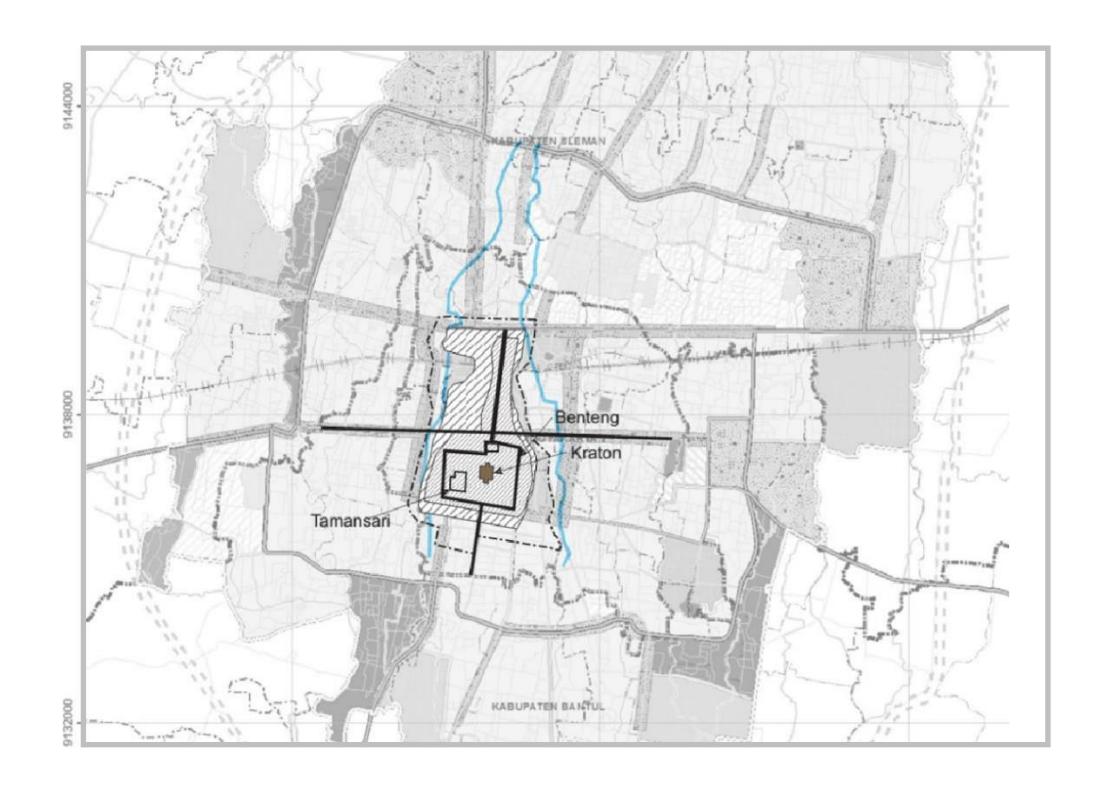
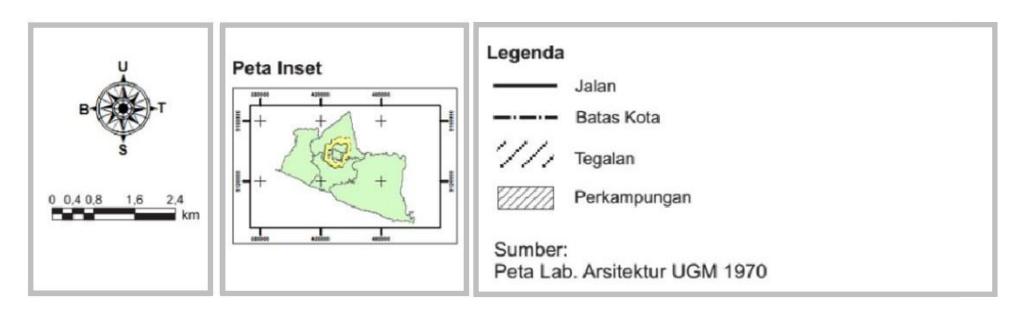
Figure 1. Catur Sagatra Concept in Yogyakarta City Area Source: Adopted from Suryanto et al. (2015).
Malioboro area is known as various uniqueness that succeeded in making a strong impression in the minds of tourists which is "never been in Yogyakarta if have not visited the Malioboro". The uniqueness is first seen in the commodities offered. Along the Malioboro road, we can find a variety of local products sold by street vendors such as souvenirs, batik, paintings, special foods, and also other trinkets that are sold at affordable prices. The existence of a street vendor arrangement design that is side by side with modern shops that lined the road with the local distinctiveness of the residents in selling their goods has created an atmosphere that will not be obtained anywhere else. This is what became second uniqueness.
The third uniqueness can be seen from the attractions displayed along this road especially at night. We can find the lesehan tent stalls that are bustling with people and hear the distinctive music of Yogyakarta and various other attractions that add to the hustle and bustle of the area.
The number of students who come from all over the region of Indonesia is also increasing the alive atmosphere of Yogyakarta. This atmosphere makes people assume that every corner in the City Yogyakarta is romantic. Thanks to its uniqueness. This area is not only crowded by local tourists but also by foreign tourists.
With the rapid development of tourism activities in the Malioboro area and its surroundings, it has indirectly initiated the growth of other areas. Formerly, behind the Malioboro area was only an ordinary residential area. However, now the area has developed into a tourist support area where the main actors come from the local community. Their efforts in juggling the area where they live in order to attract tourists then they call it the 'tourist village'. Currently in the city of Yogyakarta has grown to 17 Tourism Villages with their respective uniqueness.
Table 2. List of Urban Tourist Village in Yogyakarta City
| No. | Name of the tourist village | Uniqueness |
|---|---|---|
| 1 | In year | Batik and jumputan cloth as well as cultural arts attractions, especially classical Yogyakarta style music. Another attraction is a creative industry of making replicas and costumes of super hero figures. |
| 2 | Dipowinatan | Ramayana Ballet and Ndalem Djojodipuran cultural heritage building. |
| 3 | Purbayan | Historical education, silver craft, traditional culinary. |
| 4 | Prenggan | Historical education, traditional cuisine. |
| 5 | Tamansari | Cyber village. |
| 6 | Kauman | Religious tourism. |
| 7 | Kadipaten | Art and cultural tourism. |
| 8 | Pandean | Puppet show, gamelan making workshop. |
| 9 | Becak Maju | River bank tours, music and traditional songs. |
| 10 | Rejowinangun | Agro education. |
| 11 | Pakualaman | Pakualaman palace buffer zone. |
| 12 | Cokrodiningratan | Eco-tourism and heritage. |
| 13 | Warungbata | Buffer XT square tourist area. |
| 14 | Niti Gedongkiwo | Supporting Animal Market and Taman Yogya. |
| 15 | Sayidan | Arab village tour. |
| 16 | Sosromenduran | Multicultural tourism, accommodation and shopping. |
| 17 | Dewa Bronto | River-based social ecotourism. |
Source: Dinas Pariwisata Kota Yogyakarta (2018).
At the beginning of its development, some of these villages emerged sporadically, were built by the community and some others emerged at the initiative of the city government. However, in its current development, there have been several forms of city government intervention. In one of them through the holding of the village tour festival.
In addition to the tourist village, the rapid tourist activity in the city of Yogyakarta has also grown community-based tourism activities in the surrounding areas such as Bantul Regency, Sleman Regency, Gunung Kidul Regency, and also Kulon Progo Regency, in the form of rural tourist villages. The development of the tourist village can also be seen as an effort by the regional government to increase the local potential and evenly spread regional growth. This is done so tourism growth is not only concentrated in the city of Yogyakarta but also spread on the periphery. This, of course, can also add attraction for tourists, especially foreign tourists who want to feel the atmosphere or new experiences, namely rural tourism that may not be found in their home regions.
Figure 2. Sosromenduran Tourist Village Source: Dinas Pariwisata Kota Yogyakarta (2018).
4.2 Non-visual Change in Function and Environment
The development of tourism activities in the city of Yogyakarta, especially in the centre of the tourist area of Malioboro is the main icon of the city, turned out to have helped generate tourism support businesses engaged in accommodation. Initially, in supporting tourism activities in this city, there are only hotels that facilitate tourists who stay overnight. The growth of hotels in this city is also quite massive. But this hotel is only able to accommodate tourists who have enough budget to accommodate it while not all tourists have the capacity for it. This relates to the characteristics of local tourists who tend to travel in large numbers and foreign tourists with thin pockets who tend to choose low-budget with standard facilities. Starting from this condition, there emerged an alternative form of tourist accommodation initiated by local residents. This is also related to the development of tourist villages as a result of the expansion of tourism activities in the city of Yogyakarta.
Sosromenduran tourist village can be taken as an example of the impact of expanding tourism activities in the city of Yogyakarta, especially from expanding tourism activities on Jalan Malioboro. This tourist village has a road which is the first road to enter Malioboro so that it is in a strategic location. The village which has been known as an international village or a backpacker village has become a centre of growth in accommodation services which include hotels, inn, and homestay.
The existence of inn or homestay as an alternative accommodation in the tourist village can create its own charm namely: 1). Most are owned by residents so the price offered relatively more affordable compared to with star hotels; 2). It has long been known as an international village so foreign tourists already have their own trust for a stay in this area based on the experience of other foreign tourists; 3). The location is very close to Malioboro as the centre of the touristic area in the city of Yogyakarta so facilitate mobility; 4). Offering a new atmosphere in carrying out activities and tourist trips because live right away side by side with local residents and can do mobility on foot according to the habits of foreign tourists in particular. In addition to being a centre for growth in accommodation services, the existence of this tourist village is filled with souvenir shops, and other tourism services, such as currency exchangers, travel agents, and laundry services.
It can be said that most of the facilities in this area are built in it is a facility for tourists compared to local residents. Although so in response to this, the community still has a positive perception of the condition because on the other hand they benefit from changes in their residential areas become a supporting tourist area (Sörensson, 2008). The benefits they get are good materially and non-materially, i.e. in a form of cultural acculturation in which the local people learn the language and culture of foreign tourists.
Besides generating business related to accommodation, it turns out the rapid development of tourism in Yogyakarta, in particular, the Malioboro Street area also affects change people's livelihood. In partial terms, many residents of this tourist village work in tourism both formal and informal. Informal workers, they will be absorbed in businesses such as hotel, restaurant, and cafe workers. In informal workers, they will be absorbed in types of work such as tour guides. In this case, they have a dependence on tourists, especially foreign tourists. This is caused by the services they provide can be sold more on foreign tourists. On the other hand, domestic tourists visiting this tourist village usually not a new tourist but tourists who have been several times come to Yogya so their purpose is looking for lodging with a low budget only. Domestic tourists rarely do tourist activities there.
Those changes do not only happen to urban tourist village but also to rural village. In this context, rural tourist villages are also developed in the province of DIY provide homestay/lodging facilities which is usually more rented by foreign tourists compared to local travellers. There is a homestay managed by residents/ community groups and also small private company. The prices they offered will vary. With the alternative forms and locations of this lodging, tourism activities in the city of Yogyakarta are not only concentrated in the centre. Even so, the current existence of urban tourist village and rural tourist villages is facing the competition with Airbnb companies that provide room rentals or residential units with an online market-place system.
Figure 3. Omah Tembi Homestay Source: Dinas Pariwisata DIY, (2014).
4.3 Changes in Tourism Activities
The development of tourism activities in the centre of Yogyakarta City indirectly helped develop the types of tourism activities offered. With the emergence of tourist villages as a result of the intensification of tourism activities in the centre of the city of Yogyakarta it was able to provide new colour and atmosphere in tourism activities. In this case, the emergence of tourist villages is considered an opportunity to introduce and increase existing local potential. The real example that we can see is a tour package that is usually offered by a tourist village. Usually, they offer educational and nature tourism as the main offerings of tourism for visitors that cannot be found in the city attractions. Travel packages offered such as (DIY Tourism Office, 2014):
- a. Creative Camp, which is learning to play traditional gamelan, painting, making batik, making kites (as a form of traditional games), playing angklung and making handicrafts;
- b. Outbound and traditional sports, namely introducing types of sports such as dingklik racing, bamboo sala glundong, tug of mud, bamboo balance, bamboo shower, spherical ball, thump pillow on the water, fishing, mud soccer, mud basketball, geber volleyball, etc.;
- c. Adventure, which istracking down the tourist village and salak plantation, along the river, and off-road to the slopes of Mount Merapi;
- d. Performances and entertainment, namely introducing shadow puppets, jathilan and dance, karawitan or cokekan, sari-sari, etc.;
- e. Agriculture, namely introducing activities such as plowing the fields with buffalo, planting rice and planting rice.
The tour packages offered direct experience of tourists in carrying out activities so that they can become a medium of cultural acculturation elsewhere. However, this package looks more attractive to foreign tourists. In Sosromenduran tourism village, tourism activities carried out in it indirectly force tourists to walk. This is due to local regulations (local culture) which prohibits the existence of motor engines that crossing or entering into this area. Nevertheless, the existence of local rules that are set precisely can create a special attraction in this area.
This unique condition is able to create the impression of a pedestrian-friendly tourist area. In practice, it seems easier for foreign tourists because walking has become their habit. But on the other hand, this can also encourage the habits of local tourists to want to walk in exploring the area that is directly connected with the main tourist area of Malioboro. However, in reality, there are not a few local tourists who still choose to use online transportation, even though the distance between this area and Malioboro is less than 100 meters. This could be due to their purpose of staying in this area only for a temporary stop, not for a tour.
In addition, if viewed in terms of existing mobility it can be said to have not been influential in supporting touristification in the city of Yogyakarta. In this case, tourists in taking one tourist location to another tourist location usually use private vehicles even though it is a foreign tourist. Besides online transportation is also a major alternative in accommodating tourist mobility. That way, tourists are less able to explore the surrounding environment because it only focuses on the objectives to be achieved so that the opportunity for touristification does not occur in this case.
Similarly, using public transportation to travel in the city of Yogyakarta can also only access the tourist areas in the city centre. If the tourist area outside the city centre is still possible to reach by public transportation, it is still not easy for tourists to be able to move to other tourist sitesjust on foot because of its far location or inadequate pedestrian facilities that can endanger tourists. That way the opportunity for touristification cannot also occur. In some tourist areas that allow/require to walk or bike or use environmentally friendly transportation such as pedicabs are usually also only integrated for some tourist areas, especially in the city centre such as Malioboro area, Bringharjo market, Majid Gedhe Kauman, Kraton, Tamansari, etc. Even so, it only happens within the scope of the areas. So the opportunity for touristification in other areasisstill limited due to difficulty in walking or non-motorized mobility for tourists.
4.4 Characteristics of Touristification in Yogyakarta
The development of Yogyakarta City's spatial structure was initially strongly influenced by the social, state and functional concepts that were built by Sultan HB-1 which was embodied in the Catur Sagotra concept. Until now, the development of the city, including tourism, is very much oriented to the realization of the concept which includes four components, namely the government/leader (palace); religious, ethical and moral (mosque); economy (market) and culture (the square) which is connected by Malioboro Street. This is similar to what happened in Paris in the early 19th century where urban transformation was more influenced by the order of the ruler.
Table 3. Touristification Process in Yogyakarta
| Variables of Touristification | Result | Characteristics of Touristification |
|---|---|---|
| Changes in function and environment visually (seen from the space and the main tourist activities). | The emergence of tourist villages and tourist villages as a result of the increasing intensity of tourism activities in the central city of Yogyakarta, especially in the Malioboro Road and surrounding areas; The emergence of tourist villages and tourist villages has transformed the residential environment of local residents and in the end can make tourism activities no longer concentrated only in the centre of Yogyakarta City. | The development of Yogyakarta City spatial structure was initially strongly influenced by social, state and concept functional built by Sultan HB-1 which is realized in the concept of the Chess Sagotra; The rapid growth of tourism in the region that is central to the city of Yogyakarta creates a need for affordable accommodation and more explorative tourism activities as well as offering a more authentic atmosphere; Urban and rural tourist villages spread across the city of Yogyakarta and surrounding areas emerged as an impact touristification; At the beginning of its development there was a bottom up process that was initiated by local residents or assisted with local government intervention, but currently the development is well monitored by the local government. |
| Nonvisual change in function and environment (seen from the influence of the development of accommodation in changing the surrounding environment). | The emergence of urban and rural tourist villages has become a centre of growth in new accommodation services offering a new atmosphere in conducting activities and travel tours because they live side by side with the local population. The emergence of tourist villages are able to change the standard of living of the local population through changes in their livelihoods. The advent of tourist villages has changed most of the facilities in their residential environment become facilities for tourists. Nevertheless the acceptance of local residentsremained positive. | |
| Tourism activities (seen from changes in activity and mobility). | The emergence of tourist villages and tourist villages turned out to be able to provide new colours and atmosphere in tourism activities and have the opportunity to introduce and improve existing local potential. In terms of mobility, the context of the city of Yogyakarta has not yet had a significant effect in shaping tourism activities and expanding tourist areas. |
The rapid growth of tourism in the city of Yogyakarta eventually involves tourists and locals in their urban transformation. The needs of tourists for affordable accommodation and more explorative tourism activities that offer a more authentic atmosphere eventually encourage and arouse the emergence of tourist villages that are scattered in the City of Yogyakarta and surrounding areas. The emergence of urban tourist villages and rural tourist villages at the beginning of their development were bottom-up, initiated by local residents or assisted by local government intervention. However, at present, the development is well monitored by the regional government. This condition is not entirely the same as the City of Paris where the initiative is more bottom-up nor is it like Copenhagen where the city government and most of the city council decided not to transfer the local potential that formed itself on a tourism purpose.
With the emerges of tourist villages this has allowed tourists to get closer to residents and their experiences. In addition, this also opens up opportunities for the growing recognition of the local potential which will lead to development at a later stage. However, if viewed from the form of mobility, the context of the city of Yogyakarta has not significantly influenced the formation of tourism activities and the expansion of tourist areas as happened in the City of Paris. Based on above description, as a conclusion, the characteristics of touristification in the city of Yogyakarta can be summarized such in Table 3.
5 CONCLUSIONS
This study found that there has been a process of touristification in the city of Yogyakarta. In line with Renau (2018) that touristification in the city of Yogyakarta, led to the processes of globalization and localization which is embedded in rebuilding the city. Tourism development is characterized by global actors, concurrently enhancing investment at the local level. The phenomenon of touristification in Yogyakarta has similarities with that of other cities such as the two main cities in Europe that have been referred to, namely Paris and Copenhagen. From the touristification variables used, it has similarities and can be explained with the context of the Yogyakarta tourist area. As changes in function and environment visually, this can be seen from the emergence of tourist villages in accommodating the increasing of tourism activities in the city centre of Yogyakarta particularly Malioboro Road and its surrounding areas. And the other, tourist villages have transformed the local residential environment as a tourist attraction.
The second touristification variable is non-visual change of function and environment. It can be seen from the effect of accommodation in changing the surrounding environment. Urban and rural tourist villages have been offered accommodation with new atmosphere, where locals and tourists live side by side. The emergence of tourist villages is increasing the standard of living of the local community, because it gets new economic resources, which can add income from the main sectors, such as agriculture or other economic resources. The advent of tourist villages has changed most of the facilities in their residential environment. Nevertheless the acceptance of local residents remained positive. Finally, tourism activities (seen from the perspective of mobility), the emergence of tourist villages turned out to be able to provide new colours and atmosphere in tourism activities and have the opportunity to introduce and improve the existing local potential. In terms of mobility, the context of the city of Yogyakarta has not yet had a significant effect in shaping tourism activities and expanding tourist areas.