

1. Introduction
The economic significance of tourism is highlighted by the fact that international tourism has continued to outperform the world economic growth (UNWTO, 2020). Tourism as a sector has seen a long-term average growth of 5.1 percent with 2019 witnessing an increase of 3.8 percent in international tourist arrivals (UNWTO, 2019). Many external factors, tourist behaviour patterns and destination attributes contribute to this rise in tourism (Pearce, 2005). One such external factor, destination image is considered to play a critical role in influencing a tourist to visit a destination (Chen & Phou, 2013; Dedeoğlu, 2019). Images simplify complex ideas in minds of a person by summing up beliefs, attitudes and impressions of an object/person (Nadeau et al. 2008). These images play a strong role in driving the person's behaviour (Barich & Kotler, 1991). Past literature has provided evidence on the role of destination images in influencing tourist decision making (Baloglu & McCleary, 1999; Pike & Ryan, 2004). Destination image has been explored in terms of tourist's belief around cognitive elements related to natural environment, culture, modern society, friendliness as well as affective elements related to arousing, satisfying, exciting and relaxing (Baloglu & McCleary, 1999; Chon, 1990). Of particular interest within these studies has been the role of destination image in forming destination loyalty (Chen & Phou, 2013; Chi & Qu, 2008; Dedeoğlu, 2019, Zhang et al., 2014) as it is easier for destinations to attract past visitors than draw new ones.
Tourist decision-making is difficult to analyse in isolation since it is a continuous process with multiple phases including need recognition, goal formulation, generating alternatives, searching information, and selecting an alternative (Cohen et al., 2014). Most decision-making models in tourism consider a tourist to be rational individual whose aim is to maximize utility by increasing benefits and reducing costs (Wahab et al., 1976). This utility maximization is influenced by external factors like perceived monetary value of the destination as well as by a traveller's internal characteristics like motivation, attitudes and beliefs (Sirakaya & Woodside, 2005). Thus, perceived value of money of the location becomes an important external criterion to evaluate a tourist destination for the traveller (Dedeoğlu, 2019). Utility maximization from a destination visit is also impacted by the motivation of the tourist to undertake that visit. 'Push' motivations are those which are intrinsic to the traveller (Dann, 1977) and seeking variety or novelty has been found to be a core push motivation across multiple studies (Meng et al., 2008; Pearce & Lee, 2005). While perceived value and novelty seeking are important factors that impact tourist behaviour, evaluation of their effect in different contextual settings has been found missing.
Individual's behaviour with respect to destination is not only impacted by image of the destination but is also dependent on characteristics of the individual (Stern & Krakover, 1993) and needs to be considered under the context of his/her setting. Individual characteristics such as age, gender, education, occupation and social class have been studied as factors that influence image formation and subsequent behaviour impact. While it has been established that individual characteristics may have an impact on his/her travel behaviour (Beerli & Martın, 2004; Um & Crompton, 1990), a large number of these studies have been undertaken with developed country residents as respondents. Residents of developing countries have different motivation and drivers owing to the socio-economic conditions prevalent within the country (Saeed et al., 2011). To understand the impact of personal characteristics of individuals from a developing country on his/her travel behaviour, we undertook this study in Indian setting. Domestic and international travel by Indian tourists grew at a healthy rate of 12% and 10% respectively (Ministry of Tourism, 2019). Further, with 1854 million domestic tourist visits and 26 million international tourist visits by Indian citizens, Indian tourists presents a significant segment to be analysed (Ministry of Tourism, 2019).
With these considerations, this research aims to investigate, in a developing country scenario, the role of destination image (cognitive and affective) on behavioural aspects of tourist loyalty while exploring the moderating impact of tourist's variety seeking motivation and perceived value of money. The study shall answer three research questions – (i) does destination image positively affect tourist loyalty
(ii) does perceived monetary value influence the impact of destination image on tourist return intentions (iii) does variety seeking characteristic of a traveller influence the impact of destination image on tourist return intentions. The study contributes to academic literature by attempting to develop an integrated model that incorporates impact of destination image on tourist loyalty while accounting for individual characteristics in a developing country set-up.
2. Literature review
2.1. Destination image and tourist loyalty
Destination image has been identified as playing a strong influencing in tourists' decision making and travel behaviour (Baloglu & McCleary, 1999). While there have been a large number of definitional constructions of destination image (e.g. Baloglu & McCleary, 1999; Echtner & Ritchie, 1991; Kim & Richardson, 2003), all definitions consider destination image as being a mental representation that results from information processing of attributes and benefits sought from a destination (Zhang et al., 2014). From an operationalizing perspective, destination image has been largely operationalized using components of cognitive image and affective image (e.g. Baloglu, 2000; Lin et al, 2007; Martín & Bosque, 2008). Cognitive component alludes to the belief and knowledge that a tourist has about destination attributes (Zhang et al., 2014). Affective component on the other hand refers to the feelings or emotional responses by the tourist towards various features of the destination (Zhang et al., 2014). Some studies (Chen & Phou, 2013) have also included a conative component of destination image where the conative component refers to the behavioural manifestation of the individual. While conative component alludes to behavioural translation, cognitive-affective joint operationalization for destination image has been a common measure for measuring overall destination image (Zhang et al., 2014). In line with conceptualizations with large number of existing studies (e.g. Baloglu, 2000; Lin et al., 2007; Martín & Bosque, 2008), we have followed the cognitive-affective operationalization of determining destination image.
To assess tourist loyalty towards a destination, two of the most commonly used behavioural measures are revisit intention and intention to recommend (Bigné-Alcañiz et al., 2008; Horng et al., 2012; Hung & Petrick, 2012). Explaining this, Yoon & Uysal (2005) noted that treatment of travel destinations as products should mean that a tourist with a degree of loyalty would either revisit that destination or recommend to other potential tourists including friends and relatives. Intention to revisit has been studied extensively in tourism literature since it is easier and better to attract visitors back to destination than to attract new visitors(Um et al., 2006). Intention to revisit has also been noted to serve as an indicator of competitiveness of tourist destination (Chen & Phou, 2013; Yoon & Uysal, 2005). Positive word of mouth is a critical input in the tourism industry given the impact that opinion of previous travellers has on potential travellers (Williams & Soutar, 2009; Zhang et al., 2014). Considering the significance of intention to revisit and intention to recommend within the tourism industry, we will consider these for measuring tourist behavioural intention with respect to a destination.
Several studies have examined and found cognitive and affective components of destination image to have a significant impact on behavioural intentions of tourists (Qu et al., 2011; Wang & Hsu, 2010). Choice of tourist destination is often governed by the image they have of the destination with a positive image resulting in a greater preference (Chi & Qu, 2008). This image formation consists of beliefs and knowledge about the destination which, in turn, a result of the affective and cognitive components of destination image (Ramkissoon et al., 2011). While the affective component reflects the tourists' feelings about the destination (Lin et al., 2007), the cognitive component focuses on the tangible components (Pike & Ryan, 2004). Shani et al. (2009) found that positive image resulting from a favourable experience had a significant positive impact on future intention to revisit the destination. With the argument of positive perceptions of destination driving tourist behaviour (Woodside & Lysonski, 1989), a large number of studies have established the cognitive and affective images have a positive impact on tourist behaviour (Alcañiz et al., 2009; Chew & Jahari, 2014; S. Kim & Yoon, 2003). In line with these studies, the following hypothesis are proposed with respect to impact of cognitive and affective image on intention to return/recommend:
H1: Positive cognitive image about the destination will have a positive impact on intention to recommend
H2: Positive cognitive image about the destination will have a positive impact on intention to return
H3: Positive affective image about the destination will have a positive impact on intention to recommend
H4: Positive affective image about the destination will have a positive impact on intention to return
2.2. Moderating role of perceived monetary value on tourists' intention to return
Consumer's assessment of a service is determined by perceived sacrifice (monetary and nonmonetary) and customer's frame of reference (Xia & Suri, 2014). Reflecting the same argument in tourism, Petrick (2004) proposed that perception of price impacts perceived value and subsequently plays a critical role in influencing consumers' repurchase intention. The effect of price gets magnified in a developing country scenario where perceived monetary value could end up overriding other decision parameters (Saeed et al., 2011). Siu, Wan, & Dong (2012), in their study on convention centres found that value for money considerations enhanced the positive impact that customer satisfaction had on intention to stay. In tourism domain, Dedeoğlu (2019) established the moderating effect of monetary value between perceived destination quality and components of destination loyalty. Brida et al. (2012) noted that tourists feel satisfied if they have had adequate return on money spent. In their cross-cultural study, Mehta & Dixit, (2016) found that price-consciousness, signifying products that provide great value for money, was a trait found to be pronounced in developing country (India) as compared to a developed country (Germany). Hence, perceived monetary value is likely to moderate the impact of tourists' destination image on intention to return in the developing country context.
Considering these arguments, we propose the following hypothesis:
H5: Higher perceived monetary value about the destination will positively influence the impact of cognitive image on intention to return
H6: Higher perceived monetary value about the destination will positively influence the impact of affective image on intention to return
2.3. Moderating role of variety seeking characteristic on tourists' intention to return
Customers might switch preferences despite being satisfied with the results provided (Keaveney, 1995). McAlister (1982) suggested that this switching behaviour could be a result of novelty-seeking nature of individuals. Novelty seeking is explained as the difference between current perception and past experience (Pearson, 1970) making it an opposite of familiarity. A novel trip may be characterised by unfamiliar experiences that are different from prior life experiences (Faison, 1977). This could include discovery of innovative physical places for gaining prestige and attention from others (McIntosh et al., 1995). In tourism, novelty seeking may represent a traveller's tendency to seek diversity in his/her choice of destination (Alcañiz et al., 2009).
The concept of novelty seeking has been found to be significantly important in the tourism literature (Assaker et al., 2011; Assaker & Hallak, 2013; Feng & Jang, 2004). Jang & Feng (2007), in their temporal study, found that novelty seeking directly impacted tourist intention to return only in the medium term and did not impact in the short term. Assaker et al. (2011), on the other hand, found that novelty-seeking tourist are less likely to be satisfied from their previous visit and unlikely to return to the destination for their next visit. Zhang et al. (2014) in their meta-analysis study note that despite having a positive image of a destination, there is a likelihood that person may not revisit on account of various factors including novelty seeking pursuit. Assaker & Hallak (2013), in their study, divided tourists into groups of high, medium and low novelty seekers. They found that the strength of relationship between satisfaction from previous visit and tourists' intention to return was significantly lower for high novelty seekers than for low novelty seekers. This highlights the value that novelty driven tourists derive from the unfamiliarity/newness of a destination prompting. In line with these arguments, we argue that while destination image may positively impact intention to return, the impact would be moderated by novelty seeking tendency of individual tourist. Hence, we propose the following:
H7: Individuals with greater variety seeking characteristic about the destination will positively influence the impact of cognitive image on intention to return
H8: Individuals with greater variety seeking characteristic about the destination will positively influence the impact of affective image on intention to return.
A visual representation of proposed hypotheses is presented in Figure 1.
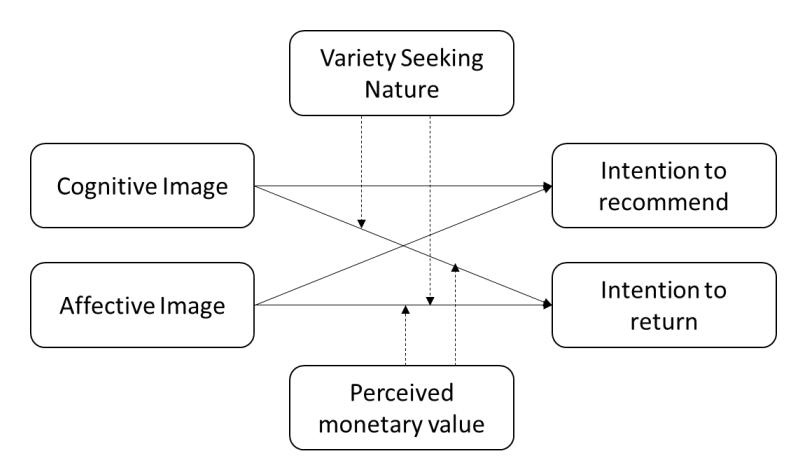
Figure 1: Summary of study hypotheses
3. Method
A descriptive research design was adopted for our study. A total of 433 responses were collected via convenient online sample of adults in India. Online sample was used for two primary reasons: a) It allowed larger reach and facilitated a more representative study and b) fixed response questions facilitated direct comparison of responses and usage of statistical analysis (Saunders et al., 2003). The scale items used for operationalization of the constructs were sourced from past studies and presented on a 5-point Likert scale. Cognitive image (14-item) and Affective image dimensions (4 item) were measured using the scale developed by Baloglu & McCleary (1999).
This scale has been validated and found reliable across multiple prior studies Kim & Richardson (2003). Items for measuring Intention to return and Intention to recommend were adopted from Bosnjak et al. (2011). Perceived Monetary Value was operationalised using 4 item scale adopted from Dedeoğlu (2019) and variety seeking behaviour was operationalised using 9 item scale adopted from McIntosh et al. (1995). 62% of the respondents were male (n=270) and 38% were female (n=163). 50% of the respondents had monthly family income of more than INR 100,000. All participants were English educated and hence there was no need of questionnaire translation.
4. Results and findings
The analysis started by verifying research constructs using an exploratory factor analysis. During the refinement process, 3 items measuring cognitive image and 2 items measuring intention to return were dropped resulting in a 11-item and a 3-item final scale respectively. All the refined constructs passed the reliability test with Cronbach's α value greater than 0.7 (Nunnally, 1978). For testing our
hypothesis, data was analysed using SPSS 26.0 and AMOS 26.0. We first tested the main effect of cognitive image and affective image on the two dependent variables of intention to return and intention to recommend. The results confirmed that cognitive image had a significant positive impact on intention to recommend (standardized coefficient = 0.222, p<0.001) and intention to return (standardized coefficient = 0.340, p<0.001). Similarly, affective image had a significant positive impact on intention to recommend (standardized coefficient = 0.350, p<0.001) and intention to return (standardized coefficient = 0.208, p<0.001). These results provide support to our hypotheses H1, H2, H3 and H4.
We then carried out independent moderation analysis with perceived monetary value and variety seeking nature as being two separate moderators with cognitive image and affective image as the independent variables and intention to return as the dependent variable. Our results indicated that perceived monetary value moderated the relationship between cognitive image and intention to return (standardized coefficient = 0.065, p<0.1) and between affective image and intention to return (standardized coefficient = 0.327, p<0.001). This lends support to our hypotheses H5 and H6. Testing for moderation effect for variety seeking nature revealed that while relationship between cognitive image and intention to return was moderated (standardized coefficient = 0.115, p<0.001) by variety seeking nature, the relationship between affective image and intention to return (p>0.1) did not find moderation support. Hence, while our hypothesis H7 was supported, hypothesis H8 did not find support.
5. Discussion
The purpose of this study was to investigate the moderating impact of tourist's individual characteristics on the impact of cognitive and affective components of destination image on tourist behavioural loyalty. We specifically explored the moderating role of perceived monetary value that an individual ascribed to a travel destination and his/her variety seeking nature on the intention to return to a destination.
The results suggest that a) cognitive and affective components of destination image have a positive impact on intention to recommend and intention to return b) perceived monetary value that an individual ascribes to a destination visit moderates the relationship between both components of destination image (cognitive and affective) and intention to return and c) variety/novelty seeking nature of an individual moderates the relationship between cognitive image and intention to return but does not moderate the relationship between affective image and intention to return. While the positive impact of cognitive and affective dimensions on intention to return is in line with wellestablished past literature (Alcañiz et al., 2009; Chew & Jahari, 2014; S. Kim & Yoon, 2003), the role of specific individual characteristics as moderators in this relationship is a key contribution of this study.
Role of perceived monetary value in moderating the impact on intention to return is particularly important in the context of a developing country scenario where price has been considered as a key determinant of consumer decision making across categories (Saeed et al., 2011). Products that are perceived as having lower monetary value may be considered expensive (Dedeoğlu, 2019) and visitors, especially from developing countries, may feel greater level of satisfaction, and subsequently exhibit greater loyalty, if they perceive that higher value is derived from the visit (Brida et al., 2012). Finding that greater variety seeking nature of an individual moderates the relationship between cognitive image and intention to return is along expected lines. This is because variety driven tourist is likely to derive a greater satisfaction from the unfamiliarity/newness of a destination impacting his intention to return. This is in line with observation by Zhang et al., (2014) that novelty seeking behavior could have an impact on individual's intention to return to a destination. On the other hand, we did not find a moderating effect of variety seeking nature of individual on the relationship between affective image and intention to return. This could be because variety-seeking attribute is a cognitive
concept and hence it might not be affecting the impact of the affective component on intention to return.
6. Conclusion
Destination Image is influential in developing behavioural loyalty of travellers. The present study further confirms this finding of earlier researches. The present study also indicates that impact of cognitive and affective image on tourist revisit intentions are strengthened if perceived monetary value of a destination is high while a tourist's variety seeking behaviour moderates the influences of cognitive image on intention to revisit. The study extends existing literature by highlighting the importance of individual characteristics, especially with reference to a developing country tourists.
With monetary component playing a critical role in decision making of developing country individuals, the perceived monetary value derived from the visit becomes an important decision making criteria. Similarly, a tourist from developing country is likely to get the most out his/her travel opportunity and hence for a variety seeking individual, their intention to return to the same destination is likely to be impacted negatively. For destination managers and travel operators, this means that their communication to potential tourists needs to take into account the affordability and value for money potential for each destination. Also, destination managers might want to talk beyond the regular tourist spots to relatively unfrequented spots, especially to the returning visitors. The study findings are limited in terms of results coming from a convenient sampling. However, given that participants in sample came from across the country in India, the limitation may not be as severe. Additionally, subsequent studies might want to validate findings of this study in other developing country scenarios as well.