

1. Introduction
As the oldest city (Sustianingsih, et al, 2019) in Indonesia, Palembang City has many potential historical and cultural heritage. The city from trading activities on the riverside has certainly inherited many cultures around its area. Such as traditional buying and selling culture which is still being conducted by the local community. Some old markets could be found in Palembang, one of them is Sekanak Market Area which located in Musi and Sekanak river estuary. Even though, Sekanak Market Area condition which is increasingly abandoned by traders and community. Whereas there is a various potential heritage that could be used as tourist attractions. As in the Heritage Area Arrangement Plan, which one of its area is Sekanak Market Area, indicate that this historical area is able to be redeveloped through historical value.
Heritage according to UNESCO is divided into cultural and natural heritage which is an invaluable and irreplaceable asset for every country and its people. This heritage has a universal value that is very important, especially from the point of view of history, aesthetics, ethnology, and anthropology, which becoming of common interest for current and future generations. Therefore, it is necessary to return Sekanak Market Area image as the historical area of Palembang City. One of the effective ways to restore people's interest in visiting this historical area could be through tourism, which reviving the area with historical and cultural-based tourism activities.
Making this historical area as the heritage tourism destinations must consider the principles of preservation in order not to damage, cover up, or even remove the existing local historical and cultural values Pratiwi (2009). Where making an area a tourist destination helps to improve and conserve the area. In line with the Goodchild's (1990) statement in the Sukmaratri (2018) that various historical objects and landscapes, especially those of significant value, must be conserved because they are physical and archaeological facts from historical and cultural heritage that contribute to the economic interests of the community.
To develop this historical area, it is necessary to formulate a development strategy that can be applied in the Sekanak Market Area. So this study concerns to Sekanak Market Area which potentially to be developed through historical and cultural heritage, elements of traditional market space, and aspects of forming tourist destination in this area by considering local communities perceptions and preferences as providers and managers of the heritage tourism area.
2. Literature Review
Some things that are considered as cultural heritage in ICOMOS can be monuments, buildings, and sites both natural and man-made or a mixture of them (including archaeological sites). In this case, Prasetyo, A. S., et al. (2017) categorize heritage consists of tangible cultural heritage, intangible cultural heritage, and natural heritage. Likewise, Katalin (2011) divides heritage elements into two main groups, namely cultural and natural heritage, where cultural heritage can be further divided into two sub-groups of elements in the form of tangible and intangible elements. Natural heritage can be said to be rarely discussed, even though there is such a thing as in the World Heritage category.
2.1. Historical Area Conservation
Determining a historical area is one of the Government's efforts to preserve historical heritage in Indonesia (Kurniawan and Purwantiasning, 2017). Regulation Number 11 of 2010 regarding Cultural Heritage defines preservation as a dynamic effort to maintain the existence of cultural heritage and its value by protecting, developing, and utilizing it. Handayani (2011) also stated that preservation could be the construction or development through the restoration, replication, reconstruction, revitalization, adaptive reuse (using old assets for new functions), or Infill design (new development in the context of old area). Preserving historical areas can through tourism development too. The National Trust for Historic Preservation (USA) stated that the development of heritage tourism does
not only preserve historical areas but also improves the quality of life for residents and visitors. Likewise, Cahyadi and Gunawijaya (2009) described a local culture in the original context as the main attraction of heritage tourism, so that concerns about the fading of local culture can be overcome. Including preservation of the natural environment, to make money it is not necessary to exploit nature but by preserving it.
2.2. Heritage tourism
Heritage tourism can be interpreted as a space with historical heritage as its main attraction. When talking about historical heritage, of course, it cannot be separated from the culture. As Fyall and Garrod (in Chhabra, Healy, and Sills, 2003) define heritage tourism as an economic activity that utilizes socio-cultural assets to attract visitors. Timothy and Nyaupane (2009) state about culturalheritage components include the Quality of Building and Historical landscape, Management through collaboration, and Economy Local. In line with Cahyadi and Gunawijaya (2009) said that heritage tourism basically connects education, tourism, natural and cultural conservation, and economic activity. In this case, many things need to be considered to manage the heritage in the historical areas such as Information and interpretation, land use and management, transportation system, pedestrian circulation, design, and quality (Orbasli, 2000). In addition to getting the success factor of heritage tourism consists of the principles for avoiding the complication of culture, heritage, and tourism, which are Collaborate, Find the Fit, Make sites and programs come alive, Focus on quality and authenticity, Preserve and protect (Nagy, 2012).
Through the theories, so the study will analyze several components as consideration to formulate the development strategy recommendations. Those are Conservation, Information and Interpretation, Accessibility, Participation and Cooperation, Quality of Buildings and Historical Landscapes, Education and Economic Activities of Local Community.
2.3. Sense of place
The traditional market could attract visitors by its space forming elements where people get experiences of feel about the place (sense of place). The especially traditional market, it is described in Kusumowidagdo et al., (2019) that the sense of place in traditional market corridors is formed by physical and social factors, which must be considered in the context of preservation and creation of similar areas.
Table 1. Sense of Place Elements of the Traditional Shopping Corridor
| Physical Factors | |||||
|---|---|---|---|---|---|
| Area | Specific surrounding areas give it a special character. Ease of access increases the | ||||
| chance of being visited and as the factor of place and user engagement. | |||||
| Architecture | Typical architecture creates the identity such as from facade, ornament and its style. | ||||
| Interior | Interior elements such as zoning, display, signage and corridor width. | ||||
| Products | Product variants give an unique value for the specific local products. | ||||
| Vocal Point | Accent of traditional shopping area could be the identity which cannot be found in | ||||
| other area. | |||||
| Social Factors | |||||
| History and | History is not only about old building, traditional architecture and historical objects, | ||||
| Memory | but also the traditions. | ||||
| Narration | Story telling from local community increases the visitor interest for shopping and | ||||
| getting new experience. | |||||
| Local Community | Local community attribute, visitor and the interaction, simultaneously create a typical | ||||
| Character | of atmosphere. | ||||
| Promotion and | The involvement of visitors and facilities creates the interaction. Intensively | ||||
| Events | interaction can increase the sense of place for the user. | ||||
Source: Kusumowidagdo et al. (2019)
3. Methodology
The location of this study is Sekanak Market Area which is one of the Heritage Planning Area in Palembang. The boundaries of this study areas are; Pangeran Ario Kesuma Abdurrochim Street, Gubah Street and Ratna Street on the North, Musi River on the South, Ki Rangga Wira Santika Street on the West, Sekanak Street on the East.
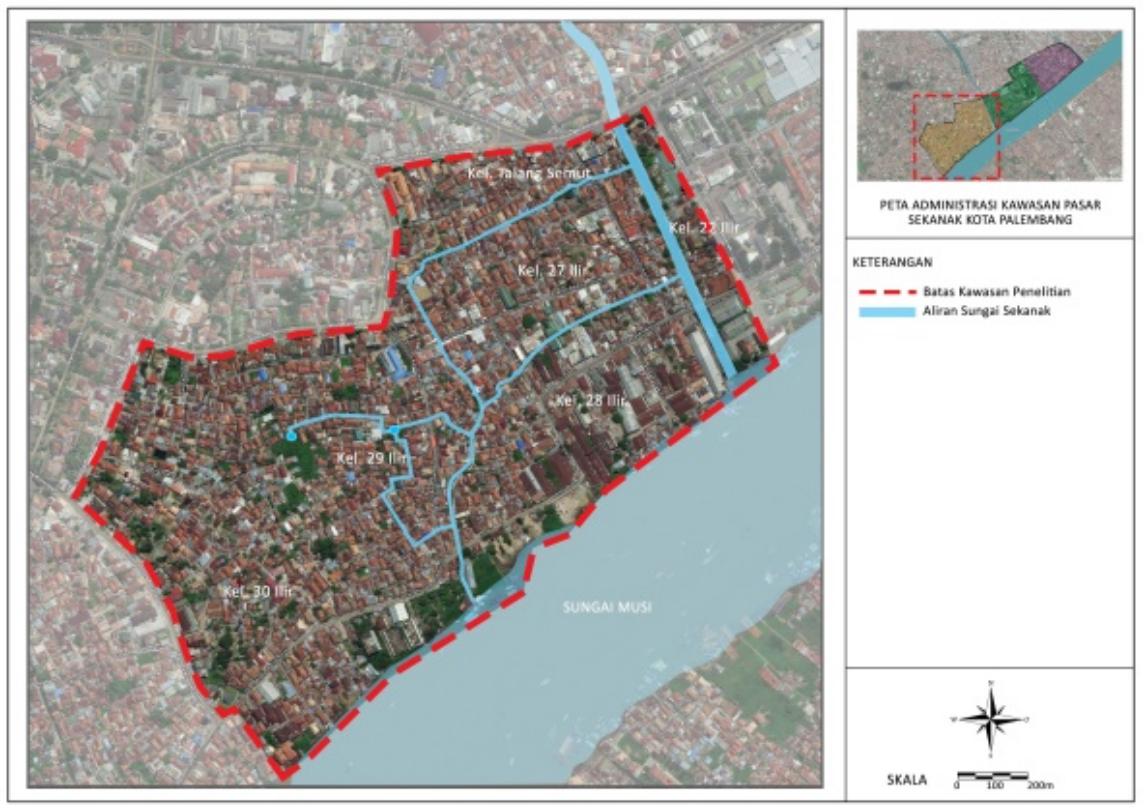
Figure 1. Study Areas Map
This study uses descriptive-quantitative method. Sudjana (2004) states that a descriptive study with a quantitative approach is used if the study aims to describe or explain events that occur at the present time in the form of meaningful numbers. In this case, the instruments used to collect data should be valid, reliable, have norms, and practical. The data collection was carried out through observation, interviews, questionnaires, and official documents. In order to determine the perceptions and preferences of local communities, questionnaires were distributed randomly, both from traders and local residents. In accordance with Sugiyono (2001: 57) who explains that the Simple Random Sampling technique is a sampling technique from members of the population which is carried out randomly without considering the strata. In some discussions also use Cross Tabulation Analysis, which for identifying correlations between variables used in study. Cross tabulation is also cited in Santoso & Tjiptono (2001), which is used to calculate the frequency and percentage of two or more variables at once by crossing variables that are considered related so that the meaning of the relationship between the two variables is easy to understand descriptively.
4. Discussion
The issue of this historical area, which is increasingly abandoned by traders and communities, needs attention to increase the number of visits. It is necessary to assess the condition of this area which is focused on infrastructure, facilities, level of security, cleanliness, and comfort. This condition is reviewed through the observations and perceptions of the local community.
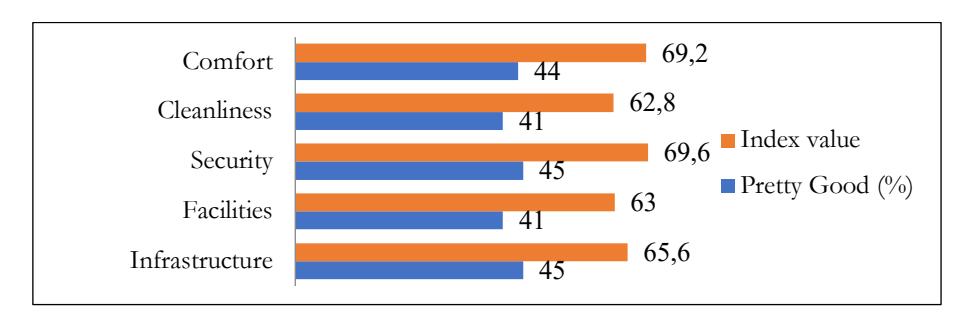
Figure 2. The Percentage of Local Community Perceptions regarding to Sekanak Market Area Condition
Through the index values of the result, the condition of Sekanak Market Area is Good. However, from each category or assessment aspect namely Infrastructure, Facilities, Level of Security, Cleanliness and Comfort, there are still negative assessments stated by several respondents.
The observation table shows that the facilities and infrastructure condition of Sekanak Market Area is not so good, such as street in the market and drainage in slum area. Some facilities which are necessary to increase the visitors comfort still have less attention, such as trash bin, market and shop house building, pedestrian ways, lodging, parking, plaza, or another public space for recreation. Minimum and not maintained facilities certainly affect the historical area condition. The result of local community perceptions is considered in corresponding with the observation. In fact, the condition of Sekanak Market Area still needs to be regenerated, especially on the main market. Whether it is part of infrastructure or facilities, in terms of quality and quantity. So the formulation of strategy recommendation for solving its deficiency to support the developing area is needed.
Table 2. Observation of Facilities and Infrastructure Condition
| Infrastructure | ||||
|---|---|---|---|---|
| Street | - Main street is still good | |||
| - Residential street has been renovated a lot | ||||
| - Street in the market is still quite a lot of damage | ||||
| Drainage | There is drainage but not in several slum area | |||
| Waste | - There is UPTD Subdistrict of IB II of Palembang Department of Sanitation office | |||
| management | - Garbage collection system on some points by janitors | |||
| Street light | There are street lights with good condition | |||
| Facilities | ||||
| Cleanliness | There are no trash bins available yet at several points | |||
| Finance | There is only one Bank operating | |||
| Trading | - Store types from grocery, vegetable, fruit, fish and equipment store besides restaurant and food stalls. | |||
| - Many Los were closed in the market as well as several shop houses on the main corridor. | ||||
| - Many shops and booths are not maintained, such as perforated/ destroyed zinc roofs, some roads and building walls look broken. | ||||
| Security | - There is police station | |||
| - This area is also close to the TNI area | ||||
| Other | - There is only one dormitory | |||
| supporting | - There is no Pedestrian ways yet | |||
| facilities | - People use roadside as parking area which making traffic jams | |||
| - There is no plazas yet | ||||
| - The pedicab base has no certain points yet | ||||
4.1. Sense of Place Elements in Sekanak Market Area
Sekanak Market Area is also supported by the sense of place elements which function to create its atmosphere for the visitors. So this study needs to analysis traditional market area elements which can support the development of heritage tourism in Sekanak Market Area.
Table 3. Sense of Place Analysis in Sekanak Traditional Market Area
| Physical Factors | |
|---|---|
| Potential | Obstacles encountered |
| Area | |
| - Many old building strengthen the heritage character | - A slum area is on the riverside |
| - There is a row of shop house | - The parking area for residents, visitors |
| - There is a typical residential of stilt house | and traders causes congestion |
| - Many small alleys, which especially connecting settlements and | - Pedestrian circulation on the market |
| creating the village corridors | corridor is considered insufficient and |
| - Easy access for land and water routes | comfortable |
| Architecture | |
| - The building style is considered authentic | - Tradisional houses have not been fully |
| - Pasar Sekanak Shophouse has Tionghoa architectural style with | functional for tourism |
| a unique facade | - The application of murals has not raised |
| - There is Palembang Traditional House namely the Limas and | yet the local wisdom of historical area |
| Warehouse | |
| - There is the oldest Palembang mosque | |
| Interior/ zoning | |
| - The main corridor displays Sekanak shophouse | - Many shops in Sekanak Market are no |
| - The main corridor intersection displays the abundance of | longer operating |
| bananas from traders. | - Market condition looks unclean |
| - In the morning, many snacks and breakfast traders in almost | - Traders are not have innovated in |
| every street of this area | managing their shops. |
| Products | |
| - Typical products are Palembang Mattresses and Fabric (Songket and Jumputan) | - There are still minimum of souvenir shops |
| - Those products are processed into souvenirs such as fans, | - There is still a lack of handicraft |
| wallets, pencil cases | production activities or local specialties |
| - There are special foods such as Pindang Ikan and Pempek with | that visitors can enjoy and learn about. |
| its processed | |
| Vocal Point | |
| - Painting house in Kampung KB Layang-Layang makes it stand | - Tourism supporting facilities such |
| out than others settlements | signage, interpretation and street |
| - The pedestrian bridge on Sekanak River applies a songket | furniture are still minimal |
| shape, as well as the walls around the river which are painted | - The existing facilities are not raised yet |
| with Songket motif. | the local wisdom |
| Social Factors | |
| Potential History and Memory | Obstacles encountered |
| - The history of city's growth in trading makes this area has many | - There is no more floating market at the |
| old buildings of former offices, warehouse and shops. | mouth of Sekanak River |
| - There is trading over the water surface by using boat namely | - Traditional Raft Houses are also rarely |
| Ketek | found in this area |
| - Traditional transportation which still used by local | - There are no interpretations that |
| community(Pedicab, Ketek, Ontel bicycle) | provide additional information for |
| - Some traditional houses still have historical relics (cabinet, | visitors about the history of this area |
| table, lamp, chest, etc.) | |
| Narration | |||
|---|---|---|---|
| - Tawar river flow is believed to cure disease, where it flows through the Suro Mosque - The history of community's life in Sultanate to Colonial Era is considered interesting to be told - There is a connection between the Suro Mosque and Mahkam Kijai H. ABD Rahman | - Not many local community understand about history and culture - The right and good technique of delivering historical narratives is still less attention | ||
| Local Community Character | |||
| - Traders are quite friendly in bargaining - Characters of the elderly are mostly found in this area, and they are still productive in trading. - Traders or laborers like to spend time at the mouth of the Sekanak River to fish with other residents on cargo ships. Promotion and Events | - Residents are not aware much to environment and tourism. - Residents are difficult to actively participate because of the minimal injection of funds and income. | ||
| - Bidar Competitions annual event. The participants held a decorative pedicab competition to enliven the celebration. - Islamic traditions are still practiced (Prophet's birthday, Isra' Mi'raj, 1 Muharram, etc.) | - There are not many promotions done yet by holding events in this area. - Lack of place for events | ||
4.2. Components of Heritage Tourism in Sekanak Market Area
A. Preservation
One of the preservation activities by the City Government is implementing the old area with the theme 'Sekanak Kerihin' (Old Tempo Area) in this area. Besides revitalizing the Sekanak River and make it one of the water tourist destinations in Palembang. Some old buildings are also preserved through renovation and program of adaptive reuse as a traditional coffee, crafts, and culinary center. This preservation is basically adjusted to each existing heritage. The preservation is also supported by the local community. An average of one hundred respondents stated that they Do Not Throw Garbage or Waste Into The River and make efforts such as Using and Teaching Local Languages in Socializing with visitors.
B. Interpretation and Information
The provision of information and interpretation is able to facilitate visitors as well as educate the historical and cultural knowledge that exists. Basically, information not only can be provided by tour guide services but also by the provision of a TIC (Tourist Information Center) which is a center for visitors to obtain information related to tourism in this area and its surroundings. However, in Sekanak Market Area, the information center has not been provided yet. Through observations, the provision of interpretation both within the area and on existing tourist attractions is still minimal. Only several signages or directions, warning boards, and kind of landmark have been provided.
C. Accessibility
The accessibility that supports the development of heritage tourism is not only from the circulation of vehicles, pedestrians, transportation facilities, and infrastructure. But it is also how visitors could access to seeing, understanding, and getting unique experiences inside. In the traditional limas house, for example, visitors are given access to enter and take a tour of the various relics that are still preserved. Apart from taking pictures, visitors can also ask about the object the building manager. Even though there are still many historical old buildings in Sekanak Market Area that have not been opened to the public due to the interests of the owners, they are also empty and deliberately closed.
D. Cooperation and Participation
Tourism development in Sekanak Market Area can be seen from how the government collaborates with various parties, ranging from the private sector, academia, and the media. This positive response was also stated by the local community, where the results of the questionnaire showed that the most effort made by each age category was Directing and Introducing Heritage Objects to Visitors or Tourists (34.80%). Besides that, out of one hundred respondents stated that the most used ways of promoting tourism were Inviting Family, Friends, or Acquaintances To Visit The Sekanak Market Area (34.00%).
E. Quality of Building and Historical Landscape
Authenticity provides quality and value to attract visits, where visitors don't get the same experience elsewhere. Through observations and interviews with the Palembang Department of Culture and the local community, there are many original buildings, such as traditional houses (Limas house and Warehouse). Other historical buildings such as warehouses or offices are still original as well as their function. So the quality of historical buildings is considered good in supporting the development of heritage tourism. Meanwhile, the land use in this area is considered to have not changed much, namely the market, warehouse, and residential areas. So the historical landscape actually compensates and becomes an additional value for the quality of existing historical buildings. It's just that the addition of tourism facilities and the needs of the population make this area has a more complex function.
F. Education
Education in heritage tourism is basically not the only knowledge gained by visitors through the tours provided. However, education should also be owned by the hosts. The results of the questionnaire show that there is much local community who have not participated in the socialization related to tourism, which is about 83% of a hundred respondents stated Never. Meanwhile, those who attended the socialization, the most are from 46-55 years old (five respondents) and 56-65 years old (four respondents) age category. Education can influence the mindset of the local community in dealing with tourists. Such as the attitude of the hosts when tourists bring foreign cultures into their area. In this case, 93% of a hundred respondents chose to Respect The Foreign Culture and Maintain The Local Culture.
G. Economic Activities of Local Community
The main economic activity in Sekanak Market Area is trading. However, heritage tourism should be able to support and be further developed. Seeing the efforts of the local community in the results of the questionnaire, 24.10% of respondents Became Tourism Business Actors, which means that local economic activities in this area have developed but are not yet optimal. Some tourism businesses that can be found here are Selling Traditional Palembang Food, Opening Songket, and Palembang Mattress Business, where these economic activities have raised the local wisdom. As the intangible heritage potential, it can be developed, such the process of making Songket, processing Rendang Bread, making kites and how to play it, processing coffee, or making crafts.
4.3. Formulating Heritage Tourism Development Strategy in Sekanak Market Area
To make Sekanak Market Area a tourist destination, it is necessary to fulfill the aspects of developing the tourist destination which consists of 5As (Attraction, Accessibility, Amenities, Accommodation, and Ancillary). For formulating the development strategy, it also considers other related aspects, such as heritage potential, sense of place elements, and the heritage tourism components that have been analyzed before.
A. Heritage Tourist Attraction Development
To formulate the heritage tourism attractions development strategy that can be recommended to be applied to Sekanak Market Area, they are categorized into three types based on existing heritage potentials, namely Natural Heritage Tourist Attractions, Tangible Cultural Heritage (Physical), and Intangible Cultural Heritage (Not Physical).
| Age Range | |||||||
|---|---|---|---|---|---|---|---|
| Category | 15-17 y.o. | 17-25 y.o. | 26-35 y.o. | 36-45 y.o. | 46-55 y.o. | 56-65 y.o. | Total |
| Shopping | 0 | 8 | 13 | 8 | 8 | 7 | 44 |
| 0% | 17% | 22% | 15% | 17% | 23% | 18% | |
| Fishing | 1 | 2 | 11 | 9 | 7 | 7 | 37 |
| 33% | 4% | 18% | 17% | 15% | 23% | 15% | |
| Recreation | 1 | 15 | 11 | 16 | 12 | 5 | 60 |
| 33% | 31% | 18% | 30% | 26% | 17% | 25% | |
| Culinary | 1 | 16 | 19 | 16 | 15 | 6 | 73 |
| 33% | 33% | 32% | 30% | 33% | 20% | 30% | |
| Education | 0 | 7 | 5 | 4 | 3 | 4 | 23 |
| 0% | 15% | 8% | 7% | 7% | 13% | 10% | |
| Other | 0 | 0 | 1 | 1 | 1 | 1 | 4 |
| 0% | 0% | 2% | 2% | 2% | 3% | 2% | |
| Total | 3 | 48 | 60 | 54 | 46 | 30 | 241 |
| 100% | 100% | 100% | 100% | 100% | 100% | 100% | |
Table 4. Cross Tabulation Analysis between Age and Community Preferences
Some activities are believed by locals could be developed to support heritage tourism in Sekanak Market Area. For example, in the 26-35 years old category, most prefer Culinary (32%), Shopping (22%), and Fishing (18%), which are closely related to economic activity. Then the 36-45 and 46-55 years old category, mostly chose Culinary and Recreational activities, which balanced with social activity. The 56-65 years old category mostly chose Fishing (23%) and Shopping (23%). Meanwhile, most educational activities were chosen by the 17-25 years old category which is more productive for learning and work. So that the local community is considered productive enough to open tourism businesses such as trading food and local specialty products. However, trading is an activity that could attract visitors.
Table 5. Recommendation of Heritage Tourist Attraction Development
Natural Heritage Attraction
Sekanak River
- 1) Adding the supporting attraction, Floating Stall. Depicting the trading culture on the surface of water, allowing visitors to enjoy the past of this area directly.
- 2) Adding tourism activities with cultural and historical values, such river-tour/ punting with historical education through competent tour guides.
Edge of Musi River
Fishing is one of the local community activities that can be used as an attraction, both for tourists to enjoy and do. Provision of fishing gear rental can be added. Even providing a fishing boat will be more attractive to tourists.
Tangible Cultural Heritage
Sekanak Market
- 1) Renovation of traditional fish market and Sekanak market shophouses, such as painting and repairing the damaged parts
- 2) Giving improvements but still maintain the existing shop style
- 3) Adding night activities such as Culinary Festival
- 4) Adding, arranging and grouping the bew booths that are more attractive with local wisdom visuals
Others Heritage Old Building
- 1) Rejuvenating the exterior and interior of the building in order to be maintained but keeps the authenticity
- 2) Transferring some old buildings function that are no longer used. Such as museums, Songket craft centers, cafes, restaurants, souvenir shops, etc.
Intangible Cultural Heritage
Tradition
Adding public areas or facilities such as plazas or promenades and culinary stalls to support traditions such as the Bidar Competition. The promenade can provide space for visitors to watch the Bidar Competition or while having some meals.
Traditional Culinary
- 1) Showing the process of making traditional food
- 2) Not only in stalls or restaurants, traditional culinary can be traded on the water surface by using Ketek or Floating Stall (rafting house style)
- 3) Organizing a Culinary Festivals
Custom Home (Traditional House)
- 1) Creating a core, buffer and development zone for making the Traditional House as heritage tourist attraction but still keep preserving cultural heritage
- 2) Restoration, such as painting and arranging the non-functional spaces
- 3) Arranging the land around the Traditional House and making some area for activities such as cultural events etc.
Traditional Crafts
- 1) Processing the traditional crafts as souvenirs
- 2) Displaying processed traditional crafts at the shops for making it more eye catching and arranging it uniquely
- 3) Displaying the process of making Songket fabric or other traditional crafts and providing the education for visitors who want to learn it.
Traditional Game
Hold events or celebrations featuring traditional games in the section of the event. As the celebration of Independence Day and the anniversary of Palembang City could hold a kite contest, marbles, tops and other traditional games. It can also be a Traditional Game Festivals.
B. Provision of Heritage Tourism Supporting Amenities
Basically, some facilities that support tourism are expected by the government to start developing through their local community which is as a positive impact of tourism in this historical area. Although not all types of facilities, at least the role of the local community is needed to improve the local economy and creative culture.
It shows that the 17-25 years old (36.0%) and 46-55 years old (31.6%) category respondents prefer to provide facilities that utilize typical local transportation in opening their businesses. Not only for facilitate the circulation of visitors but also can be used as a Floating Shops. While the 26-35 years old (55.6%), 36-45 years old (41.7%) and 56-65 years old (50.0%) respondents prefer to provide facilities such as places to eat, stalls, mini gas station, gift shops and etc.
| · | Age Range | ||||||
|---|---|---|---|---|---|---|---|
| 15 - 17 y.o. | 17 - 25 y.o. | 26 - 35 y.o. | 36 - 45 y.o. | 46 - 55 y.o. | 56 - 65 y.o. | Total | |
| Utilizing the empty land as parking | 0 | 4 | 1 | 4 | 3 | 2 | 14 |
| area in an orderly manner | 0.00% | 16.00% | 5.60% | 16.70% | 15.80% | 14.30% | 13.90% |
| Opening restaurant/ cafe, stalls, | 1 | 6 | 10 | 10 | 5 | 7 | 39 |
| mini gas station, gift shops or others | 100.00% | 24.00% | 55.60% | 41.70% | 26.30% | 50.00% | 38.60% |
| 0 | 5 | 1 | 1 | 3 | 1 | 11 | |
| Providing the lodging for tourists | 0.00% | 20.00% | 5.60% | 4.20% | 15.80% | 7.10% | 10.90% |
| Utilizing the typical local | 0 | 9 | 5 | 7 | 6 | 4 | 31 |
| transportation for tourism businesses | 0.00% | 36.00% | 27.80% | 29.20% | 31.60% | 28.60% | 30.70% |
| Ni-abi | 0 | 1 | 1 | 2 | 2 | 0 | 6 |
| Nothing | 0.00% | 4.00% | 5.60% | 8.30% | 10.50% | 0.00% | 5.90% |
| 1 | 25 | 18 | 24 | 19 | 14 | 101 | |
| Total | 100.00% | 100.00% | 100.00% | 100.00% | 100.00% | 100.00% | 100.00% |
Table 6. Cross Tabulation Analysis between Age and Local Community Participation in Increasing Tourist Facilities
C. Provision of Accommodation
Through interviews with several local communities, some of them complained about the economy and housing conditions. The desire of local communities to open lodging for tourists is deemed not quite balanced with the reality. To respond to this, the provision of accommodation in Sekanak Market Area can be balanced between homestays and other inns. At least lodging such as guest houses, hostels, or even hotels and etc. can utilize the old buildings, especially those which are no longer maintained, in ways such as being repaired, restored, and re-functioned while maintaining the historical or architectural values that existed before. In addition, the provision of accommodation is expected to increase the history and memory of Sekanak Market Area, one of which can be by arranging a slum area on the banks of Musi River by applying the concept of a raft house, as the history of its settlements began with the establishment of raft houses. Not only improving slum areas and offering the concept of accommodation with a riverside atmosphere but this arrangement is also expected to foster a healthy environment for residents and visitors.
D. Enhancement of Ancillary
Through heritage tourism, it should also improve the local welfare, so both the government and the community must be creative in utilizing the enthusiasm and ability of local residents to create an image of this historical area to attract more tourist visits. Therefore, one of the ancillary enhancement can be through community empowerment.
The table shows that 63% of respondents wish to attend training related to culture, especially the 26- 35 years old category (56.5%) who has the most answer Want and the 46-55 years old category (30.0%) most answer Really Want. Even though approaches through community leaders, or those influential in this area towards local community are needed to increase tourism awareness. This is also a consideration for 7% of respondents who still do not wish to participate. Likewise, the 30% of respondents who were considered still had doubts about participating. As the assessment through observations, there are still many elderly people who are very productive. This is an opportunity to empower the local community in supporting the development of heritage tourism. So this empowerment basically frees the locals in choosing how they will utilize existing local resources, but still requires facilitators to direct and teach them to find solutions. Thus, cooperation is necessary between stakeholders to support the heritage tourism development.
Age Range 15 - 17 17 - 25 26 - 35 36 - 45 46 - 55 56 - 65 Total Category y.o. y.o. y.o. y.o. y.o. y.o. Really don't want 0 1 0 0 0 0 0% 0% 4.3% 0% 0% 0% 1.0% Don't want 0 0 1 4 0 1 6 0% 0% 0%4.3% 18.2% 11.13% 6% Want enough 11 4 30 1 5 6 3 30.0% 50.0% 45.8% 17.4% 22.7% 30.0% 33.3% Want 0 9 13 8 8 0 38 0% 37.5% 56.5% 36.4% 40.0% 0% 38.0% 1 4 4 5 5 25 Really want 6 16.7% 22.7% 50.0% 17.4% 30.0% 55.6% 25.0% 24 23 22 Total 2 20 0 100 100% 100% 100% 100% 100% 100% 100%
Table 7. Cross Tabulation Analysis betwaeen Age and Desire of Local Community to Participate the Training about Culture
E. Tourist Accessibility Development
Considering that in this area are many local people who still use traditional transportation, so to support the development of accessibility can utilize this potential. Such Ontel bicycles, this unique transportation can be provided as rental places for visitors who wish to tour this area. Besides providing attractive transportation to facilitate the circulation and experience of visitors, it is necessary to provide its bases at several spots in this area. In addition, accessibility needs to pay attention to the safety and comfort of pedestrians. Where there are heritage objects scattered in Sekanak Market Area, it also expects tourists can get a cultural experience. Thus, it is necessary to add pedestrian ways, especially in the corridor of Sekanak Market. So that tourist can explore the area while occasionally pulling over to the shops in their path. Meanwhile, in the waterway, the pier that has been provided still needs to be developed to be better and more attractive. Through structuring and polishing, such as the addition of promenades or public spaces, not only for the circulation of visitors but also for the local community to open tourism businesses.
Table 8. Summary of Heritage Tourism Development Strategy in Sekanak Market Area
| Aspects | Strategy Recommendations |
|---|---|
| Attraction | - Utilizing the river bank to increase supporting attraction, such as recreation and shopping at Floating Stalls, or punting activities through the Sekanak River |
| - Package the historical narratives through tour guides, performances, historical and cultural events | |
| - Addaptive reuse of historical buildings into heritage tourist objects, such as museums | |
| - Increase activity support for local community which also involve tourists, not only in villages but also tourist attractions | |
| - Adding tourist activities at night, such as culinary festivals | |
| Amenities | - Cooperation between Department of Tourism, Department of Culture, historians or cultural observers to provide interpretation in each heritage tourist objects and pack the narrative of Sekanak Market Area |
| - Providing bench in pedestrian ways and adding public spaces | |
| - Providing trash bins at several points and the appeal board | |
| - Cooperating in providing types of ATMs and money changers | |
| - Using the concept of shared space in managing the main street, as well as arranging the parking area | |
| - Transferring function of several historical building as a TIC (Tourist Information | |
| Center), as a souvenir center, and/or place for SMEs to entrust their products for sale |
| Aspects | Strategy Recommendations | |||||
|---|---|---|---|---|---|---|
| - Providing and coloring the tourist facilities as well as raise the local wisdom and line it with the historical area so that accentuate the existing ornaments and originality | ||||||
| Accommodation | - Conduct the adaptive reuse to historical buildings that potentially used as lodging - Provide the socialization related to the using of heritage tourism for the local economy and welfare, as well as training to manage the homestays | |||||
| Ancillary | - Forming a Pokdarwis (Tourism Awareness Group) - Conducting the local community approach through community leader, religious leader, Pokdarwis, students and/or others who are considered influential to raise the enthusiasm and awareness for supporting the development - Cooperation between Department of Tourism and organizations in providing socialization and training to local community related to heritage preservation, heritage tourism and its utilization for local well-being, how to host in tourist area, and how to promote the tourism through digital technology and etc. - Empowerment of local community in utilizing the local culinary and products or crafts, guiding tours, managing homestays, and managing heritage tourism objects - Cooperation between Department of Tourism and HPI to improve the skills and competencies of local community as tour guides - Cooperation between Department of Tourism and Media in promoting the heritage tourism of Sekanak Market Area, through events which in making interpretation use the internet or other electronic media - Cooperation between Department of Tourism and BPCB (Cultural Heritage Conservation Center) in functioning the cultural heritage buildings as amenities or accommodation | |||||
| Accessibility | - Making the traditional transportation as tourist transportation, and also arranging its bases - Rearranging the existing pier - Providing the pedestrian ways on main street of Sekanak Market Area | |||||
5. Conclusion
As for the historical area, which is issued to be increasingly abandoned, it does need to be polished back to be better, from infrastructure to facilities. This is an area of the first row shophouses in Palembang City, where many historical and cultural values that have the potential to revive this area. This potential can be developed through tourism based on history and culture (heritage tourism) which is quite different from other historical areas (Pratiwi 2009). This area is supported by the traditional market which makes up its own atmosphere, so the development also considering elements of the traditional market area. In analyzing the supporting area, the sense of place element factors is considered. In addition, the important components of heritage tourism in Sekanak Market Area are also analyzed for further consideration in order to maximize strategy recommendations.
Starting from the development of various types of heritage tourist attractions by utilizing the tangible cultural heritage, intangible cultural heritage, and natural heritage. Then began to provide tourism supporting facilities, both in terms of quantity and quality. The main facility is information and interpretation which facilitate the visitors and tourists to understand the historical and cultural values. The provision of these facilities should also raise the local wisdom. Not only Amenities but also the provision of Accommodation which is very minimal in this area. This is followed by the enhancement of Ancillary, where through education such as socialization and training. This education can support the empowerment of the local community, considering the potentials that can be utilized to improve the local economy and well-being. To improve ancillary, it still requires cooperation between stakeholders, namely Regional Apparatus Organizations, Private Sector, Academics, the Community and Media. Besides all that, aspects of Accessibility also still need to be developed both inland and water routes. Starting from providing safe and comfortable pedestrian ways to providing promenades as well as increasing the number of other small piers beside the main pier that has been provided.