

1. Introduction
The promotion of entrepreneurship in the tourism sector enhances the continued success and development of the tourism industry. Tourism enterprises have a dual role; firstly, they invite, retain, and call back visitors of various locations (demand side). Secondly, the sector develops and preserves the regional culture and ecosystem with more value added and joy (supply-side). So the study on the promotion of tourism enterprises must be discussed in tourism literature for developing a conducive tourism environment (Solvoll, Alsos, & Bulanova, 2015). Since the firm characteristics and industry types are the determinant factor in accessing finance (Beck, Demirgüç-Kunt, & Maksimovic, 2008), a more specific study on the access of finance by tourism enterprises and their deployment in the operation of the business would help to identify how the promotional agencies including financial
institutions assist tourism SMEs to explore opportunities. Tourism development has ample role in determining livelihood of local households, development of small enterprises, growth of regional as well as the national economy, and the use of natural resources and the infrastructure facilities of the destination (Romero & Molina, 2013; Samina, 2008). The development of the tourism sector creates economic growth and provides ample scope for private employment opportunities (Fayissa, Nsiah, & Tadesse, 2011). In fact, the tourism sector and tourism-oriented enterprises have emerged as an integral part of any economy.
The World Travel and Tourism Council (WTTC 2016) estimated that by 2026, the segment is expected to create 370 million job opportunities across the globe, which will be in the proportion of 1 in 9 of all jobs in the globe. In 2017, India was ranked 7th among 184 countries in terms of share of travel and tourism sector's to GDP; tourist arrivals crossed 10.56 million with an annual growth of 5.2% in 2018. India is the destination for 1.24% of the international tourist was ranked 25th in terms of the number of tourist arrivals, and the share of international tourism receipts is 1.97% with 13th position. The sector also constitutes 12% of total employment figures of the country. Similarly, the tourism opportunities in Kerala also have increased accordingly. In 2018, a total number of 1.67 crore tourists have visited with 5.93% growth over the previous year and the revenue of the sector has been increased to 8.6% (the sector achieved such growth in the mid of the deluge and flood of 2018).
Entrepreneurs are very keen to explore these opportunities with varieties of tourism services; The tourism SMEs have widely recognized as an instrumental for the growth of tourism sector; and it has been in the forefront for providing various tourism facilities such as transportation, restaurants, hotels, etc. on the flip side co-existence of small business entities and their services are necessary to develop a good tourism culture by transmitting leisure and recreational opportunities (Lee & Chang, 2008). They also act as resemble of indigenous culture and providers of local facilities which are an integral part of tourism. However, their limited internal finance sources often hindered their inclination to be an entrepreneur or to unfold growth opportunities.
Limited access to finance hinders the growth of enterprises has been elucidated in many kinds of literature related to small businesses, for instance (Beck, Demirgüç-kunt, & Maksimovic, 2003; Gbandi & Amissah, 2014). So Enterprises generally rely on financial institutions to source external funds and to unfold the opportunities in the tourism sector (Peric, Mujacevic, & Simunic, 2009.). There is ample evidence for the role of financial institutions in mitigating the financial shortages of SMEs and the promotion of enterprises, for instance (Rao & Noorinasab, 2013; Thampy, 2010). However, the growth issues of SMEs differ from segment to segment. So the problems in the promotion of tourism enterprises should be discussed separately since their requirements and promotional measures are different from general enterprises (Solvoll et al., 2015). The studies on the promotion of tourism entities and the role of financial institutions in escalating tourism enterprise help to bring new insights into tourism literature.
2. Literature Review
The literature of the study portraits the potential of the tourism industry in economic growth and the possible opportunities for tourism SMEs to excel through startups, diversifications, modernization, and adding more value-added services to the current businesses to gain the benefits of tourism development. Further, it also fortifies how financial institutions assist SMEs to meet their financial requirements to establish entrepreneurship in the tourism sector.
2.1. Financial Issues of Tourism Entrepreneurship
Studies on the tourism sector overemphasized the economic contribution of the sector (Chen & Chiou-Wei, 2009; Dritsakis, 2004; Lee & Chang, 2008); the studies of tourism enterprises not covered the promotional issues of tourism enterprises rather they linked with tourism development in general, for instance (Parra López, Buhalis, & Fyall, 2009; Rogerson, 2008; Samuel, Masaki, 2009). Hence the study on the promotional issues of tourism enterprises should be added to the tourism literature. The current study highlights the financial issues of the tourism enterprise and how could financial institutions address the same. Researchers have not treated the financial access of tourism enterprises and how financial institutions resolve it. To provide the best ancillary services to tourists, keen attention is required in the development of tourism entrepreneurship. While developing tourism entrepreneurship, the quality of entrepreneurship, leadership, market, and market orientation of entrepreneurs should be defined based on market demand (Taskov, Metodijeski, Dzaleva, & Filipovski, 2011), for best performance of tourism ecosystem the financial aspects also taken to consideration.
Research on tourism entrepreneurship must address both financial and non-financial issues, because the structure of the sector is evolving in nature, for instance, the tourism industry has been adopting changes rapidly due to shifts in the preferences of visitors and the new provision of technology, this structural shift calls for more experienced and innovative entrepreneurs, but to explore such opportunities of tourism entities, they should be supported with lenient financial sources, these issues also added to the tourism literature. In running tourism enterprises, improvement and modernization of facilities are common in nature, for instance, the traditional mode of services in accommodation, transport, and food services are being shifted to experience-based services and products (Solvoll et al., 2015).
Hence, the tourism sector develops tremendous opportunities for excel but on the flip side, the entities often failed to explore market growth innovative products due to growth hindrances including financial gap. If the growth hinders tourism entities successfully addressed, marvel development could be ensured. For instance, Thomas cook has undoubtedly been the most significant global entrepreneur in the tourism industry, often heralded as the 'father of mass tourism'. In fact, tourism development calls for diverse and more innovative entrepreneurs, they can offer products and services to meet the increasing demand for unique experiences creating memories, engagements, and emotional involvements for tourists (Solvoll et al., 2015). To cope up with the changes in the markets as well as the preferences of visitors, tourism SMEs requires continuous financial supports.
Hence, this study outlines the role of financial institutions in promoting tourism and hospitality industries in Kerala and also elicits the relevance of financial institutions in asset creation, making innovation, and attracting new entrepreneurs in the tourism sector. The remaining sections of the study have been organized into five sections, first section provides a literature background of economic development and tourism entities, research on tourism enterprises; and establish the role of financial institutions. The second part highlights opportunities for tourism entrepreneurship in the state of Kerala. The third section discusses the empirical background of the study and the current study design. The fourth section makes the analysis of the primary data. The fifth section provide a conclusion and practical implication of the study.
2.2. Studies on Tourism Entrepreneurship
Tourism sectors create tremendous employment opportunities for skilled and unskilled workers and perennially compose a significant part of economic growth. The study of (Kim, Chen, & Jang, 2006) states tourism development mediated both economic developments as well as employment generation in Taiwan. In the view of (Creaco & Querini, 2003), development in the tourism sector is positively impacted on the balance of payments, employment, on gross income generation and production(entrepreneurship). As stated by Durbarry (2004) the evidence of how Mauritius getting benefits from tourism development in the economy and the way in local economy augmented, jobs in the tourism sector by lending varieties of services in host destinations. The study of (Karatzoglou & Macedonia, 2004) assesses the role and responsibility of Greek island hotel SMEs in promoting and protecting tourism development, it is also stated as SMEs engaged in the tourism sector promote and implement environmental management which is the backbone of the tourism industry. (Samina, 2008) explains how the tourism industry escalates Pakistan's economy; the sector remains a major source for augmented capital flow and foreign investments.
Lee & Chang (2008) gives more comprehensive concepts on the impact of the tourism sector on the economic growth of OECD countries. Literature gives substantial evidence for the positive impact of tourism development on economic and social development. The arguments of a positive association of tourism entrepreneurship and economic growth; further, the studies provide shreds of evidence from both developing and developed economies (Dritsakis, 2004; Narayan, 2004; Nongsiej & Shimray, 2017; Oh, 2005; Rogerson, 2008; Samuel, Masaki, 2009; Stanislav Ivanov, 2007). The sector has been playing a forefront role in augmenting economic activities and contributing significantly to economics indices, the studies on Indian and Kerala contexts also affirm the arguments, for instance, (Chavan & Bhola, 2015; Hannam, 2004; Singh Jaswal, 2014), explains the share of the sector to GDP, foreign earnings, the balance of payment, on the other hand, employment generation, improved standard of living, cultural exchanges, the market for traditional products, crafts, etc.
However, tourism development highly depended on frequent innovations in services, up-gradation of facilities. Thus enterprises have a significant role in shaping the tourism facilities, but the contribution of tourism entrepreneurs has never been given due credit, especially in the field of tourism, and yet their contribution to be discussed in the level of attracting tourists and exchanging cultural values (Parra López et al., 2009). The discussion of tourism entrepreneurs and their role in the development of tourist destinations came from Butler (1980) in his 'Destination Life Cycle model' (Shaw and Williams, 1998), he stated as "when visitors numbers begin to increase in a destination, locals see the need to provide businesses and services to cater for the visitor needs and the economic opportunities this presented". Diversification in tourism facilities after reaching the stagnation stage would rejuvenate entrepreneurship and enhance the facilities to visitors. For instance, the business model of 'Thomas Cook', provides successive transformation tourism enterprises by exploring opportunities in each stage. Thomas cook has updated its business model by bringing about change, economic vitality and setting new social and cultural standards on the requirement (Ravindram & Vinodan, 2009).
Tourism entrepreneurship is conceptualized as; the activities related to creating and operating enterprises in the tourism sector in legal form. Such enterprises are focus to satisfy the needs of visitors with profitability (Saayman & Saayman, 1997). The critical factor of tourism enterprise is making innovation, for continues operation novel concepts are frequently added to the services. This challenge remains among enterprises at global and regional levels (Parra López et al., 2009; Solvoll et al., 2015). However, the research on tourism entrepreneurship is not developed well; the main reason is the lack of unique discussions on tourism entrepreneurship. Further, the definition of entrepreneurship itself is complex it involves multiple fields like perspectives and disciplines, and tasks, etc, the definition of entrepreneurship is not straightforward (Parra López et al., 2009). However, now the concept is emerged and got separate attention from mainstream enterprises developments. The concept of tourism entrepreneurship can be explained in mixed ways. (Kallmuenzer, Kraus, Peters, Steiner, & Cheng, 2019), the study identified factors that influence entrepreneurship as multidimensional Entrepreneurial Orientation (EO), financial endowment, and personal and professional networks. It includes varieties of services in hospitality, transportation, and shopping facilities.
2.3. Empirical Review: Role of Financial Institution
The theme of the current study is to identify the role of financial institutions in facilitating tourism entities to create assets, enhance recreation facilities, and stimulate tourism entrepreneurship. Issues on the promotion of tourism entrepreneurship are needed to address separately, regarding the financial aspects of tourism entrepreneurship is at the cradle stage. The tourism sector is not an exceptional segment of financial support; to explore the growth trajectory, this sector also needs continuous and huge investments. Since the source of an entrepreneur is limited, he obviously approaches external finance, and mainly from financial institutions, so the financial institutions have a dynamic role in promoting entrepreneurship (Beck, Demirgüç-kunt, & Martinez-Pería, 2008). Entrepreneurs in the tourism sector generally seek funds from financial institutions for their start-up and diversification(Peric et al., 2009). The availability of finance is critical to shape tourism development and to promote enterprises in the tourism sector. The major investment drives for the tourism sector are specialized financial institutions, commercial banks, and government financial packages, in macro-level international investments too. Thrust areas of investment in the tourism sector include establishment, nursing, growth of enterprises, and the development of tourism destination (Sharma, 2014) finance is also required for the expansion, growth, and sustaining the business (Aziz & Siddique, 2016), therefore, every business enterprise, irrespective for their size needs finance for to unfold opportunities to expand and to run the operation.
Business enterprises require capital for various purposes for creating facilities (Fixed Assets) and maintaining fixed assets (working capital) every time (Kayanula & Quartey, 2000). In addition, (Becker 1995) explained that government financing institutions should open special credit programs for private sector development. The role of financial institutions in promoting entrepreneurship in Assam and concluded that various financial institutions are making attractive schemes for the availability of finance apart from other assistances, including technical know-how, training, sales, purchases, etc(Beck, Homanen, & Uras, 2019). Thus the tourism entrepreneurship development is highly relaid on financial accessibility. In this fact, the current study checks the involvement of financial institutions in fostering tourism enterprises. The government support also augments tourism entrepreneurship, the state of Kerala has such an advantage. government tourism policy also encourages direct investment in the tourism sector (Chaudhary 2009) he further revealed that various tourism organizations are playing a major role in the tourism development in Kerala. The government of Kerala through its tourism policy cleared the importance of tourism investment by fortifying the role of private investments and the development is mainly owed to the synergy between the private and public sector (Kerala Tourism Policy, 2016), and government acts as a facilitator to create a favorable environment to attract private investment through various schemes of premier institutions such as Kerala Tourism and Development Corporation (KTDC), Kerala Finance Corporation (KFC), Kerala State Industrial Development Corporation (KSIDC) and Commercial banks.
To analyze the growth of the tourism sector, variables like tourist arrival and revenue of tourism sector have been considered (Romero & Molina, 2013; Stanislav Ivanov, 2007); the studies of The trend of revenue earning of the tourism sector and arrivals of (both domestic as well as foreign) visitors shows the market coverage of tourism sector. The study of (Samina, 2008) has used growth in the number of visitors to depict tourism development in Pakistan. The earnings of the tourism sector are used in the study of Fayissa et al., (2011) with the GDP of Latin American Countries to establish contribution to economic growth. Besides, the study has taken the availability of accommodation facilities in the tourism sector as an opportunity for tourism enterprises. Coming to the main theme of the study, the role of financial institutions in the promotion tourism industry, the study identifies entrepreneurs' perception of the services of financial institutions and analyses their role in meeting the diverse needs of tourism enterprises.
Financial assistance has been used to measure the role of financial institutions (Feakins, 2004; Fowowe, 2017). On the flip side, to measure the effect of financial assistance on enterprise-level, promotional measures such as Asset Creation (Kersten, Harms, Liket, & Maas, 2017; Piza et al., 2016) Innovation Recreation Facilities (Roy & Misra, 2015), and Motive for starting enterprises in tourism sector (Beck et al., 2019) have been considered. The overall effect of financial institutions on entrepreneurship promotion has been elucidated in the studies by many researchers (i. e. Beck,
Homanen, & Uras, 2019; Parra López et al., 2009; Lopez-Acevedo & Tinajero, 2010 ). Specifically, over SME promotion factors and measurement scales have been developed based on the study by Kallmuenzer et al. (2019) and Solvoll et al. (2015). To set the background and to establish the potential growth opportunities for tourism enterprises, the first part of the study elucidated the growth trend of the tourism sector in Kerala; and the second part analyzed the role of financial institutions in the promotion of tourism enterprises amid consecutive growth trend of the tourism industry.
2.4. Tourism Entrepreneurship in Kerala: Opportunity Side
Tourism entrepreneurship in Kerala is yet to develop by exploring its natural settings and more valueadded services with world-class standards. Kerala, the greenest state, is on the southern tip of India blessed with excellent tropical weather and two rainy seasons; southwest mansoon (Edvapathi) and northeast monsoon (Thulam), these golden interludes provide an equilibrium to life's natural flow. The state is networked by 44 rivers, 34 lakes, canals, ponds, paddy fields, etc; these unique natural blessings make life in Kerala priceless, which has made it popularly known as the 'God's own country in the tourism circle. This lush green strip of land ie 38,863 sq. km, frame by the Arabian Sea and the steep Western Ghats.
Kerala is a leader in India when it comes to tourism destination and promotion in a short period. The tourism sector of Kerala has started emerging only after the establishment of the first international beach resort at Kovalam in the 1980s and followed the declaration of tourism as an industry in 1986. In the early 1990s, the state was known for a single beach destination; later Kerala marketed its unique advantages such as serene backwaters, natural sceneries, wildlife sanctuaries, Ayurveda treatments, culture and heritage, and temple festivals, etc, successfully. Now the state has many internationally well-known destination places like Ponmudi, Veli, Alappuzha Backwaters, Thenmala, Varkala, Kumarakom, Fort Kochi, Eravikulam, Thekkady, Soochipara, Kuruva, Pookot Lake, and Bekal. Further Kerala's topography, dotted with a wide array of peaks, mountains, and water bodies, is the attraction for adventure tourism. The tourism industry of the state is a significant contributor to the growth of the service sector and the economic development of Kerala. The total revenue generated by the sector (including direct and indirect means) during the year 2018 comes to 28239.08 crore, which shows an increase of 8.61 percent over the last year. During the last 14 years, the Revenue of the sector has grown from 7,738 crores in 2005 to 28239.08 crores by 2018 with a CAGR of 9.69% (Economic Review, 2019). Figure 1 shows the trend of tourism revenues of the state of Kerala.
The tourism revenue of the state is a significant share of state GDP and foreign exchange earnings. Foreign earnings of the sector in 2018 were 8,764.46 crore and the earnings from domestic tourists were 19,474.62 crores respectively. Arrivals of both domestic and foreign tourists also show an increasing trend. Graph 2 provides the trend of tourists' arrivals of the last 14 years (2003 – 2018) with the R2 value of 0.636. Gross tourist arrivals increased from 61, 65849 in 2003 to 1, 67,01068 in 2018 with a CAGR of 7.38. In 2018, the potential tourism market of foreign tourists arrivals to the state are, United Kingdom with a percentage share of 18.35% followed by the USA with 8.80%, other major foreign markets for Kerala are, France, Germany, Saudi Arabia, Russia, Australia, Canada, Malaysia, and Switzerland.
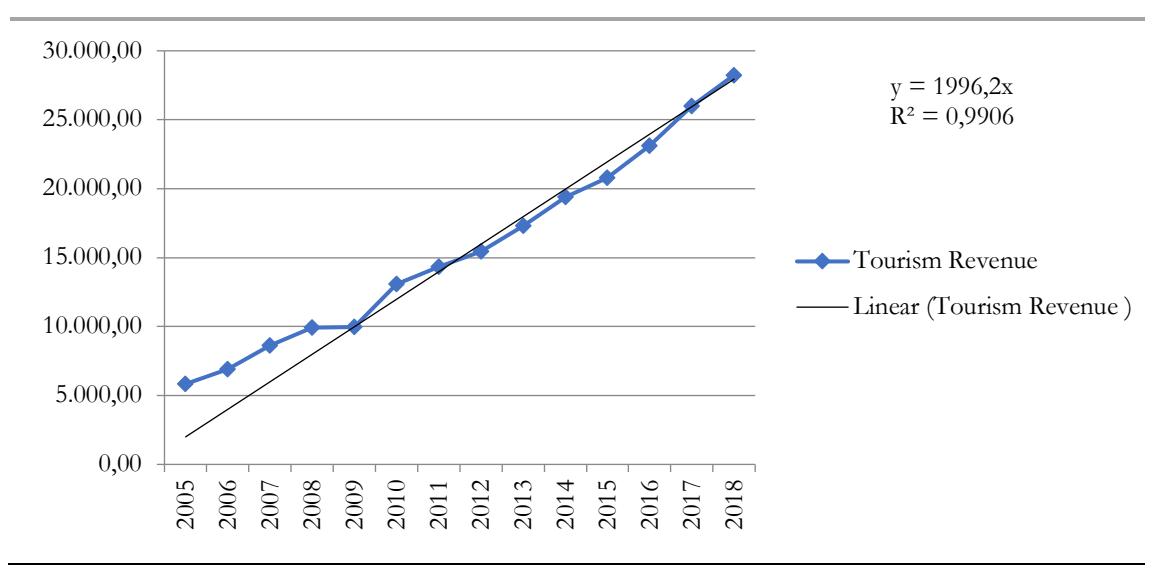
Figure 1. Tourism Revenue
Source: Economic Review 2019, State Planning Board, Kerala.
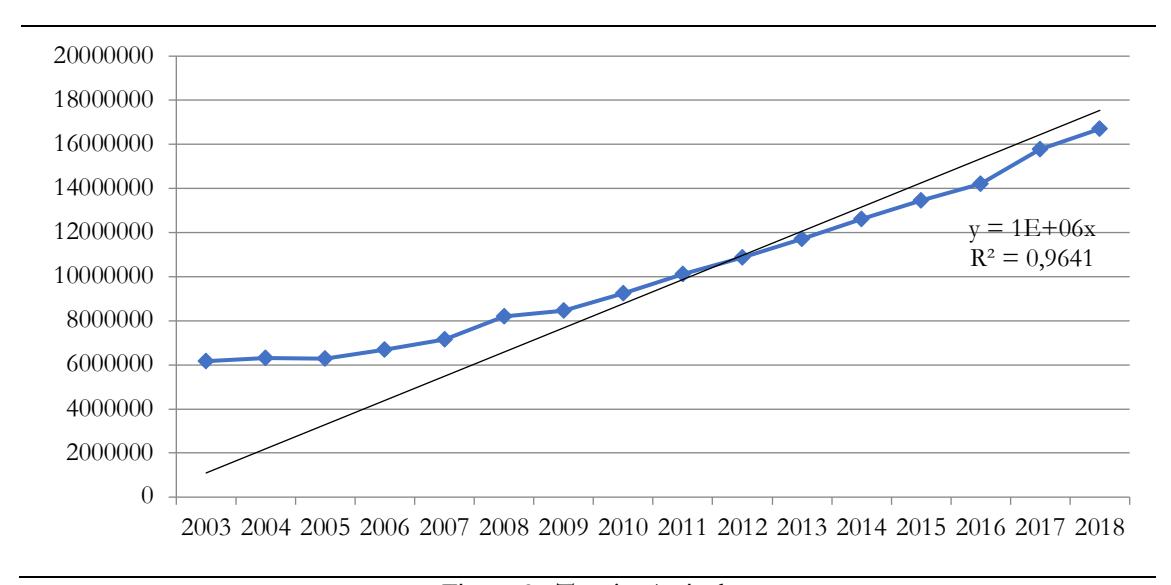
Figure 2. Tourist Arrivals Source: Economic Review 2019, State Planning Board, Kerala.
The domestic tourism market also contributes significantly to the total tourists' arrivals share. The majority of the domestic visitors are from neighboring states such as Tamil Nadu, Karnataka, Andhra Pradesh, and Maharashtra. Thiruvananthapuram and Ernakulam are the two districts mostly preferred by tourists.
The infrastructure of the tourism sector in the state needed to improve. Since the tourists' arrivals show an increasing tendency, it has reached 1.67 crores in 2018, the facilities should be enhanced with the view of most comfortable and accessible services. Improving facilities helps to attract, retain and call back the visitors, by comparing the trend of tourists' arrivals and earnings the facilities must be improved to accommodate visitors. Table I shows the available accommodation facilities in the state. Improvement of infrastructure is opened to tourism entrepreneurs because the government can't develop facilities alone but can assist by extending entrepreneurship promotion services.
Table I. Accommodation Facilities
| Enterprise Type | Number of Units Provide Accommodation | Total No of Rooms Available | Average no of units (District Wise) | Average No of Rooms (District Wise) |
|---|---|---|---|---|
| Ayurvedic centers | 129 | 1839 | 52.07 | 131.35 |
| Houseboats | 928 | NA | NA | NA |
| Hotels/Others | 3749 | 68076 | 267.78 | 4862.57 |
| Home stays | 1040 | 3532 | 74.28 | 252.28 |
| Grihasthali | 5 | 28 | .35 | 14 |
| Rest House | 193 | 2144 | 13.78 | 153.14 |
| Guest House | 90 | 1179 | 6.42 | 84.21 |
| Yathri Nivas | 9 | 106 | .64 | 7.57 |
| Resorts | 694 | 10963 | 49.57 | 783.07 |
| Serviced Villa | 180 | 906 | 12.85 | 64.71 |
| Total | 7022 | 88773 | 501.57 | 6340.92 |
Source: Economic Review 2019, State Planning Board, Kerala.
Even though the state dominates in tourism growth, the infrastructure facilities of the state are yet to develop. From the table, I, reveal that there are only 88,773 rooms available, at district level on average of 6340 rooms. The figures in the average show the proportions facilities among 14 districts. The number of available Resorts (694), Serviced Villa (180) and Rest House (193) needed to increase. The House boating and boating services in Alappuzha is a unique feature of Kerala, it must be extended to all inland water service areas. Hotels provide maximum accommodation but it is needed to improve. Since visitors are increasing so to attract new visitors, retain the existing and call back old visitors the overall faculties must be improved with the latest recreation facilities.
In addition, unique features of Kerala tourism like backwater tourism and Ayurveda are acclaimed as innovations in the tourism industry which attained international heed. To unfold the growth opportunities and retain the constant growth trend of the state tourism sector, tourism entrepreneurship has been under regenovation through the promotion of new tourism enterprises and renovation of existing entities by assimilation and modernization. These drastic changes involve the creation of infrastructure of world-class standard with the provision of basic amenities in all destinations, improvement in recreation facilities of hotels, restaurants and visitor points; and attraction of new investors, for up-gradation of facilities in place of interest and to upkeep overall improvements and to maintain local attraction at destinations. To cater to the requirements of tourists, various business entities having developed with high diversity and to accommodate multicultural perceptions, and are highly dependent on financial institutions for their business developments.
State-level financial institutions both public and private plays a key role in the development of the tourism sector particularly tourism enterprises. The Kerala Industrial Development Corporation (KSIDC), Kerala Financial Corporation (KFC), and Commercial banks have been at the forefront in promoting tourism enterprises in the state. With the advent of tourism growth the state cannot afford to let these advantages slip away, to explore the pristine nature in the state and for its sustenance; the State government has been giving strong support, facilities to promote the tourism industry. Specialized financial institutions such as KFC and KSIDC along with commercial banks act an intermediary role in extending means for tourism enterprises in the state; it helps tourism entities to asset creation, development, and overall development. Kerala's tourism has been enjoying investment financing basically from banks and financial institutions.
There are various institutions both financial and non-financial actively involving the promotion of tourism in Kerala. The primary sources of entrepreneurship promotion in the tourism sector are KFC and KSIDC, they provide both financial and non-financial assistance such as credit, managerial assistance, technical know-how, and other advisory services. KFC provides credit with relaxed norms, similarly, KSIDC also extends credit with the approval of the state government. Commercial banks also extending credit facilities to tourism entrepreneurship. In fact, the financial institutions in the states play an important role in developing tourism entrepreneurship by extending promotional facilities in the following ways; (i) As financial intermediaries by giving funds for meeting their varied requirements starting from seed and throughout the growth. (ii) Financial institutions further extend their credit for Modernization and diversification of tourism operation (iii) Timely guidance assistance for the growing tourism sector and tourism entrepreneurship with the specific project.
3. Methodology
3.1. Data Collocation
Based on the empirical review and the specific review on the prospectus of Kerala tourism, the study argues that; (i) tourism sector of state Kerala is providing tremendous business opportunities; (ii) the financial institutions in the state Kerala are very instrumental to promote tourism enterprises in the form of (a) asset creation, (b) innovations in recreation facilities and (c) being motive to start enterprises in the tourism sector. Hence the study state that the assistances of financial institutions have a significant impact on facilitating tourism enterprises. To establish the relationship of financial institution and development of tourism enterprise, both primary and secondary data were employed in the study, use of a mixed methodology helps to reach a consistent conclusion, than focusing only on the quantitative or qualitative part (Kallmuenzer et al., 2019).
Primary data was used to identify the role of financial institutions in the promotion of tourism enterprises. Data have been generated from 222 tourism entrepreneurs who have been engaged in entrepreneurial activities for instance like house boating, hotels and restaurant, resort, Travel and tour operations, and entrepreneurs engaged in Ayurvedic activities. A structured questionnaire was used to obtain the response on the quality and quantity of financial assistances; their effectiveness in asset creation, improvement of recreation facilities through modernization, and diversification as per the requirements of visitors. To measure the financial assistances, 5 items were used to define the credit services of financial institutions including the statement like 'financial assistant sufficient to meet my requirement completely' and 'norms of financial institutions is satisfactory'.
The items related to the accessibility of financial supports measured with the items used in the studies of (Aldakhil, Qazi Abro, Khurshid, & Aamir, 2015), which includes the perception of credit norms, the quantum of credit, timeliness of credit, rate of interest and cost of credit were also collected from the respondents. Regarding the effect of financial assistances, changes in asset, facilities, coverage, level modernization, etc collected in the slab with the comparison of last 10 years. The level of SME promotion has been measured with the measurement scale used by Kallmuenzer et al., (2019). All data were collected in 5-point Likert where 1 was anchored as strongly disagree and 5 represented strongly agree. Demographic features of entrepreneurs and characteristics of enterprises were also considered. Secondary data pinned from the annual reports of Kerala Tourism Development Corporation (KTDC) and the Economic Review, Published by State Planning Board, Kerala.
3.2. Statistical Techniques
To test the effectiveness of financial assistances on SME promotion, simple regression equation was employed. The basic form of regression equation as given in equation (1)–(3), was used where, the dependent variable is denoted as '"' and the independent variable as '', the variable never perfectly related so the error term in the relation is denoted as ''
\[\hat{Y} = b_0 + b_1 x_i + \epsilon \tag{1}\]
Where,
\[b_1 = \frac{\sum (Y - \bar{Y})(x - \bar{x})}{\sum (x - \bar{x})^2} \tag{2}\]
And
\[b_0 = \bar{Y} - b_1 \bar{x} \tag{3}\]
'b"' is the slope of the line and is known as the regression coefficient and is the change in ' Y.' associated with a one-unit change in' x,'; and '!'or -intercept is the value of when x, = 0.
So the model for the impact of financial assistance on asset creation of the firm as stated as in equation (4);
\[ac = b_0 + b_1 f_i + \epsilon\] (4) Where, \['ac' = \text{asset creation}\]
''' = level of financial assistance.
The second model for measuring the relationship between innovation in recreation facilities and financial assistances is as shown in equation (5);
\[rf = b_0 + b_1 f_i + \varepsilon \tag{5}\]
Where,
'' = innovation in recreation facilities '' = level of financial assistance
The third model for measuring the relationship between motive for tourism entrepreneurship and financial assistances is as shown in equation (6);
\[bm = b_0 + b_1 f_i + \varepsilon \tag{6}\]
Where,
'' = motive for tourism enterprises '' = level of financial assistance
The fourth equation is to identify the impact of the overall impact of financial assistance in the promotion of tourism enterprises is shown in equation (7)
\[pte = b_0 + b_1 f_i + \varepsilon \tag{7}\]
Where,
'' = promotion of tourism entrepreneurship '#' = level of financial assistance
Promotion of tourism entrepreneurship is the proxy of asset creation, recreation facilities and the motive for business to start in the tourism sector. Before testing the hypothesis the quality of the data also measured using pre-test analysis such as normality, linearity, autocorrelation etc. to ensure the validity of the scale exploratory factor analysis using principal factor analysis also have performed.
4. Data Analysis
The study used a sample of 222 SME owners/ managers who have been engaged in tourism enterprises and have also used financial institutions' assistance at least once in their business. Responders of the study have been segregated into four categories based on the nature of business; Hotel and Restaurant (29.72%), Travel and Tour (27.02%), Ayurvedic Enterprises (18.91%), and House Boating services (24.32%). In the sample, 43.69% of entrepreneurs are either professionally qualified or post-graduation degree holders; interestingly all responders have at least secondary level education; it may be due to the higher literacy rate of the state. 42.79% of entrepreneurs of the study sourced institutional finance for initial investment whereas 39.18% are used funds from friends and family, remaining 18.01% used self-earnings to start the business. 58.10% of entrepreneurs have preferred specialized financial institutions such as KFC or KSIDC for sourcing finance rather than commercial banks; it may be due to the relaxed credit norms of institutions. Out of the sourced loans, 62.61% were long-term in nature, and the remaining 37.38% of loans are medium (less than 3 years). (Data on short-term loans was not taken since they are temporary adjustments). Employment of the loan amount has set in four heads; 18.46% of the responders used the loan amount for working capital and 56.75% of the responders have sourced loan for starting a business, while 13.06% of responders have used the loan for expansion of the business capacity and remaining 11.71% responders have used the loan for modernization of the business facilities.
4.1. Pre Test Requirements
To identify the quality of the sample to determine the study objectives, pre-test requirements have been tested with standard measurements. The study sample is adequate to test, the KMO and Bartlett's Test for sample adequacy was 0.882, chi-square 3007.973, df 153, P<.000. Normality of the data was checked with Kolmogorov-Smirnov and Shapiro-Wilk tests, all four cases the p<.000, further skewness and kurtosis values were checked, all case values are acceptable within the range of +/-2, the data follows assumptions of normal distribution. Regarding the autocorrelation of the variables, the Durbin Watson test was performed, in all cases the values in between 1.5 to 2.5, which is an acceptable range. The total variance explained by four factors was 66.77%.
The reliability of the scale was measurement and tested with Cronbach's Alpha value, the values in four cases are above 0.70, after the reduction of items the final items as; Financial Assistance - five items (0.864), Asset Creation – four items (0.755), Innovation in recreation facilities – five items (0.785) and Business motive – four items (.809). The data set adheres to all requirements, so the data set has the basic strength to perform statistical analysis. Factor analysis was also performed to check the validity of the items, it has found some factors have cross-loading, but the chi-square value 416.665, with df. of 87 is significant with p<.000, the method used to factor analysis is maximum likely hood and rotation method was Promax with Kaiser normalization. The variances explained by four factors are 71.59%.
4.2. Regression Result and Discussion
The study performed three simple linear regression analyses and one common regression analysis to access the overall impact of financial institutional support in the promotion of enterprises in the tourism sector. The study found a positive correlation and impact in four cases regarding the role of financial institutions. First, a simple linear regression was performed to predict the impact of Financial Assistance (FA) on the Asset Creation (AC) of tourism entities, a significant regression equation was found (1,220) F = 330.274,p<.000), at 95% confidence level, with R2 of .600 Firm's Asset creation is equal to 1.646 +.646FA when FA measured with a given scale. The test further reveals that the Pearson's correlation, R is 0.775, i.e. financial assistance and performance of the firm's Asset creation are highly positively associated. The financial assistances explain 60% of the variance in the Assets of the tourism enterprises with an adjusted the R2 of 0.598. Second simple linear regression was performed to check the involvement of financial assistance in innovating recreation facilities
(Innovation), a significant regression equation was found (1,220) F=409.942,p<.000) at a 95% confidence level with R2 of 65.1%. The firm's innovation in improving recreation facilities is equal to 1.991+.603FA when financial assistance is measured with a given scale.
The regression result further reveals that the Pearson's correlation, R is 0.807; financial assistance and innovation in recreation facilities are highly positively correlated. Financial assistances explain 65.1% of the change in the innovation of recreation facilities of a firm with an adjusted R2 of 64.9%To check the role of financial assistance as a motive for business operation, regression analysis between financial assistances and business motives was performed, a significant regression equation was found (1,220). F = 315.038,p<.000, at 95% of the significant level, with R2 of ...589. The motive to start a business in the tourism sector is equal to 1.440+ .682FA when financial assistance is measured on a given scale.
The regression result further reveals that the Pearson's correlation, R is 0.767, financial assistance and business motive are highly positively associated; and FA explains 58.9% of motive to start a business in the tourism sector with the adjusted R2 of 58.7%. To find the overall impact of financial assistance on enterprises in the tourism sector, regression on financial assistance on the overall promotion factor was performed, over promotional factors measured by combining the measures of asset creation, recreation facilities, and motive for starting tourism business. A significant regression equation was found (1,220), F= 769.959, p<.000, at 95% significant level with R2 of 0.778. The overall impact of financial assistance on tourism enterprise promotion is equal to 1.647+.644FA, where FA is measured on a given scale. The regression result further reveals that the Pearson's correlation, R is 0.882, is highly positively associated; financial assistance is explaining the total SME promotion in the tourism sector is 77.8% with an adjusted R2 of 77.7%.
The result of regression equations sheds light that the role of a financial institution in SME promotion is highly corroborates. But that needs to redefine and improve since the firms are highly relying on financial institutions' lending on asset creation, modernization of recreation facilities, and starting a business in the tourism sector. The study result found that financial institutional support affects asset creation, innovation in recreation facilities, and is also a motive in starting a tourism business to a large extend. It may be due to relaxed norms of financial institutions and the positive relationship with entrepreneurs and financial institutions (Cenni, Monferrà, Salotti, Sangiorgi, & Torluccio, 2015); the relationship is a significant factor in SME lending. It also inferred that entrepreneurs highly depend on the initial stage of business rather than the later stages(Ang, 1992). The reason my initial experiences with the financial institution was not good for enterprises in terms of norms of the financial institution and the number of loans (Fowowe, 2017). So they rely on the internal source rather than external source due to risk aversion factor, but it may affect the growth pace of the tourism sector and eventually, tourism industry the is study provides positive evidence for the role of financial institutions in the promotion of tourism enterprises in Kerala.
5. Conclusion and Policy Recommendation
In summary, the study provides three important insights into the promotion of tourism enterprises. Firstly, there is a dearth of research on the promotion of tourism enterprises specifically on the financing aspects of tourism enterprises. Since the tourism sector is more vibrant and dynamic the financing requirements are high, often entrepreneurs failed to source external funds, Which will negatively affect the development of the tourism sector. So there is a need for more studies on the financing of tourism enterprises. Secondly, tourists arrivals and tourism earnings of the state show an increasing tendency, so there is a need for more attention from the government to improve infrastructure facilities to provide world-class recreation facilities. Tourism entrepreneurs should explore the growth of the tourism industry by providing more value-added experiences. Third, the study found positive association financial assistance of financial institutions in the promotion of tourism enterprises in the form of asset creation, innovation, and motive for starting a business, however, the role is fragile needs to strengthen.
The implication of the results, the financial institutions should design a special scheme/ funds for the promotion of tourism enterprises with more relaxed norms. The introduction of specific products like modernization funds or start-up funds will help to mitigate credit shortages and to improve the financial relationship with entrepreneurs. The government should develop separate credit guarantee funds linked with the major financial institution to guarantee financial assistance. Considering the relevance and strength of tourism enterprise, a policy level initiative is required to ensure tourism lending as Priority Sector Lending (PSL) along with other prime lending sectors.