

1. Introduction
The tourism industry is considered one of the largest industries in the global economy in terms of capital investments and as a source of foreign exchange earnings. In turn affecting the development of societies and their economies (Magatef, 2015) such as providing employment opportunities, a fair return on investment, and conservation of resources (Rome, 1963), infrastructure development, and export revenues (UNWTO, 2015).
Sri Lanka, due to its strategic geographical location has been able to attract many merchants and explorers even in the past (Lakmali et al., 2014) and coupled with its natural attractions able to compete with other worldwide travel destinations (Fernando, 2017) and in 2019 a globally recognized company 'Lonely Planet' named Sri Lanka as the number-one travel destination of the year. Significant contribution made by the tourism industry to the national economy by contributing to the government budget, foreign earnings, and employment generation. Only a few places in the world can offer the traveller an exceptional combination of pristine beaches, remarkable landscapes, rich cultural heritage, and unique experiences within such a solid location and Sri Lanka can be considered as one destination among them. Among the above, this research study considers the cultural triangle of Sri Lanka, which is the place historically evolved, unique, and extremely rare and its authenticity is its main attractiveness for tourists to visit.
According to Sri Lanka Tourism Development Authority (2018) the cultural triangle reports as the highest contributor for earning revenue including different sources such as entrance fees for the attractions and sites located in the cultural triangle such as temples, ruins, museums, rock, monasteries etc. However Cultural Triangle region attracts a reasonable number of tourist arrivals throughout the last few years, but still, the tourist's arrivals seem low when compares with other regions such as South Coast, Colombo City and Greater Colombo.
According to Swarbrooke & Horner (2004), understanding consumer decision-making is a cornerstone of marketing strategy. Consumer behaviour in tourism is established by general assumptions about how decisions are made. A tourism product is not a tourism destination, but it is about the experience and activities provided by the tourism destination. Potential tourists are always able to make choices, to choose between two or more alternatives, and for selecting the tourist destination, tourists will consider various attributes of the destination (Papatheodorou, 2001). The relationship between destination attributes and tourist's destination selection in the tourism industry has been found as an important research context (Cakici and Harman 2007; Mahdzar and Gani, 2018; Waas and Chandrarathne, 2020). If tourists' expectations cannot be really met, they are more likely to become dissatisfied tourists and develop intention not to revisit again that tourist destinations (Lai & Nguyen, 2013).
Therefore, analysing the destination attributes is essential when trying to promote a destination and to attract more tourists towards that destination (Molefe et al., 2018). Accordingly, analysing what tourists seek at cultural and heritage attractions may help tourism marketers to better understand their customers. Further, identifying which attributes satisfy tourists who visit Cultural Triangle could help tourism planners to develop strategies to attract customers and it helps to maintain the destination`s sustainability in the Cultural Triangle region. Based on these facts, this research study will conduct to identify the impacts of destination attributes on tourist's destination selection, and accordingly, the specific focus of the study is the Cultural triangle (the region covers Kandy, Anuradhapura, Polonnaruwa, Dambulla and Sigiriya) in Sri Lanka. The key research problem of the study is set as: "How destination attributes impact on tourists` destination selection; with special reference to Cultural Triangle of Sri Lanka". Research Objectives: (1) To identify the factors that influence the tourists' in selecting the cultural triangle as a tourist destination; (2) To establish the relationship between destination attributes and tourists' destination selection. (3) To identify the most influencing destination attribute among the identified destination attributes. (4) To identify the demographic profile of tourists visiting the cultural triangle.
2. Literature Review
Tourism comprises the activities of persons traveling to and staying in places outside their usual atmosphere for less than one consecutive year for leisure, business, and other purposes (Macintosh and Goeldner, 2015). The tourism industry is a large sector, includes several actors and variability of goods and services offered. Those actors in the tourism industry include a bundle of tourist activities, services, experiences, and benefits that reflect the entire tourism experience towards the visitors. In the tourism sector, destinations can be defined as an amalgam of tourism products, offering an integrated experience to consumers and those are known as well-defined geographical areas (Buhalis, 2000). According to Cooper et al., (1998), a destination is a place that focuses on facilities and services designed to meet the needs and wants of the tourists. To become a tourist destination, the location or the region must have the factors that determine the tourist destinations. Further, Prior to travel, people choose a destination based on their expectations of the destination as well as people to consider what the destination can offer and the potential experience they will have at the destination (Prebensen, 2011). Therefore, it's clear the success and failure of a destination depend on tourists' evaluation of the destination, and the most fundamental elements which are using for tourist`s evaluation regarding a destination are identified as destination attributes in tourism.
Destination attributes can be defined as a mixture of different elements that attract travelers to a destination which is critically important for tourists to evaluate a destination during their travel (Crouch, 2011). According to Kim et al., (2010), these attributes represent a set of destination features that describe a place as a tourist destination, and it affects the image of a destination. Usually, tourists will compare the attributes of destinations when selecting a destination and they will choose a destination with attributes that are important for them as tourists compare the possible destinations they can visit and make their decisions according to the attributes of the destination. Therefore, it highlights tourists' satisfaction with a destination and destination selection can be influenced by destination's attributes which can be offered by a destination. Further destination attributes are a fundamental research concept in tourism because each travel destination consists of multiple destinations attributes. Several studies analysed the impact of the evaluation of destinations attributes on the tourist behaviour intention (Prayag & Ryan, 2012; Chi & Qu, 2008; Chen & Tsai, 2007; Chen & Chen, 2010), and few studies also observed how tourists are attracted by special features embedded within a destination (Gunapala and Sadaruwani, 2016; Lee, Huang & Yeh, 2010).
Buhalis (2000) listed six main components of tourism resources that can be used in evaluating the elements of a tourist destination: attractions, accessibility, amenities, packages by intermediaries, activities, and available ancillary services. Guzel (2017) explored the factors that tourists consider while selecting the tourist destination as transportation, availability, and price of suitable accommodation, infrastructure, tourists' attractions, local people, tour operators, weather conditions, and availability of time. Further, it has been identified that destination competitiveness is majorly dependent upon its destination attributes and has a significant impact on the overall visitor satisfaction and experience (Reisinger et al., 2009) and it's important to identify which destination attributes offer better value to tourists and make that destination more attractive. Based on that, the relationship between destination attributes and tourists' destination selection in the tourism industry has been found as an important research context including many tourism regions in different countries all over the world Guzel, 2017; Mahadzar & Gani, 2018; Waas, & Chandrarathne, 2020).
In the tourism industry, no destination will succeed without putting in some effort. Therefore, the identification of the destination's important attributes and comprehensive analysis of those attributes that impacting international tourist's destination selection is important. However, as there are several attributes associated with a destination, not each destination attribute impacts on tourists' destination selection equally. Some attributes might play a more important role than others (Swarbrooke, 1999). However, scholars identified that there is no set universally accepted dimensions of destination attributes (Gunasekara, 2014; Atilgan et al., 2003). Therefore, the commonly attractive attributes identified in tourism literature given much attention to conduct this study. Therefore, with reference to destination attributes models of empirical researches and based on its significant findings, this study considered the destination attributes which are analysed by Buhalis (2000), using Six A's Framework for Tourism Destination Attributes in worldwide as well as destination attributes model identified in Sri Lankan context based on empirical models. Accordingly, this study considers the combination of major destination attributes by categorizing it to separate segments which are Tourists' Amenities as the dimensions of the independent variables of this research study. Thus, considering those attributes, the conceptual model developed for this study is shown in the figure below and the related hypotheses are:
- H1: There is a significant relationship between Amenities and Tourist's Destination Selection.
- H2: There is a significant relationship between Destination Attractions and Tourist's Destination Selection.
- H3: There is a significant relationship between Accessibility and Tourists' Destination Selection.
- H4: There is a significant relationship between Ancillary Services and Tourists' Destination Selection.
- H5: There is a significant relationship between Destination Environment and Tourists' Destination Selection.
- H6: There is a significant relationship between Service Quality and Tourists' Destination Selection.
To test these hypotheses, the following regression model was developed and the equation is represented below.
\[TDS = AM + DA + AC + AS + DE + SQ + \varepsilon\]
These are represented as follows:
TDS - Tourists Destination Selection
AM - Amenities
DA - Destination Attractions
AS - Ancillary Services
DE - Destination Environment
SQ - Service Quality
The conceptual model of the study is depicted in the figure 01.
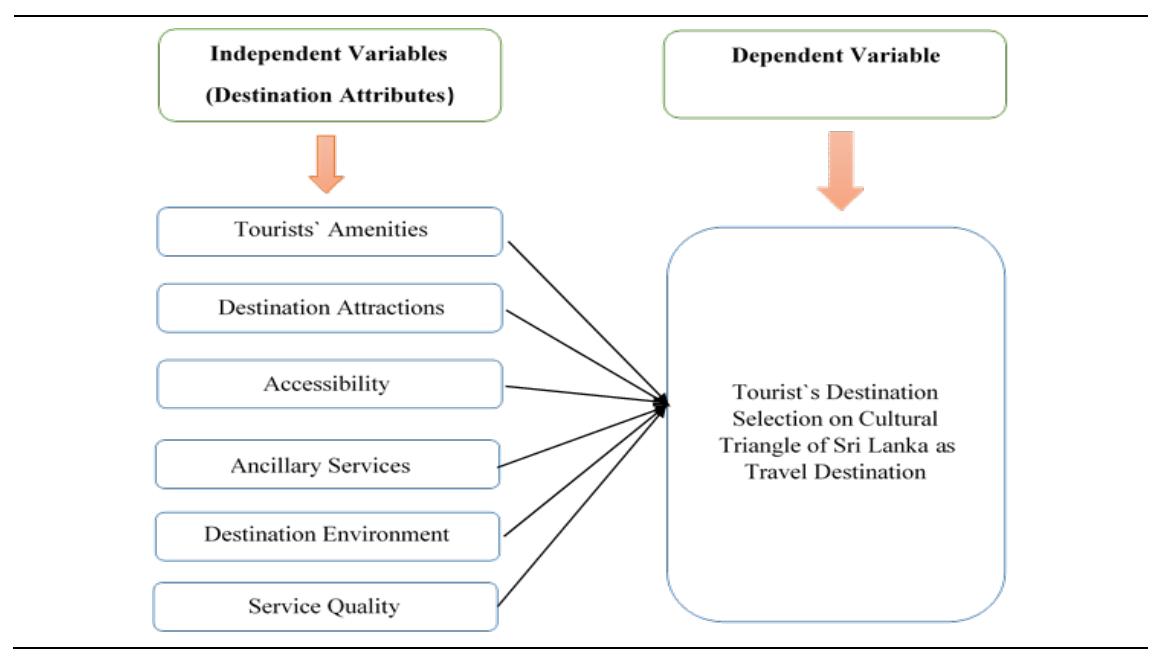
Figure 1. Conceptual framework
3. Methodology
This study adopts a quantitative method and the population includes all the inbound tourists who visit the Cultural Triangle of Sri Lanka. A convenient sample of 222 inbound tourists who visited the Cultural Triangle region of Sri Lanka during the year 2019 was selected for the study. Primary data was collected through a structured questionnaire delivered to tourists of a selected travel agent in Sri Lanka. Secondary data was gathered through the review of websites, articles, journals, annual reports. How variables were operationalised is depicted in the table below.
| Variable | Dimension | Indicators | Measurement | Source |
|---|---|---|---|---|
| Independent variables | Amenities | • Accommodation • Food & Beverages Shopping Facilities | 5-point Likert Scale | Buhalis (2000), Dwyer et. al, (2004) |
| Destination Attraction | • Natural Attractions • Cultural Sites • Leisure • Outdoor Activities | 5-point Likert Scale | Buhalis (2000), Li & Ali (2015), Mahdzar & Gani (2018) | |
| Accessibility | • Transportation Mode Convenience • Road Condition | 5-point Likert Scale | Buhalis (2000), Guzel (2017) | |
| Ancillary Services | • Telecommunication • Health & Sanitary • Information Centres | 5-point Likert Scale | Buhalis (2000), Fernando et., al (2017) | |
| Destination Environment | • Local Community • Climate & Weather • Safety & Security • Language Barriers | 5-point Likert Scale | Mahdzar & Gani (2018), Kozak (2003), Li & Ali (2015) | |
| Service Quality | • Value for Money • Prompt Service • Hygiene Cleanliness | 5-point Likert Scale | Dwyer and Kim (2003), Waas & Chandrarathne (2020) | |
| Dependent Variable | Tourists Destination Selection | • Revisit Intention Recommendation • Tourist Satisfaction | 5-point Likert Scale | Mahdzar & Gani (2018), Li & Ali (2015) |
Table 1. Operationalization Table
4. Data analysis and findings
The table below summarises how data was analysed to answer the key research question and related research objectives.
4.1. Demographic Profile Analysis
In line with the fourth objective, the analysis of the demographic details reveals that majority of tourists arrived from India (21%) and China (16.6%) and a significant number of tourists visited from Australia (12.7%), UK (9.3%), USA (7.3%) and Singapore (8.8%). In gender distribution, 126 foreign tourists were males as 61.46% meanwhile 79 female tourists visited with 38.54%. Majority of the tourists are youngers belonging to the age group of 18-29 which indicates 121 tourists as 42.67%. Marital status of the tourists shows 106 tourists are singles with 51.71% and 47.80% tourists are married. When considering their employment status, 35.61% tourists are working in private sector while 24.88% are self-employed people. When looking at the educational level of the tourists, majority of the people are graduates with the percentage of 69.0 and 35.6% people are diploma holders.
Table 2. Data Analysis Techniques
| Research Objectives | Method |
|---|---|
| To identify the factors that influence the tourists in selecting the cultural triangle as a tourist destination. | Reviewed the literature & developed the conceptual framework with identified variables to measure respondents' responses |
| To establish the relationship between destination attributes and tourists` destination selection. | Correlation Coefficient Analysis |
| To analyze the impacts of destination attributes on tourist's destination selection and to identify the most influencing destination attribute among the identified destination attributes. | Multiple Regression Analysis |
| To identify the demographic profile of tourists visiting the cultural triangle | Descriptive Statistical Analysis & Graphical Representation |
4.2. Correlation Coefficient Analysis
The relationship between destination attributes and tourists` destination selection is depicted in the table below.
Table 3. Correlation coefficient analysis
| Tourist Destination Selection | |||
|---|---|---|---|
| Destination Attributes | Pearson Correlation | Sig. value (2 tailed) | |
| Amenities | 0.363 | 0.000 | |
| Destination Attractions | 0.577 | 0.000 | |
| Accessibility | 0.469 | 0.000 | |
| Ancillary Services | 0.331 | 0.000 | |
| Destination Environment | 0.558 | 0.000 | |
| Service Quality | 0.294 | 0.000 | |
Source: Survey Data (2020)
Based on the above correlation coefficient analysis it was found that the Amenities, Destination Attractions, Accessibility, Ancillary Services, and Destination Environment are having a moderate positive relationship with Tourists' Destination Selection which shows the above attributes are moderately but positively influences the Tourist's Destination Selection. And Service Quality has a weak positive relationship with Tourists Destination Selection which means it is weakly but positively influences the Tourist's Destination Selection. Further, each variable has the significant value of the correlation as 0.000 with tourists' destination selection which emphasizes all the destination attributes are having a highly significant association between tourist's destination selection at 0.01 significant level.
The impact of destination attributes on destination selection was measured using multiple regression and the results of related hypothesis developments are depicted in table 4.
Table 4. Test of Hypothesis
| Hypothesis | Pearson Correlation | Sig. value (2 tailed) | Outcome |
|---|---|---|---|
| H1: There is a significant relationship between Amenities and Tourist's Destination Selection. | 0.363 | 0.000 | Accept H1 |
| H2: There is a significant relationship between Destination Attractions and Tourist's Destination Selection. | 0.577 | 0.000 | Accept H1 |
| H3: There is a significant relationship between Accessibility and Tourists` Destination Selection. | 0.469 | 0.000 | Accept H1 |
| H4: There is a significant relationship between Ancillary Services and Tourists' Destination Selection. | 0.331 | 0.000 | Accept H1 |
| H5: There is a significant relationship between Destination Environment and Tourists' Destination Selection. | 0.558 | 0.000 | Accept H1 |
| H6: There is a significant relationship between Service Quality and Tourists` Destination Selection. | 0.294 | 0.000 | Accept H1 |
Based on the hypothesis testing, all the hypothesis can be accepted at 0.01 level of significance. Further it emphasizes that there is significant relationship between Amenities, Destination Attractions, Accessibility, Ancillary Services, Destination Environment, Service Quality and Tourists' Destination Selection based on the analysis.
4.3. Multiple Regression Analysis
Table 5. Model Summary
| Model | R | R Square | Adjusted R Square | Std. Error of the | |
|---|---|---|---|---|---|
| Estimate | |||||
| 1 | .735a | .540 | .527 | .35550 | |
a. Predictors: (Constant), Service Quality, Amenities, Ancillary Services, Attractions and Activities, Accessibility, Destination Environment
Source: Survey Data (2020)
Table 6. ANOVA Table
| Model | Sum of Squares | df | Mean Square | F | Sig. | ||
|---|---|---|---|---|---|---|---|
| 1 | Regression | 29.430 | 6 | 4.905 | 38.811 | .000b | |
| Residual | 25.023 | 198 | 0.126 | ||||
| Total | 54.453 | 204 | |||||
a. Dependent Variable: Tourist`s Destination Selection
Source: Survey Data (2020)
b. Dependent Variable: Tourist's Destination Selection
b. Predictors: (Constant), Service Quality, Amenities, Ancillary Services, Attractions and Activities, Accessibility, Destination Environment
Model Unstandardized Coefficients Standardized Coefficients T Sig. B Std. Error Beta 1 (Constant) .903 .245 3.680 .000 Amenities .052 .042 .071 1.251 .212 Destination Attractions .285 .047 .370 6.038 .000 Accessibility .178 .054 .203 3.320 .001 Ancillary Services -.021 .043 -.033 -.492 .624 Destination Environment .214 .043 .317 4.958 .000 Service Quality .110 .041 .136 2.645 .009
Table 7. Coefficients
Source: Survey Data (2020)
a. Dependent Variable: Tourist's Destination Selection
According to the coefficient table, it indicates the beta coefficients, one to go with each predictor. Therefore, the general form of the equation for the regression line can be, Tourist's Destination Selection vs factors affecting to the Tourist's Destination Selection is,
Tourist's Destination Selection 0.903 = - 0.052 (Amenities) + 0.285 (Destination Attractions) + 0.178 (Accessibility) - (0.021) (Ancillary Services) + 0.214 (Destination Environment) + 0.110 (Service Quality) + ε
Accordingly, the above analysis shows the most significant factor for Tourists' Destination Selection is Destination Attractions which includes natural attractions, cultural & heritage sites, leisure & recreation, and outdoor activities which shows a coefficient value of 0.285, higher among all the other independent variables.
This study investigated the effects of destination attributes on tourists' decision-making on destination selection. Destination attributes are a fundamental concept used in tourism studies that underpins destination image, destination competitiveness, importance, and performance. There have been mainly two approaches to pre-identify the destination attributes as a measurement. One is to find a more generalizable set of destination attributes scales that is reliable and parsimonious and the other is to adopt the destination attributes scale from previous studies and modify it to apply to the specific destination characteristics.
There is no consensus on which approach should be used. However, the generalizable scale serves as a guideline, and modification is needed because no destination in the world is the same as another destination. Accordingly, the purpose of this study was to identify the destination attributes which is important to the Cultural Triangle of Sri Lanka in attracting more international tourists towards it and focused on identifying multiple attributes affecting tourists' destination selection and revisit intention, level tourist overall satisfaction, and word-of-mouth recommendation. The tourists select a destination based on their travel expectations and other tangible and intangible benefits. After arriving at the destinations, the tourists experience many different products and services called destination attributes. The strength of each factor differs from one customer group to another and each factor item contributed at different levels to each analysis and each tourist market. Accordingly, the identification of Cultural Triangle's important attributes was based on the literature review, and it was categorized into six main components namely amenities, destination attractions, accessibility, ancillary services, destination environment, and service quality can be deemed as important attributes.
5. Conclusion
This study revealed the influencing factors that attract tourists to the Cultural Triangle. Natural attractions, cultural & heritage sites, leisure & recreation, and outdoor activities are the key indicators of Destination Attractions which shows the highest coefficient value of 0.285, higher among all the other independent variables as well as has a positive relationship with tourists destination selection with the highly significant association. Next, the environment of the travel destination also has an influence on the destination selection of tourists in a positive manner. Based on that, local community, climate and weather, safety and security and language barriers are the key strategic dimensions affecting tourist decision making through customer satisfaction on the travel destination. Further convenient accessibility to a destination is another key factor that influences on destination selection of tourists. Different mode of transportation systems and easy access should be available to a travel destination as well as the proper good road condition and proper direction boards also should be there to attract more tourists towards it. Apart from it, service quality plays an important role in every destination to make the visitors satisfied throughout their journey. Value for the money, prompt service, cleanliness, and neatness in the services should be available for all the tourists who visit a destination to attracts more tourists towards it. The tourism service providers should always be aware of their products and services and always they need to make sure proper services should be given to their customers during their journey.
Amenities are another important attribute influencing the tourist's decision making which will serve tourists with proper accommodation facilities, food and beverages, and a variety of shopping outlets during their travel. Further ancillary services are also one of the important factors which provide various services to the clients during their journey. However, unfortunately, according to the above results, it shows the ancillary services given to the clients are not at a satisfactory level in the Cultural Triangle of Sri Lanka. This can be due to a lack of proper telecommunication facilities, health, and sanitary facilities, and information centers for the tourists to obtain proper information about their travel destination. The government and relevant tourism authorities in Sri Lanka such as SLTDA can focus on the outcomes of this study to improve the Cultural Triangle region as a travel destination for a majority of the tourists visiting Sri Lanka.