

1. Introduction
The outbreak of global pandemic COVID-19 disrupted travelling to various destinations for stopping the spread of the virus. The worldwide travel restrictions dipped down the GDPs of many countries and popular service industry, and tourism came on ground zero. All prediction models failed in assessing the customer requirements, obstructing the smooth flow of goods and services across the tourism supply chain. Restrictions on large gatherings and social mobility (Griffin et al., 2020) impacted the specific type of tourism like religious tourism, mass gatherings, religious fairs etc. (FICCI report 2020). The Tourism sector is lucrative for India, and the country is placed at eighth position in terms of contribution by travel and tourism to its GDP. Initiatives by the government such as "IRCTC plans for senior citizens", "Mahakal Express", "PRASAD City" enhanced the demand and invited both domestic as well as foreign tourists to India. Subsequently, it became necessary to manage the supply chain of this sector for a smooth flow of people from source to destination. The main components of a tourism supply chain were elaborated by (Zhang, 2009) which mainly deals with a smooth flow of people from source to destinations.
India is a multi-religion country with solid societal roots and rich ancient heritage. It has been an epicentre of various religious activities for ages. The ancient tradition of pilgrimage is transformed into the modern theme of religious tourism (refer to figure 1). Although the religious journey represents touristic features, tourists' intent, purpose, and spirit remain the same. This transition resulted in the commercialisation of religious journeys with comfortable travel packages. Tourism is a sensitive service industry. Well-coordinated and best efforts become null and void when the service supply chain is disrupted by external factors/natural disasters like floods, earthquakes, pandemics, etc. Any mundane uproar in one link affects all the links creating a swinging across the whole supply chain. In December 2019, Covid-19 hit the Wuhan city (Huawei province) in the Peoples Republic of China, subsequently spreading across the globe. It was unbelievable for Indians that doors of religious destinations may be closed under any eventuality. However, the famous temples were closed for more than six months (Shirdi Sai Baba temple, Vaishno Devi Shrine, Banke Bikari etc.).
The influx of people at these destinations was very high, resulting in both opportunities and threats (Sharma, 2019). Many other seasonal religious journeys like (Badri Nath Yatra, Kailash Mansarovar Yatra, Kawad Yatra) stood cancelled. Although disasters occurred in the past (Pande, 2010; Parkash, 2011; Pradeep Kumar et al., 2011; Sharma, 2019; Shinde, 2018), the pious destinations were never closed. These events were short-lived, belonging to a specific location, and loss of lives was considered the wish of God. Hence the operations resumed to normalcy in a while without interrupting the routine religious activities. However, this time the disaster is different, and the scope and timeline are unpredictable to date. Hence, the expectations of pilgrims will be different from all the stakeholders managing this religious tourism supply chain. As the world is coping with restoring normalcy, there is an opportunity to think about how religious tourism that was part of people's lives will look like in the new normal. Does it require transformation with adequate institutional innovation on both the demand and supply side to encourage new policies and processes? What imprint will the pandemic have on the demand and supply of the religious tourism supply chain, leading to the transformation of the tourism sector? Which factors or enablers can facilitate the religious tourism supply chain?
The paper is an attempt to identify and model the enablers of the religious tourism supply chain. The identified enablers and their modelling will subsequently assist in reviving the tourism sector by highlighting the factors which the stakeholders feel will affect the travelling decisions of religious tourists. The revival in the tourism sector will raise the country's GDP. The manuscript has been organised in the following sequence. Post the introduction is the literature review section. The Research methodology segment describes Interpretive Structural Modelling (ISM) and its
implementation in the religious tourism supply chain context. The subsequent section discusses results and conclusions. The last section describes the limitations and scope for further study.
2. Literature Review
Reviewing any literature serves two purposes: identifying issues related to a specific field or identifying the conceptual content for the field to be studied. While preparing this manuscript, the authors focussed on how the trade of religious tourism will transform from pre to post COVID-19 era. They also tried to identify the enablers of the religious tourism supply chain, which can minimise the disruptions across this people-dominated supply chain. The literature of this manuscript was reviewed under the mentioned two heads, and gaps in the study were identified: a) religious tourism supply chain management and post-Covid religious tourism; and, b) ISM in services and tourism supply chain management.
2.1. Religious tourism supply chain management and post-Covid religious tourism
Religious tourism is a subset of tourism that emerged from the ancient tradition of pilgrimage (figure 1). The intent, purpose, and spirit remain pious with religious tourism, but the journey presents touristic features. The modern-day religious journey is a pilgrimage clubbed with features of extended tourism. The various causes of this transformation are destination visibility, last-mile connectivity, affordability, and annual family vacations. This transformation has also led to the commercialisation of religious journeys augmented with customised star packaged travels.
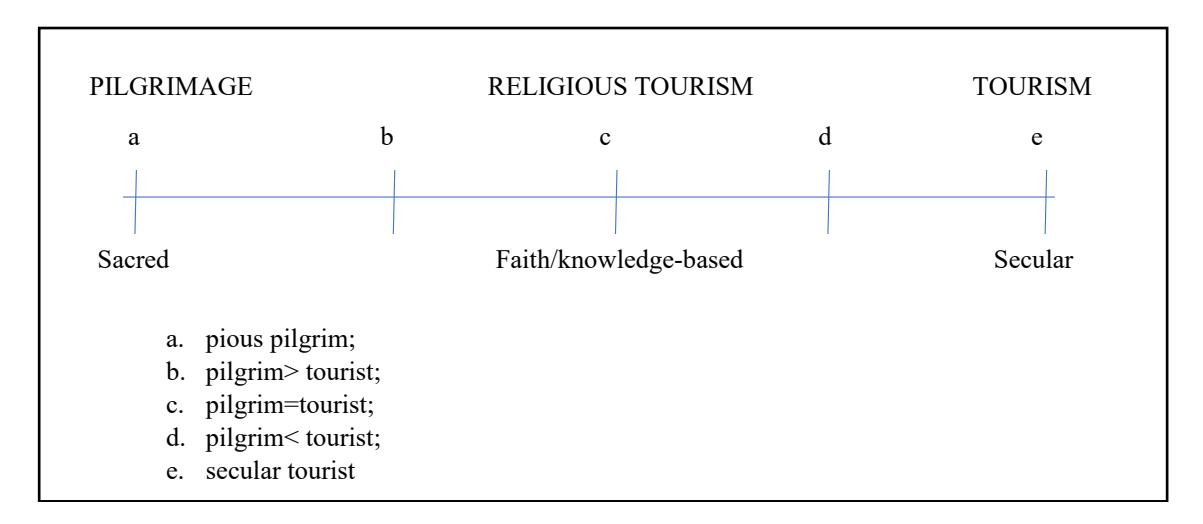
Figure 1. The Pilgrim-Tourist Path Source: Smith (1992a)
Sharma (2000) emphasised consistent methods and continuous increase in the quality of service for the tourism Industry. Micheal (2014) elucidated the interface between tourism and religion in his book. Shinde (2012) discussed the timely preparation of policies to diminish the cultural and environmental threat due to the heavy influx of people at the religious destinations. Kakati (2016) elaborated the possible avenues of religious tourism in India for Shirdi Sai Baba temple at Maharashtra. The work by Katarzyna et al., (2014) discussed the alliance between religious tourism and logistics. Quattrociocchi (2017) focused on the apparent relationship between the tourism supply chain and strategic partnership to diminish the complexity across this chain. Sharma, (2019) explained the prospectus of religious tourism in India, along with opportunities and challenges.
A thesis, namely "Pilgrimage Tourism – A case study of Brajmandal" by Mishra (2000), discusses how people are making frequent trips over the weekends to religious destinations. Manhas and Nair
(2020) discussed the strategic role of religious tourism in reviving the economy post-Covid-19. They used Faulker's (2001) crisis management model to study religious tourism in the post covid era. Hence organised management of the supply chain at these religious destinations became the need of the hour to encash the opportunities and reduce various threats. Sanchez et al., (2018) described a bibliometric overview of religious tourism and pilgrimage in their work. Mittal and Sinha (2021) developed a conceptual framework for a resilient, religious tourism supply chain for mitigating postpandemic risk. The flow across any religious tourism supply chain (Song, 2012) is as shown in Figure 2 below:
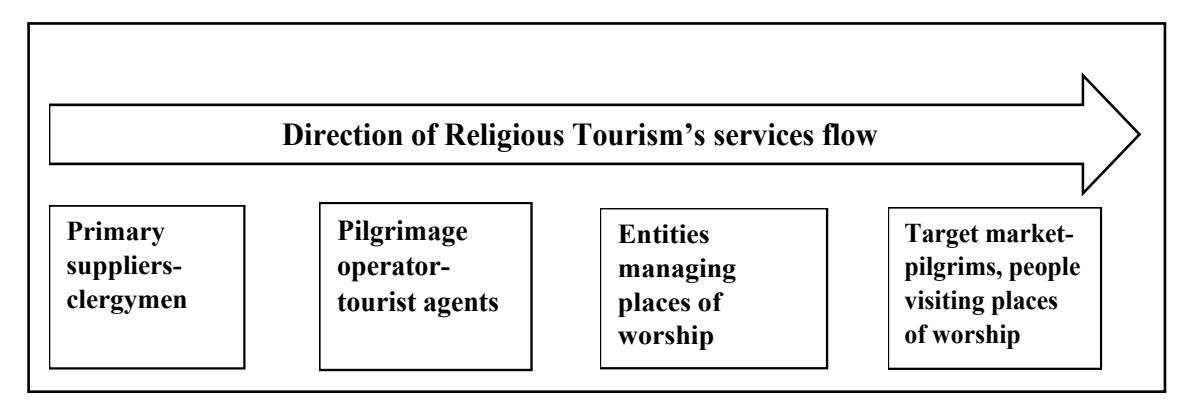
Figure 2. Religious Tourism Supply Chain Flow Source: adapted from Song (2012)
2.2. ISM in services/tourism supply chain management.
Many researchers across various domains have utilised the concept of interpretive structural modelling. ISM transforms ambiguous and inadequately articulated conceptual models into wellspecified and observable models. The method is interpretive because the observer groups identify certain factors or attributes. They further decide how the factors or attributes relate to each other and form a structured model. Hence the overall structure is extracted from the intricated set of factors based on their association. Sahney et al. (2006) explained that ISM is a qualitative tool used to inflict order and direction on the complexity of relationships amongst the attributes of a system. (Hu et al., 2009) explained the utility of MICMAC analysis for systematically resolving complex issues. Although ISM has been used in both manufacturing and service industries, the authors have limited their review only to the service sector, further concentrating it on religious tourism. Sushil (2012) elaborated how ISM should be interpreted to make it clear among the mind of academicians, practitioners etc. Pramod and Banwet (2010) applied ISM for understanding the inhibitors of telecom service supply chain.
Shahbadkar et al. (2012) performed a meta-analysis and described how ISM had been deployed in managing supply chains. (Roy and Misra, 2016) describe the modelling of travel and tourism enablers using ISM. Attri et al. (2013) gave an overview of the ISM approach, its pros and cons. (Tyagi et al.,2013) used ISM for identifying and applying TPM (total productive maintenance). Faisal et al. (2006) used ISM for modelling the enablers which can mitigate risk across supply chains. (Faisal et al., 2007) employed ISM to understand the interrelationships among the enablers of information risks mitigation. Debata et al. (2013) developed a framework using ISM to recognise and categorise medical tourism enablers (MTEs). This study further helped to understand MTEs direct and indirect effects on the growth of medical tourism in India. Sadeh and Garkaz (2018) integrated quality factors of both medical and hospitality services in medical tourism using ISM.
Post studying the literature under mentioned two heads above, the authors observed that religious tourism offers a lucrative business opportunity for a multi-religion country like India. It attracts domestic and international tourists every year, leading to revenue generation and reaping a bundle of non-monetary benefits (Mittal and Sinha, 2021). Many authors attempted to study the opportunities, challenges, prospectus of the religious tourism supply chain described in section 2.1 above. However, the fundamental enablers for this sector's growth and sustainability in the post-Covid era are yet to be identified. It is a people-intensive service sector and requires close monitoring of processes across its supply chain. Hence understanding the interrelationship between religious tourism enablers becomes the need of the hour, especially in the post-Covid-era. As described in segment 2.2 of the literature review, many authors have used ISM across various service supply chains. However, none of the previous works attempted to identify the enablers of the religious tourism supply chain and understand their interaction in the Indian context. The absence of studies on these issues shaped the direction of research for the authors. The same helped them in framing the objectives of this manuscript. Research Objectives are: 1) To identify the post-Covid enablers for the religious tourism supply chain in India; 2) To understand the association among enablers and classify them in order of their dependencies and driving powers; 3) To develop a conceptual model using ISM. The following Figure 3 summarises the systematic literature review:
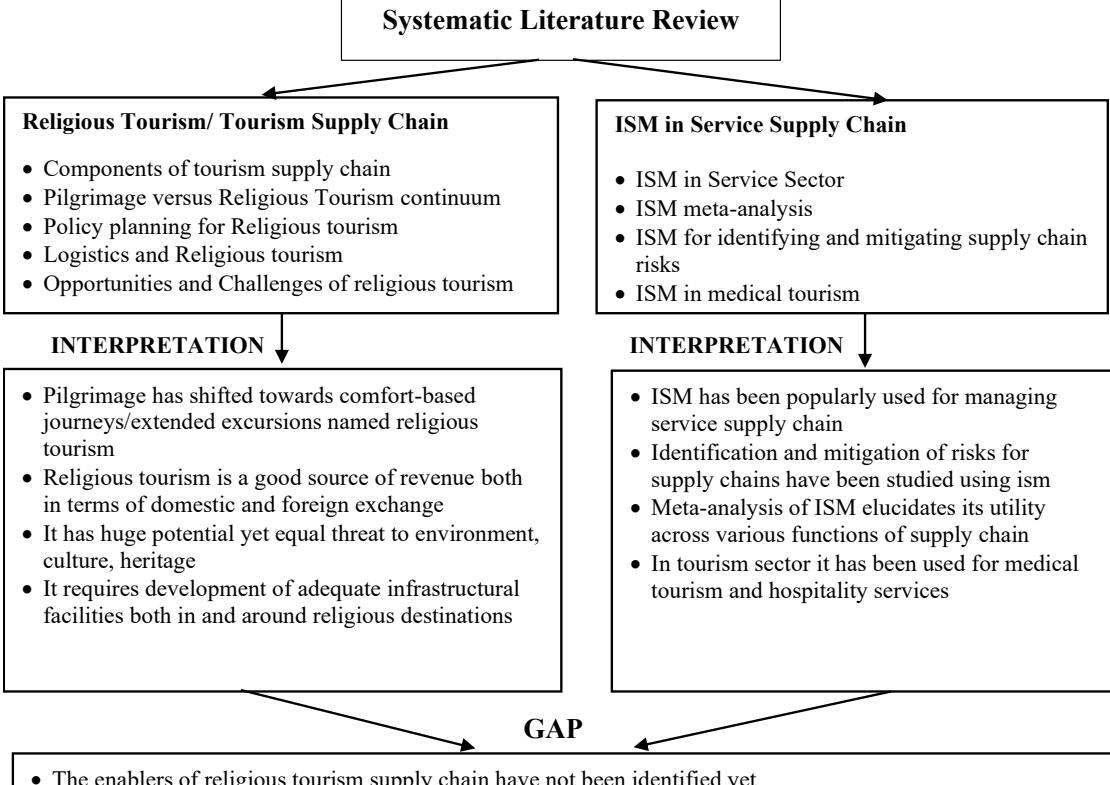
- The enablers of religious tourism supply chain have not been identified yet
- The Religious tourism supply chain needs formal attention to enhance and sustain its performance post covid-19
- The ISM technique can be used to identify and model the Religious tourism supply chain
Figure 3. Systematic Literature Review
2.3. Religious tourism enablers
After reviewing the literature, it was found that religious tourism is not a recent trend in India. Instead, it has changed its shape and face with time (refer to figure 3). The enablers and the association amongst them were found following a series of steps. Firstly, secondary literature from newspapers, magazines, and government guidelines was studied. Secondly, around 15 experts from various facets of the religious tourism industry (travel and tour operators, academicians, priests, etc.) were identified and consulted for recognising the enablers and developing the ISM model. The experts were selected according to three parameters, willingness to participate, experience in the religious tourism domain (minimum ten years) and belongingness to popular religious tourism destinations like Mathura, Varanasi, Shirdi, Haridwar, Tirupati, Vaishno Devi, Puri, Dwarka, etc. The identification of enablers and their contextual relationship was undertaken through the brainstorming process of these experts. Before the brainstorming session, an introductory session was also organised through a zoom meeting to introduce the research agenda and its significance. After a fortnight, the final brainstorming session was held, and enablers of religious tourism in the post-Covid-19 era were identified and compiled. Finally, 11 enablers were shortlisted for the modelling. The responses for these 11 enablers were used to model them in a hierarchical order and represent their contextual relationships. The various enablers identified for the study are mentioned below:
- 1. Efficient and integrated information system
- The use of Efficient and Integrated Information systems is increasing across various domains of religious tourism. People who visit these destinations can have a real-time update about the weather and other live events. The old aged and disabled people can have a real-time experience of visiting the destination with the help of Online live aartis etc.
- 2. Logistics and Connectivity restructuring The restructuring of logistics and last-mile connectivity is working as a catalyst for the religious tourism supply chain. Comfortable and affordable logistics in the form of taxis, air-conditioned train coaches, and highways infrastructure are various factors that facilitate tourists to travel to these destinations frequently.
- 3. Safe Stay, Lodging and boarding A clean and safe stay at an affordable price is another essential attribute to affect the flow of people across the religious tourism supply chain. Customised stay packages attract tourists with complimentary sightseeing to nearby destinations.
- 4. Pilgrims belief and value, a mandatory obligation Trust or association towards a particular religious destination creates faith in the mind of tourists. This faith makes the journey to these destinations mandatory, increasing the influx of people at these destinations, impacting the flow across the supply chain.
- 5. Health care infrastructure facility The Health care infrastructure facilities affect the popularity of any religious destinations, subsequently affecting its supply chain. Sanitation standards, availability of safe drinking water, advanced medical facilities near the destination are various factors impacting the performance of the religious tourism supply chain.
- 6. Food Food is one of the essential enablers for the religious tourism supply chain. People residing in the southernmost province of India prefer to travel to the Northern part if they get south Indian food and vice versa is also true.
- 7. International pilgrims The influx of International pilgrims is affected by many factors. Some of their basic requirements are good healthcare infrastructure, food, weather, language, immigration norms, and safety.
- 8. Government Initiatives (Boost domestic tourism, incredible India, SWADESH, PRASAD) The affordable and popular initiatives by the government of India create safety in tourists' minds and impact the quantum of crowd visiting a particular destination.
- 9. Destination Management (Certification, temperature check, social distancing, hygiene protocol, sanitation measures, medical aid Destination management appears as a recent enabler for the Religious tourism supply chain. As post covid, people will be more conscious towards hygiene standards, so management of
10. Individual self-immunity and comorbidity
This factor affects an individual to execute or suspend his or her journey as per their health conditions. People with health complexities are advised not to travel to odd geographical destinations located at high altitude terrains.
11. Developed trans reformed packages to promote thematic tourism, wellness tourism, community activities In Post Covid era, many people will face multiple health issues like loneliness, anxiety, obesity, relationship problem, etc. So, theme-based tourism (partnership camps), wellness tourism (yoga retreat, naturopathy) and community activities, religious get-togethers, social services camps will provoke the performance of the religious tourism supply chain.
3. Methodology
For the attainment of research objectives, the ISM methodology has been used in this manuscript. ISM portrays the overall structure of the considerate system in the form of a model. The prepared model depicts the structure of a complex subject or problem in a judiciously designed pattern implying graphics and words. Singh and Kant (2008), Khurana et al. (2010), and Debata et al. (2013) have described the various steps to using ISM methodology across different domains of service. The systematic approach for following ISM is mentioned below:
- Identification of factors: The factors/enablers affecting the system under consideration are identified and listed after a brainstorming session with respondents
- Establishing contextual relationship: A contextual relationship is formed among the factors/enablers concerning which pairs would be examined.
- Preparing SSIM (Structural self-interaction matrix): It shows the direction of contextual relationships among the elements. A structural self-interaction matrix is prepared based on a pairwise comparison of the system of interest factors, enablers in this case.
- Developing a reachability matrix: After preparing the SSIM, a reachability matrix is developed and checked for transitivity. The transitivity concept assumes that if an enabler A is related to an enabler B, and an enabler B is related to enabler C, then enabler A is mandatorily related to enabler C.
- Final reachability matrix: The final reachability matrix is partitioned into different levels wherein each level defines the placing of variables (Religious tourism enablers) in a hierarchy. The final reachability matrix is also converted into a canonical matrix that presents mainly zero (0) variables/Religious tourism enablers in the upper half of the matrix and predominantly unitary (1) variables/Religious tourism enablers in the lower half.
- Making a diagraph: A directed graph is drawn based on the relationship in the reachability matrix and the partition level for every factor(enabler). Also, the transitive links are removed.
- The obtained diagraph is converted into ISM by replacing variable nodes with statements.
- The Developed ISM model is then reviewed to check for conceptual inconsistency, and required rectifications are made.
3.1 Structural self-interaction matrix
As per the opinion of experts, a VAXO model (Table 1) is developed, keeping in view the contextual relationship for each enabler. The relationship between two variables/enablers (i and j) and the effective direction of the relationship is determined. The commonly used four symbols indicating the direction of the relationship between the enablers (i and j) are mentioned below.
V= enabler i helps to attain enabler j
A= enabler j will be attained by enabler i
X= enabler i and j will help to attain each other
O = enabler i and j are not related
Enablers of Religious Tourism 11 10 9 8 7 6 5 4 3 2 1 1 Efficient and Integrated Information System O O V A V O O O O V X 2 Logistics and Connectivity Restructuring V O O A V O O O O X 3 Safe Stay -Lodging and Boarding V O O A V O O O X 4 Pilgrims Beliefs and Value- Mandatory Obligation O O O V O O O X 5 Healthcare Infrastructure facilities X A O A V O X 6 Food O O O A A X 7 International pilgrims X O A A X 8 Government Initiatives V O V X 9 Destination Management V O X 10 Individual Self-Immunity and Comorbidities O X 11 Developed Trans(Re)Form Packages X
Table 1. VAXO Model
A brief explanation of using V, A, X, O symbols is as mentioned below:
- An efficient and integrated information system (RTE1-religious tourism enabler 1) will help achieve destination management (RTE9-religious tourism enabler 9); hence the relationship between these two variables is described as V, guiding the direction from RTE1 to RTE9.
- Government initiatives (RTE8) will help make an efficient and integrated information system (RTE1); hence the relationship between these two enablers is described by A, guiding the direction from RTE8 to RTE1.
- International pilgrims (RTE7) will get attracted by developed/transformed travel packages (RTE11), and vice versa is also true; hence the relationship between (RTE7) and (RTE11) is described by X, allowing association and attainment in both directions.
- Since an efficient and integration system (RTE1) does not affect the food (RTE6) pattern/habits of any religious destinations, hence the sign O is used between these two.
3.2 Attaining reachability matrix
The attained SSIM is transformed into a binary matrix called reachability matrix/initial reachability matrix by replacing the V, A, X, O signs with binary variables 1 and 0. The rules to substitute 1 and 0 are as followed:
- If the (i, j) entry in the SSIM matrix shows a V sign, then the (i, j) entry in the reachability matrix is replaced by 1 and the (j, i) entry is replaced by 0.
- If the (i, j) entry in the SSIM denotes A, then the (i, j) entry in the reachability matrix is replaced by 0, but the (j, i) entry becomes 1.
- If the (i, j) entry in the SSIM is X, then both the (i,j) and (j, i) entries are replaced by 1.
- If the (i, j) entry in the SSIM shows O, then both (i, j) and (j, i) are replaced by 0 in the reachability matrix.
| Enablers of Religious Tourism | 1 | 2 | 3 | 4 | 5 | 6 | 7 | 8 | 9 | 10 | 11 | |
|---|---|---|---|---|---|---|---|---|---|---|---|---|
| 1 | Efficient and Integrated Information System | 1 | 1 | 0 | 0 | 0 | 0 | 1 | 0 | 1 | 0 | 0 |
| 2 | Logistics and Connectivity Restructuring | 0 | 1 | 0 | 0 | 0 | 0 | 1 | 0 | 0 | 0 | 1 |
| 3 | Safe Stay -Lodging and Boarding | 0 | 0 | 1 | 0 | 0 | 0 | 1 | 0 | 0 | 0 | 1 |
| 4 | Pilgrims Beliefs and Value | 0 | 0 | 0 | 1 | 0 | 0 | 0 | 1 | 0 | 0 | 0 |
| 5 | Healthcare Infrastructure facilities | 0 | 0 | 0 | 0 | 1 | 0 | 1 | 0 | 0 | 1 | 1 |
| 6 | Food | 0 | 0 | 0 | 0 | 0 | 1 | 0 | 0 | 0 | 0 | 0 |
| 7 | International pilgrims | 0 | 0 | 0 | 0 | 0 | 1 | 1 | 0 | 0 | 0 | 1 |
| 8 | Government Initiatives | 1 | 1 | 1 | 0 | 1 | 1 | 1 | 1 | 1 | 0 | 1 |
| 9 | Destination Management | 0 | 0 | 0 | 0 | 0 | 0 | 1 | 0 | 1 | 0 | 1 |
| 10 | Individual Self-Immunity and Comorbidities | 0 | 0 | 0 | 0 | 0 | 0 | 0 | 0 | 0 | 1 | 0 |
| 11 | Developed Trans (Re)Form Packages | 0 | 0 | 0 | 0 | 1 | 0 | 1 | 0 | 0 | 0 | 1 |
Table 2. Initial Reachability Matrix
Using these rules and integrating the transitiveness, the final reachability matrix is achieved, as shown in Table III below:
Enablers of Religious Tourism 1 2 3 4 5 6 7 8 9 10 11 Driver Power 1 Efficient and Integrated Information System 1 1 0 0 0 1* 1 0 1 0 1* 6 2 Logistics and Connectivity Restructuring 0 1 0 0 1* 1* 1 0 0 1* 1 6 3 Safe Stay -Lodging and Boarding 0 0 1 0 1* 1* 1 0 0 1* 1 6 4 Pilgrims Beliefs and Value- Mandatory Obligation 1* 1* 1* 1 1* 1* 1* 1 1* 1* 1* 11 5 Healthcare Infrastructure facilities 0 0 0 0 1 1* 1 0 0 1 1 5 6 Food 0 0 0 0 0 1 0 0 0 0 0 1 7 International pilgrims 0 0 0 0 1* 1 1 0 0 0 1 4 8 Government Initiative 1 1 1 0 1 1 1 1 1 1* 1 10 9 Destination Management 0 0 0 0 1* 1* 1 0 1 0 1 5 10 Individual Self-Immunity and Comorbidities 0 0 0 0 0 0 0 0 0 1 0 1 11 Developed Trans (Re)Form Packages 0 0 0 0 1 1* 1 0 0 1* 1 5 Dependents 3 4 3 1 8 10 9 2 4 7 9
Table 3. Final Reachability Matrix
Table 3 shows the final reachability matrix that also displays the driving power and dependence of each enabler. The power of driving for any enabler is the total number of enablers (including itself), which it may influence. Similarly, dependence is the total number of enablers (including itself) impacting any enabler. The driving and dependence powers are used to perform MICMAC analysis, where the enablers will be classified into four groups of autonomous, dependent, linkage and independent (driver) enablers.
3.3 Level partitioning
After attaining the final reachability matrix (Table 3), a cycle/string of partitions is made. It helps to decide the hierarchy of variables of interest (enablers). Reachability sets and antecedent sets are found for every enabler from the final reachability matrix (Warfield, 1974) and Table 5 is built as follows. The reachability set contains the religious tourism enabler itself and the other enablers that it may affect. The antecedent set carries the religious tourism enabler itself and the set of enablers that may affect it. Hence the reachability set for the first religious tourism enabler (efficient and integrated information system) contains the set of religious tourism enablers comprising 1 in the first row (1,2,6,7,9,11). Similarly, the antecedent set of the first religious tourism enabler (efficient and integrated information system) is the set of religious tourism enablers in different rows containing 1 in the column (1,4,8) as shown in Table 5 for all the Enablers of Religious Tourism (RTEs).
The next step requires finding out the intersection of these sets for all the enablers, as listed in Table 5. Thereafter, the intersection of these sets is derived for all the RTEs. The RTEs for which the reachability and the intersection sets are the same occupy the top level in the ISM hierarchy. Hence, in Table 5, it was found that RTE6 and RTE10 are at Level I after the first iteration. Once the topmost enabler is identified, it is removed from all elements and subsequent iterations are performed to achieve other hierarchy levels. Henceforth the enablers (RTE6 and RTE10) are removed from the subsequent iterations and Table 6 is reached. The second iteration in Table 6 help us identify RTE5, RTE7 and RTE11 at Level II. The third iteration in Table 7 help us identify RTE2, RTE3 and RTE9 ( common values in Reachability set and Interaction set) at level IV. Subsequent iterations as displayed in Table 8 finished the partitioning process and the final result is as displayed in Table 4 (Khurana et al., 2010, Mohare, R., 2020). These levels obtained in Table 4 help build the diagraph and final ISM model.
| RTEs | Reachability set | Antecedent set | Interaction set | Level |
|---|---|---|---|---|
| 1 | 1 | 1,4,8 | 1 | IV |
| 2 | 2 | 1,2,4,8 | 2 | III |
| 3 | 3 | 3,4,8 | 3 | III |
| 4 | 4 | 4 | 4 | VI |
| 5 | 5,7,11 | 2,3,4,5,7,8,9,11 | 5,7,11 | II |
| 6 | 6 | 1,2,3,4,5,6,7,8,9,11 | 6 | I |
| 7 | 5,7,11 | 1,2,3,4,5,7,8,9,11 | 5,7,11 | II |
| 8 | 8 | 4,8 | 8 | V |
| 9 | 9 | 1,4,8,9 | 9 | III |
| 10 | 10 | 2,3,4,5,8,10,11 | 10 | I |
| 11 | 5,7,11 | 1,2,3,4,5,7,8,9,11 | 5,7,11 | II |
Table 4. Levels of enablers for religious tourism supply chain
3.4 Building the ISM model
Post obtaining the final reachability matrix, the structural model is generated using nodes and lines of edges. If an association/ relationship exists between the enablers, an arrow is drawn from enabler i to enabler j. The graphical structure prepared this way is called a diagraph or directed graph. After removing the transitivities, the diagraph is converted into the final ISM model shown in Figure 4. It is found from the framed ISM model that belief, values and mandatory obligation (RTE4) enabler is at the lowest level of the ISM model. Hence this enabler influences the next level enabler, RTE8(government initiatives), above it, directly, and other enablers at a higher level in the hierarchy indirectly. It is found that enablers up in the hierarchy are not influencing the enablers below their level.
The subsequent enabler government initiatives (RTE8) directly influence the enabler RTE1(efficient and integrated information system) and indirectly other enablers except (RTE4) from which it gets influenced. RTE3 (safe stay, lodging and boarding) is the next level enabler influenced by base-level enablers RTE4, RTE8, and RTE1 and influences the rest enablers model. It is also noticed that logistic connectivity and restructuring (RTE2) and destination management (RTE9) will help create safe stay and lodging and boarding facilities (RTE3) at any religious tourism destination. Safe stay, lodging boarding (RTE3), and logistic connectivity (RTE2) and destination management (RTE9) will attract international tourists (RTE7), who also get attracted by health care infrastructure (RTE5) and developed reformed packages (RTE11). International tourists (RTE7) are the enabler that influences food habits (RTE6) and self-immunity and comorbidities (RTE10).
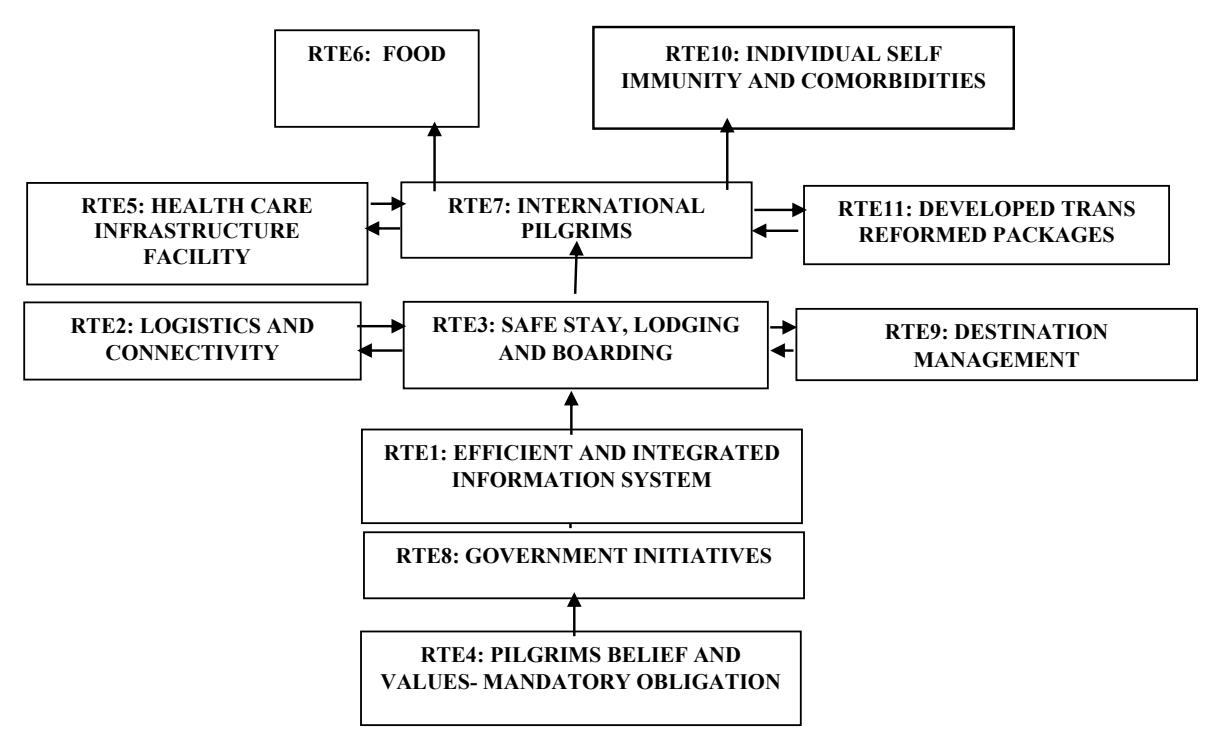
Figure 4. Final ISM Model
3.5 MICMAC analysis
Matrice d'Impacts croises-multiplication appliqúe an classment or cross-impact matrix multiplication applied to classification is the abbreviation of MICMAC analysis. It is performed to classify the key factors that drive a system into various categories depending upon their driver power and dependence power. These factors have been located into four categories, i.e., autonomous, linkage, dependent and independent. Figure 5 classify the enablers(factors) of the religious tourism supply chain in four different clusters mentioned above. The southwest quadrant contains autonomous factors/enablers that have weak driving power and weak dependence. These enablers are relatively disconnected or not associated with the system. In the context of religious tourism enablers, RTE number (1,2,3,9) falls in the autonomous category. The next set of factors in the southeast quadrant named dependent enablers possess strong dependence, but weak driving power and RTE (5,6,7,10,11) fall under this category. The cluster of enablers housed in the northeast quadrant is relatively unstable and known as linkage enablers/factors with solid driving power and strong dependence. However, there are no linkage enablers/factors in this case. The north-west quadrant named independent houses enablers with strong driver power but weak dependence, RTE 4 and RTE 8 fall under this category.
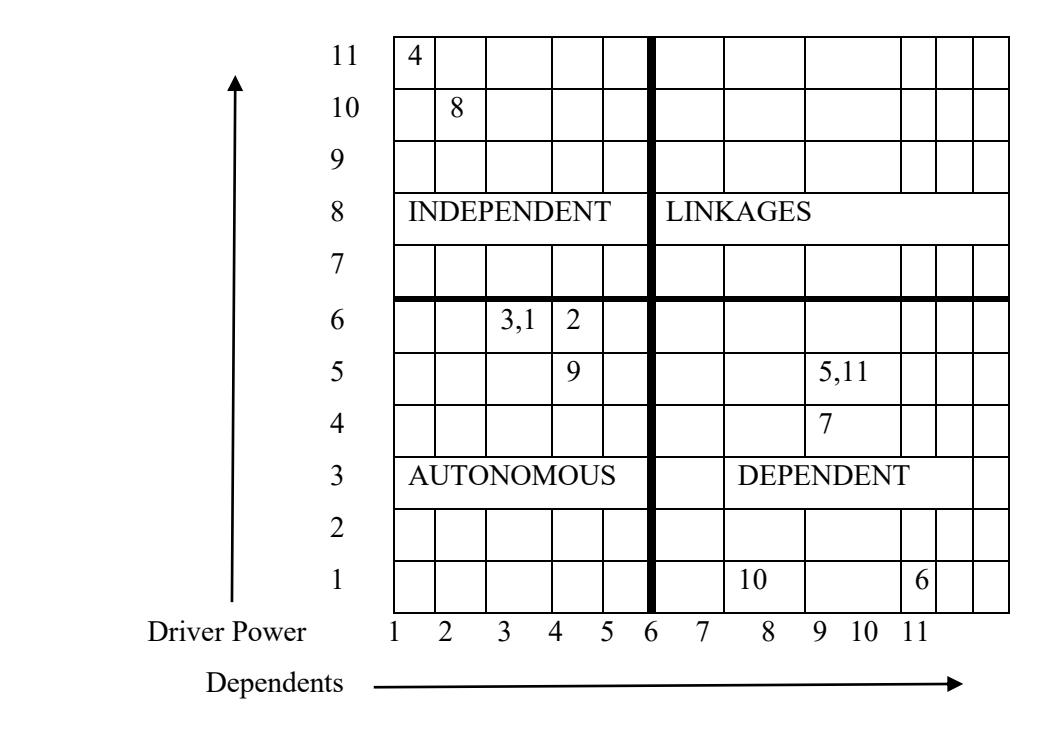
Figure 5. MICMAC Analysis (Dependence Diagram for Religious Tourism Enablers
4. Discussion and Conclusion
The ISM model helps to create a hierarchy among the eleven enablers of the religious tourism supply chain. It is found from the model that pilgrim's beliefs, values, and mandatory obligations influence government initiatives. The government initiatives directly influence efficient and integrated information systems and indirectly other enablers except for pilgrim's beliefs, values and mandatory obligations from which it is getting influenced. Also, the belief, values, and mandatory obligations to any tourism destination make it an attractive spot and direct governments to take initiatives for destination management. Hence, popular destinations like the Vaishno Devi shrine, Shirdi Sai baba temple, Tirupati Balaji, Varanasi, Mathura, and Vrindavan have drawn more attention from the state and central governments.
Safe stay, lodging, and boarding are influenced by pilgrim's beliefs, values and mandatory obligations, government initiatives, and efficient and integrated information systems. It is also noticed that logistic connectivity and restructuring and destination management will contribute to safe stay, lodging and boarding facilities, attracting international tourists. They will also get fascinated by good health care infrastructure and developed reformed packages. Food practices and the self-immunity and comorbidities of any tourist are not influencing his plan to visit any religious destination. Hence these enablers are not influencing any other enabler and lie at level 1 of the ISM model. However, they may get influenced by other enablers below them.
This research manuscript aims to identify and develop a hierarchical model for the Religious tourism supply chain enablers. These enablers play a catalytic role in reviving the post-pandemic operations of the religious tourism sector, which has a significant role in the Indian economy. Since the flow of goods and services is more delicate across the service supply chain, it is required to identify respective
supply chain enablers and awareness of their driving power and dependence. It will help the stakeholders identify and focus on the enablers and prioritise them as a strategic issue. The hierarchybased ISM model further describes which enablers require immediate attention and others that require little attention but are unavoidable. This model will help in making strategic decisions and future policy formulations for the religious tourism sector.
The limitations of this study: the manuscript provides deep insights for both industry and academia to understand various religious tourism supply chain enablers. However, the research also carries few limitations. The scope of the study required limiting the authors work to religious tourism destinations in India, focusing only on the Hindu pilgrimage centres. Although, India has many famous Islamic and Christian tourism destinations. However, they were kept out of scope due to a paucity of time and other resources. The developed ISM model is not statistically validated. The work can be extended by using SEM (Structural equation modelling) to substantiate its validity further.
References
- Attri, R., Dev, N., & Sharma, V.(2013). Interpretive Structural Modelling (ISM) approach: An Overview. Research Journal of Management Sciences, 2 (2), 3-8.
- Brandon-Jones, E., Squire, B., Autry, C.W. & Petersen, K.J. (2014).A contingent resource-based perspective of supply chain resilience and robustness. Journal of Supply Chain Management, 50(55).
- Chaturvedi, A., (2020), March 21).COVID-19 puts curbs on religious travel. E.T. Bureau, 21 March. Retrieved from https://economictimes.indiatimes.com/news/politics-and-nation/covid-19 puts-curbs-on-religious-travel/articleshow/74742051.cms on 24 August 2020.
- Debata, B. R., Sree, K., Patnaik, B., & Mahapatra, S. S. (2013). Evaluating medical tourism enablers with interpretive structural modelling. Benchmarking: An International Journal, 20(6). 716 – 743. DOI: 10.1108/BIJ-10-2011-0079.
- Dubey, R., Gunasekaran, A., Childe, S.J., Fosso Wamba, S., Roubaud, D. & Foropon, C. (2019). Empirical investigation of data analytics capability and organisational flexibility as complements to supply chain resilience. International Journal of Production Research, 59(1). DOI: 10.1080/00207543.2019.1582820.
- Dufour, É., Laporte, G., Paquette, J. & Rancourt, M.È. (2018). Logistics service network design for humanitarian response in East Africa. Omega, 74, 1.
- Durán-Sánchez, A., Álvarez-García, J., Del Río-Rama, M.D.l.C., Oliveira, C., (2018). Religious Tourism and Pilgrimage: Bibliometric Overview. Religions, 9(9). 1-15. DOI: 10.3390/rel9090249.
- Ehsan Sadeh & Mansour Garkaz (2018). Interpretive structural modeling of quality factors in both medical and hospitality services in the medical tourism industry. Journal of Travel & Tourism Marketing. DOI: 10.1080/10548408.2018.1527273.
- Faisal, M.N., Banwet, D.K., Shankar, R., (2006).Supply chain risk mitigation: modeling the enablers. Business Process Management Journal, 12(4), 535 – 552. DOI: 10.1108/14637150610678113.
- Fink, A., (2005).Conducting Research Literature Reviews: From the Internet to Paper. Sage Publication, New Delhi.
- Future Markets Insights, (2020). Religious Tourism In Asia Pacific Sector Overview And Analysis. Ongoing up to October 2020. Retrieved from https://www.futuremarketinsights.com/ reports/religious-tourism-in-asia-pacific-sector-overview-and-analysis on 24 August 2020.
- Griffin, K. & Raj, R. (2017). The Importance of Religious Tourism and Pilgrimage: reflecting on definitions, motives and data. International Journal of Religious Tourism and Pilgrimage, 5 ( 3, Article 2). Retrieved from https://zeenews.india.com/culture/puri-rath-yatra-2020-reason-behindunfinished-hands-of-lord-jagannaths-idols-2294875.html on 10 August 2020.
- Hu, H.Y., Chiu, S.I. & Yen, T.M. (2009). Modified IPA for order winner criteria improvement: a MICMAC approach. Journal of Applied Sciences, 9 (21), 3792-3803.
- Indian Tourism and Hospitality Industry Analysis, IBEF Report (July 2020). Retrieved from https://www.ibef.org/industry/indian-tourism-and-hospitality-industry-analysis-presentation
- Kakati, S. (2016). Study on Religious Tourism-Potential and Possibilities with reference to Shirdi A place of Religious Tourism. International Interdisciplinary Research Journal, 6(3), 115.
- Katarzyna, G., Beata, Ś., & Sebastian, K., (2014). Logistics view on religious tourism, Conference paper, DOI:10.13140/2.1.1338.1128, Retrieved from https://www.researchgate.net/profile/ Sebastian_Kot/publication/266825665_Logistics_view_on_religious_tourism/links/543cdd 240cf24ef33b7646b1/Logistics-view-on-religious-tourism.pdf.
- Khurana, M.K., Mishra, P.K., Jain, R. & Singh, A.R. (2010). Modeling of information sharing enablers for building trust in Indian manufacturing industry: an integrated ISM and fuzzy MICMAC approach.International Journal of Engineering Science and Technology, 2(6), 1651-1669.
- Kovács, G. & Spens, K.M. (2007). Humanitarian logistics in disaster relief operations. International Journal of Physical Distribution & Logistics Management, 37(2), 99.
- Kunz, N., Van Wassenhove, L.N., Besiou, M., Hambye, C. & Kovács, G. (2017). Relevance of humanitarian logistics research: best practices and way forward. International Journal of Operations & Production Management, 37(11), 1585.
- Ladki, Said M. & Mazeh, Rayan A. (2017). Comparative Pricing Analysis of Mecca's Religious Tourism.International Journal of Religious Tourism and Pilgrimage, 5(1). DOI: 10.21427/D76Q7Z.
- Mandal, A. & Deshmukh, S.G. (1994). Vendor Selection Using Interpretive Structural Modelling (ISM). International Journal of Operations & Production Management, 14(6), 52-59. DOI: 10.1108/01443579410062086.
- Manhas, Parikshat Singh & Balakrishnan Nair, Bipithlal (2020). Strategic Role of Religious Tourism in Recuperating the Indian Tourism Sector Post-Covid-19.International Journal of Religious Tourism and Pilgrimage. 8(7), 6. Retrieved from https://arrow.tudublin.ie/ijrtp/8/iss7/6/ on 12 December 2020.
- Meredith, J. (1993). Theory Building through Conceptual Methods. International Journal of Operations & Production Management, 13(5), 3.
- Ministry of Health and Family Welfare, Government of India, (2020, June 4), SOP on preventive measures to contain spread of COVID-19 in religious places/places of worship, available at https://www.mohfw.gov.in/pdf/2SoPstobefollowedinReligiousPlaces.pdf (last accessed on August 24 2020).
- Ministry of Tourism, Government of India, Prasad cities, available at http://tourism.gov.in/search/ node/prasad (retrieved on 17 July 2020)
- Mishra R., (2000). Pilgrimage Tourism. William. H.S. Jr. and Luigi Tomasi (Ed.).Religion in the Age of Transformation from Medieval Pilgrimage to Religious Tourism. Published by ABC-CLIO.
- Mittal, R. & Sinha, P. (2021). Framework for a resilient religious tourism supply chain for mitigating post-pandemic risk. International Hospitality Review, ahead-of-print. DOI: 10.1108/IHR-09- 2020-0053.
- Mohare Rahul (June,2020). Interpretive Structural Modelling. Retrieved from https://www.youtube.com/watch? v=EMJq-UJNXwg on 10 January 2022.
- Nayak, M.,(2020, August 11). Unlock 3: Religious Places in J-K to Open From August 16, Touching Idols Not Allowed, Going in line with the Unlock 3 guidelines of the Central government, the Jammu and Kashmir administration on Tuesday allowed religious places/ places of worship within the Union Territory. Retrieved from https://www.india.com/news/india/unlock-3-religious-places-in-j-k-to-open-fromaug-16-touching-idols-not-allowed-check-sops-4108720/ on 24 August 2020.
- Negi, S. & Negi, G. (2020). Framework to manage humanitarian logistics in disaster relief supply chain management in India. International Journal of Emergency Services, ahead-of-print DOI: 10.1108/IJES-02-2020-0005.
- Nishat Faisal, M., Banwet, D.K. & Shankar, R. (2007). Information risks management in supply chains: an assessment and mitigation framework. Journal of Enterprise Information Management, 20 (6), 677-699. DOI: 10.1108/17410390710830727.
- Pande, R.K. (2010). Flash flood disasters in Uttarakhand. Disaster Prevention and Management. 19 (5), 56.
- Parkash, Surya. (2011). Historical Records of Socio-economically Significant Land-slides in India. Journal of South Asia Disaster Studies, 4(2), 177.
- Perry, M. (2007). Natural disaster management planning: a study of logistics managers responding to the tsunami. International Journal of Physical Distribution & Logistics Management, 37(5), 409.
- Polyviou, M., Croxton, K.L. & Knemeyer, A.M. (2020). Resilience of medium-sized firms to supply chain disruptions: the role of internal social capital. International Journal of Operations & Production Management, 40(1), 68.
- Pradeep Kumar, A.P., Hsu, E., Shah, S., Burkle, F. & Joseph, J. (2011). Epidemiology of stampedes: the case of Sabarimala pilgrimage in Kerala, India. International conference on comprehensive disaster management 2011: Disaster Risk and Vulnerability Conference at Mahatma Gandhi University, Kottayam, Kerala, India.
- Pramod, V.R., Banwet, D.K.(2011). Interpretive Structural Modelling for Understanding the Inhibitors of Telecom Service Supply Chain, proceedings of 2011 International Conference on Industrial Engineering and Operations Management, Dhaka, Bangladesh January 9-10, 2010.
- PTI, (2020, June 6). Covid-19: Will people visit religious places opening from Monday? Here's what survey reveals. Retrieved from https://www.financialexpress.com/lifestyle/covid-19-willpeople-visit-religious-places-opening-from-monday-heres-what-survey-reveals/1983542/ on 24 August 2020.
- PTI, (2020, May 18).Covid-19: Shrine board formulating SOPs for Vaishno Devi yatra. Retrieved from https://economictimes.indiatimes.com/news/politics-and-nation/shrine-boardformulating-sops-for-vaishno-devi-yatra/articleshow/75803238.cms?from=mdr on 24 August 2020.
- Quattrociocchi, B., F. Mercuri, M. Perano & M. Calabrese (2017).Tourism Supply Chain Management & Strategic Partnerships for managing the complexity in tourism industry. Enlightening Tourism. A Pathmaking Journal, 7(1), 62.
- Raj, Razaq & Griffin, Kevin A. (2020). Reflecting on the Impact of COVID-19 on Religious Tourism and Pilgrimage. International Journal of Religious Tourism and Pilgrimage, 8(7), 2. DOI: 10.21427/8f91-6z16.
- Rashid, O., (2020, June 21). COVID-19 Kanwar yatra deferred. Retrieved from https://www.thehindu.com/news/national/other-states/covid-19-kanwar-yatradeferred/article31882342.ece on 24 August 2020.
- Roy, S., & Misra, S. (2016). Interpretative Structural Modeling (ISM) of Travel and Tourism Enablers. Specialty Journal of Psychology and Management, 2(2), 32-45. available at http://sciarena.com/storage/article/file/AC633Article.pdf.
- Sahney, S., Banwet, D.K. & Karunes, S. (2006). An integrated framework for quality in education: application of quality function deployment, interpretive structural modelling and path analysis. Total Quality Management, 17(2), 265-285.
- Shahabadkar, Pramod , Hebbal, S.S. & Prashant, S.. (2012). Deployment of Interpretive Structural Modeling Methodology in Supply Chain Management –An Overview. International Journal of Industrial Engineering and Production Research, 23, 195-205.
- Sharma, J.K., (2000). Tourism Planning and Development. Kanishka Publisher, New Delhi, 17.
- Sharma, T., (2019). Prospects of Religious Tourism in India. Shodh Samagam, ISSN : 2581-6918 (Online), 2582-1792 (Print), p. 358. Retrieved from http://shodhsamagam.com/admin/ uploads/Prospects%20of%20Religious%20Tourism%20in%20India.pdf on 5 August 2020.
- Sheffi, Y. (2001). Supply Chain Management under the Threat of International Terrorism. International Journal of Logistics Management. 12(2), 1.
- Shinde, K. (2012). Policy, planning, and management for religious tourism in Indian pilgrimage sites. Journal of Policy Research in Tourism, Leisure and Events, 4(3), 277.
- Shinde, K.(2018) .Governance and Management of Religious Tourism in India. International Journal of Religious Tourism and Pilgrimage. 6(1). 58.
- Singh, M.D. & Kant, R. (2008). Knowledge management barriers: an interpretive structural modeling approach. International Journal of Management Science and Engineering Management, 3(2), 141-150.
- Smith, Valery. L. (1992a). Introduction: The Quest in Guest. Annals of Tourism Research, 19, 1–17. DOI: 10.1016/0160-7383(92)90103-V
- Song H., (2012). Tourism supply chain management. Routlege, New York.
- Staff, O.T. (2020, April 24). The Sikkim government has closed the Nathu La Pass due to the coronavirus pandemic. available at https://www.outlookindia.com/outlooktraveller/travelnews/story/ 70217/kailash-mansarovar-yatra-cancelled-and-nathu-la-pass-closed-due-to-coronavirus (last accessed on August 24 2020).
- Stausberg, M, (2010), Religion and Tourism-Crossroads, destination and encounters, Publisher-Taylor & Francis Ltd.
- Stevenson, M., & Busby, J. (2015). An exploratory analysis of counterfeiting strategies Towards counterfeit-resilient supply chains. International Journal of Operations & Production Management, 35, 110.
- Suffian, M., (2020, June 23). Rath Yatra 2020 News: Pulling of Lord Balabhadra's chariot Taladhwaja begins, Puri. Retrieved from https://www.indiatoday.in/india/story/jagannath-puri-rath-yatra-2020 live-updates-1691757-2020-06-23 on 24 August 2020.
- Sushil, (2012). Interpreting the Interpretive Structural Model. Global Journal of Flexible Systems Management. 13, 87–106. DOI: 10.1007/s40171-012-0008-3.
- The New Indian Express, (2020). Lockdown 5.0: Uttarakhand to ease restrictions on religious tourism soon, Portals of the Char Dham shrines were opened but pilgrims are not allowed to travel to the shrines yet. 31 May. Retrieved from https://www.newindianexpress.com/nation /2020/may/31/lockdown-50-uttarakhand-to-ease-restrictions-on-religious-tourism-soon-2150453.html on August 24 2020.
- Thürer, M., Tomašević, I., Stevenson, M., Blome, C., Melnyk, S., Chan, H.K. & Huang, G.Q. (2019). A systematic review of China's belt and road initiative: implications for global supply chain management. International Journal of Production Research, 2436.
- Travel and Tourism Survive, revive and thrive in times of COVID-19 , FICCI report 2020. Retrieved from http://ficci.in/spdocument/23252/Travel-june-FGT-n.pdf. on 15 July 2020
- Tyagi, Anupriya S.; Baag, Disha; Jailkhani, Himanshu; Poulose, Jacob; Patel, Jay (2013). Identification of the Success Factors for the Implementation of Total Productive Maintenance in an Organisation Using Interpretive Structural Modeling(ISM). Journal of Supply Chain Management Systems, Publishing India, 2 (4), 20-36.
- Warfield, J.W. (1974).Developing interconnected matrices in structural modelling. IEEE Transcript on Systems Men and Cybernetics, 4 (1), 51-81.
- Whybark, D. C., Melnyk, S. A., Day, J. M., & Davis, E. (2010).Disaster Relief Supply Chain Management: New Realities, Management, Challenges, Emerging Opportunities. Decision Line, 41(3), 4.
- World Economic Forum (2013). Building resilience in supply chains. Retrieved from www3.weforum.org/docs/WEF_RRN_MO_BuildingResilienceSupplyChains_Report_2013. pdf on 12 August 2020.
- Zhang, X., Song, H. & Huang, G. (2009). Tourism Supply Chain Management: A New Research Agenda, Tourism Management. 30, 345-358.
Annexures:
Table 5. Partition of reachability matrix: First iteration
| Iteration 1 | Reachability set | Antecedent set | Interaction set | Level |
|---|---|---|---|---|
| 1 | 1,2,6,7,9,11 | 1,4,8 | 1 | |
| 2 | 2,5,6,7,10,11 | 1,2,4,8 | 2 | |
| 3 | 3,5,6,7,10,11 | 3,4,8 | 3 | |
| 4 | 1,2,3,4,5,6,7,8,9,10,11 | 4 | 4 | |
| 5 | 5,6,7,10,11 | 2,3,4,5,7,8,9,11 | 5,7,11 | |
| 6 | 6 | 1,2,3,4,5,6,7,8,9,11 | 6 | I |
| 7 | 5,6,7,11 | 1,2,3,4,5,7,8,9,11 | 5,7,11 | |
| 8 | 1,2,3,5,6,7,8,9,10,11 | 4,8 | 8 | |
| 9 | 5,6,7,9,11 | 1,4,8,9 | 9 | |
| 10 | 10 | 2,3,4,5,8,10,11 | 10 | I |
| 11 | 5,6,7,10,11 | 1,2,3,4,5,7,8,9,11 | 5,7,11 |
Table 6. Partition of reachability matrix: Second iteration
| Iteration 2 | Reachability set | Antecedent set | Interaction set | Level |
|---|---|---|---|---|
| 1 | 1,2,7,9,11 | 1,4,8 | 1 | |
| 2 | 2,5,7,11 | 1,2,4,8 | 2 | |
| 3 | 3,5,7,11 | 3,4,8 | 3 | |
| 4 | 1,2,3,4,5,7,8,9,11 | 4 | 4 | |
| 5 | 5,7,11 | 2,3,4,5,7,8,9,11 | 5,7,11 | II |
| 7 | 5,7,11 | 1,2,3,4,5,7,8,9,11 | 5,7,11 | II |
| 8 | 1,2,3,5,7,8,9,11 | 4,8 | 8 | |
| 9 | 5,7,9,11 | 1,4,8,9 | 9 | |
| 11 | 5,7,11 | 1,2,3,4,5,7,8,9,11 | 5,7,11 | II |
Table 7. Partition of reachability matrix: Third iteration
| Iteration 3 | Reachability set | Antecedent set | Interaction set | Level |
|---|---|---|---|---|
| 1 | 1,2,9 | 1,4,8 | 1 | |
| 2 | 2 | 1,2,4,8 | 2 | III |
| 3 | 3 | 3,4,8 | 3 | III |
| 4 | 1,2,3,4,8,9 | 4 | 4 | |
| 8 | 1,2,3,8,9 | 4,8 | 8 | |
| 9 | 9 | 1,4,8,9 | 9 | III |
Table 8. Partition of reachability matrix: Fourth, Fifth and Sixth iteration
| Iteration 4 | Reachability set | Antecedent set | Interaction set | Level |
|---|---|---|---|---|
| 1 | 1 | 1,4,8 | 1 | IV |
| 4 | 1,4,8 | 4 | 4 | |
| 8 | 1,8 | 4,8 | 8 | |
| Iteration 5 | Reachability set | Antecedent set | Interaction set | Level |
| 4 | 4,8 | 4 | 4 | |
| 8 | 8 | 4,8 | 8 | V |
| Iteration 6 | Reachability set | Antecedent set | Interaction set | Level |
| 4 | 4 | 4 | 4 | VI |