

1. Introduction
Ecotourism is considered as a sustainable tourism model that aims at providing a solution to two major issues, namely, poverty and biodiversity degradation (Cabral & Dhar, 2020). It offers unique opportunities for integrating rural development, tourism, resource management, and protected area management in many sites around the world. The involvement of the local community and benefits to the local community is an integral part of ecotourism (Edward & Kumar, 2012). It is a general norm and a myth that these kinds of tourism are actually benefiting the local community, but only persistent researches can bring out the truth in it.
The ecotourism activities are mostly carried out in the buffer zones of Protected Areas (PA) and it is observed that a large majority of the residents in these parts belong to the tribal communities. The tribal communities are grouped by the Government of India, under the category, Scheduled Castes and Tribes of India, indicating the Social and Economic backwardness. The picture is no different globally, be it Alaska, Louisiana, the Pacific Islands, or anywhere for that matter, the tribal communities tend to be the poorest and the most helpless sector of the society who are forced to succumb to whatever is given to them. The local residents of any other form of tourism are predominantly non-tribal who consider themselves as the stakeholder of the tourism project, whereas in the case of ecotourism, the local communities are the indigenous folks, and they perceive themselves as the "relatives" of the land (Whiteman, 2009).
Hence it is extremely important to understand their support for the ecotourism activities wherein they are the major stakeholders who have been forced to shift from their traditional occupations to this newfound income generation mode. For them, their traditional occupations have never been a source of income generation, whereas it was more of a method for sustenance. Their traditional occupations were highly forest-dependent and involved various activities like, farming, honey collection, and fruit gathering. The local communities were forcefully weaned off their traditional occupations after the strict enforcement of the Forest Acts, like the Forest Conservation Act of 1980. The landmark judgment of the Supreme Court of India in 1996, verdict of the Godhavarman Case, was yet another milestone forcing the tribes out of the forests, where they had lived in perfect harmony with the environment. Following which, the unemployment and poverty became prevalent issues. This led to a lot of protests and stir against the government, which led to the introduction of the Forest Tribes and other Dweller's Act, 2006, which focused on the development of the residents of these regions. Hereafter, it was decided that the local community ought to be an integral part of the Eco-development activities, like ecotourism. Hence it is imperative to understand the residents' support for ecotourism and also their perceptions of costs and benefits due to ecotourism.
The theoretical basis of this study is one of the most widely used theories to study the residents' support for tourism development, namely, the Social Exchange Theory (SET) (Gursoy, Chi, & Dyer, 2010; Lee, Kang, Long, & Reisinger, 2010). The SET is elaborated as a sociological theory concerned with understanding the exchange of resources between individuals and groups in an interaction situation (Ap, 1992). The concept of power is a central component of SET (Emerson, 1962). Political empowerment is relative to power and the role of power within tourism development is evidenced in sustainable tourism literature (Cole, 2006; Scheyvens, 1999). Foucault (1984) notes that the inclusion of power in social exchanges is necessary because it determines the partners' ability to take advantage of the outcomes of the exchange. Hence, understanding the relationship of the construct political empowerment as the precedents of support for tourism development by the resident communities of the ecotourism zones is deemed crucial. This will be very beneficial for promoting ecotourism since we can predict the level of support by empowered communities. The influence of political empowerment has been explored only in a few studies and sufficient gap persists in this arena of research with respect to the application of power (Beritelli & Laesser, 2011; Cheong & Miller, 2000; Hall, 1994; Nunkoo & Ramkissoon, 2012; Reed, 1997).
It was seen that the results in past studies were contradictory, certain studies claimed that residents' power was positively related to perceived benefits and negatively related to perceived costs of tourism (Nunkoo and Ramkissoon, 2011), whereas, other studies showed that power was not a determinant of perceived tourism impact (Latkova and Vogt,2012). These sorts of differences in the previous studies have prompted the rise of new studies like this. As mentioned before, the need to conduct this study also arises from the fact that the local residents' of the ecotourism zones belong to the indigenous communities, and it is crucial to understand their perceptions on support for ecotourism. To fill these research gaps, the study modified and adopted the structural model proposed by Nunkoo and Ramkissoon (2012) to study community support for tourism. The model was utilized to examine the relationship between the residents' support for ecotourism development and the precedent variables of political empowerment, perceived benefits, and perceived costs. Practical implications and further research are also discussed.
2. Literature Review
In this section of the article, the theoretical model is discussed, to understand how political empowerment, perceived benefits, and perceived costs correlate with residents' support for sustainable tourism development.
2.1. Residents Support for Ecotourism Development
Ecotourism has extensively been discussed in the tourism sector because such developments can meet the needs of tourists, equip economic growth of local residents' and at the same time, enable ecological development. Hence ecotourism has become an essential tool for sustainable tourism development. Previous studies have shown that the host resident opts whether to go in for ecotourism or not is based on the SET. Their decision depends on their perception of benefits and costs from tourism by taking into account the economic, social, cultural and environmental aspects (Ap, 1992; Yoon et al., 2001; Gursoy & Rutherford, 2004; Gursoy, Chi, & Dyer, 2010; Nunkoo & Ramkissoon, 2011). As per SET, if the local community feels that they are likely to benefit from ecotourism without incurring high costs, the chances are more that these residents will support and participate in exchanges with visitors. At the same time, if the local residents perceive that the tourism activities incur more costs than benefits, they are likely to object tourism development in their region (Ap, 1992; Gursoy et al., 2002; Jurowski, Uysal, & Williams, 1997). Understanding the host residents' support for tourism is a critical factor in the successful management and marketing of tourism products. The study of sustainable tourism development has been an intensely researched topic in the West, but this subject still remains unexplored in the Eastern nations ( Yoon et al., 2001; Gursoy et al., 2002; Lai & Nepal, 2006; Tosun, 2006; Nicholas et al., 2009). To fill these research gaps, this study presents the following research hypotheses:
H1: The perceived benefits of ecotourism development directly and positively affect residents' support for ecotourism development.
H2: The perceived costs of ecotourism development directly and negatively affect residents' support for ecotourism development.
2.2. Political Empowerment
Resident empowerment has always been depicted as an essential component in all forms of sustainable tourism development (Scheyvens, 1999; Cole, 2006). Ecotourism, being a form of sustainable tourism, local resident empowerment is an essential component. Empowerment has been defined by Sofield in 2003 as a "lesser traveled" path of tourism development and it has been mentioned by Choi and Murray in 2010 that if the government fails to empower the residents, the success of tourism development and its sustainability could be at stake. Friedmann in 1992 developed the ecotourism framework , which comprises of four levels, namely, psychological, social, political, and economic empowerment. It is believed that in an ecotourism zone, the community's political structure provides a forum through which people can raise questions and address the concerns relating to ecotourism. Of the four categories of empowerment, this study has considered only the political empowerment aspect of the local community. The inclusion of other constructs seemed less relevant in this context as they were mostly reflected in the construct perceived benefits. The construct, political empowerment, was more to do with the power and decision-making capacity of the residents. The local communities of the ecotourism zones, comprised mostly of the tribal or the indigenous people who were always regarded as the downtrodden lot, and with the decades-long struggle, the law has turned favorable towards them. Hence, it is very essential to focus on this one variable and understand how all these years of transformation have influenced shaping their attitude towards tourism.
A community can be considered as politically empowered when all community members feel fairly represented and when they have outlets to share their concerns about tourism development (Scheyvens, 1999). Political empowerment emphasizes the increased need to give residents control over tourism development through having an active voice in the planning process (Scheyvens, 1999). Much of the research in this area has happened in the context of sustainable tourism development, which focuses on residents' quality of life, thereby, bringing maximum benefits to the destination in terms of economic, environmental, and socio-cultural sustainability. Some of the studies identified that for tourism development to be sustainable, the residents need to be empowered (Scheyvens, 1999; Cole, 2006). One of the most significant research gaps in the area of political empowerment pertains to the measurement and application of power, which is a central theme within the tourism research (Hall, 1994; Reed, 1997; Cheong & Miller, 2000; Beritelli & Laesser, 2011; Nunkoo & Ramkissoon, 2012).
However, during a previous assignment with a project conducted by Department of Administrative Reforms and Public Grievances, Government of India, in 2017, in the study locality, we had come across both directly and indirectly, peculiar behavioral patterns by the local community members, wherein, it conveyed a more or less general perception of more negative effects due to tourism than the benefits. Even though these observations are not from systematic scientific observations, we became more and more aware of the additional nuances associated with applying the generic principles of empowerment upon non-mainstream indigenous communities. Say, what if empowerment also means the ability to identify certain inherent traps in the way the tourism system is constructed? Empowered individuals and communities, once they recognize that the trajectories of their livelihoods are undesirable, will take corrective actions (Walsh & George, 2019). In many indigenous community locations, even when a fictitious sense of control over tourism is "handed over" to these communities, there are still more powerful external actors managing the "big piture" (George, 2008). Given this, we decided to retest some of the widely held assumptions about political empowerment in ecotourism development.
The following hypotheses for the study were formulated in this light:
- H3: Political Empowerment directly and negatively affects the perceived benefits of ecotourism.
- H4: Political Empowerment directly and positively affects the perceived costs of ecotourism.
- H5: Political Empowerment has a negative relationship with overall support for tourism.
- H6: Political empowerment bears an indirect positive relationship with the overall support for ecotourism through perceived benefits.
- H7: Political empowerment bears an indirect negative relationship with the overall support for ecotourism through perceived costs.
3. Research Methodology
3.1. Research Instruments
On the basis of a review of the literature pertaining to community-based tourism, an initial research instrument was developed. This questionnaire included items to measure political empowerment, perceived benefits of ecotourism, perceived costs of ecotourism, and support for sustainable tourism development, that were adopted from previous studies. Measurement items for the variable, Political empowerment due to ecotourism was adopted from B.B. Boley (2014) and modified according to R. Scheyvens (1999) so as to understand if residents' voices and their concerns guide the development of ecotourism projects. This construct consisted of eight items. The mediating variables used in this study are the perceived benefits and perceived costs due to ecotourism. Seven items were used to measure the perceived benefits of the host residents and seven items for the perceived costs, and the scales have been adopted from those developed by Gursoy and Rutherford (2004), Latkova and Vogt (2011), and Sanchez et al. (2009). A three-item scale for support of ecotourism development was adopted from the studies conducted by Perdue et al. (1990) and McGehee and Andereck (2004).
This instrument developed by the review of the literature was revised by experts in ecotourism and changes were suggested. This revised questionnaire was translated into the regional language, Malayalam since the questionnaire was to be circulated among the local community of the region. This questionnaire was further cross verified to confirm appropriateness in wordings. This translated questionnaire was reviewed by a selected local resident from the three Protected Areas studied to check for the content validity. The questionnaire was also verified by experts from the Forest Department as well as the Tourism Department. Some changes were recommended, which included alteration of wordings, and restructuring of sentences, to suit the local context. These changes were accommodated. Finally, the translated questionnaire was back-translated from Malayalam to English by a language expert to confirm if the translated one conveyed the intended meaning.
The study is analatycal and descriptive in nature and followed a cross-sectional survey design. The survey participants included the local inhabitants of the ecotourism zones of three protected areas in India. Three of the Protected Areas chosen for the study were Parambikulam Tiger Reserve, Periyar Tiger Reserve (PTR), and Shenduruney Wildlife Sanctuary. The Parambikulam Tiger Reserve comprises exclusively of the tribal population, the second one, PTR comprised of a mixed population of tribal as well as non-tribal community members, and the third one, Shenduruney Wildlife Sanctuary, is an exclusively non-tribal zone. The administered questionnaire survey took place at six tribal colonies of Parambikulam Tiger Reserve from 15th June 2018 to 15th August 2019, the survey was carried out in Periyar Tiger Reserve from 8th October 2019 to 1st December 2019 and finally in Shenduruney Wildlife Sanctuary from 15th December 2019 to 1st February 2020.
3.2. Sampling and surveying
The questionnaires were administered using a direct face-to-face survey methodology, taking into account the literacy levels of the residents, since most of the residents' found it difficult to read and comprehend the questions, it was read out to them. Though the process was time-consuming, the response rates were incredible. The responses of the aforementioned constructs were rated on a fivepoint Likert scale. The questionnaire included questions relating to demographic factors too. The sample size for final data collection was estimated, and 600 useable responses were obtained by employing systematic random sampling method. Survey instruments were hand-delivered to a random sample of 600 households in the three protected areas, viz., 200 from Parambikulam Tiger Reserve, 200 from Periyar Tiger Reserve, and 200 from Shenduruney Wildlife Sanctuary.
The Eco-Development Committee (EDC) list comprising of details of the forest-dependent families participating in planning and implementation of various forestry and community development
programs was used as the sampling frame. In the present study, systematic random sampling was adopted to draw samples from the population divided into separate stratum based on the tribal hamlet or the colony to which the resident belonged. This method was adopted because it adequately ensured the representation of the diverse geographical distribution of the residential areas of the community (Graziano & Raulin, 2004).
Table 1. Sampling frame for local community residents based on population.
| No. of Households | Available Sample Size |
|---|---|
| 308 | 200 |
| 1292 | 200 |
| 575 | 200 |
| 2175 | 600 |
Source: Data from Eco Develpoment Committee list (2018)
3.3. Quality of Research Instrument
Based on the sample size (N= 600), this study's survey results have a 3.0% sampling error with a 95% confidence level. This sample size seems to be adequate for performing the Structural Equation Modeling analysis, based on studies by Marsh, Hau, Balla, and Grayson (1998) and Westland (2010). The pilot study which was conducted showed that the Cronbach's alpha scores for the latent variables of political empowerment, perceived benefits, perceived costs and support for ecotourism development were 0.944, 0.879, 0.53, and 0.861 respectively. The scores of all constructs except that of perceived costs were seen to be well within the limits proposed by Nunnally & Bernstein (1994). Deletion of three items from the construct perceived costs, raised Cronbach's alpha from 0.53 to 0.706. The deleted-questions were regarding drug abuse in the region, increased noise pollution in the region, and also a decrease in wildlife due to tourism. All the composite scales in the study met the score of 0.7 except for perceived costs from tourism (0.53). These scores indicated that the instrument had an acceptable level of internal consistency for items measuring the same construct.
3.4. Data Analysis
The demographic profiles and descriptive statistics of the study variables among the sample respondents who took part in the final survey were elaborated. Stringent checks for data quality, in terms of screening the data for missing values, outliers, multicollinearity, and linearity were done, to ensure that empirical results obtained could be interpreted accurately. The factor structure of the constructs under the focus of the study was checked and it was confirmed alongside the existing literature. Adequate validity and reliability were taken into consideration and corroborated statistically and also to test the hypotheses linked to the proposed model. The software packages engaged in the analysis were Statistical Package for the Social Science (SPSS) version 23.0 for the descriptive analysis part and Warp PLS 7.0 for evaluating the Structural Equation Modelling.
4. Findings
4.1. Profile of Respondents
Briefly, 55% of the respondents were male; the average age of the respondents were 41 years, and 47 percentage of the respondents directly relied on tourism for their means of livelihood, finally 62 percentage hailed from the tribal community.
| Description | Value |
|---|---|
| Age | M=40.753 S.D.= 10.4797 |
| Gender | M=55% F=45% |
| Direct Dependency on Tourism | Dependent=47.4% Not Dependent=52.6% |
| Ethnicity | Tribal=62.1% Non-tribal=37.9% |
Table 2. Summary of the results of Descriptive Analysis
4.2. Measurement Model
Measurement model is used to understand how the latent variables or hypothetical constructs are measured in terms of their corresponding observed variables, it also represents the validity and reliability of the observed variable's responses for the latent variables (Bagozzi & Yi, 1988; Hair, Black, Babin, Anderson, & Tatham, 2006).
In this study, the analysis is being performed in Partial Least Squares (PLS)-based SEM and it mainly comprises of two stages, namely, PLS regression analysis, wherein the weights and loadings are analyzed; which is followed by the path analysis. The measurement model has been analyzed by taking into account the following items, namely, the individual item reliability (indicator reliability), indicator consistency reliability (composite reliability), convergent validity and discriminant validity.
The reliability of a scale ensures whether a scale consistently reflects the subset it measures (Churchill, 1979; Nunnally & Bernstein, 1994). Though the popular method for testing reliability is by measuring the Cronbach's Alpha (Carmines & Zeller, 1979), in the case of PLS-SEM, the composite reliability is greatly relied upon rather than Cronbach's alpha. The customary way to check the internal reliability is by analyzing the data's Cronbach's alpha, but this is not suitable for PLS-SEM analysis. As cited by Werts et al. (1974), Cronbach's alpha is not suited for PLS-SEM, since it is sensitive to the number of items in the scale and it is also seen to produce severe underestimation when applied to PLS path model. In this study, the conventional method of measuring Cronbach's alpha, as well as the measurement of composite reliability, has been taken into consideration. It can be seen from Table 3 that the Composite reliability in the present study is well within the satisfactory limits of 0.60 to 0.95 (Hair et al., 2016, and Becker, Ringle and Sarstedt, 2018). The Cronbach's alpha, obtained for the present study is above the Nunnally's (1970) threshold limit of 0.70 for all the hypothesized constructs which are a clear indicator of adequate reliability. Table 3 lists the factor loadings, composite reliability (CR) and the Cronbach's alpha.
Table 3. Factor loadings, average variance extracted and composite reliability of the measurement model.
| Construct | Item (Summary) | CFA | CR* | Alpha |
|---|---|---|---|---|
| Political | Participation | 0.912 | 0.944 | 0.944 |
| Empowerment | Planning | 0.551 | ||
| Decision making | 0.736 | |||
| Concerns sharing | 0.785 | |||
| Project Evaluations | 0.799 | |||
| Decisions in project | 0.97 | |||
| Beneficiary | 0.789 | |||
| Organizing related activities | 0.994 | |||
| Listens to concerns about tourism | 0.554 | |||
| Ensures local participation | 0.78 | |||
| Perceived | Job opportunities | 0.491 | 0.875 | 0.879 |
| Benefits | Revenue has increased | 0.763 | ||
| Increase in business | 0.451 | |||
| Improve public facilities | 0.645 | |||
| Local culture is being promoted | 0.565 | |||
| Cultural exchange | 0.786 | |||
| Animal Poaching | 0.343 | |||
| Illegal tree felling | 0.459 | |||
| Forest fire | 0.654 | |||
| Local dependency on forest | 0.541 | |||
| Conservation awareness among tourists | 0.340 | |||
| Prices of goods | 0.555 | 0.878 | 0.879 | |
| Pollution and Litter | 0.753 | |||
| Noise Pollution | 0.795 | |||
| Alcoholism and drug | 0.775 | |||
| Decrease in wildlife | 0.802 | |||
| Conflicts between tourists and locals | 0.603 | |||
| Over crowding | 0.69 | |||
| Support for | Development of ecotourism | 0.768 | 0.850 | 0.861 |
| tourism | Participate in cultural exchanges | 0.899 | ||
| Tourism planning and development | 0.678 |
Table 4 reflects the intercorrelations between the pair of constructs. The data estimated shows that all of the intercorrelations between the pairs of constructs were less than the square root of the average variance extracted, providing discriminant validity (Hair et al., 2006). Hence it is indicated that this study had adequate levels of convergent as well as discriminant validity.
Table 4. Correlation matrix of the latent variables
| PE | Benefits | Cost | Support | |
|---|---|---|---|---|
| PE | (0.850) | -0.709 | -0.573 | 0.771 |
| Benefits | -0.709 | (0.762) | 0.700 | -0.830 |
| Costs | -0.573 | 0.770 | (0.882) | -0.687 |
| Support | 0.771 | -0.830 | -0.687 | (0.792) |
Note: Diagonal values indicated the square root of average variance extracted of each construct
4.3. Measurement Model
As depicted in Table 5.0, the model fit indices of the structural model has been assessed using ten model fit indices, namely, Average Path Co-efficient (APC), Average R-squared (ARS), Average Adjusted R-squared (AARS), Average block Variance Inflation Factor (AVIF), Average Fullcollinearity VIF (AFVIF), Tenenhaus GOF (GOF), Sympson's Paradox Ratio (SPR), R-squared Contribution Ratio (RSCR), Statistical Suppression Ratio (SSR) and Non-Linear Bivariate Causality Direction Ratio (NLBCDR).The APC, ARS and AARS values are significant at 0.05 level. The next two indices such as AVIF and AFVIF indicate the collinearity issue with the variables under the study. Even though the ideal value for AVIF and AFVIF is below 3.3, the values obtained in this study are slightly above this, but well within the permissible threshold limit. The next fit index, GOF is interpreted with the Wetzels et al. (2009) thresholds values for the GOF: it is small, if equal to or greater than 0.1, medium, if equal to or greater than 0.25 and large, if equal to or greater than 0.36. As per this study's results, the GOF value is 0.723 indicating a larger fit which suggests greater explanatory power of the model and is acceptable. The measure of how free the model is from Simpson's paradox instances is measured by SPR index (Pearl, 2009; Wagner, 1982). It is a possible indication of a causality problem, suggesting that a hypothesized path is either implausible or reversed. Ideally, the SPR should be equal to 1. Here the analysis results show that SRS is 0.929, which is close to the ideal value and above the acceptable threshold of 0.7. RSCR index is a measure of the extent to which a model is free from negative R-squared contributions (Pearl, 2009; Wagner, 1982), which occurs along with Simpson's paradox instances. The threshold values of RSCR is 0.9 and here the RCSR reported is 0.966 which is greater than the acceptable value of 0.9, indicating that there are no negative R squared contributions in the model. The SSR index is a measure of the extent to which a model is free from statistical suppression instances (MacKinnon et al., 2000). Like Simpson's paradox instance, a statistical suppression instance is a possible indication of causality problems. The acceptable value of SSR is equal to or greater than 0.7. In this study, the reported SSR is 1.00 suggesting all the paths in the model are free from statistical suppression.
Table 5 Model fit and quality indices
| Fit Index | Value | Threshold Limit |
|---|---|---|
| Average path coefficient (APC) | 0.226 | P<0.001 |
| Average R-squared (ARS) | 0.754 | P<0.001 |
| Average adjusted R-squared (AARS) | 0.752 | P<0.001 |
| Average block VIF (AVIF) | 3.919 | Acceptable if <= 5, ideally <= 3.3 |
| Average full collinearity VIF (AFVIF) | 3.571 | Acceptable if <= 5, ideally <= 3.3 |
| Tenenhaus GoF (GoF) | 0.723 | small >= 0.1, medium >= 0.25, large |
| >= 0.36 | ||
| Sympson's paradox ratio (SPR) | 0.929 | acceptable if >= 0.7, ideally = 1 |
| R-squared contribution ratio (RSCR) | 0.966 | acceptable if >= 0.9, ideally = 1 |
| Statistical suppression ratio (SSR) | 1.000 | acceptable if >= 0.7 |
| Nonlinear bivariate causality direction ratio | 1.000 | acceptable if >= 0.7 |
| (NLBCDR) |
Figure. 1 shows the path diagram for the structural relationships. The Structural Equation Modeling analysis revealed that the construct perceived benefits of ecotourism bears a direct, positive, and significant relationship with the support for ecotourism (β=0.49, P<0.01); thus, H1 was accepted. The perceived costs due to ecotourism affect support for ecotourism directly, negatively, and significantly (β=-0.47, P<0.1); thus, H2 was accepted. Political empowerment was seen to directly and negatively affect the perceived benefits (β= -0.73, P<0.01); H3 was accepted, and hence the relationship between the two constructs was seen to be inverse, unlike seen in past studies. Here, the political empowerment was seen to have a positive and direct effect on the perceived costs of ecotourism (β=0.80, P<0.01); hence H4 was also accepted. This finding is also not in line with those of the previous studies, wherein, the political empowerment was seen to be inversely related to the perceived costs, but as mentioned earlier the peculiar characteristic of the community is confirmed here. It was seen in the next relationship that, as hypothesized, the political empowerment bears a negative relationship with over all support for tourism (β=-0.18, P<0.01); H5 accepted. In case of the indirect effect, the relationships where in line with previous studies, which showed that the political empowerment is seen to have a positive relationship with the support for ecotourism when mediated by perceived benefits (β=0.75, P<0.01); H6 accepted, and the political empowerment is also seen to have a negative and significant relationship with support for ecotourism through perceived costs (β=-0.80, P<0.01); thereby H7 also accepted.
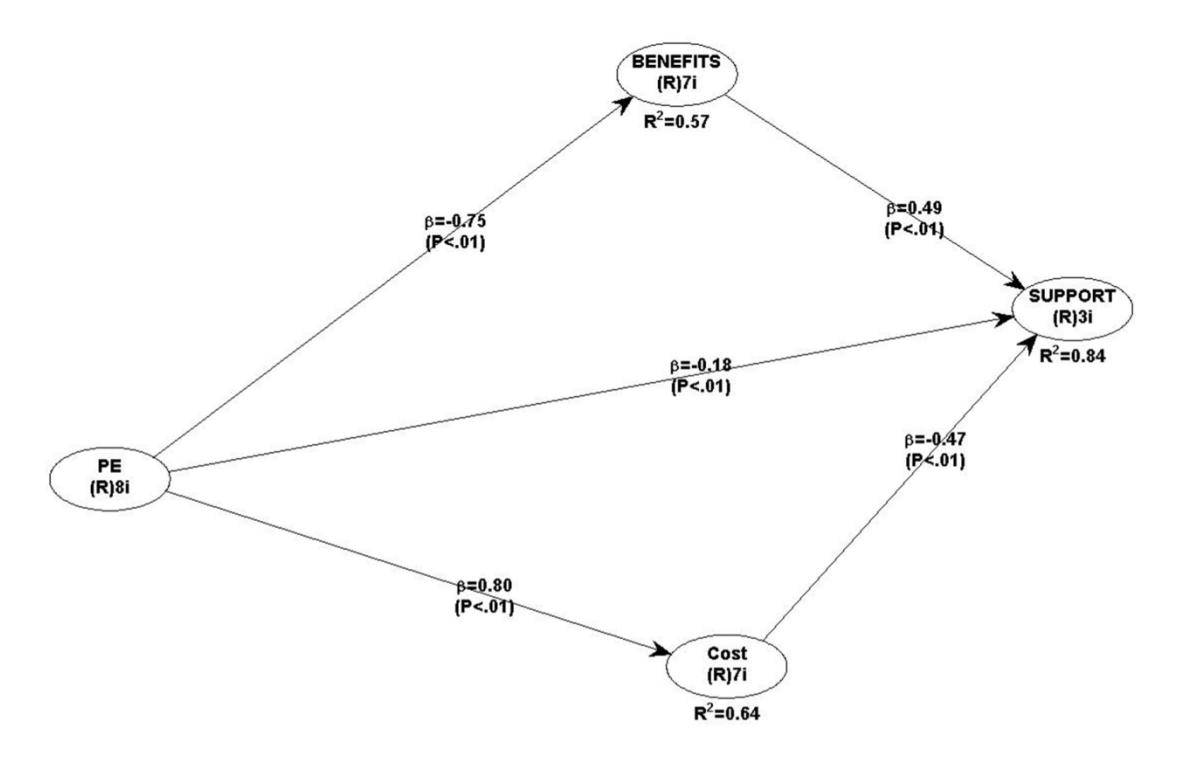
Figure 1. Proposed model
5. Discussion
The present study identifies perceived benefits and perceived costs as important mediating factors interlinking community political empowerment and community support for ecotourism. It was seen that the perceived benefits bore a direct and positive relationship with the local community's support for ecotourism. The finding is consistent with that of previous studies which state that the positive perceptions about tourism are one of the main reasons for wanting tourism development in local communities (Ap, 1992; Jurowski, Uysal, & Williams, 1997; Yoon, Gursoy, and Chen 2001; Gursoy et al., 2002; Lee and Chang 2008). Similarly, the construct perceived costs were seen to have a direct, negative impact on the residents' support for tourism, this finding was also in-line with those of previous researches (Gursoy et al., 2002; Gursoy & Kendall, 2006; Gursoy & Rutherford, 2004; Nicholas et al., 2009; Nunkoo & Ramkissoon, 2011; and Lee, 2012). Based on the social exchange theory, perceived benefits and costs are effective predictors of the support for sustainable tourism development.
In studies carried out globally, it was seen that powerful residents are more likely to view tourism resulting in benefits than costs (Kayat, 2002; Madrigal, 1993; Nunkoo & Ramkissoon, 2012). In contrast to the experiences of many other areas, as reflected in previous studies, the study area of the present research work depicts a peculiar pattern of relationship between political empowerment and perceived benefits and perceived costs, as well as support for ecotourism. In all the three study areas in general, the respondents were found to consist of some who felt empowered and some who did not feel empowered, with a few who chose to be neutral about empowerment. This has resulted in the mean political empowerment index of 3.36 (and a median value of 3), denoting the entire sample, in general, being neutral to the aspect of political empowerment. The peculiar behavioral pattern of people in these areas appeared to be a little different: those who felt empowered seemed to ambitiously nurse very high levels of expectations about benefits from ecotourism with perceived benefits always lagging behind their expectations, whereas those who did not feel empowered were found to reap high levels of perceived benefits compared with their low expectations; this behavioral pattern thus writes a negative relationship between political empowerment and perceived benefits. Similarly, high expectations of the empowered respondents were able to accommodate high levels of perceived costs of ecotourism, whereas low expectations of the other group went with low levels of perceived costs, resulting in a positive relationship between political empowerment and perceived costs. A similar agreement goes for the construct, support of ecotourism.
The residents in these areas had to forgo their traditional occupations and had to switch to Ecodevelopment activities for their livelihood, and this was a kind of 360-degree swing for them, from their traditional means of livelihood, which they had been practicing for the past several centuries. Ecotourism was introduced with a twin objective of environmental conservation and livelihood security of the local community. It was learned from the field that, initially, this was carried out in perfect unison between the government and the local community. With the passing of time, increased exposure and experience led to an increase in the empowerment of the local community members, and this in turn seems to have influenced their outlook towards ecotourism.
These results stand by the strong tradition seen amongst the indigenous community studies in the arena of industrial relations wherein the community emphasised more on the 'social structure' and thereby downplaying the 'agency' (Darlington, 2002). The ironic deviations seen in this work might be due to multidimensional factors that came into existence with the empowerment of the local residents, such as the membership in collective trade unions, negative impacts of the increase in workers' bargaining power, which has deviated their interests from the very objective of ecotourism as such. As stated by Kerr and Siegel in their study conducted in 1954, some industries and occupations are more prone to internal agitations than others. This tendency of internal revolt and agitation is mostly seen in those occupations involving more danger and physical effort. The tasks involved in ecotourism are mostly laborious and risk-prone. Hence in such cases, it has been seen that greater the empowerment more is the possibility to feel discontent and revolt against the agency.
Yet another reason for this peculiar reaction is the extraordinarily rapid sea-change in the realms of political imaginaries of the resident communities, who earlier lived as a single clan, especially the tribal folks. The community members started affiliating with political parties and this, in turn, has got them involved in the race to become the power centre of their Eco-Development Committee (EDC). Again, these factors lead to a deviation from the initial objectives of ecotourism, and hence the initial zest in the groups towards ecotourism certainly diminished, especially amongst the more powerful category.
The reduced support for ecotourism in case of the empowered community might also be due to limited participation of the residents in decision-making activities. In spite of the participatory approach being practiced, the residents seem to feel that they lack the institutional space to voice their opinions in a meaningful way. The main reason for this reduced participation from the part of the indigenous community might be because the community members lack sufficient past experience or knowledge to assess the impacts of new improvisations (McCormick, 2006; Whiteman and
Mamen, 2002). The role transformation of the tribal community is a serious problem affecting their attitude towards ecotourism. The switch of the community members, who were previously involved in ethnic, group-specific traditional jobs, to the present jobs within the hospitality industry, which requires a totally different level of skill sets. This 'de-ethnicisation of work' hypothetically breaks away from a tradition, inherited over centuries and therefore this could also be a reason for their objection to supporting the cause.
Some of the identified limitations of this research need special mention. Firstly, the findings from this study may not be relevant to the local community elsewhere in the world, which might have different characteristics such as, type of tourism practiced in their vicinity, level of economic development, their dependency on forests, exposure level to the outside world, the cultural context, and geographical characteristics of that area. Secondly, during the time when the research was conducted, there were two major issues that had rocked the tourism industry of Kerala, namely, the major floods that struck Kerala in 2018, as well as the ongoing safety issues associated with the decommissioning of the Mullaperiyar dam. Both these incidents had a profound impact on the tourism industry of Kerala and affected the tourist footfall, especially in PTR. Hence these factors might have influenced the opinions and perceptions of the local residents' during the study. Thirdly, a majority of the respondents belonged to the indigenous communities who spoke a different dialect; hence there were problems and difficulties associated with communicating and conveying the questionnaire to them. This may have influenced the results in an unknown way. Finally, the tribal segments studied are a highly heterogeneous group, comprising of several independent communities within. All these could have influenced our findings in an indefinite manner.
6. Conclusion
The more the community members become empowered, the more they see the positive and negative impacts of ecotourism as it is practiced. This in fact prompts us in advancing a new dimension to the definition of empowerment: empowerment is something that enables one to see actions and their consequences and respond to it in ways that maximize their wellbeing. If positive impacts are perceived, the empowered communities would invest more into it; if negative impacts are perceived, depending upon factors such as the extent of their empowerment and opportunities for alternate courses of action, they may either try to reform the system or leave it to create new systems. The present study also seems to indicate that, thanks to empowerment, the indigenous communities became more aware of their rights to choose alternate courses of livelihoods when they could not exercise meaningful control over current opportunities in tourism.
This happens especially in cases where commoditization in tourism happens, like in the indigenous tribal communities where we did this study. By commoditisation, we mean the degradation of the intrinsic value of cultural items, beliefs, goods, and practices and may even refer to treating a human being for sale (WTO, 2002). This often happens in the case of associated ecotourism activities, wherein the traditional dance and rituals of the tribal folks are displayed before the tourists as a tourism product. The dances and rituals are often not performed by the community for entertainment, but as an offering to God, hence, the commodification of such intrinsic religious aspects could often hurt their emotional sentiments. As cited by Cohen in 1988 and also by MacCannell in 1976, the commodification of cultures destroy the authenticity of local cultural products and relationships, and this, in turn, leads to the exploitation and trivialization of the local culture.
This study has helped in developing an improved model for understanding the attitude of the local community towards ecotourism. Sharpley in 2014 had mentioned that understanding the local community's perceptions of tourism "is considered a vital ingredient of tourism planning and management". Studies have deduced that it is of utmost importance for the tourism industry, as well as for the government, to have a thorough knowledge regarding the community's perceptions of tourism impacts (Deery et al., 2012). This should be regularly checked because it helps in the process of managing places and facilitates tourism planning activities equip in marketing them, and further, it eases the process of tourism product planning and development (Gursoy and Rutherford, 2004).
An interesting observation of the study was that the more the residents get empowered the less they support tourism. This might be an indication of the fact that the tourism being practiced in the area might be detrimental to the culture and traditions of the folks of the region. Income generation is considered as the major payback to the local community involved in ecotourism and in a quest to attain this, the authorities have commercialized certain intrinsic aspects of the indigenous communities. This can be demonstrated by the inclusion of the tribal dance as an item on the tour itinerary. As already mentioned, the Tribal dance is a very auspicious ritual for the tribal communities and not a mere performing art, it is a part of their worship and ought to be performed only on certain prescribed days. Whereas the productization of such rituals and making them perform before the tourists as a revenue generation model might not be acceptable to these people. Cultural alienation might happen, hence an alternate model needs to be developed, wherein the tourists need to be a part of the actual ritual and vice versa. 'Cultural bridging' between the local communities and the tourists, is an essential aspect in tourism and it necessarily requires proper institutional support (Lertzman and Vredenburg, 2005). Development can desecrate indigenous sacred sites — a key factor in conflict situations (Burton and Ruppert, 1999; Vanden Berg, 1999). However, spiritual impacts are not well understood or are ignored by companies and government policymakers as they assess the social change brought by development (Vanden Berg, 1999).
The study also has practical implications for those within the tourism industry looking for strategies to increase their residents' support for tourism development. The findings suggest that if members of the tourism industry wish to cultivate favorable attitudes towards ecotourism, they need to take into account the ethnicity of the residents and plan the activities accordingly. The more empowered they become the more they become aware of the fact that they had been exploited by taking advantage of their ignorance. With political empowerment, they become aware of their rights. Tourism activities in tribal settlements should always be planned by taking into consideration the nature and characteristics of each tribal group under consideration. Each indigenous culture is unique and the natural resource projects are also cited specific, hence it is advisable not to adopt one-size-fits-all policy in such scenarios.
Recommendations for future studies: Some of the limitations mentioned above can be overcome by studying the difference in attitude within the indigenous group, by the application of Multigroup analysis technique. Not many studies have included the variable' Political empowerment', hence the same model needs to be replicated and analyzed in a spectrum of varied types of tourism and communities such as the fishermen communities, aboriginal communities, agricultural communities, and fishing communities, who may hold differing opinions regarding sustainable tourism development. This kind of study will be useful to analyze if this behavioral model can be applied to other forms of community-based tourism too. Next, the respondents in this study were sampled randomly over a period of seven months. Although this sampling approach allowed us to assess the suitability of the current model for the host residents, only cross-sectional data were assessed. The study could not examine longer periods of time, and hence there is a possibility that common method variance could be created by the methodology itself. Future studies could also verify the moderating effect of trust the local community had on the government or tourism implementation agency. Moreover, it may also be noted that perceived effects due to tourism change over a period of time, depending on the stage of tourism development. Hence it is recommended to investigate the residents' attitude towards tourism pertaining to host communities over a course of multiple years. This will enable us to attain a better understanding of this model to analyze the residents' support for sustainable tourism development.
It appears that the mere inclusion of the local community in decision-making activities is not sufficient to instill a feeling of justice. On the contrary, studies to understand the social sensitivity of the local authorities towards the local community, the influence of informal interactions within the community on their support for tourism, and related aspects also need to be considered. The indigenous cultural visions of justice played a crucial role in instilling community satisfaction. Hence more studies to understand the local community's perceptions of justice, such as the interactional justice received through the various activities carried out under tourism need to be considered. It is essential to treat the attitude of the indigenous communities towards tourism as a separate wing altogether, and more in-depth studies need to be carried out to understand their true perspective towards tourism and participatory forestry approaches adopted.
References
- Altman, J., & Martin, D. (2009). Power, Culture, Economy (CAEPR 30): Indigenous Australians and Mining (p. 243). ANU Press.
- Ap, J. (1992). Residents' perceptions on tourism impacts. Annals of Tourism Research, 19(4), 665-690.
- Babbie, E. (2004). The practice of social research (10th ed.). Belmont, CA: Wadsworth, a division of Thomson Learning, Inc.
- Bagozzi, R. P., & Yi, Y. (1988). On the evaluation of structure equations models. Journal of the Academic of Marketing Science, 16(1), 74-94.
- Becker, J. M., Klein, K., & Wetzels, M. (2012). Hierarchical latent variable models in PLS-SEM: guidelines for using reflective-formative type models. Long range planning, 45(5-6), 359-394.
- Becker, J. M., Ringle, C. M., & Sarstedt, M. (2018). Estimating moderating effects in PLS-SEM and PLSc-SEM: Interaction term generation data treatment. Journal of Applied Structural Equation Modeling, 2(2), 1-21.
- Berg, T. M. V. (1999). "We are not compensating rocks": Resettlement and traditional religious systems. World Development, 27(2), 271-283.
- Beritelli, P., & Laesser, C. (2011). Power dimensions and influence reputation in tourist destinations: Empirical evidence from a network of actors and stakeholders. Tourism Management, 32(6), 1299-1309.
- Boley, B. B., & McGehee, N. G. (2014). Measuring empowerment: Developing and validating the resident empowerment through tourism scale (RETS). Tourism Management, 45, 85-94.
- Burton, L., & Ruppert, D. (1998). Bear's lodge or Devils Tower: Intercultural relations, legal pluralism, and the management of sacred sites on public lands. Cornell JL & Pub. Pol' y, 8, 201.
- Cabral, C., & Dhar, R. L. (2020). Ecotourism research in India: From an integrative literature review to a future research framework. Journal of Ecotourism, 19(1), 23-49.
- Carmines, E. G., & Zeller, R. A. (1979). Reliability and validity assessment (Vol. 17). Sage publications.
- Cheong, S. M., & Miller, M. L. (2000). Power and tourism: A Foucauldian observation. Annals of tourism research, 27(2), 371-390.
- Choi, H. C., & Murray, I. (2010). Resident attitudes toward sustainable community tourism. Journal of Sustainable Tourism, 18(4), 575-594.
- Churchill, G. Jr., (1979). A paradigm for developing better measures of marketing constructs. Journal of Marketing Research, 16(1), 64-73.
- Cohen, E. (1988). Authenticity and Commoditization in Tourism. Annals of Tourism Research 15(3): 371-386.
- Cole, S. (2006). Information and empowerment: The keys to achieving sustainable tourism. Journal of sustainable tourism, 14(6), 629-644.
- Darlington, R. (2006). Agitator' theory' of strikes re-evaluated. Labor History, 47(4), 485-509.
- Deery, M., Jago, L., & Fredline, L. (2012). Rethinking social impacts of tourism research: A new research agenda. Tourism management, 33(1), 64-73.
- Edward, M., & Kumar, R. R. (2017). Ecotourism in Kerala-a case study on empowering the indigenous community. International Journal of Qualitative Research in Services, 2(4), 295-307.
- Emerson, R. M. (1962). Power-dependence relations. American sociological review, 31-41.
- Fornell, C., & Larcker, D. F. (1981). Structural equation models with unobservable variables and measurement error: Algebra and statistics.
- Foucault, M. (1984). The Foucault reader (P. Rabinow (Ed.). New York: Random House-Pantheon
- Friedmann, J. (1992). Empowerment: The politics of alternative development. Blackwell.
- George, B. P. (2008). Local community's support for post-tsunami recovery efforts in an agrarian village and a tourist destination: a comparative analysis. Community Development Journal, 43(4), 444-458.
- Graziano, A. M., & Raulin, M. L. (2004). Research methods: A process of inquiry (5th ed.). New York: Pearson Education Group.
- Gursoy, D., & Kendall, K. W. (2006). Hosting mega events: Modeling locals' support. Annals of tourism research, 33(3), 603-623.
- Gursoy, D., & Rutherford, D. G. (2004). Host attitudes toward tourism: An improved structural model. Annals of tourism Research, 31(3), 495-516.
- Gursoy, D., Chi, C. G., & Dyer, P. (2010). Locals' attitudes toward mass and alternative tourism: The case of Sunshine Coast, Australia. Journal of Travel Research, 49(3), 381-394.
- Gursoy, D., Jurowski, C., & Uysal, M. (2002). Resident attitudes: A structural modeling approach. Annals of tourism research, 29(1), 79-105.
- Hair, J. F., Ringle, C. M., & Sarstedt, M. (2012). Partial least squares: the better approach to structural equation modeling?. Long Range Planning, 45(5-6), 312-319.
- Hair, J. J. F., Black, W. C., Babin, B. J., Anderson, R., & Tatham, R. (2006). Multivariate data analysis (6th ed.). Englewood Cliffs, NJ: Prentice-Hall.
- Hall, C. M. (1994). Tourism and politics: policy, power and place. John Wiley & Sons.
- Hall, C. Michael (1994). Gender and Economic Interest in Tourism Prostitution: The Nature, Development and Implications of Sex Tourism in South-east Asia. In Tourism: A Gender Analysis. Vivian Kinnaird and Derek Hall, eds., pp. 142-163. Chichester: Wiley.
- Hipwell, W., Mamen, K., Weitzner, V., & Whiteman, G. (2002). Aboriginal peoples and mining in Canada: Consultation, participation and prospects for change. Ottawa: North-South Institute, 10.
- Jurowski, C., & Gursoy, D. (2004). Distance Effects on Residents' Attitudes Toward Tourism. Annals of tourism research, 31(2), 296-312.
- Jurowski, C., Uysal, M., & Williams, D. R. (1997). A theoretical analysis of host community resident reactions to tourism. Journal of travel research, 36(2), 3-11.
- Kayat, K. (2002). Power, social exchanges and tourism in Langkawi: Rethinking resident perceptions. International journal of tourism research, 4(3), 171-191.
- Kjosavik, D. J., & Shanmugaratnam, N. (2007). Property rights dynamics and indigenous communities in highland Kerala, South India: an institutional-historical perspective. Modern Asian Studies, 41(6), 1183-1260.
- Lai, P. H., & Nepal, S. K. (2006). Local perspectives of ecotourism development in Tawushan Nature Reserve, Taiwan. Tourism Management, 27(6), 1117-1129.
- Látková, P., & Vogt, C. A. (2012). Residents' attitudes toward existing and future tourism development in rural communities. Journal of Travel Research, 51(1), 50-67.
- Lee, C. C., & Chang, C. P. (2008). Tourism development and economic growth: A closer look at panels. Tourism management, 29(1), 180-192. Yoon, Y., Gursoy, D., & Chen, J. S. (2001). Validating a tourism development theory with structural equation modeling. Tourism management, 22(4), 363-372.
- Lee, C. K., Kang, S. K., Long, P., & Reisinger, Y. (2010). Residents' perceptions of casino impacts: A comparative study. Tourism Management, 31(2), 189-201.
- Lee, T. H. (2013). Influence analysis of community resident support for sustainable tourism development. Tourism Management, 34, 37-46.
- Lertzman, D. A., & Vredenburg, H. (2005). Indigenous peoples, resource extraction and sustainable development: An ethical approach. Journal of Business Ethics, 56(3), 239.
- MacCannell, D. (1976). The Tourist: A New Theory of the Leisure Class. London: Macmillan.
- Madrigal, R. (1993). A tale of tourism in two cities. Annals of Tourism Research, 20(2), 336-353.
- Marsh, H. W., Hau, K. T., Balla, J. R., & Grayson, D. (1998). Is more ever too much? The number of indicators per factor in confirmatory factor analysis. Multivariate Behavioral Research, 33(2), 181-220.
- McCormick, S. (2006). The Brazilian anti-dam movement: Knowledge contestation as communicative action. Organization & Environment, 19(3), 321-346.
- McGehee, N. G., & Andereck, K. L. (2004). Factors predicting rural residents' support of tourism. Journal of Travel Research, 43(2), 131–140.
- Nicholas, L. N., Thapa, B., & Ko, Y. J. (2009). Residents' Perspectives of a World Heritage Site: The Pitons Management Area, St. Lucia. Annals of tourism research, 36(3), 390-412.
- Nicholas, L. N., Thapa, B., & Ko, Y. J. (2009). Residents'perspectives of a World Heritage Site: The Pitons Management Area, St. Lucia. Annals of tourism research, 36(3), 390-412.
- Nunkoo, R., & Ramkissoon, H. (2011). Developing a community support model for tourism. Annals of Tourism Research, 38(3), 964-988.
- Nunkoo, R., & Ramkissoon, H. (2012). Power, trust, social exchange and community support. Annals of Tourism Research, 39(2), 997-1023.
- Nunkoo, R., Ramkissoon, H., & Gursoy, D. (2012). Public trust in tourism institutions. Annals of Tourism Research, 39(3), 1538-1564.
- Nunnally, J. (1970). Introduccion a la medicion psicologica. Buenos Aires, Argentina: Centro Regional de Ayuda Tecnica.
- Nunnally, J. C., & Bernstein, I. H. (1994). Psychometric theory (3rd ed.). New York: McGraw-Hill.
- Pearl, J. (2009). Causality: Models, reasoning, and inference. Cambridge, England: Cambridge University Press.
- Perdue, R. R., Long, P. T., & Allen, L. (1990). Resident support for tourism development. Annals of Tourism Research, 17, 586–599.
- Reed, M. G. (1997). Power relations and community-based tourism planning. Annals of tourism research, 24(3), 566-591.
- Scheyvens, R. (1999). Ecotourism and the empowerment of local communities. Tourism Management, 20(2), 245-249.
- Sharpley, R. (2014). Host perceptions of tourism: A review of the research. Tourism Management, 42, 37-49.
- Sofield, T. H. (Ed.). (2003). Empowerment for sustainable tourism development. Emerald Group Publishing.
- Tosun, C. (2006). Expected nature of community participation in tourism development. Tourism Management, 27(3), 493-504.
- UNWTO (May 2002). Final Report of The World Ecotourism Summit; Published by the World Tourism Organization and the United Nations Environment Programme; Quebec Canada
- Vargas- Sánchez, A., Plaza- Mejia, A., & Porras-Bueno, N. (2009). Understanding residents' attitudes toward the development of industrial tourism in a former mining community. Journal of Travel Research, 47(3), 373–387.
- Wagner, C.H. (1982). Simpson's paradox in real life. The American Statistician, 36(1), 46–48.
- Walsh, T., & George, B. (2019). The ecotourism principle-practice divide: factors that limit the applicability of ecotourism principles into practice. Revista TURISMO: Estudos e Práticas, 8(2).
- Werts, C. E., Linn, R. L., & Jöreskog, K. G. (1974). Intraclass reliability estimates: Testing structural assumptions. Educational and Psychological Measurement, 34(1), 25-33.
- Westland, J. C. (2010). Lower bounds on sample size in structural equation modeling. Electronic Commerce Research and Applications, 9(6), 476-487.
- Whiteman, G. (2009). All my relations: understanding perceptions of justice and conflict between companies and indigenous peoples. Organization Studies, 30(1), 101-120.
- Yoon, Y., Gursoy, D., & Chen, J. S. (2001). Validating a tourism development theory with structural equation modeling. Tourism Management, 22(4), 363-372.