

1. Introduction
Technology has made online distributing methods possible in the tourism industry. One of the popular distributors in marketing hotel accommodations is online travel agencies (OTA). Kotler et al. (2017) defined OTA as the "travel agency that conducts business through the Internet with no physical locations or stores" (p. 358). In 1996, the giant OTA, Booking.com, was founded and followed by several sister companies like Agoda.com, which is based in Asia, and Kayak.com in the United States of America. The success of OTAs in distributing hospitality products and services has led to the establishment of other OTAs. For example, in 2005, Booking.com's major competitor, Trivago.com, a German-based company, was established. Studies have found that OTAs have dominated the distribution of hotel accommodations over the last ten years or so (Law, 2009; Toh et al., 2011).
For hoteliers, OTAs provide economies of scope and competitive advantage (Kim et al., 2009), offer different business models (Lee et al., 2013), and provide smarter business practices with respect to pricing (Tso and Law, 2005). For smaller hotels, due to the lack of online resource capabilities, OTAs provide a better opportunity to reach a wider target market, which in turn improves sales and revenues. Indeed, smaller hotels that choose to advertise using OTAs can bolster their sales and profitability and thus capture more economic value from their visibility on these distribution channels (Raguseo et al., 2017). The relationship between the hoteliers and OTAs often resulted in channel conflicts due to the heavy reliance on OTAs to distribute hospitality products and services (Law et al., 2015). As a result, this conflict can cause anxiety and stress for the hospitality employees and does not benefit the consumers (Yang and Leung, 2018).
The bulk of the past studies examining the relationship quality between business-to-business in the tourism industry have focused on the relationships among tour operators, travel agencies, and accommodation providers (Ivanov et al., 2015; Law et al., 2004, 2015; Tse, 2003). The research on the buyer-seller relationship between hoteliers and OTAs has remained deficient (Yin et al., 2019). From the inter-organizational relationship quality theoretical perspective, the diffusion of new technologies has changed the dynamic of relationships between buyers and sellers. For example, the supply chain dynamic within tourism industry has changed; technology has added more value and is presented as a new and effective way to increase business between buyers and sellers (Law et al., 2015; Masiero et al., 2016). However, technology has also impacted customer expectations, as their needs and wants are constantly evolving, and this needs to be managed wisely (Boateng, 2019). Past studies have also observed the swiftly developed relationship between inter-organizations due to online interactivity and purchase intention (Chong et al., 2018; Masiero et al., 2016). In the hospitality industry, studies have found how the latent and powerful Internet technology has undermined traditional distribution chains, yet there is a paucity of research in this area in examining the relationship quality between OTAs and hoteliers (Yin et al., 2019). This present study attempts to fill the gap.
Several theories on trust and commitment have proposed that social relationship enhances relationship quality between buyers and sellers (Blau, 1964; Morgan and Hunt, 1994; Young, 2006). Hence, it is not surprising that previous studies on inter-organization relationship quality have empirically focused on examining the effect of the social relationship on trust and commitment (Chang et al., 2012; Ferro et al., 2016; Geysken et al., 1999; Wisker, 2020a). However, the results were often inconclusive. For examples, Chang et al. (2012) have observed a positive relationship between social bonding and trust. Similarly, Ferro et al. (2016) have found the non-economic domain to influence trust. In contrast, Shanka and Buvik (2019) have observed how social bonds in businessto-business failed to enhance relationship satisfaction at the beginning of the relationship. Wisker (2020a) have also observed the insignificant effect of non-economic benefits on trust and commitment. In synthesizing these studies, it was apparent that they neglected to consider the multidimensional constructs of a social domain. Based on Young's (2006) business-to-business nature of trust model, this study provides evidence that social relationship domain is multidimensional constructs.
It is timely for academics and practitioners to understand the relationship between online travel agencies (OTAs) and hoteliers. What factors constitute this relationship? Does the domain of interorganizational relationship exist in this online relationship? More specifically, this study addresses the following three research questions: RQ1 – Do the shared values, duration of relationship and other non-economic benefit constructs contribute to the social satisfaction domain, and do task performance and economic benefit constructs contribute to the cognitive satisfaction domain? RQ2 – Is the relationship quality as measured by the commitment between OTAs and hoteliers influenced by both social and cognitive satisfactions? RQ3 – Does trust mediate the relationship between social and cognitive satisfaction, and commitment?
This study contributes to the literature in three ways. First, this study enhances our understanding of the relationship quality between OTAs and hoteliers. The research in this area is deficient (Law et al., 2015; Yin et al., 2019). The present study unpacks key concepts in inter-organizational relationships between hoteliers and OTAs. Blau's (1964) social exchange theory argued that relationship quality is influenced by cognitive and social exchanges; therefore, it would be interesting to see if this is the case with OTAs-hoteliers' relationship. As observed by Ferro et al. (2016), there is confusion as to whether satisfaction is the outcome of trust and commitment or vice versa. This confusion is due to the cognitive and social aspects of satisfaction. This study hypothesizes that satisfaction is constituted of two domains: cognitive and social, which affect trust and commitment.
Past studies neglect to consider the multidimensional constructs for a social relationship domain. This study fills the gap by empirically tested the multidimensional constructs for social relationship domain.
Third, this study provides insights for tourism industry practitioners on the inter-organizational relationship between hoteliers and OTAs. This is fairly new territory, as only in the last ten years have hoteliers intensively used OTAs to distribute their products and services (Gazzoli et al., 2008; Iversini and Masiero et al., 2014). The hotel industry and OTAs are important players in the supply chain tourism industry (Law et al., 2015; Yin et al., 2019). Therefore, all stakeholders must understand the relationship between the hoteliers and OTAs to develop successful destination marketing. In ensuring the success of a destination, all stakeholders need to develop integrated effort strategies (Haywood, 1990). Integration is not easy to carry out without transparency and understanding each other's processes and systems.
2. Theoretical Framework
2.1. Relationship Development
This study's conceptual model is based on social exchange theory (Blau, 1964), Young's (2006) trust theory and stakeholder theory (Donalson and Preston, 1995). Social exchange theory suggests that exchanges in a relationship are influenced by economic and social benefits. The two dyadic parties in the relationship are generally motivated by the reciprocal behaviour benefits and sense of indebtedness (Adler and Kwon, 2002). Ultimately, relationships are developed based on selfdisclosure, partner responsiveness, closeness, attachment, and connectedness (Beetles and Harris, 2010). In the supply chain literature, the social relationship is a type of commitment in which the two dyadic parties recognize the value of each member and also the emotional attachment that both parties will foster (Wetzels et al., 1998; Fu et al., 2017). On the other hand, the cognitive relationship is about economic benefits for which cost input and income are calculated (Brown et al., 1995; Young, 2006; Zhao et al., 2008). Stakeholder theory (Donalson and Prerston, 1995) proposes four foundations for the framework, two of which are associated with cognitive and intrinsic (social) domains. The cognitive domain emphasizes the aspect of conventional performance such as profitability, stability, and growth. The other domain is intrinsic, based on normative and involving acceptance.
Many relationship quality studies in the traditional context have observed several constructs such as satisfaction, trust, commitment, intimacy perception, quality of communication, relationship benefit, and shared values, to name a few (de Wulf et al., 2001; Murphy and Sashi, 2018; Vesel and Zabkar, 2010; Wisker et al., 2020b). However, trust and commitment are the two most popular relationship quality constructs that have been studied over time (Morgan and Hunt, 1994). Trust and commitment have been found to influence customer loyalty behaviors such as repurchase intention and word-ofmouth (Harrison-Walker, 2001; Jain, 2017; Lo et al., 2015; Morgan and Hunt, 1994; Ponder et al., 2014). Previous studies on inter-organizational relationships in business-to-business particular have also observed how trust enhances commitment, which in turn improves the relationship strength between buyers and sellers (Frasquet et al., 2008; Gounaris, 2005). Table 1 summarizes findings
related to relationship quality studies. The findings show the consistent domains of trust and commitment that measure relationship quality. Cognitive and social relationship satisfaction are the two consistent antecedents that affect trust and commitment.
Table 1. Relationship Quality Domains
| Authors | Findings | |||
|---|---|---|---|---|
| Crosby et al. (1990) | Shared value, satisfaction and commonality in status affect trust and relationship quality. | |||
| Moorman et al. (1992) | Positive relationship between trust and commitment. | |||
| Anderson and Weitz (1992) | Commitment reflects desires to maintain a quality relationship. | |||
| Morgan and Hunt (1994) | Shared values, communication and opportunistic behaviour affect trust. Shared value, relationship benefits and relationship terminations cost influences commitment. | |||
| Donalson and Patterson (1995) | Cognitive and intrinsic domains affect relationship quality. | |||
| Brown et al. (1995) | Instrumental commitment affect relationship quality. | |||
| Geysken et al. (1999) | Non-economic satisfaction affects B2B to work together. | |||
| Sanzo et al. (2003) | Economic satisfaction and economic benefits affect trust. | |||
| Lau et al (2004) | Conventional channel affects 'against disintermediation relationship' and online channel affects 'for disintermediation relationship'. | |||
| Young (2006) | Cognitive elements include calculation of cost, benefit, value, and risk, while social elements include duration, affect, gratitude, security, acceptance, contentment, and satisfaction affect relationship quality. | |||
| Theron et al. (2008) | Trust, communication, shared value and attractiveness alternatives affect relationship commitment. | |||
| Fiol et al. (2009) | Perceived values (economic value), social value, emotional values affect satisfaction and loyalty. | |||
| Chang et al. (2012) | Customer relationship, social bonding, termination cost and customer expertise affect trust. Trust acts as a mediator on commitment relationship. | |||
| Ferro et al. (2013) | Economic satisfaction and non-economic satisfaction affect trust and commitment. Trust affects commitment. | |||
| Franklin and Marshall (2018) | Co-creation, shared value, competence, integrity affect trust. | |||
| Tonder et al. (2018) | Perceived value, customer satisfaction affect trust. Trust mediates the relationship between perceived value and commitment, and, satisfaction and commitment. | |||
| Shanka and Buvik (2019) | Social bond affects supplier satisfaction and this relationship is moderated by duration. | |||
| Yin et al. (2019) | Knowledge sharing, continuous commitment, relationship investment, coordination enhancement and value creation are domains for a successful relationship. | |||
| Zietsman et al. (2020) | Economic and non-economic satisfaction influence relationship. | |||
2.2. Trust
Trust is defined as a "willingness to rely on an exchange partner in whom one has confidence and has the enduring desire to maintain a valued relationship" (Moorman et al., 1993, p. 82). This is derived from Rotter's (1967) classic view that trust is a generalized expectation held by an individual that the word of another party can be relied upon. It is a perception that an individual has confidence in the other party's reliability and integrity (Lo et al., 2015; Morgan and Hunt, 1994). Trust is also defined as "an evolving effect, that is, an interacting set of emotions and assessment that develop and change over time" (Young, 2006, p. 439). Note that this scholar included the domains of emotion and time in the conceptualization of trust. She further theorised that trust has cognitive and social elements. Cognitive elements include calculation of cost, benefit, value, and risk, while social elements include gratitude, security, acceptance, contentment, and satisfaction (Young, 2006). Similar to Young's (2006) concept of trust, Franklin and Marshall (2019) have also included the element of time, arguing that trust emerges over time, although it can develop more quickly if the element of cognitive cues emerges in the buyer-seller relationship. The cognitive domain includes competence, satisfaction, communication, and integrity, while the affective domain includes shared value, benevolence, and co-creation (Franklin and Marshall, 2019; Wisker, 2020b). Scholars have argued that trust is an essential in the basis of healthy interpersonal relationships, a prerequisite for cooperation, and essential for stable relationships in both the social and business spheres (Young, 2006). Drawing on these concepts, it is apparent that the concept of trust is constituted of economic factors and non-economic factors such as social and shared values.
2.3. Commitment
Morgan and Hunt (1994) conceptualised commitment as "an exchange partner believing that an ongoing relationship with another is so important as to warrant maximum efforts at maintaining it; that is the commitment party believes the relationship is worth working on to ensure it endures indefinitely" (p. 23). In business, commitment indicates that both buyers and sellers will be loyal, reliable, show stability in the relationship, and maintain that commitment over the long term (Bejou and Palmer, 1998). The commitment–trust theory argues that trust and commitment are essential to in forming effective relationship between buyers and sellers. This is because commitment and trust can encourage marketers to collaborate with their partners in preserving investments, achieving longterm goals and believing that their partners will not be opportunists, thereby resulting in better efficiency, productivity, and effectiveness for both parties (Morgan and Hunt, 1994). However, the question remains of what constitutes a commitment. Given Blau's (1964) social exchange theory, Morgan and Hunt's (1994) commitment-trust theory, and Donalson and Preston's (1995) stakeholder theory, this study argues that both cognitive benefits and social benefits contribute to the quality of the relationship between hoteliers and their online distributors. This study measures cognitive domain through economic satisfaction (Ferro et al., 2016) and task performance (Lawson et al., 2014) and measures social domain through non-economic satisfaction (Ferro et al., 2016), duration (Shanka and Buvik, 2019) and shared value (Theron et al., 2008).
3. Hypothesis Development
3.1. Cognitive Relationship, Trust and Commitment
This study posits economic satisfaction and task performance as the antecedents for the cognitive relationship in the B2B marketplace. If relationship quality involves economic benefits between the two parties, firms would assume that their online distributors provide valuable services in order to be competitive in the market that enhances those firms' sales growth and revenues. Fiol et al. (2009) argued that relationship marketing assigns a fundamental role in economic benefits in explaining customer loyalty behaviour. This claim is also supported by several other studies, including that of
Sweeny and Soutar (2010). In defining the concept of economic satisfaction in a B2B marketplace, this study borrows Ferro et al.'s (2016) concept, which can be defined as "incentives and benefits such as financial performance, sales goal and growth in number of clients" (p. 16). Similarly, other studies suggest that the most common definition of economic satisfaction involves incentive and benefits (Ting, 2011), improved financial performance and sales goals, and other economic rewards (Geyskens et al., 1999; Sanzo et al., 2003). Economic satisfaction should include a positive affective response to the economic reward derived from the relationships; it is about working together and recognition of mutual dependence between the two parties (Brennan et al., 2003). Regardless of its conceptualization, economic satisfaction plays a role in influencing the relationship and strengthening the effect of trust and commitment between the two parties involved (Hakansson and Pearson, 2004; Wisker, 2020a). In studying the relationship between manufacturer-supplier relationships with Spanish SMEs, Ferro et al., (2016) found that economic satisfaction influences exchanges and reinforces trust and commitment.
On the other hand, task performance is defined as the distributor's performance in terms of its creativity and technological contributions to generating sales and growth (Kim et al., 2009). When a hotelier lacks the technological capability to distribute its products and services, they turn to independent distributors such as online travel agencies to complete the job (Raguseo et al., 2017; Toh et al., 2011). Arguably these OTAs would have the ability to provide effective and up-to-date technological capabilities tailored to the firm's needs. In the B2B buyer-seller relationship literature, it is established that when a firm chooses a particular partner, they expect this partner to have the technological capabilities and marketing effectiveness to generate new sales and market growth (Lawson et al., 2014; Takeishi, 2001). Summing up the argument thus far, the following hypotheses are posited:
H1: Cognitive relationship domain is a cluster in a second-order multidimensional construct consisting of two dimensions, economic satisfaction and task performance.
H2: Cognitive relationship domain is positively related to commitment and this relationship is mediated by trust.
3.2. Social Relationship, Trust and Commitment
Arguably, the relationship quality in a B2B situation is not only limited to economic satisfaction but is also extended to a social relationship (Ferro et al., 2016; Geyskens et al., 1999). The social relationship can be measured through a social bond (non-economic satisfaction) shared value and duration (Morgan and Hunt, 1994; Shanka and Buvik, 2019). Non-economic satisfaction refers to a positive affective response to a psychological effect such as the exchange of ideas, contacts, and business networking for competitive advantage (Fiol et al., 2009; Nevin, 1995; Geyskens et al., 1999). In a B2B relationship, the relationship often goes beyond economic satisfaction. The social relationship or, as some term it social dimension is becoming more and more important as it portrays the firm's image, reputation, and credibility for any firm to enter into a partnership with others (Bonner and Calantote, 2005; Fiol et al., 2009). When a firm trust its business partner, it would be able to communicate openly and develop non-economic satisfaction and vice versa, which in turn would improve the firm's reputation and performance (Donalson and Preston, 1995; Farrelly and Quester, 2005). Previous studies have also observed how non-economic satisfaction leads to trust and relationship commitment (Nyaga et al., 2010).
Shared value is conceptualized as "the extent to which partners have beliefs in common about what behaviors, goals, and policies are important or unimportant, appropriate or inappropriate, and right or wrong" (Morgan and Hunt, 1994, p. 25). Values are fundamental and provide the foundation for a firm's culture and norms. For firms to develop trust and commitment and to work harmoniously with their partners (e.g., distributors), they have to share similar business values (Theron et al., 2008) to avoid conflict. These values span from elements on business goals, business ethics, product and service quality, and profitability. Fu et al. (2017), in studying the behaviour of contract farmers in Chinese agriculture supply chains, has observed how social elements help firms and farmers to identify and internalize each other's norms and values, which in turn helps them to communicate and invest in their relationships. Several other studies have found a positive relationship between shared value and relationship commitment in the context of B2B relationship marketing (De Ruyter and Wetzels, 1999; Theron et al., 2008).
The other construct that may strengthen the domain of social relationship is the relationship duration (Brevik, 2016; Shanka and Buvik, 2019). Relationship duration refers to the length of time the relationship between buyer-seller has formed (Palmatier et al., 2006). Schurr (2007) argued that the length of a relationship often had a crucial effect on relationship outcomes. The social aspect of the relationship may appear in a longer and stronger relationship. This is because a social relationship ties that develop exchange relationship through interaction, emotion and identification boosting exchange overtime (Nath et al., 2011; Young, 2006). Previous studies on the inter-organizational relationship have observed how the duration of relationship enhances social relationship strength (Shanka and Buvik, 2019; Wulf et al., 2001). To the extreme's Mohd Noor et al. (2015) and Voldnes et al. (2012) have observed stronger social domain than economic benefits on the satisfaction of the exchange relationship. Summarizing the discussion thus far, it is fair to hypothesize the followings:
H3: Social relationship domain is a cluster in second-order multidimensional constructs consisting of three dimensions, non-economic satisfaction, shared value and duration.
H4: Social relationship domain is positively related to commitment and this relationship is mediated by trust.
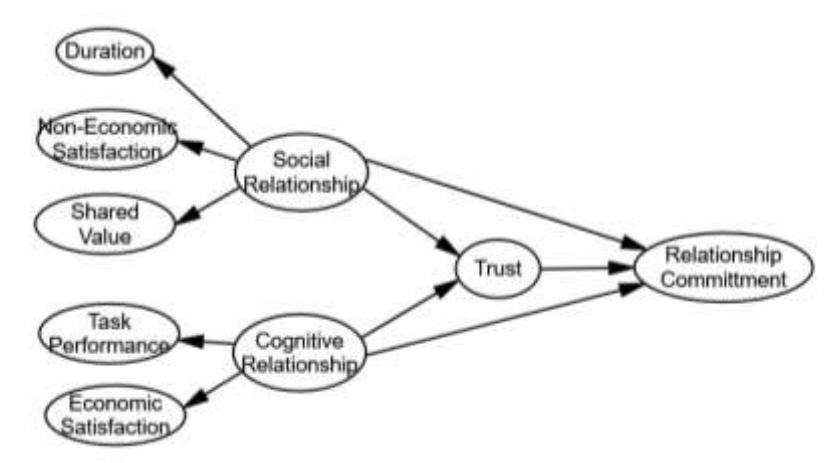
Figure 1. Framework Model
4. Methodology
Data was collected from registered hotels in New Zealand Registered Companies. This study has adopted a stratified sampling frame. The population was divided into two subgroups based on the star ratings of the properties. Group 1 is for three- to five-star ratings, and Group 2 is for the unrated up to two stars. The reason for dividing into two groups is to avoid skewing the data. Previous studies have found that star ratings have influenced organizations' performance and how they manage their revenue and cost control (Narangajavana, 2008). Data was gathered predominantly through an online survey by way of a SurveyMonkey platform. Participants for the survey were operation managers, senior managers, financial executives, business partners, and owners. Arguably these are the personnel who are able to make decisions regarding their Online Travel Agencies (OTAs). The potential participants were invited to participate in the survey through an email with an attached information sheet and a link to the survey. The participants were asked to complete the survey within
10 working days. Although they were encouraged to take part, it was explained that participation was entirely voluntary and that the identities of all participants would be kept anonymous. Additionally, some of the surveys were mailed out to the properties. We also hand-delivered the questionnaires to some hotels. Reminder emails were sent to non-respondents three days prior to the due date of the survey. Ultimately, the study received 214 responses from 577 questionnaires. After close examination only 208 were usable and retained, resulting in a response rate of 36.04 per cent. Nine responses were eliminated due to missing or invalid responses.
4.1. Measures
The study used established measures to gather data about trust, commitment, economic and noneconomic satisfaction, shared values and task. The variables of trust, commitment, and economic and non-economic satisfaction were adapted from Ferro et al. (2016), the shared value was measured through Theron et al. (2008), and task performance was measured through Lawson et al.'s (2014) established scales. The domain of trust, commitment, non-economic, economic satisfactions, and shared value have three items each, while the task performance domain has six items. All scales were measured on a 5-point Likert scale ranging from '1 = strongly disagree to 5 = strongly agree". Relationship duration was measured using the amount of time (in years) during which the hoteliers has work together with the current primary OTA (Shanka and Buvik, 2019).
4.2. Reliability of Measurement
The study used structural equation modelling (SEM) through AMOS 27 to test the posited hypotheses. The study performed exploratory factor analysis (EFA) and confirmatory factor analysis (CFA) to validate the reliability of the measurement. Table 2 depicts the EFA and CFA results. All factor loadings were greater than .4 and statistically significant at .005 and the values of Cronbach α were also above the cut-off value of .70 (Hair et al., 2014). The AVEs ranged from .51 to .61, which is also exceeded the cut-off value of .40 (Hair et al., 2014). The final model shows model fit; χ2 = 768.80; d.f = 541; (χ2/d.f) = 1.421; Normed Fit Index (NF1) = .911; Non-normed Fit Index (NNF1) =.915; Comparative Fit Index (CFI) = .899; Root Mean Squared Error of Approximation (RMSEA) = .055; p-Value ≤ .01.
4.3. Control Variables
The study controls three variables: firm size, age and star rating. Previous studies have found how firm characteristics affect its performance (Narangajavana, 2008), hence it is important to control these demographic characteristics because they might influence the results of this study.
5. Results
The study conducted Pearson correlation between variables and descriptive tests for demographic statistics. Results are depicted in Table 2 and Table 3. Following that, the study tested H1 and H3 to validate the proposed multidimensional constructs for the cognitive and social domains. The result for the second-order multidimensional constructs in shown in Figure 2. For clarity of the diagram, the value loadings for the items have been removed. In sum, the cognitive relationship domain is contributed by economic and task performance constructs and social relationship domain is contributed by non-economic, duration and shared value constructs. Therefore, H1 and H3 are accepted. Subsequently, the study tested H2 and H4 using Hair et al. (2014) mediation effect procedure. Three nested structural model were developed and tested. For testing H2, Model A shows full mediation, where trust fully mediates the relationship between cognitive domain and relationship commitment. Model B is a partial mediation model where trust partially mediated cognitive domain and relationship commitment.
Table 2. Scale Reliabilities
| Variable | Loadings | (α) | AVE |
|---|---|---|---|
| Economic Satisfaction | .73 | .58 | |
| Our current OTA contributes to our sales goal | .76 | ||
| Our current OTA contributes to our financial performance | .81 | ||
| Our current OTA generates economic growth for us | .71 | ||
| Distributors Task Performance | |||
| Our current OTA exhibits a great deal of creativity in its work | .73 | .73 | .51 |
| Our current OTA's technology is up to date | .77 | ||
| Our current OTA's technology is innovative | .68 | ||
| Our current OTA's technology contributes a great deal to the | .66 | ||
| competitiveness of our products | |||
| Our current OTA's technology contributes a great deal to the | .62 | ||
| functionality of our products | |||
| Our current OTA's technology contributes a great deal to the | .82 | ||
| profitability of our products | |||
| Non-Economic Satisfaction | .78 | .61 | |
| The relationship between current OTA and us is positive | .77 | ||
| Looking out for each other's best interest | .82 | ||
| Our organization is content about our relationship with OTA | .76 | ||
| Shared Value | .84 | .58 | |
| The current OTA respects our business value | .73 | ||
| The current OTA has business values similar to ours | .81 | ||
| The current OTA shares the same views about most business | .75 | ||
| practice | |||
| Trust | .81 | .55 | |
| We can rely on our current OTA to keep promises made to us | .88 | ||
| Happy to do business with current OTA even during periods of | .82 | ||
| recession | |||
| Our OTA is trustworthy | .55 | ||
| Commitment | .73 | .53 | |
| We intend to do business with current OTA well into the future | .76 | ||
| We are dedicated to do business with current OTA | .75 | ||
| We are resolute about our future intent to do business with our | .68 | ||
| current OTAs |
*The factor loadings (≥.4) and Cronbach Alphas (≥.6) for all items are above the accepted threshold. Fit statistics: (χ2/d.f) = 1.421; NF1 = .911;NNF1 =.915; CFI = .899; RMSEA = .055; p-Value ≤ .01
Table 3. Correlation Result
| Variables | CR | SR | TR | CO |
|---|---|---|---|---|
| Cognitive Relationship | 1 | |||
| Social Relationship | .24** | 1 | ||
| Trust | .43** | .17* | 1 | |
| Commitment | .33** | .08 | .48* | 1 |
**Correlation is significant at the 0.01 level (2-tailed). *Correlation is significant at the 0.05 level (2-tailed)
Finally. Model C shows no mediation where cognitive domain directly affects relationship commitment. For the cognitive domain, the study has observed Model B to show significant goodness-of-fit indicators (Fit Stats χ2/d.f = 1.68; NF1 = .90, NNF1 =.89; CFI = .92; RMSEA = .06). The regression statistics are as follows: Cognitive to relationship commitment: β =.49, t = 7.671, cognitive to trust, β =.33, t = 3.719; trust to relationship commitment β =.42, t = 4.114 that were all above the minimum threshold (Kline, 2005), concluding that partial mediation was observed for H2.
Similar process was conducted for the effects of social domain on relationship commitment (H4). Model A, which is a full mediation shows significant goodness-of-fit indicators (Fit Stats χ2/d.f = 1.411; NF1 = .91;NNF1 =.90; CFI = .89; RMSEA = .060). The regression statistics are as follows: Social to relationship commitment: β =.19, t = 2.115, social to trust, β =.21, t = 3.111; trust to relationship commitment β =.42, t = 4.114 that were all above the minimum threshold (Kline, 2005), resolving that full mediation was observed for H4.
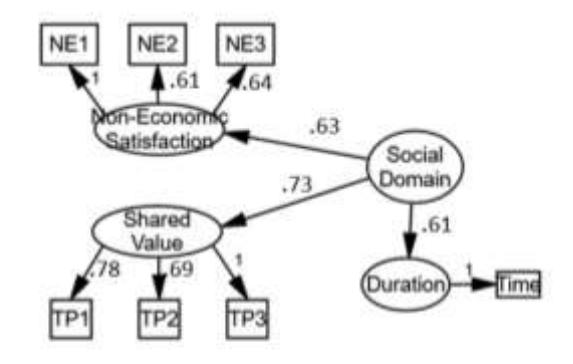
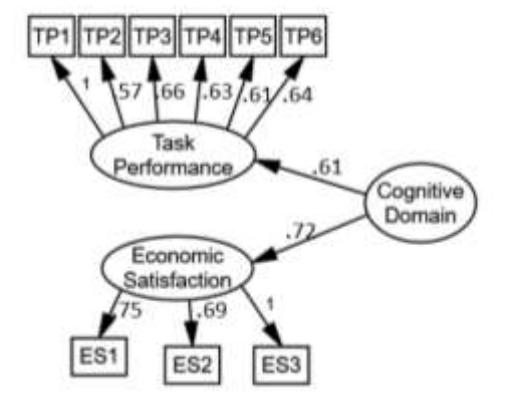
Fit Statistics: (χ2/df) = 1.231 NF1 = .901; NNF1 =.911; CFI = .899; RMSEA = .055; p value ≤ .01
Figure 2. Hypothesized Second-Order Model
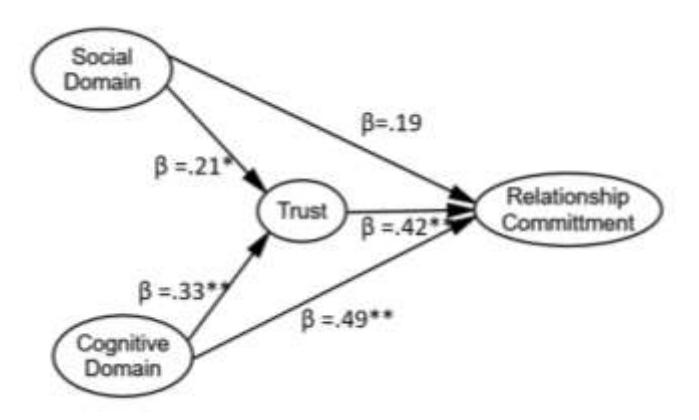
Figure 3. Mediation Results
6. Discussion and Conclusion
6.1. Theoretical Implication
This study sought to understand the impact of the cognitive satisfaction domain and social satisfaction domain on trust and commitment between hoteliers and their online distributors, OTAs. This study has produced evidence in favour of conceptualizing cognitive and social relationship domains as clusters in second-order multidimensional constructs. Cognitive relationship domain is contributed by economic performance and task performance constructs, whilst social relationship domain is contributed by non-economic satisfaction, shared values and duration of the relationship. Previous studies on social relationship domain predominantly focused on a unidimensional construct (e.g. Chang et al., 2012; Wisker, 2020a). These works overlooked the potential of multidimensional constructs; therefore, the other contribution of this research is related to the integration effects of duration of the relationship, shared valued and other non-economic benefits in a social relationship domain. Social relationship in an inter-organization relationship is about sharing similar values, respecting, appreciating and contenting each other. The relationship is strengthened over time.
The results of this study have observed how cognitive relationship domain affects commitment directly and indirectly through the mediating variable trust. The direct relationship was strong, thereby demonstrating that cognitive element matters in a hotelier-online distributor relationship. This has theoretical implications. If the relationship is motivated only by economic benefit, it can be fragmented and easily broken. To quote Brown et al. (1995), "when cognitive commitment is prevalent, the selfish interests of each party dominate" (p. 371). This sort of firm-distributor relationship will not be healthy in the long run. Each party will be concerned only about their economic interests, rather than the development of common interest.
Nonetheless, this result mirrors those of several other studies that have observed how economic benefits influence business-to-business relationships (Ferro et al., 2016; Payen et al., 2010). This is a direct implication result. The main aim of relationship marketing in a business-to-business market place such as hoteliers-OTAs relationships is to improve sales, as well to generate revenue and market growth. It is why firms engage distributors to distribute their products and services. Both parties should gain mutual economic benefits to foster quality relationships. Senior managers view relationship marketing with their partners (in this case, online distributors) as a marketing strategy to help the organization to attain better financial performance. It is worth mentioning that this result confirms cognitive stakeholder theory (Donalson and Preston, 1995) that posits that the logic of relationship management between stakeholders (firm-distributor relationship) is a result of a connection between stakeholders' approaches to achieving objective and creating a competitive advantage that results directly in improved revenue and market growth for all parties.
The result has found full mediation effect, through the variable of trust. This is worthy for finding. It suggests that social relationship alone may not be strong enough to enhance commitment. Social relationship affects commitment when the relationship has formed trust between the buyers and sellers. Trust can be absent if the relationship strength is relatively weak (Chang et al., 2012). This finding concurs Shanka and Buvik's (2019) about the importance of the duration of the relationship. The relationship strength between the inter-organization varies due to the length and the degree of dependence between the two. Trust is built over time through economic benefits, emotional intensity involved, confidence, shared value and the reciprocal services, that characterize the relationship. If the relationship has a weak tie, this is more cognitive than social because it is less costly to maintain and does not involve emotional intensity, closeness, and connectedness (Grannovetter, 1973). In the inter-organizational relationship theory, social bonds are ties that are developed through interpersonal interactions, friendship, and the length of exchange relationships between trading partners (Wulf et al., 2001). Huang and Wilkinson (2014) emphasized that in a business relationship, trust should not be treated as a static but a dynamic construct. Indeed, this study has observed the social dedicationbased relationship are derived from a trust that is built over time which in turns affect commitment.
This study has confirmed the results of other previous studies that proposed cognitive and social relationship domains are the antecedents of trust (Morgan and Hunt, 1994; Young, 2006) in a buyerseller relationship, although this study acknowledges the work of others such as Cannon and Perreault Jr. (1999), who observed six additional relationship connectors. This study also confirms McKnight et al. (2002) and Brun et al. (2013), who argued that the relationship quality in both traditional and online marketing is somewhat similar. Additionally, this study concurs with those of Ching and Ellis (2006) who suggested that the Internet has other characteristics such as the advancement of technology that may pose additional challenges to building online relationship quality between buyers and sellers. The rationale for this seems straightforward. When a firm is satisfied and has a sense of trust, they will come back to the same distributor and will commit to the relationship.
6.2. Managerial Implication
This study has observed how social elements by themselves fail to enhance relationship commitment between hoteliers and OTAs. The social relationship is built over time, and this would enhance trust, which in turns influences commitment. If the relationship is only motivated by economic (cognitive) benefits, this can result in a fragmented and short-term relationship in which the calculation of costs and benefits will drive each party. For the hoteliers, the distributors could put tremendous pressure on the room list price to generate sales and earn commissions. OTAs can also increase their commissions to generate revenues for them. Similarly, the hoteliers can also put pressure on the OTAs. Hoteliers may treat these third-party websites (OTAs) only as a supplement for the company's website; therefore, the normal buyer-seller, manufacturer-supplier, firm-distributor relationship characteristics might be absent in the relatively new relationship.
The online distributing market can be quite competitive if there are many new entries and substitutions in the market. The hoteliers could easily switch to another online distributor that can provide better economic benefits. OTAs need to have superior marketing effectiveness and services to be competitive. From the OTAs' perspective, they would need to keep investing in their technology capabilities and be creative in the products and services that they offer to retain the relationship.
6.3. Managerial Implication
This study has several limitations that may provide opportunities for future studies. First, this study limits the constructs of cognitive relationship to two and social relationship to three. Future studies could examine other potential constructs. Second, this study examines relationship quality between hoteliers and OTAs without differentiating between heavy users and light users of OTAs' services. Nor did this study examine the tie strength (weak versus strong) of the relationship. When interpreting the current findings, it is necessary to keep in mind that results are bound by the context, structure, and the environment of the market. In this case, a mature market and an online distributor, and hence this result may not be generalizable to other firm-distributor relationships. Finally, this study has geographical limitations, focusing only on hoteliers in New Zealand. Future studies can also investigate the OTA-hotelier relationship in different geographical and touristic contexts to support a broader generalization.