

1. Introduction
Marketers have used advertising to create a positive brand image, influence consumer behaviour, increase brand awareness, and eventually impact the purchasing decision (Watkins et al., 2016). However, the exponential growth in advertising content and rise of new promotion channels have made it increasingly difficult for the marketers to effectively communicate advertising messages that are comprehended and retained by consumers (Magnini et al., 2008; Malhotra, 1982). Messaging medium, storyline, aesthetics and the endorser have been identified as four critical aspects of an effective advertising communication (Hemamalini & Kurup, 2014). Research studies establish that endorser plays the most critical role amongst these four aspects of the marketing communication (Ohanian, 1991).
Researchers have broadly categorises the endorsers into three types – users, experts and celebrities (Kamins, 1990). Celebrity endorsers, out of the three endorser types, tend to receive excessive attention due to the consumers forming a para-social relationship with them (Gamson, 2015), making celebrity brand endorsement a popular communication strategy (Keel & Nataraajan, 2012). Brand equity, brand image, brand recall, and attitude towards the brand are some of the characteristics that have been found to be impacted by celebrity endorsements (Braunstein-Minkove et al., 2011). Other benefits include increased higher message recall and appeal, consequently resulting in consumer choosing the endorsed brand. Therefore, the use of celebrities for messaging has been happening for long and is still a growing phenomenon (Pringle, 2004). Academic studies, estimating that nearly 30 percent of the advertisements feature celebrities, validate this trend (Törn, 2012). As a result, celebrity endorsement process draws revenues in excess of millions (Choi & Berger, 2009) and the commercialization is only increasing over the years. For instance, $917 million was paid to the top hundred highest-paid athletes for endorsements in 2015.
Researchers have extensively investigated the appropriateness of a celebrity endorser from the perspective of spokesperson characteristics and spokesperson credibility. A review of literature suggests physical attractiveness of the celebrity as primary characteristics, and trust and expertise as the principal credibility source of the celebrity that make him or her desirable for Brand communication (Ohanian, 1991). An alternate view is to explore the celebrity suitability from the standpoint of 'match-up' between the brand and the endorser (Kamins & Gupta, 1994). The matchup hypothesis proposes that stronger the synergy between the brand and the endorser, greater will be the probability of brand recall by consumers and consequently brand purchase (Törn, 2012). The synergy can be measured with respect to different attributes like equity, perception, and image. Image Congruence is a concept that measures the extent of image similarity between two entities (Sirgy et al., 1997). Erdogan et al. (2001) applied the concept of Image Congruence in the context of celebrity advertising and concluded consumers demonstrated more favourable response in cases where celebrity had a higher Image Congruence with the product, service or brand due to greater endorser believability. As per our review of the literature, the impact of celebrity endorser on consumer behaviour has not been studied from the combined perspective of celebrity characteristics and celebrity-brand image congruence that can provide in-depth consumer insight with respect to celebrity messaging. Therefore, the first objective of this research is to propose a model that incorporates relevant celebrity attributes along with image congruence as a mediating element in the brand messaging and consumer behaviour relationship.
Surprisingly, the influence of celebrity endorsement on consumer behaviour has rarely been studied in tourism context despite the large number of researches having been done on celebrity endorsement. This is startling considering that tourism emerged as a fast growing industry till the pandemic hit in 2020 and despite the present crisis, the industry is expected to show robust growth over the long-term (UNWTO Tourism Market Intelligence and Competitiveness Department, 2021). The prospective benefits of increased revenue, high number of job creation, infrastructure development and export growth have led to intense competition between destinations seeking
differential advantage (Crouch, 2010). In this competitive tourism sector, an important differentiation strategy that has emerged is destination branding and advertising (Chen & Phou, 2013; Kumar, 2016) with New Zealand being frequently cited as an example of how a comprehensive destination branding may result in a positive destination-tourist relationship (Piggot et al., 2010).
Destination Marketing Organizations (DMOs) have also frequently collaborated with celebrity endorsers for advertising their destinations and hence distinguishing the tourism brand (Pringle, 2004). Lionel Messi's appointment as Brand ambassador for Responsible Tourism is a recent global example (UNWTO Communications & Publications Programme, 2018). Glover (2009) identifies five key benefits for a tourism destination when endorsed by a celebrity. These include gaining the tourist attention, increased destination credibility, improved recall for the destination and the advertisement, higher destination recognisability, and enhanced positive consumer attitude towards the destination (Agrawal & Kamakura, 1995).
Celebrity endorsement needs to be separately studied in tourism context since consumer buying behaviour is unique to the category (van der Veen, 2008). Some of the distinctive characteristics that might modify the celebrity endorser influence include the group decision making process, greater role of emotions than cognition, inflexibility of destination attributes, impact of perceived image, and constraints like accessibility (Crouch, 2010; van der Veen, 2008). Despite the imposed challenges, past studies indicate that celebrity endorsers can positively influence the image of a destination to increase its appeal to the target audience (Glover, 2009; Pringle, 2004).
Nonetheless, tourism literature review reveals that Image Congruency theory has rarely been applied in tourism destination research. Pre-trip visitation interest (Goh & Litvin, 2000), post-visit behaviour (Kumar & Nayak, 2014), and satisfaction (Jamal & Goode, 2001) are few of the tourism concepts studied from Image Congruence perspective. Moreover, there seems to be no study within the tourism literature to investigate the relationship between celebrity endorser attributes, image congruence between celebrity and destination and the resultant behavioural intention to visit a destination. Therefore, the second aim of this research is to explore the role of celebrity endorser on a destination and to empirically examine the relationships among celebrity endorser characteristics, celebrity-destination Image Congruence, and behavioural intentions of the traveller in the context of destinations endorsed by celebrities.
To summarize, this study investigates the relationship between destination promotion and traveller behaviour by developing a model that incorporates celebrity attributes along with image congruence as a mediating element. We approach this study by first understanding the constructs of celebrity endorsement and Destination Image and the theoretical foundation that determines the relationship between the two. Subsequently the research paper shall build a conceptual framework based on existing literature and shall test it using quantitative techniques. Finally, the results would be discussed and conclusions reported with an indication on possible future research areas.
2. Literature Review
2.1 Celebrity Attributes Impacting Communication Effectiveness
Celebrity endorsers are most commonly defined in literatures as "any person who enjoys public recognition and who uses this recognition to endorse consumer goods or services by appearing with it in an advertisement" (McCracken, 1989, p. 310). Many studies report that effectiveness of advertisements with celebrity endorsers is significantly higher as compared to advertisements without their presence (Kim et al., 2018) with greater Brand Awareness and increased consumer attention span towards the advertisement being some of the noted positive impacts (Biswas et al., 2009; Um & Lee, 2015). This section describes the underlying theories that may explain the phenomenon of greater advertising effectiveness for celebrity endorsed brands and subsequently identify the celebrity attributes which make them such highly valued endorsers.
2.1.1. Elaboration Likehood Model
Celebrity endorsements are considered to be external stimuli that associate the product or brand with the endorsing celebrity leading to positive Brand Attitude of the consumer and greater probability of purchase (Dean, 1999). Elaboration Likelihood Model by Petty & Cacioppo (2012) explains this phenomenon by proposing that celebrity endorsed communications persuade the target consumers through logical reasoning and this could happen through central, peripheral or dual routes. Central persuasion route is effective when consumer actively processes the message information while peripheral route works if the consumer is not motivated enough to focus on the messaging communication.
2.1.2. Associative Learning Theory
Associative Learning Theory (ALT) conceptualises memory as a network of nodes joined by associative links (Atkin & Block, 1983). ALT can be applied in the context of celebrity endorsement by considering celebrities and brands as two distinct nodes that get connected over time through the process of celebrity endorsement (Kamins et al., 1989). Therefore, celebrity advertisements can be visualised as a tool to develop an association between the preconceived celebrity node and the endorsed brand node by transferring celebrity image to the endorsed brand in the minds of consumers. The resulting memory association is what makes celebrity endorsed advertisement effective (Kamins et al., 1989).
2.1.3. Message Source Model – Source Credibility and Source Attractiveness
Celebrities while endorsing products, services or brands can be conceptualised as source of communication and hence Message Source Model can be applied to understand their effectiveness (Ohanian, 1990, 1991). The Message Source Model itself has two component that are Sourcecredibility Model (Hovland et al., 1953) and the Source-attractiveness Model (McGuire, 1985). Source-credibility is described as spokesperson's positive characteristics that increase the degree of message acceptance by the receiver. The model proposes that source credibility constitutes of two factors – expertise and trustworthiness (Hovland et al., 1953). Expertise is defined as the extent to which an individual's skill, knowledge or experience leading to competency and authoritativeness sought by target consumers (Magnini et al., 2008; Magnini et al., 2010). On the other hand, the sourceattractiveness model proposes that messaging effectiveness is influenced by the familiarity, likability, similarity, and attractiveness of the messaging source to the targeted consumer (McGuire, 1985).
Applying this model to celebrity endorsement, it can be concluded that attractiveness, expertise, and trustworthiness are the key attributes of celebrity endorser, which can positively influence advertisement messaging and impact the behavioural intention of the target consumers (Ohanian, 1991).
2.1.4. Celebrity Endorsement in Tourism
few researches have focused on tourism (Kim et al., 2018) and the role of celebrities in tourism endorsements has hardly been explored. Some of the prominent researches examining the role of celebrities in tourism include identification of the characteristics of effective celebrity spokespersons (Magnini et al., 2008), role of celebrity endorsement on destination image and intention to revisit (Lee et al., 2008), designing a scale for measuring advertising effectiveness of celebrity endorsers in tourism context (van der Veen & Song, 2013), assessing the mediating effects of celebrity image on tourists' intentions to visit (van der Veen & Song, 2013), effect of celebrity endorsement to influence travellers' visitor intention (Rajaguru, 2013) and effect of celebrity endorsement on destination image (Glover, 2009). A related area of research has been the influence of celebrity fan involvement on destination image (Yen & Croy, 2013), destination perception (Lee et al., 2008) and on place attachment (Chen, 2017).
For the purpose of this study the critical attributes of the endorser identified for effectively endorsing are expertise, trustworthiness and physical attractiveness based on the original study of Ohanian (1990, 1991) since these constructs have been since then confirmed by many researches (Magnini et al., 2008; Till & Busler, 2000). In tourism context, expertise of celebrity can be extremely critical since consumers generally do not have prior sufficient knowledge of the destination and may need an additional opinion of an expert to help them make the decision. The expertise of celebrity provides the prospective travellers with additional knowledge which can likely result in desired action (Magnini et al., 2008). Similarly, trustworthiness of celebrities is critical for tourism endorsement since tourism as a category is high on experience element and the product can be evaluated only during or after consumption (Magnini et al., 2008). Physical attractiveness has been added as an attribute because physically attractive endorsers have been found to be more successful in changing consumer attitudes and influencing purchase intentions (Chao et al., 2005).
2.2 Destination Image
Destination image is defined as sum of beliefs, impressions, ideas and perceptions that people hold of objects, behaviours and events (Crompton, 1979) and arguably, the largest body of work in the destination marketing literature has been related to Destination Image (Pike & Page, 2014).
The review of literature suggests that Destination Image comprises of three dimensions - cognitive image, affective image, and conative image (Beerli & Martín, 2004). Traditionally, Destination Image was considered to be only the result of cognitive process (Um & Crompton, 1990) but subsequent literature stresses on the added components of affective dimension for destination image formation (Baloglu & McCleary, 1999; Kim & Richardson, 2003) along with conative dimension to capture the aspect of actual traveller experience into image formation. Gallarza et al. (2002) identified four interrelated characteristics of destination image. These are 'complexity' due to three different dimensions, 'multiplicity' because of being influenced by multiple factors and formed in a multi-stage process, 'relativity' since a lot of subjectivity is associated with Destination Image perception, and 'dynamics' as Destination Image, although gradually, changes over time and space due to interaction of potential visitors with external stimuli and internal factors (Baloglu & McCleary, 1999; Pike, 2009; Um & Crompton, 1990).
A destination image is influenced by multiple factors and formed in a multi-stage process considered to be a continuum of different agents or information sources which act independently to form one single image in the mind of the individual. Information sources for image formation are commonly categorized into three different groups (Gunn, 1988). These are (a) induced sources (b) organic Sources (c) autonomous sources. Gartner (1994) further specified eight different image formation agents - induced I, overt induced II, covert induced I, covert induced II, autonomous, unsolicited organic, solicited organic, and organic.
For the purpose of this study, we shall focus primarily on Cognitive and Affective dimensions of Destination Image and assess how the congruence of Destination Image with the celebrity impacts the behavioural intention of the traveller.
2.3 Celebrity-Destination Image Congruence
So far, the possible attributes of celebrities, which are effective for persuasive message formation, have been identified. In this section, we investigate how this effective communication might happen.
2.3.1. Match-up Hypothesis
Van der Veen & Song (2013) suggest that celebrity endorsement effectiveness might better be explained by the "meanings" that people associate with the celebrity endorser and which subsequently get transferred to the endorsed product or brand instead of the persuasion effect. Meaning Transfer Model applied to celebrity endorsement can explain the process of how celebrities effectively
communicate through advertisements targeted at consumers. According to Meaning Transfer Model, celebrities may have positive meanings and images associated with them in the minds of consumers, which can then be transferred to a product or brand (Braunstein-Minkove et al., 2011; Keller, 2003) through the process of celebrity image formation, meaning transfer from celebrity image to the product, and subsequently from the product to the targeted consumer. This suggests that the celebrity image when congruent with the product or brand will lead to high advertisement effectiveness (Kamins, 1990)
A schema is an abstract, cognitive structure that represents a stimulus domain like a person or place. Applying this in context of celebrities, individuals would typically have person-schemas of celebrities, created over time. When a celebrity endorses a brand, the characteristics of that celebrity may be compared with the advertised attributes of the brand by the audience for congruence or fit with their available person-schema. The degree of congruence between the new information (the brand attributes) and the existing information (the celebrity's characteristics) may then influence the level of recall of the new information. Misra & Beatty (1990) in their study provide three schema-based theoretical frameworks for assessing how a consumer might rate the match up hypothesis at an overall level. The Filtering Model proposes that when an individual receives new information on a brand, any information that is incongruent with the celebrity's existing schema may be ignored, while congruent information will be more readily encoded in memory, thus leading to subsequent recall superiority for the congruent information related to brand. The Network Model suggests that information inconsistent with an individual's schema may be quite informative and, hence would be processed more deeply (Craik & Lockhart, 1972). Thus, incongruent information will be processed more extensively and remembered better than congruent information (Srull et al., 1985). Schema-Pointer + Tag Model proposes that consistent items are encoded in terms of a "pointer" to a generic schema that contains the typical components and relationships for that particular knowledge domain whereas incongruent items are encoded with a distinctive "tag" and stored as a separate unit. The tag however tends to decay within a week or two with limited accessibility in memory. Thus, incongruent information will be recalled better immediately after exposure whereas congruent information will be remembered better after a time gap of the exposure.
To summarize, the match-up hypothesis suggests that for celebrity endorsement to be effective, the celebrity image and the endorsed product should be congruent (Kamins, 1990) and hence researchers emphasize the importance of selecting the right types of endorsers to match the brand (Kamins, 1990; Misra & Beatty, 1990) where the celebrity's image, reputation, values, and appearance must be relevant to the product or service endorsed (Misra & Beatty, 1990; Till & Busler, 2000). Based on match-up theory it can be hypothesised that congruency between the endorser and brand is essential since endorser image gets transferred to the brand. Specifically, in the case of tourism industry it is suggested that congruency between the endorser and the tourism destination is critical because tourism destination images are extremely vulnerable to unforeseen situational forces. Since destination images are highly susceptible to unforeseeable events, the strong image and values of an effective celebrity endorser can be a significant asset.
2.3.2. Image Congruence
As noted, earlier congruence of image between endorser and tourism destination is critical for message effectiveness. This is termed as Image Congruence and has been defined as a similarity between the image of celebrity endorser, and the image of the brand being endorsed (Sirgy et al., 1997). Organizations select an endorser based on endorser attributes like attractiveness, trust and expertise and Image Congruence is considered the most important factor while choosing the endorser (Dwivedi et al., 2015). Many research studies confirm the impact of Image Congruence on Purchase Intention (Hemamalini & Kurup, 2014). Knoll & Matthes (2016) conducted a meta-analysis of celebrity endorsements and find strong positive effect for male actors and most negative effect for female models. Rossiter & Smidts (2012) demonstrate that some celebrity-product pairings have a good fit leading to high persuasive quality whereas pairings having a poor fit dissuade consumers from buying the product. Few studies also highlight the negative effect of celebrity-brand mismatch on Purchase Intention (Zhou &Whitla, 2013). As a corollary, findings of many studies reveal that similarity between the celebrity image and the brand image increases Purchase Intention toward that brand (Hemamalini & Kurup, 2014). Image Congruence between the celebrity and the product being advertised increases the brand recall and advertisement recall, while negative image of the celebrity can adversely affect brands being endorsed by that celebrity (White et al., 2009).
The Image Congruence concept is based on the theory of self-congruity defined by Sirgy and Su (2000) as the congruence between self-concept of an individual and the image of the brand to which the individual is exposed. Self-congruity theory hypothesises that consumers tend to prefer products or services having personality traits that are congruent to their own attributes (Sirgy, 1982; Sirgy & Su, 2000). Hence, a consumer prefers products or services with images congruent to their own selfimage since product images activate a self-schema connected to the self-concept (Sirgy, 1982) as concluded by Misra & Beatty (1990). Initially, self-concept was conceptualized having two components of actual and ideal self-concept but Sirgy (1982) further broadened the definition by including social self-concept and ideal social self-concept. Actual self-concept indicates how an individual perceives himself or herself, ideal self-concept is how the individual wants to be, social self-concept specifies how the social structure perceives the individual and ideal social self-concept is how an individual would want to be perceived by the society (Sirgy & Su, 2000)
Applying self-congruity and Image Congruence concepts in tourism, we can argue that greater the similarity between a celebrity's image and the self-concept of the tourist, higher is the likelihood of travel intention. Past studies have theoretically hypothesised validity of Image Congruence in tourism but empirical validation on how congruence between Destination Image and tourist's image of celebrity endorser is absent in academic literature (Biswas & R.V., 2020). This study proposes that Congruity theory when applied to match-up between celebrity endorser image and Destination Image could possibly explain the psychological phenomenon of "why" the tourists choose a particular destination (Kumar, 2016). Four components of congruity, as identified by Sirgy et al. (1997) are actual, ideal, social, and ideal–social, but in this study our focus will only be on actual and ideal congruity since past studies have found strongest empirical evidence for these two congruities (Sirgy et al., 1997). The model proposed in this research shall explore the possible mediation by Image Congruence on the relationship between celebrity endorser attributes and a travellers' behavioural intention to visit a destination.
2.4 Behaviour Intention
The outcome variable for this study is behaviour intention, which is often the eventual desired objective for most destination marketing organizations. Intention is the likelihood of a person intending to do something or a self-prediction or expectation that one will act (Ajzen & Fishbein, 1980). Oliver (1997) described behavioural intentions as the probability of engaging in certain behaviour. Many tourism studies have attempted measuring behaviour intention (Pratt & Sparks, 2014; Yen & Teng, 2013). Literature suggests that intentions to revisit the destination and intention to recommend are two most commonly used indicators for measuring behavioural intentions (Chen & Tsai, 2007; Williams & Soutar, 2009). Based on this definition, behavioural intention in this research has been defined as the possibility to revisit the same destination or to recommend the destination to others in the future.
3. Hypothesis Development and Reseach Method
3.1 Hypotheses Development
Basis the discussion above, the hypothesized model of this research has been arrived (Fig 1). It has been suggested that a physical attractiveness, expertise and trustworthiness of a celebrity has positive influence on behavioural intention of tourists (Ohanian, 1991). Previous studies have investigated the effects of these attributes on tourist behavioural intention. For instance, van der Veen & Song (2013) empirically assessed impact of celebrity endorser's image on tourists' intentions to visit. They confirm the positive impact of expertise and trustworthiness, constructed as believability, on attitude toward the advertisement although they were not able to establish the significance of celebrity attractiveness on attitude towards the brand. Similarly, Magnini et al. (2008) found that trustworthiness and expertise are important characteristics for a celebrity to possess for being an effective endorser in tourism context. Following these studies, the present study proposes that physical attractiveness, expertise and trustworthiness will have a direct positive influence on tourist's behavioural intentions. Accordingly, the following hypotheses were derived:
- H1: Physical attractiveness of celebrity endorser will have a positive impact on behavioural intention
- H2: Trustworthiness of celebrity endorser will have a positive impact on behavioural intention
- H3: Expertise of celebrity endorser will have a positive impact on behavioural intention
The hypothesized model also posits that image congruence will have a positive impact on tourist's behavioural intentions. In other words, greater the match between the destination image and the celebrity endorser, higher the likelihood that prospective tourist will have an intention to revisit or recommend. It is important to note that there are four major types of congruence in the literature, namely, actual, ideal, social, and ideal social (Sirgy et al., 1997). However, this study would focus only on actual and ideal congruity, because these two types of congruence have received the strongest empirical support and are most commonly used (Sirgy et al., 1997)
H4: Image congruence between celebrity endorser and destination will have a positive impact on behavioural intention
Finally, the proposed model investigates the mediating role of image congruence on the relationship between celebrity endorser attributes and tourist behavioural intentions. According to the proposed model, celebrity characteristics also indirectly influence behavioural intention through image congruence. Therefore, the following hypotheses are derived:
- H5: Physical attractiveness of celebrity endorser will have a positive impact on Image congruence
- H6: Trustworthiness of celebrity endorser will have a positive impact on Image congruence
- H7: Expertise of celebrity endorser will have a positive impact on Image congruence
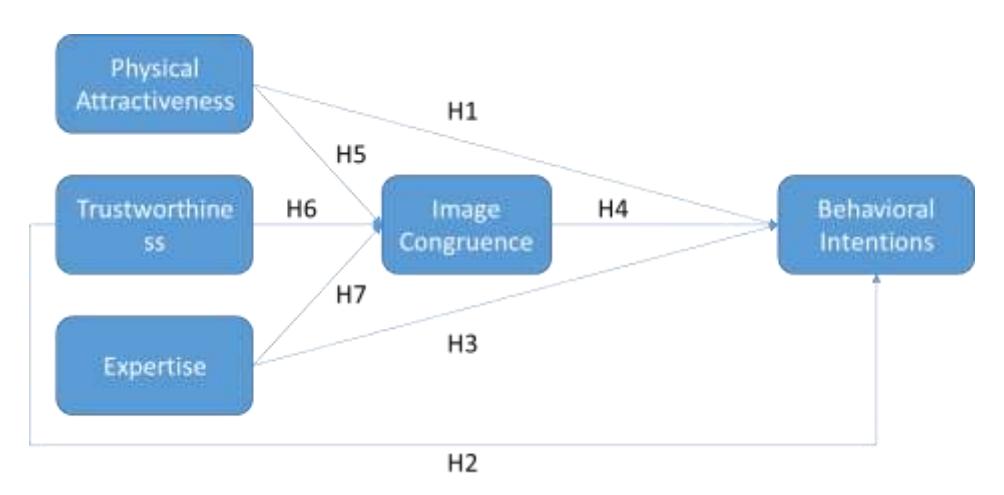
Figure 1. The Hypothesized Model
3.2 Research Design
The questionnaire for survey had twenty-two items to operationalize the five constructs of the model. The twenty-two items were sourced from prior research and were rated by respondents on a 5-point Likert scale. The operationalizing items are listed in table 1 along with their construct and prior study from which they were adopted.
Table 1. The Hypothesized Model
| Construct | Operationalizing Statement | Sourced from |
|---|---|---|
| Celebrity | I find the celebrity endorser qualified in subject matter of travel | Ohanian (1991) |
| Expertise | I find the celebrity endorser experience in subject matter of travel | |
| I find the celebrity endorser skilled in subject matter of travel | ||
| I find the celebrity endorser an expert in subject matter of travel | ||
| I find the celebrity endorser knowledgeable in subject matter of travel | ||
| Celebrity | I find the celebrity endorser honest | Ohanian (1991) |
| Trustworthiness | I find the celebrity endorser reliable | |
| I find the celebrity endorser sincere | ||
| I find the celebrity endorser trustworthy | ||
| I find the celebrity endorser dependable | ||
| Celebrity | I find the celebrity endorser sexy | Ohanian (1991) |
| Physical | I find the celebrity endorser handsome/beautiful | |
| Attractiveness | I find the celebrity endorser attractive | |
| I find the celebrity endorser classy | ||
| I find the celebrity endorser elegant | ||
| Celebrity-Image | This destination tourist is consistent with how I believe others see the | Sirgy & Su (2000) |
| Congruence | celebrity endorser | |
| This destination tourist is consistent with how I like to see the | ||
| celebrity endorser | ||
| This destination tourist is consistent with how I would like others to | ||
| see the celebrity endorser | ||
| This destination tourist is consistent with how I see the celebrity | ||
| endorser | ||
| Behavioural | I would like to go to other such destinations in future | Yen & Teng |
| Intentions | I would like to recommend this destination to others | (2013) |
| I would like to revisit destination again |
Another four questions on age, gender, education and family income captured the demographic break-up of the respondents. The data for the study was collected using convenient online sampling of adults in India. The online method of data collection allowed for a larger sample size of 310 usable responses (42 responses were incomplete and hence not used in analysis) and it ensured standardized data from respondents resulting in direct comparisons between responses with the use of statistical analyses (Saunders et al., 2003). Sample size was calculated using N:q rule (Kline,1998) where N refers to the number of observations required to the number of parameters (q) to be estimated. Kline (1998) suggested a required sample size of around 10:1. With 22 questions, our sample size of 310 is much larger than the suggested size as indicated by Kline (1998). The frequency distribution of surveyed sample respondents is given in table 2.
Table 2. Frequency distribution of sample
| Variable | Frequency | Percentage | |
|---|---|---|---|
| Age | |||
| Less than 20 | 28 | 9.0 | |
| 20 – 30 | 277 | 89.4 | |
| 31 – 40 | 3 | 1.0 | |
| 41 – 50 | 1 | .3 | |
| More than 60 | 1 | .3 | |
| Gender | |||
| Male | 191 | 61.6 | |
| Female | 119 | 38.4 | |
| Highest Education Level | |||
| Higher Secondary (Grade XIIth) | 22 | 7.1 | |
| Undergraduate | 122 | 39.4 | |
| Postgraduate | 165 | 53.2 | |
| More than Postgraduate | 1 | .3 | |
| Monthly Family Income in INR | |||
| Less than INR 20,000 | 41 | 13.2 | |
| INR 20,000 - INR 50,000 | 37 | 11.9 | |
| INR 50,000 - INR 1,00,000 | 78 | 25.2 | |
| More than INR 1,00,000 | 154 | 49.7 | |
4. Results and Findings
The constructs of hypothesised model were validated through exploratory factor analysis. Principal factor analysis (eigen value λ > 1) with Varimax rotation method was carried out. During the refinement process, the following item was dropped due to cross loading: 'I find the celebrity endorser dependable'. Kaiser-Meyer-Olkin measure of sampling adequacy was >0.8 indicating the sufficiency of sample size and results also had a significant χ2 at <.001 as per the Barlett's Test of Sphericity.
Cronbach's alpha coefficient was calculated to measure reliability of the multi-item constructs. Reliability of constructs was established since Cronbach alpha coefficients of all constructs was found to be greater than 0.7, suggesting that the constructs are reliable (Nunnally, 1978). Table 3 shows the reliability values recorded for the constructs. Thereafter, we examined convergent validity of the constructs by examining the average variance extracted for each construct. AVE for all constructs (Table 3) was above the recommended threshold of 0.5 and hence convergent validity was established.
| Construct | Cronbach Alpha | Average Variance Extracted (AVE) | |
|---|---|---|---|
| Physical Attractiveness | 0.779 | 0.44 | |
| Trustworthiness | 0.903 | 0.64 | |
| Expertise | 0.905 | 0.6 | |
| Image Congruence | 0.835 | 0.57 | |
0.782
0.6
Table 3. Convergent validity and reliability of construct
Post establishing convergent validity, we examined constructs whether constructs had sufficient discriminant validity. Establishing discriminant validity warrants that square root of each construct's AVE be greater than the construct's correlation with other constructs. Results in Table 4 suggests that sufficient discriminant validity with square root of AVE for each construct being higher than its correlation with other constructs.
Table 4. Correlations between research constructs
| Physical Attractiveness | Trustworthiness | Expertise | Image Congruence | Behavioural Intention | |
|---|---|---|---|---|---|
| Physical Attractiveness | 0.67 | ||||
| Trustworthiness | 0.537 | 0.8 | |||
| Expertise | 0.429 | 0.526 | 0.78 | ||
| Image Congruence | 0.47 | 0.437 | 0.54 | 0.75 | |
| Behavioural Intention | 0.393 | 0.424 | 0.489 | 0.392 | 0.77 |
Note: The bold elements in diagonal are the square root of AVE
Behavioural Intentions
Having established the reliability, convergent and discriminant validity of the constructs, we carried out hypotheses testing using Structured Equation Modelling (SEM). SEM was carried out using AMOS 27. Results of SEM are presented in Figure 2. The figure shows the standardized coefficients along with their statistical significance.
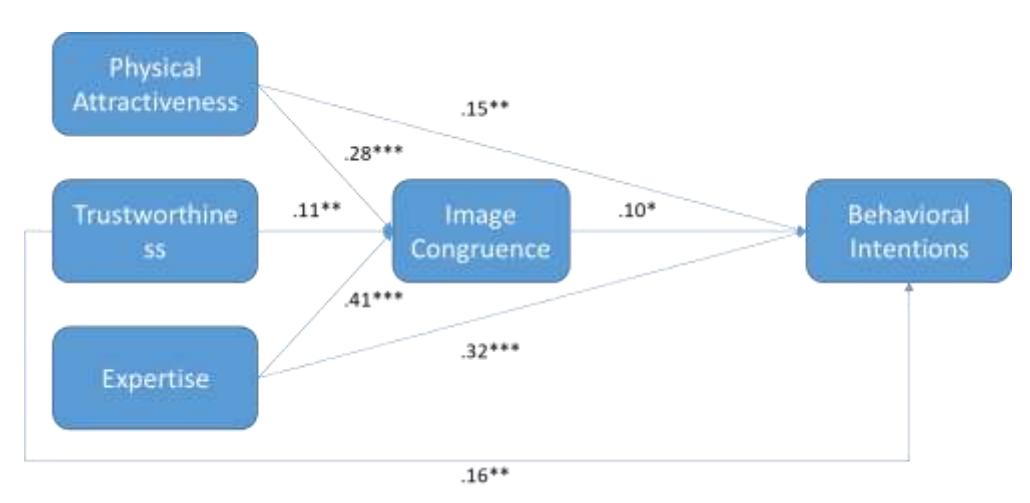
Figure 2. Results of Structured Equation Modelling
Note: *** significance at 0.01, ** significance at 0.05, *significance at 0.1
Results of hypotheses testing reveal that physical attractiveness of the celebrity endorser, their perceived expertise and level of trust that audience had on celebrity had a significant impact on the Image congruence. This lent support to our hypothesis H5, H6 and H7. Image congruence was also found to have a significant impact on behavioural intention. This lends support to H4.
Finally, the results also highlighted a direct significant impact of physical attractiveness of the celebrity endorser, their perceived expertise and level of trust that audience had on celebrity had a significant impact on their behavioural intention. This lent support to our hypothesis H1, H2 and H3.
Summary of hypotheses testing is presented in Table 5:
Hypothesis Hypothesis description Results H1 Physical attractiveness of celebrity endorser will have a positive impact on behavioural intention Accepted H2 Trustworthiness of celebrity endorser will have a positive impact on behavioural intention Accepted H3 Expertise of celebrity endorser will have a positive impact on behavioural intention Accepted H4 Image congruence between celebrity endorser and destination will have a positive impact on behavioural intention Accepted H5 Physical attractiveness of celebrity endorser will have a positive impact on Image congruence Accepted H6 Trustworthiness of celebrity endorser will have a positive impact on Image congruence Accepted H7 Expertise of celebrity endorser will have a positive impact on Image congruence Accepted
Table 5. Summary of Hypotheses testing
5. Discussion
The objective of this research was to investigate how the perceived Image Congruence of the traveller influences the relationship between celebrity endorser attributes and travel behaviour intentions in the tourism context. We specifically explored the mediating role of perceived Image Congruence of a tourist with the celebrity endorsing a destination while studying the impact of relevant celebrity characteristics on the traveller intention to visit.
The empirical results suggest that a) endorser celebrity traits of physical attractiveness, trustworthiness, and expertise positively impact a tourist's intention to revisit or recommend the endorsed destination b) greater Image Congruence between the celebrity endorser and the endorsed destination suggests higher intention of the traveller to visit the destination c) celebrity endorser characteristics of physical attractiveness, trustworthiness, and expertise positively influence the Image Congruence between the celebrity and the destination.
The positive impact of the celebrity endorser on purchase intention of consumers and the influence of Image Congruence during consumer decision-making process is well established (Ohanian, 1991; Sirgy & Su, 2000). While, the positive impact of celebrity endorsement and Image Congruence on a traveller's intention to visit is in line with established literature, empirically demonstrating the results in tourism context is one of the academic contributions of this research. However, the most important contribution of this study is to demonstrate how the celebrity endorser characteristics and destination Image Congruence jointly influence the traveller behaviour intentions, something not researched earlier in academic literature. The results suggest that greater the extent of physical attractiveness, trustworthiness, and expertise more will the prospective traveller relate his or her image to that of the destination and the tourists at the destination. Further, this greater perceived congruity between himself or herself with the destination image shall subsequently lead to higher
travel intent for the traveller to the endorsed destination. The results of this research have academic significance since they not only establish that celebrity endorsements positively impact purchase intention of tourists in tourism context, but also explain 'why' are traveller purchase intentions getting influenced using the concept of Image Congruence.
The results also have implications for the Destination Management Organizations (DMOs) aiming to differentiate their destination in the highly competitive tourism industry. As noted earlier, destination branding and advertising is a critical differentiation strategy that can be applied to attract more tourists and create a positive destination-tourist relationship (Chen & Phou, 2013; Kumar, 2016; Piggot et al., 2010). The results of this research suggest that destinations that collaborate with celebrity endorsers shall experience an increase in number of tourists intending to travel to the corresponding destination. More importantly, the results propose that the celebrity to endorse the destination needs to be identified carefully. The endorser celebrity should not only be either physically attractive, trustworthy, or a tourism expert (Ohanian, 1991), but also have an image that is congruent with the destination image and consistent with the perceived image that the prospective tourist has of himself or herself (Sirgy & Su, 2000).
6. Conclusion
Celebrity endorsements are influential in impacting purchase intention of consumers. This research further confirms this finding specifically in tourism context. The present study also validates prior tourism studies that the destination choice of a traveller is influenced by the extent of perceived congruity between the traveller and the destination under consideration. The study contributes to the existing body of academic literature by demonstrating the combined influence of celebrity characteristics and image congruence on the travel intentions of a tourist. The results of this research validate that identified celebrity traits positively influence the sense of congruity between the prospective traveller and the destination, and the increased image congruence subsequently raises the likelihood of destination visit by the traveller.
With tourism destination competitiveness growing significantly over the years, it is critical for destination managers to adopt a differentiation strategy that is impactful as well as relevant for the targeted travellers. This research benefits the practitioners by suggesting that destinations should focus on carving a messaging strategy focusing on how the destination image is consistent with how the targeted traveller perceives himself or herself with the messaging source being a celebrity who is either physically attractive, trustworthy or a travel expert.
The present study is limited in terms of sampling being convenient sampling but considering that participants in sample are demographically diversified, the limitation might not be acute. Subsequent studies might want to further investigate how celebrities segmented based on attractiveness, trustworthiness, and expertise would have differential impact on diverse destination types like natural, heritage, religious, or film.