

1. Introduction
Job crafting is defined as "the physical and cognitive changes individuals make in the task or relational boundaries of their work" (Wrzesniewski & Dutton, 2001). By improving job performance, job crafting results in positive outcomes for individuals and organizations. Many factors explain the job crafting and job performance relationship. Personally, it results in job satisfaction (Kim, Im, Qu, & NamKoong, 2018), health, well-being (Bakker et al., 2016). By being proactively involved in the job crafting, the employees have enhanced job engagement (Chen, Yen, & Tsai, 2014; Shin, Hur, & Choi, 2020; Tims et al., 2012). The process of job crafting enable the individuals to reframe the purpose of the job (Wrzesniewski & Dutton, 2001) and resulted in a positive change in work identity, self–image, and meaningfulness (Mattarelli & Tagliaventi, 2015; Wrzesniewski et al.,, 2013). Employee develops personal resources of hope, optimism, resilience, and self-efficacy (Van Wingerden, Bakker, & Derks, 2017) which are predictors of employee motivations (Bakker & Demerouti, 2014). The accumulated extra resources, making them psychologically available to meet job demands more easily and protects them from stress, burnout, and exhaustion (Nielsen & Abildgaard, 2012; Petrou et al., 2015; Singh, & Singh, 2018). In the process of crafting, the employee develops enhanced professional competence and the ability to cope with future adversity (Berg, Dutton, & Wrzesniewski, 2007). Crafting positively and significantly influences employees' task and contextual performance (Esmaeili, Mohammad, & Soltani, 2019). Job crafting behaviors benefit organizational outcomes as it reduces turnover and higher performance (Tims & Bakker, 2010).
Briefly, job crafting reduces job demands through the enhancement of personal resources and enables the employees to show better performance, as explained by the job demand and resource model (Bakker, & Demerouti, 2007). The enhanced resources may be due to the positive emotion the employee develops in the process of job crafting. Job crafting is a proactive initiative of the employees. The employees enjoy the process of crafting which results in positive experiences such as achievement, enjoyment, and meaning in the professional life (Tims, Bakker, & Derks, 2015). As a result, they find the job interesting as well as rewarding. In this process, employees develop new skills. Hence, the opportunity to craft the job may be a 'positive affective event' in the organization. This positive event triggers employees' positive emotions which can be the reason for the development of personal resources, and better job performance (Peñalver et al., 2019). Positive affectivity in the workplace moderates the impact of burnout on the extra role behavior and quitting intentions (Yavas, Karatepe, & Babakus, 2018). The job demand - resource (JD-R) model, and the available literature of crafting are silent about this emotional aspect or overlooked this 'positive affect' aspect that mediates the crafting and job performance. Though the process of crafting is employee-driven (Costantini, & Sartori, 2018), the organizational culture and the role of the managers are also important in facilitating the process (Kim, Im & Qu, 2018; Zhang, Wang, & Shi, 2012). The employees successfully overcome the crafting challenges and enhance their skill, competence (Berg, Dutton, & Wrzesniewski, 2007). As a result, employees may be grateful to the managers for the given opportunity. Gratitude is defined as "a positive emotional reaction experienced by the beneficiary when s/he perceives to have benefited from the other party's altruistic act" (Tsang, 2006). Feeling grateful can provide personal resources that can cope with the job demand (Converso et al., 2015; Martini & Converso, 2014). We contend that job crafting can be an antecedent in eliciting gratitude and enhances job performance. To our little knowledge, we found only one study relating gratitude and job crafting (Chen et al., 2021) in which the focus was on job satisfaction. The job satisfaction should result in better perfrmance which was not studied. Moreover, job crafting may provide some scope for the employees to develop gratitude. Hence, it would be more meaningful to examine the job crafting as antecedent and gratitude as a mediator while examining the crafting and job performance relationship Studies have acknowledged the need for crafting among service personal in the tourism industry to enhance job performance (Luu, 2020; Tuan, 2020). The crafting research among the service personal of tourism is important because, in the hospitality sector, the service provider is also part of the product itself. The customers' feeling of being valued or respected by the service person is a key factor that determines customer satisfaction in the industry (Scott-Halsell, Blum, & Huffman, 2008). Any investment in them (e.g. autonomy to craft their job), positively influences customer-oriented behavior through job satisfaction (Choi, & Joung, 2017). In this study, we intend to examine the mediating role of gratitude between job crafting and job performance among the sales employees of tourism companies in India.
We make the following notable contributions to the gratitude and job crafting literature. By exploring the role of gratitude, we show that the crafting process can be a workplace antecedent of a positive affective event and may elicit a grateful feeling. Second, gratitude can provide personal resources that can counter the job demands and enhance job performance which has not been explored in the job demand–resource model to explain the consequences of job crafting. Collectively, our study provides evidence to suggest that employee-driven initiative, not necessarily the HR or top management, can also be a source of triggering workplace desired behavior, and contributes to better performance.
2. Theory and Hypothesis
Affective events theory (Converso et al., 2015) explains how the job performance, as well as job satisfaction of employees, got influenced by their 'affect' (O'Donoghue, Conway, & Bosak, 2016). The affective event theory applies to all emotions (both positive and negative). The workplace (positive or negative) events influence the employees' feelings and subsequently their workplace behavior (Diener, Thapa, & Tay, 2020). A reward makes the employees happy, satisfied with the job, and motivates them to perform better. An unfair reward distribution may make the employee unhappy, dissatisfied, and demotivated to work. Similarly, we can attribute emotions to all the events in the organization. An event that benefits the employees, might elicit a feeling of gratitude. For example, certain HR practices such as reward management or employee training significantly influence employee engagement, and performance (Ali Ababneh, Awwad, & Abu-Haija, 2021; Chien, Mao, Nergui, & Chang, 2020; Presbitero, 2017) and therefore may act as a positive affect in the organization. Job crafting cultivates skill enhancement, process improvement in the job, and empowers the employee to have control over the environment (Costantini, & Sartori, 2018; Van Wingerden, Derks, & Bakker, 2017). The manager and the organizational culture facilitate the crafting process. Hence the employees may feel grateful for the same. This positive emotion of gratitude provides necessary personal and social resources to cope up with the job demands and better job performance, as contended by the Job demand and resource model (Bakker & Demerouti, 2007).
Proactive personality and job performance are positively correlated (Sumaneeva, Karadas, & Avci, 2021). Job crafting, being a proactive initiative of employees, can have the three different forms. First, task crafting where employees alter the number of tasks in the job or by changing the way the job is performed. Second, relational crafting where employees change the intensity of interactions with others both on the job and finally, cognitive crafting where employees change the meaning of their job by reframing the impact the job has on them because the task and relational crafting could represent changes in job characteristics (Wrzesniewski & Dutton, 2001).
Through task crafting, employees increase or decrease the no of tasks involved or change the way the work was being carried out. Thus, the employee tries to have control over the process, improve the process so that better performance is exhibited. Through relational crafting, employees actively change social relationships with their colleagues and develop additional relationships (Batova, 2018; Murray, 2014). For example, Employees may seek feedback from others about their crafting process and develop or strengthen new relationships (Bruning & Campion, 2018). The process of getting support and assurance (Renkema et al., 2018); gaining confidence and appreciation (Grant-Vallone & Ensher, 2017; Lyons, 2008) from colleagues for the crafted work or improved work process builds social and emotional resources. Through cognitive crafting, the employees redefine their view of the nature of tasks or relationships or reframe in such a way that the work positively impacts the lives of others (Berg et al., 2010b) or reframe the job's purpose (Singh & Singh, 2016). When people reconstruct their meaning, its viewed as the success of the organization.
Engaging in job crafting increases employees' perception of their self-confidence (Buonocore et al., 2018; Janssen et al., 2016). Employees improved psychological availability due to their higher emotional, physical, and cognitive resources (Singh, & Singh, 2018) engage them in the job. The employees have meaningfulness, esteem-enhanced occupational identity, and job satisfaction from job crafting (Fuller & Unwin, 2017; Meged, 2017). Performance modifications in the job lead to a more resourceful and challenging work environment for employees. It motivates them to pursue the goal (Tims & Bakker, 2010), and intrinsically, leads to satisfaction of basic human needs (Ryan & Deci, 2000).
The above studies explain the crafting and performance relationship through multiple mediating mechanisms. What is ignored in the study is the 'affect' aspect of job crafting. Job crafting is a 56 R, Bala Subramanian. et al.
voluntary behavior of the employee (Singh, & Singh, 2018) with the moral motive of making the work environment a better one. There is an opportunity to improve the process either through task modification, managing relations, and cognition. The manager or the organization's culture provides a supportive platform for the employees (Lazazzara, Tims, & De Gennaro, 2020). By successfully managing them, the employee overcomes the hindrance stressors, got positive feedback, and appreciation from the colleagues. This motivates the employees to pursue their job crafting efforts (Batova, 2018). Thus, the process of crafting can be an antecedent for generating positive affect in the workplace. The employee will be grateful to the people (manager, colleagues), an organization for the support provided.
The grateful feeling provides personal and social resources to perform the job better. Personally, gratitude enhances wellbeing, reduces stress (Jans-Beken et al., 2020; Stegen, & Wankier, 2018), and results in positive evaluation (Williams & Bartlett, 2015) of the work environment and the fellow workers. They easily recollect the positive things (Dickens, 2017). This enables them to count the blessing in the job as well as in the organization. Grateful people can recall positive things (positive memory bias) easily. They tend to reinterpret the situation positively due to a positive coping strategy. The received benefit in the work context is appraised positively, seeing the help as more valuable, costlier to offer, and more altruistically motivated (Wood et al., 2008).
Socially, grateful feeling strengthens the relationship with the workers as gratitude and pro-social behavior have a significant positive relationship (Ma, Tunney, & Ferguson, 2017). For example, successful employees encourage their colleagues in the job crafting process as well (Fuller & Unwin, 2017; Mattarelli & Tagliaventi, 2015), a type of pro-social behavior. The feeling of gratitude triggers goodwill within the social network (Chang, Lin, & Chen, 2012), and encourages collaborative information sharing in the team (Pillay et al., 2020). Employees' collective gratitude leads to highquality connections among the employees and firm service innovativeness (Akgün et al., 2016). These prosocial consequences of gratitude promote organizational citizenship behaviors (Ford et al., 2018; Jimenez, 2018) and loyalty to the organization (Osborne, Smith, &Huo, 2012; (Dasborough, Hannah, & Zhu, 2019). Prosocial behavior is an 'other-oriented trait. This other orientation, gratitude, and job performance are positively related. Grateful employees tend to do high core self-evaluation which motivates them to perform better (Grant, & Wrzesniewski, 2010). Thus, the job crafting, and performance relationship are explained by gratitude. To state formally, we hypothesize that gratitude mediates the relationship between job crafting and performance.
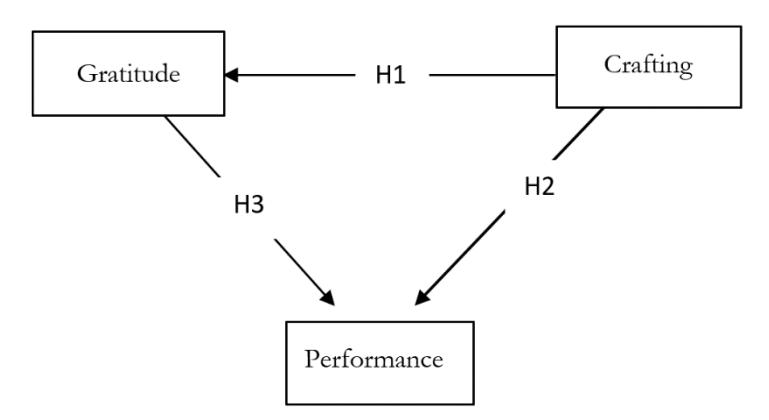
Figure 1. Conceptual model
- H1: Crafting influences on gratitude positively.
- H2: Crafting has a positive impact on the performance.
- H3: Gratitude mediates the relationship between crafting and performance.
3. Method
We contacted 25 team leaders of popular tourism and hospitality companies that have a pan India presence. They offer a wide variety of services in multiple business domains related to tourism and hospitality. A letter of requisition was sent to the regional head of tourism and hospitality companies, in India, stating the study purpose and a request for the participation of the sales team leaders as well as their members. Each of the team leaders has five to six salespeople in their team. Their role is characterized by attending to the query of individuals, groups, corporate, and converting the queries into business. Their performance is directly linked to the organizational goals. Participation in the survey was purely voluntary, and we assured perfect confidentiality to all the participants. Data was collected over 40 days from October to November 2019.
2.1. Samples
The study was carried out among the sales service personal of these companies. A total of 103 team members responded to the survey from 11 different organizations. The team leaders have also sent their scores for these members separately.
2.2. Measures
The questionnaire measures the job crafting, gratitude, and job performance. The details of the same is present in (Table 1).
| Variable measured | No of items | Authors |
|---|---|---|
| Job crafting | 5 | Tims et al.'s (2012) |
| Gratitude | 3 | Bartlett and DeSteno, (2006) |
| Job performance | 5 | Kirkman & Rosen (1999) and Post (2015) |
Table 1. Measures used
Job crafting – Job crafting was measured by three sub-dimensions of Tims et al.'s (2012) job crafting scale (as in Bakker et al., 2012): "increasing structural job resources" (Cronbach's alphas was .76), "increasing social job resources" (Cronbach's alphas was.69), and "increasing challenging job demands" (Cronbach's alphas was .72). Each sub-scale included five statements (e.g., "I try to develop myself professionally", "I ask others for feedback on my job performance", and "When an interesting project comes along, I offer myself proactively as project co-worker" respectively). Items were answered using a 7-point frequency scale (from 1 = Never to 7 = Always). The employees did selfrating about their job crafting.
Gratitude – Gratitude was assessed via the most widely used and validated scale, three items. This scale was a modified version of Bartlett and DeSteno, (2006) in which we measured employees' gratitude towards their coworkers and organization. The employees did self-rating about their feeling of gratitude.
Job performance – The job performance scale contained five items. It was adopted from Kirkman & Rosen (1999) and Post (2015). The team leaders of the respective salespeople rated employees on a five-point scale (1 – Inadequate, 5 – Beyond expectations) based on their performance appraisal of the company.
Control variables – We have kept gender, organizational tenure, and age as control variables.
58 R, Bala Subramanian. et al.
4. Analysis
3.1. Reliability and normality analysis
We have done the structural equaleling model (SEM) process with the maximum likelihood estimation technique (Ladhari, 2007) to do justice with statistical testing that is typically be considered a comparatively robust estimation alternative (Joreskog & Sorbom, 1993; Ladhari, 2007). All the values of Cronbach's alpha coefficients (Table-2) are meeting the minimum required level of 0.70 (Fornell & Larker, 1981; Hair et al., 2008; Nunnally, 1978).
| Factors | Items | Factor loading (Standardized value) | Cronbach's Alpha coefficient | Average Variance Extracted | Composite Reliability |
|---|---|---|---|---|---|
| Crafting | CC1 | 0.8125 | |||
| CC2 | 0.7915 | ||||
| CC3 | 0.7165 | 0.901 | 0.581 | 0.873 | |
| RC1 | 0.7495 | ||||
| RC2 | 0.7355 | ||||
| Performance | P1 | 0.7735 | |||
| P2 | 0.8435 | 0.869 | 0.625 | 0.833 | |
| P3 | 0.7515 | ||||
| Gratitude | G1 | 0.7375 | |||
| G2 | 0.7615 | 0.847 | 0.592 | 0.813 | |
| G3 | 0.8075 |
Table 2: Factor analysis results
3.2. Construct validity
(Table 2) indicates all the factor loadings (latent variables) in this present study are having a higher value of 0.50 and above that confirms the minimum required factor analysis (Hair et al., 2008), and are to be considered as significant at the 0.01 level indicating convergent validity (Kline, 1998; Anderson & Gerbing, 1988, Hair et al., 2008).
The composite reliability (CR) of all factors or dimensions values (Table-2) are meeting the minimum average, with values 0.70 and above, (Hair et al., 2008; Bagozzi & Yi, 1988), which supports the interior constancy of the tested model.
The different values of Average Variance Extracted (AVE) of all constructs (Table-2), which are: 0.581 (Crafting), 0.625 (Gratitude), and 0.592 (Performance). This can be observed that all the construct maintained the minimum standards of statistical convergence (Hair et al., 2008; Fornell & Larker, 1981).
(Table 3) indicates the model fit indices. This indicates that all the model fit indices are acceptable and validate the acceptance of the tested SEM model in the present study.
Model Fit Indices Value Cut-off for good fit Chi-square statistic 92.943 (Probability level=.000) p-value> 0.05 (Awang, 2012; Hooper et al., 2008; Kline, 2005) χ 2 / d. f 2.2673 close to or less than 3 specifies a good fit (Awang, 2012; Hooper et al., 2008; Kline, 2005) Normed Fit Index (NFI) 0.961 NFI ≥ 0.95 Comparative Fit Index (CFI) 0.952 CFI ≥.90 (Fan, Thompson, & Wang, 1999) Goodness-of-Fit Index (GFI) 0.943 GFI ≥ 0.90(Awang,2012; Kline, 2005; Hair et al., 2008) Adjusted Goodness-of-Fit Index (AGFI) 0.907 AGFI ≥0.90 Tucker Lewis Index () 0.936 TLI > .90 (Byrne, 1994; Tucker & Lewis, 1973) Relative Fit Index (RFI) 0.891 RFI close to 1 specifies a good fit RMSEA 0.067 RMSEA < 0.08 (Awang, 2012; Hooper et al., 2008) PCLOSE 0.006 close to zero specifies a good fit (Awang, 2012; Hooper et al., 2008)
Table 3: Model Fit Indices of the current research model
3.3. Structural equation modeling (SEM) procedures
(Table 4) presents the value for the supported relationships among the latent variables. The statistical results of SEM (Table-3) demonstrates that Crafting is having a significant positive influence on Gratitude (Path Coefficient =0.637, t =7.532, p-value < 0.01), Crafting is having important effect on Performance (Path Coefficient =0.238, t = 2.661, p-value < 0.01) and Gratitude is having a strong positive effect on Performance (Path Coefficient =0.382, t = 4.378, p-value < 0.01).
Default or Basic Model Hypotheses and Path standardized Path coefficients S.E. t-value P Results H1:Crafting Gratitude 0.637 0.085 7.532 ** Supported H2: Crafting Performance 0.238 0.089 2.661 0.008 Supported H3: Gratitude Performance 0.382 0.087 4.378 ** Supported
Table 4. Testing of Hypotheses
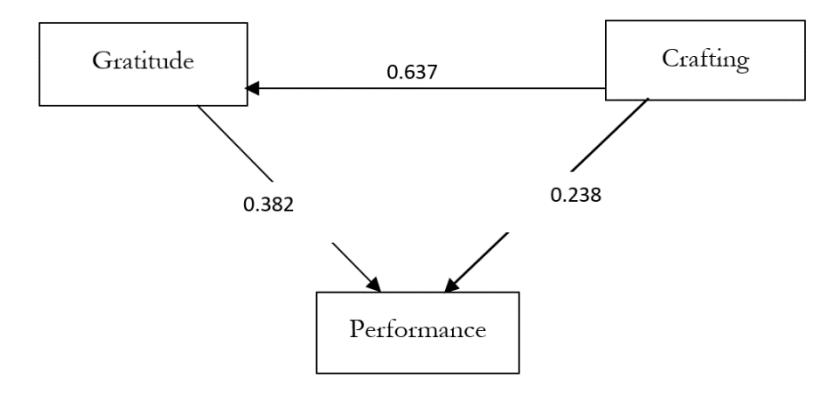
Figure 2. Tested model
60 R, Bala Subramanian. et al.
The indirect effect in crafting gratitude to performance indicates the partial mediation role of gratitude (Table 5). That signifies the mediating role of gratitude in strengthening the relationship between crafting and performance.
Table 5. Estimated direct and indirect effects
| Mediating path | Direct effect | Indirect effect |
|---|---|---|
| Crafting – Performance | 0.238 | |
| Gratitude – Performance | 0.382 | |
| Crafting – Gratitude – Performance | 0.243 (Partial mediation) |
5. Discussion
We proposed that employees' job crafting, and performance relationship is mediated by employees' gratitude. The hypothesis got supported in our study. Job crafting and performance were positively related, as supported by research (Esmaeili, Mohammad, & Soltani, 2019). Gratitude mediated this relationship which is our contribution from this study.
Gratitude's personal and social consequences explain the mediating role. Personally, grateful feelings positive association enables employees to find opportunities for growth in the workplace instead of complaining or disengaging from the work. The positive memory bias, positive coping strategy, and positive benefit appraisal, due to gratitude, employees develop a 'grateful outlook' (ability to infer with the positivity) in their perception. Such a 'grateful outlook' enhances their psychological immunity (due to the experience of gratitude) and confers resilience to depression in later life (Emmons & Crumpler, 2000).
Gratitude's pro-social consequences play a key role in the mediation of crafting and performance relationships. The feedback and appreciation of the colleagues about the crafting process is a 'responsive interaction' of the coworkers. It shows how much a coworker cares about the other for which the employee feels grateful feeling towards them, develop a close bond with them (Algoe, 2012). The earned social resources facilitate better job performance. Personally, grateful feelings promote well-being and enable the employees with positive perception (Williams, & Bartlett, 2015). Employees will feel grateful for the support provided in overcoming the obstacles while crafting the job. They try to look at the challenges rather than obstacles. Having successfully overcome the challenges was also one of the reasons for this. Therefore, they positively evaluate the challenges in the work environment. So, a target (or an enhanced target) is seen as an opportunity to perform better or earn more.
6. Conclusion
Organizational scholars continue to research job crafting, job performance, and their mediating variables. Scant attention has been devoted to the associated positive emotion in this process, particularly among hospitality and tourism sector employees. The objective of the study was to explore the mediating role of gratitude between job crafting and job performance among the sales employees of tourism and hospitality organizations in India. The study results got support for the proposed hypothesis, explained by affective event theory, in addition to the job demand and resources model. We conclude that job crafting is a workplace antecedent of positive affect, can elicit employees' grateful feelings, and results in job performance.
Theoretically, we have integrated the job resource-demand model and affective event theory and proposed that job rafting is a workplace antecedent of gratitude. We have shown a different mediating
mechanism (emotion) that explains the crafting and performance relationship. Gratitude studies in organizations recommended the different ways of cultivating gratitude in the workplace (Fehr et al., 2017). Job crafting is one such efficient way. It is an efficient way of cultivating gratitude because, compared to other organizational sources of gratitude (reward, appreciation program), crafting is driven by the employees (Bruning & Campion, 2018), not involving any cost to the organizations, improves the work process, outcome as well as inspires others to craft the job. Management can influence some of the causative factors of employees' emotional exhaustion (Schiffinger, & Braun, 2020). Organizations aiming to do so can do through organizationally based gratitude interventions and by institutionalizing gratitude into workplace culture to enhance performance. By facilitating job crafting in the organization, managers can cultivate gratitude and harvest the positive organizational behavior of the employees with less effort.
This article has several managerial implications. An interesting outcome in this research is that when crafting passes through gratitude, the performance results increase. Breaking the monotony and promoting the creativity to perform the job within the bounded framework can encourage human resources to perform better. In the service business, people are considered as one of the important strategic elements and are also considered internal customers. Employees' satisfaction leads to better consumers management and promotes loyalty. Any little effort and encouragement for job crafting may increase employees' motivation and gratitude. Organizations engaged in services business can facilitate its employees for job crafting that motivates the employees to contribute to business success.
7. Limitation and Direction for Future Research
Instead of restricting to a certain job (sales), future studies can expand the scope for a variety of jobs. Though the job performance is rated by the team leader, a lack of objective rating (maybe performance appraisal) is another limitation. As certain personalities are prone to initiate (therefore crafting), future studies can take personality variables as a moderator to examine this relationship. The supportive role of colleagues, managers, or culture facilitates job crafting and performance. It's worthwhile to explore these supportive roles as a moderator. Though we have established that gratitude is positively related to job performance, what mediates this relationship is a potential area to be explored. The mediating factors can be personal or social resources. A similar examination between crafting and gratitude is solicited. The positive association of self-efficacy with gratitude and crafting suggests it as a potential mediator. We encourage continued research along these lines to have a nuanced understanding of other positive emotions as well.