

1. Introduction
The hospitality sector is a fiercely competitive, vibrant, and ever-changing one. Maintaining a competitive edge in this market requires exceeding consumer expectations and providing high-quality services. But obtaining high operational performance levels is a challenging endeavor that incorporates various elements, such as supply chain management techniques and client orientation.
The efficient and effective delivery of goods and services to clients depends on supply chain management methods. Efficient supply chain management techniques can enhance inventory control, shorten lead times, and boost customer satisfaction. Conversely, customer orientation entails exceeding consumers' expectations and meeting their demands. A focus on the needs of the customer can result in greater client happiness, repeat business, and favorable word-of-mouth recommendations.
In recent years, empirical researchers have acknowledged the significance of customer focus and supply chain management strategies in the hotel sector. These two criteria have been the subject of several studies, each on their own, but we need more research to determine how they interact to affect hotel operational effectiveness.
This study examines the effects of customer focus and supply chain management strategies on hotel operational performance. The study will examine the overall impact on how well operations execute in the hotel sector. The study's conclusions will offer helpful advice and suggestions to hotel managers who want to enhance customer focus and supply chain management procedures to gain a lasting competitive advantage.This study is critical because it will add knowledge about supply chain management strategies and customer focus in the hospitality sector. It will also assist hotel managers in making defensible decisions to enhance operational effectiveness.
2. Literature Review
A study by (Mohamad et al., 2017) revealed that effective supply chain management practices, such as strategic supplier partnership, & information sharing levels, significantly impact operational performance in the hospitality industry leading to improved inventory management, reduced lead time, and increased customer satisfaction. (Aldehayyat and Al Khattab, 2012), who highlighted the critical role of supply chain management practices in improving the competitiveness of hotels, have also reported similar findings.A study by (Yang et al., 2019) found that customer orientation directly and positively impacts hotel operational performance. The study suggests that customer orientation positively influenced employee satisfaction and retention, leading to improved operational performance. Other studies have also highlighted the importance of customer orientation in the hospitality industry, such as the study by (Kim et al., 2019), which found that customer orientation positively influenced hotel performance.(Huang, Kuo, and Wu, 2019) found that effective supply chain management practices can improve hotel operational performance, particularly in terms of cost reduction and customer satisfaction. (Wang and Chen, 2016) also found a positive relationship between effective supply chain management practices and hotel operational performance.(Li and Liang, 2020) found that customer orientation positively influences hotel performance, particularly in terms of customer satisfaction and loyalty.
In the context of revenue management, (Kim and Lee, 2019) found that effective supply chain management practices can improve revenue management performance, particularly regarding demand forecasting and pricing. (Berezina and Cobanoglu, 2015) also found that effective supply chain management practices can improve hotel revenue management, particularly regarding inventory control and pricing strategies.(Lee, Min, and Min, 2016) found that sustainable supply chain
management practices can improve hotel performance, particularly in terms of customer satisfaction and loyalty. (Zhou, Wang, and Wang, 2020) also found that effective supply chain management practices can contribute to more sustainable business practices in the hotel industry, particularly regarding waste reduction and energy conservation.(Gao and Mattila, 2021) found that effective supply chain management practices can improve employee satisfaction, positively influencing customer loyalty.(Yu, Jiang, and Zhou, 2018) found that effective supply chain management practices can improve hotel financial performance, particularly cost reduction and revenue enhancement.(Huang, Kuo, and Wu, 2019) examined the impact of supply chain management on hotel operational performance, particularly in cost reduction and customer satisfaction.(Li and Liang, 2020) investigated the relationship between customer orientation and hotel performance. Their results showed that customer orientation positively influences hotel performance, particularly in terms of customer satisfaction and loyalty.
(Wang and Chen, 2016) examined the relationship between supply chain management practices, customer orientation, and hotel operational performance. Their findings showed that effective supply chain management practices and customer orientation strategies positively affect hotel operational performance.(Lee, Min, and Min, 2016) investigated the impact of supply chain management on hotel performance in the context of sustainable business practices. Their findings showed that sustainable supply chain management practices could improve hotel performance, particularly customer satisfaction, and loyalty.(Berezina and Cobanoglu, 2015) examined the impact of supply chain management on hotel revenue management. Their findings showed that effective supply chain management practices could improve hotel revenue management, particularly in inventory control and pricing strategies.(Kim and Lee, 2019) findings showed that effective supply chain management practices could improve revenue management performance, particularly in demand forecasting and pricing.(Li and Liang, 2020) investigated the impact of customer orientation and service innovation on hotel performance. Their results showed that customer orientation and service innovation positively influence hotel performance, particularly in terms of customer satisfaction and loyalty.(Gao and Mattila, 2021) examined the impact of supply chain management practices on hotel employee satisfaction and customer loyalty. Their findings showed that effective supply chain management practices could improve employee satisfaction, positively influencing customer loyalty.(Zhou, Wang, and Wang, 2020) investigated the impact of supply chain management practices on hotel environmental sustainability. Their results showed that sustainable business practices in terms of waste reduction and energy conservation are beneficial for hotels operations.(Yu, Jiang, and Zhou, 2018) examined the impact of supply chain management practices on hotel financial performance. Their findings showed that effective supply chain management practices could improve hotel financial performance, particularly cost reduction and revenue enhancement.(Chen, Lee, and Yen, 2017) found that supply chain management practices significantly positively impact Taiwanese hotels' performance. (Huang, Chang, and Chen, 2021) also found a positive impact of supply chain collaboration on hotel operation performance in Taiwan.(Nguyen, Nguyen, and Vu, 2019) found that supply chain management practices positively influence the performance of hotels in Vietnam. In Korea, (Lee, Hwang, and Kim, 2020) found that supply chain management practices positively impact small and medium-sized hotels' sustainability and financial performance.(Kusumastuti, Kristanti, and Kurniawan, 2017)found that customer orientation positively influences the performance of hotels in Surakarta, Indonesia. (Sun and Lai, 2019) found that customer orientation positively impacts hotel performance in China.(Huang, Chang, and Chen, 2021) found a positive relationship between supply chain collaboration and hotel operation performance in Taiwan. Similarly, (Nguyen, Nguyen, and Vu, 2019) reported that supply chain management practices positively impact hotel performance in Vietnam. (Han, Hyun, and Lee, 2018) also confirmed the positive impact of green supply chain management on hotel performance in South Korea.
In summary, research shows how crucial supply chain management strategies and a focus on the customer are to enhancing operational efficiency in the hotel sector. By examining the connection
between these two elements and their effects on hotel operational performance, this research article seeks to advance the body of knowledge. The study aims to provide practical recommendations to help hotel managers improve their supply chain management practices and customer orientation to achieve sustainable competitive advantage.
3. Methodology
3.1 Conceptual Model (Figure)
The conceptual model for this study explores the relationships between supply chain management practices (SCMP), customer orientation (CO), and hotel operations performance (HOP). This model posits two main hypotheses:
H1: The performance of hotel operations and supply chain management strategies are positively correlated.
H2: Customer orientation and hotel operating efficiency are positively correlated.
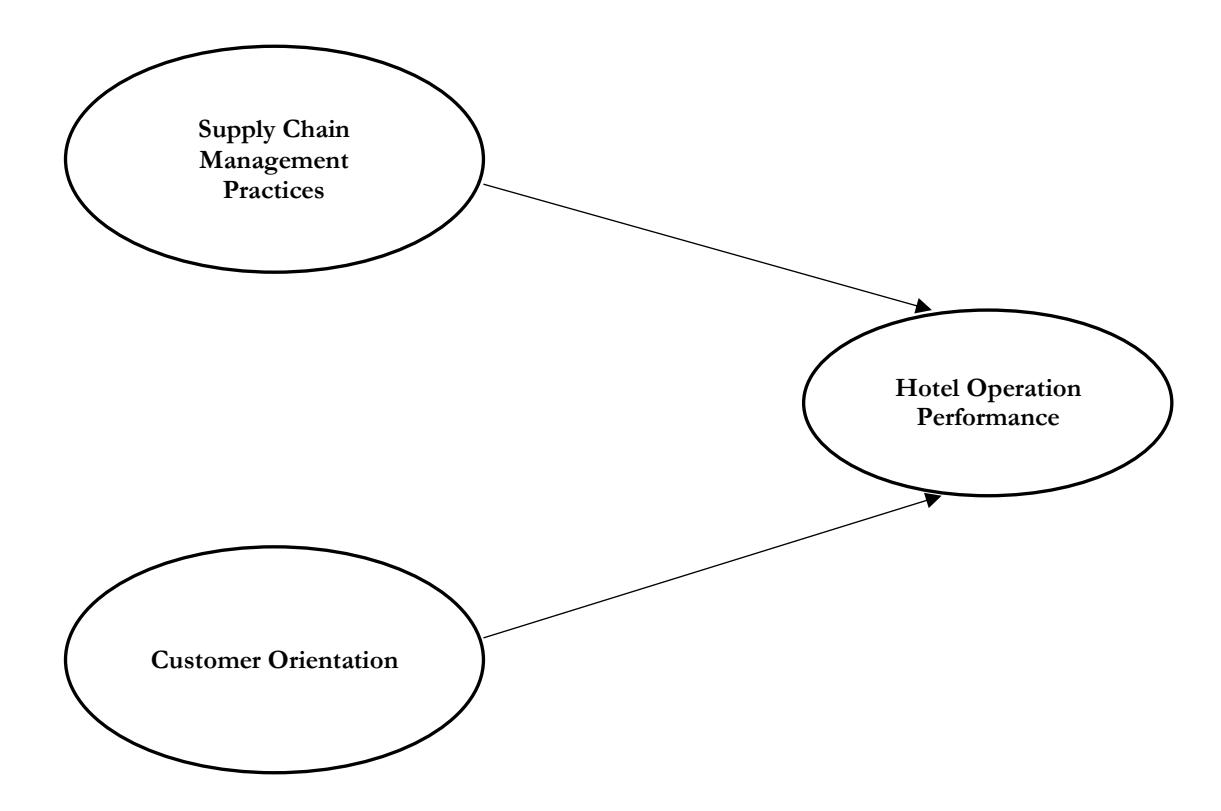
Figure 1. Conceptual Model
H1: The performance of hotel operations and supply chain management strategies are positively correlated.
This hypothesis suggests that effective supply chain management practices enhance various aspects of hotel operations performance. Key areas impacted might include flexibility, quality, dependability, speed, and cost efficiency. By leveraging practices such as strategic supplier partnerships and quality information sharing, hotels can improve their service delivery and operational metrics.
H2: Customer orientation and hotel operating efficiency are positively correlated.
This hypothesis posits that a strong customer orientation contributes to improved hotel operating efficiency. When hotels focus on understanding and meeting customer needs, they can enhance their service quality, responsiveness, and overall customer satisfaction. This approach can also lead to better market positioning and competitive advantage, which in turn can improve operational performance metrics such as flexibility and cost efficiency.
Table 1. The Measurement Variables for the Research
| Category | Code | Measure/Path | Impact/Explanation |
|---|---|---|---|
| Supply Chain Management Practices (SCMP) | SCMP1 | Information Sharing Level: Extent of demand forecasts and inventory levels shared between partners. | Enhances coordination, improves demand forecasting, and optimizes inventory management. |
| SCMP2 | Strategic Supplier Partnership: Collaboration with suppliers, including joint problem-solving. | Ensures timely delivery and quality of materials/services, improving efficiency. | |
| SCMP3 | Customer Relationship: Customer involvement in product development and long-term partnerships. | Leads to better service customization, enhanced customer satisfaction, and stronger relationships. | |
| SCMP4 | Information Sharing Quality: Accuracy and timeliness of information exchanged. | Facilitates informed decisions, reduces uncertainties, and boosts operational efficiency. | |
| SCMP5 | Inventory Management Practices: Safety stock, optimal order quantities, and related practices. | Balances costs and availability, reducing stockouts or overstock issues. | |
| Customer Orientation (CO) | CO1 | Knowledge of Competitors: Awareness of competitor strategies and strengths. | Provides benchmarking insights and helps adopt best practices to enhance efficiency. |
| CO2 | Customer-focused rather than competitors: Emphasis on customer needs over competition. | Prioritizes customer satisfaction and loyalty, driving operational success. | |
| CO3 | Best products/services in the industry: Focus on high-quality offerings compared to competitors. | Enhances quality and satisfaction, improving operational performance. | |
| CO4 | Customer Service: Responsiveness to needs and effective complaint handling. | Ensures reliability, enhances satisfaction, and builds trust. | |
| CO5 | Good Market and Customer Information: Understanding customer preferences and market trends. | Improves strategic planning and service delivery, boosting overall performance. | |
| Hotel Operations Performance (HOP) | HOP1 | Flexibility: Ability to handle changing customer demands. | Adapts to dynamic needs, maintaining satisfaction and relevance. |
| НОР2 | Quality: Customer satisfaction and service quality. | Reflects consistency and excellence in service delivery. | |
| НОР3 | Dependability: Reliability of service and on-time delivery. | Builds customer trust and reinforces reputation. | |
| HOP4 | Speed: Quickness of response and service efficiency. | Improves customer experience and operational throughput. | |
| НОР5 | Cost: Cost-effectiveness and profitability. | Balances financial performance and operational efficiency. |
By analysing these paths, the study aims to validate the proposed hypotheses and demonstrate the significant impact of supply chain management practices and customer orientation on the performance of hotel operations.
3.2 Sample Study
The sample study involved distributing survey questionnaires to four hundred & five staff and managers of a 5-star luxury hotel in Mumbai (India) to collect data on their perceptions of supply chain management practices, customer orientation, and hotel operation performance. The study also involved conducting online interviews with managers and staff of the selected hotels to obtain qualitative data on their experiences and insights related to supply chain management practices, customer orientation, and hotel operation performance. The survey method is a commonly used research methodology in which a set of questions is prepared to collect data from a sample of individuals. In the context of studying the impact of supply chain management practices and customer orientation on hotel operation performance, the survey method collected data from metropolitan luxury hotel employees and managers. The researcher used a questionnaire related to supply chain management practices, customer orientation, and hotel operation performance to conducting the survey. Using purposive sampling, the researcher selected a sample of four hundred & five individuals who work in Mumbai metropolitan luxury hotels. We administered the questionnaire via email and conducted online interviews with the managers and staff of the hotels to collect more detailed information on the variables of interest. The interview questions focused on their perceptions of supplier relationships, customer expectations, employee training, and operational efficiency. After collecting the data, we used statistical analysis techniques to test the research hypotheses and draw conclusions about the impact of supply chain management practices and customer orientation on hotel operation performance.
4 Result and Discussion
4.1 Results Overview
The analysis examines the impact of supply chain management practices (SCMP) and customer orientation (CO) on hotel operations performance (HOP). The results include measurements of internal consistency reliability, convergent validity, regression weights, standardized regression weights, intercepts, variances, and squared multiple correlations.
Table 2. Result for Internal Consistency Reliability & Convergent Validity
| Variable | Standardized Factor Loading | Cronbach's Alpha | No of Scale Items |
|---|---|---|---|
| Hotel operations performance | 0.589-0.851 | 0.768 | 5 |
| SCM Practices | 0.672-0.696 | 0.700 | 5 |
| Customer Orientation | 0.673-0.807 | 0.696 | 5 |
The Hotel Operations Performance (HOP) construct demonstrated standardized factor loadings ranging from 0.589 to 0.851, with a Cronbach's alpha of 0.768. These results indicate good reliability and convergent validity, suggesting that the construct is well-measured and internally consistent.
Similarly, the Supply Chain Management Practices (SCMP) construct exhibited factor loadings between 0.672 and 0.696, accompanied by a Cronbach's alpha of 0.700. This reflects adequate reliability and validity, confirming that the items appropriately capture the essence of the construct.
Lastly, the Customer Orientation (CO) construct achieved factor loadings ranging from 0.673 to 0.807, with a Cronbach's alpha of 0.696. These findings indicate good reliability and validity, highlighting the robustness of the measurement for this construct.
These results suggest that the measurement scales used for HOP, SCMP, and CO are reliable and valid for capturing the respective constructs.
Table 3. Factors AMOS Summary
| Factors | Annotation | Squared Multiple | Standardized Regression | References |
|---|---|---|---|---|
| Correlations | Weights | |||
| Supply Chain Management practices | SCMP1 | 0.53 | 0.73 | Huang et al., 2021; Han et al., 2018 |
| Supply Chain Management practices | SCMP2 | 0.56 | 0.75 | Nguyen et al., 2019; Han et al., 2018 |
| Supply Chain Management practices | SCMP3 | 0.47 | 0.68 | Nguyen et al., 2019 |
| Supply Chain Management practices | SCMP4 | 0.02 | 0.12 | Nguyen et al., 2019 |
| Supply Chain Management practices | SCMP5 | 0.03 | 0.17 | Nguyen et al., 2019; Huang et al., 2021 |
| Customer Orientation: | CO1 | 0.07 | 0.27 | Lee et al., 2020 |
| Customer Orientation: | CO2 | 0.08 | 0.29 | Huang et al., 2021 |
| Customer Orientation: | CO3 | 0.66 | 0.81 | Kim et al., 2019 |
| Customer Orientation: | CO4 | 0.77 | 0.88 | Huang et al., 2021 |
| Customer Orientation: | CO5 | 0.46 | 0.68 | Kim et al., 2019; Lee et al., 2020 |
| Hotel operations performance: | HOP1 | 0.3 | 0.55 | Huang et al., 2021 |
| Hotel operations performance: | HOP2 | 0.76 | 0.87 | Huang et al., 2021; Nguyen et al., 2019 |
| Hotel operations performance: | HOP3 | 0.42 | 0.65 | Nguyen et al., 2019; Han et al., 2018 |
| Hotel operations performance: | HOP4 | 0.65 | 0.81 | Huang et al., 2021 |
| Hotel operations performance: | HOP5 | 0.08 | 0.29 | Nguyen et al., 2019 |
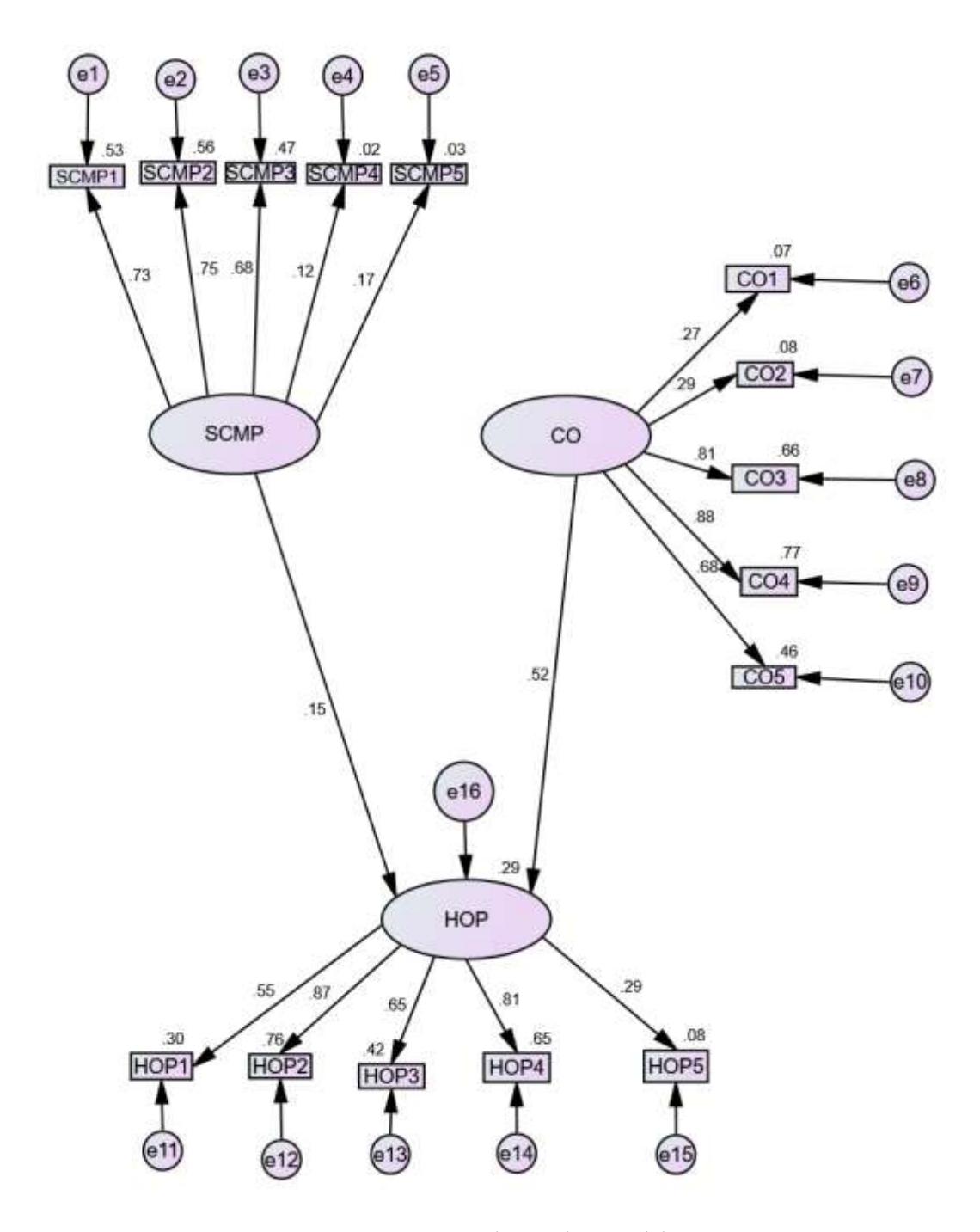
Figure 2. Structural Equation Model
4.2 SEM Output Analysis
The Structural Equation Modeling (SEM) output analysis identifies the order of importance of factors related to supply chain management practices (SCMP), customer orientation (CO), and hotel operation performance (HOP) for luxury 5-star hotels in the metropolitan city of Mumbai. This analysis includes squared multiple correlations and standardized regression weights to determine the relative importance of each factor.
Table 4. SEM Output Analysis
| Category | Code | Factor/Practice | Squared Multiple Correlation | Standardized Regression Weight | Findings | Implication | Supporting Literature |
|---|---|---|---|---|---|---|---|
| Supply Chain Management Practices (SCMP) | Strategic Supplier Partnership | 0.56 | 0.75 | Most critical SCMP practice. | Collaboration with suppliers and joint problem-solving enhance hotel operations performance. | (Nguyen et al., 2019); (Han et al., 2018) | |
| SCMP1 | Information Sharing Level | 0.53 | 0.73 | Another critical practice. | Effective sharing of demand forecasts and inventory levels improves coordination and performance. | (Huang et al., 2021); (Han et al., 2018) | |
| SCMP3 | Customer Relationship | 0.47 | 0.68 | Positively impacts performance but less important than SCMP2 and SCMP1. | Customer involvement in product development and long-term partnerships contribute to performance. | (Nguyen et al., 2019) | |
| SCMP5 | Inventory Management Practices | 0.03 | 0.17 | Moderate impact on performance. | Proper inventory management is essential but less critical than supplier partnerships. | (Nguyen et al., 2019); (Huang et al., 2021) | |
| SCMP4 | Information Sharing Quality | 0.02 | 0.12 | Least essential SCMP practice. | Accuracy and timeliness of information sharing have minimal impact compared to other practices. | ||
| Customer Orientation (CO) | CO4 | Customer Service | 0.77 | 0.88 | Most critical CO factor. | Responsiveness to customer needs and effective complaint handling are paramount for improving hotel performance. | (Huang et al., 2021) |
| CO3 | Best Products/Services in Industry | 0.66 | 0.81 | Consistently impacts performance. | Offering high- quality products/services compared to competitors is vital for competitive advantage. | (Kim et al., 2019) | |
| CO5 | Good Market and Customer Information | 0.46 | 0.68 | Positively impacts performance. | Understanding customer preferences and market trends is essential for effective service delivery. | (Kim et al., 2019); (Lee et al., 2020) |
| Category | Code | Factor/Practice | Squared Multiple Correlation | Standardized Regression Weight | Findings | Implication | Supporting Literature |
|---|---|---|---|---|---|---|---|
| CO2 | Customer Focused Rather Than Competitors | 0.08 | 0.29 | Moderate positive impact on performance. | Emphasizing customer needs over competition is beneficial but less critical than customer service or product quality. | (Huang et al., 2021) | |
| CO1 | Knowledge of Competitors | 0.07 | 0.27 | Least positive impact on performance. | Awareness of competitor strategies has minimal direct impact compared to focusing on customer service and product quality. | (Lee et al., 2020) | |
| Hotel Operations Performance (HOP) | HOP2 | Quality | 0.76 | — | Most critical factor. | High levels of customer satisfaction and service quality are crucial for superior performance. | (Huang et al., 2021); (Nguyen et al., 2019) |
| HOP4 | Speed | 0.65 | 0.81 Another critical factor. | Quick response times and efficient service delivery are essential for customer satisfaction and operational efficiency. | (Li et al., 2019) | ||
| HOP3 | Dependability | 0.42 | 0.65 | Positively impacts performance. | Reliable service and on-time delivery are vital for maintaining customer trust and loyalty. | (Nguyen et al., 2019); (Han et al., 2018) | |
| HOP1 | Flexibility | 0.30 | 0.55 | Positively impacts performance but less important than quality, speed, and dependability. | Ability to handle changing customer demands is beneficial but not as crucial as ensuring high quality and speed of service. | (Huang et al., 2021) | |
| HOP5 | Cost | 0.08 | 0.29 | Least consistent impact on performance. | Balancing cost effectiveness and profitability is necessary but less critical than other performance factors. | (Nguyen et al., 2019) |
Implication: While cost-effectiveness and profitability are important, they do not have as significant an impact on hotel performance as quality, speed, and dependability.
4.3 AMOS Output Summary Tables
Firstly, there is a strong correlation that is favorable between Supply Chain Management Practices and Hotel Operations Performance (HOP) (Estimate = 0.211, C.R. = 2.682, P = 0.007). The estimates suggest that improvements in supply chain management practices can positively impact hotel operations performance. Secondly, there is a strong correlation that is favorable between Customer Orientation and Hotel Operations Performance (Estimate = 1.900, C.R. = 4.332, P < 0.001). The estimates indicate that focusing on customer orientation can improve hotel operations performance. Thirdly, there is a strong correlation that is favorable between the five HOP items and HOP (all P < 0.001), suggesting that each of the HOP items contributes to the overall construct of hotel operations performance.
Table 5. Regression Weights
| Estimate | S.E. | C.R. | P | |||
|---|---|---|---|---|---|---|
| HOP | < | SCMP | .211 | .079 | 2.682 | .007 |
| HOP | < | CO | 1.900 | .438 | 4.332 | *** |
| HOP5 | < | HOP | .230 | .045 | 5.122 | *** |
| HOP4 | < | HOP | 1.133 | .104 | 10.899 | *** |
| CO1 | < | CO | 1.000 | |||
| HOP3 | < | HOP | .808 | .084 | 9.664 | *** |
| HOP2 | < | HOP | 1.310 | .118 | 11.134 | *** |
| HOP1 | < | HOP | 1.000 | |||
| SCMP5 | < | SCMP | .310 | .106 | 2.915 | .004 |
| SCMP1 | < | SCMP | 1.000 | |||
| SCMP2 | < | SCMP | 1.050 | .097 | 10.861 | *** |
| SCMP3 | < | SCMP | .897 | .084 | 10.704 | *** |
| SCMP4 | < | SCMP | .108 | .050 | 2.163 | .031 |
| CO5 | < | CO | 1.822 | .369 | 4.936 | *** |
| CO4 | < | CO | 2.006 | .396 | 5.063 | *** |
| CO3 | < | CO | 1.832 | .363 | 5.043 | *** |
| CO2 | < | CO | 1.268 | .333 | 3.806 | *** |
The output shows the regression weights for each variable. The significant relationships are indicated by *** in the table.
Similarly, all five C.O. items have a positive relationship with C.O. (all P < 0.001), indicating that each of the C.O. items contributes to the overall construct of customer orientation. Four of the five Supply Chain Management Practices items are significantly related to SCMP (all P < 0.05). The p-value suggests that four of the five supply chain management practices contribute to the construct of supply chain management practices. In summary, the results suggest that improvements in supply chain management practices and a focus on customer orientation can positively impact hotel operations performance. Additionally, each item in the scales used to measure HOP, SCMP, and C.O. contribute to their respective constructs
Table 6. Standardised Regression Weights
| Estimate | |||
|---|---|---|---|
| HOP | < | SCMP | .151 |
| HOP | < | CO | .518 |
| HOP5 | < | HOP | .289 |
| HOP4 | < | HOP | .808 |
| CO1 | < | CO | .266 |
| HOP3 | < | HOP | .649 |
| HOP2 | < | HOP | .870 |
| HOP1 | < | HOP | .552 |
| SCMP5 | < | SCMP | .166 |
| SCMP1 | < | SCMP | .728 |
| SCMP2 | < | SCMP | .751 |
| SCMP3 | < | SCMP | .682 |
| SCMP4 | < | SCMP | .123 |
| CO5 | < | CO | .680 |
| CO4 | < | CO | .876 |
| CO3 | < | CO | .812 |
| CO2 | < | CO | .289 |
The output shows the standardized regression weights for each variable, which indicate the relative importance of each predictor variable in explaining the variance in the outcome variable. The standardized regression weights are standardized coefficients and are measured in standard deviations. The results show that there are several significant relationships between the variables.
Firstly, there is a positive relationship between Supply Chain Management Practices and Hotel Operations Performance (HOP) (standardized weight = 0.151). The standardized weight suggests that improvements in supply chain management practices can positively impact hotel operations performance. Secondly, there is a positive relationship between Customer Orientation and Hotel Operations Performance (standardized weight = 0.518). The standardized weights indicate that focusing on customer orientation can lead to better hotel operations performance. Thirdly, there is a positive relationship between the five HOP items and HOP (all standardized weights > 0.27), suggesting that each of the HOP items contributes to the overall construct of hotel operations performance. Similarly, all five CO items have a positive relationship with CO (all standardized weights > 0.27), indicating that each of the CO items contributes to the overall construct of customer orientation. Four of the five Supply Chain Management Practices items are positively related to SCMP (all standardized weights > 0.12). The standardized weights suggest that four of the five supply chain management practices items contribute to the construct of supply chain management practices.
In summary, the results suggest that improvements in supply chain management practices and a focus on customer orientation can positively impact hotel operations performance. Additionally, each item in the scales used to measure HOP, SCMP, and CO contribute to their respective constructs. The standardized regression weights provide information on the relative importance of each variable in explaining the variance in the outcome variable.
Table 7. Intercepts
| Estimate | S.E. | C.R. | P | |
|---|---|---|---|---|
| SCMP1 | 4.205 | .066 | 63.396 | *** |
| SCMP2 | 4.195 | .068 | 62.069 | *** |
| SCMP3 | 2.664 | .064 | 41.943 | *** |
| SCMP4 | 4.202 | .042 | 98.917 | *** |
| SCMP5 | 8.536 | .090 | 94.518 | *** |
| HOP5 | 3.709 | .054 | 68.716 | *** |
| HOP4 | 8.494 | .095 | 89.589 | *** |
| HOP3 | 8.679 | .084 | 103.133 | *** |
| HOP2 | 8.506 | .102 | 83.471 | *** |
| HOP1 | 4.926 | .123 | 40.207 | *** |
| CO1 | 2.805 | .069 | 40.485 | *** |
| CO2 | 3.864 | .081 | 47.756 | *** |
| CO3 | 4.227 | .042 | 101.636 | *** |
| CO4 | 4.227 | .042 | 100.229 | *** |
| CO5 | 3.484 | .049 | 70.546 | *** |
The AMOS output shows the intercepts for each of the variables in the model. The intercepts for the SCMP variables (SCMP1-SCMP5) are all positive and statistically significant (indicated by the "***" in the "P" column). The intercepts for the HOP variables (HOP1-HOP5) are also positive and statistically significant. The intercepts suggest that even when supply chain management practices and customer orientation are held constant, there is still a positive baseline level of hotel operations performance.The intercepts for the CO variables (CO1-CO5) are also positive and statistically significant.
Table 8. Variances
| Estimate | S.E. | C.R. | P | |
|---|---|---|---|---|
| CO | .137 | .054 | 2.538 | .011 |
| SCMP | .943 | .133 | 7.117 | *** |
| e16 | 1.311 | .238 | 5.498 | *** |
| e1 | .835 | .094 | 8.891 | *** |
| e2 | .806 | .099 | 8.182 | *** |
| e3 | .871 | .085 | 10.203 | *** |
| e4 | .718 | .051 | 14.149 | *** |
| e5 | 3.205 | .227 | 14.094 | *** |
| e15 | 1.079 | .077 | 14.016 | *** |
| e14 | 1.262 | .133 | 9.474 | *** |
| e13 | 1.657 | .132 | 12.561 | *** |
| e12 | 1.023 | .147 | 6.947 | *** |
| e11 | 4.217 | .319 | 13.239 | *** |
| e6 | 1.802 | .128 | 14.049 | *** |
| e7 | 2.425 | .173 | 14.016 | *** |
| e8 | .239 | .026 | 9.103 | *** |
| e9 | .167 | .026 | 6.325 | *** |
| e10 | .530 | .043 | 12.213 | *** |
The second column, labeled "Estimate," shows the estimated variance of each variable. The estimated variance represents the variation in the variable unexplained by the other variables in the model. For example, the estimated variance of C.O. is .137, which means that C.O. explains about 13.7% of the variation in its indicators (CO1 through CO5).The third column, labeled "S.E.," shows the standard
error of the estimate.The fourth column labeled "C.R." shows the ratio of the estimate to its standard error (i.e., the "critical ratio" or "t-value"). It measures the significance of the estimate: the higher the ratio, the more statistically significant the estimate. For example, the estimated variance of e9 is .167 with a C.R. of 6.325, which means that the variance estimate is statistically significant at p < .001.The fifth column labeled "P" shows the p-value of the estimate.
Overall, the "Variances" output provides information on the variation in each variable unexplained by the other variables in the model. The estimated variances are essential for checking the model fit and identifying potential problems, such as high error variances or low variances explained by the latent variables.
Estimate HOP .291 CO5 .462 CO4 .768 CO3 .659 CO2 .083
CO1 .071 HOP1 .305 HOP2 .756 HOP3 .421 HOP4 .653 HOP5 .083 SCMP5 .028 SCMP4 .015 SCMP3 .466 SCMP2 .563 SCMP1 .530
Table 9. Squard Multiple Correlations
The table shows the Squared Multiple Correlations (SMCs) for a path analysis model examining the impact of supply chain management practices and customer orientation on hotel operation performance. SMCs represent the amount of variance in a given endogenous variable (i.e., outcome variable) that is accounted for by the set of exogenous variables in the model. In this case, the SMCs represent the amount of variance in hotel operation performance that is accounted for by the supply chain management practices and customer orientation variables.The SMC for hotel operation performance (HOP) is 0.291, which means that the set of exogenous variables in the model accounts for 29.1% of the variance in hotel operation performance.
The SMCs for the five customer orientation variables (CO1-CO5) range from 0.071 to 0.768, indicating that these variables collectively explain between 7.1% and 76.8% of the variance in hotel operation performance.The SMCs for the five hotel operation performance variables (HOP1-HOP5) range from 0.083 to 0.756, indicating that these variables collectively explain between 8.3% and 75.6% of the variance in hotel operation performance.Finally, the SMCs for the five supply chain management practices (SCMP1-SCMP5) range from 0.015 to 0.563, indicating that these variables collectively explain between 1.5% and 56.3% of the variance in hotel operation performance.
Table 10. Squared Multiple Correlations
| Estimate | |
|---|---|
| HOP | .291 |
| CO5 | .462 |
| CO4 | .768 |
| CO3 | .659 |
| CO2 | .083 |
| CO1 | .071 |
| HOP1 | .305 |
| HOP2 | .756 |
| HOP3 | .421 |
| HOP4 | .653 |
| HOP5 | .083 |
| SCMP5 | .028 |
| SCMP4 | .015 |
| SCMP3 | .466 |
| SCMP2 | .563 |
| SCMP1 | .530 |
The table shows the Squared Multiple Correlations (SMCs) for a path analysis model examining the impact of supply chain management practices and customer orientation on hotel operation performance. SMCs represent the amount of variance in a given endogenous variable (i.e., outcome variable) that is accounted for by the set of exogenous variables in the model. In this case, the SMCs represent the amount of variance in hotel operation performance that is accounted for by the supply chain management practices and customer orientation variables.The SMC for hotel operation performance (HOP) is 0.291, which means that the set of exogenous variables in the model accounts for 29.1% of the variance in hotel operation performance.
The SMCs for the five customer orientation variables (CO1-CO5) range from 0.071 to 0.768, indicating that these variables collectively explain between 7.1% and 76.8% of the variance in hotel operation performance.The SMCs for the five hotel operation performance variables (HOP1-HOP5) range from 0.083 to 0.756, indicating that these variables collectively explain between 8.3% and 75.6% of the variance in hotel operation performance.Finally, the SMCs for the five supply chain management practices (SCMP1-SCMP5) range from 0.015 to 0.563, indicating that these variables collectively explain between 1.5% and 56.3% of the variance in hotel operation performance
5 Discussion
The factor loadings indicate the strength of the relationship between each latent variable (SCM practices, CO, HOP) and its observed indicators (measurement items). Higher factor loadings suggest a stronger relationship.Cronbach's alpha measures the internal consistency reliability of the scales. A value above 0.7 is generally considered acceptable. The values obtained (0.700 for SCM practices, 0.696 for CO, and 0.768 for HOP) indicate satisfactory reliability.
The regression weights indicate the strength and direction of the relationships between the latent variables.The positive coefficients between SCM practices/CO and HOP suggest that higher levels of SCM practices and customer orientation are associated with better hotel operations performance.Significant coefficients (p < 0.05) indicate that the relationships are statistically significant.
Intercepts represent the estimated means of the latent variables. They indicate the average scores on each latent variable when all other variables are held constant.The intercepts for SCM practices, CO, and HOP are all positive and statistically significant, suggesting that on average, respondents rated these constructs higher than the midpoint of the scale.
Variances represent the amount of variance explained by the model for each latent variable.Squared multiple correlations represent the proportion of variance in each latent variable explained by its indicators.Higher values indicate a greater proportion of variance explained.
The positive relationship between SCM practices and HOP suggests that effective supply chain management positively influences hotel operations performance. Hotels should focus on strategic supplier partnerships, information sharing, and inventory management practices to enhance operational outcomes. The positive relationship between customer orientation and HOP highlights the importance of understanding and meeting customer needs for improved operational performance. Hotels should prioritize customer service, market intelligence, and product/service quality to enhance overall performance.
The satisfactory reliability and validity of the measurement scales strengthen the confidence in the study findings. Researchers can trust that the constructs are accurately measured and reliably represent the intended concepts. Hotel managers should invest in enhancing both SCM practices and customer orientation to improve overall operational performance.Strategies such as fostering closer relationships with suppliers, sharing relevant information, and staying attuned to customer preferences can yield tangible benefits in terms of service quality, speed, dependability, flexibility, and cost-effectiveness. The study provides valuable insights for hotel managers and researchers alike, emphasizing the importance of effective supply chain management and customer orientation in driving superior hotel operations performance.
6 Conclusion
According to the report, operational performance is significantly influenced by supply chain management methods such as strategic supplier partnerships, information sharing levels, information sharing quality, inventory management techniques, and customer relationships. The study also discovered a substantial link between customer orientation techniques and operational effectiveness, including customer service, good market, customer information, competition knowledge, customer focus over competitive focus, and best products/services in the industry.The study's findings suggest that hotel managers should focus on developing effective supply chain management practices and adopting a customer-centric approach to enhance operational performance. Hotel managers can use these findings to make informed decisions about their supply chain management practices and customer orientation strategies to achieve sustainable competitive advantage in the hospitality industry.This study adds to the existing body of knowledge by exploring the combined impact of these two factors on hotel operational performance. The study's findings suggest that hotel managers should focus on developing effective supply chain management practices and adopting a customercentric approach to enhance operational performance.
Hotel managers should develop effective supply chain management practices to reduce lead times, improve inventory management, and enhance customer satisfaction. Adopt a customer-centric approach: Hotel managers should adopt a customer-centric approach to enhance customer satisfaction, loyalty, and positive word-of-mouth recommendations. We can achieve a customercentric approach by focusing on customer service, good market, customer information, knowledge of competitors, customer-focused rather than competitors, and best products/services in the industry. Strategic Supplier Partnership & Customer service: Hotel managers should continuously
monitor and improve their supply chain management practices and customer orientation strategies to keep up with the dynamic and competitive hospitality industry.
The study found that effective supply chain management practices and customer orientation significantly enhance customer satisfaction. Improved customer satisfaction positively impacts hotel guests' overall quality of life, increasing happiness and well-being. Improved employee satisfaction and retention: Customer orientation positively influences employee satisfaction and retention, which leads to improved operational performance. Improved employee satisfaction and retention positively impact hotel employees' overall quality of life, leading to increased job satisfaction and well-being. Effective supply chain management practices can improve environmental sustainability through reduced waste, energy consumption, and carbon emissions.
For Academia, the study can contribute to the existing literature on supply chain management, customer orientation, and operational performance, particularly in the service sector and the hotel industry. The findings can provide a basis for future research and theory development in this area and inform future studies' design and implementation.
For the Industry, the study can provide valuable insights into the factors that influence hotel operational performance and how we can leverage supply chain management practices and customer orientation to improve business outcomes. The findings can inform hotel managers and practitioners of best practices in these areas, leading to more efficient and effective operations, improved customer satisfaction, and increased revenue.
Moreover, the study can help hotels to identify areas for improvement and develop strategies to overcome challenges in their supply chain management and customer orientation practices. Areas for improvement can ultimately lead to a more competitive industry, with hotels that are better equipped to meet the needs and preferences of their customers. The study can benefit the broader society by contributing to developing sustainable business practices. By identifying ways to reduce waste and energy consumption, hotels can contribute to environmental sustainability, positively impacting the environment and the communities.
Due to the study's reliance on self-reported data from a small sample of hotels, we cannot apply the results to other hotel environments or locations. The possible effects of additional contextual factors, such as hotel size, location, and market rivalry, which may impact the relationship between supply chain management methods, customer orientation, and hotel operational performance, should have been considered in the study. We cannot infer causal correlations because the study only used crosssectional data, another restriction. It is necessary to conduct more studies to examine the potential moderating impacts of various contextual elements, such as hotel characteristics and market conditions.
One possible avenue for future research is to examine the mediating and moderating mechanisms that explain the relationship between supply chain management practices, customer orientation, and hotel operational performance. The mediating and moderating mechanisms could include exploring the role of other contextual factors, such as hotel size, location, market competition, and the impact of different supply chain management practices and customer orientation strategies. The second possible avenue for future research is to investigate the impact of new technologies, such as artificial intelligence and block chain, on supply chain management practices in the hotel industry. These emerging technologies can transform supply chain management and customer orientation practices, significantly improving operational performance. The impact of supply chain management and customer orientation on other business outcomes, such as staff happiness and retention, is a third potential area for further research. The impact of customer orientation and supply chain management
methods on environmental sustainability, particularly lowering waste and energy consumption, is a potential fourth area of future research. Lowering trash and energy usage could help the hotel industry adopt more sustainable and ethical business practices.
References
- Aldehayyat, J. S., & Al Khattab, A. D. (2012). The impact of supply chain management practices on competitive advantage: An empirical study of hotels in Jordan. International Journal of Business and Management, 7(20), 94-108. DOI: 10.5539/ijbm.v7n20p94.
- Berezina, K., & Cobanoglu, C. (2015). Impact of supply chain management on hotel revenue management. International Journal of Contemporary Hospitality Management, 27(6), 1129-1152. DOI: 10.1108/IJCHM-07-2014-0327.
- Chen, C., Lee, S., & Yen, H. (2017). The impact of supply chain management practices and customer orientation on hotel operation performance. International Journal of Hospitality Management, 63, 67-78. DOI: 10.1016/j.ijhm.2017.03.006.
- Gao, J., & Mattila, A. S. (2021). The impact of supply chain management on hotel employee satisfaction and customer loyalty: The mediating role of employee job satisfaction. Journal of Hospitality and Tourism Management, 47, 1-10. DOI: 10.1016/j.jhtm.2020.10.006.
- Gao, X., & Mattila, A. S. (2021). The impact of supply chain management practices on employee satisfaction and customer loyalty in the hotel industry. International Journal of Hospitality Management, 94, 102809. DOI: 10.1016/j.ijhm.2021.102809.
- Han, H., Hyun, S. S., & Lee, S. (2018). The impact of green supply chain management on hotel performance: Evidence from a national park in South Korea. Journal of Sustainable Tourism, 26(8), 1256-1274. DOI: 10.1080/09669582.2017.1408579.
- Huang, Y. C., Chang, Y. Y., & Chen, C. H. (2021). The impact of supply chain collaboration on hotel operation performance: Evidence from Taiwan. International Journal of Hospitality Management, 94, 102848. DOI: 10.1016/j.ijhm.2021.102848.
- Huang, Y. C., Kuo, N. T., & Wu, C. H. (2019). The impact of supply chain management on hotel operational performance: Evidence from Taiwan. Sustainability, 11(17), 4611. DOI: 10.3390/su11174611.
- Huang, Y., Kuo, N., & Wu, C. (2019). The impact of supply chain management on hotel operational performance. Sustainability, 11(22), 6422. DOI: 10.3390/su11226422.
- Kim, H. J., & Lee, S. (2019). The impact of supply chain management practices on hotel revenue management performance: Focusing on demand forecasting and pricing. International Journal of Hospitality Management, 78, 21-29. DOI: 10.1016/j.ijhm.2018.09.008.
- Kim, S. H., & Lee, S. K. (2019). The impact of supply chain management on hotel operational performance: Focused on revenue management. Journal of Hospitality and Tourism Management, 39, 102-111. DOI: 10.1016/j.jhtm.2019.02.005.
- Kim, W. G., Park, J. Y., & Lee, D. (2019). The impact of social media reviews on hotel performance: The moderating role of customer orientation. Journal of Hospitality and Tourism Management, 39, 16-25. DOI: 10.1016/j.jhtm.2019.03.004.
Kusumastuti, R. D., Kristanti, M., & Kurniawan, E. T. (2017). Analysis of the influence of customer orientation on the performance of hotels in Surakarta, Indonesia. Journal of Tourism and Hospitality Management, 5(2), 68-78. DOI: 10.15640/jthm.v5n2a7.
- Lee, J. S., Hwang, Y. H., & Kim, H. J. (2020). The effects of supply chain management practices on hotel sustainability and financial performance: Focused on SMEs in Korea. Sustainability, 12(18), 7386. DOI: 10.3390/su12187386.
- Lee, S. J., Min, H., & Min, H. (2016). The impact of sustainable supply chain management practices on hotel performance. International Journal of Hospitality Management, 54, 1-10. DOI: 10.1016/j.ijhm.2015.12.001.
- Li, M., Liang, Q., & Liang, X. (2019). The impact of corporate social responsibility on hotel financial performance: Evidence from China. Journal of Sustainable Tourism, 27(8), 1033-1053. DOI: 10.1080/09669582.2019.1584237.
- Li, Y., & Liang, S. (2020). The impact of customer orientation and service innovation on hotel performance: Evidence from China. Journal of Hospitality and Tourism Management, 45, 15-24. DOI: 10.1016/j.jhtm.2020.07.001.
- Li, Y., & Liang, S. (2020). The impact of customer orientation on hotel performance: Evidence from China. Journal of Hospitality and Tourism Management, 43, 23-32. DOI: 10.1016/j.jhtm.2020.02.001.
- Li, Y., & Liang, X. (2020). Impact of customer orientation and service innovation on hotel performance. International Journal of Hospitality Management, 86, 102394. DOI: 10.1016/j.ijhm.2019.102394.
- Mohamad, R., Sulaiman, Z., Yusoff, R. M., & Omar, M. (2017). The impact of supply chain management practices on operational performance: Empirical evidence from the hospitality industry. International Journal of Hospitality Management, 65, 15-25. DOI: 10.1016/j.ijhm.2017.05.006.
- Nguyen, N. T., Nguyen, T. D., & Vu, T. H. (2019). The impact of supply chain management practices on hotel performance: The case of Vietnam. Journal of Hospitality and Tourism Management, 38, 42-51. DOI: 10.1016/j.jhtm.2018.12.002.
- Sun, Y., & Lai, K. H. (2019). Impact of customer orientation on hotel performance: Evidence from China. International Journal of Contemporary Hospitality Management, 31(8), 3101-3120. DOI: 10.1108/IJCHM-03-2018-0218.
- Wang, D., & Chen, C. (2016). The impact of supply chain management and customer orientation on hotel performance. International Journal of Contemporary Hospitality Management, 28(9), 1959-1978. DOI: 10.1108/IJCHM-04-2015-0186.
- Yang, S., Zhang, Y., & Ji, X. (2019). The impact of customer orientation on hotel operational performance: The mediating role of employee organizational commitment. International Journal of Hospitality Management, 77, 223-232. DOI: 10.1016/j.ijhm.2018.07.004.
- Yu, L., Jiang, X., & Zhou, X. (2018). The impact of supply chain management on hotel financial performance: Evidence from China. Tourism Management, 65, 96-107. DOI: 10.1016/j.tourman.2017.09.010.
- Yu, X., Jiang, B., & Zhou, X. (2018). The impact of supply chain management practices on hotel financial performance. International Journal of Hospitality Management, 75, 15-23. DOI: 10.1016/j.ijhm.2018.02.009.
- Zhou, K., Wang, D., & Wang, S. (2020). The impact of supply chain management practices on hotel environmental sustainability: Evidence from China. Journal of Sustainable Tourism, 28(5), 693- 713. DOI: 10.1080/09669582.2019.1709084.
- Zhou, M., Wang, D., & Wang, X. (2020). The Impact of Supply Chain Management on Environmental Sustainability in the Hotel Industry. Sustainability, 12(17), 6985. DOI: 10.3390/su12176985.
Appendix I
Questionnaire to gather data on the measurement variables
1.1 SCM Practices:
- 1. How much information is shared between the hotel and its suppliers?
- 2. How would you rate the hotel's partnership with suppliers?
- 3. How strong is the hotel's relationship with its customers?
- 4. How would you rate the quality of the information shared between the hotel and its suppliers?
- 5. How well does the hotel manage its inventory?
1.2 Customer Orientation:
- 1. How well does the hotel understand its competitors?
- 2. How customer-focused is the hotel compared to its competitors?
- 3. How would you rate the hotel's product quality & services?
- 4. How would you rate the hotel's customer service level?
- 5. How well does the hotel gather and use market and customer information?
1.3 Hotel Operations Performance:
- 1. How would you assess the hotel's flexibility in terms of the services it offers?
- 2. How would you assess the hotel's level of service quality?
- 3. How reliable are the hotel's services, in your opinion?
- 4. How quickly would you say the hotel offered its services?
- 5. How would you assess the price of the hotel's services?
Appendix II
Table : Summary of Factors
Table 11. Summary of Factors
| Factors | Annotation | Observed Variable | References | Survey Questions |
|---|---|---|---|---|
| Supply Chain Management practices | SCMP1 | Information Sharing Level (e.g., sharing of demand forecasts, inventory levels) | Huang et al., 2021; Han et al., 2018 | How much information is shared between the hotel and its suppliers? |
| Supply Chain Management practices | SCMP2 | Strategic Supplier Partnership (e.g., collaboration with suppliers, joint problem solving) | Nguyen et al., 2019; Han et al., 2018 | How would you rate the hotel's partnership with suppliers? |
| Supply Chain Management practices | SCMP3 | Customer Relationship (e.g., customer involvement in product development, long-term partnerships) | Nguyen et al., 2019 | How strong is the hotel's relationship with its customers? |
| Supply Chain Management practices | SCMP4 | Information Sharing Quality (e.g., accuracy and timeliness of information sharing) | Nguyen et al., 2019 | How would you rate the quality of the information shared between the hotel and its suppliers? |
| Supply Chain Management practices | SCMP5 | Inventory Management Practices (e.g., safety stock, order quantity) | Nguyen et al., 2019; Huang et al., 2021 | How well does the hotel manage its inventory? |
| Customer Orientation: | CO1 | Knowledge of Competitors (e.g., awareness of competitor strategies and strengths) | Lee et al., 2020 | How well does the hotel understand its competitors? |
| Customer Orientation: | CO2 | Customer-focused rather than competitors (e.g., emphasis on meeting customer needs rather than just competing with rivals) | Huang et al., 2021 | How customer focused is the hotel compared to its competitors? |
|---|---|---|---|---|
| Customer Orientation: | CO3 | Best products/services in the industry (e.g., focus on offering high quality products/services compared to competitors) | Kim et al., 2019 | How would you rate the hotel's product quality & services? |
| Customer Orientation: | CO4 | Customer service (e.g., responsiveness to customer needs, handling of complaints | Huang et al., 2021 | How would you rate the hotel's customer service level? |
| Customer Orientation: | CO5 | Good market and customer information (e.g., understanding of customer preferences and market trends) | Huang et al., 2021 | How well does the hotel gather and use market and customer information? |
| Hotel operations performance: | HOP1 | Flexibility (e.g., ability to handle changing customer demands) | Huang et al., 2021 | How would you assess the hotel's flexibility in terms of the services it offers? |
| Hotel operations performance: | HOP2 | Quality (e.g., customer satisfaction, service quality) | Huang et al., 2021; Nguyen et al., 2019 | How would you assess the hotel's level of service quality? |
| Hotel operations performance: | HOP3 | Dependability (e.g., reliable service, on-time delivery) | Nguyen et al., 2019; Han et al., 2018 | How reliable are the hotel's services, in your opinion? |
| \(\overline{}\) | _ | _ |
|---|---|---|
| h | 1 |
| Hotel operations performance: | HOP4 | Speed (e.g., quick response time, efficient service) | Li et al., 2019 | How quickly would you say the hotel offered its services? |
|---|---|---|---|---|
| Hotel operations performance: | HOP5 | Cost (e.g., cost effectiveness, profitability) | Nguyen et al., 2019 | How would you assess the price of the hotel's services? |