

1. Introduction
The hospitality sector plays a crucial role in global and Thai economies. Prior to the COVID-19 pandemic in 2019, this industry accounted for roughly twenty-two percent of Thailand's GDP, attracting approximately 40 million international tourists and employing 6.27 million individuals. Employee dedication is a key factor in the success of an industry. Elevated staff turnover can result in numerous adverse effects such as decreased efficiency, higher costs associated with hiring and training, and diminished customer satisfaction (Simons & Hinkin, 2001). Consequently, it is essential for organizations to comprehend the elements that influence employee loyalty within this sector. Generations X, Y, and Z are set to dominate the future workforce, each exhibiting distinct beliefs, attitudes, and behaviors. By comprehending how these factors influence employee loyalty within the hospitality industry, companies can develop strategies to retain staff and enhance organizational efficiency.
This study aimed to identify the specific factors influencing job satisfaction and loyalty among Generation X, Y, and Z employees in Bangkok's hospitality industry, focusing on hotels and restaurants. By examining and contrasting the attitudes and behaviors of these three generational cohorts regarding five crucial elements—employee empowerment, work-life balance, teamwork, and employee training—the investigators seek to provide valuable recommendations for enhancing employee loyalty, ultimately benefiting organizations within these sectors.
This study explored several aspects of job satisfaction in the hotel and restaurant sectors of Bangkok. First, we examined how various elements, including employee training, employee compensation, employee empowerment, teamwork, and work-life balance, influence job satisfaction. Second, we analyzed the impact of job satisfaction on employee loyalty. Lastly, we investigated the differences in factors affecting job satisfaction across Generations X, Y, and Z.
This study makes two primary contributions to this field. First, it expands the existing body of knowledge by investigating the various factors influencing job satisfaction and loyalty across different generations, an area that has been insufficiently studied. It enhances our understanding of how to engage and retain workers in this sector by comparing the attitudes and behaviors of three key generational groups in the workforce. Second, this study explores how organizations can develop strategies to mitigate turnover and maintain their workforce by considering generational disparities. By analyzing the viewpoints and actions of Generations X, Y, and Z regarding five critical aspects work-life balance, teamwork, employee empowerment, training, and compensation - businesses can adapt their human resources practices to better suit the preferences and needs of various workforce segments.
The remainder of this paper is organized as follows. Section 2 provides a review of existing research and establishes the study's hypotheses. Section 3 describes the research methodology. Section 4 analyzes the data and presents the findings. Section 5 offers a discussion of the results, outlines the theoretical and practical implications, and addresses the study's limitations.
2. Literature Review
Job satisfaction refers to the extent to which people experience positive or negative feelings about their work (Locke 1976). As a crucial element of organizational behavior, it has been extensively researched in the fields of management and psychology because of its potential impact on employee productivity and well-being (Bakker & Demerouti, 2007). High levels of job satisfaction are linked to numerous beneficial outcomes such as enhanced productivity and work quality (Heimerl et al., 2020), reduced absenteeism and employee turnover, improved organizational citizenship behaviors, and greater employee loyalty (Heimerl et al., 2020). Conversely, low job satisfaction has been associated with negative consequences, including an increased likelihood of employees leaving their positions and decreased productivity (Jex & Gudanowski, 1992).
Herzberg's two-factor theory is frequently used to elucidate the factors that influence job satisfaction (Ann & Blum, 2019; Chitiris, 1988; Heimerl et al., 2020; Saad & Hasanein, 2018; Simons & Enz, 1995; Sobaih & Hasanein, 2020). This theoretical framework differentiates between motivators and hygiene factors (Noell 1976). Hygiene factors encompass external variables such as compensation and work environment, which can result in dissatisfaction if absent. By contrast, motivators are intrinsic elements that enhance job satisfaction and drive, including achievement and acknowledgment.
Several studies have challenged Herzberg's theory by demonstrating that both motivation and hygiene factors positively influence job satisfaction. Thant and Chang (2021) revealed that in the public sector, both motivators and hygiene factors contribute to employee satisfaction. Comparable findings have been observed among university employees (Mehrad, 2020; Miah & Hasan, 2022) and clinical laboratory settings (Alrawahi et al., 2020). A study conducted by Lee et al. (2022) across nine diverse industries found that motivational elements, such as advancement opportunities, as well as hygiene factors, such as compensation systems and work-life balance, all had significant correlations with job satisfaction.
Research findings in the hospitality sector have yielded varying results. Several studies have indicated that hygiene factors, rather than motivators, play a significant role in employee satisfaction (Chitiris, 1988; Saad & Hasanein, 2018; Sobaih & Hasanein, 2020). Conversely, other studies suggests that motivational elements, such as opportunities for growth, also contribute to job satisfaction (Heimerl et al., 2020; Simons & Enz, 1995). However, several studies have reported conflicting results. For instance, Ashton (2018) discovered that enhancing employee pay does not boost job satisfaction, and is not a crucial factor (Heimerl et al., 2020). By contrast, additional research has identified employee compensation as a key component of job satisfaction (Simon & Enz, 1995; Sobaih & Hasanein, 2020). Al-Ababneh (2017) determined that hygiene factors had a more substantial impact on job satisfaction in the hospitality sector compared to other industries.
The inconsistencies in previous findings may be attributed to generational differences. Specifically, recent research has identified that Generation Z exhibits significant differences from preceding generations. For instance, Generation Z was found to demonstrate greater concern for positive work environments and cultures (Kapuściński et al., 2023), and prioritize gaining experience and regular income (Törn-Laapio & Ekonen, 2021) in the hospitality industry. In the retail sector, compared with Generation X and Y, Generation Z was observed to have lower satisfaction with job security (Machova et al., 2022). Numerous other factors remain unexplored. To address this research gap, this study aims to identify the specific factors influencing job satisfaction and loyalty among Generation X, Y, and Z employees in Bangkok's hospitality industry, with a focus on hotels and restaurants. By examining and contrasting the attitudes and behaviors of these three generational cohorts regarding five key aspects—employee empowerment, work-life balance, teamwork, and employee training the study seeks to provide valuable recommendations for enhancing employee job satisfaction and loyalty, ultimately benefiting organizations within these sectors. An additional research gap from previous studies is that respondents were predominantly university students (Goh & Lee, 2018; Kapuściński et al., 2023; Ngian et al 2022). This study addresses this gap by recruiting respondents who are currently employed in the hospitality industry.
2.1. Employee Training and Job Satisfaction
Employee training is defined as a systematic approach to acquiring and enhancing the knowledge, abilities, and proficiencies necessary for workers to perform their roles within an organization (Noe, 2017). This process encompasses a variety of structured activities and programs designed to enhance individual and collective efficiency, support professional growth, and align employee capabilities with organizational objectives (Goldstein & Ford, 2002). Through training, employees can acquire specific abilities or knowledge that enables them to excel in their current or future job positions (Baldwin & Ford, 1988). According to Herzberg's two-factor theory, employee training is considered a motivational element.
Job satisfaction is intricately linked to employee training, as it substantially enhances workers' skills, knowledge, and performance, ultimately leading to increased satisfaction with their roles. Several studies have explored the positive relationship between staff training and workplace contentment. Asgarova (2019) investigated the impact of formal training programs on job satisfaction and productivity among workers in Turkey's manufacturing industry. Utilizing data from 307 employees, this research supports the 'train to gain' concept, demonstrating that investing in employee development boosts job satisfaction and motivation, making it an effective human resource management strategy. Another study examined the effects of staff training initiatives on job satisfaction and performance in Malaysian telecommunication companies. The findings reveal that training programs significantly influence employees' job satisfaction and performance levels. This study underscores the importance of ongoing training in maintaining a robust and lasting competitive advantage in the telecommunications sector (Kanapathipillai and Azam, 2020). These investigations indicate that employee training is a crucial factor in job satisfaction as it enables workers to acquire new abilities, improve their performance, and enhance their overall job contentment. Organizations that invest in employee training programs can boost job satisfaction, leading to increased productivity, lower turnover rates, and stronger organizational commitments. Consequently, we formulate the initial hypothesis as follows:
H1: Employee training has a positive effect on job satisfaction.
2.2. Employee Compensation and Job Satisfaction
Employee compensation encompasses the financial and non-financial benefits and rewards workers obtain in exchange for their services. Monetary compensation includes forms such as wages, salaries, and bonuses, whereas non-monetary compensation comprises benefits such as healthcare coverage, retirement plans, and paid leave. As a crucial element of organizational management, employee compensation can influence worker motivation, job satisfaction, and overall performance (Inda & Mishra, 2016). According to Herzberg's two-factor theory, employee compensation is considered a motivational factor.
Job satisfaction is significantly affected by compensation. Studies have shown that higher compensation results in greater job satisfaction (Inda and Mishra, 2016; Miah and Hasan, 2022; Sobaih and Hasanein, 2020). Conversely, inadequate employee compensation is the primary cause of dissatisfaction among workers (Alrawahi et al., 2020; Mehrad, 2020). Zayed et al. (2022) investigated the connection between employee happiness and compensation structure, with employee motivation serving as a mediator. Their findings indicated that the compensation system positively influences employee satisfaction, which is partially moderated by motivation. Consequently, we propose our second hypothesis, as follows:
H2: Employee compensation has a positive effect on job satisfaction.
2.3. Employee Empowerment and Job Satisfaction
Employee empowerment is defined as the act of granting workers authority, means, and support to take initiative, resolve problems, and make choices within their roles (Spreitzer 1995). Liden et al. (2000) describe empowerment as the process of increasing employees' independence and influence over their job responsibilities, along with the capacity to assume accountability for their work. Al-Ababneh (2017) further categorized employee empowerment into two types: structural and psychological. Structural empowerment encompasses concrete aspects, such as access to information, resources, and opportunities to engage in decision-making processes. Psychological empowerment relates to employees' subjective perceptions of empowerment, including feelings of competence, selfdetermination, significance, and influence on their work. According to Herzberg's two-factor theory, employee empowerment is a motivator.
Studies have shown a favorable link between employee empowerment and job satisfaction. Al-Ababneh (2017) found that both structural and psychological empowerment methods had a positive correlation with job satisfaction. Khaliq et al. (2020) identified employee empowerment as the second most significant predictor of job satisfaction following collaboration. Choi et al. (2016) revealed that employee empowerment partially mediates the positive relationship between transformational leadership and job satisfaction. Based on these findings, we propose the following third hypothesis:
H3: Employee empowerment positively affects job satisfaction.
2.4. Teamwork and Job Satisfaction
Collaborative efforts aimed at achieving a shared goal are known as teamwork (Guzzo & Dickson, 1996). Organizations can benefit significantly from teamwork because it enables employees to pool their knowledge and resources, allocate tasks and responsibilities, and provide mutual support in pursuit of team objectives (Hackman, 2006). Various elements, including team composition, size, leadership, and internal processes can affect the efficacy of teamwork. While Herzberg's two-factor theory does not explicitly categorize teamwork as either a motivator or a hygiene factor, extensive research has been conducted on its role as a crucial determinant of job satisfaction.
Research across various sectors has shown a positive correlation between teamwork and job satisfaction. In the nursing field, one study revealed that nurses' intention to leave their jobs was directly linked to their level of interprofessional collaboration. Job satisfaction and burnout were found to indirectly mediate the relationship between collaboration and desire to quit (Al Sabei et al., 2022). Similarly, a healthcare sector study (Körner et al., 2014) indicated that interprofessional collaboration significantly impacted healthcare workers' job satisfaction, although the two factors were evaluated differently by workers. Adesola et al. (2013) observed a positive association between teamwork and job satisfaction among Nigerian bank employees in the banking industry. Research in the Malaysian hotel industry by Abdullah et al. (2012) also showed that teamwork had a significant positive effect on job satisfaction. These findings highlight the critical role that teamwork plays in enhancing job satisfaction. Organizations can potentially improve employee well-being and satisfaction by encouraging teamwork, which fosters a more collaborative and supportive work environment. Based on these observations, we propose our fourth hypothesis.
H4: Teamwork has a positive effect on job satisfaction.
2.5. Work-life Balance and Job Satisfaction
Work-life balance refers to an individual's ability to effectively manage their professional responsibilities alongside personal commitments, including family obligations (Greenhaus & Beutell, 1985). This balance is a crucial element in organizational behavior as it can influence employee wellbeing and job performance (Rice et al., 1992). Factors such as the degree of control over work schedules and organizational support can significantly impact work-life balance. Companies can assist their staff in juggling professional and personal demands by offering adaptable work options, such as remote work and flexible hours, as well as providing resources for nonwork-related responsibilities, such as childcare (Grzywacz and Marks 2000). In the context of Herzberg's two-factor theory, worklife balance is typically considered a hygiene factor.
Previous studies have provided support for the relationship between work-life balance and job satisfaction. For instance, Susanto et al. (2022) demonstrated how work-life balance positively affects both job satisfaction and performance. According to Haar et al. (2014), work-life balance has a favorable influence on workplace and life satisfaction across seven different cultures. Wahyudi et al. (2022) found that in Indonesia, work-life balance, together with organizational commitment and talent management, significantly influence job satisfaction and employee performance. Lee et al. (2022) also revealed that satisfaction with work-life balance positively impacts overall job satisfaction across nine industries. In the hospitality industry, Xu and Cao (2019) showed that balancing the conflicts between work and leisure contributes to job satisfaction. Thus, our fifth hypothesis is:
H5: Work-life balance has a positive impact on job satisfaction.
2.6. Job Satisfaction and Employee Loyalty
Employee loyalty is defined as the level of enthusiasm and dedication a worker exhibits towards their organization (Meyer, 1997). Among the various factors influencing employee loyalty and retention, job satisfaction stands out as one of the most crucial. Numerous studies have corroborated these findings. For instance, Arifin et al. (2022) revealed a positive and significant correlation between job satisfaction and employee loyalty to environmental and sanitation agencies in Aceh, Indonesia. Similarly, in the hospitality industry, job satisfaction plays a vital role in fostering employee loyalty and enhancing job performance (Phuong & Tran, 2020). The public sector also demonstrated a strong link between job satisfaction and employee loyalty, as reported by Turkyilmaz et al. (2011). When employees are pleased with their work environment, interpersonal relationships, opportunities for advancement, and compensation policies, they are more likely to develop a strong sense of commitment to their organization. Consequently, the sixth hypothesis is formulated as follows:
H6: Job satisfaction has a positive effect on employee loyalty.
2.7. Job Satisfaction and Generation X, Y and Z
The elements contributing to job satisfaction can differ substantially among generations (i.e., X, Y, and Z). Various studies have identified disparities in job satisfaction criteria across these generational groups. Research by Rusnac and Martiniuc (2023) revealed notable differences in job satisfaction, work values, and perceptions of success and performance among employees from Generations X, Y, and Z. In another investigation, psychological empowerment was found to have a statistically significant positive impact on job satisfaction only for Generation Y employees, but not for those from Generation X, in the Karaman Provincial Health Directorate, Turkey (Erdogan & Tekin, 2023). Additionally, a study conducted in India during the COVID-19 pandemic across various industries
uncovered several generational discrepancies in job satisfaction (Coelho and Bhattacharya, 2022). The study found that job security was the primary driver of job satisfaction among baby boomers. Workplace conditions and culture were the most crucial factors for Generation X. Generation Z prioritized career advancement opportunities as the most satisfying aspect. Notably, equality has emerged as a significant factor across all generations. These discoveries point to considerable variations in the factors influencing job satisfaction among generations X, Y, and Z. Consequently, our final hypothesis is formulated as follows:
H7: There is a significant difference between the factors that lead to job satisfaction across generations, respectively.
2.8. Teamwork and Job Satisfaction
This study's theoretical foundation rests on the premise that several key factors influence employee job satisfaction, including work-life equilibrium, collaborative efforts, staff empowerment, professional development, and compensation. The model proposes that job satisfaction has a substantial positive impact on employee loyalty (Fig. 1). This suggests that by focusing on and enhancing these elements, companies can boost job satisfaction in their workforce, which in turn can lead to increased employee loyalty.
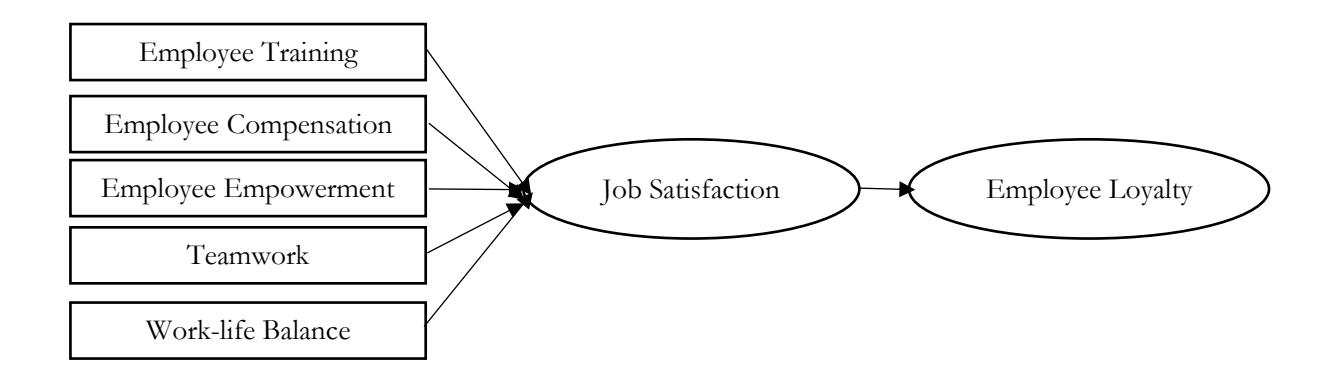
Figure 1. Conceptual Framework
3. Methodology
This study used a descriptive, correlational approach. A questionnaire was distributed to workers in Bangkok's hotel and restaurant sectors as the primary data-collection method. The survey instrument comprised both multiple-choice questions and Likert scale items, with the latter using a 5-point scale ranging from "strongly disagree" to "strongly agree." The information gathered was based on the participants' answers to these structured inquiries. The collected data were analyzed using SEM-PLS techniques, which were executed using the SEMinR package in the R programming environment.
This study included 565 individuals across three generations: 178 Gen Z participants (26 years old and younger), 225 Gen Y participants (27-42 years old), and 162 Gen X participants (43-58 years old). An online survey was conducted to gather information. Table 1 displays the demographic characteristics of the survey respondents.
Characteristics Frequency Percentage Gender Female 306 54.2% Male 259 45.8% Age Gen X: 43-58 162 28.7% Gen Y: 27-42 225 39.8% Gen Z: 26 or below 178 31.5% Education Master or above 17 3% Bachelor 404 70.5% High School 23 4.1% Vocational Certificate 121 21.4% Working Experience 10 years or more 101 17.9% 5 years or more and less than 10 years 122 21.6% 2 years or more and less than 5 years 107 18.9% 1 year or more and less than 2 years 197 34.9% Less than 1 year 38 6.7%
Table 1. Demographic Profile of the Respondents
To assess various aspects of employee experience and attitudes, we utilized scales established in previous research. These included measures for employee training (Jun et al., 2006) with four items, employee compensation (Jun et al., 2006) with five items, employee empowerment (Jun et al., 2006) with four items, teamwork (Shanahan et al., 2007) with six items, work-life balance (Talukder et al., 2018) with three items, job satisfaction (Jun et al., 2006) with four items, and job loyalty (Jun et al., 2006) with four items. Each item was evaluated using a 5-point scale, ranging from 1 (strongly disagree) to 5 (strongly agree).
To mitigate generational biases in responses, all measures utilized were standardized, validated instruments that have been widely adopted in numerous studies, thereby reducing reliance on subjective interpretations. Furthermore, our sample was relatively evenly distributed across three generations, with Generation Y comprising a slightly higher proportion. Additionally, respondents were assured of complete anonymity, and the information provided did not include any personal identification data.
4. Data Analyses and Results
To examine the proposed framework, we employed PLS-SEM, a technique widely used in tourism studies (Lata, 2021) that is suitable for non-normal data distributions (Hair et al., 2021a). The PLS-SEM approach consisted of two phases: evaluation of the measurement model and assessment of the structural model. The former determines how effectively the observed indicators represent their associated latent construct, while the latter examines the strength of the relationships between constructs (Risitano et al., 2023). We used path coefficients within the structural model to evaluate the hypothesized relationships.
4.1. The Measurement Model
The measurement model demonstrated convergent and discriminant validities. Convergent validity was assessed using three metrics: composite reliability, Cronbach's alpha, and average variance extracted, as outlined by Fornell and Larcker (1981). As shown in Table 2, these values surpassed the required threshold. Discriminant validity was confirmed using the HTMT ratio, adhering to the conservative threshold of 0.85, as proposed by Henseler et al. (2015). Notably, for constructs that are conceptually related, such as job satisfaction and employee loyalty, a higher threshold of 0.90 is considered acceptable (Hair et al. 2021b).
| Construct | Scale | Loadings | Composite | AVE | Cronbach |
|---|---|---|---|---|---|
| Item | Reliability | Alpha | |||
| ET1 | 0.815 | ||||
| ET2 | 0.719 | ||||
| ET3 | 0.812 | ||||
| Employee Training | ET4 | 0.783 | 0.864 | 0.614 | 0.789 |
| EC1 | 0.743 | ||||
| EC2 | 0.774 | ||||
| EC3 | 0.839 | ||||
| EC4 | 0.801 | ||||
| Employee Compensation | EC5 | 0.709 | 0.882 | 0.600 | 0.832 |
| EE1 | 0.781 | ||||
| EE2 | 0.818 | ||||
| EE3 | 0.680 | ||||
| Employee Empowerment | EE4 | 0.695 | 0.833 | 0.556 | 0.736 |
| TW1 | 0.746 | ||||
| TW2 | 0.769 | ||||
| TW3 | 0.767 | ||||
| Teamwork | TW4 | 0.798 | 0.892 | 0.578 | 0.855 |
| WB1 | 0.821 | ||||
| WB2 | 0.895 | ||||
| Work-life Balance | WB3 | 0.817 | 0.882 | 0.714 | 0.805 |
| ES1 | 0.764 | ||||
| ES2 | 0.719 | ||||
| ES3 | 0.750 | ||||
| Job Satisfaction | ES4 | 0.824 | 0.849 | 0.585 | 0.765 |
| EL1 | 0.711 | ||||
| EL2 | 0.821 | ||||
| EL3 | 0.787 | ||||
| Employee Loyalty | EL4 | 0.772 | 0.856 | 0.599 | 0.776 |
Table 2. Item Loadings, Composite Reliability, AVE, Cronbach Alpha Coefficients
4.2. The Structural Model
To evaluate the hypotheses, we employed a structural model. The analysis revealed significant correlations between job satisfaction and employee loyalty (β = 0.692, p <.001), and between job satisfaction and several factors: employee training (β = 0.163, p < .001), employee compensation (β = 0.088, p < .05), teamwork (β = 0.192, p < .001), and work-life balance (β = 0.399, p < .001). However, employee empowerment was not significantly associated with job satisfaction (β = 0.05, p = .29). Consequently, the findings support Hypotheses 1, 2, 4, 5, and 6.
To evaluate Hypothesis 7, we categorized the sample by generation. Among Generation X participants, only employee compensation (β = 0.142, p < .05) and work-life balance (β = 0.518, p < .001) showed significant correlations with job satisfaction. For Generation Y, four factors demonstrated significant relationships with job satisfaction: employee training (β = 0.268, p < .001), employee compensation (β = 0.173, p < .05), teamwork (β = 0.277, p < .001), and work-life balance (β = 0.167, p < .05). In the case of Generation Z, three factors were significantly linked to job satisfaction: employee training (β = 0.123, p < .05), teamwork (β = 0.179, p < .05), and work-life balance (β = 0.408, p < .001). The observed variation in job satisfaction determinants across generations supports hypothesis 7.
According to Hair et al. (2021b), the magnitude of path coefficients indicates the relative importance of the factors influencing the dependent variable. This allowed us to rank the significance of the elements that affect job satisfaction across generations. For Gen X, work-life balance is the most crucial factor, followed by employee compensation. In the case of Gen Y, teamwork ranked highest, followed by employee training, compensation, and work-life balance. Gen Z prioritizes work-life balance, followed by teamwork and employee training. Table 3 summarize the results.
Table 3. Summary of Results: Factor Priorities in Generations X, Y, and Z.
| Factor | Generation X | Generation Y | Generation Z |
|---|---|---|---|
| Employee Training | ns. | 2** | 3* |
| Employee Compensation | 2* | 3* | ns. |
| Employee Empowerment | ns. | ns. | ns. |
| Teamwork | ns. | 1** | 2* |
| Work-life Balance | 1** | 4* | 1** |
Note: ns.: non-significant; * significant at 0.05 level; ** significant at 0.01 level
5. Discussion and Conclusion
In line with expectations, job satisfaction was found to have a significant positive correlation with employee training, compensation, teamwork, and work-life balance. Job satisfaction is strongly linked to employee loyalty. The sole exception was employee empowerment, which, contrary to previous research, showed no significant relationship with job satisfaction. This outcome aligns with other studies, such as that of Kim and Jogaratnam (2010), who reported no substantial connection between employee empowerment and job satisfaction. They attributed this to the limited autonomy in decision-making within the hotel and restaurant industries, where most tasks are standardized and routine. Additional factors may influence the relationship between employee empowerment and job satisfaction. For instance, Fock et al. (2011) found that collectivism moderates the association between certain aspects of employee empowerment and job satisfaction. Further research is required to explore other potential moderating variables in this relationship.
The findings of our study lend credence to the notion that job satisfaction factors are valued differently across different generations. For the youngest cohort, Generation Z, the hierarchy of importance regarding job satisfaction was found to be work-life balance, followed by teamwork and employee training. This generation appears to place a higher emphasis on interpersonal connections than on other aspects. In comparison, Generation Y, the middle-aged group, prioritized the same three elements but in a different order, with the addition of employee compensation as a factor. They ranked teamwork as the most crucial, followed by work-life balance, with employee compensation and training holding moderate significance. The oldest group, Generation X, who is nearing retirement, prioritizes achieving equilibrium between professional and personal life along with fair compensation. They considered job training and teamwork less essential for job satisfaction. These generational disparities highlight the shifting expectations and priorities of employees across different age brackets. Notably, work-life balance emerges as the sole factor universally valued by all generations.
Our findings suggest a primary theoretical implication: The elements that influence job satisfaction vary across generations. This indicates that factors contributing to job satisfaction are not universally
applicable. Moreover, the significance of these elements differs across generations. Consequently, the relationship between these factors and job satisfaction appears to be subject to generational moderating effects. Our observations align with a previous study that demonstrated how generation moderates the link between empowerment and job satisfaction (Erdogan and Tekin, 2023). Therefore, this research warrants further investigation.
This study's findings offer several managerial insights. Work-life balance emerges as the sole universal factor influencing job satisfaction across generational groups. This underscores the need for managers to implement suitable work schedules to retain the staff. While traditional management practices might have expected employees to work extended hours in exchange for overtime pay, our data suggest that this approach may not be effective for Generation Z, because monetary compensation does not significantly impact their job satisfaction. Additionally, as Generation Y and Generation Z become the dominant workforce, management should prioritize their needs. For instance, both generations valued the relational aspects of work, with teamwork being a shared source of job satisfaction. Consequently, managers should foster collaboration and trust among their employees. Lastly, our research indicates that employee training contributes to both job satisfaction and loyalty for Generation Y and Z. Offering ongoing training opportunities to these cohorts not only enhances their skills and knowledge but also serves as a strategy to maintain their allegiance to the organization.
Future potential shifts in the hospitality industry encompass the offering of bundled services to customers. These include the adoption of artificial intelligence, collaboration with other businesses, and participation in sustainable tourism. All of these require new sets of skills and flexibility that differ from traditional hospitality practices. As the workforce ages over time, Generation Y and Z will become the primary forces to assume these new responsibilities. The results indicate that Generation Y and Z regard employee training and teamwork as sources of job satisfaction, which is favorable for management. Conversely, management must balance the flexibility of the workforce with the worklife balance of employees, as the latter is also a source of job satisfaction for these two generational groups.
A key constraint of our research is its cross-sectional nature, which precludes establishing causality between the examined factors and job satisfaction despite similar findings in previous studies. Additionally, observed generational differences may not remain constant over time. For instance, it is uncertain whether employee compensation continues to be a non-significant factor in Generation Z's job satisfaction with age. Consequently, future research could benefit from a longitudinal approach. Moreover, our study's exploratory nature in identifying generational differences was limited to five factors, taking into account the survey length issues and response fatigue. However, other variables may also exhibit generational variations, presenting an opportunity for further investigation in subsequent studies.
In summary, this comparative study of the factors influencing employee loyalty among Generation X, Y, and Z in Bangkok's hospitality sector sheds light on the changing dynamics and principles of workplace preferences. The unique perspectives of each generation highlight the necessity for customized strategies to enhance job contentment and, consequently, employee retention.
References
- Abdullah, R. B., Zain, R. A., Musa, M., Khalid, K., Tajuddin, M., Armia, R., Samsudin, M. M., & Nair, G. K. S. (2012). The effects of teamwork towards jobs satisfaction in hotel industry in klang valley, malaysia. International Journal of Business and Behavioral Sciences, 2(3), 8–19.
- Adesola, M. A., Oyeniyi, K. O., & Adeyemi, M. A. (2013). Empirical study of the relationship between staff training and job satisfaction among nigerian banks employees. International Journal of Academic Research in Economics and Management Sciences, 2(6), 108.
- Al Sabei, S. D., Labrague, L. J., Al-Rawajfah, O., AbuAlRub, R., Burney, I. A., & Jayapal, S. K. (2022). Relationship between interprofessional teamwork and nurses' intent to leave work: The mediating role of job satisfaction and burnout. Nursing Forum, 57(4), 568–576. DOI: 10.1111/nuf.12706.
- Al-Ababneh, M. (2017). The influence of employee empowerment on employee job satisfaction in five-star hotels in jordan. International business research, 10(3).
- Alrawahi, S., Sellgren, S. F., Altouby, S., Alwahaibi, N., & Brommels, M. (2020). The application of herzberg's two-factor theory of motivation to job satisfaction in clinical laboratories in omani hospitals. Heliyon, 6(9). DOI: 10.1016/j.heliyon.2020.e04829.
- Ann, S., & Blum, S. C. (2019). Motivating senior employees in the hospitality industry. International Journal of Contemporary Hospitality Management, 32(1), 324–346. DOI: 10.1108/IJCHM-08-2018- 0685.
- Arifin, A. H., Dameria, E., IIS, E. Y., Zahara, L., & Putri, R. G. (2022). Compensation, protection, and leadership changes to improve job satisfaction and employee loyalty.
- Asgarova, A. (2019). Impact of employee training on employee job satisfaction and achievement: A case of turkish manufacturing industry. Available at SSRN 3398117. Retrieved August 22, 2024, from https://papers.ssrn.com/sol3/papers.cfm?abstract_id=3398117
- Ashton, A. S. (2018). How human resources management best practice influence employee satisfaction and job retention in the thai hotel industry. Journal of Human Resources in Hospitality & Tourism, 17(2), 175–199. DOI: 10.1080/15332845.2017.1340759.
- Bakker, A. B., & Demerouti, E. (2007). The job demands-resources model: State of the art. Journal of managerial psychology, 22(3), 309–328. DOI: 10.1108/02683940710733115.
- Baldwin, T. T., & Ford, J. K. (1988). Transfer of training: A review aand directions for future research. Personnel Psychology, 41(1), 63–105. DOI: 10.1111/j.1744-6570.1988.tb00632.x.
- Chitiris, L. (1988). Herzberg's proposals and their applicability to the hotel industry. Hospitality Education and Research Journal, 12(1), 67–79. DOI: 10.1177/109634808801200106.
- Choi, S. L., Goh, C. F., Adam, M. B. H., & Tan, O. K. (2016). Transformational leadership, empowerment, and job satisfaction: The mediating role of employee empowerment. Human Resources for Health, 14(1), 73. DOI: 10.1186/s12960-016-0171-2.
- Coelho, P., & Bhattacharya, S. (2022). To analyze the level and factors of job satisfaction across different generations in india during COVID-19. Cardiometry, (24), 625–634. DOI: 10.18137/cardiometry.2022.24.625634.
- Erdogan, P., & Tekin, İ. Ç. (2023). The effect of psychological empowerment on job satisfaction: Regulatory role of generations x and y. Asia Pacific Journal of Health Management, 18(3), 160–169.
- Fock, H., Chiang, F., Au, K. Y., & Hui, M. K. (2011). The moderating effect of collectivistic orientation in psychological empowerment and job satisfaction relationship. International Journal of Hospitality Management, 30(2), 319–328. DOI: 10.1016/j.ijhm.2010.08.002
- Fornell, C., & Larcker, D. F. (1981). Structural equation models with unobservable variables and measurement error: Algebra and statistics. Journal of Marketing Research, 18(3), 382–388. DOI: 10.2307/3150980.
- Goh, E., & Lee, C. (2018). A workforce to be reckoned with: The emerging pivotal generation z hospitality workforce. International Journal of Hospitality Management, 73, 20–28. DOI: 10.1016/j.ijhm.2018.01.016.
- Goldstein, I., & Ford, J. (2002). Training in organizations: Needs assessment, development, and evaluation. Wadsworth. https://books.google.com.tw/books?id=AokiAQAAMAAJ
- Greenhaus, J. H., & Beutell, N. J. (1985). Sources of conflict between work and family roles. The Academy of Management Review, 10(1), 76. DOI: 10.2307/258214.
- Grzywacz, J. G., & Marks, N. F. (2000). Reconceptualizing the work–family interface: An ecological perspective on the correlates of positive and negative spillover between work and family. Journal of Occupational Health Psychology, 5(1), 111. DOI: 10.1037//1076-8998.5.1.111.
- Guzzo, R. A., & Dickson, M. W. (1996). Teams in organization: Recent research on performance and effectiveness. Annual Review of Psychology, 47(1), 307–338. DOI: 10.1146/annurev.psych.47.1.307.
- Haar, J. M., Russo, M., Suñe, A., & Ollier-Malaterre, A. (2014). Outcomes of work–life balance on job satisfaction, life satisfaction and mental health: A study across seven cultures. Journal of Vocational Behavior, 85(3), 361–373.DOI: 10.1016/j.jvb.2014.08.010.
- Hackman, J. R. (2006). The five dysfunctions of a team: A leadership fable. Academy of Management Perspectives. DOI: 10.5465/amp.2006.19873414.
- Hair, J. J. F., Hult, G., Ringle, C. M., & Sarstedt, M. (2021a). A primer on partial least squares structural equation modeling (PLS-SEM). https://uk.sagepub.com/en-gb/eur/a-primer-on-partial-leastsquares-structuralequation-modeling-pls-sem/book270548
- Hair Jr., J. F., Hult, G. T. M., Ringle, C. M., Sarstedt, M., Danks, N. P., & Ray, S. (2021b). Partial least squares structural equation modeling (PLS-SEM) using R: A workbook. Springer Nature. DOI: 10.1007/978-3-030-80519-7
- Heimerl, P., Haid, M., Benedikt, L., & Scholl-Grissemann, U. (2020). Factors influencing job satisfaction in hospitality industry. Sage Open, 10(4), 2158244020982998. DOI: 10.1177/2158244020982998.
- Henseler, J., Ringle, C. M., & Sarstedt, M. (2015). A new criterion for assessing discriminant validity in variance-based structural equation modeling. Journal of the Academy of Marketing Science, 43(1), 115–135. DOI: 10.1007/s11747-014-0403-8.
- Inda, S. S., & Mishra, D. S. (2016). A study on influence of employee compensation, job satisfaction, working environment on employee retention. International Journal of Advance Research and Innovative Ideas in Education, 2 (1), 407, 415.
- Jex, S. M., & Gudanowski, D. M. (1992). Efficacy beliefs and work stress: An exploratory study. Journal of Organizational Behavior, 13(5), 509–517. DOI: 10.1002/job.4030130506.
- Jun, M., Cai, S., & Shin, H. (2006). TQM practice in maquiladora: Antecedents of employee satisfaction and loyalty. Journal of operations management, 24(6), 791–812. DOI: 10.1016/j.jom.2005.09.006.
- Kanapathipillai, K., & Azam, S. F. (2020). The impact of employee training programs on job performance and job satisfaction in the telecommunication companies in malaysia. European Journal of Human Resource Management Studies, 4(3).
- Kapuściński, G., Zhang, N., & Wang, R. (2023). What makes hospitality employers attractive to gen z? a means-end-chain perspective. Journal of Vacation Marketing, 29(4), 602–616. DOI: 10.1177/13567667221110234.
- Khaliq, A., Kayani, U. S., & Mir, G. M. (2020). Relationship of employee training, employee empowerment, team work with job satisfaction. Journal of Arts & Social Sciences, 7(2), 185–198. DOI: 10.46662/jass-vol7-iss2-2020(185-198).
- Kim, K., & Jogaratnam, G. (2010). Effects of individual and organizational factors on job satisfaction and intent to stay in the hotel and restaurant industry. Journal of Human Resources in Hospitality & Tourism, 9(3), 318–339. DOI: 10.1080/15332845.2010.487043.
- Körner, M., Göritz, A. S., & Bengel, J. (2014). Healthcare professionals' evaluation of interprofessional teamwork and job satisfaction / evaluation der teamarbeit und der arbeitszufriedenheit von gesundheitsfachberufen. International Journal of Health Professions, 1(1), 5–12. DOI: 10.2478/ijhp-2014-0006.
- Lata, S. (2021). What determines consumers' intention for hotel bookings through smartphone apps? ASEAN Journal on Hospitality and Tourism, 19(3), 167–184. DOI: 10.5614/ajht.2021.19.3.01.
- Lee, B., Lee, C., Choi, I., & Kim, J. (2022). Analyzing determinants of job satisfaction based on twofactor theory. Sustainability, 14(19), 12557. DOI: 10.3390/su141912557.
- Liden, R. C., Wayne, S. J., & Sparrowe, R. T. (2000). An examination of the mediating role of psychological empowerment on the relations between the job, interpersonal relationships, and work outcomes. Journal of applied psychology, 85(3), 407. DOI: 10.1037/0021-9010.85.3.407.
- Locke, E. A. (1976). The nature and causes of job satisfaction. In M. D. Dunnette (Ed.), Handbook of industrial and organizational psycholog (Vol. 2). Rand McNally.
- Machova, R., Zsigmond, T., Zsigmondova, A., & Seben, Z. (2022). Employee satisfaction and motivation of retail store employees. Marketing and Management of Innovations, 1(1), 67–83. DOI: 10.21272/mmi.2022.1-05.
- Mehrad, A. (2020). Evaluation of academic staff job satisfaction at malaysian universities in the context of Herzberg's motivation-hygiene theory. Journal of Social Science Research, 15(1), 157– 166. https://api.semanticscholar.org/CorpusID:219048682
- Meyer, J. P. (1997). Commitment in the workplace: Theory, research, and application. Sage.
- Miah, M. T., & Hasan, M. J. (2022). Impact of Herzberg two-factor theory on teachers' job satisfaction: An implication to the private universities of Bangladesh. International Journal of Business and Management Research, 10(1), 1–5.
- Ngian, E. T., Chin, C. H., Ashman Shahrudin, B. K., & Tak, P. Y. (2022). Examining the effects of monetary and non-monetary factors on generation z's job selection preferences in the hospitality industry [Publisher: Human Resource Management Academic Research Society]. International Journal of Academic Research in Business & Social Sciences, 12(5), 66–83. Retrieved November 23, 2024, from DOI: 10.6007/IJARBSS/v12-i5/13019.
- Noe, R. (2017). Employee training & development (7th). McGraw Hill.
- Noell, N. H. (1976). Herzberg's two-factor theory of job satisfaction. Defense Technical Information Center.
- Phuong, T. T. K., & Tran, T. V. (2020). Job satisfaction, employee loyalty and job performance in the hospitality industry: A moderated model. Asian Economic and Financial Review, 10(6), 698.
- Rice, R. W., Frone, M. R., & McFarlin, D. B. (1992). Work—nonwork conflict and the perceived quality of life. Journal of Organizational Behavior, 13(2), 155–168. DOI: 10.1002/job.4030130205.
- Risitano, M., Romano, R., La Ragione, G., & Quintano, M. (2023). Analysing the impact of green consumption values on brand responses and behavioural intention. Business Ethics, the Environment & Responsibility, 32(3), 1096–1112. DOI: 10.1111/beer.12543.
- Rusnac, S., & Mart,iniuc, V. (2023). Performance orientation and job satisfaction of employees from the x, y, z generation. EcoSoEn, (2), 32–51. DOI: 10.54481/ecosoen.2023.2.05.
- Saad, S. G., & Hasanein, A. M. (2018). Impact of herzberg's theory on job satisfaction and organizational commitment in egyptian hotels: Frontline employees-case study. Egyptian Journal of Tourism Studies Vol, 17(1).
- Simons, T., & Enz, C. A. (1995). Motivating hotel employees: Beyond the carrot and the stick. Cornell hotel and restaurant administration quarterly, 36(1), 20–27. DOI: 10.1177/001088049503600114.
- Simons, T., & Hinkin, T. (2001). The effect of employee turnover on hotel profits: A test across multiple hotels. Cornell Hotel and Restaurant Administration Quarterly, 42(4), 65–69.
- Sobaih, A. E. E., & Hasanein, A. M. (2020). Herzberg's theory of motivation and job satisfaction: Does it work for hotel industry in developing countries? Journal of Human Resources in Hospitality & Tourism, 19(3), 319–343. DOI: 10.1080/15332845.2020.1737768
- Spreitzer, G. M. (1995). Psychological empowerment in the workplace: Dimensions, measurement, and validation. Academy of Management Journal, 38(5), 1442–1465. DOI: 10.2307/256865.
- Susanto, P., Hoque, M. E., Jannat, T., Emely, B., Zona, M. A., & Islam, M. A. (2022). Work-life balance, job satisfaction, and job performance of SMEs employees: The moderating role of family-supportive supervisor behaviors. Frontiers in Psychology, 13, 906876. DOI: 10.3389/fpsyg.2022.906876.
- Talukder, A. K. M., Vickers, M., & Khan, A. (2018). Supervisor support and work-life balance: Impacts on job performance in the australian financial sector. Personnel Review, 47(3), 727–744. DOI: 10.1108/PR-12-2016-0314.
- Thant, Z. M., & Chang, Y. (2021). Determinants of public employee job satisfaction in myanmar: Focus on herzberg's two factor theory. Public Organization Review, 21(1), 157–175. DOI: 10.1007/s11115-020-00481-6.
- Törn-Laapio, A., & Ekonen, M. (2021). Meaning of work across different generations of tourism and hospitality employees. Proceeding of the 4th International Conference on Tourism Research ICTR2021: A Virtual Conference hosted by Polytechnic Insititute of Porto, Portugal, 20-21 May 2021. Retrieved November 23, 2024, from https://www.theseus.fi/handle/10024/703806
- Turkyilmaz, A., Akman, G., Ozkan, C., & Pastuszak, Z. (2011). Empirical study of public sector employee loyalty and satisfaction. Industrial Management & Data Systems, 111(5), 675–696. DOI: 10.1108/02635571111137250.
- Wahyudi, E., Djamil, M., Kemalasari, N., & Bari, A. (2022). Effect of talent management, work life balance and organizational commitment on employee performance and job satisfaction as intervening variables in pt. tuv nord indonesia. Dinasti International Journal of Management Science, 3(6), 1032–1046. DOI: 10.31933/dijms.v3i6.1304.
- Xu, S., & Cao, Z. C. (2019). Antecedents and outcomes of work–nonwork conflict in hospitality: A meta-analysis. International Journal of Contemporary Hospitality Management, 31(10), 3919–3942. DOI: 10.1108/IJCHM-11-2018-0897.
Zayed, N. M., Rashid, M. M., Darwish, S., Faisal-E-Alam, M., Nitsenko, V., & Islam, K. A. (2022). The power of compensation system on employee satisfaction: The mediating role of employee motivation. Economies, 10(11), 290. DOI: 10.3390/economies10110290.