

1. Introduction
COVID-19 made significant disruptions in industries globally, including the hospitality industry. According to the Centre for Monitoring Indian Economy (CMIE), industry revenues fell to ₹ 5 billion in the June 20 quarter from ₹ 35–38 billion in the 2019–20 fiscal year due to the first wave of COVID-19. Before declining again to ₹ 11.4 billion in June 2021, the income had recovered to ₹ 20.8 billion in March 2021. In April–June 2021, a severe second wave of COVID-19 further threatened the industry. Sales almost hit ₹ 35 billion in December 2021, or pre-pandemic levels. In March 2022, the sales experienced a further decline to ₹ 31 billion due to the third wave events. Hotels have had to adopt several measures to ensure the safety and well-being of their guests and employees by implementing COVID-19 protocols. These protocols include enhanced cleaning, maintaining social distancing, and using personal medical equipment for personal protection. Although these procedures are required, they might affect hotel guests' satisfaction. Investigating whether the COVID-19 protocol raises customer satisfaction in the hotel business is crucial. Customer happiness is essential to the success of the hotel sector because happy guests are more likely to suggest and return to the hotel, which increases sales and profitability (Chen & Chen, 2018). For the hotel sector to survive the pandemic, it is essential to comprehend how adopting COVID-19 protocols can impact customer satisfaction in India and the relative importance of the dimensions of the SERVQUAL Model.
Numerous research works have looked at the effects of COVID-19 on the hotel business, including how it affects customer satisfaction. For instance, (Kim et al., 2020) discovered that the pandemic has had a detrimental influence on the job satisfaction of hotel personnel. Similarly, (Liu et al., 2020) claimed that the pandemic negatively impacted hotel occupancy rates and income. However, very few researchers have looked into how COVID-19 protocols affect guest satisfaction in the hotel sector. According to (Sigala et al., 2020), the pandemic has caused changes in visitor behavior, with travelers now prioritizing safety and cleanliness when picking a hotel.
Similarly, a study (by Buhalis & Neuhofer, 2020) discovered that hotels must implement new tactics to keep clients confident and trusting in the post-COVID era. Several studies have already shown how COVID-19 protocols impacted customer satisfaction. As per (Ozturk et al., 2021), using COVID-19 standards improved guest satisfaction in the hotel industry. However, other studies have also emphasized the difficulties in putting COVID-19 standards into practice in the hotel sector. According to a study by (Gursoy et al., 2021), inconsistent COVID-19 protocol application among hotels may cause visitors confusion and discontent. The COVID-19 pandemic impacted substantially India's hotel business as well. The pandemic has significantly reduced the Indian hotel industry's occupancy rates and revenue, according to a report by the Indian Hotel Industry Survey (2020). In response, the Indian government has issued guidelines for hotels to implement COVID-19 protocols to ensure the safety and health of guests and employees and restore guests' confidence (Ministry of Tourism, 2020).
The primary objective of this study is to determine whether using COVID protocol methods significantly increases customer satisfaction or not. While the secondary objectives of this study are to understand the relative impact of SERVQUAL dimensions on customer satisfaction in a pandemic; to identify the most significant COVID protocols that impact customer satisfaction; and to find the improvement in customer satisfaction due to adopting COVID protocols.
2. Literature Review and Hypothesis Development
To create a framework and conceptual basis for the contemporary study, the researchers conducted a thorough survey of existing research on service quality in the hotel industry. The data demonstrates that hotel service quality remains a critical area of extensive international research. Various sources state customer satisfaction, loyalty, and repeat business are the main factors determining profitability. Numerous studies have established a clear correlation between these variables and service quality.
Customer's expectations and perceptions may differ, which contributes to their unhappiness with the hotel services they receive. His research demonstrated the validity of the management concerns expressed by the individual. The hotel business will benefit from the implementation of SERVQUAL because management can provide better services (Ryan & Saleh, 1991). It was necessary to establish international needs for goods and services; they did not arise naturally (O'Neil et al., 1994). Speaking with customers, meeting their desired expectations, and keeping them as customers will ensure ongoing earnings (Mack et al., 2000). Businesses lose 50% of their clients every five years.
According to (Baker & Crompton, 2000; Zeithaml & Bitner, 2000; Mohsin, 2003; and Mohsin & Ryan, 2005), service quality and strong earnings correlate. As per (Getty & Getty, 2003), customer impressions are crucial despite best efforts to provide high-quality services. Therefore, it is necessary to research hotel patron perceptions. According to (Kandampully & Suhartanto, 2000), customer loyalty is the key to a company's success. According to this study, there is a connection between customer pleasure, loyalty, and hotel image. Customer loyalty to food and drink, customer satisfaction, price, the efficiency of housekeeping and reception, and the hotel's reputation all indicated favorable relationships. The current study tries to pull Indian visitors to 3/4-star luxury hotels.
Eight new components from the hospitality sector, collectively known as HOLSERV, were added to the SERVQUAL scale as part of the study focused on the Australian hospitality sector. The results of this study concentrated on three aspects of the hotel industry's perception of service quality, including employees' appearance and behavior, tangibles, and dependability. According to the study, changing how employees act and look will help increase service quality and match customers' expectations. As a result, the dimension of the staff has become the most accurate predictor of overall service quality. The HOLSERV instrument can be used by managers in the hotel sector to create service plans that meet customer expectations (Mei et al., 1999). When measuring worldwide consumer satisfaction, the researchers must consider Regional and cultural factors. Because culture can occasionally lead to differences in customer satisfaction levels for a single product, it substantially impacts customers' perception, problem-solving skills, and cognitive abilities. In the present competitive market, when most luxury hotels offer comparable services, the industry's survival rests on providing high-quality service that leads to delighted consumers.
Quality assurance requires planning, envisioning, monitoring, providing, and maintenance (Pallet et al., 2003). They also proposed that service quality problems and significant staff issues could be addressed by using the "People and Quality" strategy, which places a strong emphasis on understanding people philosophy, training staff members, giving them decision-making authority, asking staff members for input, developing corporate quality, benchmarking, and reviewing. 'Core hotel benefits' and 'hotel technologies' are two additional quality dimensions discovered through the in-depth interviews, and the author Ramsaran found that 'core services' is the most significant quality attribute that the SERVQUAL instrument has not covered (Ramsaran, 2007). The hotel patrons in Mauritius requested technology amenities. Customers' experiences and happiness are the most crucial aspects of controlling the quality system of services in the hospitality industry (Blesic et. al., 2011). Modern travelers find furnished accommodations, entertainment, leisure, and wellness attractive, extending the travel season. The outcome indicates that clients are not happy with the services offered. Except for empathy, their expectations are always higher than what they experience. The bigger the gap is between the first determinant and the concrete components of the service.
(Briggs et al., 2007) looked at small, mid-sized, and giant hotels in Scotland and found that the industry's performance in terms of service quality could be more consistent. This study also suggested that clients are not overly picky and are OK with personalized services that offer good value for money and provide precise information. According to him, the absence of a human element and how the staff handles client complaints determine whether a hotel offers exceptional or subpar service. (Keating and Harrington, 2003) concentrated on the service quality of the Irish hotel industry in their study and discovered that many of the quality programs failed due to a lack of loyalty between senior, middle management, and front-line staff members, as well as the organizations' lack of involvement, communication, and teamwork. Chinese hotels found that managers overemphasized the quality of the service rendered compared to customers' insights of service quality, which was invariably lower than their presumptions for service quality. Therefore, service quality, customer happiness, and their connection to business profits have received significant attention in the literature and research. Other Asian nations like Taiwan have been affected by traditional cultural values in the service industry. Taiwanese Chinese people are susceptible to personal relationships in social interactions, according to (Tsai et al., 2002). They believed that interpersonal connections protect client and company ties. The question at hand is this: Does Indian traditional culture influence the way that clients are treated at upscale hotels today? Such inquiries catalyzed the current study. (Padma and Ahn, 2020; Mohsin and Lockyer, 2009) Most luxury hotels offer comparable amenities and conveniences, so the hotel industry's service quality sets it apart.
However, some studies have also highlighted the limitations of SERVQUAL in assessing service quality in hotels. According to research (Grönroos, 1990), the instrument was too general and failed to adequately account for the particular service quality characteristics in the hotel industry. According to research, the measure could not sufficiently capture the emotional dimensions of service quality in the hotel business (Caruana, 2002). Despite its drawbacks, the hotel industry widely uses the SERVQUAL Model for evaluating service quality. According to (Paraskevas & Altinay, 2003), SERVQUAL is a valid and trustworthy measure for evaluating hotel service quality. Similarly, a study (Lee & Hsu, 2011) discovered that SERVQUAL was helpful in pinpointing opportunities to raise service quality in the hotel sector.
In conclusion, SERVQUAL is a widely used tool, and the hotel industry's success hinges on the quality of its services. The tool evaluates five dimensions of service quality: tangibility, assurance, responsiveness, reliability, and empathy. The results of numerous studies that evaluated service quality in the hotel sector using SERVQUAL indicate that responsiveness and dependability are the two elements most impacting customer satisfaction. However, numerous studies have also shown how the indicator is insufficient for capturing the specific aspects of service excellence in the hotel industry. Despite these limitations, SERVQUAL is still a valuable and relevant tool for assessing hotel service quality. The hotel business, amongst others, has been significantly impacted by COVID-19. Hotels now follow new policies and processes to guarantee the security and welfare of both their visitors and staff as a result of the pandemic. It has become difficult for hotels to maintain the standard of their services, including the SERVQUAL tool's measure of service quality.
SERVQUAL is frequently used in the hotel industry to evaluate service quality developed by (Parasuraman et al., 1985) on the premise that consumers can determine the caliber of service by differentiating their perceptions of the service they received that they anticipated. The tool assesses five service quality dimensions: tangibles, reliability, responsiveness, assurance, and empathy.
The hotel business heavily depends on providing customers with good service and facilities. As a result, a key element in the hotel industry's success is service quality. SERVQUAL has been used in numerous studies to evaluate service quality in the hotel sector. For instance, a study (Kandampully, 2000) indicated that the most critical variable that affects customer satisfaction in the hotel industry is the reliability dimension of service quality. Similarly, (Kim & Lee, 2015) discovered that the responsiveness component of service quality significantly impacted satisfaction in the hotel industry.
Various studies have shown how COVID-19 affects the caliber of hotel services. The pandemic has negatively impacted hotel service quality; according to a survey by (Kim et al., 2020), customers reported poorer levels of service quality due to the new rules and procedures. Similarly, (Gursoy et al., 2021) found that implementing COVID-19 criteria has reduced the hotel business's quality of service. Some studies have also found that the hotel industry's level of service has increased due to the application of COVID-19 protocols. According to a study by (Ozturk et al., 2021), the adoption of COVID-19 criteria had a positive effect on service quality and customer satisfaction in the hotels. Similarly, research (Wang & Tsai, 2021) found that hotels that implemented COVID-19 guidelines were perceived by guests as safer and more dependable, leading to higher levels of client satisfaction.
Despite the contradictory findings, the SERVQUAL technique is still helpful for assessing service quality in the hotel business during the COVID-19 outbreak. The SERVQUAL tool was beneficial in identifying areas where the quality of the service furnished by hotels during the pandemic may have been enhanced (Chen et al., 2021). According to the study, the most important variables affecting customer satisfaction during the pandemic were responsiveness and empathy.
Thus, the COVID-19 pandemic has significantly impacted the level of service in the hotel business. While some studies have identified a detrimental impact on service quality due to applying COVID-19 standards, others have found a beneficial influence. While the responsiveness and empathy aspects are the foremost in determining customer satisfaction, the SERVQUAL instrument is still helpful for evaluating service quality in the hotel business during the pandemic.
In this research, we are measuring the mediating role of COVID-19 safety measures in improving customer satisfaction. For this purpose, we propose a new construct called "COVID Safety Measures". The operational definition for this construct is developed from the narration in the official reports published by the Ministry of Health and Family Welfare (MoHFW), Government of India. Accordingly, it can be defined as "suitable measures taken by hoteliers to prevent and mitigate the risk of the further spread of COVID-19 while providing accommodation and other tourist services". The items for this construct were developed from the standard operating procedures recommended by the Ministry of Health and Family Welfare in March 2021.
Based on the conclusions from the literature, the following hypotheses are constructed for this study (Figure 1).
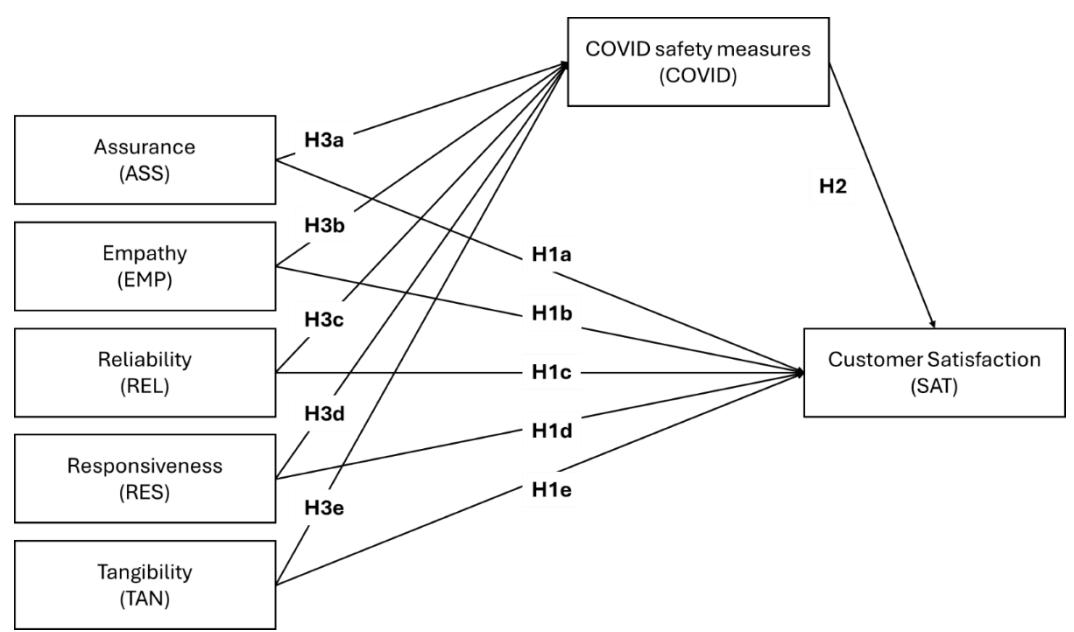
Figure 1. Conceptual Model
H1: SERVQUAL constructs (a) assurance, (b) empathy, (c) reliability, (d) responsiveness, and (e) tangibility have a significant direct impact on customer satisfaction.
H2: COVID-19 safety measures have a significant direct impact on customer satisfaction.
H3: The link between SERVQUAL constructs and customer satisfaction is mediated by COVID-19 safety measures.
3. Methodology
The hotel's ratings and amenities significantly impact customer satisfaction (Zhou et al., 2014). Therefore, the researchers targeted the properties with three-star ratings because this segment provides comfort, style, and a range of other amenities at affordable prices.
The researchers established contacts with the hotel's management and collected the email IDs of guests who stayed there between May 2021 and July 2021 for the study. The researchers did not collect any other details of the guests, such as their names, the type of room booked, or other services availed, to maintain the confidentiality and anonymity of the guests. We received 630 email IDs from 16 different hotels. Due to COVID-19 restrictions, the occupancy rates at these hotels were low, and the occupancy at these hotels ranged from a minimum of 30 to a maximum of 45 guests during the study period. The researchers identified these 16 hotels from the list of the top 20 open hotels offering services during the study period.
The study started by administering the questionnaire to the guests through email, briefly narrating the study's purpose to gain the guests' confidence. A link to the survey was attached to the email. Literature suggests that the response rate of email surveys is significantly lower (Bachman et al., 1996, 1999; Kiesler & Sproull, 1986; Opperman, 1995; Schaefer & Dillman, 1998), but due to social distance guidelines, the researcher was restricted to email surveys. We received 331 responses, out of which 269 were complete and suitable for analysis. The response rate for the email survey was 42%, around the average response rate suggested in the literature (Meng-Jia Wu et al., 2022).
To study whether adopting COVID-19 safety measures moderated satisfaction with the service offered by the hotel, the researchers included items related to COVID-19. The researchers used secondary data to identify 31 items specific to COVID safety measures followed in the Hotel industry. The researchers consulted a team of experts, including two subject matter experts, two senior managers from the hotel industry, and a guest. The researchers consulted them and asked them to rank the 31 items based on their relative importance. The questionnaire included the top 15 relative priority items to collect the responses on a 5-point Likert scale. The responses were analyzed using an exploratory factor analysis to determine the factors underlying the moderating variable of COVID-19 safety measures. Four factors had a ratio of eigenvalues greater than 1, explaining the exploratory importance of these factors concerning the mediating variable. (Ather and Balasundaram, 2009; An Gie Yong and Sean Pearce, 2013). The scree plot, a graphical representation of the eigenvalues against the number of factors, also confirms that four exploratory factors are significant in explaining the COVID-19 safety measures. Since no scale is available to measure the variable 'COVID safety measure', the exploratory factor analysis method was used to generate the items for the construct. Based on the rotated component matrix results, four items were identified that broadly covered sanitization, social distancing, use of technology, and preventive measures (use of protective gear and mitigation plan) adopted by the hotels. These four items were used to measure the COVID-19 safety measures construct.
The questionnaire used for the study adopted the five factors in the SERVQUAL Model, along with the COVID variables, to examine whether the moderating variable significantly improves the satisfaction level among the guests. The questionnaire included four sections; the first section included a brief note about the purpose of the study, assuring anonymity and confidentiality of data collected from them. The second section asked the respondents to respond to questions related to SERVQUAL variables, which captured their expectations and perceptions towards the service offered by the hotel. The third section asked the respondents about their expectations and perceptions of the COVID protocols adopted by the hotel. The respondents provided demographic information about themselves in the last section.
The researchers empirically tested the hypothesis explaining the moderating effect of COVID response-specific variables on the guests' satisfaction level. The Partial Least Squares (PLS) technique is used to analyze the data as it supports exploratory and confirmatory research in a formative construct. PLS is a powerful structural equation modeling (SEM) technique widely used for customer satisfaction research (S Sundaram et al., 2007; V Venkatesh et al., 2000). SmartPLS is also suitable when the sample size is small, which is the case here due to COVID-related restrictions on field surveys over a large sample.
4. Results
4.1 Common Method Bias, Reliability, and Validity
Variance Inflation Factor (VIF) was assessed to check for common method bias in the data. All the inner model values were lower than 3.3, indicating that the model is free of standard method bias (Kock, 2015). The outer loadings and latent variable correlation established that the measures had adequate Indicator reliability, Internal consistency reliability, Convergent validity, and Discriminant validity (Table 1). The latent variables' indicator reliability was more significant than the acceptable value 0.4 in exploratory research. (Hulland, 1997). The internal consistency reliability (composite reliability) values were more significant than the acceptable value of 0.7 (Bagozzi et al., 1988). The convergent validity values were more significant than the acceptable value of 0.5 (Bagozzi et al., 1988). LV correlations were more significant than the square root of the AVE of each construct. (Fornell et al., 1981, Chin, 1998), Therefore discriminant validity has also been established as suggested by Fornell and Larcker and the Heterotrait-Monotrait (HTMT) Method. The reliability and validity results are reported in Table 1. Table 2 shows the square root of AVE in the diagonal elements; below the diagonal elements are the correlation between the constructs (Fornell & Larcker values), and above the diagonal elements are the HTMT values.
Table 1. Item Loadings, Reliability, and Validity
| Constructs | Items | λ | α | CR | AVE | VIF |
|---|---|---|---|---|---|---|
| Assurance | assg1 | 0.800 | 0.783 | 0.786 | 0.698 | 1.491 |
| assg2 | 0.843 | 1.707 | ||||
| assg3 | 0.863 | 1.803 | ||||
| empg1 | 0.824 | 0.794 | 0.796 | 0.709 | 1.871 | |
| Empathy | empg2 | 0.884 | 2.208 | |||
| empg3 | 0.815 | 1.485 | ||||
| relg1 | 0.764 | 0.748 | 0.752 | 0.665 | 1.362 | |
| Reliability | relg2 | 0.837 | 1.582 | |||
| relg3 | 0.843 | 1.656 | ||||
| resg1 | 0.822 | 0.774 | 0.774 | 0.689 | 1.542 | |
| Responsiveness | resg2 | 0.858 | 1.844 | |||
| resg3 | 0.809 | 1.540 | ||||
| Tangibility | tang1 | 0.820 | 0.756 | 0.757 | 0.672 | 1.486 |
| tang2 | 0.818 | 1.584 | ||||
| tang3 | 0.821 | 1.507 | ||||
| COVID | covg1 | 0.744 | 0.841 | 0.847 | 0.678 | 1.522 |
| covg2 | 0.857 | 2.119 | ||||
| covg3 | 0.850 | 2.116 | ||||
| covg4 | 0.837 | 1.905 | ||||
| sat1 | 0.958 | 0.902 | 0.907 | 0.91 | 3.080 | |
| Satisfaction | sat2 | 0.950 | 3.080 |
Table 2. Discriminant Validity
| Assurance | Empathy | Reliability | Responsiveness | Tangibility | COVID | Satisfaction | |
|---|---|---|---|---|---|---|---|
| Assurance | 0.836 | 0.844 | 0.764 | 0.943 | 0.848 | 0.805 | 0.691 |
| Empathy | 0.667 | 0.842 | 0.781 | 0.849 | 0.927 | 0.786 | 0.699 |
| Reliability | 0.586 | 0.603 | 0.816 | 0.862 | 0.803 | 0.811 | 0.611 |
| Responsiveness | 0.736 | 0.672 | 0.657 | 0.830 | 0.788 | 0.859 | 0.704 |
| Tangibility | 0.654 | 0.724 | 0.604 | 0.603 | 0.820 | 0.764 | 0.634 |
| COVID | 0.654 | 0.650 | 0.641 | 0.693 | 0.615 | 0.823 | 0.662 |
| Satisfaction | 0.583 | 0.595 | 0.504 | 0.591 | 0.525 | 0.581 | 0.954 |
4.2 Structural Model
A Following the measurement model assessment, the next step is to analyze the hypothesized relationship between the constructs. The results of the analysis of the direct relationships are presented in (Table 3).
Table 3. Direct Relationships
| Hypotheses | μ | σ | t-stats | p value | Decision | |
|---|---|---|---|---|---|---|
| Assurance -> Satisfaction | H1a | 0.159 | 0.065 | 2.456 | 0.007 | Supported |
| Empathy -> Satisfaction | H1b | 0.218 | 0.07 | 3.106 | 0.001 | Supported |
| Reliability -> Satisfaction | H1c | 0.041 | 0.07 | 0.588 | 0.278 | Not Supported |
| Responsiveness -> Satisfaction | H1d | 0.154 | 0.07 | 2.188 | 0.014 | Supported |
| Tangibility -> Satisfaction | H1e | 0.035 | 0.071 | 0.487 | 0.313 | Not Supported |
| COVID -> Satisfaction | H2 | 0.18 | 0.063 | 2.872 | 0.002 | Supported |
The findings reveal that, except for REL→SAT and TAN→SAT, all other hypotheses are positive and significant. Therefore, hypotheses H1a, H1b, H1d, and H2 are accepted, while H1c and H1e are not accepted.
4.3 Mediation Analysis
The mediation effect of the COVID variables is tested and presented in (Table 4).
Table 4. Direct Relationships 2
| Hypotheses | μ | σ | t-stats | p value | Decision | |
|---|---|---|---|---|---|---|
| Assurance-> COVID-> Satisfaction | H3a | 0.028 | 0.019 | 1.531 | 0.063** | Supported |
| Empathy-> COVID-> Satisfaction | H3b | 0.029 | 0.019 | 1.513 | 0.065** | Supported |
| Reliability-> COVID-> Satisfaction | H3c | 0.039 | 0.018 | 2.097 | 0.018** | Supported |
| Responsiveness-> COVID-> Satisfaction | H3d | 0.048 | 0.024 | 1.982 | 0.024** | Supported |
| Tangibility-> COVID-> Satisfaction | H3e | 0.019 | 0.021 | 0.93 | 0.176 | Not Supported |
*5% significance level **10% significance level
The results of Table 4 reveal that the mediating role of the COVID variables is positive and significant at 95% and 90% CI, except for mediation in the TANàSAT relationship. Therefore, hypotheses H3a, H3b, H3c, and H3d are accepted, while H3e is not accepted.
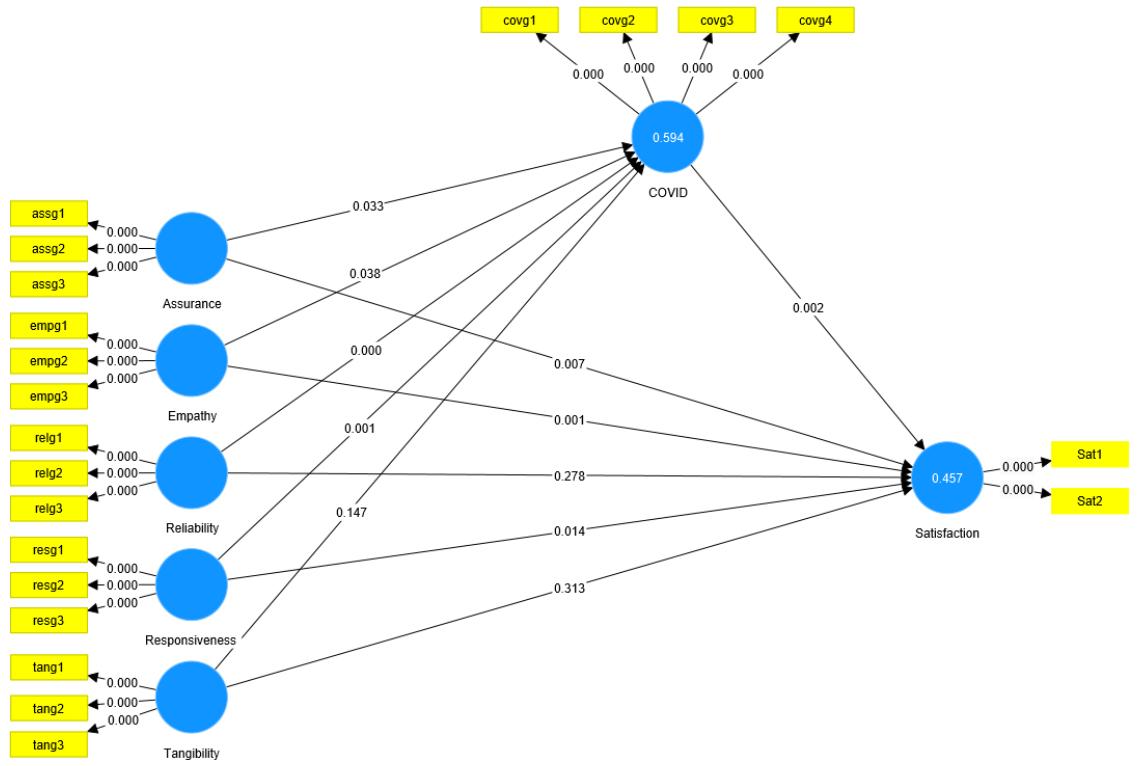
Figure 2. SEM
5. Discussion
The study examined the role of SERVQUAL factors in improving customer satisfaction by exploring the direct and mediated effects of COVID-19 safety measures. The findings revealed a significant and positive relationship between customer satisfaction and assurance, empathy, responsiveness, and COVID-19 safety measures, supported by previous literature. Therefore, the study supports the argument that customers are satisfied with the service received from the hotel if they exhibit assurance, empathy, and responsiveness. During the pandemic, when there were a lot of restrictions and regulations imposed by the Government to curb the spread of the virus, hotels were also guided by the SOP issued by the Ministry of Health and Family Welfare (MoHFW) to minimize the risk of spread of the COVID virus. The study reveals that customers who had to travel for emergency purposes and stayed in these hotels felt that the measures adopted by the hotel to ensure their safe stay gave them confidence in the services offered by the hotel, and therefore, they were satisfied with the hotel.
The findings revealed the significant mediating effect of the COVID variable. When the hotel adheres to the safety measures, they feel confident and trust the hotel, they think that the hotel is empathetic to their demands and safety, they are consistent in ensuring the safe stay of the customers, and that they are prompt to offer any support if they feel sick or unwell. However, since most of the safety gadgets and sanitization were prone to being exposed to all the customers, it could be implied that customers felt that there were risk factors involved. This fact may justify the low significance value in the mediating role of COVID-19 in the relationship between tangibility and customer satisfaction.
This result explains that even when the hotel strictly follows the COVID protocol, the empathy, reliability, and responsiveness shown by the hotel staff and the assurance guaranteed by the hotel about the safety and well-being of the customers have significantly contributed to improving customer satisfaction.
5.1 Theoretical and Managerial Implications
The extant literature regards the SERVQUAL Model as a well-established and popular measure of customer satisfaction. The researchers developed and experimented with the Model globally across industry and geography to establish its validity. The researchers found no evidence of any research work on the Model during an unusual event like COVID-19. As a theoretical impact, this work now establishes a method to measure the effect of an extraordinary event (COVID-19 pandemic in this case) of enormous nature on customer satisfaction during the temporary transition of the event, considering the SERVQUAL Model as a reference.
Regarding the managerial impact, this work validates management attention to various COVID protocols or sets of responses to sudden events of a similar magnitude. It prioritizes the interventions within the protocol and allocation of resources across the SERVQUAL dimensions during unusual events. The findings of this study can help managers in the hotel industry and policymakers in India understand the impact of the COVID-19 protocol or responses to sudden events that have an extraordinary effect on customer satisfaction and develop strategies to prioritize budget allocation across various dimensions of SERVQUAL. The findings of this study help enhance the customer service delivery experience during the transition period of the pandemic or an event of a similar nature, and predict the changing customer behavior.
5.2 Research Limitations and Future Scope of Research
Collecting responses during the pandemic was a challenge. So, the researchers relied on an online survey with telephonic interactions. This study is on the hotel industry in the three-star category in India. Future research can extend this study to other hotel categories in and outside India. While considering the impact on the hospitality industry, the researchers considered only the hotel sector severely affected by the pandemic. Future works can extend this study on shared service models to other hospitality industry segments, like travel, restaurants, and private shared service accommodation providers. A larger sample over a more comprehensive geography and service industry can help arrive at a more generalized conclusion. A longitudinal study across pandemic and post-pandemic times may throw interesting insights to work on, like exploring if the event-led additional dimensions get subsumed in the standard five dimensions of the SERVQUAL Model after the event ceases to exist.
6. Conclusion
The researchers found no evidence of research on the SERVQUAL Model during an unusual event like COVID-19 in the hospitality industry in India. The study establishes that during the occurrence of an unusual event with an incredible impact on humankind, the relative importance of the five dimensions of the SERVQUAL Model undergoes a shift, leaving room for creating a new dimension built over items that primarily include various responses to the event, like COVID protocol in the case of the current research. Adopting COVID protocols impacts customer satisfaction, although the increase in R2 value is just marginal. The authors found that SERVQUAL as a model stood firm even during a high-impact temporary incident, with a negligible increase in R2 value when the authors added a new dimension specific to COVID-19 precautions adopted by the hotel industry. Besides, the authors also noticed a temporary change in the relative impact of some dimensions in the SERVQUAL Model. Even when the hotel strictly follows the COVID protocol, the empathy, assurance, and responsiveness dimensions significantly improve customer satisfaction. Customers are, therefore, eager to refer others to the hotel. At the same time, the other two dimensions of the SERVQUAL Model, tangibles and reliability, received very low priority in impacting customer satisfaction.
While the research establishes the SERVQUAL Model's robustness and marginal relative impact on its dimensions during unusual events, the new event-response-driven dimension may cease to exist after the event, and its items may likely be subsumed in the five elements of the SERVQUAL Model.
References
- Abraham Pizam, Taylor Ellis. (1999). Customer satisfaction and its measurement in hospitality enterprises. International Journal of Contemporary Hospitality Management, 11(7), 326-339.
- Amy Wong Ooi Mei Alison M. Dean Christopher J. White. (1999). Analysing service quality in the hospitality industry. Managing Service Quality: An International Journal, 9(2), 136 – 143.
- Baker, D. and Crompton, J. (2000). Quality, satisfaction, and behavioral intentions. Annals of Tourism Research, 27, 785–804.
- Blesic, I. (2011). Improving the Service Quality as a Socially Responsible Activity of Hotel Companies. Amfiteatru Economic, 13(29), 273-286.
- Briggs, S., Sutherland, J. & Drummond, S. (2007). Are hotels serving quality? An exploratory study of service quality in the Scottish hotel sector. Journal of Tourism Management, 28(4), 1006–1019.
- Buhalis, D., & Neuhofer, B. (2020). COVID-19 and tourism: The implications for advancing and resetting industry and research. Journal of Travel Research, 0047287520963835.
- Caruana, A. (2002). Service loyalty: The effects of service quality and the mediating role of customer satisfaction. European Journal of Marketing, 36(7/8), 811–828.
- Chen, C. C., & Chen, S. Y. (2018). Investigating the effects of service quality and customer satisfaction on customer loyalty in mobile value-added services. Telematics and Informatics, 35 (4), 1080-1093.
- Chen, C. C., Chen, S. Y., & Chen, Y. H. (2021). Investigating the effects of COVID-19 on service quality and customer satisfaction in the hotel industry: A study of hotels in Taiwan. Sustainability, 13(3), 1248.
- Getty, J.M. & Getty, R.L. (2003). Lodging quality index: assessing customers' perceptions of quality delivery. International Journal of Contemporary Hospitality Management, 15(2), 94–104.
- Grönroos, C. (1990). Service quality: The six criteria of good perceived service. Review of Business, 11 (4), 10–13.
- Gursoy, D., Chi, C. G. Q., & Lu, L. (2021). Antecedents and outcomes of travelers' COVID-19 preventive behaviors. Journal of Travel Research, 0047287521994313.
- Indian Hotel Industry Survey. (2020). COVID-19 impact on the Indian hospitality industry. Retrieved from https://www.hvs.com/article/9015-covid-19-impact-on-indian-hospitality-industry
- Jay Kandampully, Dwi Suhartanto. (2000). Customer loyalty in the hotel industry: the role of customer satisfaction and image. International Journal of Contemporary Hospitality Management, 12 (6), 346-351
- Kandampully, J. (2000). Service quality to service loyalty: A relationship beyond customer services. Total Quality Management, 11(4-6), 509–515.
- Keating, M. & Harrington, D. (2003). The challenges of implementing quality in the Irish hotel industry. Journal of European Industrial Training, 27(9), 441–53.
- Kim, H. J., & Lee, H. J. (2015). The impact of service quality on customer satisfaction and loyalty in Korean hotels. International Journal of Tourism and Hospitality Research, 9(1), 25-43.
- Kim, H. J., Gursoy, D., & Lee, S. (2020). The impact of COVID-19 on service quality and customer satisfaction in the hotel industry: A conceptual framework and research agenda. Journal of Hospitality and Tourism Management, 45, 81-91.
- Lee, Y. K., & Hsu, C. C. (2011). A study of service quality in the hospitality industry: The case of hotels in Taiwan. Journal of Quality Assurance in Hospitality & Tourism, 12(2-3), 87–97.
- Liu, X., Li, Y., & Li, S. (2020). Economic impact analysis of COVID-19 on China's tourism industry. Journal of Sustainable Tourism, 29 (7), 1-20.
- Mack, R., Mueller, R., Crotts, J. and Broderick, A. (2000). Perceptions, corrections, and defections: implications for service recovery in the restaurant industry. Managing Service Quality, 10(6), 339– 46.
- Ministry of Tourism. (2020). Operational recommendations for hotels to prevent the spread of COVID-19. Retrieved from https://tourism.gov.in/sites/default/files/OperationalRecommendations _for_Hotels.pdf
- Mohsin, A. (2003). Service quality assessment of restaurants in Darwin, NT Australia. Journal of Hospitality and Tourism Management, 10(1), 23–34.
- Mohsin, A. and Ryan, C. (2005). Service quality assessment of 4-star hotels in Darwin, Northern Territory. Australia Journal of Hospitality and Tourism Management, 12(1), 25-36.
- Mohsin, A., Lockyer, T. (2010). Customer perceptions of service quality in luxury hotels in New Delhi, India: an exploratory study. International Journal of Contemporary Hospitality Management. 22(2), 160–173.
- O'Neil, M., Watson, H., & McKenna, M. (1994). Service quality in the Northern Ireland hospitality industry. Managing Service Quality, 4(3), 36–40.
- Ozturk, A. B., Okumus, F., & Bilim, Y. (2021). The impact of COVID-19 on hotel guest satisfaction and engagement. International Journal of Hospitality Management, 94, 102868.
- Pallet, W.J., Taylor, W.W. and Jayawardena, C. (2003). People and quality: the case of Delta Hotels. International Journal of Contemporary Hospitality Management, 15(6), 349-51.
- Paraskevas, A., & Altinay, L. (2003). We are planning research in hospitality and tourism. Routledge.
- Paraskevas, A., & Arendell, B. (2007). Measuring service quality in the hotel industry: A study in a business hotel in Turkey. International Journal of Hospitality Management, 26(2), 284-296.
- Parasuraman, A., Zeithaml, V. A., & Berry, L. L. (1985). A conceptual model of service quality and its implications for future research. Journal of Marketing, 49(4), 41–50.
- Saleh, F. and Ryan, C. (1991). Analysing service quality in the hospitality industry using the SERVQUAL model. The Service Industries Journal, 11(3), 324-43.
- Sigala, M., Gretzel, U., & Xiang, Z. (2020). The impact of COVID-19 on tourism. Journal of Tourism Management, 81, 104164.
- Tsai, M., Ryan, C. & Lockyer, T. (2002). Culture and evaluation of service quality a study of the service quality gaps in a Taiwanese setting. Asia Pacific Journal of Tourism Research, 7(2), 8–18.
- Tsang, N. and Qu, H. (2000). Service quality in China's hotel industry: a perspective from tourists and hotel managers. International Journal of Contemporary Hospitality Management, 12(5), 316–26.
Wang, Y., & Tsai, C. H. (2021). The effects of COVID-19 on hotel online reviews and perceptions of safety and trustworthiness. International Journal of Contemporary Hospitality Management, 33(2), 682-700.
Zeithaml, V.A. and Bitner, M.J. (2000). Services Marketing: Integrating Customer Focus across the Firm, McGraw-Hill, New York, NY.