

1. INTRODUCTION
Some types of mosquitoes are known as major vectors that can transmit a number of disease-causing viruses to human such as Aedes (causing Dengue, Zika, and Chikungunya), Anopheles (Malaria) and Culex (West Nile Virus) [1]. Virus transmission can occur through the biting process of infected adult female mosquitoes. Biologically, the biting is a natural behavior of mosquitoes to obtain protein from the blood for their breeding process [2]. Prevention and reduction of virus transmission especially on humans are mainly dependent on the effectiveness in controlling the contact between human and mosquitoes.
Currently, the most commonly used mosquito control methods are larvacide, fumigation, Indoor Residual Spraying (IRS), Insecticide-Treat Bed Nets (ITNs), and the use of repellent products (in the form of lotion, coil, or liquidator). Repellent in the form of a chemical compound is designed to push the mosquito's flying orientation away from its source [4]. It is estimated that the effectiveness of repellent only persists in a relatively short time or about 3-6 hours after its usage [5]. In addition, the researchers suggested that the use of repellent applied directly to the skin in high concentrations and long periods of time can cause side effects to the skin [6]. Hence, alternative in implementation techniques of repellent such as in fabrics and walls are being developed in textile industries [7], [8].
Repellent usage in clothing is one of the revolutionary methods in the textile development [6]. The results showed that the use of 20 grams of repellent (permethrin) per kilogram of fiber in clothing has a durability of 20 leaching (depending on the type of compound used) [9]. The use of repellent clothing can provide personal protection to human, and at the larger scale of implementation, this strategy is effective to reduce the bitting of some species of mosquitoes such as Aedes Aegypti which are active during daylight both inside and outside of home [10]. Currently, the use of repellent in textiles is widely applied to travel clothing, recreational clothing, and military uniforms to protect the soldiers who work in the forestry area. The researchers are also evaluating the possible use of repellent in school uniforms to protect children from the threat of mosquito-borne diseases, particularly in developing countries [11].
Basically, mosquitoes have the opportunity to choose the blood meal of available host in nature such as mammals, birds, reptiles, amphibians and fish [12], [13]. In the blood-seeking process, environmental
Received Mei 07nd, 2018, Revised August 7 th, 2018, Accepted for publication September 20th, 2018. Copyright ©2018 Published by Bio Mathematical Society, e-ISSN: 2549-2896, DOI:10.5614/cbms.2018.1.2.2
conditions such as host availability and host abundance may form the characteristic in the mosquito to chose a particular host as compared to other hosts (preferences) [14]. This is supported by the number of studies showing that differences of mosquitoes preference can occur between different species, between populations of the same species, and between the same species in a population [15], [16], [17]. Studies in southern Tanzania show that the proportion of human blood taken from An. Arabiensis decreases by more than 50 % when at least one cow is kept in a household [18]. Other experiments have also been conducted to see the potential of inheritance in host selection on An. Gambiae, and show that the vector significantly increases their preference for livestock (relative to humans) in several generations of selection [15], [19]. Although it has a genetic base, the mosquitoes preference can be controlled by the adaptability or the habit of mosquitoes in sucking blood from certain host species [2].
Generally, mosquito preferences can be categorized into two groups: (i) mosquitoes with specific orientations, i.e. mosquitoes which are sucking blood only from certain host species (e.g. in humans called anthropophilic and in animals called zoophilic), (ii) mosquitoes with opportunistic properties, i.e. mosquitoes that can take blood from any host available [2]. In the process of finding their host, the female mosquitoes use a combination of various signals such as smell, color (visual), and temperature in their environment [20]. The odor is the most important signal for mosquitoes to detect the presence of the host. In the early stages, chemical compounds emanating from the host (such as volatile, CO2, lactic acid, ammonia, ketone sulfide, etc.) will stimulate the mosquito olfactory receptor [21], [22]. After the mosquito detects the odor signal, the mosquito will do an orientation to the host by detecting the signal of visual and temperature. Then, the mosquito will localize the host and do their activity to get blood from the host (landing, probing, feeding) [23].
The presence of repellent on clothing can affect mosquito orientation in finding their blood resource. It is known that the chemical compounds contained in fabric fiber will evaporate and mix with the air, thus blocking and affecting the mosquito's olfactory sensors in detecting the odor released by humans. In this case, the human seems to be 'invisible' to mosquitoes [20]. In the process of blood seeking, the presence of repellent can change the orientation of blood seeking of mosquitoes, while the landing, probing, and feeding ability will be essentially blocked by the existence of repellent [23]. After the mosquito detects the presence of repellent, they will turn, and look for other available and unprotected blood resources.
It is then already known that in a heterogeneous environment, mosquitoes have the possibility to alter their host preferences. In addition, the repellent clothing usage can also reduce the availability of humans as a mosquito blood resource. Based on these conditions, the mosquitoes preference alteration can be used as a control strategy to prevent transmission of the virus to humans. In this paper, we want to know the dynamics of mosquito preferences alteration in obtaining blood resource based on the application of repellent clothing and fumigation effect.
We organize the rest of the paper as the following. In Section 2, we construct the model of mosquito preferences alteration in choosing a blood resource based on the application of repellent clothing usage and fumigation. In Section 3, we analyse the dynamics of the model that has been constructed. Global sensitivity analysis and numerical simulation are given in Section 4 to verify the analysis results in Section 3. Finally, conclusions are given in the last section.
2. MATHEMATICAL MODEL
Suppose that in one region there are human, animal, larva and mosquito populations. With the use of repellent clothing, the human population is divided into two groups: i.e. the human with protection and human without protection. The application of repellent clothing usage can affect mosquitoes in seeking their blood resources. Here in this model, the mosquito population is divided into three groups: i.e. anthropophilic mosquito, opportunistic mosquito, and zoophilic mosquito. Here are some assumptions used in this model.
- 1) The animal population is assumed to be constant.
- 2) To simplify the dimensions, the phase of egg and pupa are not involved in model construction.
- 3) The anthropophilic and opportunistic mosquitoes can only produce larvae with anthropophilic traits, whereas zoophilic mosquitoes can produce larvae with zoophilic traits (with probability p) and anthropophilic traits (1-p) [24].
- 4) The logistic limitations at the larva stage have an impact on the competition between larvae to obtain microorganism as their food resource.
5) The process of preference alteration may occur when the mosquito is exposed to repellent (as a result of reduced human availability as a blood source and there is the repellent effect on mosquito's odor sensors) and when the mosquito receives the blood from another host besides of their main preference (as a form of mosquitoes adaptation). Especially in mosquitoes with specific characteristics (anthropophilic or zoophilic), preference alteration is not a simple process (the chances are relatively small), but the possibility still exists in which regular blood resource is less available, and there are abundant other blood resources [2].
Specifically, the process of preference alteration for every mosquito characteristics is assumed as follows.
- a. When the anthropophilic and opportunistic mosquitoes are exposed to repellents, the characteristics of each mosquito may turn into an opportunistic and zoophilic mosquito.
- b. When the anthropophilic and opportunistic mosquito obtains blood from the animal, then the characteristics of each mosquito may turn into an opportunistic and zoophilic mosquito.
- c. When the opportunistic and zoophilic mosquito obtains blood from humans without repellent, then the characteristics of each mosquito may turn into an anthropophilic and opportunistic mosquito.
- 6) The preference alteration is proportional to the ratio between humans with protection and the number of humans and animals.
The flow diagram of mosquito and larva in a heterogeneous environment based on the application of repellent clothing usage is described in Figure 1.
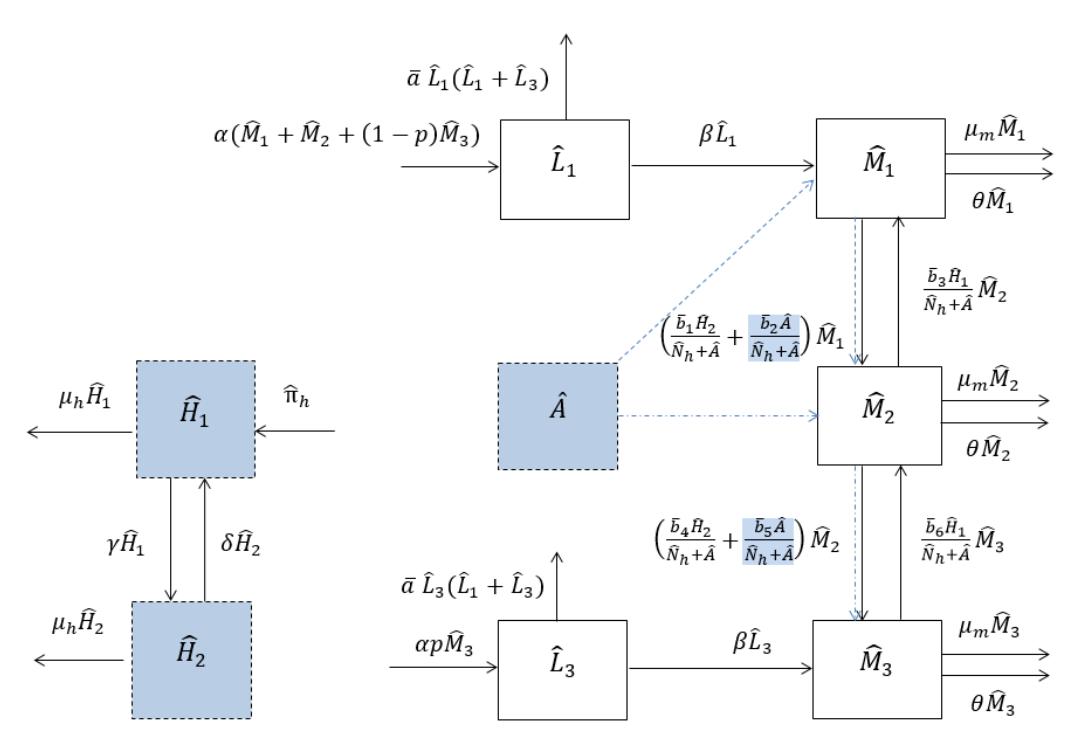
Fig. 1: Flow diagram of the mosquito-human-animal interaction
The description of variables and parameters used in this model is shown in Table I.
TABLE I: Description of variables and parameters
| Variable/ parameter | Description | Unit | |
|---|---|---|---|
| \(\hat{L}_1\) | Larvae with anthropophilic traits | larva | |
| \(\hat{L}_3\) | Larvae with zoophilic traits | larva | |
| \(\hat{M}_1\) | Anthropophilic mosquitoes | mosquito | |
| \(\hat{M}_2\) | Opportunistic mosquitoes | mosquito | |
| \(\hat{M}_3\) | Zoophilic mosquitoes | mosquito | |
| \(\hat{H}_1\) | Humans without protection | human | |
| \(\hat{H}_2\) | Humans with protection | human | |
| \(\hat{A}\) | Animals | animal | |
| \(\alpha\) | Mosquitoes ovulation rate which is hatching into larva | day-1 | |
| p | Probability of \(\hat{M}_3\) produce larvae with the zoophilic trait | - | |
| β | Transition rate from mosquitoes to larvae | day-1 | |
| \(\mu_m\) | Mosquito natural dead rate | day-1 | |
| \(\mu_h\) | Human natural dead rate | day-1 | |
| \(\hat{\pi}_h\) | Human birth rate | human -1x day | |
| \(\gamma\) | Rate of repellent clothing usage | day-1 | |
| δ | Drop out rate of human from using repellent clothing | \(day^{-1}\) | |
| \(\theta\) | Parameter of fumigation | day-1 | |
| \(\bar{a}\) | Competition parameter between larvae | larva-1 x day- | |
| \(\bar{b}_1\) | Mosquito preference alteration rate from anthropophilic to opportunistic when \(\hat{M}_1\) is in contact (mass action) with humans | \(day^{-1}\) | |
| \(\bar{b}_2\) | Mosquito preference alteration rate from anthropophilic to opportunistic when \(\hat{M}_1\) obtains blood from animals | \(day^{-1}\) | |
| \(\bar{b}_3\) | Mosquito preference alteration rate from opportunistic to anthropophilic when \(\hat{M}_2\) obtains blood from humans | \(day^{-1}\) | |
| \(\bar{b}_4\) | Mosquito preference alteration rate from opportunistic to zoophilic when \(\hat{M}_2\) is in contacts (mass action) with humans | \(day^{-1}\) | |
| \(\bar{b}_5\) | Mosquito preference alteration rate from opportunistic to zoophilic when \(\hat{M}_2\) obtains blood from animals | \(day^{-1}\) | |
| \(\bar{b}_6\) | Mosquito preference alteration rate from zoophilic to anthropophilic when \(\hat{M}_3\) obtains blood from humans | \(day^{-1}\) | |
| \(\hat{N}_h\) | Human population | human | |
From the flow diagram of mosquito-human-animal interaction, we have the following differential equations systems.
\[\frac{d\hat{L}_{1}(t)}{dt} = \alpha(\hat{M}_{1}(t) + \hat{M}_{2}(t) + (1 - p)\hat{M}_{3}(t)) - \bar{a}\hat{L}_{1}(t)(\hat{L}_{1}(t) + \hat{L}_{3}(t)) - \beta\hat{L}_{1}(t),\] \[\frac{d\hat{L}_{3}(t)}{dt} = \alpha p\hat{M}_{3}(t) - \bar{a}\hat{L}_{3}(t)(\hat{L}_{1}(t) + \hat{L}_{3}(t)) - \beta\hat{L}_{3}(t),\] \[\frac{d\hat{M}_{1}(t)}{dt} = \beta\hat{L}_{1}(t) - \left(\frac{\bar{b}_{1}\hat{H}_{2}(t)}{\hat{N}_{h} + \hat{A}} + \frac{\bar{b}_{2}\hat{A}}{\hat{N}_{h} + \hat{A}}\right)\hat{M}_{1}(t) + \frac{\bar{b}_{3}\hat{H}_{1}(t)}{\hat{N}_{h} + \hat{A}}\hat{M}_{2}(t) - \mu_{m}\hat{M}_{1}(t) - \theta\hat{M}_{1}(t),\] \[\frac{d\hat{M}_{2}(t)}{dt} = \left(\frac{\bar{b}_{1}\hat{H}_{2}(t)}{\hat{N}_{h} + \hat{A}} + \frac{\bar{b}_{2}\hat{A}}{\hat{N}_{h} + \hat{A}}\right)\hat{M}_{1}(t) - \frac{\bar{b}_{3}\hat{H}_{1}(t)}{\hat{N}_{h} + \hat{A}}\hat{M}_{2}(t) - \left(\frac{\bar{b}_{4}\hat{H}_{2}(t)}{\hat{N}_{h} + \hat{A}}\right)\hat{M}_{2}(t)\] \[- \left(\frac{\bar{b}_{5}\hat{A}}{\hat{N}_{h} + \hat{A}}\right)\hat{M}_{2}(t) + \frac{\bar{b}_{6}\hat{H}_{1}(t)}{\hat{N}_{h} + \hat{A}}\hat{M}_{3}(t) - \mu_{m}\hat{M}_{2}(t) - \theta\hat{M}_{2}(t),\] \[\frac{d\hat{M}_{3}(t)}{dt} = \beta\hat{L}_{3}(t) + \left(\frac{\bar{b}_{3}\hat{H}_{2}(t)}{\hat{N}_{h} + \hat{A}} + \frac{\bar{b}_{4}\hat{A}}{\hat{N}_{h} + \hat{A}}\right)\hat{M}_{2}(t) - \frac{\bar{b}_{6}\hat{H}_{1}(t)}{\hat{N}_{h} + \hat{A}}\hat{M}_{3}(t) - \mu_{m}\hat{M}_{3}(t) - \mu_{m}\hat{M}_{3}(t) - \theta\hat{M}_{3}(t),\] \[\frac{d\hat{H}_{1}(t)}{dt} = \hat{\pi}_{h} - \gamma\hat{H}_{1}(t) + \delta\hat{H}_{2}(t) - \mu_{h}\hat{H}_{1}(t),\] \[\frac{d\hat{H}_{2}(t)}{dt} = \gamma\hat{H}_{1}(t) - \delta\hat{H}_{2}(t) - \mu_{h}\hat{H}_{2}(t).\] (1)
We normalize the System (1) by dividing every state variable with the total number of human \((\hat{N}_h = \hat{H}_1 + \hat{H}_2)\). Lets
\[\begin{array}{lll} L_i = \frac{\hat{L}_i}{\hat{N}_h}, & \text{for } i = 1, 3 & ; & a = \bar{a}\hat{N}_h \\ M_i = \frac{\hat{M}_i}{\hat{N}_h}, & \text{for } i = 1, 2, 3; & ; & A = \frac{\hat{A}}{\hat{N}_h} \\ H_i = \frac{\hat{H}_i}{\hat{N}_h}, & \text{for } i = 1, 2 & ; & b_i = \frac{\hat{N}_h}{\hat{N}_h + \hat{A}} \, \bar{b}_i, & \text{for } i = 1, .., 6 & ; & \pi_h = \frac{\hat{\pi}_h}{\hat{N}_h}, \end{array}\] then we have the normalized system as shown in the following equations
\[\frac{dL_{1}(t)}{dt} = \alpha(M_{1}(t) + M_{2}(t) + (1 - p)M_{3}(t)) - aL_{1}(t)(L_{1}(t) + L_{3}(t)) - \beta L_{1}(t),\] \[\frac{dL_{3}(t)}{dt} = \alpha p M_{3}(t) - aL_{3}(t)(L_{1}(t) + L_{3}(t)) - \beta L_{3}(t),\] \[\frac{dM_{1}(t)}{dt} = \beta L_{1}(t) - (b_{1}H_{2}(t) + b_{2}A) M_{1}(t) + b_{3}H_{1}(t)M_{2}(t) - \mu_{m}M_{1}(t) - \theta M_{1}(t),\] \[\frac{dM_{2}(t)}{dt} = (b_{1}H_{2}(t) + b_{2}A) M_{1}(t) - b_{3}H_{1}(t)M_{2}(t) - (b_{4}H_{2}(t) + b_{5}A) M_{2}(t)\] \[+ b_{6}H_{1}(t)M_{3}(t) - \mu_{m}M_{2}(t) - \theta M_{2}(t),\] \[\frac{dM_{3}(t)}{dt} = \beta L_{3}(t) + (b_{4}H_{2}(t) + b_{5}A) M_{2}(t) - b_{6}H_{1}(t)M_{3}(t) - \mu_{m}M_{3}(t) - \theta M_{3}(t),\] \[\frac{dH_{1}(t)}{dt} = \pi_{h} - \gamma H_{1}(t) + \delta H_{2}(t) - \mu_{h}H_{1}(t),\] \[\frac{dH_{2}(t)}{dt} = \gamma H_{1}(t) - \delta H_{2}(t) - \mu_{h}H_{2}(t).\] (2)
From Equations (2), the equilibrium point for human without repellent and human with repellent are
\[H_1 = \frac{(\mu_h + \delta)\pi_h}{\mu_h(\gamma + \mu_h + \delta)} \quad ; \quad H_2 = \frac{\gamma \pi_h}{\mu_h(\gamma + \mu_h + \delta)}. \tag{3}\]
Assuming the values of \(\pi_h\) and \(\mu_h\) are equal, then the sum of \(H_1\) and \(H_2\) will be constant in time. Meanwhile, from the dynamics of larvae and mosquitoes, there are two equilibria, i.e. trivial equilibrium
\[(L_1, L_3, M_1, M_2, M_3) = (0, 0, 0, 0, 0), \tag{4}\] and coexistence equilibrium
\[(L_1, L_3, M_1, M_2, M_3) = (L_1^*, L_3^*, M_1^*, M_2^*, M_3^*),\] (5)
where
\[L_{1}^{*} = \frac{\beta (\alpha - \mu_{m} - \theta)}{a (\mu_{m} + \theta)} \frac{P + Q + R (1 - p)}{P + Q + R}\] \[L_{3}^{*} = \frac{\beta (\alpha - \mu_{m} - \theta)}{a (\mu_{m} + \theta)} \frac{R p}{P + Q + R}\] \[M_{1}^{*} = \frac{\beta^{2} (\alpha - \mu_{m} - \theta)}{a (\mu_{m} + \theta)^{2}} \frac{P}{P + Q + R}\] \[M_{2}^{*} = \frac{\beta^{2} (\alpha - \mu_{m} - \theta)}{a (\mu_{m} + \theta)^{2}} \frac{Q}{P + Q + R}\] \[M_{3}^{*} = \frac{\beta^{2} (\alpha - \mu_{m} - \theta)}{a (\mu_{m} + \theta)^{2}} \frac{R}{P + Q + R}\] with
\[P = (b_4 H_2 + b_5 A) (\mu_m + \theta)(1 - p) + (b_3 H_1 + \mu_m + \theta) (b_6 H_1 + (\mu_m + \theta)(1 - p))\] \[Q = (b_1 H_2 + b_2 A) (b_6 H_1 + (\mu_m + \theta)(1 - p))\] \[R = (b_4 H_2 + b_5 A) (b_1 H_2 + b_2 A).\]
Since the probability value p is always in the interval [0, 1], then we have the existence of coexistence equilibrium, provided that α > µm + θ (the rate of mosquito ovulation which is successfully hatching into larva is greater than the total of mosquito natural death rate and mosquito death rate due to fumigation).
3. DYNAMICAL ANALYSIS
In this section, we will linearize the system in Equation (2) to determine the stability of the equilibrium points. The characteristic polynomial resulted from the linearization process of dynamical system at the trivial equilibrium is given as follow
\[\left(\lambda^2 + (\beta + \mu_m + \theta)\lambda - \beta(\alpha - \mu_m - \theta)\right)\left(a_3\lambda^3 + a_2\lambda^2 + a_1\lambda + a_0\right) = 0.\] (6)
From the equation (6), the eigenvalues satisfies
\[\lambda^2 + (\mu_m + \beta)\lambda - \beta(\alpha - \mu_m) = 0. \tag{7}\]
It has been known that from the coexistence condition α > µm + θ, then the eigenvalues are positive and negative. It can be concluded that the trivial equilibrium is not stable. In other words, the population of larva and mosquito will never be extinct. Meanwhile, the following equation is the characteristic polynomial resulted from the linearization process of dynamical system at the coexistence equilibrium
\[\left( (\mu_m + \theta)\lambda^2 + (\mu_m + \theta)^2 + \alpha \beta + \beta (\alpha - \mu_m - \theta) \lambda + \beta (\mu_m + \theta) (\alpha - \mu_m - \theta) \right).\] \[\left( s_3 \lambda^3 + s_2 \lambda^2 + s_1 \lambda + s_0 \right) = 0,\] (8)
with
\[\begin{split} s_3 &= \mu_m + \theta, \\ s_2 &= {\mu_m}^2 + 2\,\theta^2 + 4\,\theta\,\mu_m + \alpha\,\beta + (\mu_m + \theta)\,((b_6 + b_3)\,H_1 + (b_1 + b_4)\,H_2 + (b_2 + b_5)\,A)\,, \\ s_1 &= \alpha\,\beta\,\left((2 - p)\,(\mu_m + \theta) + (b_2 + b_5)\,A + (b_6 + b_3)\,H_1 + (b_1 + b_4)\,H_2\right) + (\mu_m + \theta)\,(b_4H_2 + b_5A)\,b_2A \\ &\quad + (\mu_m + \theta)\,((b_6H_1 + \mu_m + \theta)\,(b_3H_1 + b_2\,A) + (\mu_m + \theta + b_1H_2)\,(b_6H_1 + b_4H_2 + b_5\,A + \mu_m + \theta))\,, \\ s_0 &= \left(b_6H_1 + b_4H_2 + b_5A\right)b_2\,A + b_3b_6H_1^2 + \left(b_4H_2 + b_5\,A\right)b_1H_2 + (\mu_m + \theta + b_1H_2)\,b_6H_1 \\ &\quad + (\mu_m + \theta)\,(1 - p)\,((b_2 + b_5)\,A + (b_1 + b_4)\,H_2 + b_3H_1 + \mu_m + \theta)\,. \end{split}\]
From the coexistence condition α > µm +θ and 0 < p < 1, then all the characteristic polynomial coefficients are positive (s3 > 0, s2 > 0, s1 > 0, and s0 > 0). In addition, it can also be proven that s1s2 > s0s3. Base on this result and according to the Routh-Hurwitz criteria, all eigenvalues will be negative or in other words, the coexistence equilibrium is locally asymptotically stable.
4. GLOBAL SENSITIVITY ANALYSIS AND NUMERICAL SIMULATION
As described in [25], the concept of sensitivity analysis is used to investigate the influence of model parameters on the ODE solutions. A more general approach of sensitivity functions is introduced and computed in [26], for interpreting any dynamical model consisting of ordinary differential equations. In this section, we briefly present the concept of global sensitivity analysis to analyze the parameter influence of repellent clothing usage, fumigation effect, and mosquitoes preference alteration on the variable of anthropophilic, opportunistic, and zoophilic in Model (2). Suppose we have the following n-dynamical system with k-parameters
\[\dot{X} = F(X, P),\tag{9}\] with \[F = \langle F_1, F_2, ..., F_n \rangle\], \(X = \langle x_1, x_2, ..., x_n \rangle\), and \(P = \langle p_1, p_2, ..., p_k \rangle\).
Define
\[S = D_P X\], by assuming that the function of S is continuously differentiable, then we have the following differential equation
\[\dot{S} = \frac{d}{dt}D_P X = D_P \frac{dX}{dt} = (D_X F)(D_p X) + D_P F = (D_X F)S + D_P F.\] (10)
At the equilibrium state, we have
\[\lim_{t \to \infty} \frac{dX}{dt} = 0,\] and then from the Equation (10), for \(t \to \infty\), we obtain the following equation
\[\lim_{t \to \infty} \frac{dS}{dt} = \lim_{t \to \infty} \frac{d}{dt} D_P X\]\[= D_P \lim_{t \to \infty} \frac{dX}{dt} = 0.\]
Suppose that \(D_X F\) at the coexistence equilibrium is a non-singular matrix, then the solution of S at the equilibrium state will satisfy the following equation
\[\tilde{S} = -(D_X F)^{-1} D_P F. \tag{11}\]
This matrix S represents the global change of the states with respect to all parameters at the coexistence equilibrium.
In the following, numerical simulations are presented to support the analysis result in section III. Biological parameters in Equation (2) are taken (estimated) directly from the Human Blood Index (HBI) in [27]. The parameter value of \(\alpha\) is multiplication between mosquito ovulation rate (100 egg per mosquito per 30 days), probability of successful mosquito egg hatching into larva (0.5), and proportion of female mosquito (0.5). The Table II gives the biological parameter values to be used in the process of simulation.
TABLE II: Parameter values used in the model
| Param. | \(\alpha\) | \(\bar{a}\) | β | \(\mu_m\) | p | δ | \(\mu_h\) | \(\pi_h\) | \(\hat{N}_h\) |
|---|---|---|---|---|---|---|---|---|---|
| Unit | day-1 | larva-1 x day-1 | day-1 | day-1 | - | day-1 | day -1 | day-1 | ind |
| Est. Val. | 0.83 | 0.0008 | 1/7 | 1/30 | 0.75 | 0.2 | 1/(70 x 365) | 1/(70 x 365) | 100 |
In this numerical simulations, the parameters of mosquito preference alteration are divided into two cases of simplification, i.e. when the parameters are assumed to have the uniform value and when the parameters are grouped on the based of the similarity process in obtaining blood resources.
In the first case, by assuming that all parameter of mosquito preference alteration are uniform \((b_1 = b_2 = b_3 = b_4 = b_5 = b_6 = B)\), then the control parameters are chosen as the rate of repellent clothing usage \(\gamma\) and the rate of fumigation effect \(\theta\). Further, the ratio between the zoophilic population and the total populations of anthropophilic and opportunistic at the equilibrium state can be represented as a function of \(\gamma\) and \(\theta\). Define the zoophilic ratio
\[R = \frac{M_3}{M_1 + M_2}. (12)\]
The level sets of R in the space of control parameters \(\gamma\) and \(\theta\) for the variation value of B are shown in Figures 2 (a)-(c) with the corresponding values of B are 0.1, 0.2, and 0.3. These simulations show that the level set of R increases as the fumigation rate \(\theta\) decreases. In other words, for the case of uniform parameter alteration, the use of fumigation is counterproductive. On the other hand, the increase of repellent clothing rate, as expected, will increase the zoophilic ratio R. Furthermore, mosquito dynamics are evaluated by taking three variations of parameters \(\gamma\) and \(\theta\) when the value of B is equal to 0.2 (represented by the black dots in Figure 2 (b)). The mosquito dynamics are shown in Figure 2 (d)-(f). Within the same value of zoophilic ratio R, the mosquito population decreases as the value of γ and θ increase, with the anthropophilic still dominates the population. Meanwhile, for the fixed value of γ, the increase zoophilic ratio R unexpectedly may not decrease the population of each characteristic of mosquitoes.
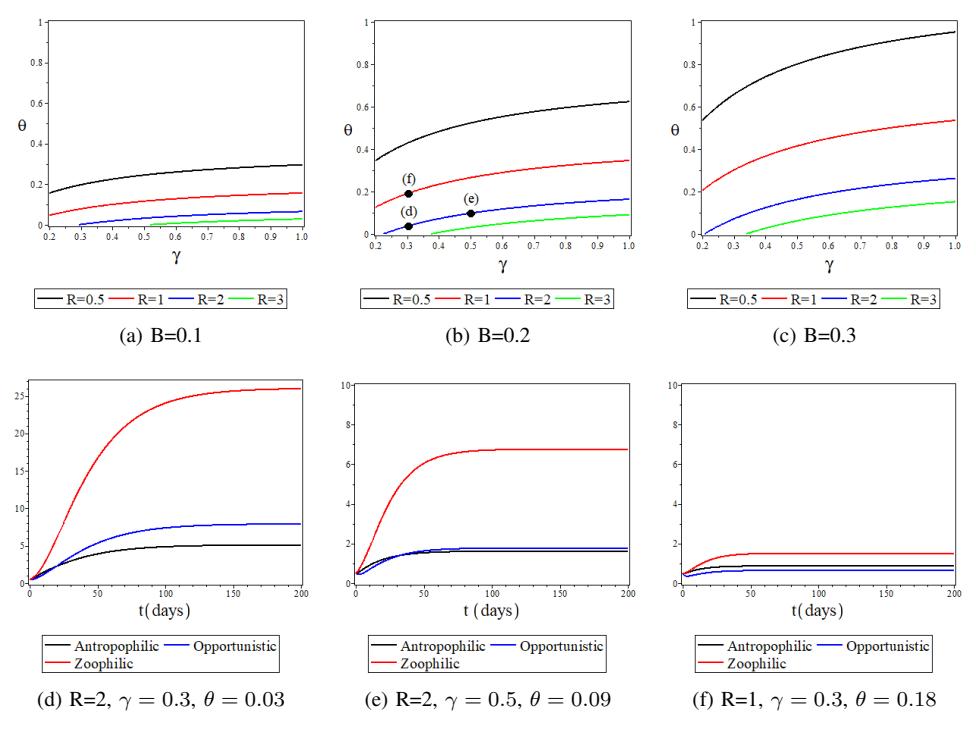
Fig. 2: Level set of zoophilic ratio R in the parameter space γ-θ with variation value of B in (a), (b), (c). The corresponding mosquitoes dynamics with B=0.2 in (d), (e), (f).
Furthermore, sensitivity analysis is done to show the dynamics of the change effect of mosquitoes with respect to the parameters B, γ, and θ in Equation (10), at the parameter values of B = 0.2, γ = 0.3, θ = 0.03, and with the initial condition S(0) = 0. The results are shown in the following figures.
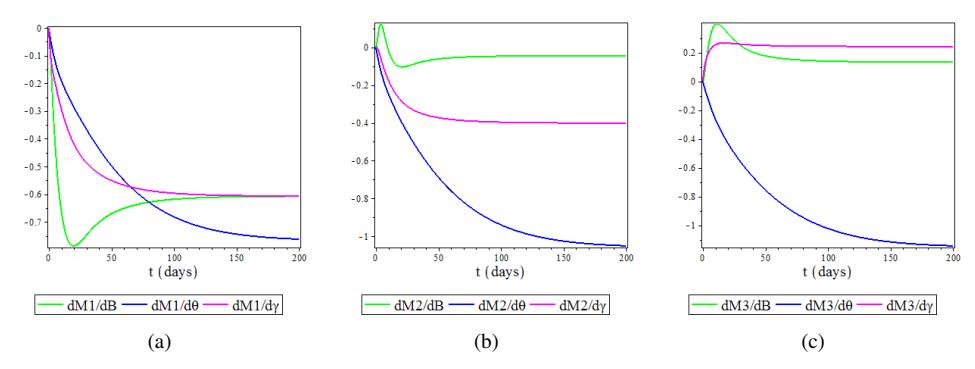
Fig. 3: The mosquitoes sensitivity dynamics S(t) of (a) anthropophilic, (b) opportunistic, and (c) zoophilic with respect to the parameters B, θ, and γ.
At the equilibrium state, the sensitivity matrix in (11) is given as
\[\begin{bmatrix} \frac{\partial M_1}{\partial B} & \frac{\partial M_1}{\partial \theta} & \frac{\partial M_1}{\partial \gamma} \\ \frac{\partial M_2}{\partial B} & \frac{\partial M_2}{\partial \theta} & \frac{\partial M_2}{\partial \gamma} \\ \frac{\partial M_3}{\partial B} & \frac{\partial M_3}{\partial \theta} & \frac{\partial M_3}{\partial \gamma} \end{bmatrix} = \begin{bmatrix} -0.6077 & -0.7686 & -0.6073 \\ -0.0450 & -1.0603 & -0.4020 \\ 0.1327 & -1.1525 & 0.2412 \end{bmatrix}.\](13)
Based on the computing result of the sensitivity matrix in Equation (13), the parameter \(\theta\) as a control parameter of fumigation provides the most dominant reduction effect toward the anthropophilic, opportunistic and zoophilic mosquitoes.
Basically, before the simplification process, the parameters of \(b_1\), \(b_2\), \(b_3\), \(b_4\), \(b_5\), and \(b_6\) are considered as unobservable parameters. For the simulation process, due to the limitations of data related to mosquito preferences, the parameter values \(b_1\), \(b_2\), \(b_3\), \(b_4\), \(b_5\), and \(b_6\) are reduced with the use of Human blood index (HBI) data. HBI was obtained from experimental results in a heterogeneous population (humans and animals) to estimate the proportion of the blood meals of a mosquito population obtained from human [29]. The data of HBI may vary base on the type of mosquito and the experiment region. In this model, the relation between HBI and the mosquito populations of anthropophilic, opportunistic, and zoophilic at the coexistence equilibrium is expressed by the following equation
\[HBI \approx \frac{M_1}{M_1 + M_2 + M_3}. (14)\]
In the second case, to simplify the estimating process of unobservable parameter values (due to the high dimension of parameter space), we divide the parameters into two groups based on the similarities in the process of mosquito preference alteration, i.e.
\[b_1 = b_2 = b_4 = b_5 = B_a\], and \(b_3 = b_6 = B_b\).
Both parameters of \(b_3\) and \(b_6\) describe the preference alteration when the mosquito receives the blood from human. In the process of simulation, the HBI data was selected from the experimental result of several species of mosquitoes in some region as shown in Table III.
| IABLE III: The data of Human Blood Index | |||||||||
|---|---|---|---|---|---|---|---|---|---|
| Species | Region | Description | HBI | ref | |||||
| Anopheles pseudopunctipennis | Central Andes, Bolivia | The main vector causing malaria | 30-50 % | [14] | |||||
| disease in South America | |||||||||
| Anopheles Sinensis | Korea | The vector species of malaria | 7 % | [28] | |||||
By substituting the data in Table II to Equation (14) without involving the control parameters (\(\gamma = 0, \theta = 0\)), we have the level set of HBI in the parameter \(B_a\) and \(B_b\). As shown in Figure 4, the level set of HBI is
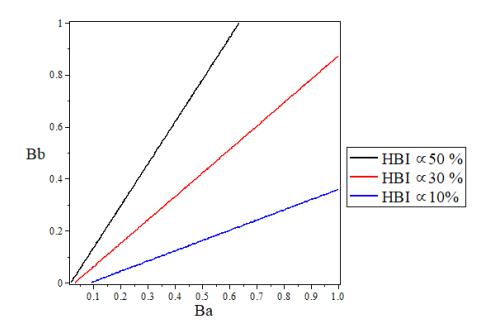
Fig. 4: Level set of HBI approximation in the parameters space of \(B_a\)-\(B_b\)
linearly dependent on the parameter \(B_a\) and \(B_b\). We perform the mosquitoes dynamics of anthropophilic, opportunistic and zoophilic by estimating the value of \(B_a\) and \(B_b\) from the experimental result in Table III. For 50% HBI approximation, we specify the parameters value of \(B_a = 0.2\) and \(B_b = 0.2936\). The mosquitoes dynamics with the variations parameter value of repellent clothing usage \(\gamma\) and the effect of fumigation \(\theta\) are shown in Figure 5.
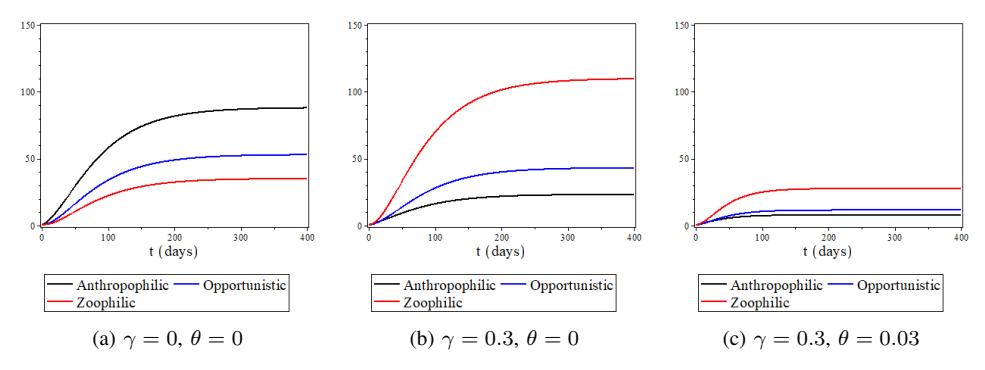
Fig. 5: The mosquitoes dynamics of anthropophilic, opportunistic, and zoophilic with \(B_a = 0.2\) and \(B_b = 0.29\)
From Figure 5, the use of repellent clothing reduces the anthropophilic and opportunistic populations and increases the zoophilic population significantly. Consequently, the approximation value of HBI will decrease. For 50 % initial HBI approximation, after the repellent clothing is applied with a parameter value of \(\gamma=0.3\) and \(\theta=0\), the approximation value of HBI decreases to around 13%. Meanwhile, the effect of fumigation significantly reduces the population of mosquitoes as a whole.
Furthermore, sensitivity analysis is presented to investigate how the change effect of parameters \(B_a\), \(B_b\), \(\gamma\), and \(\theta\) towards the mosquito population of anthropophilic, opportunistic, and zoophilic. The dynamics of mosquitoes sensitivity towards the parameters \(B_a\), \(B_b\), \(\gamma\), and \(\theta\), with the parameters estimation value as shown in Table II along with \(B_a=0.2\), \(B_b=0.2936\), \(\gamma=0.3\), \(\theta=0.03\), and initial condition S(0)=0, are shown in Figure 6.
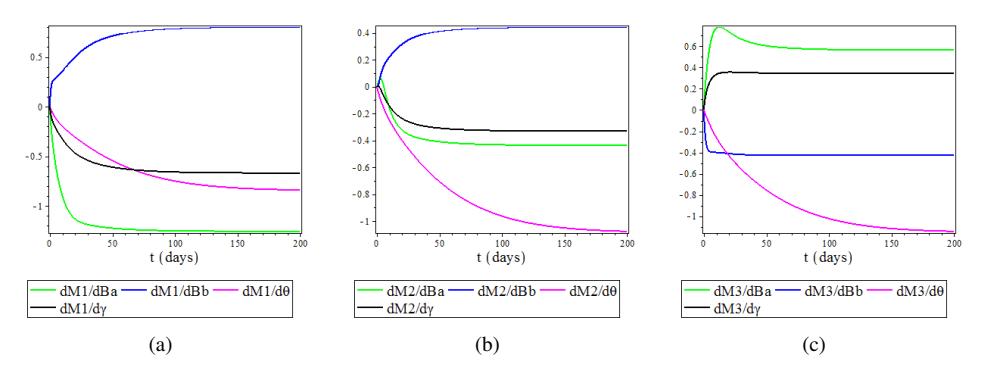
Fig. 6: The mosquitoes sensitivity dynamics S(t) of (a) anthropophilic, (b) opportinistic, and (c) zoophilic with respect to the parameter of \(B_a\), \(B_b\), \(\theta\), and \(\gamma\).
At the equilibrium state, the sensitivity matrix in (11) is given as
\[\begin{bmatrix} \frac{\partial M_1}{\partial B_a} & \frac{\partial M_1}{\partial B_b} & \frac{\partial M_1}{\partial \theta} & \frac{\partial M_1}{\partial \gamma} \\ \frac{\partial M_2}{\partial B_a} & \frac{\partial M_2}{\partial B_b} & \frac{\partial M_2}{\partial \theta} & \frac{\partial M_2}{\partial \gamma} \\ \frac{\partial M_3}{\partial B_a} & \frac{\partial M_3}{\partial B_b} & \frac{\partial M_3}{\partial \theta} & \frac{\partial M_3}{\partial \gamma} \end{bmatrix} = \begin{bmatrix} -1.25 & 0.80 & -0.84 & -0.67 \\ -0.43 & 0.44 & -1.08 & -0.33 \\ 0.56 & -0.42 & -1.15 & 0.34 \end{bmatrix}.\](15)
Based on the computing result of the sensitivity matrix in Equation (15), the parameter Ba provides the significant reduction effect to anthropophilic mosquitoes. Meanwhile, the parameter θ as a control parameter of fumigation effect provides the dominant reduction effect toward the opportunistic and zoophilic mosquitoes.
5. CONCLUSION
Locally asymptotically stable coexistence equilibrium of larvae (anthropophilic and zoophilic traits) and mosquitoes (anthropophilic, opportunistic and zoophilic) is shown when the rate of mosquito ovulation, which is successfully hatching into larva, is greater than the total of mosquito natural death rate and mosquito death rate due to fumigation. Basically, in a heterogeneous environment, the coexistence equilibrium is locally asymptotically stable even in the absence of a control mechanism with the use of repellent clothing and fumigation. However, when this controls mechanism is applied, then the zoophilic ratio may not always increase.
Simulation results show that the effect of fumigation significantly reduces the population of each characteristic, but the zoophilic ratio may decrease. Sensitivity analysis confirms that the effect of fumigation is dominant in reducing the total population than the effect of repellent clothing usage. In order to increase the zoophilic ratio as well as to reduce the mosquito population, a proper combination of fumigation and repellent clothing should be carefully selected.
ACKNOWLEDGEMENT
Part of the research is funded by RistekDikti-Indonesia Grant 2017.