

1. Introduction
Dengue fever is a disease caused by the dengue virus which is transmitted primarily by the Aedes aegypti mosquitoes [1]. The disease is highly endemic in the tropical and subtropical regions, making nearly a third of the human population in the world is at risk of infection [2]. There are four types of dengue virus, i.e., DENV 1, DENV 2, DENV 3, and DENV 4. If someone infected by one type of dengue virus, that person becomes immune to that virus and only immune to other types in a certain period [3]. Generally, the transmission of dengue virus needs mosquitoes as a vector, so direct interaction between human could not cause the disease to spread [1]. But in a rare case, dengue virus can be transmitted during a blood transfusion or organ transplants from infected donor to the recepient [4], [5].
One of the important factors in understanding the transmission of dengue virus is knowing mosquito feeding behavior. Dengue fever is transmitted to humans through the bites of infected female mosquitoes [6]. Female mosquito needs protein in the host's blood to produce and develop their eggs. When the mosquito feeds the blood containing the virus from an infected human, then it becomes infected [7]. Naturally, mosquitoes have a preference to choose their blood resources, such as mammals, reptiles, amphibians, birds, and fishes [8], [9]. But, mosquito species like the Aedes aegypti has a preference towards humans [10], [11]. This preference makes the Aedes aegypti be an effective vector in spreading the dengue virus in human population [12], [13].
In blood seeking process, female mosquito use combination of various signals to find their hosts such as smell, color (visual), and temperature in their environment [14]. The steps involving in this process are take-off (detecting odor emitted by the host), orientation (using a visual or thermal sign of host), landing, probing, and feeding [15], [16]. In the probing step, mosquito pierces the human skin and injects saliva to makes the area numb and keeps blood from clotting. After that, mosquito begins to suck blood into its abdomen [17].
Received December \(07^{th}\), 2018, Revised December \(12^{th}\), 2018 (first) and April \(15^{th}\), 2019 (second), Accepted for publication April \(22^{nd}\), 2019. Copyright ©2019 Published by Indonesian Biomathematical Society, e-ISSN: 2549-2896, DOI:10.5614/cbms.2019.2.1.2
It has been reported that the Aedes aegypti prefers to bite more than one person during the feeding period [7]. The multiple feeding has been recognized as: (1) supplementary feeding because of nutritional reserves depletion of in teneral female (i.e., achieving specific characteristic that female mosquito was attractive and was able to mate with males) and (2) host reflex movements or interrupted feeding owing mainly to host defense [18], [19], [20]. So it allows mosquitoes to bite several hosts in their environment until satiated.
In the process of virus transmission, there are two mechanisms in transmitting the virus from host to host, i.e., biological transmission and mechanical transmission. In the biological transmission, a susceptible human is assumed to be infected by dengue virus only when an infectious mosquito bites the person and the virus successfully transmitted to the person. As the name implies, the virus must undergo some biological development in mosquito's body before finally being transmitted to humans. Aside from biological transmission, there is a probability that viruses can be spread by the mechanical transmission. The mechanical transmission means that virus can be transmitted without waiting the mosquitoes to become infected, but the mosquitoes directly transmit the virus to the susceptible human just after they bite an infectious human. Almost at the same time, the mosquitoes transmit the virus carried in their saliva to a susceptible human at the second bite. In this case, the mosquito transports virus before the virus develops in the mosquito's body [3], [21], [22]. This mechanism is certainly supported by the possibility that the Aedes aegypti is a multiple-biter.
In modeling dengue transmission, the process of virus transmission is generally under the assumption of the biological process [23]. Research involving mechanical process is still rarely found, except a few, e.g. [24]. Hence, in this paper, we construct a general mechanical transmission model of dengue fever with n-mosquito-bites. The basic reproduction number, which is the important parameter indicating the endemicity and disease free condition such as shown in [25], [26], [27], will be determined. Numerical simulation and the ratio of the basic reproduction number using mechanical transmission model and biological transmission model will be evaluated.
2. MODEL DEVELOPMENT
The model discussed in this paper is an SIR (Susceptible, Infectious, Recovery) model which involves two populations: human and mosquitos. We discuss two models in this paper, i.e., the biological transmission model and the mechanical transmission model. Here we assume that human population has a uniform birth rate and the offsprings born as susceptible. A person in human population can only be infected through mosquitoes' bites. An infectious person can be recovered, and after that becomes immune to the virus. Only one type of dengue virus is considered. Further, it is assumed that once a mosquito infected by the virus, it becomes infected forever. We also assume that both the number of human and mosquito are constant. The models in this paper use day as the time dimension.
2.1. The Biological Transmission Model
The original model is constructed by Lourdes Esteva and Chistobal Vargas in 1998. In their paper "Analysis of a Dengue Disease Transmission Model", they assume there are two populations, i.e., human and mosquito. Furthermore, there are three compartments of human population (\(S_H\) as susceptible human, \(I_H\) as infectious human, and \(R_H\) as recovered human) and two compartments of mosquito population (\(S_V\) as susceptible mosquito and \(I_V\) as infectious mosquito). The interaction of each compartment is represented in Fig.1.
From the interaction diagram, the model can be constructed using ordinary differential equation as
\[\frac{dS_H}{dt} = \mu_H N_H - \frac{b\beta_H S_H I_V}{N_H} - \mu_H S_H,\] \[\frac{dI_H}{dt} = \frac{b\beta_H S_H I_V}{N_H} - (\mu_H + \gamma_H) I_H,\] \[\frac{dR_H}{dt} = \gamma_H I_H - \mu_H R_H,\] \[\frac{dS_V}{dt} = \mu_V N_V - \frac{b\beta_V S_V I_H}{N_H} - \mu_V S_V,\] \[\frac{dI_V}{dt} = \frac{b\beta_V S_V I_H}{N_H} - \mu_V I_V.\] (1)
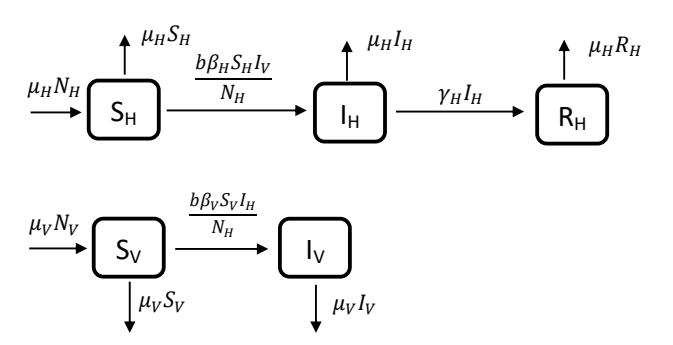
Figure 1: Interaction Diagram of Biological Virus Transmission Model
In the human population, \(\mu_H\) denotes the human birth and death rate, \(\beta_H\) is the probability of transmitting the virus from mosquito to human, and \(\gamma_H\) is the human recovery rate. In the mosquito population, \(\mu_V\) denotes the mosquito birth or death rate, \(\beta_V\) is the probability of transmitting the virus from human to mosquito. The average number of mosquito bites per unit time is denoted by b.
All parameters in the model are non-negative, and the model will be analyzed in a biologically-feasible region defined as follows,
\[\mathbb{D} = \{ (S_H, I_H, R_H, S_V, I_V) \in \mathbb{R}^5_+ : S_H \ge 0, I_H \ge 0, R_H \ge 0, S_V \ge 0, I_V \ge 0 \}.\] (2)
The disease-free equilibrium of model (1) is
\[S_H = N_H, \quad I_H = 0, \quad R_H = 0, \quad S_V = N_V, \quad I_V = 0,\] (3)
and the endemic equilibrium of model (1) is
\[S_{H} = \frac{(b\mu_{H}\beta_{V} + \gamma_{H}\mu_{V} + \mu_{H}\mu_{V}) N_{H}^{2}}{\beta_{V} (bN_{V}\beta_{H} + N_{H}\mu_{H}) b},\] \[I_{H} = \frac{\mu_{H}N_{H} (b^{2}N_{V}\beta_{H}\beta_{V} - \gamma_{H}N_{H}\mu_{V} - N_{H}\mu_{H}\mu_{V})}{\beta_{V} (bN_{V}\beta_{H} + N_{H}\mu_{H}) (\mu_{H} + \gamma_{H}) b},\] \[R_{H} = \frac{\gamma_{H}N_{H} (b^{2}N_{V}\beta_{H}\beta_{V} - \gamma_{H}N_{H}\mu_{V} - N_{H}\mu_{H}\mu_{V})}{\beta_{V} (bN_{V}\beta_{H} + N_{H}\mu_{H}) (\mu_{H} + \gamma_{H}) b},\] \[S_{V} = \frac{\mu_{V} (bN_{V}\beta_{H} + N_{H}\mu_{H}) (\mu_{H} + \gamma_{H})}{b\beta_{H} (b\mu_{H}\beta_{V} + \gamma_{H}\mu_{V} + \mu_{H}\mu_{V})},\] \[I_{V} = \frac{\mu_{H} (b^{2}N_{V}\beta_{H}\beta_{V} - \gamma_{H}N_{H}\mu_{V} - N_{H}\mu_{H}\mu_{V})}{b\beta_{H} (b\mu_{H}\beta_{V} + \gamma_{H}\mu_{V} + \mu_{H}\mu_{V})}.\] (4)
The disease-free equilibrium exists without conditions, while the endemic equilibrium exists only if the condition (5) holds,
\[b^2 N_V \beta_H \beta_V > \gamma_H N_H \mu_V + N_H \mu_H \mu_V. \tag{5}\]
Using the next generation matrix, the basic reproduction number of the model (1) is given by
\[R_0 = \sqrt{\frac{N_V \beta_H \beta_V}{N_H \mu_V (\gamma_H + \mu_H)}} b. \tag{6}\]
2.2. The Mechanical Transmission Model
Here we construct the general model of mechanical virus transmission with n-mosquito-bites per day, \(n \in \mathbb{I}\). This model is a modification of the biological transmission model, so it still has the same compartments as the previous ones. But here we assume that the transmission also considers the contribution from mechanical process. The interaction diagram of mechanical transmission is represented in Fig. 2.
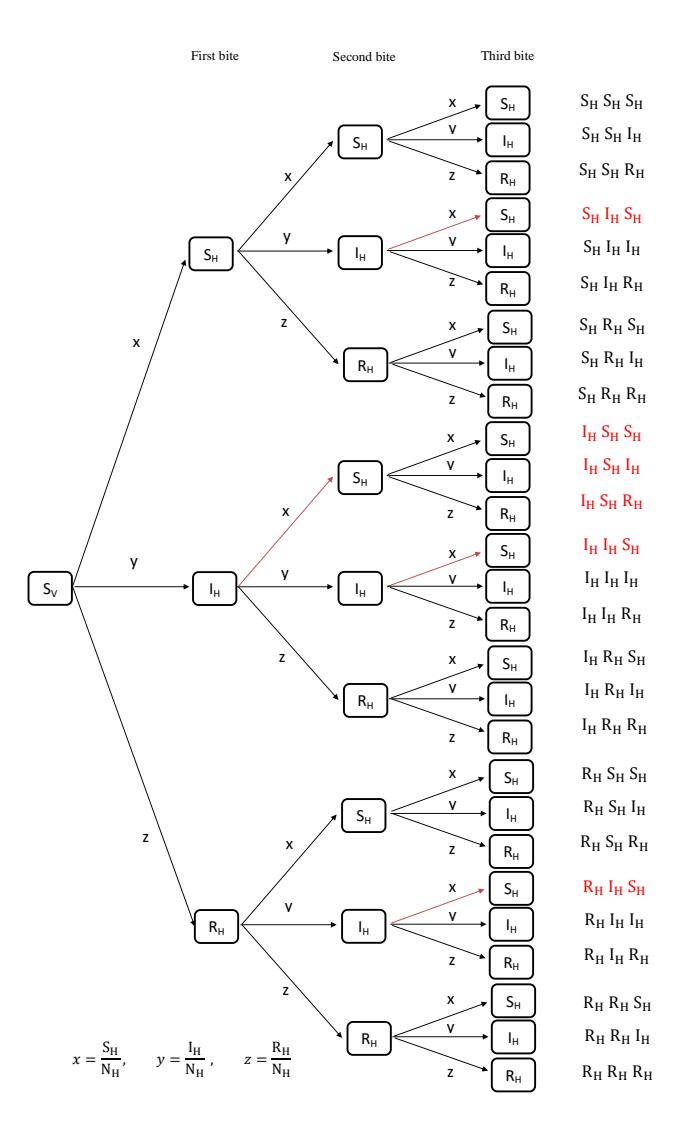
Figure 2: The interaction diagram of mechanical virus transmission
Assume that the first bite and the second bite are almost at the same time, and susceptible mosquitos saliva that contains dengue virus are all discharged when the mosquito bites the susceptible human at the second bite. In the mechanical transmission process, \(\beta_M\) denotes the probability of transmitting the virus from mosquito to human mechanically for every \(n \in \mathbb{I}\). In Figure 2, for n=2, the interaction process
between humans and mosquitoes which contributes to the incidence of mechanical transmission is
\[S_v I_H S_H\].
For n = 3, the interaction process is given by
\[\begin{array}{lll} S_V I_H S_H S_H, & S_V I_H S_H I_H, & S_V I_H S_H R_H, \\ S_V S_H I_H S_H, & S_V I_H I_H S_H, & S_V R_H I_H S_H. \end{array}\]
Suppose that MTn is the non-linear part of mechanical transmission process with n-mosquito-bites, then for two, three, and four-mosquito-bites, the interaction between human and mosquito is stated in Equation (7), (8), and (9). For two-mosquito-bites, the part of non-linear equation is given by
\[MT_2 = \beta_M S_V \frac{I_H S_H}{N_H^2}. (7)\]
For three-mosquito-bites, the part of non-linear equation is
\[MT_{3} = MT_{2} + \beta_{M}S_{V} \left( \frac{S_{H}I_{H}S_{H}}{N_{H}^{3}} + \frac{I_{H}I_{H}S_{H}}{N_{H}^{3}} + \frac{R_{H}I_{H}S_{H}}{N_{H}^{3}} \right),\] \[= MT_{2} + \beta_{M}S_{V} \left( S_{H} + I_{H} + R_{H} \right) \frac{I_{H}S_{H}}{N_{H}^{3}},\] \[= MT_{2} + \beta_{M}S_{V}N_{H} \frac{I_{H}S_{H}}{N_{H}^{3}},\] \[= \beta_{M}S_{V} \frac{I_{H}S_{H}}{N_{H}^{2}} + \beta_{M}S_{V} \frac{I_{H}S_{H}}{N_{H}^{2}},\] \[= 2\beta_{M}S_{V} \frac{I_{H}S_{H}}{N_{H}^{2}}.\] (8)
For four-mosquito-bites, the part of non-linear equation is
\[\text{[rumus tidak dapat ditampilkan dengan baik — lihat PDF asli]}\]
Therefore, the part of non-linear factor in the mechanical transmission model with n-mosquito-bites can be expressed by the following equation.
\[MT_n = (n-1)\beta_M S_V \frac{I_H S_H}{N_H^2}.\] (10)
Now we have a new interaction diagram of the mechanical transmission model with n-mosquito-bites as shown in Fig. 3.
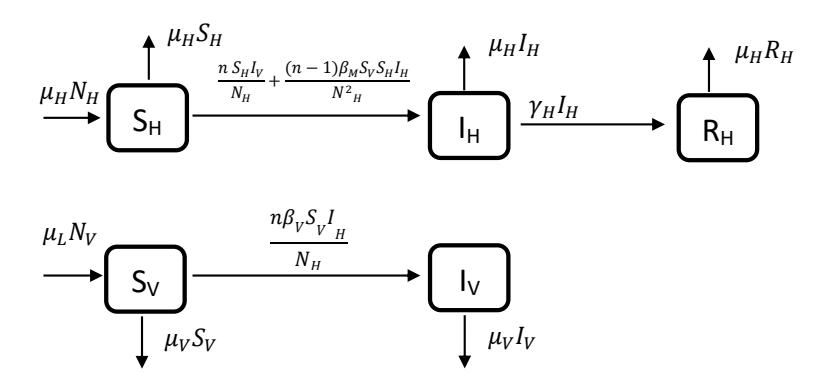
Figure 3: Interaction Diagram of Mechanical Transmission Model
From the interaction of each compartment in Figure 3, the model can be constructed using a system of ordinary differential equations as
\[\frac{dS_{H}}{dt} = \mu_{H} N_{H} - \frac{n \beta_{H} S_{H} I_{V}}{N_{H}} - \frac{(n-1)\beta_{M} S_{V} S_{H} I_{H}}{N_{H}^{2}} - \mu_{H} S_{H}, \frac{dI_{H}}{dt} = \frac{n \beta_{H} S_{H} I_{V}}{N_{H}} + \frac{(n-1)\beta_{M} S_{V} S_{H} I_{H}}{N_{H}^{2}} - (\mu_{H} + \gamma_{H}) I_{H}, \frac{dR_{H}}{dt} = \gamma_{H} I_{H} - \mu_{H} R_{H} \frac{dS_{V}}{dt} = \mu_{V} N_{V} - \frac{n \beta_{V} S_{V} I_{H}}{N_{H}} - \mu_{V} S_{V}, \frac{dI_{V}}{dt} = \frac{n \beta_{V} S_{V} I_{H}}{N_{H}} - \mu_{V} I_{V}.\] (11)
The difference from the previous model is the addition of non-linear factor in the susceptible and infectious human compartment, with \(\beta_M\) as the probability of transmitting the virus from mosquito to human mechanically. All parameters in the model are non-negative, and as before the model will be analyzed in a biologically-feasible region defined as follows
\[\mathbb{D} = \{ (S_H, I_H, R_H, S_V, I_V) \in \mathbb{R}^5_+ : S_H \ge 0, I_H \ge 0, R_H \ge 0, S_V \ge 0, I_V \ge 0 \}.\] (12)
The disease-free equilibrium of mechanical transmission model is
\[S_H = N_H, \quad I_H = 0, \quad R_H = 0, \quad S_V = N_V, \quad I_V = 0,\] (13)
and the endemic equilibrium is given by
\[S_{H} = \frac{N_{H}^{2} (n\mu_{H}\beta_{V} + \gamma_{H}\gamma_{V} + \mu_{H}\mu_{V})}{n^{2}N_{V}\beta_{H}\beta_{V} + nN_{H}\mu_{H}\beta_{V} + (n-1)N_{V}\mu_{V}\beta_{M}},\] \[I_{H} = \frac{\mu_{H}N_{H} (n^{2}N_{V}\beta_{H}\beta_{V} - (\gamma_{H} + \mu_{H})N_{H}\mu_{V} + (n-1)N_{V}\mu_{V}\beta_{M})}{(n^{2}N_{V}\beta_{H}\beta_{V} + nN_{H}\mu_{H}\beta_{V} + (n-1)N_{V}\mu_{V}\beta_{M}) (\mu_{H} + \gamma_{H})},\] \[R_{H} = \frac{\gamma_{H}N_{H} (n^{2}N_{V}\beta_{H}\beta_{V} - (\gamma_{H} + \mu_{H})N_{H}\mu_{V} + (n-1)N_{V}\mu_{V}\beta_{M})}{(n^{2}N_{V}\beta_{H}\beta_{V} + nN_{H}\mu_{H}\beta_{V} + (n-1)N_{V}\mu_{V}\beta_{M}) (\mu_{H} + \gamma_{H})},\] \[S_{V} = \frac{\mu_{V} (n^{2}N_{V}\beta_{V}\beta_{H} + nN_{H}\mu_{H}\beta_{V} + (n-1)N_{V}\mu_{V}\beta_{M}) (\mu_{H} + \gamma_{H})}{(n^{2}\beta_{H}\beta_{V} + (n-1)\mu_{V}\beta_{M}) (n\mu_{H}\beta_{V} + \gamma_{H}\mu_{V} + \mu_{H}\mu_{V})},\] \[I_{V} = \frac{n\mu_{H}\beta_{V} (n^{2}N_{V}\beta_{H}\beta_{V} - (\gamma_{H} + \mu_{H})N_{H}\mu_{V} + (n-1)N_{V}\mu_{V}\beta_{M})}{(n^{2}\beta_{H}\beta_{V} + (n-1)\mu_{V}\beta_{M}) (n\mu_{H}\beta_{V} + \gamma_{H}\mu_{V} + \mu_{H}\mu_{V})}.\] \[(14)\]
The disease-free equilibrium exist without conditions, while the endemic equilibrium exists only if the condition (15) holds.
\[n^2 N_V \beta_H \beta_V > (\gamma_H + \mu_H) N_H \mu_V - (n-1) N_V \mu_V \beta_M.\] (15)
To evaluate the threshold of mechanical transmission model, the jacobian matrix and the corresponding diagonal matrix of the infectious human and mosquito evaluated at the disease-free equilibrium are
\[F = \begin{bmatrix} \frac{(n-1)\beta_m N_V}{N_H} - \mu_H - \gamma_H & n\beta_H \\ \frac{n\beta_V N_V}{N_H} & -\mu_V \end{bmatrix}, \qquad V = \begin{bmatrix} \mu_H + \gamma_H & 0 \\ 0 & \mu_V \end{bmatrix}.\]
Then, the next generation matrix (NGM) is given by
\[NGM = FV^{-1} = \begin{bmatrix} \frac{(n-1)\beta_M N_V}{N_H(\mu_H + \gamma_H)} & \frac{n\beta_H}{\mu_V} \\ \frac{n\beta_V N_V}{N_H(\mu_H + \gamma_H)} & 0 \end{bmatrix}.\] (16)
The characteristic polynomial of NGM satisfies the following equation
\[\mu_V N_H (\mu_H + \gamma_H) \lambda^2 - N_V \mu_V \beta_M (n - 1) \lambda - n^2 \beta_H \beta_V N_V = 0.\] (17)
Then, we obtain the basic reproduction number of mechanical transmission model as follows
\[R_{0} = \frac{N_{V}\mu_{V}\beta_{M}(n-1) + \sqrt{N_{V}^{2}\mu_{V}^{2}\beta_{M}^{2}(n-1)^{2} + 4n^{2}\mu_{V}\beta_{H}\beta_{V}N_{H}N_{V}(\mu_{H} + \gamma_{H})}}{2\mu_{V}N_{H}(\mu_{H} + \gamma_{H})}.\] (18)
By taking the probability of the mechanical transmission equals to zero (βM = 0) or assuming there is no mechanical transmission process, then the equation of R0 will be the same as the R0 from the biological transmission model in Eq. 6 with b = n.
3. SIMULATION
In this section, numerical simulations are presented to evaluate the dynamics of the biological transmission model and the mechanical transmission model. The ratio of R0 from both models is also evaluated. Here are the parameters values used in the simulation process [12], [28].
Table 1: Parameters value used in numerical simulation
| Param. | µh | µv | βh | βv | γh | |
|---|---|---|---|---|---|---|
| Unit | day−1 | day−1 | day−1 | day−1 | day−1 | |
| Est. Val. | 1/(70x365) | 1/30 | 1/5 | 1/10 | 1/10 |
The numerical simulations of the ratio between the basic reproduction number (R0) of the mechanical and biological transmission models with the variation value of βm and n are shown in the following figures.
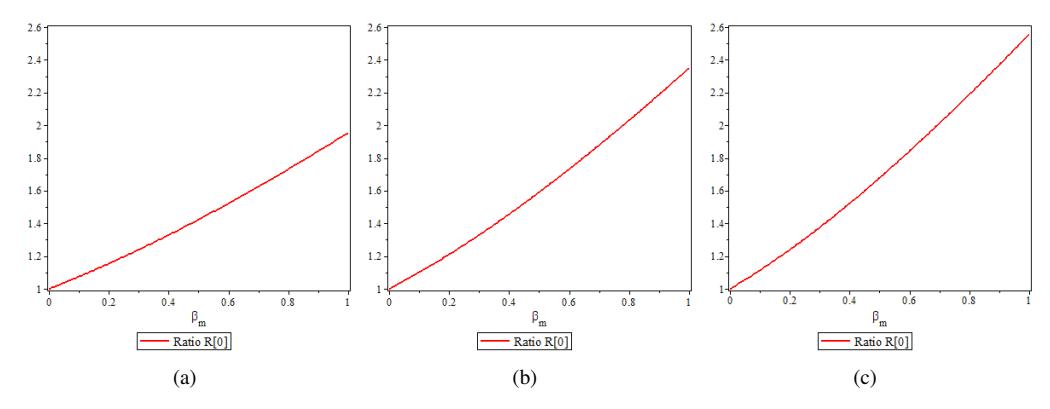
Figure 4: The ratio of the basic reproduction number with the respect to βM for various value of mosquito bites n: (a) n = 2, (b) n = 3, (c) n = 4.
In Fig. 4, the ratio of the basic reproduction number increases when the parameter value of βm and the number of mosquito bites (n) increase. In the dynamical simulation process, both models are normalized. The dynamics of the infectious human population using the biological and mechanical transmission models with the variation value of βM, the mosquito bites (n), and the ratio of human to mosquito population are shown in Fig. 5, 6, and 7.
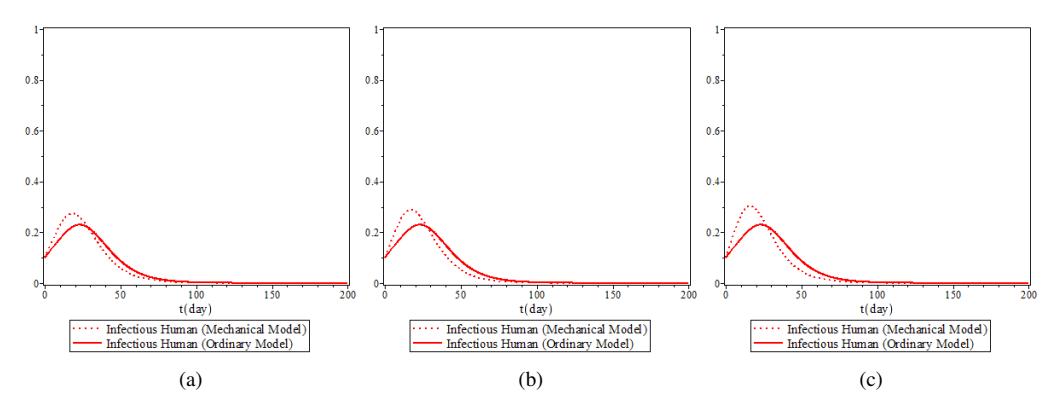
Figure 5: The dynamics of infectious human with the ratio of human to mosquito 2:1, n = 2, for various value of βM: (a) βM = 0.3,(b) βM = 0.4,(c) βM = 0.5.
The numerical simulations in Fig. 5 show that the existence of mechanical transmission process increases the number of infectious humans at the outbreak period. This result corresponds to the fact that in the mechanical transmission model, there is an additional non-linear factor in the infectious human compartment. Meanwhile, the effect of mosquito bites number to the infectious human dynamic is shown in Fig. 6.
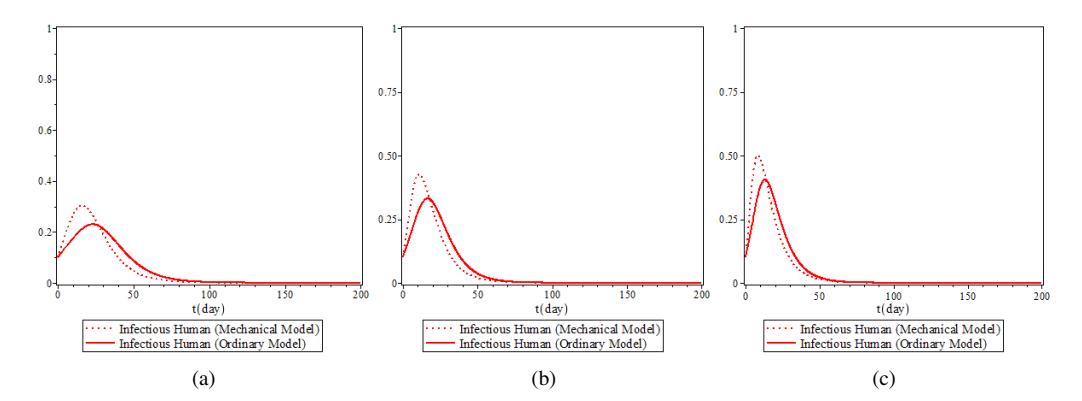
Figure 6: The dynamics of infectious human from mechanical and biological models, with the ratio of human to mosquito population 2:1, \(\beta_M = 0.5\), for various values of mosquito bites n: (a) n = 2, (b) n = 3, (c) n = 4.
In Fig. 6, at the outbreak period, the infectious human population from both models increase when the number of mosquito bites increases. For \(\beta_m=0.5,\ n=4\), and the ratio of human to mosquito population 2:1, the difference of outbreak intensity between the mechanical and biological transmission model is approximately 10% of the human population.
Furthermore, the infectious human dynamics with the variation of the ratio between human and mosquito population are shown In Fig. 7. At the outbreak period, the infectious human population increase when the ratio of human to mosquito decrease.
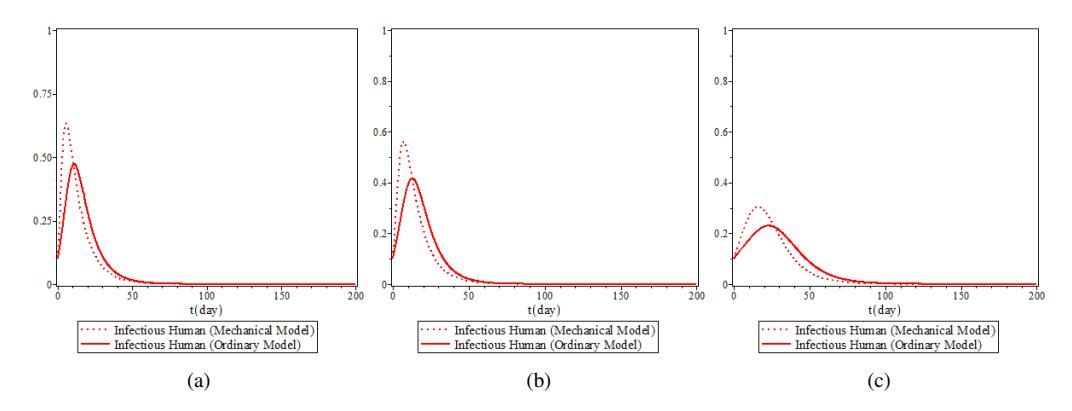
Figure 7: The dynamics of infectious human from mechanical and biological models, with \(\beta_M = 0.5\), n=2, for various ratio between human and mosquito population (a) 0.8:1, (b) 1:1, (c) 2:1.
4. CONCLUSION
The multiple-biter behavior in mosquito allows the virus to transmit into the human body mechanically. The existence of mechanical transmission process in the model of dengue virus transmission can increase the infectious human population. For n-mosquito-bites, there is the addition of non-linear factor in the infectious human compartment, expressed by the interaction between susceptible mosquito, infectious human, and susceptible human \((S_V - I_H - S_H)\) with multiplier parameters \((n-1)\beta_M/N_H^2\).
The spreading behavior of dengue fever is described by the basic reproduction number. If R0 < 1 the disease will die out and if R0 > 1 the disease will remain endemic in both of two models. The simulation shows that the ratio of the basic reproduction number between mechanical and biological transmission model increase as the mechanical transmission rate and the number of mosquito bites increase. There is a significant change in the infectious human population during the outbreak period especially when the mechanical transmission rate is greater than the biological transmission rate in the human population. It is also observed that the outbreak occurs slightly earlier than in the case of the absence of mechanical transmission. This might be imply a different strategy of disease intervention should be set whenever there is a contribution of mechanical process in the transmission of the disease.
ACKNOWLEDGEMENT
The work was funded by the Academic Leadership Grant (ALG) from Padjadjaran University to AKS. NA was supported by The Ministry of Research, Technology and Higher Education of Indonesia, through the scheme Penelitian Dasar. The authors thank the anonymous reviewers for giving constructive comments to improve the earlier version of the manuscript.